
 Between Narratives and Climate Justice: Globo and UOL’s Coverage of Activism at the COPs
Abstract
Although climate change is increasingly covered in the media, the narratives surrounding socio-environmental issues have never been neutral or unified. This study examines how the largest Brazilian media conglomerates, Globo and UOL, covered the popular protests during the 26th and 27th editions of the United Nations Conference on Climate Change (Conference of the Parties - COP). We intended to identify the main themes of the news articles published on these portals regarding the protests and discuss them through the lens of climate justice. Content analysis assisted by unsupervised Artificial Intelligence (AI) was used to cluster 45 news articles. The results reveal three distinct thematic clusters: “Activist Greta Thunberg”, “Popular Demands”, and “Commitments of the Parties”. Except for one news article, the narratives found do not promote climate justice. Additionally, more than half of the news articles were from international agencies.
Keywords:
Protests; climate justice; media; lexical analysis; COP
Resumo
Apesar da crescente presença da mudança climática na mídia promover a popularização da problemática na esfera pública, as narrativas sobre questões socioambientais nunca foram neutras ou uníssonas. O trabalho analisa a cobertura de portais dos maiores conglomerados de mídia brasileiros, Globo e UOL, sobre os protestos populares durante a 26ª e 27ª edição da Conferência das Nações Unidas sobre as Mudanças Climáticas (COP). O objetivo foi identificar os principais temas das notícias publicadas nos portais ao tratarem dos protestos, e discuti-los a partir da lente da justiça climática. Foram empregadas análises lexicais assistidas por Inteligência Artificial (IA) não supervisionada para classificação (cluster analysis) de 45 notícias. Os resultados mostram a formação de três diferentes agrupamentos temáticos: “Ativista Greta Thunberg”, “Demandas populares” e “Compromissos das partes”. Salvo a exceção de uma notícia, as narrativas encontradas não fomentam a justiça climática. Mais da metade das notícias provém de agências internacionais.
Palavras-chave:
Protestos; justiça climática; mídia; análise lexical; COP
Resumen
Aunque la creciente presencia del cambio climático en los medios de comunicación promueva su popularización, las narrativas sobre cuestiones socioambientales nunca han sido neutrales ni unánimes. Este estudio analiza la cobertura de los principales conglomerados de medios de comunicación brasileños, Globo y UOL, sobre las protestas durante las Conferencias de las Naciones Unidas sobre el Cambio Climático (COP) 26 y 27. El objetivo fue identificar los temas principales de las noticias publicadas en los portales al abordar las protestas y discutirlos desde la perspectiva de la justicia climática. Se utilizaron análisis de contenido asistidos por Inteligencia Artificial (IA) no supervisada para clasificar 45 noticias. Los resultados muestran la formación de tres grupos temáticos diferentes: “Activista Greta Thunberg”, “Demandas populares” y “Compromisos de las partes”. A excepción de una noticia, las narrativas encontradas no promueven la justicia climática. Más de la mitad de las noticias provienen de agencias internacionales.
Palavras clave:
Protestas; justicia climática; medios de comunicación; análisis léxico; COP
Introduction
In modernity, the climate emergency has become the primary manifestation of human impact on Earth. As experts had already warned in the mid-20th century, the increasing concentration of carbon dioxide in the atmosphere has altered climate dynamics (CALLENDAR, 1938; REVELLE; SUESS, 1957; KEELING, 1960), impacting both natural and human systems (IPCC, 2022). Nevertheless, discussions on the issue took time to extend beyond the academic field and gain traction in the public sphere - a process that has been greatly facilitated by news media.
The media plays a key role in connecting society, science, and politics. It helps the public understand climate change and its associated risks (BOYKOFF; MCNATT; GOODMAN, 2015; KASPERSON et al., 1988). Given a continuous flow of newsworthy events, journalistic facts can be understood as units of meaning (GENRO FILHO, 1987), formed through the articulation of material objectivity and editorial decicions. In this sense, the same real-world event can be reported from multiple perspectives, featuring different actors or institutions, geographic or historical contexts, and linguistic approaches.
In Brazil, until 2008, climate coverage was mainly concentrated in nationally circulated newspapers and tended to reproduce the international climate agenda (VIVARTA, 2010) and the perspectives of national and international executive powers (23.3% of cases from 2005 to 2007 and 32.7% from 2007 to 2008). As noted by Anabela Carvalho (2019), it is common for dominant media to reproduce and endorse the voices of actors with significant political and economic power. In this regard, studies such as those by Caporal and Costabeber (2000), Oreskes and Conway (2010), Leff (2015), and Dryzek (2013) observe that environmental discourse may appear unified at first glance but is not necessarily environmentalist or homogeneous.
Environmental discourses emerge in industrial societies from institutions and actors with radically different ideological backgrounds, such as liberalism, conservatism, socialism, Marxism, and fascism. These ideologies manifest in discourse through the articulation of elements that include specific entities and natural relationships, which can either support or challenge existing social structures (DRYZEK, 2013; FAIRCLOUGH, 2001). In the context of the climate emergency, this study argues that closely examining environmental discourses in mainstream media is a way to understand the social success of competing ideologies and their relationship with climate justice.
Climate justice, according to Mary Robinson, “insists on a shift from a discourse on greenhouse gases and melting ice caps into a civil rights movement with the people and communities most vulnerable to climate impacts at its heart” (ROBINSON, 2019). The promotion of climate justice, therefore, is opposed to technocratic perspectives on contemporary socio-environmental issues. It is based on the recognition that historically constituted patterns of inequality - such as colonialism, gender, ethnic, and low-income marginalization - affect populations’ vulnerability to climate change (IPCC, 2022).
The study sheds light on media coverage of popular climate protests that took place alongside the 26th and 27th editions of the United Nations Climate Change Conference (COP). It is understood that media discourses on such mobilizations may have social effects, such as fostering popular awareness of the intrinsic link between the climate crisis and the deepening marginalization of minority groups. Thus, our goal is to identify the main narrative themes in the coverage of protests by the media portals of the “Globo” and “UOL” conglomerates and discuss them through the lens of climate justice. To this end, content analysis procedures based on Bardin (2011) were performed, combined with multivariate lexical analyses for classification (cluster analysis).
There is no neutrality in environmental narratives
To grasp discussions on climate and climate justice, it is crucial to acknowledge the diversity of environmental narratives that have emerged over five decades of environmental discourse. International environmental concern was established in the early 1970s through discourses on the Earth’s limits in the face of industrial development. Since then, different narratives have arisen - some contesting these limits, others advocating for radical systemic transformations, and others proposing solutions based on public administration, democratic interaction between social actors, market mechanisms, or even more radical cultural and political transformations. Despite this, as Dryzek (2013) argues, the discourse on sustainable development is probably the one that has achieved the greatest social success, especially after the publication of the Brundtland Report (1991) - Our Common Future - within the framework of the United Nations (UN).
Initially, sustainable development was part of the environmentalist lexicon, particularly in developing countries, which envisioned the potential of accessible technologies consistent with local realities (DRYZEK, 2013; LEFF, 2015). In Brundtland’s conception, sustainable development is “that which meets the needs of the present without compromising the ability of future generations to meet their own needs” (BRUNDTLAND, 1991, p.46). It carries an imaginative and conciliatory character, envisioning economic, ecological, and social development in a possible new world. Nevertheless, what sustainable development means in practice has been and continues to be a matter of dispute, in which different ideological interests seek to consolidate their own meanings in a broad manner.
According to the Brazilian researchers Francisco Caporal and José Costabeber, sustainability is a concept whose indiscriminate use “has allowed all kinds of ideological concealments” (CAPORAL; COSTABEBER, 2000, p.19, our translation). In this sense, the authors highlight two theoretical currents related to sustainable development that emerged in the 1970s: the ecotechnocratic and the ecosocial. The ecotechnocratic current, most prominently represented in the Brundtland Report, maintains a close relationship with liberal discourse. Despite ecological and social harm, it is oriented towards continuous economic growth and remains optimistic about technological and economic solutions. It does not question the model of Western industrialized society or address issues such as respect for cultural and biological diversity.
The ecosocial current, on the other hand, openly criticizes the liberal approach. While recognizing the relevance of technologies, this perspective is characterized by advocating for the transformation of industrialized societies structured around economic imperatives. It is heterogeneous and combines culturalist and ecosocialist perspectives that recognize the insufficiency of the market as a means of resolving the socio-environmental crisis. In its diversity, the ecosocial current calls for solutions that move beyond the economic connotation of development (CAPORAL; COSTABEBER, 2000). These voices, within a capitalist economic order, are more frequently expressed in organized popular movements. Examples include events such as Klimaforum 09 - People’s Climate Summit, held in parallel with COP 15, and protests that take place annually on the sidelines of COPs.
Specifically regarding the climate issue, an environmental discourse - though not environmentalist -that gained prominence in the late 1980s was the corporate-sponsored campaigns aimed at casting doubt on global warming, driven by fossil fuel interests (UCS, 2013; BRULLE, 2019). In the early stages, the so-called “climate countermovement” sought to ridicule and deny the findings of climate scientists. To this end, news articles, newspaper opinion editorials (op-eds), books, magazines, and other types of content were published in the late 20th century to promote narratives opposing the climate movement (MCCRIGHT; DUNLAP, 2000). However, by the 1990s, many companies recognized the competitive advantages of adopting a technocratic discourse in defense of the environment (NOBLE, 2009).
The technocratic discourse allowed corporations to simultaneously (1) appropriate the climate agenda, suggesting that solutions should be entrusted to technologies and market mechanisms (NOBLE, 2009); (2) promote a “green” and sustainable image; (3) ease public concern about anthropogenic global warming; and (4) conceal their association with the climate countermovement (GELBSPAN, 1998). To promote this “green” image, it has been crucial for a network of actors and institutions - including scientists, news media, non-governmental organizations (NGOs), and other stakeholders - to attest to the credibility of corporate narratives (ALMEIDA JUNIOR; GOMES, 2012).
In this context, Diprose and collaborators (2017) highlight the challenges posed by climate change to community development, emphasizing the complexity of interactions between biophysical, socioeconomic, and political factors. Their reflections, illustrated by mobilizations in New Zealand, demonstrate that the fight for climate justice can yield effective practical results but is not free from violent resistance by both the state and society. On the other hand, in corporatist government contexts, even the inclusion of more critical environmentalists - such as ecofeminists, ecosocialists, ecotheologists, and advocates of environmental and climate justice - risks exhausting these movements in the public sphere (DRYZEK, 2013). These are crucial reflections for understanding the dynamics of contemporary climate activism and its implications for the construction of climate justice narratives and practices.
Amid disputes over narratives surrounding the climate issue, the importance of social studies in critically analyzing media coverage of contemporary environmental issues emerges. Studies such as those by Painter and Ashe (2011) and McAllister et al. (2021) recognize that skeptical discourses regarding the existence, causes, or impacts of anthropogenic climate change are concentrated in Anglophone countries. However, there is a broad spectrum of widely circulated climate narratives that may obscure a major social problem underlying the climate emergency: the unequal distribution of risks associated with the phenomenon (DRYZEK, 2013). In this sense, climate justice concerns the relationship between the environmental risks generated by industrial societies and their effects on women, low-income and Black populations, and those directly dependent on natural resources, such as riverine, Indigenous, and quilombola communities.
According to Bullard (2005), equality holds different meanings for different people. The perception of equality/inequality can be related to justice in government decisions, ensuring that policy implementation does not occur in a discriminatory manner; to equity in the spatial distribution of communities, considering their proximity to environmental risks; and/or to social equality - racial, ethnic, cultural, class-based, lifestyle-based, etc. - considering the existence of structurally marginalized groups. In this sense, promoting climate justice also involves a process of shedding light on local impacts and experiences, unequal vulnerabilities, community voices, and demands for sovereignty and communal governance (SCHLOSBERG; COLLINS, 2014).
In Brazil, a developing country that is central to various international climate discussions - especially due to its history of deforestation - there remains a gap in research on the different climate discourses promoted by non-institutional actors. Thus, investigations that center the perspectives and roles of climate activists in this agenda and assess how they are portrayed in dominant discourses are necessary. Media studies, operating at the intersection of social and environmental sciences, can pave the way for understanding how environmental narratives relate to specific ideological frameworks and contribute to the advancement of climate justice.
Media and coverage of the climate agenda
Over the past decades, Brazilian literature has monitored the role of the media in covering the climate agenda. This topic remains more prevalent in nationally circulated media in the country (VIVARTA, 2010) - which is why we focus on this scale. Across different media outlets, a set of biases influences the selection of topics, the contextualization, the framing of the issue, and the sources consulted. According to Adelmo Genro Filho (1987), every news production carries a certain degree of subjectivity, as it involves choosing what will be considered a journalistic fact and how it will be portrayed. Chaparro (2007) also highlights that journalistic production is influenced by various factors, including professional norms, institutional conventions, commercial pressures, and political and ideological influences. Thus, productive routines shape not only the content of the news but also elements beyond the surface of the text, such as the ideological investment in the narrative and the perspective presented to the public.
Among mainstream media, it is possible to notice a tendency to present liberal perspectives (CARVALHO; LOOSE, 2018; MORAES, 2017). According to Anabela Carvalho (2019), these outlets prioritize profit, target large audiences, often defend hegemonic viewpoints, and maintain close ties with official sources, such as politicians and business representatives. In her words:
[...] even the most progressive of dominant media build on certain - seemingly unquestionable - ideas that are at the foundation of climate injustice, namely the metadiscourses of free market economy and elite policy-making, both underpinned by the metadiscourse of techno-scientific progress (CARVALHO, 2019, p. 122-123).
In this sense, major Brazilian media outlets, such as Folha de S. Paulo, have failed to critically examine the state of climate actions in the country (ZAMITH; PINTO; VILLAR, 2012). Small and independent media, on the other hand, can present radically different framings when discussing the same social phenomenon. This process was observed by Martirani and Peres (2016) in their analysis of the media coverage of the 2014 water crisis in São Paulo. In summary, while major outlets focused broadly on water consumption and climate change, smaller media highlighted the lack of government transparency in managing the crisis, also addressing the structural causes of the problem and private interests.
It is also common for mainstream media to host advertising campaigns promoting the “green” image of large corporations and industry groups (ALMEIDA JÚNIOR; GOMES, 2012). Analyzing advertisements about the ethanol industry in Brazilian, U.S., and European media, Assis (2016) found that environmental protection, economic development, combating global warming, and clean energy are key narratives mobilized to portray the sector as “green”. In this process, the negative impacts of sugarcane monoculture are obscured, and the issue of global warming is framed in a way that justifies the continuation of the existing production model.
News media are crucial agents in shaping public opinion and setting the agenda for public debates. In the case of a complex issue like climate change, the process of translating scientific language into more accessible terms and using visual resources gives the media the power to shape public perceptions and attitudes toward the issue (FERNÁNDEZ; FERNÁNDEZ; MENDOZA, 2021). However, it is necessary for media outlets to be oriented toward climate justice and to provide space for transformative perspectives on addressing climate change and its systemic causes.
We understand that the protests during COPs 26 and 27 represent just a small fraction of the various forms of resistance by groups and communities in response to a socio-environmental crisis that affects human populations unequally. For this reason, a critical reading of climate reality is particularly relevant in Latin American countries and other regions considered hotspots of high vulnerability to the current crisis (IPCC, 2022).
Materials and Methods
To identify the main themes presented by Globo and UOL in their coverage of the protests at COP 26 (in Glasgow, Scotland) and COP 27 (in Sharm el-Sheikh, Egypt), this study analyzes news articles published on their websites during the Conferences, focusing on lexical analysis. COP 26 was held from October 31 to November 13, 2021, while COP 27 took place from November 6 to November 18, 2022.
Content Analysis (CA), as defined by Laurence Bardin (2011), consists of a set of methodological tools that allow for the objective and systematic analysis of texts. Typically, CA involves a pre-analysis phase, material exploration, categorization or coding, followed by result processing and the development of inferences and interpretations (BARDIN, 2011). Guided by the theoretical perspective of climate justice, this study employs a nested concurrent mixed-methods research strategy (CRESWELL, 2007) to integrate automated procedures into CA. This strategy allows for both qualitative and quantitative data analysis, enabling the study to incorporate multiple analytical perspectives.
With the support of the Iramuteq software (Interface de R pour les Analyses Multidimensionnelles de Textes et de Questionnaires), CA benefits from a complementary approach to textual data interpretation, enabling a systematic, detailed, and statistically rigorous understanding of the phenomenon under study (CAMARGO; JUSTO, 2013a). The software does not replace the researcher’s role but rather assists in the pre-analysis and categorization phases of the corpus by providing insights into the existence of patterns and trends within the texts. In practice, pre-analysis is facilitated by textual statistics, while categorization is guided by cluster analysis. Finally, inferences and interpretations describe both quantitative and qualitative aspects of the analyzed materials.
Authors such as Chen et al. (2022), Ahmed et al. (2020), and Ceron, De-Lima-Santos, and Quiles (2021) have used clustering in content analysis, with special emphasis on the study by Keller and collaborators (2020), who applied it to investigate two decades of news on climate change, identifying trends and debates in India. It is important to emphasize that clustering facilitates content categorization but does not replace the analyst’s role. Automated analyses serve as a subsidiary tool, providing an initial structure that directs researchers’ attention to latent issues in the original texts. The combined approach enhances content comprehension, enabling the identification of patterns and offering a comprehensive view of the phenomenon under study.
a. Data extraction
To construct the analysis corpus, news articles were selected in two stages. Initially, a keyword search was conducted using Google’s search engine, restricting the query to the domains of Grupo Globo and UOL and to the period of the two conferences. Subsequently, only news articles specifically covering street demonstrations during COPs 26 and 27 were selected. Operationally, this identification was carried out by collecting news articles that contained the keywords in their titles or leads (figure 1).

A total of 20 news articles were collected from Grupo Globo’s digital platforms, distributed as follows: Época Negócios (8), G1 Meio Ambiente (4), Jornal Nacional (2), G1 Natureza (2), O Globo - Mundo (2), G1 Mundo (1), G1 Distrito Federal (1), G1 Política (1), Galileu (1), and Vogue (1). From Grupo UOL, 25 articles were obtained from the following pages: UOL Meio Ambiente (9), Folha de S. Paulo (7), Ecoa (4), UOL Internacional (1), and UOL Política (1) 1.
Although this distribution may be considered proportional in relation to the media groups, only four out of the 45 collected news articles referred to COP 27. This disparity limited the study’s ability to present comparative analyses between the two conference editions. Nonetheless, it suggests the existence of non-quantifiable issues underlying the popular demonstrations at COP 27.
During COP 27, media outlets such as Eco2, Mídia Ninja3, and Exame4 reported a series of problems faced by protesters in Egypt, including the arrest of protest organizers, the designation of a remote desert area for public demonstrations, and the prohibition of protests within the event complex. Some of these issues were also highlighted in a report by O Globo5 after COP 27 had ended, framing the repression as a broader characteristic of the country’s political regime.
Another factor that may have influenced the lack of protests - and, consequently, the lower volume of news coverage in 2022 - is the global pandemic context. COVID-19 exacerbated restrictions on people’s access to various countries, including Egypt. However, it is worth noting that this obstacle did not have the same effect in 2021, when COP 26 attracted thousands of demonstrators.
b. Description and analysis
For our analyses, we defined the use of the following grammatical classes (active forms): all verbs, adjectives, and nouns. With the data structured according to the software’s specifications, the corpus was described, and the analyses were conducted. With 45 news articles, the texts were transformed into structured data to adapt the corpus to the format required by Iramuteq. The corpus structuring process involved removing characters such as @, %, $, *, °, ª, “, ‘, -. -, …, URLs, photo captions, and advertisements. Another standard procedure performed by Iramuteq is lemmatization - an automatic process that reduces all inflected forms of a word to the same base form or lemma. Thus, nouns are converted to the singular form, adjectives to the singular masculine form, and verbs to the infinitive.
Several authors highlight the versatility of Iramuteq for conducting lexical, content, and discourse analyses (CAMARGO & JUSTO, 2013a, 2013b; FERREIRA; OLIVEIRA-FILHO, 2021; SÁNCHEZ; ARROZ; GABRIEL, 2021). Using this tool, we aimed to classify the extracted content, advancing toward a thematic organization of the key discussions raised by Globo and UOL news portals. The analyses followed the guidelines of Camargo and Justo (2013a, 2013b) for the multivariate analyses described below:
-
Descending Hierarchical Classification (DHC): a cluster analysis performed through unsupervised machine learning. This is an inductive artificial intelligence procedure that groups Text Segments (TS) (~40 words) into classes based on the frequency of their lemmatized vocabulary.
-
Correspondence Factor Analysis (CFA): which summarizes the original qualitative variable information from the DHC into a small number of factors. This procedure allows for better visualization of word associations identified by the cluster analysis.
From the DHC, we also examined the Typical Text Segments (TTSs) of each class for a better understanding of the lexicon in each grouping. The TTSs have scores, which consist of the sum of the chi-square values of words with a p-value < 0.05 present in the text segment.
Results and Discussion
From the 45 news articles collected, a total of 638 Text Segments (TSs) were obtained, with 513 TSs being retained (80.41%). These segments contained 22,636 occurrences, with 3,826 distinct words and 1,894 appearing only once (hapax). Through an exploratory reading of the texts, key points of attention in the analyzed news were identified, such as the Glasgow COP, the Swedish activist Greta Thunberg, and Indigenous issues. It was also observed that 23 out of the 45 articles (51.1%) originated from international news agencies, such as the Spanish EFE, the French RFI and AFP, the British BBC and Reuters, and the Italian ANSA. This result supports the conclusions of Vivarta (2010) and Zamith, Pinto, and Villar (2012) regarding the high frequency of news published in Brazil that reproduces the international, particularly European, climate agenda.
Given this and the tendency of major Brazilian media outlets to present a liberal perspective (CARVALHO; LOOSE, 2018; MORAES, 2017), the initial contact with the corpus led to the structuring of the following hypotheses:
a. Cluster analysis
The cluster analysis generated three classes: Class 1, with 199 Text Segments (TSs) (38.79%); Class 2, with 190 TSs (37.04%); and Class 3, with 124 TSs (24.17%). Figure 2 presents an organigram with the most statistically significant words for each class (i.e., those with p-value < 0.0001), their respective frequencies (f), and chi-square values (x²).

Organigram displaying the classes obtained in the cluster analysis and the words with the highest statistical significance for each class (p-value < 0.0001). Note: The analysis was conducted using the original text corpus (in Portuguese), and the figure was translated into English.
A total of 114 words were included in Class 1 (p-value < 0.05). It was also identified that this class is more associated with the media G1 Natureza (p-value 0.00033), UOL Meio Ambiente (p-value 0.01098), and O Globo - Mundo (p-value 0.01311).
In Class 2, 101 words were classified (p-value < 0.05). This class is more strongly associated with Folha de S. Paulo (p-value < 0.0001) and Galileu (p-value 0.0269). Classes 1 and 2 are more closely related compared to Class 3. From the organigram, it is possible to observe that while the first two classes address protests and activists, Class 3 covers broader issues and concepts associated with country commitments, particularly regarding climate change mitigation. Class 3 includes 144 words (p-value < 0.05) and does not show a stronger or weaker association with any specific media outlet analyzed. This indicates that the words in this class are distributed in such a way among the texts that they cannot be linked to particular pages.
b. Correspondence Factor Analysis
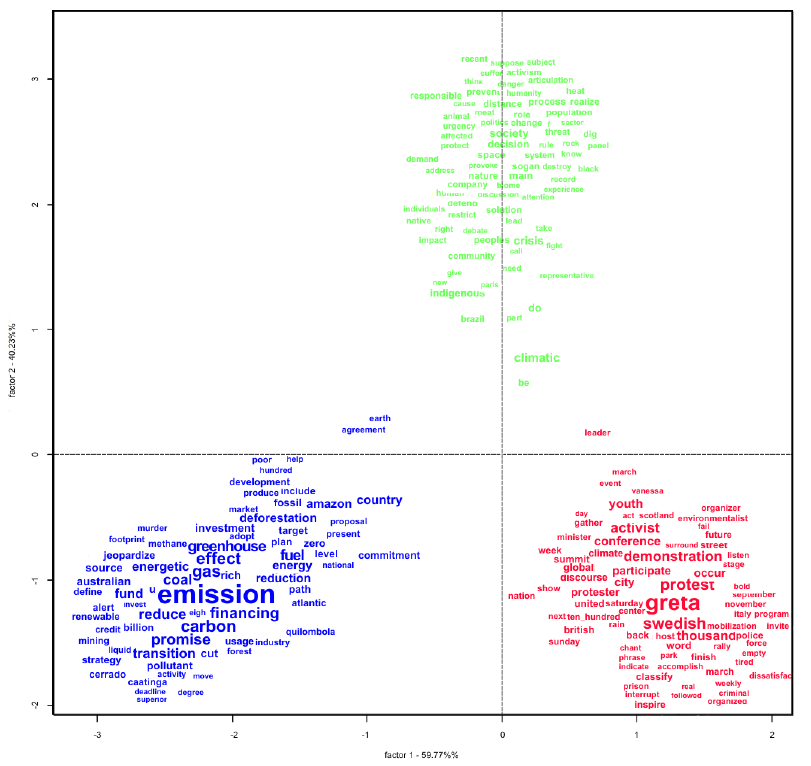
To visualize the relationships between the classes, a Correspondence Factor Analysis (CFA) was performed. The analysis identified two factors responsible for retaining corpus information (Factor 1 - 59.77%; Factor 2 - 40.23%) (Figure 3).

Correspondence Factor Analysis based on Cluster Analysis (word size proportional to chi-square value). Note: The analysis was conducted using the original text corpus (in Portuguese), and the figure was translated into English.
The CFA illustrates the formation of the three clusters in the Cartesian plane. By examining the respective profiles of the three classes, outlined through clustering and factorial analysis, it is possible to name them based on their thematic content as follows:
-
Class 1: “Activist Greta Thunberg”
-
Class 2: “Popular Demands”
-
Class 3: “Commitments of the Parties”
To advance the discussion and draw inferences about this categorization, the main Typical Text Segments (TTSs) for each class are presented and analyzed.
Typical Text Segments (TTSs)
Each of the three classes has its own Typical Text Segments (TTSs), which are the segments that best represent them. These segments are selected based on a score, calculated by summing the chi-square values of words in a Text Segment (TS) that have statistical significance for the class (p-value < 0.05; marked in bold in Table 1). Thus, TTSs are TSs with high scores. Below, in Table 1, we present the three highest-scoring TTSs from Class 1, along with the media portals where they were published.
Class 1 is named “Activist Greta Thunberg” due to its focus on the activist. Her name, “Greta”, is the most frequent word in this class, appearing 74 times. From the cluster analysis, it is evident that this class is more associated with G1 Natureza, UOL Meio Ambiente, and O Globo - Mundo, meaning that these media outlets were the ones that most emphasized narratives portraying Thunberg as a central figure in the protests.
From a climate and epistemic justice perspective, the portrayal of a single protagonist, personifying the protests through the image of the Swedish activist, is problematic insofar as the issue is reduced to a narrow set of individual behaviors and statements. In this process, the thousands of demonstrators are no longer recognized as agents in the face of the climate emergency, leaving only the image of a dissatisfied teenager. The construction of this figure reinforces stereotypes of youthful behavior, placing it in contrast to the commitments of COP authorities, who are recognized as a legitimate entity. This reveals a concern with maintaining a safe distance from criticism of the convention, which brings Class 1 closer to an ecotechnocratic and bureaucratic perspective. In the textual materiality, this distancing is also evident in the use of direct quotes (marked by quotation marks) to highlight Thunberg’s harsher statements, such as “failure” (see STT 2, Class 1, in Table 1).
A climate justice-oriented coverage could take the protests as opportunities to denounce systemic inequalities, the vulnerability of certain social groups, and present transformative perspectives for addressing the crisis. Considering the wide reach of the media associated with Class 1, it would be socially and environmentally relevant to present the criticisms of Brazilian protesters, contextualizing them with national climate demands, such as Indigenous land demarcation, adaptive urban planning, and the eradication of illegal deforestation in the Amazon, Cerrado, and Atlantic Forest.
Class 2, named “Popular Demands”, highlights the claims, values, and ideals of different protest groups. Among the most frequent terms in the class are “people”, “Indigenous”, and “society”, which indicate proximity to social justice discussions. The Folha de S. Paulo and Galileu portals are the ones that best illustrate Class 2, according to the analyses. In the first STT of Class 2 (Table 1), extracted from an article published by Galileu, the highlighted words refer to Indigenous issues in Brazil and the demarcation of these peoples’ lands. Thus, there is a concern with contextualizing the protest themes in relation to a reality closer to Brazilian readers. The news article from which this STT was taken addresses the land demarcation issue, includes data and scientific references, and touches on the importance of cultural preservation. The article published by Galileu fosters climate justice by placing Indigenous experiences, vulnerabilities, and demands at the center of the discussion. In this process, Indigenous peoples are recognized as legitimate agents, as well as their relationship with nature.
In the second STT of Class 2 (Table 1), Folha de S. Paulo presents a brief description of vegan activist groups present at the protests. The article from which this excerpt was taken recognizes the participation of various social movements - “pacifists”, “anti-meat activists”, “religious groups”, “therapists”, “cultural activists”, “educators”, “labor activists”, “separatists”, “peasants”, “anti-racists”, “immigrants”, “Indigenous groups”, “alternative movements”, “youth”, “feminists”, and “socialists”-which emphasizes the diversity of popular perspectives in the climate movement. However, Folha de S. Paulo portrays the protests as a “gathering of tribes” and simplifies climate justice to an “expanded and updated version of environmentalism”. No connections are drawn between these movements and Brazil or Brazilian activists. In fact, there is no mention of Brazil in the entire article.
In contrast, the third STT of Class 2 (Table 1), published by Ecoa, focuses on the perspective of a Brazilian activist, Marcelo Rocha. The article presents his expectations regarding COP 26 negotiations, discusses concepts such as “climate racism”, and fully reproduces his demands for a revision of the current development model to strengthen human relations. In the TTS, this appeal is incorporated in the terms “crisis”, “climate”, “urgent”, “relations”, and “humans”. However, the activist’s position exists in the article only in relation to those considered the true agents in addressing the climate crisis-the state representatives at the official conference.
The STs grouped in Class 2 share the theme of “popular demands”, with diverse voices and excerpts treating the climate emergency as a human rights issue. However, except for Galileu’s article, which recognizes Indigenous issues and discusses them critically and contextually, the perspective of activists is presented ad referendum (subject to validation by institutions-as in the case of Marcelo Rocha) or as an aggregate of various demands, lacking a clear central focus. As a result, Class 2 gathers a broad range of popular claims, which is reflected in the lack of predominant terms. In the Correspondence Factor Analysis (CFA), unlike Class 1 (where words like “Greta” and “protest” stand out) and Class 3 (where terms like “emission”, “reduce”, and “gas” are prominent), Class 2 does not have any clearly dominant words. Additionally, Figure 2 shows a smaller number of words classified with a p-value < 0.0001 in this class. Thus, it can be inferred that Class 2 does not have a clear relationship with either the technocratic or ecosocial approach to the socio-environmental crisis. This highlights that merely covering “popular demands” does not necessarily promote climate justice.
Class 3, named “Commitments of the Parties”, is the most distinct among the three. While Classes 1 and 2 focus on activists, Class 3 concentrates on the actions, goals, and commitments undertaken by nations in both editions of the COPs, especially concerning climate change mitigation. This focus is evident in the most frequent words (Figure 2) and the TTSs of the class (Table 1). The three excerpts share common terms such as “countries”, “committed”, “emissions”, “gases”, “effect”, “greenhouse”, “reduce”, “coal”, and “energy”, which refer to the technical and political aspects of the negotiations.
Class 3 did not show a stronger association with any of the media outlets analyzed. This suggests that the issue of “commitments of the parties” is a more cross-cutting topic than those covered by the first two classes. In the news articles analyzed, the presentation of the state of international negotiations helped contextualize the protests. Words like “credit” and “carbon” are strongly related to this class (p-value < 0.0001). See an example of a TTS from Class 3, with a score of 282.87, extracted from Vogue magazine:
COP 26 is happening this week in Glasgow and discusses the reasons why each country should adopt measures to reduce pollution, use carbon credits, and help finance climate measures for poorer countries. (VOGUE, 2021, emphasis added, our translation).
In this excerpt, the focus on mitigation (represented by “reduce”, “pollution”, “reduction”), the optimism regarding the carbon credit market (“credits”, “carbon”, “help”), and the trust in international negotiations (“financing”, “help”, “countries”, “poorer”) reflect a strong alignment with liberal discourse. The STs classified in this group do not indicate any promotion of climate justice. On the contrary, they present a technocratic perspective that places the conference, the parties, and carbon at the center of the discussion.
Final considerations
The study proposed a systematization of the themes underlying news coverage by major media outlets on climate activists at COP 26 and COP 27. Three main themes were identified among the news articles covering climate activism at the conferences, which were synthesized into the classes “Activist Greta Thunberg”, “Popular Demands”, and “Commitments of the Parties” and discussed in relation to the concept of climate justice.
Understanding that climate justice is inseparable from the experiences, vulnerabilities, and demands of local communities, especially those most vulnerable to the risks of the climate crisis, we found that the vast majority of news articles published by Globo and UOL do not promote climate justice in their coverage of the protests parallel to COPs 26 and 27. On the contrary, these media outlets showed a tendency to present liberal perspectives and reinforce hegemonic viewpoints. The findings support media studies that identify Global North agencies as key content providers for Brazilian media. More than half of the analyzed news articles reproduced content from international agencies, mostly European, which reflects a pattern of epistemic injustice underlying the selection of news topics by Brazilian media outlets.
The study also demonstrated that even in news articles covering climate activism, there was a tendency to focus on the official negotiations at the COPs or on youth perspectives. These perspectives, in turn, were often associated with Greta Thunberg. Among the articles that most emphasized popular demands (Class 2), only one, published by Galileu, acknowledged the role of Indigenous communities as agents in addressing the climate emergency in Brazil, their relationship with nature, and their cultural values.
The methods adopted facilitated a comprehensive understanding of the actors and voices echoed in the climate debate within large-scale media outlets through tools for identifying word patterns. However, this classification approach is limited by the scope of the Iramuteq dictionary and, consequently, its ability to recognize relevant terms for analysis. Since the quality of clustering depends on vocabulary, organization, and linguistic structure, the presence of colloquial language, slang, irony, sarcasm, and implicit contexts may have affected the accuracy of the classification of text segments.
The study does not allow for the extrapolation of findings to other COP editions or other environmental movements. Thus, it opens the way for further refinements of this systematization, aiming to incorporate additional media sources and scales as well as nuances of speech, which may require adjustments to the dictionary to capture cultural meanings, complex technical terms, and other text-specific details. Furthermore, the limited number of news articles about COP 27 prevented the development of comparative analyses between the two editions, which would have been useful for the consolidation of a more representative typology of narratives.
Despite this, the news articles on COP 27 were retained precisely because of the excessively low volume of content on that edition. It indicates the existence of subjective factors, such as the restriction of public demonstrations, which may have influenced the protests’ materialization in 2022. The physical and moral repression faced by organized society engaged in socio-environmental struggles reinforces the inequality of access to decision-making processes, an issue that climate justice movements have long challenged. In this context, media can serve as a platform for denouncing injustices and circulating new social meanings and transformative perspectives for Brazilian society in the face of climate change. By proposing a critical understanding of the interactions between climate activism and large-scale media, the study offers insights that can inform fairer journalistic practices.
The media plays a crucial role in shaping public opinion and setting agendas. Thus, it is socially relevant that communication outlets, whether national, regional, or local, go beyond simply translating technically complex issues. Advancing climate justice requires raising public awareness, appealing to both individual action potential and collective engagement. In the coverage of climate activism at the COPs, this can be facilitated by recognizing protesters as legitimate agents in the climate crisis, contextualizing journalistic facts based on regionally or locally relevant issues (e.g., deforestation in Brazil, increased frequency of storms in various cities), and clarifying the relationship between risks and the vulnerabilities of specific groups. Within the spectrum of socio-environmental issues, guiding media coverage toward climate justice is also a way to acknowledge the objective and historically constructed reality: inequality patterns still separate those who benefit from environmental degradation from those who suffer the most from it.
Acknowledgments
We would like to thank the Ibero-American University Union (UIU) and, in particular, the professors of the course Challenges and Possibilities in Transnational and Interdisciplinary Studies for the exchange of knowledge, encouragement, and valuable insights provided on this work. We also express our gratitude to the Coordination for the Improvement of Higher Education Personnel (CAPES) and the National Council for Scientific and Technological Development (CNPq) for supporting the research projects CAPES No. 88887.613020/2021-00 and CNPq No. 381825/2025-6.
References
-
AHMED, W.; VIDAL-ALABALL, J.; DOWNING, J.; SEGUÍ, F. L. COVID-19 and the 5G Conspiracy Theory: Social Network Analysis of Twitter Data. Journal of Medical Internet Research, [S.l.], v. 22, n. 5, p. e19458, 2020. https://www.jmir.org/2020/5/e19458 DOI: 10.2196/19458.
» https://www.jmir.org/2020/5/e19458 -
ALMEIDA JÚNIOR, A. R.; GOMES, H. L. R. M. Gestão ambiental e interesses corporativos: imagem ambiental ou novas relações com o ambiente?. Ambiente & Sociedade, v. 15, n. 1, p. 157-177, 2012. DOI: 10.1590/S1414-753X2012000100011
» https://doi.org/10.1590/S1414-753X2012000100011 -
ASSIS, W. F. T. Media Justifications: Strategies for Environmentalization of Ethanol Production Through Advertising. Ambiente & Sociedade, v. 19, n. 3, p. 67-86, jul. 2016. DOI: 10.1590/1809-4422ASOC135961V1932016
» https://doi.org/10.1590/1809-4422ASOC135961V1932016 - BARDIN, L. Análise de Conteúdo. São Paulo: Edições 70, 2011.
- BOYKOFF, M. T.; MCNATT, M. B.; GOODMAN, M. K. The cultural politics of climate change news coverage around the world. In: HANSEN, A.; COX, J. R. The Routledge handbook of environment and communication. Londres: Routledge, 2015, p. 221-231.
-
BRULLE, R. J. Networks of opposition: A structural analysis of US climate change countermovement coalitions 1989-2015. Sociological Inquiry, v. 20, n. 10, 2019. DOI: https://doi.org/10.1111/soin.12333
» https://doi.org/10.1111/soin.12333 - BRUNDTLAND, G. H. Nosso Futuro Comum. 2 ed. Rio de Janeiro: Fundação Getúlio Vargas, 1991.
- BULLARD, R. Environmental justice in the 21st century. Debating the earth, p. 3222-3356, 2005.
-
CALLENDAR, G. S. The artificial production of carbon dioxide and its influence on temperature. Quarterly Journal of the Royal Meteorological Society, v. 64, n. 275: p. 223-240, 1938. DOI: 10.1002/qj.49706427503
» https://doi.org/10.1002/qj.49706427503 -
CAMARGO, B. V.; JUSTO, A. M. IRAMUTEQ: um software gratuito para análise de dados textuais. Temas em Psicologia, v. 21, n. 2, 2013a. DOI: 10.9788/TP2013.2-16.
» https://doi.org/10.9788/TP2013.2-16. -
CAMARGO, B. V.; JUSTO, A. M. Tutorial para uso do software de análise textual IRAMUTEQ. LACCOS. 2013b. Disponível em: <http://www.iramuteq.org/documentation/fichiers/tutoriel-en-portugais>. Acesso em: 05 jul. 2023.
» http://www.iramuteq.org/documentation/fichiers/tutoriel-en-portugais - CAPORAL, F. R.; COSTABEBER, J. A. Agroecologia e Desenvolvimento Rural sustentável: perspectivas para uma Nova Extensão Rural. Agroecologia e Desenvolvimento Rural Sustentável, v. 1, n. 1, 2000, p. 16-37.
- CARVALHO, A. Media and Climate Justice: What Space for Alternative Discourses? In: BHAVNANI, K.; FORAN, J.; KURIAN, P. A.; MUNSHI, D. Climate Futures: Re-imagining Global Climate Justice. Londres: Zed Books, 2019, p.120-126.
- CARVALHO, A.; LOOSE, E. B. Climate Change in Brazilian Media. In: BREVINI B.; LEWIS, J. Climate Change and the Media. New York: Peter Lang, 2018, p. 79-94.
-
CERON, W.; DE-LIMA-SANTOS, M. F.; QUILES, M. G. Fake news agenda in the era of COVID-19: Identifying trends through fact-checking content. Online Social Networks and Media, v. 21, p. 100116, 2021. ISSN 2468-6964. DOI: 10.1016/j.osnem.2020.100116
» https://doi.org/10.1016/j.osnem.2020.100116 - CHAPARRO, M. Pragmática do jornalismo: buscas práticas para uma teoria da ação jornalística. São Paulo: Summus Editorial. 2007.
-
CHEN, H.; HUANG, X.; LI, Z. A content analysis of Chinese news coverage on COVID-19 and tourism, Current Issues in Tourism, 25:2, 198-205, 2022. DOI: 10.1080/13683500.2020.1763269
» https://doi.org/10.1080/13683500.2020.1763269 - CRESWELL, J. W. Projeto de Pesquisa: Métodos qualitativo, quantitativo e misto. 2 ed. Porto Alegre: Artmed, 2007.
-
DIPROSE, G.; BOND, S.; THOMAS, A. C.; BARTH, J.; URQUHART, H. The violence of (in) action: communities, climate and business-as-usual. Community Development Journal, v. 52, n. 3, p. 488-505, 2017. DOI: 10.1093/cdj/bsx023
» https://doi.org/10.1093/cdj/bsx023 - DRYZEK, J. The Politics of the Earth, Oxford: Oxford University Press, 2013.
- FAIRCLOUGH, N. Discurso e Mudança Social. Brasília: Universidade de Brasília, 2001.
-
FERREIRA, A. F. A.; OLIVEIRA-FILHO, E. C. Perceptions and Willingness of Brazilian Federal District Farmers Regarding Payment for use of Water Resources. Ambiente & Sociedade, v. 24, p. e02051, 2021. DOI: 10.1590/1809-4422asoc20200205r1vu2021L5AO
» https://doi.org/10.1590/1809-4422asoc20200205r1vu2021L5AO -
FERNÁNDEZ, S. P.; FERNÁNDEZ, M. M.; MENDOZA, P. A Approaching climate change to society from the media: formative elements in Spanish digital newspapers. Ambiente & Sociedade, v. 24, p. e0186, 2021. DOI: https://doi.org/10.1590/1809-4422asoc20200186vu2021L2AO
» https://doi.org/10.1590/1809-4422asoc20200186vu2021L2AO - GELBSPAN, R. The heat is on the climate crisis, the cover-up, the prescription. New York : Basic Books, 1998.
- GENRO FILHO, A. O Segredo da Pirâmide. Dissertação (Mestrado em Ciências Sociais) - Universidade Federal de Santa Catarina. Florianópolis, 1987.
-
IPCC. Climate Change 2022: Impacts, Adaptation and Vulnerability. Summary for Policymakers, 2022. Disponível em: <https://www.ipcc.ch/report/ar6/wg2/>. Acesso em: 05 jul. 2023.
» https://www.ipcc.ch/report/ar6/wg2 -
KASPERSON, R. E.; RENN, O.; SLOVIC, P.; BROWN, H. S.; EMEL, J.; GOBLE, R.; KASPERSON, J. X.; RATICK, S. The social amplification of risk: A conceptual framework. Risk analysis, v. 8, n. 2, p. 177-187, 1988. DOI: 10.1111/j.1539-6924.1988.tb01168.x
» https://doi.org/10.1111/j.1539-6924.1988.tb01168.x -
KEELING, C. D. The concentration and isotopic abundances of carbon dioxide in the atmosphere. Tellus, v. 12, n. 2, p. 200-203, 1960. DOI: 10.3402/tellusa.v12i2.9366
» https://doi.org/10.3402/tellusa.v12i2.9366 -
KELLER, T. R.; HASE, V.; THAKER, J.; MAHL, D.; SCHÄFER, M. S. News Media Coverage of Climate Change in India 1997-2016: Using Automated Content Analysis to Assess Themes and Topics. Environmental Communication, v. 14, n. 2, p. 219-235, 2020. DOI: 10.1080/17524032.2019.1643383
» https://doi.org/10.1080/17524032.2019.1643383 - LEFF, E. Saber Ambiental: Sustentabilidade, Racionalidade, Complexidade, Poder. 11. ed. Petrópolis: Vozes, 2015.
-
MARTIRANI, L. A.; PERES, I. K. Water crisis in São Paulo: news coverage, public perception and the right to information. Ambiente & Sociedade, v. 19, n. 1, jan. 2016. DOI: 10.1590/1809-4422ASOC150111R1V1912016
» https://doi.org/10.1590/1809-4422ASOC150111R1V1912016 -
MCALLISTER, L.; DALY, M.; CHANDLER, P.; MCNATT, M.; BENHAM, A.; BOYKOFF, M. Balance as bias, resolute on the retreat? Updates & analyses of newspaper coverage in the United States, United Kingdom, New Zealand, Australia and Canada over the past 15 years. Environmental Research Letters, v. 16, n. 9, 2021. DOI: 10.1088/1748-9326/ac14eb
» https://doi.org/10.1088/1748-9326/ac14eb -
MCCRIGHT, A. M.; DUNLAP, R. E. Challenging global warming as a social problem: An analysis of the conservative movement’s counter-claims. Social problems, v. 47, n. 4, p. 499-522, 2000. DOI: 10.2307/3097132
» https://doi.org/10.2307/3097132 -
MORAES, C. H. A mudança climática no enquadramento discursivo da revista Época. Desenvolvimento e Meio Ambiente, v. 40, p.37-56, 2017. DOI: http://dx.doi.org/10.5380/dma.v40i0.49071
» http://dx.doi.org/10.5380/dma.v40i0.49071 - NOBLE, D. O golpe climático corporativo. In: ALMEIDA JÚNIOR, A. R.; ANDRADE, T. Mídia e Ambiente: estudos e ensaios. São Paulo: Hucitec, 2009. p. 15-28.
- ORESKES, N.; CONWAY, E. M. Merchants of doubt: How a handful of scientists obscured the truth on issues from tobacco smoke to global warming. New York: Bloomsbury Press, 2010.
-
PAINTER, J.; ASHE, T. Cross-national comparison of the presence of climate scepticism in the print media in six countries, 2007-10. Environmental research letters, v. 7, n. 4, 2012. DOI: 10.1088/1748-9326/7/4/044005
» https://doi.org/10.1088/1748-9326/7/4/044005 -
REVELLE, R.; SUESS, H. E. Carbon dioxide exchange between atmosphere and ocean and the question of an increase of atmospheric CO2 during the past decades. Tellus, v. 9, n. 1: p. 18-27, 1957. DOI: 10.3402/tellusa.v9i1.9075
» https://doi.org/10.3402/tellusa.v9i1.9075 -
ROBINSON, M. Climate Justice. Organização das Nações Unidas (ONU). 2019. <https://www.un.org/sustainabledevelopment/blog/2019/05/climate-justice/>. Acesso em: 05 jul. 2023.
» https://www.un.org/sustainabledevelopment/blog/2019/05/climate-justice -
SÁNCHEZ, A. F.; ARROZ, A. M.; GABRIEL, R. Social representations about sustainable development: the perspectives of residents of small islands’ cities. Ambiente & Sociedade, v. 24, 2021. DOI: 10.1590/1809-4422asoc20180212r1vu2021L3AO
» https://doi.org/10.1590/1809-4422asoc20180212r1vu2021L3AO -
SCHLOSBERG, D.; COLLINS, Lisette B. From environmental to climate justice: climate change and the discourse of environmental justice. Wiley Interdisciplinary Reviews: Climate Change, v. 5, n. 3, p. 359-374, 2014. DOI: 10.1002/wcc.275
» https://doi.org/10.1002/wcc.275 -
UCS. The Climate Deception Dossiers, 2013. Disponível em: <https://www.ucsusa.org/resources/climate-deception-dossiers#:~:text=Containing%2085%20internal%20memos%20totaling,by%20the%20fossil%20fuel%20industry>. Acesso em: 05 jul. 2023.
» https://www.ucsusa.org/resources/climate-deception-dossiers#:~:text=Containing%2085%20internal%20memos%20totaling,by%20the%20fossil%20fuel%20industry - VIVARTA, V. Mudanças climáticas na imprensa brasileira: uma análise comparativa de 50 jornais nos períodos de julho de 2005 a junho de 2007-julho de 2007 a dezembro de 2008 (Relatório de Pesquisa/2010). Brasília, DF: Agência de Notícias dos Direitos da Infância (Andi), 2010.
-
ZAMITH, R.; PINTO, J.; VILLAR, M. E. Constructing climate change in the Americas: An analysis of news coverage in US and South American newspapers. Science Communication, v. 35, n. 3, p. 334-357, 2012. DOI: 10.1177/1075547012457470
» https://doi.org/10.1177/1075547012457470
-
1
- Corpus available at: <https://zenodo.org/doi/10.5281/zenodo.14884986>
-
2
- Full article available at: <https://oeco.org.br/noticias/boletim-cop-27-finalmente-ocorreu-o-primeiro-protesto/>
-
3
- Full article available at: <https://midianinja.org/news/protestos-na-cop-27-pedem-por-justica-climatica-e-fim-dos-combustiveis-fosseis/>
-
4
- Full article available at: <https://exame.com/esg/cop27-tem-protestos-apesar-da-linha-dura-adotada-pelo-governo-egipcio/>
-
5
- Full article available at: <https://oglobo.globo.com/mundo/noticia/2022/11/entre-o-deserto-e-o-mar-vermelho-sharm-el-sheikh-evidencia-contradicoes-da-cop27.ghtml/>

 Source: Authors, 2025.
 Source: Authors (2025).
 Source: Authors, 2025.