
 Nature-cultures do not exist! Ontological propositions at the Biology-Anthropology interface
Abstract
The nature/culture dualism in West has long been questioned. This article proposes some reflections on theoretical approaches that seek to overcome this division within Anthropology and Biology. From the view of Anthropology, perspectives related to its “ontological turn” are discussed. But it is in Tim Ingold’s concept of “environment” that a solution for the problem is recognized here. Within the scope of Biology, thinkers such as Richard Lewontin, Georges Canguilhem, and Jakob von Uexküll, in addition to the concepts of Niche Construction and Extended Evolutionary Synthesis, are focused on. The meeting of these conceptions, with independent origins, constitutes a new opportunity for dialogue between Biology and Anthropology. More than this, the reconceptualization of “environment”, “history”, and “ecology”, can represents a true overcoming of the dualism in discussion, in its ontological dimension. Implications of these revisionisms for themes at the Society-Environment interface, involving Human Evolution, Human Ecology, Historical Ecology, Domestication, and Socio-Ecological Systems, are problematized.
Keywords:
Environmental Epistemology; Ontology of Nature; Society-Environment Relations; Environmental Anthropology; Biological Philosophy
Resumo
Há muito o dualismo natureza/cultura no Ocidente vem sendo questionado. Este artigo propõe algumas reflexões sobre abordagens teóricas que buscam superar essa divisão no interior da Antropologia e Biologia. Pela ótica da Antropologia, perspectivas associadas ao seu “giro ontológico” são discutidas. Mas é no conceito de “ambiente”, de Tim Ingold, que uma superação do problema é aqui reconhecida. No âmbito da Biologia, pensadores como Richard Lewontin, Georges Canguilhem e Jakob von Uexküll, além de conceitos sobre Construção de Nicho e Síntese Evolutiva Estendida, são enfocados. O encontro entre essas concepções, gestadas independentemente, configura nova oportunidade de interlocução entre Biologia e Antropologia. Mais do que isto, a ressignificação de “ambiente”, “história” e “ecologia” pode representar uma superação real do dualismo em questão, em sua dimensão ontológica. Implicações desses revisionismos para temas na interface Sociedade-Ambiente, envolvendo Evolução Humana, Ecologia Humana, Ecologia Histórica, Domesticação e Sistemas Socioecológicos, são problematizadas.
Palavras-chave:
Epistemologia Ambiental; Ontologia da Natureza; Relações Sociedade-Ambiente; Antropologia Ambiental; Filosofia Biológica
Resumen
El dualismo naturaleza/cultura en Occidente ha sido cuestionado durante mucho tiempo. Este artículo propone algunas reflexiones sobre enfoques teóricos que buscan superar esta división dentro de la Antropología y la Biología. Desde la perspectiva de la Antropología, se discuten perspectivas asociadas a su “giro ontológico”. Pero es en el concepto de “medio ambiente” de Tim Ingold donde se reconoce aquí la superación del problema. En el ámbito de la Biología se centran en pensadores como Richard Lewontin, Georges Canguilhem y Jakob von Uexküll, así como conceptos sobre Construcción de Nichos y Síntesis Evolutiva Extendida. El encuentro entre estas concepciones, creadas de forma independiente, constituye una nueva oportunidad de diálogo entre Biología y Antropología. Más aún, la resignificación de “medio ambiente”, “historia” y “ecología” puede representar una superación real del dualismo en cuestión, en su dimensión ontológica. Se problematizan las implicaciones de estos revisionismos para temas en la interfaz Sociedad-Medio ambiente, que involucran la evolución humana, la ecología humana, la ecología histórica, la domesticación y los sistemas socioecológicos.
Palabras-clave:
Epistemología Ambiental; Ontología de la Naturaleza; Relaciones Sociedad-Medio Ambiente; Antropología Ambiental; Filosofía biológica
Delimiting the problem
Anthropology, through its “ontological turn” (HOLBRAAD; PEDERSEN, 2017), has proposed new perspectives to address the longstanding problem of the dualism between “nature” and “culture” within the discipline (SILVA, 2020). Theoretical developments associated with the ontological turn include the problematization of indigenous cosmologies, such as animism (DESCOLA, 2006, 2013) and perspectivism (LIMA, 1996; VIVEIROS DE CASTRO, 2004) in the Amazon, as well as the concepts of “nature-culture hybrids” (HARAWAY, 2008; LATOUR, 1994), “multispecies landscapes” (AISHER; DAMODARAN, 2016), “multispecies ethnographies” (KIRKSEY; HELMREICH, 2010; TSING, 2015), among others. In this article, we will also refer to the aforementioned dualism as the Great Divide (SERRES, 1992).
Other analogous expressions have also been proposed to address similar conceptual challenges, such as those of biocultural (MAFFI, 2001), biosocial (INGOLD; PALSSON, 2013; STÉPANOFF; VIGNE, 2019), and socioecological systems (BERKES; COLDING; FOLKE, 2003; FOLKE et al., 2010). Acknowledging the efforts of authors who propose hybrid concepts of “nature-culture” and those who have sought to operationalize them within new analytical frameworks, we will offer some critical reflections on the heuristic value of this type of formulation in its ontological dimension.
In this article, we understand ontology as a set of underlying premises and concepts about reality-that is, the nature of beings and things-approaching the notion of ontology from the perspective of the epistemology of science. From this perspective, we agree with the idea that the construction of scientific knowledge is structured depending on the ontological foundations that underpin it (ALVES-MAZZOTTI; GEWANDSZNAJDER, 1999; SEVERINO, 2007). The discussion we propose here aims to explore, on an ontological level, the separation between “nature” and “culture,” which permeates biology and anthropology, as well as their interfacing fields. Thus, we seek to examine the ontological dimension underlying the phenomena that constitute the interface of society and the environment.
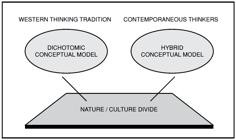
As an initial example we draw on Latour’s (1993) conception of “nature-culture” hybrids, which has been employed to classify beings and entities that straddle the boundary between “nature” and “culture.” Our first observation is that this conception seeks to overcome the Great Divide retaining the two key concepts-nature and culture-not as opposing categories but domains that, when combined, give rise to new formations with emergent properties.
In Latour’s (1994) formulation, the concepts of nature and culture are not fundamentally questioned in the process of abstraction; rather, they are combined to give rise to another category of beings: hybrids. What occurs is a syntactic shift that replaces the classical opposition of nature or culture with a synthesis expressed as nature and culture.
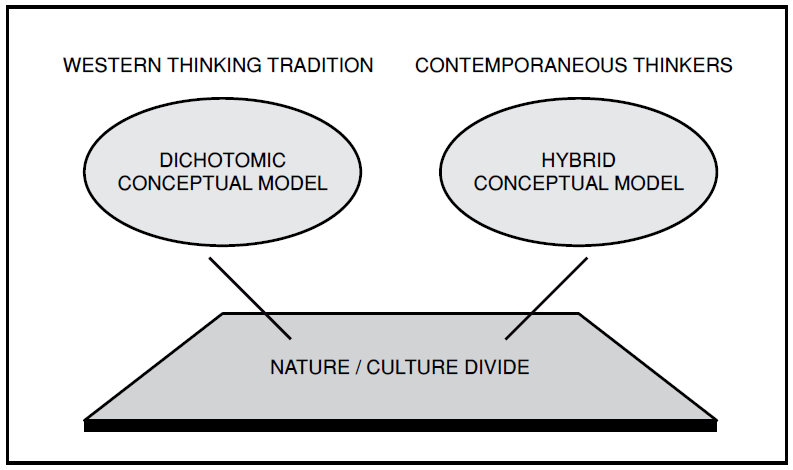
Nevertheless, from a logical standpoint, we argue that a hybrid concept such as natural-cultural can only be conceived insofar as the two constituent elements are maintained as distinct conceptual categories. In this sense, the Western ontology of the Great Divide serves as the condition of possibility for the concept of a natural-cultural hybrid. Without separating nature from culture, it would not be possible to rearticulate these same elements in a second movement (Figure 1).
In our view, while the idea of hybrids admits the combination between “nature” and “culture” in beings, it ultimately reinforces their ontological limits. We argue that the diffusion of this concept in the contemporary thinking, far from overcoming dualism, tends to reproduce it in new forms.
Our response to the limitations of anthropological approaches to nature and culture lies in Tim Ingold’s work. As shown in the next section, Tim Ingold’s thinking qualitatively differs from all others and indicates a coherent solution for the nature/culture divide in Western thinking. Conversely, in the natural sciences, the answer to the problem apparently lies with philosophers and authors such as Whitehead (2004), Uexküll (1926), Canguilhem (1965), Oyama (1985, 2000) and Lewontin (1982, 2000), Beyond more recent contributions of Extended Evolutionary Synthesis (DANCHIN et al., 2011; LALAND et al., 2015). Interestingly, those still unorthodox anthropological and biological approaches converge with each other. If articulated, they form an epistemological model capable of jointly approaching life processes. Thus, they indicate the real possibility of overcoming the ontological division between nature and culture in Western thinking.
The meaning of ‘nature’ in Tim Ingold and Natural Sciences
Before more directly delving into the argument based on Ingold’s thinking, we must highlight some key concepts underlying and coherently substantiating his propositions. Ingold (2015a) himself, summarises the trajectory of his work into four main phases: (1) his study on production; (2) the meaning of history; (3) the development of his notion of dwelling; and (4) his conception of life. Throughout these phases, Ingold has constructed and redefined the set of concepts that primarily underlie his conception of ‘nature’, which will be analysed here.
In this theoretical development, Ingold has used as reference and mainly discussed the phenomenology of Heidegger (1971) and Meleau-Ponty (1962), the philosophy of nature of Whitehead (1929) and Bergson (1911), the approach of ecological psychology of Gibson (1979), the conception of life as a phenomenon of lines of Deleuze and Guattari (2004), and DST in the biological sciences, particularly in the field of genetics and evolution (LEWONTIN, 1982; OYAMA, 1985, 2000).
In this effort to summarise the Ingoldian conceptual repertoire, which deserves a more detailed analysis here, we will begin with the problem that may be one of the main drivers of his work: the great division between nature and culture in the Western philosophical-scientific tradition (SILVA, 2020). Ingold recurrently highlights, in his writings, a hitherto insurmountable contradiction in the conception of modern man. He is now treated as a biological being, part of nature and the world in which he lives, breathes, moves and feeds. Simultaneously, we define ourselves as cultural-rational beings, supposedly capable of objectively analysing the nature and environment of which we are a part (INGOLD, 1996a). It is as if, to know himself and the world in which he lives, modern man denies his existence in this very world.
Thus, in modernity, man is conceived both inside and outside the domain of nature, and this is where the great contradiction lies, which manifests itself in formulations such as “the human-nature relationship”, as if both elements belonged to different ontological domains. Seeking to resolve this ambiguity, Ingold begins to negate the concept of culture that operates apart from the domain of nature, thereby also refuting the concept of humanity that implies its abduction of concrete existence in the world of life. For such purpose, Ingold uses the conception that man, as an organism among others, becomes himself during his existence as a way of inhabiting the environment (INGOLD, 1995a).
Ingold’s notion of dwelling primarily refers to the phenomenology of Heidegger, who negates the Cartesian intellectualist paradigm. From the foundations of the phenomenology of Husserl, Heidegger (1971) reintroduces the experience of the concrete world as a starting point for understanding man. Ingold particularly explores the Heideggerian concept of “being-in-the-world”. Ingold’s intent in this movement is to negate the rationalism/intellectualism paradigm founded on Descartes’ philosophy, and its main manifestation in structuralist linguistics (SAUSSURE, 1959) and anthropology (LÉVI-STRAUSS, 1968).
In the phenomenological conception, existence precedes essence (HEIDEGGER, 1971), whether the latter is conceived as cultural (maintained by tradition) or natural (defined by the genetic code). Therefore, Ingold bases his re-articulation of man with the concrete world of objects and living beings with whom he lives on this primacy of existence of Heidegger. Simultaneously, Ingold develops the conception that the organism, whatever it may be, has no reality or essence in itself. The “being-in-the-world” of Heidegger leads to the concept of “organism-in-the-environment” of Ingold (2000).
Thus, the “organism” of Ingold, instead of being circumscribed in itself and graphically represented as a closed circle (to the world), starts to be conceived as a being that participates in a given environmental context. Ingold opens the circle and turns it into a line (INGOLD, 2007, 2015b, 2015a). The living being then becomes represented by lines of growth and movement, which draw trajectories during his existence (DELEUZE; GUATTARI, 2004). A multitude of interwoven lines forming a meshwork will result in the texture of the living world in the Ingoldian approach.
Ingold’s lines and meshwork contrast head-on with the conception of nodes and network in the interactionist approaches of both ecology and social sciences ((INGOLD, 2008). Networks consist of nodes (organisms or people), predefined by their internal properties, albeit interacting with each other. Accordingly, Ingold apparently proposes a deeper sense of interaction, itself posited as the framework of the organism-in-the-environment development process.
In this conception, instead of establishing a relationship with the environment, the organism is the environment in which it lives. Such a perspective also contrasts with the organism+environment formula present in ecological thinking. In mirroring the epistemological foundations of the Natural Sciences, ecological thinking roughly operates on the assumption that these two elements are defined a priori: the organism by its genes and the environment by the relatively fixed (non-historic) scenario to be completed by the former.
A counterpoint to this orthodox conception of organism and environment in the natural sciences can be identified in Lewontin (1982) and Lewontin & Levins (1997) , for whom these two concepts must be analysed interdependently: “Just as can be no organism without an environment, so can be no environment without an organism” (LEWONTIN; LEVINS, 1997, p. 96). Lewontin seeks here a relational concept of environment, one that takes effect from the biological needs and sensory apparatus of organisms.
This concept of environment, proposed by Lewontin (1982), in turn, is aligned with other previously developed conceptions. More precisely, we can identify its correspondence to the concepts of Umwelt by Uexküll (1926) (KULL, 2014), of niche in ecology (HUTCHINSON 1959) and of “affordances” developed by Gibson (1979) in the realm of his ‘Ecological Psychology’. In these conceptions, the ontological constitution of the environment invariably involves the necessity or agency of the organism during its existence; therefore, there is no ontological separation between these two instances. This conceptual convergence observed between different approaches apparently indicates a process of gestation of a new environmental ontology still under construction, which is reflected and updated in Tim Ingold’s work.
To strengthen his proposition that “the organism is the environment” Ingold also supports his argument on Developmental Systems Theory - DST (OYAMA, 1985). In this conception, ontogenesis (the development of the organism itself) ultimately shapes the living being (OYAMA, 2000). In DST, and for Ingold as well, the organism is a becoming, constituting itself during its participation in the world, while contributing to the formation of that same world. This position of Ingold is aligned, albeit not explicitly in his writings, with other conceptions that emerged in the natural sciences from the 1990s (SILVA, 2016), especially the concepts of niche construction (ELLIS, 2015; ODLING-SMEE; LALAND; FELDMAN, 1996) and extended evolutionary synthesis (DANCHIN et al., 2011; LALAND et al., 2015).
Based on these conceptions, the environment is constantly changed by organisms, which collaborate in creating selective pressures that operate on themselves. Thus, for Ingold, the evolutionary process is dialectic (JABLONKA; LAMB, 2005)), during which the world of life is in constant formation.
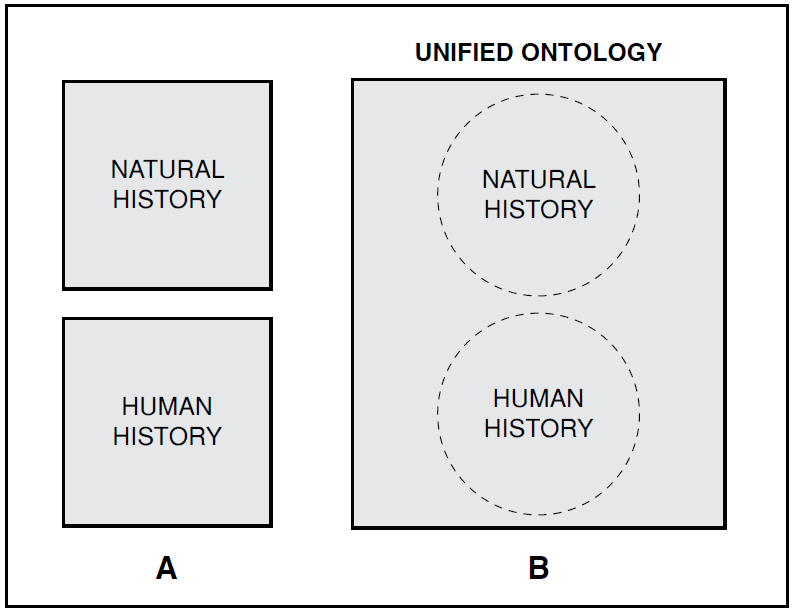
Ingold (2002) proposes to dissolve, at the ontological dimension, the distinction between Natural History (Evolution) and Human History. He denies that humans transform “Nature”, separating himself from the “natural” and thus giving rise to his own History. In his conception, man does not act on the environment, but in the environment, as part of relational and developmental processes inherent to the phenomenon of life (OYAMA, 1985).
In this sense, for Ingold, the world of life is, fundamentally, historical (NGOLD, 1995b, 1996b, 2011)). Returning to the concept of environment-organism as a line, in Ingoldian thinking, the life trajectory in each environment-organism (or evolutionary lineage) represents its history, and the encounter between different trajectories forms a type of meshwork consisting of different individual histories (or different lineages).
Accordingly, for Ingold, Natural History is not ontologically different from Human History (Figure 2A). The notion of a history that starts with the arrival of humanity is negated. Ingold rejects this narrative and replaces it with another in which Natural History and Human History are merely analytical models of one and the same historical process that defines the world of life (Figure 2B) - similarly to the centrality of time in Whitehead’s ontology of nature (WHITEHEAD, 2004).
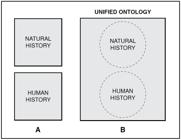
Ontological compartmentalization between Natural History and Human History (A). Unified ontology model (B).
Implications for Areas at the Society-Environment Interface
Beginning with the perspective of Ingold, combined with the natural sciences approaches mentioned above, we will demonstrate how it is possible to move beyond the nature or culture and nature and culture concepts in order to better understand phenomena at the society-environment interface. This approach involves adopting a conception of nature that places strong emphasis on the historical processes of development and evolution of organisms. Within this conception, the changes human populations impose on the environment, resulting in what we term anthropogenic environments, do not occur, ontologically, outside the biological realm. Human activities within a landscape are understood as an integral part of a broader set of interactions involving other organisms inhabiting the same environment, which contribute to altering the developmental conditions of other organisms, in addition to humans themselves.
In this sense, culture can be understood in its original meaning: not as a phenomenon unrelated to biology but as (another) element participating in life processes, which contributes to the formation of the developmental conditions of organisms in a given environment (INGOLD, 2004).
It is important to emphasize that, in light of proposals from the field of Developmental Systems Theory as well as Ingoldian thought, references to development inherently include the process of evolution. It is throughout the development process that organisms are concretely constituted within an environmental context inherited from previous generations. This process can also be understood from the concepts of cultural inheritance and ecological inheritance, mobilized within the scope of the extended evolutionary synthesis (DANCHIN et al., 2011; LALAND et al., 2015). If part of the genotype is capable of transmission between generations, the environmental conditions in which the organism’s formation occurs throughout its ontogeny are also capable of transmission.
Based on these considerations, we can also affirm that by inhabiting a given environment, humans modify the conditions of what we now term development-evolution, without ever existing outside this context or being alien to the process. In light of the approaches discussed here, development-evolution constitutes the universal ontological condition of all living beings.
Following this line of argument, we can also say that culture alters the conditions under which the development-evolution process occurs, without altering its inherent relational and situational dynamics. Thus, the phenomena evidenced in studies at the society-environment interface can be more accurately classified as developmental systems that also operate under human influence.
Unlike the unified epistemology we are proposing here, in the current literature on human evolution, evolutionary ecology, human ecology, historical ecology, domestication, and approaches in biocultural and socioecological systems, a hybrid ontological conception of the observed phenomena still prevails. Let us now problematize some of these topics considering the theoretical reflections we are here proposing.
Topics in Human Evolution and Behavior
As we know, within the cultural dimension of humanity, in terms of technical inventions, technologies, institutions, among others, we have an almost unlimited capacity to modify the environment, thus altering the selective pressures that will act upon us and consequently influence the trajectory of our evolution. This process is referred to as self-domestication, biocultural evolution, or gene-culture coevolution. For example, humanity’s control of fire over the last 1.5 million years and the invention of cooking, which increased the availability of calories in food, appears to have contributed to significant brain enlargement and a drastic reduction in intestinal volume observed in the genus Homo (WRANGHAM, 2009). Subsequent changes to our digestive system suggest that modern humans would no longer be able to survive today without cooking or other forms of food processing (LIEBERMAN, 2015).
More recently in Human History, during the Neolithic Revolutions (the last 10,000 years), selective pressures favored the ability of adults in pastoralist societies to consume milk. Within the context of humans living alongside and managing herds, selection acted to fix genetic mutations associated with the continued production of lactase (the enzyme responsible for milk digestion) in adults (ENATTAH et al., 2008). A similar process occurred among agricultural societies, with the diversification of genes responsible for the production of amylase (the enzyme that digests starch), linked to a grain-based environmental and dietary context (PERRY et al., 2007).
Also related to the Neolithic Revolutions, archaeogenetic studies have demonstrated that skin lightening was associated with agricultural populations in Europe. These groups, whose diets became increasingly less carnivorous over the last 8,000 to 5,000 years, no longer obtained sufficient vitamin D from dietary sources alone. Increased reliance on the synthesis of vitamin D via ultraviolet radiation exposure to the skin, combined with migration to progressively northern regions with reduced sunlight, created selective conditions favoring a gradual reduction in melanin levels in these populations (KRAUSE; TRAPPE, 2022).
These few examples involve processes in which technological innovations perpetrated by humans modify the environment, alter selective pressures, and, ultimately, the evolutionary dynamics of the species itself. In these cases, there is also considerable emphasis on niche construction, ecological inheritance, cultural inheritance, among other concepts that fall within the scope of the extended evolutionary synthesis also mentioned here.
We agree, in terms of nomenclature, to refer to these processes as gene-culture coevolution or biocultural coevolution, in the sense that we recognize the degree of agency that we have over the course of our own evolution. However, based on the discussion proposed in this article, we caution against reifying these terms, lest we reinforce the idea that on the ontological level, there exist two worlds: one of nature, the other of humanity.
The fact that humans construct new environments and new selective pressures that will fall upon them does not place them, in ontological terms, outside the ecological and evolutionary processes that constitute life. Indeed, in essence, such environmental transformations are not fundamentally different from the construction of niches between beavers and earthworms-two ancient and didactic examples, already cited by the founding fathers of anthropology (MORGAN, 1868) and modern biology (DARWIN, 1881), respectively.
And what about human behavior? Efforts to understand it at the intersection of anthropology and biology date back to the origins of anthropology itself and the emergence of Darwinian evolutionary theory in 19th-century biology. Broadly speaking, from the second half of the 20th century onward, we can cite the main research programs on the subject, such as sociobiology (WILSON, 1975), evolutionary psychology (BARKOW et al., 1992), human behavioral ecology (CRONK et al., 2000), and dual inheritance (RICHERSON et al., 2010). Despite their particularities, all are neo-Darwinian in essence and consider culture as a form of adaptation to the environment, that is, to nature.
In his writings, Ingold directly criticizes theoretical proposals that assume the existence of any “program” capable of governing human behavior a priori. For him, the notion of a pre-experiential program is expressed in biology and anthropology, through genes and culture. This concept appears, for example, in the form of innate cognitive apparatuses, genetically determined and previously formed by natural selection, within the scope of evolutionary psychology. In the case of human behavioral ecology, with its analysis focused on the degree of adaptability (fitness) of individual behavior, the notion of program manifests itself in the form of behavioral patterns maintained by culture (through enculturation), also subject to natural selection.
In his texts, Ingold also questions the classical sense of culture and enculturation within sociocultural anthropology-based on the idea of the social transmission of pre-experiential codes or “representational schemes” embedded in transmission (INGOLD, 1996a; 2000). By denying any (dualistic) essence for understanding human behavior, Ingold remains grounded in the phenomenological maxim that existence precedes essence, an aspect of his theoretical project already introduced here.
From the perspective of Ingold, growing up and socializing in an environment involves experiencing, throughout life, a flow of relationships with beings and things that are part of that environment. This implies an active, lived experience of the world through engagement in practices and situations that are constitutive of the developing person, incluiding their behavior and decision-making (INGOLD, 2015a). Thus, in Ingold’s model, human capabilities and behaviors emerge as part of Developmental Systems, a theoretical framework previously introduced in this text (OYAMA, 1985; INGOLD, 1996a).
Historical Ecology, Domestication, and Socioecological Systems
In the course of development of theoretical currents in Environmental Anthropology, the Historical Ecology emerged as a Research Program characterized by an analytical model that highlights the historical-anthropic dimension of a given landscape. In their search for systematising Historical Ecology as a research program, Crumley (1994) and Balée (2006) highlight the centrality of the landscape in this approach and its analysis at different spatial and temporal scales.
In the case of anthropogenic environments highlighted in Historical Ecology research, humans change the conditions for the development of the organisms they use. Taking some well-known examples of this research field, consider the so-called ‘cultural forests’ (BALÉE, 1994), artificial clustering of utilitarian species of plants (POSEY, 1985), as well as anthropogenic soils (terra preta de índio), evidenced by studies carried on in both ethnographic and archaeological contexts (HECHT; POSEY, 1989; NEVES et al., 2003). These are typical examples of historical-human dimension as part of what we call ‘nature’.
We sustain that, beyond a simplistic interpretation, mediated by the hybrid idea of nature-cultures, the most important (at the ontological level) is to know that human interference in these environments, even in the cases of huge transformations, does not take away their ecological essence. In other words, considering that “culture”, when present, is part of environment in which an organism develops, the cultural factor is constitutive of an ecological process per se, rather than a new element that modifies this essence.
Similarly, about domestication, another central topic at the Society-Environment interface, as well as in Historical Ecology, domesticated organisms are characterised as the result of a historical-evolutionary or biocultural process and are portrayed as the concrete manifestation of a natural-cultural hybrid entity.
If we take as a reference the biological, archaeological, and anthropological debate since the publication of The variation of animals and plants under domestication (DARWIN, 1868) until now (STÉPANOFF; VIGNE, 2019; ZEDER, 2015), domestication can be defined as a process whereby populations of organisms are phenotypically and/or genetically altered through human manipulation.
Ultimately, domestication can be conceived as an evolutionary process, which, in turn, is characterised by biological and environmental (selective) contingencies that define transformations in populations at a given time in their history. Simultaneously, based on the approach explained thus far, we can argue that a domesticated organism is not less natural because it evolved from environmental conditions largely defined by humans (whether intentionally or unintentionally).
Similarly to the domestication process, the fact that a landscape partly results from more or less intensive forms of environmental use and modification by human populations does not make it less ecological for this reason. Thus, an anthropogenic environment should not be understood as harbouring two ontologically distinct phenomena (‘nature’ and ‘culture’). In the line of our theoretical analysis, we state that anthropogenic environments continue to operate ecologically because they are also mediated by human interventions, not despite them. If they are not pristine nature, they cannot be considered ontologically hybrid environments either.
We can understand, from the theoretical perspectives discussed here, the anthropogenic term as designating an environment whose developmental conditions were modified by human action, such as clearing for agriculture, selective plant collection, propagule transport, and selective hunting patterns, for example. The very human management of organisms and their environments come from a refined knowledge about their growth strategies, adaptation and resistance to specific conditions, as clearly shown by studies in Ethnoecology (CONKLIN, 1954; TOLEDO, 2002).
Therefore, human populations within the landscape, by manipulating organisms and environmental conditions, ultimately manipulate ongoing developmental processes, thereby changing the abundance and spatial range of specific groups of organisms over others, including in agricultural fields or in agroforestry landscapes in general (MAEZUMI et al., 2018; PIPERNO, 2011).
As discussed above, we can conceive of domestication of organisms as an evolutionary process. On another scale, landscape domestication (ERICKSON, 2006; HYNES; CHASE, 1982; LEVIS et al., 2018) can be understood as the human management of ecological processes beyond the organism scale (populations, communities, and ecosystems, among others).
Beyond the heuristic limitation of applying the classical concept of domestication of organisms to the landscape scale, as already identified by Balée (2013, p.176-177), we would like to highlight that the conventional conception based on which we state the domestication of organisms and domestication of environments (or landscapes) provides for a necessary ontological separation between organism and environment. Based on the ontological continuity of ‘organism-in-the-environment’ present both in Uexküll (1926) and Lewontin (1982) in Biology, as well as in Ingoldian Anthropology, however, ways of ‘domesticating organisms’ cannot be conceived without (simultaneously) altering their environmental conditions of development, nor would it be possible to change environmental conditions via human management without (simultaneously) altering the very developmental process of organisms and ultimately themselves (their phenotype) (JABLONKA; LAMB, 2005; LEWONTIN, 2000). See also Sullivan et al. (2007) for empirical examples along these lines. As a result, the domestication of organisms or landscapes is now conceived as the same evolutionary phenomenon: human interference in the course of developmental processes at a given time of a particular environmental history.
Consider, to conclude this section, the socioecological approach (SES). In its heuristics, SES raised from the theoretical model of Adaptive Complex Systems (BERKES; COLDING; FOLKE, 2003; FOLKE et al., 2005), related to the concepts of adaptation, self-organization, out of equilibrium, non-linear dynamic, resilience, and emergent properties (HOLLAND, 2006; LANSING, 2003; LEVIN et al., 2013). Under the premise that practices of management are immersed in informal institutions, the SES seeks explain how resilience (HOLLING, 1973) emerges from local systems of resource governance (FOLKE et al., 2010). In this sense, the studies in SES represent important advances, especially in articulating natural (ecological) and cultural (institutions) components of the system within of a same analytic process.1
From a methodological perspective, the advances of SES approach are unquestionable. However, at the ontological level, calling a system that is partially influenced by humans a “socioecological system” proves to be somewhat redundant. For us, the social (cultural) element is part of what we are here conceiving as an (still) ecological phenomenon, from an expanded conception of ecology which we identify both in Ingold (2000) and in heterodox currents of biology mentioned above. We are not, at this point, proposing a change in the nomenclature of this Research Program, but rather drawing attention to the fact that we should not reify the term, in the light of the ontological implications discussed here.
Final Considerations
Using the distinction between the concepts of network and meshwork proposed by Ingold (INGOLD, 2006, 2008, 2015b)) as a reference to describe relationships between organisms in a given environment, we can also represent the central difference between a dualistic orthodox epistemology (‘nature’ x ‘culture’) from the one we aim to summarise here (Figure 3). In the orthodox model, we have ‘nature’ and ‘culture’ as ontologically distinct entities that combine to form hybrids (Fig 3A).
In turn, in the conception that we seek to outline here, we have the phenomenon of life understood as a unified historical-ecological process that can be represented as a single meshwork (Figure 3B). The meshwork consists of organisms-in-the-environment developmental systems, forming the substrate or texture of the life world, to cite an image often used by Ingold. The line represents the temporal dimension of phenomena, the becoming of all that is alive and constitutes itself during their existence throughout their history. Organism-in-environment developmental systems intersect and reciprocally form themselves in points in the meshwork, which represent the ecological dimension of life processes. Herein lies the concept of correspondence of Ingold (2015b), in contrast to that of interaction used in both Ecology and Social Sciences.
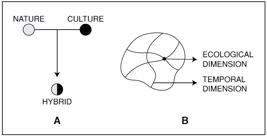
Hybrid formation from ontologically independent entities (A). Historical-ecological unity constituting the environment (B).
Based on the above, we conclude that Ingold and the biological currents addressed escape the dualism between ‘nature’ and ‘culture’ and operate through monism, using, for such purpose, a comprehensive conception of life processes. The phenomenological maxim that existence precedes essence precisely summarises the centrality of time and its ecological relations (or correspondences) in the process of constitution of organisms-in-the-environment. In short, the world of life, or the environment, can be conceived as essentially historical and ecological.
Regarding the historical dimension, notable is the position of Schelling that ‘Nothing exists alone, but everything becomes’. Merleau-Ponty (2003, p.48) termed this approach the philosophy of time, as opposed to a philosophy of existence (or Being) that refers to the Hegelian tradition of thought.
Thus, the organism is formed as part of the environment in which it is inserted during its historical existence, that is, during the organism’s relations with the other elements of the environment. For us, the relationship, rather than signifying the interaction between independently constituted elements, should be conceived as the framework of any and every manifestation of life. This is the conception of ecology revised and mobilised by the theoretical approach summarised here. Hence, in our argument, ecology and history are no longer merely analytical dimensions for the study of we have named ‘nature’ but come to be understood as a historical-ecological unit which defines fundamentally (ontologically) the life processes (Figure 3B).
In orthodox and current conceptions, the phenomena at the interface Society-Environment, evidenced by the studies in Human Ecology, Socioecology, Archaeology, and related areas, are conceived as a hybrid between ‘nature’ and ‘culture’. The term ‘Historical Ecology’ (BALÉE, 2006; CRUMLEY, 1994) itself, for example, carries this dualistic epistemology: ‘Ecology’ refers to the natural dimension of phenomena, while ‘Historical’ refers to culture, or to Human History, with its own ontology.
Based on the exercise of theoretical synthesis undertaken throughout this article and from the phenomena highlighted by the studies on Society-Environment interactions, we can emerge from this type of dualist epistemology and the conception of ontologically hybrid entities. In the theoretical approach discussed here, organisms-in-the-environment and landscapes can be conceived as historical-ecological units.
This results in a monistic epistemology that operates as a unified analytical model. The latter, in turn, can be mobilised for an unambiguous understanding of life processes, including those in which humans play a central role. In this respect, the current frameworks of biocultural (MAFFI, 2001), biosocial (STÉPANOFF; VIGNE, 2019) and social-ecological systems (COLDING; BARTHEL, 2019) approaches, as well the Anthropocene analysis (BRONDIZIO et al., 2016), have been relevant in trying operationalizing more integrative studies involving cultural and natural dimensions of environment.
However, in our view, they have not yet explicit an environmental ontology attuned to their methodological proposals. We think the theoretical discussion herein presented may contribute to this kind of ontological foundation, still latent and heterodox in both Anthropology and the Natural Sciences. Finally, we hope with this article fostering the problematization and resignification of key topics of inquiry in the fields of Human Ecology, Human Evolution, Environmental History, Historical Ecology, Archaeology, and Environmental Sciences.
Acknowledgement
The authors would like to thank Tiago Santi for his help in editing the figures and The São Paulo Research Foundation - FAPESP (Process 2016/04680-4. Process 2017/25105-0).
References
- AISHER, A.; DAMODARAN, V. Introduction: Human-nature Interactions Through a Multispecies Lens. Conservation and Society, v. 14, n. 4, p. 293-304, 2016.
- ALVES-MAZZOTTI, A. J.; GEWANDSZNAJDER, F. O método nas ciências naturais e sociais - pesquisa quantitativa e qualitativa. 2. ed. São Paulo: Thomson, 1999.
- BALÉE, W. Footprints in the Forest: Ka’apor Ethnobotany-The Historical Ecology of Plant Utilization by an Amazonian People. New York: Columbia University Press, 1994.
- BALÉE, W. The research program of historical ecology. Annu. Rev. Anthropol., v. 35, p. 75-98, 2006.
- BALÉE, W. Cultural Forests of the Amazon: A Historical Ecology of People and Their Landscapes. Tuscaloosa: University of Alabama Press, 2013.
- BARKOW, J. H.; COSMIDES, L.; TOOBY, J. (Eds.). The adapted mind: Evolutionary psychology and the generation of culture. Oxford University Press, 1992.
- BERGSON, H. Creative Evolution. London: Macmillan, 1911.
- BERKES, F.; COLDING, J.; FOLKE, C. Navigating social-ecological systems: building resilience for complexity and change. Cambridge, UK: Cambridge University Press, 2003.
- BRONDIZIO, E. S. et al. Re-conceptualizing the Anthropocene: A call for collaboration. Global Environmental Change, v. 39, n. 2015, p. 318-327, 2016.
- CANGUILHEM, G. La connaissance de la vie. Paris: J. Vrin, 1965.
- COLDING, J.; BARTHEL, S. Exploring the social-ecological systems discourse 20 years later. Ecology and Society, v. 24, n. 1, 2019.
- CONKLIN, H. C. An ethnoecological approach to shifting agriculture. Transactions of the New York Academy of Sciences, v. 17, p. 133-142, 1954.
- CRONK, L.; CHAGNON, N.; IRONS, W. (Eds.). Adaptation and human behavior. New York: Aldine De Gruyter, 2000.
- CRUMLEY, C. L. Historical Ecology: Cultural Knowledge and Changing Landscapes. Santa Fe, NM and Seattle, WA: School of American Research Press, 1994.
- DANCHIN, É. et al. Beyond DNA: Integrating inclusive inheritance into an extended theory of evolution. Nature Reviews Genetics, v. 12, n. 7, p. 475-486, 2011.
- DARWIN, C. The variation of animals and plants under domestication. London, UK: John Murray, 1868.
- DARWIN, C. The Formation of Vegetable Mould Through the Action of Worms, with Observations on their Habits. London: John Murray Albemarle Street, 1881.
- DELEUZE, G.; GUATTARI, F. A Thousand Plateaus: Capitalism and Schizophrenia. London: Continuun, 2004.
- DESCOLA, P. As lanças do crepúsculo: relações Jivaro na Alta Amazônia. São Paulo: COSACNAIFY, 2006.
- DESCOLA, P. Beyond Nature and Culture. Chicago, IL: University of Chicago Press, 2013.
- ELLIS, E. C. Ecology in an Anthropogenic Biosphere. Ecological Monographs, v. 85, n. 3, p. 287-331, 2015.
- ENATTAH, N. S. et al. Independent Introduction of Two Lactase-Persistence Alleles into Human Populations Reflects Different History of Adaptation to Milk Culture. American Journal of Human Genetics, v. 82, n. 1, p. 57-72, 10 jan. 2008.
- ERICKSON, C. L. The Domesticated Landscapes of the Bolivian Amazon. In: BALÉE, W.; ERICKSON, C. L. (Eds.). Time, Complex, and Historical Ecology. New York: Columbia, University Press, 2006. p. 235-278.
- FOLKE, C. et al. Adaptive Governance of Social-Ecological Systems. Annual Review of Environment and Resources, v. 30, n. 1, p. 441-473, 21 nov. 2005.
- FOLKE, C. et al. Resilience thinking: Integrating resilience, adaptability and transformability. Ecology and Society, v. 15, n. 4, 2010.
- GIBSON, J. The ecological approach to visual perception. Boston: Houghton Mifflin, 1979.
- HARAWAY, D. When species meet. Minneapolis: University of Minnesota Press, 2008.
- HECHT, S. B.; POSEY, DARREL, A. Preliminary results on soil management techniques of the Kayapó Indians. In: POSEY, D. A.; BALÉE, W. (Eds.). Resource management in Amazonia: indigenous and folk strategies (Advances in Economic Botany n.7). New York: New York Botanical Garden, 1989. p. 174-188.
- HEIDEGGER, M. Poetry, Language, Thought. Nova York: Harper and Row, 1971.
- HOLBRAAD, M.; PEDERSEN, M. A. The Ontological Turn: An Anthropological Exposition. Cambridge: Cambridge University Press, 2017.
- HOLLAND, J. H. Studying Complex Adaptive Systems. Jrl Syst Sci & Complexity, v. 19, p. 1-8, 2006.
- HOLLING, C. S. Resilience and Stability of Ecological Systems. Annual Review of Ecology and Systematics, v. 4, p. 1-23, 1973.
- HUTCHINSON, G. E. Homage to Santa Rosalia or Why Are There So Many Kinds of Animals? The American Naturalist, v. 93, n. 870, p. 145-159, 1959.
- HYNES, R. A.; CHASE, A. K. Plants, Sites and Domiculture: Aboriginal Influence upon Plant Communities in Cape York Peninsula. Archaeology in Oceania, v. 17, n. 1, p. 38-50, 1982.
- INGOLD, T. Building, dwelling, living: How animals and people make themselves at home in the world. In: STRATHERN, M. (Ed.). Shifting contexts: transformations in anthropological knowledge. London: Routledge, 1995a. p. 57-80.
- INGOLD, T. People like us: The Concept of the Anatomically Modern Human. Cultural Dynamics, v. 7, n. 2, p. 187-214, 1995b.
- INGOLD, T. The optimal forager and economic man. In: DESCOLA, P.; PÁLSSON, G. (Eds.). Nature and society: anthropological perspectives. London: Routledge, 1996a. p. 25-44.
- INGOLD, T. Culture, perception and cognition. In: HAWORTH, J. T. (Ed.). Psychological research: innovative methods and strategies. London: Routledge, 1996b. p. 99-119.
- INGOLD, T. Culture, nature, environment: steps to an ecology of life. In: INGOLD, T. (Ed.). The perception of the environment: essays in livelihood, dwelling and skill. London: Routledge, 2000. p. 13-26.
- INGOLD, T. On the distinction between evolution and history. Social Evolution & History, v. 1, n. 1, p. 5-24, 2002.
- INGOLD, T. Culture on the ground: The world perceived through the feet. Journal of Material Culture, v. 9, n. 3, p. 315-340, 2004.
- INGOLD, T. Rethinking the animate, re-animating thought. Ethnos, v. 71, n. 1, p. 9-20, 1 mar. 2006.
- INGOLD, T. Lines: A Brief History. New York: Routledge, 2007.
- INGOLD, T. When ANT meets SPIDER: Social Theory for Arthropods. In: KNAPPETT, C.; MALAFOURIS, L. (Eds.). Material Agency: Toward a Non-Anthropocentric Approach. New York: Springer Science & Business Media, 2008. p. 209-215.
- INGOLD, T. Anthropology comes to life. In: INGOLD, T. (Ed.). Being Alive. New York: Routledge, 2011. p. 3-14.
- INGOLD, T. Repensando o animado, reanimando o pensamento. In: INGOLD, T. (Ed.). Estar Vivo: Ensaios sobre movimento, conhecimento e descrição. Petrópolis: Editora Vozes, 2015a. p. 115-126.
- INGOLD, T. The Life of Lines. New York: Routledge, 2015b.
- INGOLD, T.; PALSSON, G. Prospection. In: INGOLD, T.; PALSSON, G. (Eds.). Biosocial Becomings: Integrating Social and Biological Anthropology. New York: Cambridge University Press, 2013. p. 1-21.
- JABLONKA, E.; LAMB, M. J. Evolution in four dimensions: genetic, epigenetic, behavioral, and symbolic variation in the history of life. Cambridge, MA: MIT Press, 2005.
- KIRKSEY, S. E.; HELMREICH, S. The emergence of multispecies ethnography. Cultural Anthropology, v. 25, n. 4, p. 545-576, 2010.
- KRAUSE, J.; TRAPPE, T. A jornada de nossos genes: a história da humanidade e de como as migrações nos tornaram quem somos. Sextante, 2022.
- KULL, K. Adaptive evolution without natural selection. Biological Journal of the Linnean Society, n. 112, p. 287-294, 2014.
- LALAND, K. N. et al. The extended evolutionary synthesis: Its structure, assumptions and predictions. Proceedings of the Royal Society B: Biological Sciences, v. 282, n. 1813, 2015.
- LANSING, J. S. Complex Adaptive Systems. Annual Review of Anthropology, v. 32, p. 183-204, out. 2003.
- LATOUR, B. Jamais fomos modernos: ensaio de antropologia simétrica. São Paulo: Editora34, 1994.
- LEVIN, S. et al. Social-ecological systems as complex adaptive systems: modeling and policy implications. Environment and Development Economics, v. 18, n. 2, p. 111-132, 27 abr. 2013.
- LEVIS, C. et al. How People Domesticated Amazonian Forests. Frontiers in Ecology and Evolution, v. 5, p. 1-21, 2018.
- LÉVI-STRAUSS, C. Structural Anthropology. Harmondsworth: Penguin, 1968.
- LEWONTIN, R. C. Organism and environment. In: PLOTKIN, H. C. (Ed.). Learning, Development and Culture. Chichester: Wiley, 1982.
- LEWONTIN, R. C. The Triple Helix: Gene, Organism and Environment. Cambridge, MA: Harvard University Press, 2000.
- LEWONTIN, R. C.; LEVINS, R. Organism and environment. Capitalism, Nature, Socialism, v. 8, n. 2, p. 95-98, 1997.
- LIEBERMAN, D. E. A história do corpo humano: evolução, saúde e doença. Rio de Janeiro: Zahar, 2015.
- LIMA, T. S. O dois e seu múltiplo: reflexões sobre o perspectivismo em uma cosmologia tupi. Mana, v. 2, n. 2, p. 21-47, 1996.
- MAEZUMI, S. Y. et al. The legacy of 4,500 years of polyculture agroforestry in the eastern Amazon. Nature Plants, v. 4, n. 8, p. 540-547, 2018.
- MAFFI, L. On Biocultural Diversity: Linking Language, Knowledge, and the Environment. Washington, DC: Smithsonian Institution Press, 2001.
- MERLEAU-PONTY, M. Phenomenology of Perception. London: Routledge & Kegan Paul, 1962.
- MERLEAU-PONTY, M. Nature. Evanston, Illinois: Northwestern University Press, 2003.
- MORGAN, L. H. The American beaver and his works. J.B. Lippincott & CO., 1868.
- NEVES, E. G. et al. Historical and socio- cultural origins of Amazonian Dark Earths. In: LEHMANN, J. et al. (Eds.). Amazonian Dark Earths: Origin, Properties, Management. Dordrecht, Netherlands: Kluwer Academic, 2003. p. 29-50.
- ODLING-SMEE, F. J.; LALAND, K. N.; FELDMAN, M. W. Niche construction. American Naturalist, v. 147, p. 641-648, 1996.
- OYAMA, S. The Ontogeny of Information: Developmental Systems and Evolution. Cambridge: Cambridge University Press, 1985.
- OYAMA, S. Ontogeny and the Central Dogma: Do We Need the Concept of Genetic Programming in Order to Have an Evolutionary Perspective? In: Evolution’s Eye: A Systems View of the Biology-Culture Divide. Durham & London: Duke University Press, 2000. p. 1-25.
- PERRY, G. H. et al. Diet and the evolution of human amylase gene copy number variation. Nature Genetics, v. 39, n. 10, p. 1256-1260, 2007.
- PIPERNO, D. R. The Origins of Plant Cultivation and Domestication in the New World Tropics: Patterns, Process, and New Developments. Current Anthropology, v. 52, n. S4, p. S453-S470, 2011.
- POSEY, D. A. Indigenous management of tropical forest ecosystems: the case of the Kayapo indians of the Brazilian Amazon. Agroforestry Systems, n. 3, p. 139-158, 1985.
- RAPPAPORT, R. A. Ritual Regulation of Environmental Relations Among a New Guinea People. Ethnology, v. 6, n. 1, p. 17-30, 1967.
- RICHERSON, P. J.; BOYD, R.; HENRICH, J. Gene-culture coevolution in the age of genomics. Proceedings of the National Academy of Sciences, v. 107, n. Supplement 2, p. 8985-8992, 2010.
- SAUSSURE, F. Course in general linguistics. New York: The Philosophical Library, 1959.
- SERRES, M. Le Contrat Naturel. Paris: Éd. Champs-Flammarion, 1992.
- SEVERINO, A. J. Metodologia do trabalho Científico. São Paulo: Cortez Editora, 2007.
- SILVA, G. Epigênese e epigenética: as muitas vidas do vitalismo ocidental. Horizontes Antropológicos, v. 22, n. 46, p. 425-453, 2016.
- SILVA, G. A seleção natural como narrativa sobre o grande divisor, a biossemiótica e as etnografias das pessoas humanas e não-humanas. Interseções: Revista de Estudos Interdisciplinares, v. 22, n. 2, p. 300-329, 2020.
- STÉPANOFF, C.; VIGNE, J.-D. Introduction. In: STÉPANOFF, C.; VIGNE, J.-D. (Eds.). Hybrid Communities: Biosocial Approaches to Domestication and Other Trans-species Relationships (Routledge Studies in Anthropology). London and New York: Routledge Taylor & Francis Group, 2019. p. 1-20.
- SULLIVAN, A. P.; BIRD, D. W.; PERRY, G. H. Human behavior as a long-term ecological driver of non-human evolution. Nat. Ecol. Evol, v. 1, p. 1-11, 2017.
- TOLEDO, V. M. What is Ethnoecology? Origins, Scope, and Implications of a Rising Discipline. Etnologica, v. 1, n. 1, p. 5-21, 2002.
- TSING, A. L. The mushroom at the at the end of the World: On the possibility of life in capitalist ruins. Princeton and Oxford: Princeton University Press, 2015.
- UEXKÜLL, J. VON. Theoretical Biology. London: Kegan Paul, Trench, Trubner & Co., 1926.
- VAYDA, A. P.; RAPPAPORT, R. A. Ecology, Cultural and Non-Cultural. California Indian Library Collections, 1968.
- VIVEIROS DE CASTRO, E. Perspectivismo e multinaturalismo na América indígena. O que nos faz pensar, v. 18, p. 225-254, 2004.
- WHITEHEAD, A. N. Process and Reality: An Essay in Cosmology. Cambridge: Cambridge University Press, 1929.
- WHITEHEAD, ALFRED. N. The concept of nature. New York: Dover Publications, INC., 2004.
- WILSON, E. O. Sociobiology: The New Synthesis. Cambridge, MA: Harvard University Press, 1975.
- WRANGHAM. Catching fire: how cooking made us human. New York: Basic Books, 2009.
- ZEDER, M. A. Core questions in domestication research. Proceedings of the National Academy of Sciences of the United States of America, v. 112, n. 11, p. 3191-3198, 2015.
Not applicable: no research data were generated or analyzed. This is a theoretical article based on the referenced literature.

 Source: Authors.
 Source: Authors.
 Source: Authors.