 First report in Cuba of the presence of the louse Goniodes colchici (Denny, 1842) (Phthiraptera: Goniodidae) on Gallus gallus domesticus (Galliforme, Phasianidae).
ABSTRACT.
Laying hens are affected by numerous species of lice. High infestations cause intense itching, irritation and destruction of feathers. In addition to interfering with the nutrition and rest of the birds, with the consequent impact on meat and egg production. Although several studies have been carried out on this topic in Cuba, findings of a species of louse were recently observed whose taxonomic characteristics differ from the species described in the country. The objective of the study is to report this new species of malophagous insect in Gallus gallus domesticus. Laying hens of the White Leghorn breed, 445 days old, from the Mayabeque province, Cuba, were sampled. From each bird, 3 to 5 feathers were extracted from seven regions of the body: head, back, wings, cloaca area, anterior thigh, tail and pectoral area. The collected specimens were mounted in Canada Balsam, on slides and coverslips for taxonomic identification under an optical microscope. The slides were placed in an incubator at 28ºC for seven days for clarification and subsequent identification. The level of infestation or intensity of invasion was determined taking into account the number of feather insects found. The taxonomic characteristics found in these insects coincide with those described for the species Goniodes colchici (Denny, 1842). The presence of the louse G. colchici (Phthiraptera: Goniodidae) on Gallus gallus domesticus is reported for the first time in Cuba.
Keywords:
hens; ectoparasites; malophagous
Introduction
Chickens are frequently affected by high infestations of ectoparasites, mainly represented by mites and lice (Lakyat et al., 2022; Endale et al., 2023). These arthropods, in severe infestations, cause intense itching, irritation, weight loss, anemia and decreased consumption, with a marked drop in egg production (Torres-Cabra & Lagos-López, 2019; Sleeckx et al., 2019, Lakyat et al., 2022). Indyuhova et al. (2022) demonstrated the occurrence of metabolic disorders with increases in cortisol levels and a decrease in triiodothyroxine in parasitized chickens, thus increasing susceptibility to other diseases.
Malophagous lice (Phthiraptera) are classified into Amblycera and Ischnocera (Martín Mateo, 2006). The Amblycera are characterized by having very large heads, wider than the thorax, with powerful mouthparts adapted for chewing (Martín Mateo, 2002). The Ischnocera do not have maxillary palps, with antennae of three to five segments, filiform in females and sometimes showing sexual dimorphism in males; mouthparts movable in a horizontal plane parallel to the head and the apparent presence of only two thoracic segments, since mesothorax and metathorax join to form the pterothorax. In turn, the Goniodidae family is characterized by having a subtriangular head, more or less angular temporal bones, and antennae formed by five segments: first (scape), second (pedicel) and three flagellomeres of variable shape and structure. The thorax consists of a rectangular prothorax and a trapezoidal pterothorax. The abdomen is oval (Martín Mateo, 2009).
These insects feed on skin peelings, feathers, sebaceous secretions and in exceptional cases blood (Martín Mateo, 2006; García Ferrer et al., 2018). Another aspect that increases the pathogenicity of external parasitism in birds turns out to be the common presentation of mixed outbreaks, that is, where more than one species of parasite is involved (García Ferrer et al., 2018). The effect of ectoparasites on birds is manifest in moderate to severe infestations, when there are very few, no damage is observed and they can go unnoticed (García Ferrer & Rodríguez García, 2020; Castaño-Vázquez et al., 2022). The effect of lice is generally a function of their density. High infestations of lice can cause itching, destruction of feathers, excoriations and/or infected wounds (Midala et al., 2025).
Although the entomofauna of Gallus gallus domesticus in Cuba has been studied extensively (Hernández et al., 2006), observations made recently refer to the presence of a malophagous insect in chickens, whose morphological characteristics do not correspond with the species described in Cuba, neither in chickens nor in other chicken species. As explained above, the objective of the study is to identify this new species of malophagous insect in Gallus gallus domesticus in Cuba.
Material and methods
The present study was carried out in the Parasitology department of the Avian Research and Diagnostic Laboratory (LIDA), Poultry Research Institute, Havana, Cuba. The research was approved by the Ethics and Biosafety Committee of the institution. 107 laying hens of the White Leghorn breed, 445 days old, from the Mayabeque province were sampled.
For bird sampling, 3 to 5 feathers were extracted from the following body regions: head, back, wings, cloacal area, anterior thigh, tail and pectoral area (Rodríguez et al., 2021). The collected specimens were mounted in Canada Balsam, on slides and coverslips for taxonomic identification under an optical microscope. The sheets were placed in an incubator at 28 °C for seven days to clarify the samples with a view to their subsequent identification (García Ferrer & Rodríguez García, 2020). The insect species was determined taking into account their basic structures according to keys described in the literature by Martín Mateo (2009). Subsequently, the level of infestation or invasion intensity was determined taking into account the number of feather insects found as described in Table 1 by García Ferrer and Rodríguez García (2020):
The characters that were used to determine that the collected specimens belong to the described species, according to taxonomic keys were: head somewhat wider than long, frontoclipeal region arched, with the clipeal band slightly widened in its middle area, temporal angles expanded, but much less prominent than in the female. Dimorphic antennae, filiform in the female, while in the male, the scape is very dilated and has a slight prominence on the posterior edge and the first flagellomere has an internal apical process, blunt and almost equal in length to the segment. Vulvar edge convex, devoid of setae and with 7-8 spiniform setae that form an irregular row. Abdomen oval y fusiforme. Paratergal plates arcuate with an anterior prominence that extends well beyond the preceding segment.
Results and discussion
The taxonomic characteristics found in these insects coincide with the distinctive characters described for the species Goniodes colchici (Denny, 1842) referred to by Martín Mateo (2009):
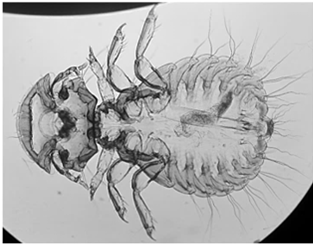
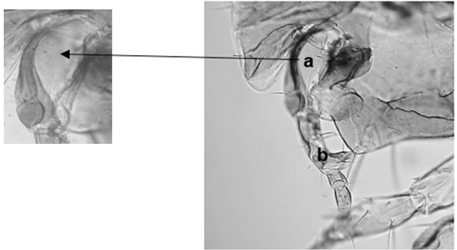
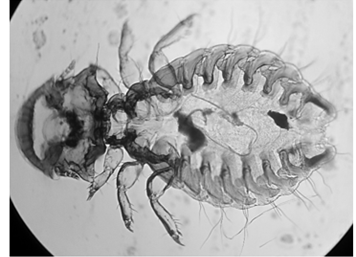
Male (Figure 1): Length: 2.10-2.34 mm. Head somewhat wider than long, frontoclipeal region arched, with the clipeal band slightly widened in its middle área, temporal angles expanded, but much less prominent than in the female; pronounced occipital angles and delimit a somewhat concave occipital region (Figure 2). Dimorphic antennae, the scape is very dilated and has a slight prominence on the posterior edge and the first flagellomere has an internal apical process, blunt and almost equal in length to that of the segment (Figure 3). Oval and fusiform abdomen, paratergal plates arched with a blunt anterior prominence that widely exceeds the preceding segment (Figure 4). Genital apparatus with a conical basal plate and a complex apical part with wide parameres (Figure 5).
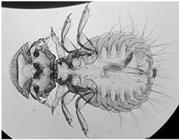

Head of the male G. colchici (a. clypeal región, b. temporal angles, c. occipital angles). 10 x. Original photograph taken by the author.

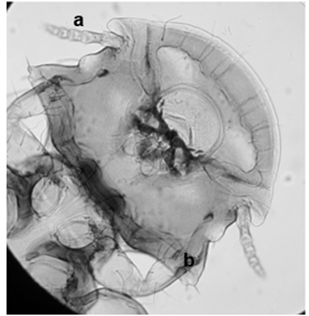
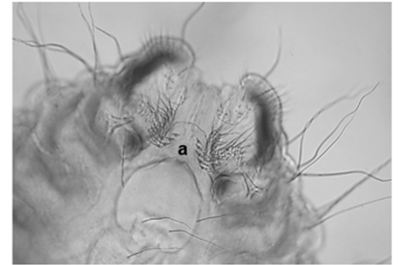
Famale (Figure 6): Length: 2.48-2.67 mm. Mostly like the male. Temporal angles more expanded than in the male and filiform antennae (Figure 7). Vulvar edge clearly convex, devoid of setae and with 7-8 spiniform setae that form an irregular row, separated from the edge on each side; lateral edges with a series of long setae and other small and fine ones (Figure 8).
This louse is a common parasite of Phasianus colchicus (Toderaş et al., 2019; Ștefan 2020), a bird native to Eurasia, introduced to western Europe and Great Britain, North Africa, America, Australia and New Zealand. In Spain, G. colchici has been reported from its usual host and from Chrysolophus pictus (golden pheasant) in Córdoba, Barcelona and Tarragona (Martín Mateo, 2009). In the Czech Republic it has been found in Alectoris chukar (chucar partridge), Perdix perdix and Syrmaticus reevesi (Sychra, 2005).


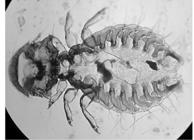
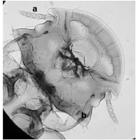
Female of G. colchici. Head (a. antennae, b. temporal angles).40 x. Original photograph taken by the author.

Female of G. colchici. Terminalia (a. vulva).40 x. Original photograph taken by the author.
Although Gallus gallus domesticus is not the usual host of G. colchici, it has been found in these birds Ullah and Khan (2021) reported a prevalence of 34.4% in pheasants in Pakistan, suggesting that this species can also parasitize chickens.
The level of infestation found in the birds under study was classified as mild. Although it is known that these parasites are not so harmful in light infestations, they do cause significant damage when the degree of infestation is moderate to severe. Rodríguez et al. (2021) suggest that these arthropods, in severe infestations, can cause a marked decline in egg production and bioproductive indicators in laying hens.
Studies conducted by Midala et al. (2025) have reported the presence of Menacanthus stramineus, Lipeurus caponis, Columbicola columbae, and Menopon gallinae infesting poultry. These findings are consistent with Hernández et al. (2006), who stated that among the species of malophagous insects diagnosed so far in Gallus gallus domesticus, Menopon gallinae is one of the most frequent, with a prevalence of 22.4% and an infestation extent of 23.7%. Research shows that in Cuba, the presence of G. colchici has not been reported; therefore, this study constitutes the first report of the presence of the louse Goniodes colchici in Cuba.
Conclusion
The presence of the louse Goniodes colchici on Gallus gallus domesticus is reported for the first time in Cuba.
Data availability
The images (Figures 1-8) used in this study are original and were taken by the author during fieldwork as part of the identification process of a new feather louse species in chickens. The data (photographs) are not publicly archived but can be made available by the corresponding author upon reasonable request.
References
-
Castaño-Vázquez, F., Merino, S., Valera, F. & Veiga, J.. (2022). Experimental manipulation of humidity in a cavity-nesting bird influences ectoparasites’ abundance. Parasitology, 149(4), 436-443. https://doi.org/10.1017/S0031182022000026
» https://doi.org/https://doi.org/10.1017/S0031182022000026 -
Denny, H. (1842). Monographia Anoplurorum Britanniae: on, an essay on the british species of parasitic insects. Belonging to the order Anoplura of Leach. In H. G. Bohn (pp. i-xxvi, 1-262). https://phthiraptera.myspecies.info/sites/phthiraptera.info/files/39533.pdf
» https://phthiraptera.myspecies.info/sites/phthiraptera.info/files/39533.pdf -
Endale, H., Aliye, S., Mathewos, M. & Adimasu, W.. (2023). Identification and estimation of the prevalence of ectoparasites of backyard chicken in Boloso Sore District, Wolaita zone, southern Ethiopia. Veterinary Parasitology: Regional Studies and Reports, 42, 100884. https://doi.org/10.1016/j.vprsr.2023.100884
» https://doi.org/https://doi.org/10.1016/j.vprsr.2023.100884 -
García Ferrer, Y., Rodríguez García, D. & Pino Quintana, Y. (2018). Ectoparásitos en aves del género Agapornis en cautiverio en La Habana, Cuba. Revista de Investigaciones Veterinarias del Perú, 29(3), 1043-1051. https://doi.org/10.15381/rivep.v29i3.14767
» https://doi.org/https://doi.org/10.15381/rivep.v29i3.14767 -
García Ferrer, Y. & Rodríguez García, D.. (2020). Piojos Neocolpocephalum turbinatum en patos Pekín (Anas platyrhynchos domesticus) en la provincia Artemisa, Cuba. Revista de Investigaciones Veterinarias del Perú, 31(2), e17852. https://doi.org/10.15381/rivep.v31i2.17852
» https://doi.org/https://doi.org/10.15381/rivep.v31i2.17852 -
Hernández, M., González, A., Larramendy, R. & Szczypel, B. (2006). Ectoparásitos diagnosticados en gallinas ponedoras de crianzas comerciales en Cuba. Informe de la presencia de un nuevo ácaro plumícola: Megninia ortari (Acari: Analgidae). Revista Cubana de Ciencia Avícola, 30(1), 15-20,. https://agris.fao.org/search/en/providers/122642/records/64724ca553aa8c8963058ff1
» https://agris.fao.org/search/en/providers/122642/records/64724ca553aa8c8963058ff1 -
Indyuhova, E. N., Arisov, M. V., Maximov, V. I. & Azarnova, T. O. (2022). Characteristics of metabolic disorders in laying hens with dermanyssosis. Veterinary Archives, 92(2) 161-169,. http://dx.doi.org/10.24099/vet.arhiv.1376
» https://doi.org/http://dx.doi.org/10.24099/vet.arhiv.1376 -
Lakyat, A., Pumnuan, J. & Thipmanee, K. (2022). Ectoparasite species attacking chicken in eastern area of Bangkok, Thailand. International Journal of Agricultural Technology, 18(4), 1619-1632. http://www.ijat-aatsea.comISSN 2630-0192
» http://www.ijat-aatsea.comISSN 2630-0192 -
Martín Mateo, M. P. (2002). Mallophaga, Amblycera. In M. A. Ramos (Eds.), Fauna Ibérica (Vol. 20, pp. 16-18). Museo Nacional de Ciencias Naturales/CSIC. https://l1nq.com/8StBp
» https://l1nq.com/8StBp -
Martín Mateo, M. P. (2006). Diversity and distribution of species of Mallophaga (Insecta) on birds and mammals from Madrid. Graellsia, 62(Extra), 21-32. https://doi.org/10.3989/graellsia.2006.v62.iExtra.108
» https://doi.org/https://doi.org/10.3989/graellsia.2006.v62.iExtra.108 -
Martín Mateo, M. P. (2009). Phthiraptera, Ischnocera. In M. A. Ramos (Eds.) Fauna Ibérica (Vol. 32, pp. 46-47). Museo Nacional de Ciencias Naturales/CSIC. https://l1nq.com/vmVzR
» https://l1nq.com/vmVzR -
Midala, C. A., Kyari, F., Thekisoe, O. M. M. & Onyiche, T. E. (2025). Parasites of poultry in Nigeria from 1980 to 2022: a review. Journal of Parasitic Diseases, 49(1), 1-12. https://doi.org/10.1007/s12639-025-01792-5
» https://doi.org/https://doi.org/10.1007/s12639-025-01792-5 -
Rodríguez, G. D., García, F. Y., Valdés, F. L., Correoso, M. O., González, N. M. & Valdés, R. M.. (2021). Evaluación de alfacipermetrina para el control de ácaros en gallinas ponedoras en condiciones de laboratorio. Revista de Investigaciones Veterinarias del Perú, 32(3), e20404. https://dx.doi.org/10.15381/rivep.v32i3.20404
» https://doi.org/https://dx.doi.org/10.15381/rivep.v32i3.20404 -
Sleeckx, N., Van, G. S., Koopman, R., Kempen, I., Van Hoye, K., De Baere, K., Zoons, J. & Herdt, P.. (2019). Producction losses in laying hens during infestation with the poultry red mite Dermanyssus gallinae. Avian Pathology, 48(sup1), S17-S21. https://doi.org/10.1080/03079457.2019.1641179
» https://doi.org/https://doi.org/10.1080/03079457.2019.1641179 -
Ștefan, R. (2020). The diversity of the pheasant parasitofauna from various natural and anthropized biotopes of the Republic of Moldova. Buletinul AŞM. Ştiinţele vieţii, 2(341). https://ibn.idsi.md/sites/default/files/imag_file/108-118%20(1).pdf
» https://ibn.idsi.md/sites/default/files/imag_file/108-118%20(1).pdf -
Sychra, O.. (2005). Chewing lice (Phthiraptera: Amblycera, Ischnocera) from chukars (Alectoris chukar) from a pheasant farm in Jinacovice (Czech Republic). Veterinární Medicína - Czech, 50(5), 213-218. https://doi.org/10.17221/5617-VETMED
» https://doi.org/https://doi.org/10.17221/5617-VETMED -
Toderaş, I., Zamornea, M., Rusu, T., Erhan, D., Savin, A., Chihai, O. & Gliga, O.. (2019). Cuantificarea unor indici biochimici i productivi la fazanii infesta i cu ectoparaziţi. Boletinul AŞM. Ştiinţele vieţii, 2(338), 112-117. https://ibn.idsi.md/sites/default/files/imag_file/112-117_3.pdf
» https://ibn.idsi.md/sites/default/files/imag_file/112-117_3.pdf -
Torres-Cabra, E. & Lagos-López, M. I.. (2019). Evaluación del aceite esencial de cilantro (Coriandrum sativum L.) sobre el ácaro rojo de aves Dermanyssus gallinae (De Geer, 1778) (Acari: Dermanyssidae) bajo condiciones de laboratorio. Ciencia y Tecnología Agropecuaria, 20(1), 53-60. http://www.scielo.org.co/pdf/ccta/v20n1/0122-8706-ccta-20-01-00053.pdf
» http://www.scielo.org.co/pdf/ccta/v20n1/0122-8706-ccta-20-01-00053.pdf -
Ullah, S. & Khan, M. (2021). Prevalence of ectoparasites in pheasants at Dhodial Pheasantry, Mansehra District, KPK, Pakistan. International Journal of Poultry Science, 20(7), 255-259. https://doi.org/10.3923/ijps.2021.255.259
» https://doi.org/https://doi.org/10.3923/ijps.2021.255.259