 Physical and chemical properties of açaí after blanching in small-scale açaí processing units in the Amazon Forest Biome
ABSTRACT.
During açaí pre-processing, blanching aims to eliminate the protozoan responsible for Chagas disease, which can be transmitted by ingesting contaminated açaí juice. In the municipality of Tomé-Açu, Pará State, Brazil, most açaí pre-processing and processing are performed small-scale local units. Each unit employs their own blanching method, which may modify the physical and chemical characteristics of the resulting juice (the final product). In this context, this study aimed to evaluate the physical and chemical properties of açaí after blanching in four small-scale processing units located in the municipality of Tomé-Açu, Pará State, Brazil. During each visit, a questionnaire addressing good açaí juice manufacturing practices was completed. In addition, açaí samples were collected from each processing unit before and after blanching. The samples were analyzed for their physical characteristics-length (a), width (b), thickness (c), geometric diameter (Dg), sphericity (S), and circularity (C)-and chemical characteristics, such as water content, pH, and soluble solids. The analyses showed that processing units that used water with lower temperatures after immersion in hot water produced products with greater variation in the physical properties. Furthermore, there was a reduction in pH and an increase in the water content of açaí after blanching, although these changes were not significant.
Keywords:
questionnaire; Euterpe oleracea Mart.; pH.
Introduction
Açaí (Euterpe oleracea Mart.) and its dietary supplements have gained in popularity throughout the world because of a nutritional profile rich in proteins, fibers, lipids, vitamins, and minerals. Açaí also has a high content of anthocyanins, which are used for medicinal purposes as antioxidants, anti-inflammatory agents, and for their antiproliferative effects (Melo et al., 2021; Mulabagal et al., 2012). Açaí has a globose or slightly flat drupe, with remnants of the lateral stigma. Its diameter ranges from 1 to 2 cm, and it has an average weight of 1.5 g (Atkinson & Atkinson, 2002).
Hygiene along the açaí production chain is inadequate, from harvesting through transportation, storage, and processing (Ribeiro et al., 2021). Açaí may harbor a high microbial load, including pathogenic microorganisms such as Salmonella spp., which can contaminate the final product if proper processing is not applied (Rogez et al., 2012). During processing, microorganisms, mainly Trypanosoma cruzi, are removed from açaí by blanching in hot water at 80-90°C for 10s. Subsequently, the fruit is cooled in room temperature water for 2 min. to inactivate the protozoan (Pessoa & Silva, 2007). Importantly, blanching can modify the physical and chemical characteristics of açaí, such as the size, shape, soluble solids, and titratable acidity, among others.
Although there are official recommendations regarding the blanching process, each small-scale processing unit follows its own methodology. Most of them leave the fruit immersed in hot water for a longer time and do not always use the recommended temperature. It is unclear how these changes influence the physical and chemical properties of the fruit. In this context, we aimed to evaluate how the blanching methods used by small-scale açaí processing units in the municipality of Tomé-Açu, Pará State, Brazil, can modify the physical and chemical properties of açaí. We hypothesized that the variable blanching practices adopted by small-scale açaí processing units induce measurable changes in size, shape, soluble solids, and titratable acidity compared with açaí subjected to the standard recommended blanching procedure.
Material and methods
Application of the questionnaire
Four small-scale açaí processing units were visited from December 13 to 15, 2021, in the municipality of Tomé-Açu, Pará State, Brazil. A questionnaire was completed at each unit, recording information regarding the structure of the units, employee uniforms, the water supply, hygiene and sanitation of facilities and equipment, storage of açaí before processing, and washing of açaí and containers used as part of the blanching procedure.
Observation of açaí processing
After completing the questionnaire, each stage of açaí processing was observed and analyzed, considering the unique practices adopted by the processing unit.
Sample collection
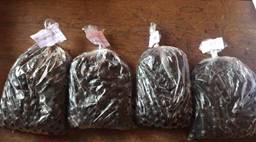
Two 500-g açaí samples were collected from each processing unit before and after blanching (Figure 1). The samples were taken to the Laboratory of Agricultural Engineering at UFRA/Tomé-Açu Campus, where they were used for the physical and chemical analyses.

Physical analyses
The size and shape analysis consisted of measuring the dimensions of the orthogonal axes, that is, the length (the longest axis) (a), the width (the intermediate axis) (b), and the thickness (the shortest axis) (c), using 40 açaí from each sample (with and without pulp before blanching and with and without pulp after blanching; Figure 2).

The average geometric diameter was calculated using Equation 1 (Mohsenin, 1986):
Dg = (abc)1/3(1)
Sphericity was calculated using Equation 2:
S = (abc)(1/3)/a (2)
Circularity was calculated using Equation 3, considering the natural resting position of açaí:
C = di/d * 100 (3)
where C is circularity (%), di is the diameter of the b axis (mm), and dc is the diameter of the a axis (mm).
Chemical analyses
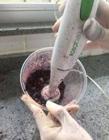
The chemical analyses were carried out using 100 g of each sample, which was processed by a hand mixer (Mallory Robot 250) with 40 mL of water (Figure 3).
pH
The pH of each sample was determined with a pH meter (MS Tecnopon mPA-210) previously calibrated with buffer solutions of pH 7.0 and 4.0 (Figure 4).

image of a solution being analyzed with a pH meter to determine pH. Source: the authors.
Soluble solids
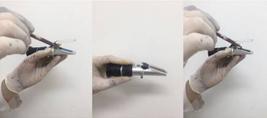
A refractometer (RBR RM-T90) was used to determine soluble solids, with the results expressed in ºBrix (Figure 5).
Water content
First, an empty container and the container plus açaí were weighed. Approximately 30 g of açaí was placed in each container (Figure 6). The samples were dried in an air fryer at 200°C. The mass was measured every 15 min. until it reached a constant mass, which occurred after 75 min. Equation 4 was used to calculate the water content:
%b. u = (μi-μf)/(μi-T) * 100 (4)
in which %b.u is the water content (%), µi is the initial mass (g), µf is the final mass (g), and T is the tare (g).

image of açaí being weighed and placed in the air fryer for drying. Source: the authors.
Statistical analyses
The data were subjected to descriptive analysis with an electronic spreadsheet and multivariate analysis with the R program. The data were standardized to the same scale and the hierarchical clustering method with the nearest neighbor (single) was used for analysis.
Results
Table 1 shows the results of the questionnaire completed for each small-scale açaí processing unit. The questions and observations made on the unit were based on good manufacturing practice (GMP) of açaí processing units (Bezerra 2009).
Table 2 shows what employees wear when producing açaí juice. Regarding uniforms, 100% of the employees of the processing units did not use adornments, 100% wore an apron, 50% wore boots, 50% wore gloves, 25% wore disposable masks, and 100% wore caps. There were serious flaws regarding the uniform. According to Bezerra (2009), the use of aprons, boots, gloves, and disposable masks is essential during açaí processing, and the lack of compliance and use of equipment facilitates the contamination of the product, posing a risk to consumer health.
Table 3 shows the type of water supply of each interviewed processing unit. All processing units were supplied by water from the public service.
Table 4 shows the analysis regarding the presence of animals in the processing units. Pets were not observed at any of the processing units. This finding is in accordance with the criteria by Bezerra (2009), who established that units manufacturing and selling açaí should not have any type of animals. The presence of animals greatly increases the risk of contamination and may even attract insects and parasites to the location.
Table 5 shows the data on the hygiene of the facilities and equipment, an important and relevant point for the research, as it is a food (açaí juice). According to the criteria proposed by Bezerra (2009), the facilities and equipment must be cleaned and sanitized daily, always with soap and bleach. All equipment and utensils in contact with açaí must be made of stainless steel or resistant plastic. Only processing unit 3 used a material that is not suggested (aluminum).
Table 6 shows the details regarding fruit washing, including the number of times each açaí is washed, the use or diluted chlorinated water for washing, and the type of material of the container used for washing, among other questions.
Table 7 shows the blanching data, analyzing the water temperatures before, during, and after the process. The initial hot water temperature in the processing units was 45.0-69.0°C, which is below the temperatures recommended by GMP (80-90°C). Furthermore, the açaí were processed in hot water for 6-40 min. in the processing units, much longer than the recommended time of 10s (Bezerra, 2009).
The water at room temperature varied from 20.5 to 24.0°C, with processing unit 1 presenting the highest temperature, possibly because the process was carried out close to 12:00 p.m. when the room temperature was higher. Processing unit 3 had the lowest water temperature, with the process being conducted at 6:00 a.m., when the temperature was milder.
Processing unit 1 had the smallest variation between the initial hot water temperature and the final hot water temperature. This may be related to the container material in which the treatment was carried out: This unit was the only one to use a stainless steel tank, which best maintains the water temperature.
Table 8 shows the average values of the physical properties: length (a), width (b), thickness (c), geometric diameter (Dg), sphericity (S), and circularity (C) of açaí with pulp before and after blanching.
Table 9 shows the mean values of length (a), width (b), thickness (c), geometric diameter (Dg), sphericity (S), and circularity (C) of açaí without pulp before and after blanching.
Table 10 shows the mean values of the chemical properties pH, ºBrix, and water content of the pulp of açaí before and after blanching.
Discussion
According to Bezerra (2009), small-scale açaí processing units must have a masonry structure, with a tile or flagstone floor with walls that are also tiled (or painted so that the wall does not absorb the washing water) to make cleaning the area easier. These requirements prevent açaí and its juice from being contaminated. All four of the small-scale açaí processing units we observed had masonry buildings; 100% had tiled floors, 75% had tiled walls, and 25% had painted walls; and all units were cleaned daily. Thus, all units followed GMP regarding structure and cleanliness.
Table 6 shows that 50% of the small-scale açaí processing units washed açaí with diluted chlorinated water. According to Bezerra (2009), açaí must be sanitized with a 200 ppm chlorinated water solution followed by immediate rinsing with drinking water so that their quality and flavor are not altered. Although this step was not prioritized by the small-scale açaí processing units, it plays an essential role in the extermination of microorganisms that are harmful to human health.
Açaí with pulp before and after blanching presented similar physical properties for all four processing units. In this case, açaí that arrive at the processing units have a similar pattern and their physical properties did not change after going through blanching. Açaí without pulp presented lower values for all physical properties compared with açaí with pulp. We expected this behavior, given that açaí without pulp are smaller than açaí with pulp.
After bleaching, açaí with pulp showed an increase in the mean values of °Brix and the water content (Table 10). Importantly, the samples from all small-scale açaí processing units had a higher water content after blanching, with processing unit 2 showing the lowest increase because the açaí were immersed in water for a shorter time (6 min.).
Based on multivariate analysis, processing units 1 and 2 are more similar, as they show higher water temperatures for washing açaí after blanching and present the least variation in sphericity after blanching (Figures 7 and 8). In contrast, processing units 3 and 4 are more similar because they have milder water temperatures to wash açaí after blanching and present more pronounced changes in sphericity after blanching.


component Dim.1, based on multivariate analysis. Dim 1 = 0.9809 TFWRT + 0.9809 TIWRT - 0.9883 VEcP.
The pH results of the açaí samples before and after blanching are in accordance with the limit established by the Identity and Quality Standards (PIQ) of Normative Instruction No. 1, of January 7, 2000 (Ministério da Agricultura, Pecuária e Abastecimento [MAPA], 2000). Specifically, the pH of the açaí pulp should range from 4.0 to 6.20. Although there is no official standard for soluble solids in açaí, our results are similar to those reported by Souza et al. (2006). They reported a value of 3.2 °Brix before heat treatment and 3.6 °Brix after treatment.
Conclusion
The physical properties of the açaí samples from the four processing units did not change after blanching. The lower the temperature of the washing water after immersing the açaí in hot water, the greater the variation in sphericity. The chemical analyses showed that the pH of açaí pulp decreased after blanching, and the water content and soluble solids increased.
Data availability
Not applicable.
Acknowledgements
We thank the Coordination for the Improvement of Higher Education Personnel (CAPES) for their support through the PDPG POST-DOC Project (No. 88887.692109/2022-00) for supporting the research.
References
-
Atkinson, M. D. & Atkinson, E.. (2002). Sambucus nigra L. Journal of Ecology, 90(5), 895-923. https://doi.org/10.1046/J.1365-2745.2002.00698.X
» https://doi.org/https://doi.org/10.1046/J.1365-2745.2002.00698.X - Bezerra, V. S. (2009). As boas práticas de fabricação na amassadeira de açaí (Comunicado Técnico, 124). Embrapa Amapá.
-
Goneli, A. L. D., Corrêa, P. C., Magalhães, F. E. A. & Baptestini, F. M.. (2011). Volumetric contraction and shape of castor beans during drying. Acta Scientarium. Agronomy, 33(1), 1-8. https://doi.org/10.4025/actasciagron.v33i1.4629
» https://doi.org/https://doi.org/10.4025/actasciagron.v33i1.4629 -
Melo, P. S., Selani, M. M., Gonçalves, R. H., Paulino, J. O., Massarioli, A. P. & Alencar, S. M.. (2021). Açaí seeds: An unexplored agro-industrial residue as a potential source of lipids, fibers, and antioxidant phenolic compounds. Industrial Crops and Products, 161, 113204. https://doi.org/10.1016/J.INDCROP.2020.113204
» https://doi.org/https://doi.org/10.1016/J.INDCROP.2020.113204 - Ministério da Agricultura, P (2000). Instrução normativa nº 01, de 7 de janeiro de 2000. Regulamento técnico geral para fixação dos padrões de identidade e qualidade para suco de fruta Diário Oficial da União, Brasília.
- Mohsenin, N. M. (1986). Physical properties of plant and animal material 2nd ed.. Gordon and Breach Science Publishers.
-
Mulabagal, V., Keller, W. J. & Calderón, A. I.. (2012). Quantitative analysis of anthocyanins in Euterpe oleracea (açaí) dietary supplement raw materials and capsules by Q-TOF liquid chromatography/mass spectrometry. Pharmaceutical Biology, 50(10), 1289-1296. https://doi.org/10.3109/13880209.2012.674141
» https://doi.org/https://doi.org/10.3109/13880209.2012.674141 -
Pessoa, J. D. C. & Silva, P. V. S.. (2007). Effect of temperature and storage on açai Euterpe oleraceai fruit water uptake simulation of fruit transportation and pre-processing. Fruits, 62(5), 295-302. https://doi.org/10.1051/fruits:2007025
» https://doi.org/https://doi.org/10.1051/fruits:2007025 -
Ribeiro, L. O., Bastos, A. O., Santos, C. R. C. & Fernandes, A. P. D.. (2021). Açaí production in the municipality of São Miguel do Guamá, Pará: perspective of açaí beaters. Revista agro@mbiente on-line, 15, 1-15. https://doi.org/10.18227/1982-8470ragro.v15i0.7115
» https://doi.org/https://doi.org/10.18227/1982-8470ragro.v15i0.7115 -
Rogez, H., Akwie, S. N. L. T., Moura, F. G. & Larondelle, Y.. (2012). Kinetic modeling of anthocyanin degradation and microorganism growth during postharvest storage of açai fruits (Euterpe oleracea). Journal of Food Science, 77(12), 1300-1306. https://doi.org/10.1111/J.1750-3841.2012.02996.x
» https://doi.org/https://doi.org/10.1111/J.1750-3841.2012.02996.x -
Souza, M. A. C., Yuyama, L. K. O., Aguiar, J. P. L. & Pantoja, L.. (2006). Suco de açaí (Euterpe oleracea Mart.): Avaliação microbiológica, tratamento térmico e vida de prateleira. ACTA Amazônica, 36(4), 483-496. https://doi.org/10.1590/S0044-59672006000400010
» https://doi.org/https://doi.org/10.1590/S0044-59672006000400010