 Homology, Collective and Cultural Memory: Augustus’ Portraiture and Augustan Poetry
Abstract:
This paper aims to establish a homology between two forms of art: the portraits of Octavian Augustus and Augustan poetry, particularly the works of Horace, Ovid, Propertius, and Virgil. The theoretical frameworks of Nora (1989), Assmann (1995 and 2011), Halbwachs (1968), and Galinsky (2014-2016) are mobilized to support the argument that both artistic expressions can be interpreted as vehicles of collective memory and cultural memory, serving the perpetuation of power and art
Keywords:
Augustus; Collective memory; Cultural memory; Portraiture; Augustan Poetry
I.
Quibus pro tantis [1] rebus, Quirites, nullum ego a vobis praemium uirtutis, nullum insigne honoris, nullum monumentum laudis postulabo praeterquam huius diei memoriam sempiternam. In animis ego uestris omnis triumphos meos, omnia ornamenta honoris, monumenta gloriae, laudis insignia condi et conlocari uolo. Nihil me mutum potest delectare, nihil tacitum, nihil denique eius modi quod etiam minus digni adsequi possint. Memoria uestra, Quirites, nostrae res alentur, sermonibus crescent, litterarum monumentis inueterascent et conroborabuntur [10]; eandemque diem intellego, quam spero aeternam fore, propagatam esse et ad salutem urbis et ad memoriam consulatus mei, unoque tempore in hac re publica duos ciuis exstitisse quorum alter finis uestri imperi non terrae sed caeli regionibus terminaret, alter huius imperi domicilium [15] sedisque seruaret.
And for these exploits, important as they are, O Romans, I ask from you no reward of virtue, no badge of honour, no monument of my glory, beyond the everlasting recollection of this day. In your minds I wish all my triumphs, all my decorations of honour; the monuments of my glory, the badges of my renown, to be stored and laid up. Nothing voiceless can delight me, nothing silent - nothing, in short, such as even those who are less worthy can obtain. In your memory, O Romans, my name shall be cherished, in your discourses it shall grow, in the monuments of your letters it shall grow old and strengthen; and I feel assured that the same day which I hope will be for everlasting; will be remembered for ever, so as to tend both to the safety of the city and the recollection of my consulship; and that it will be remembered that there existed in this city at the same time two citizens, one of whom limited the boundaries of your empire only by the regions of heaven, not by those of the earth, while the other preserved the abode and home of that same empire.1
In the Third oration against Catiline,2 Cicero summarizes some aspects concerning memory in a broader sense for Roman citizens. I say "broader" because the memory to which Cicero refers is not individual but collective; that is, he wishes it to be the memory of all Romans about his consulate. I think that ever more than some kind of general collective memory, this speech points to some aspects of the cultural identity of Roman citizens that will be highly valued in the early Principate. When Cicero tells us that he yearns neither for praemium uirtutis, nor insigne honoris, nor monumentum laudis, but “only” for the memoria sempiterna “in the Roman soul,” he is seeking, through his own deeds and speech, to participate in the “concretion” of a Roman “identity,”3 so that he becomes an integral part of Roman minds. Furthermore, with this discourse about his own deeds, Cicero is bulding a cultural memory, which is guaranteed by cultural formation - texts, rites, monuments - and institutional communication, which Assmann has called “figures of memory.”4 Moreover, contiones - oratoris maxima scaena - “had a central function as a medium of collective memoria.”5
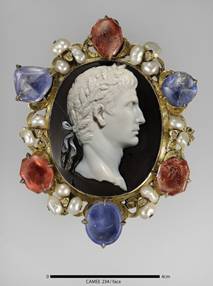
This paper deals with two forms of cultural memory in the Augustan age.6 The first is the portrait of Octavian Augustus, both in uita and post mortem; the second is an important element of Augustan poetry: the commonplace of the perenniality of art. The hypothesis I pursue is that the idealistic/simulacrum portrait7 disseminated from Augustus, as well as this commonplace, so often employed by Horace, Virgil, Propertius, and Ovid, comprises an ideological program for the perpetuation of a kind of power, based on Augustus’ auctoritas and potestas,8 and established by him since the end of the triumvirate, although it had already been intended by Julius Caesar with the perpetual dictatorship. This kind of power, or at least its symbolic - aesthetic or semiotic -9 representation, I believe, exceeds the Roman Empire and becomes a model for the representation of power. How is the Augustan era bequeathed to posterity a specific and lasting form of cultural memory, as we can see, for instance, in the Lothar cross (figure 1 and 2)10 and in the camée de Saint Hilaire or camée “Auguste” (figure 3 and figure 10).11


In these circumstances, these two expressions of art constitute a collective memory - mémoire collective - as proposed by Maurice Halbwachs (1950, 1968), or a form of cultural memory, as established by Jan Assmann (1995, 2011) and updated by Astrid Erll (2008), since both can be understood as artes longae. After all, the first is an image that surpasses the lifespan of the portrayed subject, and the second is a text that extends far beyond the envisaged purposes for which it had been uttered. Both become not only memories for those who experienced the visual art and the text, but moreover, they become loci memoriae of the new age. In this sense, we must evaluate, as Halbwachs did, a reconstruction of the past that heavily borrows data from the present, a reconstruction prepared by the reconstructions of earlier periods wherein past images had been altered.12
These contents of memory are organized and verified - based on external conditions - by cultural context. Assmann argues that cultural memory coincides almost entirely with whatever meaning circulates within the group,13 and this means that both the simulacra of Augustus and the poetry that elevates him and his time represent the opinions of the majority of Roman citizens about the new age, establishing an engagement between the center of power and the Roman people. Furthermore, these images and poetry correspond to the construction of a collective memory in the present, which in the future will be reconsidered as cultural memory, adapting to new contexts and producing new effects within the same society, or even in other society at different historical moments. For instance, by discussing lacus Curtius, Hölkeskamp presents exactly this idea: “the lacus marked a very special space in the midst of the politico-sacral topography of urbs Roma,” and it is literally laden with symbolic meaning and mythical historical allusions.14
I must point out another question regarding these figures of memory. On the one hand, the most important feature of Augustus’ posthumous image is its youthful appearance. However, when Augustus died in 14 A.D., he was 77 years old; therefore, this image is a simulacrum of Augustus, not an effigies sculpted from a wax mask, which already circulates across the empire - as he should be. It is very important to remember that the imagines of Augustus, regardless of how old he is portrayed, will always be simulacra. In fact, after the Augustan Age, only Vespasian would be depicted as a simple member of the aristocracy. In turn, the commonplace of perenniality draws from Pindar, in the sense that poetry produced in the past will be read in a new way in the future.15 I, therefore, can propose that these figures of cultural memory rediscover their past and present while constructing the future.
However, Assmann clarifies that there is a distinction between autobiographical memory and the posthumous commemoration of someone by posterity. The latter reveals a specifically cultural element of collective memory, while the former is limited to individual memory. However, as Halbwachs clearly proposes, individual memory is almost always indelibly linked to collective memory.16 Assmann concludes that in truth, this is an act of resuscitation driven by the group's desire not to let the dead fade away, but rather, with the help of memory, to keep them as members of their community and to carry them forward into their progressive present. 17
This would have to be highlighted if the imagines of Augustus had been replicated according to the rituals of the ancestors, in which the effigies of the dead are placed in the vestibule of the domus.18 The image from the wax mask is carried by a member of the gens in the pompa of the gentilicia funera,19 and the ashes are placed in the columbarium.20 The imperial cult of Augustus will be essential for his permanence in cultural memory. After all, the image of Octavian began to be worshipped in some regions of the Empire and, subsequently, in all districts of Rome, and would eventually become an image on the altar of the Lares, alongside the pater familias as pater patriae.21 Thus, the simulacrum is nothing more than this possibility, unlike the effigies, which seeks, through a plastic technique based on wax images, to reconstruct the "truth" that, as we know, is an idiosyncratic abstraction.
I will next develop the argument that Augustus’ public image, as well as some aspects of Augustan poetry - homologies - concerning the perenniality of art and of power, constitute collective constructs of cultural memory, which convey the same idea: the beginnings of a new age, of a new government, whose fundamental feature is rebirth and, consequently, eternal youth, as if the Romans were living in a new Golden Age. Revitalizing Augustus, the court of Otto III confirms the circulation of Augustus' cultural memory in the cross, alongside Jesus Christ. The repurposing of the image of the pater patriae in the reliquary of Saint Hilary accentuates the reach of his memory and its reinterpretation, after all “Peiresc notes that the cameo was moved and fixed to the neck of the reliquary of Saint Hilaire, made in 1606”.22
The concept of monumentum23 isthus essential to the construction of the image of Augustus, as well as to poetry, because both are monumenta24 - lieux de mémoire - and in accordance with Galinsky,25 quoting Prophirio, “monumentum non sepulcrum tantum dicitur, sed omne quicquid memoriam testatur.”26 In addition, Simpson argues that in the Augustan era, there are both metaphorical and referential uses of the term "monument." That is, Rome, under Augustus, undergoes great architectural changes, and simultaneously, poetry uses the same architectural word to reference the poetic construct whose sense is immortal monumentality.27
II.
When we think of Roman portraiture, Schweitzer’s classification (1948), reviewed by Breckenridge, immediately comes to mind in the discussion. From this taxonomy, two categories must be considered together: the veristic and the idealistic portraits.28 It is certain, however, that neither verism converges to the truth nor idealism converges to the ideal in both types of images. I understand that any image, for the Romans, is merely a representation intended to make present something that is absent, so the concepts of truth and ideal do not apply. Therefore, although I find the categories of verism and idealism useful, cannot to be regard verism as a monolithic concept, nor can we assert that idealism belongs to any specific historical period.29
However, Breckenridge highly proposes that these types are aspects of the same general practice, as they were honors reserved for members of the Roman aristocracy - monumenta. Thus, they are aspects of a commemorative cult in the strictest sense and suggest that public honors were viewed as sources of distinction in much the same way as the right to maintain one’s own clan’s death mask might have been.30 I, thus, think that while the images of ancestors point to private rites supported by the ius imaginum,31 the images exhibited in the forum can be considered public monumenta, whose aim is to promote the ciuitas.
Ovid, in the Pontica32, tells that when he received three portraits from Maximus Cotta during his exile at the Black Sea, these images revived his memory of Rome. By seeing images of Augustus, Tiberius, and Livia, the poet says he felt as if he were there, on the Palatine Hill, near the houses of Livia and Augustus.33 The effect produced by the images thus evokes the urban space associated with homesickness, but mainly the images correspond to lieux de mémoire, which not only move the poet but anyone in the same situation. If this is true, then individual insight may be part of the construction of a collective memory as cultural memory.34
Although for the author of the Rhetorica ad Herenium,35 Cicero,36 and Quintilian,37loci memoriae are powerful tools associated with a specific mnemonic procedure, this does not entail that the concept of lieux de mémoire lacks a significant ideological component in this Roman past, as Nora convincingly argues for modernity. Contra Boer, at least since Julius Caesar’s government,38 the idea of loci, lieux, serves to establish an ideology that will be passed on to posterity and linked to some cultural and historical moment. Although rhetorical treatises do not address memory - or the topoi of memory - beyond mnemonic technique, it is undeniable that there is a Roman awareness of the idea of monument,39 which clearly contradicts Boer’s argument denying the ideological character of such places. After all, when Cicero says monumenta huius ordinis,40 he is suggesting that the actions of the Senate must be remembered.41
I think that both loci memoriae and loci communes can be read as metaphors in Antiquity, although the former loci memoriae will be more explicitly referential. In fact, the basis of Pierre Nora’s hypothesis in Les Lieux de Mémoire is that only after the French Republic were “symbols, handbooks, disciplines, monuments, commemorations, and expositions” used as lieux de mémoire. Nora would have included commemorations in the topoi of memory (as Winter points out in reference to Bastille Day and to Independence Day), but limited this use to the eighteenth century onwards. However, there is no doubt that the Principate of Augustus utilized its loci memoriae for the same purpose. In fact, not only the early Empire but also the Republic used them, as we can see in some fasti such as the Compitalia, Lupercalia, Liberalia, and Ludi Apollinares, etc.
Regarding images of ancestors, Juvenal,42 despite his severe moral criticism of the Roman aristocracy, reveals that these images are part of the collective Roman consciousness and thus hold ethical and symbolic meanings for Romans of all ranks. They invigorate images of the past, bringing them into the present, which cumulatively increases the clan's power in the future. These images serve as a source of family pride, sustained by their preservation in a ritualized form. In this case, the images of the ancestors constitute the collective memory of the gens, representing the clan publicly. However, each image only makes sense to the family43 members, in contrast to the public images in the forum, which resonate with every Roman citizen. I think, for instance, of the summi viri from Augustus’ Forum.44 Thus, the public representation - simulacra - constitutes a memory for the Romans, while the effigies - the private portraits - serve as the collective memory of the aristocratic family.
Concerning the image of Augustus, scholars have explored various perspectives on this question. Zanker, for instance, shows that there was an evident alteration of Octavian's model at least since 27 BC, when Julius Caesar’s great-nephew became Augustus. Zanker45 proposes that instead of the bony face, small eyes, and nervous expression of Octavian’s portrait, the new type is marked by harmonious proportions. To a certain extent, his physiognomy becomes calm and elevated, and his head acquires a spontaneous turn. All of this adheres to the classical principles of symmetry, as seen in the Doryphoros of Polykleitos,46 whose main feature, according to Quintilian, is to be grauis and sanctus.47
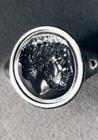
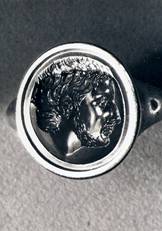
For Bandinelli, the central question regarding the Roman portrait is its categorization based on public or private uses, as well as the evaluation of plebeian or patrician origins. Although all types of portraits of Augustus have a typically public basis, an interesting phenomenon occurs: the private use of the public image, as seen in seal stone rings48 (figures 4 and 5). For her part, Walker attributes the alteration of the image of Octavian to the excessive use of the traditional Roman Republic portrait by Julius Caesar. Thus, even using the same type became problematic, leading to the conclusion that a more neutral image, fitting Octavian’s presentation of himself as princeps of the restored Republic was required (… and) the first emperor’s new image may be closely associated with the establishment of a new constitution.49

Kleiner, in turn, analyzing Augustan art, first outlines the main features of this art and tells us that Augustus preserves the past heritage while combining it with a new Augustan vision to artistically create a new Golden Age. This vision is echoed by Virgil and Horace: ille deum uitam accipiet diuisque uidebit/permixtos heroes et ipse uidebitur illis/pacatumque regit patriis uirtutibus orbem”50and “tua aetas, Caesar,/fruges et agris retullit uberes.51 Kleiner concludes: the resultant achievement was passed to posterity and exerted a lasting influence not only on later Roman art but on the art of more recent times.52 The scholar understands that the new emperor fully exploits the art of propaganda among the Romans, using art “in service of his political and social ideology.”53 However, as Kleiner highlights, Augustus, at 32 years old, emerges victorious from a civil war and brings peace and prosperity to the Romans; therefore, a new image is needed to express a new Golden Age. “The image was of a young man full of vitality and enthusiasm for the business of running the empire.”54 In this regard, Augustus will thereafter appear as a youngster in all his portraits, even at his death in 14 AD, at the age of 77. Definitely, regarding Augustus’ portrait, the concept of likeness does not imply adherence to the emperor’s actual complexion.
I would like to consider another problem about the age of Octavian Augustus, as it influenced his portraiture. The new age required a new representation of Augustus; the traditional language of Republican portrait imagery was not suitable for depicting a nineteen-year-old young man. Galinsky55 reminds us that Roman virtues, which are expressed through physiognomy, are typically qualities associated with advanced age. The minimum age for the consulship had been set at 42. Therefore, according to Stewart: the solution devised by Augustus (or by whoever created his earliest portraits) was not just to portray him as he was, but consciously to make a virtue of youth and evoke successful, admired Greek precedents for the artistic representation of a young man.56
Finally, I believe that Galinsky’s thoughts on this subject are quite accurate. He proposes that creating any taxonomic categories in Roman portraiture imposes a linear progression on a dynamic phenomenon. In point of fact, the portraits of Octavian and Augustus - despite displaying four different types: Type B, Actium, Prima Porta, and Forbes, along with two hundred examples57 - partake “in many different traditions without being a slave to them and, in one of the many paradoxes characteristic of Augustus and his culture, its most ‘de-individualized’ type became the one that was most recognizable and distinctive.58 That is to say, the portraits, in their broad variety, form the core of the same memory, both cultural and collective.
The most important feature of this range of late Republican and early Empire portraits - more than a mere reflection of likeness, as advocates of the veristic portrait argue - is the expression of a specific ethos.59 The solution found by Augustus and his sculptors was to compose a typical ethos of advanced age to emphasize the new era, highlight the novelty, and simultaneously confer grauitas, auctoritas, and sanctitas, which were essential to the Principate. The portrait of Pompey (figure 6) and of Alexander (figure 7) were used as appropriated models, whose calmness and moderation were desirable traits for the new leader of the Romans, as Virgil presents him in the first simile of the Aeneid:60
ac ueluti magno in populo cum saepe coorta est seditio saeuitque animis ignobile uulgus iamque faces et saxa uolant, furor arma ministrat; tum, pietate grauem ac meritis si forte uirum quem conspexere, silent arrectisque auribus astant; ille regit dictis animos et pectora mulcet: sic cunctus pelagi cecidit fragor, aequora postquam prospiciens genitor caeloque inuectus aperto flectit equos curruque uolans dat lora secundo.
And as, when ofttimes in a great nation tumult has risen , the base rabble rage angrily, and now brands and stones fly, madness lending arms; then, if perchance they set eyes on a man honoured for noble character and service, they are silent and stand by with attentive ears with speech he sways their passion and soothes their breasts: just so, all the roar ocean sank, soon as the Sire, looking forth upon the waters and driving under clear sky, guides his steeds and, flying onward, gives reins to his willing car.61

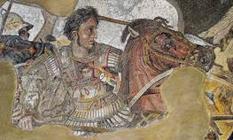
I have no doubt that the possibilities of Type B, the first representation of Octavian, modeled after Pompey and Alexander, resolved the issue of age and its consequence, which is the ethos of grauitas. This type, in some cases, presents an interesting element: a beard, “which is a typically multiple allusion” to his youth, his mourning for Julius Caesar, and to Alexander’s portrait (figures 6 and 7), especially the image from the House of the Faun (Pompeii). Another question is the migration of this type of image from public to private use or surroundings. Many rings and cameos were produced featuring these images.


I can synthesize the issue of Augustan portraiture in Zanker’s wording: “The new likeness was unlike anything found in late Republican portraiture. It expresses Augustus’s new image of himself, how he imagined himself as ‘Augustus,’ and how he identified himself with this new title.”62 The created image will be confirmed as cultural memory, even though it is individualized. The last type of Augustus’ image, the posthumous image (figures 1, 2 and 10), renews the constructed memory until his death in 14 AD. This can be read as a “trans-historical” amplification of Augustus’s power. Therefore, cultural memory consolidates as a hyperbole of his image in life (figure 10). Moreover, I believe that the posthumous Augustus, as well as its use by later cultures, becomes a relic; and inasmuch as they are considered relics, they become, according to Koselleck, something other than the relic itself.63

III.
Catullus, in the first poem of the collection, tells us:
qualecumque quidem, patroni ut ergo
plus uno maneat perenne saeclo. 64
By offering the new book to his friend, he also hopes that it will be remembered for more than one century. The poetae noui,65 of whom Catullus is the main figure, introduce themselves as a new poetic experience in Rome. Their poetry aims to represent Roman youth by opposing the rumoresque senum seueriorum66 the voices of the older generation. Therefore, this new poetry, voice, or era links the idea of novelty - though I rule out the idea of originality - to the concept of durability or perenniality of a new aesthetic purpose.
As regards the durability of art, we must consider its diffusion, i.e., how art disseminates itself in time and space. We know that more than 25,000 copies of portraits of Augustus were spread throughout the Empire during his government and afterwards; therefore, we can associate cultural memory with a concept that was important to the Romans: fame and glory. As, Propertius and Ovid phrase it:
Famam, Roma, tue non pudet historiae.
nam quantum ferro tantum pietate potentes
stamus: uictrices temperat ira manus”67 - 22
It is a land more fit for war than disposed to crime: Fame blushes not for your history, Rome. For we stand a strong nation as much through humanity as through the sword: our anger stays its hand victory.68
And,
It is but mortal, the work you ask of me; but my quest is glory through all the years, to be ever known in song throughout the earth.70
Virgil also suggests the Roman concern with fame in Book 4 of the Aeneid. Observing Dido's destiny, he describes mala fama, whose features are swiftness, strength, and reach. She walks on the ground with her head in the clouds. Fame is an awful and huge monster: she has several eyes, tongues, mouths, and pricked-up ears; fleet of wing, her body is covered with feathers:
stridens, nec dulci declinat lumina somno;
luce sedet custos aut summi culmine tecti
turribus aut altis, et magnas territat urbes,
tam ficti pravique tenax quam nuntia veri.71
By night, midway between heaven and earth she flies through the gloom, screeching, and droops not her eyes in sweet sleep; by day she sits on guard on high rooftop or lofty turrets, and affrights great cities, clinging to the false and wrong, yet heralding truth.72
Therefore, I think that mala fama can be the goal of memory, especially collective memory, as we can observe in Roman history the phenomenon of damnatio memoriae, which was the condemnation of memory through the material destruction of monuments; in other words, the destruction of an expression of cultural memory constructed in the past. Flower has proposed that this phenomenon has its roots in the triumviral period, and its first “real example of a leading Roman subjected to this treatment”73 was Marcus Antonius. This information is very important because it seems that during the same period, when Augustus was busy constructing a cultural memory, he simultaneously operated the destruction of another memory.74
However, I am not concerned with oblivion, but now only with what must be recollected. The Romans were concerned with both mala fama and bona fama, and these are reverberations of two levels of the demonstrative discourse: laudatio and uituperatio. However, as Flower tells us: “By definition, memoria recalled the successful and famous rather than obscure and unsuccessful.”75 As we know, the monumentum is a locus memoriae, but it can be also a locus communis, an important element of a discourse. So, both the material and the literary monumentality must be considered when we deal with cultural memory, because they frequently share the same characteristics. Ovid suggests that his books are a great and lasting monument, although they may also have damaged him, and concludes:
et diuturna magis sunt monimenta mihi,
quos ego confido, quamvis nocuere, daturos
nomen et auctori tempora longa suo.
tu tamen extincto feralia munera semper
deque tuis lacrimis umida serta dato.
quamvis in cinerem corpus mutaverit ignis,
sentiet officium maesta favilla pium.76
(…) my books are a greater and more enduring memorial. These I have sure trust, although they have injured him, will give a name and a long enduring life to their author. Yet do you ever give to dead the funeral offerings and garlands moist with your own tears. Although the fire change my body to ashes, the sorrowing dust shall feel the pious care.77
In fact, this idea was proposed by Horace years before. Therefore, my point is that the Augustan poets recovered and renewed this idea, linking it to the concept of fama (both bona and mala) and to the survival of the poet through poetry. They were aware of a cultural memory in the same way that Augustus was aware of his public image. Pearcy,78 for example, shows us that Horace, in constructing his independence from his opus, gains textual immortality. If we examine Epistle 1.20, we will note that it resembles a funerary inscription, a monumentum, in that Horace “gives it the specific form of an elogium appropriate to a member of the governing class,” perhaps a princeps, even though he is the son of a freedman: “me libertino natum patre et in tenui re.”79 In this epistle, he places himself among ancestors who possess the ius imaginum, something that he does not have. Furthermore, Nisbet and Rudd, commenting on the word aere in Carmen 3.30, propose that, despite its association with hardness and durability, it can also be linked to bronze statues due to their relationship with the pyramids. Ultimately, the text preserves his memory “in a form appropriate to the monuments of the grandees of Rome.” It is clear that the poet revisits the issue raised in Carmen 3.30.
These two possibilities, fame and survival, are observed by Horace in Carmen 3.30,80 the sphragís of the first three books of Odes published in 23 BC, as well as in Propertius 3.2.17-26,81 whose first book was published in 29 BC, and in the last verses of Ovid’s Metamorphoses (15.871-9), published in 8 AD, where these poets declare to have constructed the most lasting monument of all so that the perenniality of their poetry would surpass their own lives.82 We can point at some common features in all of these texts: a) the perenniality or durability of a text, an immaterial monument: “exegi monumentum”; “carmina erunt …monumenta”; or “opus exegi,” because nothing will be able to destroy it - neither natural disasters83 nor divine actions, such as the wrath of Jupiter, time, or fire; nor are the pyramids, the House of Jupiter, or the tomb of Mausolus free from death; b) the agreement between the opus and the artist: “non omnis moriar” or “parte meliore mei super alta perennis”; c) the revitalization of a monument as time goes on: “crescam laude recens”; “non ingenio quaesitum nomen ab aeuo excidet” or “ore legar populi, perque omnia saecula fama”; d) the frontiers of memory: “dicar qua”; “ingenio stat sine morte decus” or “nomenque indelebile nostrum”; and last but not least, e) the similarity between the poet and the princeps84: “princeps Aeolium carmen ad Italos” or “siquid habent ueri uatum praesagia, uiuam.” Another very important detail in 3.30 is the mention of the Capitol. According to Nisbet and Rudd, it is a reference to the imperium and its durability. In this sense, I can establish a link between the poem and the empire’s ideology, its political and cultural identity, which, although everlasting, at any time resurges anew, reaffirming the immortality of the res publica in its broader sense.
At last, we must keep in mind that both terms auctor and augustus have the same etymological origin: augeo. Curiously, we can establish a relationship between the Augustan poet and Augustus. The first represents, as auctor, according to the OLD sense 9, the auctoritas of “a writer who is regarded as a master of his subject.” The second occupies, according to the same dictionary, sense 14, the function of “the founder of a city; the builder of an empire”, established in his own images. The first contributes to the immortality of the empire by proposing the fame of his poetic ability, recognized by readers; the second contributes to the immortality of the empire by proposing the survival and renewal of his power through his ever-renewed images. Furthermore, many times these same poets create the survival of the princeps’s image in their poetry, establishing an intersection between the two languages. It is a fact, therefore, that the same procedure observed in poetry already occurs in images; both must be considered instruments of Augustan cultural memory.
Both the images of Augustus and the poetry of his era can be demonstrated to share the same values and meanings. Moreover, poets and Augustus are considered auctores (they have auctoritas, although these do not mean the same thing85). However, if both the poet and Augustus have auctoritas, I believe that, as Rowe points out, this auctoritas comes from the fact that both are principes - one of the senatus and the other of poesis. Perenniality and renewal are the heartwood of this political and aesthetic historical moment. Octavian, since his adoption by Julius Caesar, proposes a new idea of the Republic, a new idea of government, and a new Golden Age. Therefore, the age of Augustus establishes a new paradigm of cultural memory that will be followed by posterity, as can be proved by the cameo of Saint Hilaire and the Lothar Cross; both artifacts used the renewed image of Augustus with idiosyncratic purposes. Which? Well... this is another problem.
Bibliography
- ACHCAR, F. (1991). As fontes do topos horaciano exegi monumentum In: CARDOSO, Z. A. (org.). Mito, Religião e Sociedade Atas do II Congresso Nacional de Estudos Clássicos São Paulo, SBEC, p. 191-195.
- AMATO, R. S. S.; MARTINS, P. (2012). Imagens antigas retoricamente referenciadas. In: MUHANA, A.; LAUDANNA, M.; BAGOLIN, L. A. (orgs.). Retórica São Paulo, Editora da Universidade de São Paulo, p. 125-158.
- ANDERSON, M.; NISTA, L. (1988). Roman Portraits in Context Roma, De Luca.
-
ASSMANN, J. (1995). Collective Memory and Cultural Identity. New German Critique 65, p. 125-33. DOI: 102307/488538.
» https://doi.org/102307/488538 - ASSMANN, J. (2011). Cultural memory and early civilization: writing, remembrance, and political imagination Cambridge, Cambridge University Press.
- BANDINELLI, R. B. (1988). Roma. La Arte Romana nel Centro del Potere Milano, Biblioteca Universale Rizzoli (BUR) .
- BEAL, S. (2014). Redefing verism: A Study of Roman Portraiture Columbus, The Ohio State University Press.
-
BECK, D. (2014). The first simile of the ‘Aeneid.’ Vergilius 60, p. 67-83. http://www.jstor.org/stable/43185986
» http://www.jstor.org/stable/43185986 - BENNETT, C. E. (trad.) (1995). Horace. Odes and Epodes Cambridge, Mass., Harvard University Press.
- BOER, Pim den. (2008). Loci memoriae-Lieux de mémoire In: ERLL, A.; NÜNNING, A. (eds.). Cultural memory studies: an international and interdisciplinary handbook: Media and Cultural Memory/Medien und kulturelle Erinnerung Berlin Walter de Gruyter, p. 19-26.
- BRECKENRIDGE, J. D. (1974). Origins of Roman Republican Portraiture. ANRW I, n. 4, p. 826-854.
- BRECKENRIDGE, J.D. (1981). Roman Imperial Portraiture from Augustus to Gallienus. ANRW II, n. 12.2, p. 477-512.
- CLARK, A. C. (trad.) (1908). Cicero. M. Tulli Ciceronis Orationes Oxford, Clarendon Press.
- CORNISH, F. W. (trad.) (2005). Catullus. Poems Cambridge, Mass., Harvard University Press .
- ERLL, A. (2008). Cultural Memory Studies: An Introduction. In: ERLL, A.; NÜNNING, A. (eds.). Cultural memory studies: an international and interdisciplinary handbook: Media and Cultural Memory/Medien und kulturelle Erinnerung Berlin Walter de Gruyter, p. 1-15.
- ERLL, A.; NÜNNING, A. (eds.). (2008). Cultural memory studies: an international and interdisciplinary handbook: Media and Cultural Memory/Medien und kulturelle Erinnerung . Berlin Walter de Gruyter.
- FAIRCLOUGH, H. R. (trad.) (2005). Horace. Satires, Epistles and Ars Poetica Cambridge, Mass., Harvard University Press .
- FAIRCLOUGH, H. R. (trad.) (2006). Virgil. Eclogues, Georgics and Aeneid, books 1-6 Cambridge, Mass., Harvard University Press .
- FLOWER H. I. (2006). The Art of Forgetting. Disgrace and Oblivion in Roman Political Culture Chapel Hill, The University of North Carolina Press.
- FLOWER, H. I. (1996). The Ancestor Masks and Aristocratic Power in Roman Republic Oxford, Oxford University Press.
- GALINSKY, K. (1996). Augustan Culture: An Interpretive Introduction Princeton, Princeton University Press.
- GALINSKY, K., ed. (2014). Memoria Romana. Memory in Rome and Rome in Memory Ann Harbor, University of Michigan Press.
- GALINSKY, K., ed. (2015). Memory in Ancient Rome and Early Christianity Oxford, Oxford University Press .
- GALINSKY, K.; LAPATIN, K. (eds.). (2016). Cultural Memories in the Roman Empire Los Angeles, J. Paul Getty Museum.
- GIBSON, B. J. (1997). Horace, Carm. 3.30.1-5. CQ 47, n. 1, p. 312-4.
- GOOLD, G. P. (ed. e trad.) (1990). Propertius. Elegies Cambridge, Mass., Harvard University Press .
- HALBWACHS, M. (1968). Mémoire Collective Paris, Presses universitaires de France (PUF).
- HALBWACHS, M. (1990). A Memória Coletiva São Paulo, Vértice.
- HALBWACHS, M. (1992). On Collective Memory Chicago, The University of Chicago Press.
-
HASEGAWA, A. P. (2010). Dispositio e distinção de gêneros nos Epodos de Horácio: estudo acompanhado de tradução em verso PhD Thesis. Faculdade de Filosofia, Letras e Ciências Humanas, Universidade de São Paulo, São Paulo. DOI:10.11606/T.8.2010.tde-20062011-110201.
» https://doi.org/10.11606/T.8.2010.tde-20062011-110201 -
HOCES SÁNCHEZ, M. (2016). Iamque opus exegi: la oda III 30 de Horacio en palabras de Ovidio. Emerita 84, n. 1, p. 99-119. DOI: http://dx.doi.org/10.3989/emerita.2016.05.1429
» http://dx.doi.org/10.3989/emerita.2016.05.1429 - HÖLKESKAMP, K-J. (2014). In Defence of Concepts, Categories, and Other Abstractions. In: GALINSKY, K. (ed.). Memoria Romana. Memory in Rome and Rome in Memory . Ann Harbor, University of Michigan Press , p. 63-70.
- HULTON, A. O. (1972). Exegi Monumentum: Horace and His Poetry. Latomus 31, n. 2: p. 497-502.
- JENKYNS, R. (2014). The Memory of Rome in Rome. In: GALINSKY, K. (ed.). Memoria Romana. Memory in Rome and Rome in Memory . Ann Harbor, University of Michigan Press , p. 15-26.
- KLEINER, D. (1992). Roman Sculpture New Haven, Yale University Press.
- MADER, G. (1993). Architecture, Aemulatio and Elegiac Self-Definition in Propertius 3.2. CJ 88, n. 4, p. 321-40.
- MARTINS, P. (2011). Imagem e Poder. Considerações sobre as representações de Otávio Augusto São Paulo, Editora da Universidade de São Paulo .
- MARTINS, P. (2014). Os romanos, o direito, a imagem e a morte. In: FAVERSANI, F.; JOLY, F. D. (orgs.). As formas do Império Romano Ouro Preto, Editora da UFOP, p. 81-94.
-
MARTINS, P. (2017). Augusto como Mercúrio enfim. Revista de História 176, p. 1-43. DOI:10.11606/issn.2316-9141.rh.2017.116333.
» https://doi.org/10.11606/issn.2316-9141.rh.2017.116333 - MARTINS, P. (2021). A Representação e seus Limites. Pictura Loquens, Poesis Tacens São Paulo, Editora da Universidade de São Paulo .
-
MILLER, J. F. (1983). Propertius 3.2 and Horace. TAPhA 113, p. 289-99. DOI: 10.2307/284016.
» https://doi.org/10.2307/284016 - MURRAY, A. T. (trad.) (1934). Homer. The Iliad Vol. 1. Cambridge, Mass., Harvard University Press .
- MURRAY, A. T. (trad.) (1942). Homer. The Iliad . Vol. 2. Cambridge, Mass., Harvard University Press .
- NISBET, R. G. M.; RUDD, N. (2004). A Commentary on Horace: Odes Book III Oxford, Oxford University Press .
-
NORA, P. (1989). Between Memory and History: Les Lieux de Mémoire. Representations 26, p. 7-24. https://doi.org/10.2307/2928520
» https://doi.org/10.2307/2928520 - RACE, W. H. (ed. e trad.) (1997). Pindar. Nemean Odes, Isthmian Odes and Fragments Cambridge, Mass., Harvard University Press .
- REICHENBERGER, A. G. (1943). Monumentum et exempla. Classical Weekly 37, n. 18, p. 28-9.
-
ROWE, G. (2013) Reconsidering the Auctoritas of Augustus. JRS, 103, p. 1-15. DOI: https://doi.org/10.1017/S007543581300004X
» https://doi.org/10.1017/S007543581300004X - SCHWEITZER, B. (1948). Die Bildniskunst der römischen Republik Leipzig, Leipzig, Koehler & Amelang.
-
SCOTT, K. (1930). Emperor Worship in Ovid. TAPhA 61, p. 43-69. DOI: 10.2307/282793.
» https://doi.org/10.2307/282793 - SHOWERMAN, G. (trad.) (2002). Ovid. Herroides and Amores Cambridge, Mass., Harvard University Press .
-
SIMPSON, C. J. (2002). Exegi monumentum: Building Imagery and Metaphor in Horace 1-3. Latomus 61, n. 1, p. 57-66. http://www.jstor.org/stable/41542388
» http://www.jstor.org/stable/41542388 - STEWART, P. (2010). Roman Art Cambridge, Classical Association & Cambridge University Press.
- SUTTON, E. W. (trad.) (1996). Cicero. On orator Books I-II Cambridge, Mass., Harvard University Press .
-
TORRES-MURCIANO, R. A. (2016). La sphragís de las Metamorfosis de Ovidio (XV 871-879). Metempsicosis, apoteosis y perdurabilidad literaria. Emerita, 84, n. 2, p. 269-89. DOI: http://dx.doi.org/10.3989/emerita.2016.13.1503
» http://dx.doi.org/10.3989/emerita.2016.13.1503 - WALKER, S. (1991). Roman Art Cambridge, Mass: Harvard University Press.
- WHEELER, A. L. (trad.) (2002). Ovid. Tristia and Ex Ponto Cambridge, Mass., Harvard University Press .
- WINTER, J. (2008). Sites of Memory and the Shadow of War. In: ERLL, A.; NÜNNING, A. (eds.). Cultural memory studies: an international and interdisciplinary handbook: Media and Cultural Memory/Medien und kulturelle Erinnerung . Berlin Walter de Gruyter, p. 61-76.
- WOODMAN, A. J. (1974a). Exegi monumentum: Horace, Odes 3.30. In: WOODMAN, A. J.; WEST, D. A. (eds.). Quality and Pleasure in Latin Poetry Cambridge, Cambridge University Press , p. 115-128.
- WOODMAN, A. J.; WEST, D. (eds.). 1974b. Quality and Pleasure in Latin Poetry . Cambridge, Cambridge University Press .
- WOOLF, G. 2016. Mars and memory. In: GALINSKY, K.; LAPATIN, K. (eds.). Cultural Memories in the Roman Empire . Los Angeles, J. Paul Getty Museum , p. 206-24.
- YONGE, C. D. (trad.) (1856). Cicero. The Orations of Marcus Tullius Cicero London, Henry G. Bohn.
- ZANKER, P. 1990. The Power of Images in the Age of Augustus Translated by Alan Shapiro. Ann Harbor, University of Michigan Press .
-
1
Translated by C. D. Yonge.
-
2
Cic. Cat., 3.26.
-
3
Assmann (1995, p. 130).
-
4
Assmann (1995, p. 129).
-
5
Hölkeskamp (2014, p. 66-7). See Cic., De Or., 2.338.2: “Fit autem ut, quia maxima quasi oratoris sacena uideatur contionis esse - But as the orator’s chief stage seems to be the platform at a public meeting”. Translated by E. W. Sutton.
-
6
We have today an extensive scholarly discussion on memory, ranging from the incompatibility between history and memory, as observed by Nora (1984) and Assmann (1999), to those who think of memory and history as complementary, such as Le Goff (1992) and Burke (1989), who define history as social memory. Recently, Erll (2011) has updated the research by proposing what has been observed about it. In his latest volume on memory, Galinsky (2015) provides an exceptional summary of the recent scholarly discussion on this subject in the introduction.
-
7
Martins; Amato (2012, p. 144-53).
-
8
Recently Rowe (2013, p. 1-15) proposes new interpretation on Res Gestae 34.3, mainly the passage: “Post id tempus auctoritates omnibus praestiti, postestatis autem nihilo amplius habui quam ceteri” - After that time I took precedence of all rank, but of power I possessed no more than those who were my colleagues in any magistracy. Translated by Frederik W. Shipley. Contra Galinsky (1996).
-
9
Winter (2008, p. 67).
-
10
The cross boasts an impressive 102 gems and 35 pearls, with decoration in goldwork, and enamel. One of the most striking gems is a reused Roman cameo of Emperor Augustus dated to the first century AD. Lothar’s rock crystal is accompanied by an inscription: “+XPE ADIVVA HLOTARIVM REG” (“O Christ, help King Lothar”). The ‘back’ of the cross is much simpler, and depicts the Crucifixion. Size: 50 cm height, 38.5 cm width, 2.3 cm depth Held at: Aachen Cathedral Treasury. Access in 17/01/2025 at https://arts.st-andrews.ac.uk/after-empire/2018/03/29/lothar-cross/
-
11
Description: Auguste est vu de profil à droite. Il porte une couronne faite de deux minces branches entrelacées, l’une de chêne, l’autre d’olivier, chacune ornée de feuilles et de fruits, et nouées ensemble sur la nuque par des bandelettes retombantes. Au globe de l’oeil convexe, le bord de l’iris est légèrement incisé; la pupille percée, assez grande, fut peut-être sertie d’une pierre. La monture qui l’entoure est composée de trois saphirs et de trois cristaux sur paillons rouges, alternant avec des troches de trois perles. L'inventaire de 1534 de l'abbaye de Saint-Denis mentionne le camée sur le tombeau des Corps saints, où le voit l'érudit aixois Nicolas Fabri de Peiresc entre août 1605 et mai 1606. Lors d'une deuxième visite à l'abbaye, Peiresc signale que le camée a été déplacé et fixé au col du chef-reliquaire de saint Hilaire, réalisé en 1606. Il y restera jusqu'à la Révolution. Dom Doublet, en 1625, puis le livret de visite de l'abbaye de 1726, décrivent très précisément le camée (y compris la cassure du fond derrière la tête) et sa monture de saphirs, rubis doublets et troches de perles. Seize perles étaient présentes en 1726, l'une a disparu depuis. Lors de la Révolution française, le camée est détaché du reliquaire (destiné à la fonte) et transporté au Cabinet des médailles. Access in 17/01/2025 at: https://medaillesetantiques.bnf.fr/ws/catalogue/app/collection/record/ark:/12148/c33gbcvn3.
-
12
Halbwachs (1980, p. 69).
-
13
Assmann (2011, p. 5-8).
-
14
Hölkeskamp (2014, p. 64).
-
15
Pi., N. 6.28-30: ἔλπομαι /μέγα εἰπὼν σκοποῦ ἄντα τυχεῖν / ὥτ' ἀπὸ τόξου ἱείς· εὔ- /θυν' ἐπὶ τοῦτον, ἄγε, Μοῖσα, / οὖρον ἐπέων / εὐκλέα· παροιχομένων γὰρ ἀνέρων, / ἀοιδαὶ καὶ λόγοι τὰ καλά σφιν ἔργ' ἐκόμισαν - I hope,/ in making this great claim, to hit the mark head on,/ shooting, like an archer, from my bow./ Come, Muse, direct to that house/ a glorious wind/ of verses, because when men are dead and gone,/ songs and words preserve from them their noble deeds. Translated by Willianm H. Race. See Pi, P. 6.7-14. CIL I2. 1319: Haec est domus aeterna … hoc est monumentum nostrum. Them., Or. 4.59d: ἦρία τῶν ψθχῶν τàς βίβλους - books are tombs of spirits. See Pl. Sym. 207d-209d. Maybe this idea yet can be observed in Hom., Il. 6.357-8: οἷσιν ἐπὶ Ζεὺς θῆκε κακὸν μόρον, ὡς καὶ ὀπίσσω/ ἀνθρώποισι πελώμεθ' ἀοίδιμοι ἐσσομένοισι. - On whom Zeus hath brought an evil doom, that even in days to come we may be a song for men that are yet to be. Translated by A. T. Murray. We must be cautious with the concept of topos, as there are significant differences between this concept among the Greeks and Romans. Achcar (1991) presents an outstanding comparison of these differences. See Hoces Sánchez (2016, 103).
-
16
Halbwachs (1968, p. 15-7).
-
17
Assmann (2011, p. 19-20).
-
18
See Val. Max. 5.8.3; Sall., Iug. 4.5-6.
-
19
See Plb. 6.53-4.
- 20
-
21
See Martins (2017, p. 12-9).
-
22
See no 11.
-
23
See Lucr. 5.328 ff. (aeternis monumentis).
-
24
See Le Goff’s (1996) 535-6 reflections on the monumentum and documentum to Encyclopedia Einaudi (1977-1981).
-
25
Galinsky (2014, p. 2-3).
-
26
“A monument is called not only a tomb, but anything that bears witness to memory”. See Hor., C. 1.2.13-16: uidimus flavum Tiberim/ (…) ire deictum monumenta regis/ templa Vestae. “We saw the yellow Tiber/ (...) advance to overthrow the King’s Memorial and Vesta’s shrines”. Translated by C. E. Bennett.
-
27
Simpson (2002, p. 61-2): "That rebuilding, then, to whatever extent it was supervised by Augustus himself, was evident on every side in the 30s and 20s B.C. and certainly would have presented any perceptive poet with many artful juxtapositions. Indeed, the sights and sounds of construction, which filled the City, can be imagined as having had 'cadences' similar, in a sense, to those of literary compositions. (...) I suspect, therefore (but cannot prove) that this varied building activity affected the actual 'pace' and sentence structure of Horace's poetry." Gibson (1997, p.312): “Whereas the monumentum, the unexceptional pyramids, are not an obvious but undoubtedly a convenient symbol for after the battle of Actium.” Zanker (1990, p. 101): “A completely new pictorial vocabulary was created. (…) This meant a change not only in political imagery in the narrow sense but in the whole outward appearance of the city of Rome.” Nisbet; Rudd (2004, p. 368): “Monumentum is commonly used to refer to works of literature that preserve an auctor’s memory. (…) Horace has given new life to the word by describing his poetry as a sepulchral monument (as is shown by the comparison with the pyramids in v.2 and reference to the dead in v.6).” See Cic., Off. 1.156.
-
28
See Beal (2014).
-
29
Galinsky (1996, p. 165) demonstrates that the idea of realism is much more nuanced and that the concept of antinomy between Hellenic and Hellenistic aesthetics must be approached with caution.
-
30
Breckenridge (1974, p. 839-40).
- 31
-
32
Ov. Pont. 2.8.8-21.
-
33
Scott (1930): “Ovid says that it means much to him to pray to the images, yet he considers truly happy those who have not only images (simulacra) but the gods themselves, and see face the persons of the gods. He, to whom the fates have been unkind, ‘worships the and form which art has fashioned.’”
-
34
Jenkyns (2014, p. 15-6); Cic., Fin. 5.2.
-
35
Her. 3.28-9.
-
36
Cic., De Or. 2.353-4.
-
37
Quint., Inst. 11. 17-20.
-
38
Boer (2008, p. 20-1): “Nora has given the concept of lieux de mémoire not only a new meaning but also a highly successful programmatic significance.” (…) “For the ancients, the loci memoriae were a necessary mnemotechnics in a society without media. For Cicero and Quintilian the loci memoriae were practical mental tools, free of ideology.”
-
39
Le Goff (1996, p. 535-6).
-
40
Cic., Phil. 14.41.
-
41
Le Goff (1996, p. 535-6).
-
42
Juv. 8.1-32.
-
43
Assmann (1995, p. 127): “Every individual memory constitutes itself in communication with others. These ‘others’, however, are not just any set of people, rather they are groups who conceive their unity and peculiarity through a common image of their past. Halbwachs thinks of families, neighborhood and professional groups, political parties, associations, etc. up to and including nations. Every individual belongs to numerous such groups and therefore entertains numerous collective self-images and memories.”
-
44
Zanker (1990) 194 by telling us about the Forum Augustus innovations presents that the key innovation was the subject matter of statuary. He continues proposing that the visitor moves from the Greek myth to Roman history, from the old masters to newly commissioned images that solidified a political rather than a cultural order of things. I do not believe that no there is a cultural component in use of these images. See Woolf (2016, p. 206-11); Martins (2021, p. 268-75).
-
45
Zanker (1990, p. 42).
-
46
See Martins (2017, p. 10).
-
47
Quint., Inst. 5.12.1; Zanker (1990, p. 98-9).
-
48
Bandinelli (1988, p. 71-105).
-
49
Walker (1991, p. 26).
-
50
Verg., E. 4.15-7: He shall have the gift of divine life, shall see heroes mingled with gods, and shall himself be seen by them, and shall rule the world to which his father’s prowess brought peace. Translated by H. R. Fairclough.
-
51
Hor., C. 4.15.4-5: Thy age, O Caesar, has restored to farms their plenteous crops. Translated by C. E. Bennett.
-
52
Kleiner (1992, p. 60).
-
53
Kleiner (1992, p. 61).
-
54
Kleiner (1992, p. 61-2).
-
55
Galinsky (1996, p. 166).
-
56
Stewart (2010, p. 10-2).
-
57
apud Galinsky (1996, n.76, chap. iv), Pfanner (1989) proposes that conservatively 25.000 to 50.000 portrait heads of Augustus were made during the rule; 250 that have survived constitute 0,5 to 1 percent.
-
58
Galinsky (1996, p. 165).
-
59
Reichnberger (1943, p. 28-9) defends that there is an Augustan ethos.
- 60
-
61
Translated by H. R. Fairclough.
-
62
Zanker (1990, p. 98).
-
63
Hölkeskamp (2014, p. 65).
-
64
Catull. 1.8-10. Translated by F. W. Cornish.
-
65
Cinna, fr. 14: Seacula permaneat nostril Dictynna Catonis: "The ages may remain ours, the Dictynna (goodness) of Cato.". Cf. Catull. 95. 5-8: Zmyrna cauas Satrachi penitus mittetur ad undas/ Zmyrnam cana diu saecula peruoluent. / at Volusi annales Paduam morientur ad ipsam / et laxas scombris saepe dabunt tunicas: “the Smyrna, I say, will travel as far away as the deep-channelled streams of Satrachus, the centuries will grow grey in long perusal of the Smyrna”. Translated by F. W. Cornish. And before them, Ennius in his single epigram that remains us: Nemo me lacrimis decoret nec funera fletu/ faxit. Cur? uolito uiuus per ora uirum: Let none embellish me with tears, Or make a funeral with wailing; And why? Alive from lips to lips of men I go a-winging. Translated by E. H. Warmington.
-
66
Catull, 5.2: “all the talk of crabbed old men”. Translated by: F. W. Cornish.
-
67
Prop., 3.22.19-22.
-
68
Translated by G. P. Goold.
-
69
Ov., Am. 1.15.7-8.
-
70
Translated by G. Showerman.
-
71
Verg., A. 4. 184-8.
-
72
Translated by H. R. Fairclough.
- 73
-
74
A. Assmann apud Galinsky (2014, p. 4): “In order...to remember anything, one has to forget: but what is forgotten need not necessarily be lost forever.”
-
75
Flower (2006, p. 55).
-
76
Ov., Trist., 3.3.77-84.
-
77
Translated by A. L. Wheeler.
-
78
Pearcy (1994, p. 462-3).
-
79
Hor., Epist. 1.20.20: I was a freedman’s son, and amid slender. Translated by H. R. Fairclough.
-
80
See Hulton (1972, p. 497).
-
81
Miller (1983, p. 289-99), Mader (1993, p. 330-5), and Torres-Murciano (2016) provide outstanding analyses of this sphragis, highlighting the connection between the durability of literature and the concepts of metempsychosis and apotheosis. They argue that the immortality of poets arises from the favor of readers, rather than from a natural law (metempsychosis) or a gift from the gods (apotheosis).
-
82
Hasegawa (2010, p. 12-22) proposes excellent relationship between the horatian sphragis of third book and the Ovid’s Metamorphoses. See Verg., G. 3.1-48.
-
83
See Pi., P. 6.7-14.
-
84
Nisbet; Rudd (2004) 375: “princeps suggests leadership as well as priority.” See Hor., Epist. 1.19.21.
-
85
We must keep in mind that both auctor and Augustus have the same etymological origin: augeo. Curiously, we can establish a relationship between the Augustan poet and Augustus. The first represents, as auctor, according to the OLD v. 9, the auctoritas of “a writer who is regarded as a master of his subject.” The second occupies, according to the same dictionary, v. 14, the function of “the founder of a city; the builder of an empire,” established in his own image. The first contributes to the immortality of the empire by aiming for the permanence of his poetic ability, recognized by readers; the second contributes to the immortality of the empire by aiming for the permanence of his power through his renewed images. Furthermore, many times these poets produce in their poetry the enduring image of the princeps.
-
MARTINS, P. (2025). Homology, Collective and Cultural Memory: Augustus’ Portraiture and Augustan Poetry. Archai 35, e03505.
Edited by
-
Editor:
Gabrielle Cornelli


 Public domain via Wikimedia Commons
 Médailles et Antiques de la Bibliothèque Nationale de France, Paris
 Inv.: 1867,0507.702. The British Museum, London
 Inv.: 1799,0521.35. The British Museum, London

 National Archaeological Museum, Naples -
  Musée Départemental Arles, inv. CRY.51.00.22
 Gallery of Uffizi - Firenze, inv. No. 83
 MFA, Boston - inv. 329