 L-Carnitine enhances porcine sperm quality, longevity, and zona pellucida binding in cooled semen
Abstract
Porcine breeding industries typically ensure the viability of boar artificial insemination doses during a 5-day liquid storage period at 17 °C. This study aimed to investigate whether the addition of L-carnitine (LC) to boar semen doses on different days of cooled storage could extend their usability. In experiment 1, LC was added to porcine semen doses on the fifth day (d5) of cooled storage performing five treatments control (no LC), 0.5, 1-, 5- and 10-mM LC. On d6 and d8 of storage, semen samples were evaluated for sperm motility and kinematic parameters, membrane functionality, and hydrogen peroxide and nitrite concentrations. In experiment 2, the number of sperm bound to the zona pellucida (ZP) was determined, as a way to investigate sperm penetration capability from boar insemination doses, with co-incubation with porcine oocytes. LC concentration that produced the most favorable outcomes in Experiment 1 was chosen to experiments 2 and 3, performing two treatments in the absence and with the LC. In Experiment 3, LC was added to cooled porcine semen doses after one day of storage (d1), and the same evaluations of experiment 1 were conducted on days 5, 7, 9, and 12, including sperm membrane integrity. The addition of 10 mM LC on d5 and d1 of storage improved sperm motility, which was extended up to 8 and 12 days of cooled storage, respectively. LC addition on d5 of storage increased sperm membrane functionality, while when added to semen on d1 of storage, it decreased NO2- concentration on d9. On d6 of cooled storage 10 mM LC increased the number of sperm bound to ZP compared to the control. In conclusion, adding 10 mM LC to porcine semen doses at 17 °C improved sperm characteristics and ZP binding, ultimately enhancing sperm viability for up to 12d.
Keywords:
spermatozoa; swine; boar; antioxidant; artificial insemination
Introduction
In porcine breeding, artificial insemination (AI) doses are typically cooled to 17 °C to decrease sperm metabolism and extend their longevity (Lopez Rodriguez et al., 2017; Szymanowicz et al., 2019; Waberski et al., 2019; Hensel et al., 2020; Flowers, 2022; Henning et al., 2022; Betancur et al., 2023; Restrepo et al., 2023). However, factors such as the cooling process, storage duration, and semen handling techniques contribute to increase the in vitro reactive oxygen species (ROS) production in semen (Bansal and Bilaspuri, 2010; Bandeira et al., 2016). ROS are molecules with the ability to exist independently, characterized by containing at least one oxygen atom and one or more unpaired electrons. This category encompasses oxygen free radicals, such as the superoxide anion radical, hydroxyl radical, hydroperoxyl radical, singlet oxygen, as well as free nitrogen radicals. Within physiological conditions, cells produce small amounts of ROS during various cellular processes, including aerobic respiration and inflammatory responses. Primarily serving as signaling molecules, ROS also play roles in inducing cell differentiation and apoptosis, thereby contributing to the natural aging process (Li et al., 2016). When it exceeds the sperm's antioxidant capacity, sperm viability is compromised (Bansal and Bilaspuri, 2010). ROS primarily target the sperm membrane (Ahmadi et al., 2016), which is particularly sensitive to oxidation in porcine sperm due to their high content of polyunsaturated fatty acids and limited antioxidant defenses (Lima and Abdalla, 2001; Nordberg and Arnér, 2001; Nogueira et al., 2014). The detrimental effects of ROS and nitrogen reactive species (RNS) on sperm include membrane disorganization, increased permeability, DNA damage, apoptosis induction, interference with mitochondrial energy generation, reduced motility, and impaired fertilization (Bansal and Bilaspuri, 2010; Bandeira et al., 2016). To mitigate these damages, antioxidants have been added to semen (Severo et al., 2011).
The addition of antioxidants to cooled semen could be a valuable practice for the suine industry, ensuring a high-quality cooled semen after five day of storage. This could be especially crucial for boars with sperm that do not tolerate longer storage periods. L-carnitine (LC) is an antioxidant amino acid, a highly polar, water-soluble quaternary amine found in tissues with high metabolic activity and reproductive systems, epididymal plasma, and sperm (Surai, 2015; Abd-Elrazek and Ahmed-Farid, 2018).
The antioxidant properties of LC are attributed to its ability to reduce substrate availability for lipid peroxidation (Stradaioli et al., 2004) by transporting fatty acids into the sperm mitochondrion for beta-oxidation, thereby generating ATP (Sariozkan et al., 2014). L-carnitine increases sperm motility by changing in fatty acid metabolism (Elokil et al., 2019). Additionally, LC stimulates the enzymatic antioxidant system (Tabatabaei and Aghaei, 2012; Gibb and Aitken, 2016), enhancing the activity of superoxide dismutase and glutathione peroxidase (Lisboa et al., 2014), and exhibits free-radical scavenging, anti-cytokine, and anti-apoptotic activities (Agarwal and Saleh, 2002; Gülçin, 2006). LC also regulates the flow of acetyl groups and energy balance through the cell membrane by facilitating the transport of free fatty acids and acetyl-CoA byproducts into the mitochondrion. The acetyl groups are temporarily associated with LC, producing L-acetyl-carnitine. Consequently, carnitine facilitates the transport of acetyl groups via L-acetyl-carnitine (Bremer, 1983; Gülçin, 2006). After absorption into the blood plasma, LC passively diffuses into the epididymis (Abd-Elrazek and Ahmed-Farid, 2018) and facilitates the transport of substrates across the mitochondrial cell membrane for energy production (Jeulin and Lewin, 1996).
The addition of LC to cooled semen has been reported in studies involving equines (Lisboa et al., 2014; Gibb et al., 2015; Gibb and Aitken, 2016), roosters (Partyka et al., 2017), and in the context of fresh porcine semen, albeit in high concentrations (Yang et al., 2020).
Further, incorporating analyses of gamete interactions, alongside sperm quality assessments, could offer an improved method for predicting male fertility (Gadea, 2005). The attachment and penetration of the zona pellucida (ZP) represent crucial obstacles that sperm must overcome in the fertilization process (Harrison, 1997; Larsson and Rodriguez-Martinez, 2000). A positive correlation between zona-binding ability and fertility has been established when estimated by average litter size (Braundmeier et al., 2004). Therefore, it is worth verifying whether the addition of low LC concentrations to cooled porcine semen has a beneficial effect on sperm characteristics, antioxidant activity, and zona pellucida binding capability. This procedure could be a valuable practice for the swine industry, particularly for boars whose sperm do not tolerate extended storage periods, ensuring high-quality cooled semen for a longer duration.
This study aimed to investigate whether the addition of LC to porcine cooled semen stored at 17 °C on different days prolongs sperm motility and kinematics, membrane integrity and functionality, concentrations of nitrite and hydrogen peroxide, and enhances binding to the ZP.
Methods
All experimental procedures were performed according to the Brazilian ethical and animal welfare principles for the utilization and care of animals used in research and were approved by the ethical Committee “Comissão de ética no uso de animais” (Protocol number 40/2018) at the Faculty of Veterinary Medicine, Pontifical Catholic University (PUC-Minas) of Minas Gerais, Betim, Brazil.
All reagents were purchased from Sigma- Aldrich, Inc, St. Louis, MO unless otherwise stated.
Experiment 1: Addition of LC to semen on day 5 of cooled storage
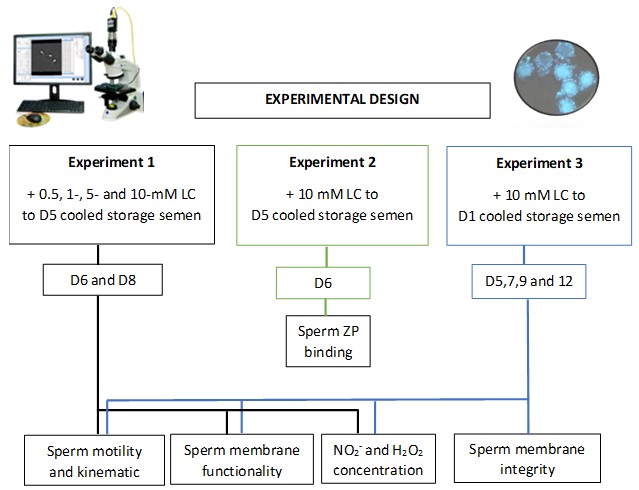
A schematic representation of the experimental design was presented in Figure 1. On d5 of storage at 17 °C, 10 porcine insemination doses (containing 100 mL each) were distributed into five separate 10 mL samples. These samples were then distributed into five experimental groups: control (no LC), and LC additions from different stock solutions (25, 50, 250, and 500 mM), resulting in final concentrations of 0.5, 1-, 5-, and 10-mM LC, respectively. On d6 and d8 of cooled storage, the semen samples were assessed as described.

Sperm motility and kinematic analysis
Following the addition of various LC concentrations to the cooled semen samples, sperm motility and kinematic parameters were assessed using a computer-assisted sperm cell analysis (CASA) system (Sperm Class Analyzer [SCA] 2005; Microptic). The following motility and kinetic parameters were measured using CASA: velocity curvilinear (VCL, μm/s), velocity straight line (VSL, μm/s), velocity average path (VAP, μm/s), linearity (LIN, %), straightness (STR, %), wobble (WOB, %), amplitude of lateral head displacement (ALH, μm), beat– cross frequency (BCF, Hz) and percentage of total (non-static) sperm motility (TM). A 5 μL semen sample was placed on a slide, covered with a coverslip (22 × 22 mm) and observed with a phase contrast microscope (×100) linked to the CASA. A total of nine fields per sample were analysed. The CASA settings used were: The CASA set-up was captured: 25 images per second; optics: Ph-; particle area greater than 10 and smaller than 80 μm2; VCL slow: between 10 and 25, medium: between 25 and 45, and rapid: greater than 45 μm/s; progressive motility: greater than 45% of STR and circular motility: smaller than 50% LIN.
Assessment of sperm membrane functionality
To evaluate sperm membrane functionality, a hypoosmotic swelling test (HOST) was conducted. Semen was added to distilled water at a ratio of 1:2 (Lagares et al., 2000), incubated in a water bath (37 °C, 5 min) and observed with phase-contrast microscopy (x400) (Lagares et al., 1998). To calculate the percentage of HOST+ sperm with swollen tails, the number of sperm with bent tails identified during the morphological evaluation was subtracted.
Concentration of nitrite and hydrogen peroxide
To assess the antioxidant effect of LC and the control group, the concentrations of NO2− and H2O2 (μM/μg protein) in the cooled semen were analyzed. As NO2− is one of the two primary, stable, and non-volatile breakdown products of nitric oxide (NO), it was quantified using spectrophotometry with Griess reagent (Green et al., 1982). This method helps measure NO formation within the sperm. The Griess reagent system relies on a chemical diazotization reaction involving 2% (w/v) sulphanilamide and 0.2% (w/v) N-(1-naphthyl) ethylenediamine dihydrochloride (NED) under acidic conditions (5% [v/v] phosphoric acid). The limit of detection was 2.5 μM (125 pmol) NO2− (in ultrapure, deionized distilled water). The samples’ absorbance was measured at 540 nm. Hydrogen peroxide concentrations were measured using the FOX2 modified method (Nouroozzadeh et al., 1994). This technique involves the oxidation of ferrous ions (Fe2+) to ferric (Fe3+) under acidic conditions by lipid hydroperoxides. The indicator used was xylene orange, which reacts with Fe3+ ions producing a blue-purplish chromophore with a coefficient of extinction of 4.3 × 10⁴ M−1 cm−1 at 560 nm. H2O2 concentrations were determined based on the molar extinction coefficient of hydroperoxide using the following equation:
where Aλ = absorbance at 560 nm; Ԑλ = molar extinction coefficient of the chromophore; C = hydroperoxide concentration (mol/mL).
Experiment 2: Assessment of sperm ZP binding with LC addition
On the d6 of cooled storage, tubes containing a pool of 10 cooled boar insemination doses were placed at 30° and incubated for 90 minutes at 37 °C to the swim-up selection. Sperm were aspirated from the surface of each tube and the concentration/ mL was calculated with a hemocytometer. The medium used was TCM 199 with Hank’s salts supplemented with 10% bovine fetal serum (BFS), 0.1mg/mL streptomycin, and 100 IU /mL penicillin. The semen samples were extended to a final concentration 0.5x10⁶ sperm per doses, and two treatments were performed: one with extended semen (control) and another containing the LC concentration that yielded the best results in Experiment 1.
Porcine oocytes were obtained from ovaries of sows slaughtered in an abattoir. Each group of 30 oocytes was incubated at 38.5 °C in a 5% CO2- atmosphere in 200µL droplet of TCM 199 medium with Hank’s salts + 10% BFS + 0.1mg/mL streptomycin + 100UI/mL penicillin until the zona binding assay was conducted. Each droplet containing 30 oocytes was inseminated with a final concentration of 0.5x10⁶ sperm stained with 10 μL of Hoechst 33342 solution (10 mg of Hoechst per 1 mL of distilled water), for each treatment and co-incubated at 38.5 °C with 5% CO2- atmosphere for 20 minutes. The sperm and oocytes of each treatment were observed using an epifluorescent microscope (filter ex, 361 nm; em, 486 nm) und the number of sperm- ZP binding were calculated. (Martins et al., 2018).
Experiment 3: Addition of LC to semen after one day of cooled storage
After one day of storage (d1) at 17 °C, 10 porcine insemination doses (containing 100 mL each) were distributed in two 10 mL samples. One sample served as the control (without LC), and the other contained the LC concentration that yielded the best results in Experiment 1. These samples were assessed on days 5, 7, 9, and 12 of cooled storage, following the same procedures described in Experiment 1, including assessment of sperm membrane integrity.
Sperm membrane integrity evaluation
Sperm membrane integrity assessment was conducted using epifluorescence microscopy, employing Hoechst 33342 (filter ex, 361 nm; em, 486 nm) and propidium iodide (PI; filter ex, 535 nm; em, 617 nm) probes. A total of 10 μL of Hoechst solution (10 mg of Hoechst per 1 mL of distilled water), 10 μL of PI solution (0.5 mg of PI per 1 mL of 0.9% saline solution), and 10 μL of formal citrate solution (1.7 mM) were added to a 100 μL semen sample. After incubation for 10 minutes at 37 °C, a droplet of the stained sample was placed on a microscope slide and covered with a coverslip. The stained sample was then examined using epifluorescence microscopy (× 1000). Sperm with red-stained heads (PI-positive) were counted as having damaged membranes (nonviable), while all sperm with blue staining (Hoechst-positive and PI-negative) were counted as having undamaged membranes (viable) and a total of two hundred spermatozoa were evaluated for each sample.
Statistical analysis
An experimental design with randomized blocks, using a porcine dose as a block, was used. The mean values of sperm analysis were analyzed using Analysis of Variance (ANOVA) and compared with the Duncan test and Kruskal Wallis. The statistical analysis of sperm ZP binding was performed using ANOVA, and the mean values were compared with the Kruskal-Wallis and Dunn tests. All data were analyzed using the Infostat program (FCA, Universidad Nacional de Córdoba, Argentina) and a probability of P < 0.05 was considered significant. When no interactions among time and treatment evaluated were observed, treatments’ mean values were presented.
Results
Experiment 1
CASA endpoints (mean ± SEM) were assessed after the addition of LC to cooled porcine semen on day 5, with evaluations conducted on days 6 and 8, as shown in Table 1. Parameters including LIN, STR, ALH, and BCF showed no significant differences among experimental groups during that period (P>0.05). Additionally, sperm TM, PM and kinematic parameters rapid, VCL, and VAP decreased significantly from day 6 to day 8 of cooling (P<0.05). On the other hand, on day 8, the percentage of sperm with TM in the 10 mM LC treatment was higher (52.2% ± 5.2%) compared to that in the control group (28.7% ± 6.3%, P<0.05).
CASA end points (mean ± SEM) after adding LC to cooled porcine semen on day 5 and evaluating on days 6 and 8.
The percentage of functional sperm membrane (HOST+) remained consistent from day 6 to day 8 of cooling (P > 0.05, Table 2). However, the mean value over both evaluated days was higher in treatments with higher LC concentrations (1-, 5-, and 10-mM LC) compared to the control (Table 2, P < 0.05)
Percentage of functional sperm membrane (HOST+) after adding LC to cooled porcine semen on day 5 and evaluating on days 6 and 8 (Mean ± SEM).
Hydrogen peroxide and nitrite concentrations remained constant from day 6 to day 8 of cooling and showed no significant differences among experimental groups on the evaluated days (Table 3, P > 0.05).
Concentrations of hydrogen peroxide (H2O2) and nitrite (NO2-, μM/μg de protein) after adding LC to cooled porcine semen on day 5 and evaluating on days 6 and 8 (Mean ± SEM).
Experiment 2
The concentration of LC selected for testing in the third experiment was 10 mM. This choice was based on the results of the first experiment, where the addition of 10 mM LC to cooled semen led in increased percentages of total motility (TM) compared to the control group. Consequently, in the second experiment, our objective was to ascertain whether the addition of 10 mM LC on day 6 of storage increased the number of sperm bound to the zona pellucida (ZP) compared to the control group. The addition of 10 mM LC to cooled semen at d6 of storage increased the number of sperm bound to ZP compared to the control (27.7 ± 1.4 vs. 14.2 ± 1.1 sperm, P<0.05).
Experiment 3
The concentration of LC selected for testing in the third experiment was 10 mM. This choice was based on the results of the first experiment, where the addition of 10 mM LC to cooled semen on day 5 (d5) resulted in increased percentages of total motility (TM) and functional sperm membrane on day 8 (d8) compared to the control group. Therefore, in the third experiment, we aimed to determine whether the addition of 10 mM LC to cooled porcine semen after the first day of semen storage would lead to improvements and sustained semen characteristics. The analysis was performed on days 5, 7, 9, and 12 to track any potential long-term effects of LC supplementation on semen quality.
No significant differences were observed among the experimental groups on days 5, 7, and 9 of semen storage (Table 4). However, on day 12, the addition of LC resulted in significant improvements compared to the control group. Specifically, LC increased the following sperm characteristics: TM (88.8 vs 64.0%), rapid (43.5 vs 22.5), VAP (30.6 vs 22.9 µm/s), VCL (48.6 vs 34.4 µm/s), ALH (2.4 vs 2.0 µm) and BCF (2.5 vs 2.0 Hz) compared to the control (Table 4, P < 0.05).
CASA endpoints, presented as both mean ± SEM and median (minimum - maximum), assessed after adding LC to cooled porcine semen following one day of storage and evaluating on days 5, 7, 8, and 12.
The percentage of sperm with a functional plasma membrane decreased only on day 12 of cooling in both treatments compared to that on day 9 (Table 5, P > 0.05). Sperm membrane functionality and integrity did not show any significant differences between the treatments during the 12 days of analysis (P > 0.05, Table 5).
Percentage of functional (HOST+) and intact sperm membrane of cooled porcine sperm assessed after adding LC to semen following one day of storage and evaluated on days 5, 7, 8 and 12 (Mean ± SEM and median (minimum-maximum)).
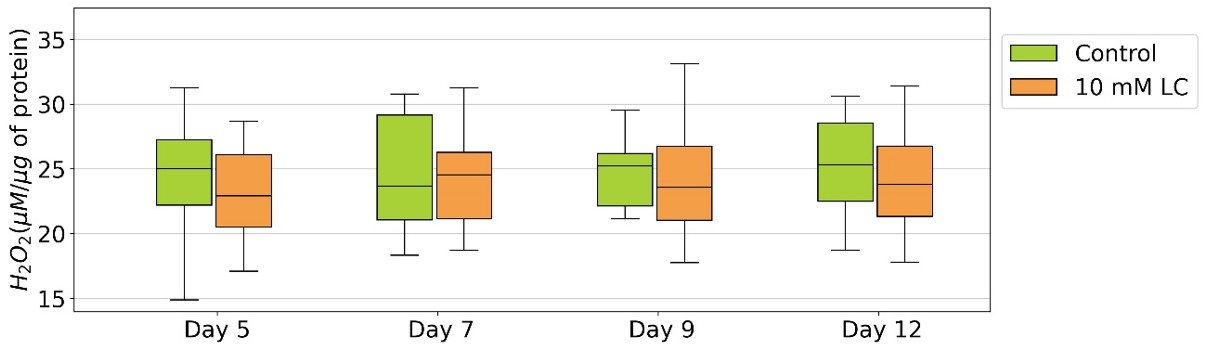
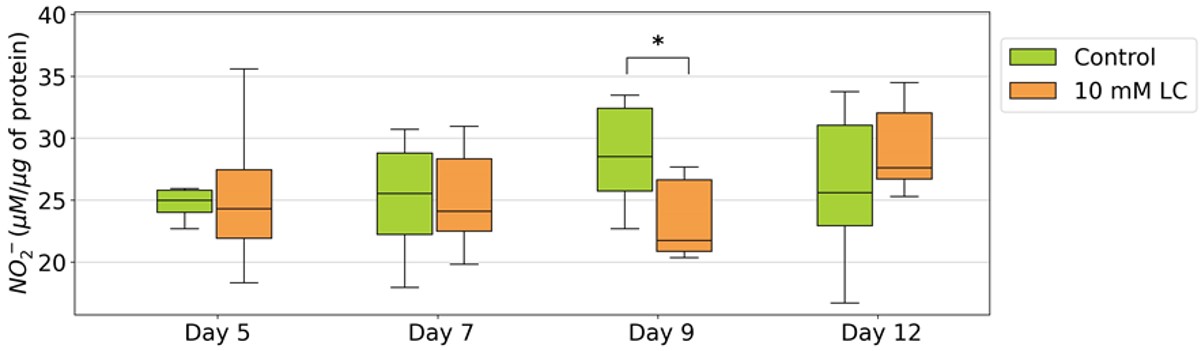
Hydrogen peroxide concentration did not exhibit significant differences among the various time points and treatments (Figure 2, P > 0.05). In the control treatment, NO2- concentration remained constant until day 12 of cooled semen storage (Figure 3, P > 0.05). However, on day 9, LC supplementation led to a decrease in NO2- concentration compared to the control (21.7% vs. 28.5%, P<0.05).

Hydrogen peroxide (H2O2) concentration (μM/μg protein) of cooled porcine sperm assessed after adding LC to semen following one day of storage and evaluated on days 5, 7, 8 and 12.

Nitrite (NO2-) concentration (μM/μg protein) of cooled porcine sperm assessed after adding LC to semen following one day of storage and evaluated on days 5, 7, 8 and 12. Values with * differ significantly (P < 0.05).
Discussion
In the present study, the addition of 10 mM LC improved and prolonged sperm total motility (TM) for at least three days beyond the typically recommended usage of insemination doses (five days) and when it was added to semen on day 1 of storage, it extended sperm kinematic characteristics to day 12. These findings align with reports in other species demonstrating the positive effects of LC addition on sperm motility and kinematic parameters. LC supplementation improved sperm motility and kinematic characteristics in frozen epididymal cat sperm (25 mM, Manee-In et al., 2014), cooled equine semen stored for 48 hours (0.1 mM/mL, Lisboa et al., 2014), and post-thawed equine semen (1 mM, Lagares et al., 2022). These results are consistent with the increased number of sperm bound to ZP observed in the LC treatment during the present study. The interaction with the oocyte plasma membrane appears to explain much of the variability in sperm fertilizing potential among fertile boars and has been correlated with in vivo fertility (Berger et al., 1996). Therefore, in the present study, the enhanced sperm ZP- binding capability with LC addition seemed to be due to its positive effects on sperm metabolism.
Since porcine sperm motility typically declines after three days of storage (Storey, 1997; Awda et al., 2009), semen extenders are used to mitigate the detrimental effects of storage on sperm viability, thereby prolonging its longevity to at least five days (Gibb et al., 2015; Menegat et al., 2017). The sperm motility decrease during in vitro storage, might be a consequence of the increase in reactive oxygen species (ROS) as byproducts of sperm metabolism that disrupts sperm homeostasis and depletes energy (Gibb et al., 2015; Cerolini et al., 2000). In the present study, when LC was added to semen on day 1 of storage, it decreased NO2- concentration on d9 exhibiting antioxidant properties. Nitric oxide (NO) is a free radical that plays a role in sperm physiology, motility, acrosome reaction and is produced by the intracellular enzyme nitric oxide synthase (NOS) (Staicu and Parra, 2017). In high concentrations, it increases ROS and RNS production leading to a decrease of sperm motility and membrane integrity (Balercia et al., 2005). Furthermore, since the sperm plasma membrane is rich in lipids, contributing to its fluidity, this also makes the membrane more susceptible to lipid peroxidation (Sanocka and Kurpisz, 2004). ROS attacks on sperm membranes disrupt their structure, altering fluidity and permeability (Flesch and Gadella, 2000).
Most studies assess the impact of oral l-carnitine supplementation on semen quality (Khaw et al., 2020; Nazari et al., 2021; Szymański et al., 2021; Balogun et al., 2022; Ma and Sun, 2022; Chang et al., 2023; Lahimer et al., 2023). However, it is possible that when directly added to the semen, its action mechanism remains unchanged. LC facilitates the transfer of lipids and other substrates across the mitochondrial membrane for use in sperm energy production, reduces lipid availability for peroxidation and ROS formation, thereby stabilizing the membrane (Jeulin and Lewin, 1996; Gibb et al., 2015). In vivo studies have demonstrated that LC can reduce the concentration of malondialdehyde (MDA), a marker of lipid peroxidation, ensuring efficient fatty acid oxidation and preventing the accumulation of damaged lipids (Cabral et al., 2018). Elevated lipid peroxidation can have detrimental effects on the functional integrity and fluidity of the sperm plasma membrane due to its high levels of polyunsaturated fatty acids (PUFAs), rendering it particularly susceptible to damage (Hosen et al., 2015). As a result of lipid peroxidation, compounds such as MDA and 4- hydroxynonenal (4-HNE), further compromising sperm quality (Gomez et al., 1998). In a study, supplementation with LC was found to enhance seminal antioxidant activity, prevent MDA production, and protect sperm during storage in the epididymis and oviduct in aged roosters (Elokil et al., 2019). However, in the present study the direct access to lipid peroxidation through measurements of MDA and 4-HNE production was not performed. On the other hand, it is possible that LC acts indirectly decreasing lipid peroxidation by scavenging ROS and reducing oxidative stress, improving sperm parameters such as motility, morphology, and concentration (Mateus et al., 2023). In this study, when 1-, 5-, and 10-mM LC were added to semen on day 5 of storage, sperm membrane functionality increased. This may have resulted from a decrease in ROS availability, leading to enhanced membrane stabilization (Gibb et al., 2015). Similarly, in this study, when LC was added at the beginning of storage, it acts as an antioxidant reducing NO2- concentration. Thus, the action of LC could potentially mitigate lipid peroxidation, suggesting a beneficial effect on boar sperm quality.
The LC solution can be stored by freezing at -20 °C. Prior to adding the LC solution to the semen doses, it should be thawed and then mixed with boar semen at a temperature of 16 °C, which is consistent with the temperature of cooled stored boar semen. This process ensures that the quality of the cooled semen will not be compromised until it is ready for use. This procedure could be a valuable practice for the suine industry, especially crucial for boars with sperm that do not tolerate longer storage periods, ensuring a high-quality cooled semen for up to 12 days. Thus, in addition to its positive effects on sperm metabolism and ZP- binding, LC also appears to have antioxidant properties and protects sperm membrane functionality in porcine sperm. These findings suggest that the addition of 10 mM LC to cooled porcine semen may potentially enhance the fertility of porcine semen doses up to 12 days.
Conclusion
The addition of LC both at days 1 and 5 of storage to cooled porcine semen seemed to be advantageous in extending the viability of porcine sperm doses. The improvements in sperm characteristics and the increased number of sperm bound to ZP after five day of storage suggest that adding 10 mM LC to porcine semen doses might potentially enhance the fertility of porcine semen. Therefore, the addition of LC to cooled semen could be a valuable practice for the suine industry, ensuring a high-quality cooled semen for up to 12 days. This could be especially crucial for boars with sperm that do not tolerate longer storage periods.
-
Financial support: This work was supported by the CAPES [grant-number: 1690817/2017-0487].
-
How to cite: Lagares MA, Amaral NA, Braga JJ, Alves NC, Freitas MM, Nicolino RR, Wenceslau RR, Anselmo FR, Oliveira MMCS, Costa ED, Almeida FRCL, Stahlberg R. L-Carnitine enhances porcine sperm quality, longevity, and zona pellucida binding in cooled semen. Anim Reprod. 2025;22(1):e20230143. https://doi.org/10.1590/1984-3143-AR2023-0143
References
- Abd-Elrazek AM, Ahmed-Farid OAH. Protective effect of L-carnitine and L-arginine against busulfan-induced oligospermia in adult rat. Andrologia. 2018;50(1):1-8. PMid:28444774.
-
Agarwal A, Saleh RA. Role of oxidants in male infertility: rationale, significance, and treatment. Urol Clin North Am. 2002;29(4):817. http://doi.org/10.1016/S0094-0143(02)00081-2 PMid:12516754.
» http://doi.org/10.1016/S0094-0143(02)00081-2 -
Ahmadi S, Bashiri R, Ghadiri-Anari A, Nadjarzadeh A. Antioxidant supplements and semen parameters: an evidence-based review. Int J Reprod Biomed. 2016;14(12):729-36. http://doi.org/10.29252/ijrm.14.12.729 PMid:28066832.
» http://doi.org/10.29252/ijrm.14.12.729 -
Awda BJ, Mackenzie-Bell M, Buhr MM. Reactive oxygen species and boar sperm function. Biol Reprod. 2009;81(3):553-61. http://doi.org/10.1095/biolreprod.109.076471 PMid:19357363.
» http://doi.org/10.1095/biolreprod.109.076471 -
Balercia G, Regoli F, Armeni T, Koverech A, Mantero F, Boscaro M. Placebo-controlled double-blind randomized trial on the use of L-carnitine, L-acetylcarnitine or combined L-carnitine and L-acetylcarnitine in men with idiopathic asthenozoospermia. Fertil Steril. 2005;84(3):662-71. http://doi.org/10.1016/j.fertnstert.2005.03.064 PMid:16169400.
» http://doi.org/10.1016/j.fertnstert.2005.03.064 -
Balogun KB, Lu N, Orlando U, Torborg H, Kleve-Feld M, Denton A, Holstine A, Stewart KR. Effects of dietary carnitine supplementation on semen output and quality of boars. Transl Anim Sci. 2022;6(4):c143. http://doi.org/10.1093/tas/txac143 PMid:36381951.
» http://doi.org/10.1093/tas/txac143 - Bandeira TB, Toniolli LS, Guimarães DB, Freitas EN, Nunes TGP, Toniolli R. Curvas de resfriamento do sêmen do varrão diluído em acp 103 adicionado de gema de ovo em concentração fixa. Ciênc Anim. 2016;17:25-30.
-
Bansal AK, Bilaspuri GS. Impacts of oxidative stress and antioxidants on semen functions. Vet Med Int. 2010;2010:686137. http://doi.org/10.4061/2011/686137 PMid:20871827.
» http://doi.org/10.4061/2011/686137 -
Berger T, Anderson DL, Penedo MCT. Porcine sperm fertilizing potential in relationship to sperm functional capacities. Anim Reprod Sci. 1996;44(4):231-9. http://doi.org/10.1016/0378-4320(96)01565-5
» http://doi.org/10.1016/0378-4320(96)01565-5 -
Betancur GR, Zapata KV, Vidal PAC, Sánchez Y, Rojano BA. Cooling of porcine semen in an extender supplemented with isoespintanol. Cienc Rural. 2023;53(11):e20220508. http://doi.org/10.1590/0103-8478cr20220508
» http://doi.org/10.1590/0103-8478cr20220508 -
Braundmeier AG, Demers JM, Shanks RD, Miller DJ. The relationship of porcine sperm zona-binding ability to fertility. J Anim Sci. 2004;82(2):452-8. http://doi.org/10.2527/2004.822452x PMid:14974543.
» http://doi.org/10.2527/2004.822452x -
Bremer J. Carnitine-metabolism and functions. Physiol Rev. 1983;63(4):1420-80. http://doi.org/10.1152/physrev.1983.63.4.1420 PMid:6361812.
» http://doi.org/10.1152/physrev.1983.63.4.1420 -
Cabral REL, Mendes TB, Vendramini V, Miraglia SM. Carnitine partially improves oxidative stress, acrosome integrity, and reproductive competence in doxorubicin-treated rats. Andrology. 2018;6(1):236-46. http://doi.org/10.1111/andr.12426 PMid:28973833.
» http://doi.org/10.1111/andr.12426 -
Cerolini S, Maldjian A, Surai P, Noble R. Viability, susceptibility to peroxidation and fatty acid composition of boar semen during liquid storage. Anim Reprod Sci. 2000;58(1-2):99-111. http://doi.org/10.1016/S0378-4320(99)00035-4 PMid:10700648.
» http://doi.org/10.1016/S0378-4320(99)00035-4 -
Chang D, Kong F, Jiang W, Li F, Zhang C, Ding H, Kang Y, Li W, Huang C, Zhou X, Zhang X, Jiao H, Kang Y, Shang X, Zhang B. Effects of l-carnitine administration on sperm and sex hormone levels in a male Wistar rat reproductive system injury model in a high-altitude hypobaric hypoxic environment. Reprod Sci. 2023;30(7):2231-47. http://doi.org/10.1007/s43032-022-00948-5 PMid:36633830.
» http://doi.org/10.1007/s43032-022-00948-5 -
Elokil AA, Bhuiyan AA, Liu H-Z, Hussein MN, Ahmed HI, Azmal SA, Yang L, Li S. The capability of L-Carnitine mediated antioxidant on cock during aging: evidence for the improved semen quality and enhanced testicular expressions of GnRH1, GnRHR, and melatonin receptors MT 1/2. Poult Sci. 2019;98(9):4172-81. http://doi.org/10.3382/ps/pez201 PMid:31001634.
» http://doi.org/10.3382/ps/pez201 -
Flesch FM, Gadella BM. Dynamics of the mammalian sperm plasma membrane in the process of fertilization. Biochim Biophys Acta. 2000;1469(3):197-235. http://doi.org/10.1016/S0304-4157(00)00018-6 PMid:11063883.
» http://doi.org/10.1016/S0304-4157(00)00018-6 -
Flowers WL. Factors affecting the production of quality ejaculates from boars. Anim Reprod Sci. 2022;246:106840. http://doi.org/10.1016/j.anireprosci.2021.106840 PMid:34518030.
» http://doi.org/10.1016/j.anireprosci.2021.106840 -
Gadea J. Sperm factors related to in vitro and in vivo porcine fertility. Theriogenology. 2005;63(2):431-44. http://doi.org/10.1016/j.theriogenology.2004.09.023 PMid:15626409.
» http://doi.org/10.1016/j.theriogenology.2004.09.023 -
Gibb Z, Aitken RJ. The impact of sperm metabolism during in vitro storage: the stallion as a model. BioMed Res Int. 2016;2016:9380609. http://doi.org/10.1155/2016/9380609 PMid:26881234.
» http://doi.org/10.1155/2016/9380609 -
Gibb Z, Lambourne SR, Quadrelli J, Smith ND, Aitken RJ. L-Carnitine and Pyruvate are prosurvival factors during the storage of stallion spermatozoa at room temperature. Biol Reprod. 2015;93(4):104. http://doi.org/10.1095/biolreprod.115.131326 PMid:26316064.
» http://doi.org/10.1095/biolreprod.115.131326 -
Gomez E, Irvine DS, Aitken RJ. Evaluation of a spectrophotometric assay for the measurement of malondialdehyde and 4-hydroxyalkenals in human spermatozoa: relationships with semen quality and sperm function. Int J Androl. 1998;21(2):81-94. http://doi.org/10.1046/j.1365-2605.1998.00106.x PMid:9675617.
» http://doi.org/10.1046/j.1365-2605.1998.00106.x -
Green LC, Wagner DA, Glogowski J, Skipper PL, Wishnok JS, Tannenbaum SR. Analysis of nitrate, nitrite, and [15N] nitrate in biological fluids. Anal Biochem. 1982;126(1):131-8. http://doi.org/10.1016/0003-2697(82)90118-X PMid:7181105.
» http://doi.org/10.1016/0003-2697(82)90118-X -
Gülçin I. Antioxidant and antiradical activities of l-carnitine. Life Sci. 2006;78(8):803-11. http://doi.org/10.1016/j.lfs.2005.05.103 PMid:16253281.
» http://doi.org/10.1016/j.lfs.2005.05.103 - Harrison RAP. Sperm plasma membrane characteristics and boar semen fertility. J Reprod Fertil Suppl. 1997;52:195-211. PMid:9602729.
-
Henning H, Nguyen QT, Wallner U, Waberski D. Temperature limits for storage of extended boar semen from the perspective of the sperm’s energy status. Front Vet Sci. 2022;9:953021. http://doi.org/10.3389/fvets.2022.953021 PMid:35990258.
» http://doi.org/10.3389/fvets.2022.953021 -
Hensel B, Jakop U, Scheinpflug K, Mühldorfer K, Schröter F, Schäfer J, Greber K, Jung M, Schulze M. Low temperature preservation of porcine semen: influence of short antimicrobial lipopeptides on sperm quality and bacterial load. Sci Rep. 2020;10(1):13225. http://doi.org/10.1038/s41598-020-70180-1 PMid:32764567.
» http://doi.org/10.1038/s41598-020-70180-1 - Hosen MB, Islam MR, Begum F, Kabir Y, Howlader MZH. Oxidative stress induced sperm DNA damage, a possible reason for male infertility. Iran J Reprod Med. 2015;13(9):525-32. PMid:26568756.
-
Jeulin C, Lewin LM. Role of free L-carnitine and acetyl-L-carnitine in post-gonadal maturation of mammalian spermatozoa. Hum Reprod Update. 1996;2(2):87-102. http://doi.org/10.1093/humupd/2.2.87 PMid:9079406.
» http://doi.org/10.1093/humupd/2.2.87 -
Khaw SC, Wong ZZ, Anderson A, Silva SM. L-carnitine and l-acetylcarnitine supplementation for idiopathic male infertility. Reprod Fertil. 2020;1(1):67-81. http://doi.org/10.1530/RAF-20-0037 PMid:35128424.
» http://doi.org/10.1530/RAF-20-0037 -
Lagares MA, Silva GC, Cortes SF, Moreira FHM, Neves FCD, Alves NDC, Viegas RN, Diniz TF, Lemos VS, Rezende ASC, Freitas MM, Stahlberg R, Nicolino RR. L-carnitine added to post-thawed semen acts as an antioxidant and a stimulator of equine sperm metabolism. Andrologia. 2022;54(3):e14338. http://doi.org/10.1111/and.14338 PMid:34878673.
» http://doi.org/10.1111/and.14338 -
Lagares MA, Petzoldt R, Sieme H, Klug E. Assessing equine sperm-membrane integrity. Andrologia. 2000;32(3):163-7. http://doi.org/10.1046/j.1439-0272.2000.00351.x PMid:10863971.
» http://doi.org/10.1046/j.1439-0272.2000.00351.x - Lagares MA, Petzodt R, Sieme H, Klug E. Preservação do sêmen fresco eqüino: avaliação da integridade da membrana espermática sob condições hiposmóticas. Arq Fac Vet UFRGS. 1998;26:29-42.
-
Lahimer M, Gherissi O, Salem NB, Mustapha HB, Bach V, Khorsi-Cauet H, Ki H, Ali HB, Khalifa MB, Ajina M. Effect of micronutrients and l-carnitine as antioxidant on sperm parameters, genome integrity, and ICSI outcomes: randomized, double-blind, and placebo-controlled clinical trial. Antioxidants. 2023;12(11):1937-54. http://doi.org/10.3390/antiox12111937 PMid:38001791.
» http://doi.org/10.3390/antiox12111937 -
Larsson B, Rodriguez-Martinez H. Can we use in vitro fertilization tests to predict semen fertility? Anim Reprod Sci. 2000;60–61:327-36. http://doi.org/10.1016/S0378-4320(00)00089-0 PMid:10844204.
» http://doi.org/10.1016/S0378-4320(00)00089-0 -
Li R, Jia Z, Trush MA. Defining ROS in biology and medicine. React Oxyg Species. 2016;1(1):9-21. http://doi.org/10.20455/ros.2016.803 PMid:29707643.
» http://doi.org/10.20455/ros.2016.803 - Lima ES, Abdalla DSP. Peroxidação lipídica: mecanismos e avaliação em amostras biológicas. Rev Bras Ciênc Farm. 2001;37:293-303.
-
Lisboa FL, Hartwig FP, Freitas-Dell’Aqua CP, Hartwig FP, Papa FO, Dell’aqua JA Jr. Improvement of cooled equine semen by addition of Carnitines. J Equine Vet Sci. 2014;34(1):48. http://doi.org/10.1016/j.jevs.2013.10.028
» http://doi.org/10.1016/j.jevs.2013.10.028 -
Lopez Rodriguez A, Van Soom A, Arsenakis L, Maes D. Boar management and semen handling factors affect the quality of boar extended semen. Porcine Health Manag. 2017;3(1):15. http://doi.org/10.1186/s40813-017-0062-5 PMid:28770098.
» http://doi.org/10.1186/s40813-017-0062-5 - Ma L, Sun Y. Comparison of L-Carnitine vs. Coq10 and Vitamin E for idiopathic male infertility: a randomized controlled trial. Eur Rev Med Pharmacol Sci. 2022;26(13):4698-704. PMid:35856361.
-
Manee-In S, Parmornsupornvichit S, Kraiprayoon S, Tharasanit T, Chanapiwat P, Kaeoket K. L-carnitine Supplemented Extender Improves Cryopreserved-thawed Cat Epididymal Sperm Motility. Asian-Australas J Anim Sci. 2014;27(6):791-6. http://doi.org/10.5713/ajas.2013.13565 PMid:25050016.
» http://doi.org/10.5713/ajas.2013.13565 - Martins HS, Martins OA Fo, Araujo MSS, Martins NR, Lagares MA. Evaluation of fertilizing ability of frozen equine sperm using a bovine zona pellucida binding assay. Cryo Letters. 2018;39(5):298-305. PMid:30963161.
-
Mateus FG, Moreira S, Martins AD, Oliveira PF, Alves MG, Pereira ML. L-carnitine and male fertility: is supplementation beneficial? J Clin Med. 2023;12(18):5796-817. http://doi.org/10.3390/jcm12185796 PMid:37762736.
» http://doi.org/10.3390/jcm12185796 -
Menegat MB, Mellagi APG, Bortolin RC, Menezes TA, Vargas AR, Bernardi ML, Wentz I, Gelain DP, Moreira JC, Bortolozzo FP. Sperm quality and oxidative status as affected by homogenization of liquid-stored boar semen diluted in short-and long-term extenders. Anim Reprod Sci. 2017;179:67-79. http://doi.org/10.1016/j.anireprosci.2017.02.003 PMid:28215454.
» http://doi.org/10.1016/j.anireprosci.2017.02.003 - Nazari L, Salehpour S, Hosseini S, Allameh F, Jahanmardi F, Azizi E, Ghodssi-Ghassemabadi R, Hashemi T. Effect of antioxidant supplementation containing L-carnitine on semen parameters: a prospective interventional study. JBRA Assist Reprod. 2021;25(1):76-80. PMid:32598834.
- Nogueira BG, Bitencourt JL, Sampaio BFB, Bender ESC, Costa SEV, Zúccari CESN. Peroxidação lipídica e agentes antioxidantes no sêmen de mamíferos. Rev Electrón Vet. 2014;15:1-15.
-
Nordberg J, Arnér ESJ. Reactive oxygen species. antioxidants. and the mammalian thioredoxin system. Free Radic Biol Med. 2001;31(11):1287-312. http://doi.org/10.1016/S0891-5849(01)00724-9 PMid:11728801.
» http://doi.org/10.1016/S0891-5849(01)00724-9 -
Nouroozzadeh J, Tajaddinisarmadi J, Wolff SP. Measurement of plasma hydroperoxide concentrations by the ferrous oxidation-xylenol orange assay in conjunction with triphenilphosphine. Anal Biochem. 1994;220(2):403-9. http://doi.org/10.1006/abio.1994.1357 PMid:7978285.
» http://doi.org/10.1006/abio.1994.1357 -
Partyka A, Rodak O, Bajzert J, Kochan J, Nizanski W. The effect of L-carnitine. hypotaurine and taurine supplementation on the quality of cryopreserved chicken semen. BioMed Res Int. 2017;2017:7279341. http://doi.org/10.1155/2017/7279341 PMid:28523277.
» http://doi.org/10.1155/2017/7279341 -
Restrepo G, Zapata K, Colorado P, Rojano B. Cooling of porcine semen in an extender supplemented with carvacrol. Reprod Domest Anim. 2023;58(6):860-6. http://doi.org/10.1111/rda.14359 PMid:37029731.
» http://doi.org/10.1111/rda.14359 -
Sanocka D, Kurpisz M. Reactive oxygen species and sperm cells. Reprod Biol Endocrinol. 2004;2(1):12. http://doi.org/10.1186/1477-7827-2-12 PMid:15038829.
» http://doi.org/10.1186/1477-7827-2-12 -
Sariozkan S, Ozdamar S, Turk G, Canturk F, Yay A. In vitro effects of L-carnitine and glutamine on motility, acrosomal abnormality, and plasma membrane integrity of rabbit sperm during liquid-storage. Cryobiology. 2014;68(3):349-53. http://doi.org/10.1016/j.cryobiol.2014.04.006 PMid:24759298.
» http://doi.org/10.1016/j.cryobiol.2014.04.006 -
Severo CK, Pereira GR, Pereira AM, Ilha GF, Oliveira JFC, Soares M, Arruda RP, Gonçalves PBD. Cysteine addition on short-term cooled boar semen preservation and its relationship with swine field fertility. Pesq Vet Bras. 2011;31(Suppl 1):25-32. http://doi.org/10.1590/S0100-736X2011001300005
» http://doi.org/10.1590/S0100-736X2011001300005 - Staicu F-D, Parra CM. Nitric oxide: key features in spermatozoa. In: Saravi SSS, editor. Nitric oxide synthase: simple enzyme-complex roles. London: IntechOpen; 2017. p. 137-54.
-
Storey BT. Biochemical of the induction and prevention of lipoperoxidative damage in human spermatozoa. Mol Hum Reprod. 1997;3(3):203-13. http://doi.org/10.1093/molehr/3.3.203 PMid:9237246.
» http://doi.org/10.1093/molehr/3.3.203 -
Stradaioli G, Sylla L, Zelli R, Chiodi P, Monaci M. Effect of L-carnitine administration on the seminal characteristics of oligoasthenospermic stallions. Theriogenology. 2004;62(3-4):761-77. http://doi.org/10.1016/j.theriogenology.2003.11.018 PMid:15226028.
» http://doi.org/10.1016/j.theriogenology.2003.11.018 -
Surai PF. Carnitine Enigma: from antioxidant action to vitagene regulation Part 2. transcription factors and practical applications. J. Veter. Sci. Med. 2015;3(2):1-17. http://doi.org/10.13188/2325-4645.1000018
» http://doi.org/10.13188/2325-4645.1000018 -
Szymanowicz J, Schwarz T, Murawski M, MaBopolska M, Oszczda Z, Tuz R, Nowicki J, Bartlewski PM. Storage of boar semen at 16-18 °C in the long-term commercial extender prepared with deionized water or nanowater. Anim Reprod. 2019;16(4):864-70. http://doi.org/10.21451/1984-3143-AR2019-0023 PMid:32368265.
» http://doi.org/10.21451/1984-3143-AR2019-0023 -
Szymański M, Wandtke T, Wasilow K, Andryszczyk M, Janicki R, Domaracki P. Comparison of 3- and 6-month outcomes of combined oral L-carnitine fumarate and acetyl-L-carnitine therapy, included in an antioxidant formulation, in patients with idiopathic infertility. Am J Mens Health. 2021;15(5):1-11. http://doi.org/10.1177/15579883211036790 PMid:34515581.
» http://doi.org/10.1177/15579883211036790 -
Tabatabaei S, Aghaei A. Effect of L-carnitine on sperm quality during liquid storage of chicken semen. Comp Clin Pathol. 2012;21(5):711-7. http://doi.org/10.1007/s00580-010-1163-6
» http://doi.org/10.1007/s00580-010-1163-6 -
Waberski D, Riesenbeck A, Schulze M, Weitze KF, Johnson L. Application of preserved boar semen for artificial insemination: past, present and future challenges. Theriogenology. 2019;137:2-7. http://doi.org/10.1016/j.theriogenology.2019.05.030 PMid:31186127.
» http://doi.org/10.1016/j.theriogenology.2019.05.030 -
Yang K, Wang N, Guo H-T, Wang J-R, Sun H-H, Sun L-Z, Yue SL, Zhou JB. Effect of L-carnitine on sperm quality during liquid storage of boar semen. Asian-Australas J Anim Sci. 2020;33(11):1763-9. http://doi.org/10.5713/ajas.19.0455 PMid:32054191.
» http://doi.org/10.5713/ajas.19.0455