 Development and validity of an animated infographic on fall prevention in hospitals
Abstract
Objective To develop and validate an animated infographic for health education of patients on fall prevention in hospitals.
Methods This methodological study was based on the Instructional Design model and comprised four stages: 1- Planning (including literature reviews and technology script development); 2- Production (instructional design and media development with the help of a graphic designer); 3- Implementation and assessment (judges validated the infographic appearance and content using the Educational Health Content Validity Instrument); and 4- Application of educational technology with the target audience for appearance assessment. The Content Validity Index (CVI) was calculated to assess the animated infographic validity.
Results The infographic, lasting seven minutes and 43 seconds, uses audio narration with textual information, illustrations, and animations to address topics such as: definition of falls and their consequences; risk factors for falls in hospital settings; and guidance on fall prevention for patients and their companions. In the content and appearance validity by experts, the technology obtained an overall CVI of 1.0, considered the gold standard. In the appearance assessment by the target audience, it achieved an overall CVI of 0.975, considered excellent.
Conclusion The animated infographic is a valid and appropriate technology for patient education regarding fall prevention during hospital stays.
Keywords:
Patient safety; Accidental falls; Health education; Educational technology
Resumo
Objetivo Desenvolver e validar um infográfico animado para educação em saúde à pacientes sobre prevenção de queda em hospitais.
Métodos Estudo metodológico teve por base o modelo de Design Instrucional, compreendeu quatro etapas: 1- Planejamento (incluindo revisões da literatura e elaboração do roteiro da tecnologia); 2- Produção (desenvolvimento de desenho didático e mídias com ajuda de um designer gráfico); 3- Implementação e Avaliação (juízes validaram a aparência e conteúdo do infográfico usando o Instrumento de Validação de Conteúdo Educativo em Saúde, IVCES); e 4- Aplicação da tecnologia educacional com o público-alvo para avaliação da aparência. O Índice de Validade de Conteúdo (IVC) foi calculado para avaliar a validade do infográfico animado.
Resultados O infográfico, com duração de sete minutos e 43 segundos, usa narração de áudio com informação textual, ilustrações e animações para abordar conteúdos como definição de queda e suas consequências; fatores de risco para queda de pacientes no ambiente hospitalar; e orientação sobre prevenção de queda a pacientes e acompanhantes. Na validação de conteúdo e aparência por especialistas, a tecnologia obteve IVC global de 1,0, considerado padrão-ouro. Já na avaliação da aparência pelo público-alvo alcançou IVC global de 0,975, considerado excelente.
Conclusão O infográfico animado é uma tecnologia válida e adequada para educação do paciente quanto a prevenção de quedas durante a internação hospitalar.
Descritores:
Segurança do paciente; Acidentes por queda; Educação em saúde; Tecnologia educacional
Resumen
Objetivo Elaborar y validar una infografía animada para la educación sanitaria de pacientes sobre la prevención de caídas en hospitales.
Métodos El estudio metodológico se basó en el modelo de diseño instruccional y comprendió cuatro etapas: 1) Planificación (revisión de la literatura y elaboración del guion de la tecnología), 2) Producción (elaboración del diseño didáctico y de los medios con la ayuda de un diseñador gráfico), 3) Implementación y evaluación (validación por parte de los jueces de la apariencia y del contenido de la infografía utilizando el Instrumento de Validación de Contenido Educativo en Salud, IVCES) y 4) Aplicación de la tecnología educativa con el público destinatario para evaluar la apariencia. Se calculó el Índice de Validez de Contenido (IVC) para evaluar la validez de la infografía animada.
Resultados La infografía, con una duración de 07:43 minutos, utiliza narración de audio con información textual, ilustraciones y animaciones para abordar contenidos como la definición de caída y sus consecuencias, factores de riesgo de caída de pacientes en el ambiente hospitalario y orientaciones sobre la prevención de caídas para pacientes y acompañantes. En la validación del contenido y de la apariencia por parte de especialistas, la tecnología obtuvo un IVC global de 1,0, considerado el estándar de referencia. En la evaluación de la apariencia por parte del público destinatario, se alcanzó un IVC global de 0,975, considerado excelente.
Conclusión La infografía animada es una tecnología válida y adecuada para la educación del paciente sobre la prevención de caídas durante la hospitalización.
Descriptores:
Seguridad del paciente; Accidentes por caídas; Educación en salud; Tecnología educacional
Introduction
Falls occur when people inadvertently fall to a level below their initial position, or when they lose their balance and seek support but do not reach the ground.(1)The occurrence of falls in hospital settings can worsen the clinical condition of patients, cause limitations and physical disability, prolong the length of hospital stay, increase hospital costs, and have ethical and legal repercussions for healthcare institutions.(2,3)
Given these negative impacts, preventing falls and related injuries is a priority objective for national and international organizations. Considering it is one of the international patient safety goals, it is a strategic objective within the Global Action Plan for Patient Safety: 2021-2030.(1)
The main strategies for preventing falls include home-based vitamin D supplementation, exercise and assistive technologies in subacute hospital settings, interventions in the social environment, and health education at home and in hospitals.(4) Systematic reviews show that educational interventions can prevent falls in hospital settings and are well accepted by patients.(4,5) Furthermore, they result in a significant reduction in the occurrence of falls during hospitalization when mediated by educational technology.(6)
Among the various educational technologies available to prevent falls, we highlighted protocols, brochures, leaflets, videos, posters,(7)booklets,(8)and virtual reality.(9)These are mostly aimed at preventing falls among older adults in homes. In this study, we highlighted the animated infographic, a technology not yet explored in preventing falls in hospital settings. It consists of visual graphic representation of data, knowledge, or information in the form of digital animation.(10,11)
This tool uses animated visual resources that make the content more understandable than purely textual elements. Therefore, it can reach audiences with varying levels of education, especially those with low or no literacy, who are generally at higher risk of falls.(12)
Previous studies that have used infographic resources have stated that these technologies are valid, promoting knowledge, adherence to treatment, and care promotion. Once produced, they do not generate significant additional costs for use, being easy and objective to apply. Thus, infographics constitute a nursing care strategy that provides knowledge and autonomy to patients, contributing to their self-care in preventing falls during hospitalization.(13,14)
However, studies on the development of digital technologies to prevent falls during hospitalization are still scarce. Most studies that have applied video for health education on this topic have been directed towards homes and post-discharge care. In these studies, the hospital was considered an environment for recruitment, not for health promotion.(4)
Therefore, we emphasize the importance of developing and validating educational technologies, such as animated infographics, to prevent falls in hospitals. This technology can assist nursing practice in individual and collective health education activities in hospital settings. Therefore, this study aimed to develop and validate an animated infographic for patient health education on fall prevention in hospitals.
Methods
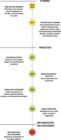
This methodological study aimed to develop and assess an educational tool.(15) The instructional design model was applied to create the animated infographic, a model widely used to produce educational materials in the health field.(16,17) This framework consisted of four stages, namely planning, production, implementation, and assessment, and their respective subdivisions.(17,18)Figure 1 describes them.
The planning phase was based on previous studies that developed printed educational materials on fall prevention and assessed their effectiveness.(8,19)The database contained opinions from patients and nursing professionals. These opinions informed the situational diagnosis, the content development, and the infographic interface.(4,8)
After compiling the data, a script was created and divided into seven topics: (1) introduction; (2) fall risks associated with patients; (3) fall risks associated with the environment; (4) fall prevention; (5) exercise is beneficial; (6) the role of companions; and (7) medications prescribed by the medical team. Each topic contained the main theme, a description of the animations, the content of the dialogue, and the estimated time for each screen.
Regarding production, the instructional and media design was carried to out by a graphic designer. This stage was developed under the supervision of the researcher, who approved the screen layouts and necessary adjustments.
After the infographic was created, the implementation and assessment phases were initiated and conducted concurrently. For the assessment process, the sample of judges was calculated using the formula n = Za2 * P(1-P)/e. The values stipulated for the variables were as follows: confidence level (Za: 95%); judge agreement index (P: 85%); and expected acceptable difference (1-P: 15%). The calculation resulted in 22 judges.
The search for judges was conducted on the Lattes Platform, where those with publications on the following topics were selected: “patient safety”, “fall prevention”, and “educational technologies”. The sample consisted of members of a multidisciplinary team, including nurses, physicians, and physiotherapists. The snowball sampling method was used to complete the sample.(15)
In order for professionals to be considered specialists in the areas of the topics, Jasper (1994) criteria were used, such as possessing knowledge and/or skills in the subject matter of interest, having knowledge/skills acquired through professional experience, and having expertise in a particular type of study.(20) The invitation to participate in the research was sent by email. Upon acceptance, the Google Forms tool was used to send the Confidentiality and Secrecy Agreement, the Educational Health Content Validity Instrument (In Portuguese, Instrumento de Validação de Conteúdo Educativo em Saúde - IVCES)(21), and the infographic in MP4 format. After obtaining the responses, the media production stage was finalized, incorporating experts’ suggestions.
The assessment phase involving the target audience was conducted with 22 patients. They were hospitalized in two medical wards of a teaching hospital that is a reference center in the northern region of the state of Ceará.
Patients hospitalized for more than 12 hours, aged >18 years, and with a suitable mental state after achieving a cut-off score of 21 (for people with 1-3 years of education), 24 (for people with 4-7 years of formal education), and 26 (for people with >8 years of education) on the Mini-Mental State Examination were included.(22) Patients with disabling mental illness, dementia, or who presented hemodynamic instability at the time of data collection (after assessment of their vital signs by professionals in the study departments) were excluded.
The study’s objectives, risks, and benefits were explained to participants. After their acceptance, they were asked to sign the Informed Consent Form. The infographic video was played on the researcher’s mobile phone (4.7 inches; ~12 cm) with audio available. Finally, the Educational Technology in Health Appearance Validity Instrument (In Portuguese, Instrumento de Validação de Aparência de Tecnologia Educacional em Saúde - IVATES) was applied.(23)
To assess and process the data from expert and target audience assessments, the Content Validity Index (CVI) was used, with a Likert-type scale (scoring: 1-5) ranging from strongly disagree to strongly agree. The calculation was performed by summing the items that achieved scores of “4” (considerably suitable) and “5” (totally suitable) and dividing the sum by the total number of responses.(24) CVI value was calculated from the mean of the selected “4” and “5” responses. The binomial test was used to confirm the statistical feasibility of CVI (p-values > 0.05 indicate that the statistical agreement was ≥90% or 95%). A significance level of 5% and a 95% Confidence Interval were adopted. IBM SPSS Statistics software (v. 25) was used for this purpose.
As this research involved human subjects, this study was submitted to the Universidade Federal do Ceará Research Ethics Committee for assessment and was approved under Opinion 5,082,265/2021 and Certificate of Presentation for Ethical Consideration 46335621.3.0000.5054.
Results
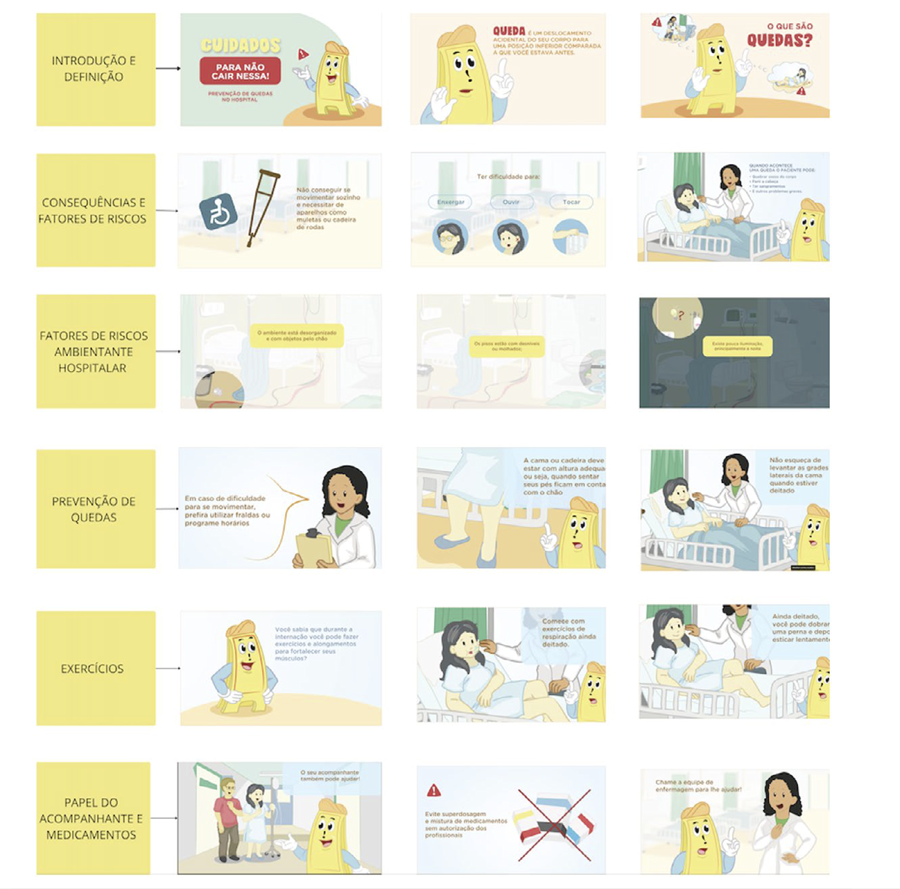
The animated infographic (duration: 7 min 43 s) consists of the following topics: (1) introduction (definition of falls and their consequences); (2) fall risks associated with patients (extreme ages, need for assistance with walking, changes in strength, and musculoskeletal pain); and (3) fall risks associated with the environment (wet or uneven floors, absence of non-slip flooring, presence of loose objects and rugs on the floor, absence of safety bars, and poor lighting).
In addition to describing falls and their risk factors, (4) the infographic also provides guidance on preventing falls. This includes following healthcare professionals’ instructions, reporting all medications being used, reporting any difficulty in moving, asking for help, and wearing closed shoes or non-slip slippers. Furthermore, it is advisable to have a well-lit environment, a clean and dry floor, an appropriate bed and chair height (so that the feet firmly touch the ground when standing up), keep bed rails raised, and (5) perform breathing and leg movement exercises (even while lying down).
Concerning (6) the role of the companions, it is important to communicate to the team whenever it is necessary to be absent and to ask for help from professionals to reposition and/or lift patients. The last topic is about (7) medications (use only if prescribed by the medical team, be careful with overdosing, and communicate with the team when there is a warning sign).
During the playback of the infographic video, there are also interactive questions to draw attention and encourage reflection from viewers. As for the audio, the reading was done with a child’s voice simultaneously with the transcription of written information.
Characters were used to dramatize the narrative through actions experienced by the patient, companion, nurse, and the “alertinha” mascot (a wet floor warning sign). The setting represented was a hospital inpatient unit with objects familiar to patients. The infographic animation (available for access at https://youtu.be/VVfrNKXy0lg?si=YUmBRGGl1_bvUEXD) was created by a professional graphic designer. This work was supervised by the research team to ensure that the illustrations are attractive and representative of hospital settings (Figure 2).

After the infographic was completed, it was assessed by healthcare professionals and the target audience. In relation to professional assessment, the sample consisted of 22 nurses. They held predominantly master’s (11), doctoral (6), and specialization with lato sensu graduate degrees (5). They had experience in teaching and research (12), worked in hospital care (7), and held management positions (1). The educational content was assessed by specialists, with maximum agreement on all items assessed (Table 1). The overall CVI value (1.00) is considered the gold standard. This means that the objective, structure, presentation, and relevance were achieved. Its content is therefore suitable for the teaching-learning process during health education.
Table 2 shows the results of the assessment by the target audience regarding appearance. It is composed of the 12 assessment items of the IVATES. Of these, eight were assessed with unanimous agreement among participants. Thus, the overall CVI was 0.975. Considering the values adopted for p-value and statistical agreement, appearance was considered valid by users for visual communication of the educational health technology.
After assessing the content by healthcare professionals and its appearance by the target audience, the animated infographic on fall prevention in hospitals was considered valid.
Discussion
Falls in hospital settings can cause direct harm to patients’ health, with physical, psychological, and social impacts, insecurity due to fear of falling again, depression, and higher rates of hospitalizations due to complications. Therefore, fall prevention has become a strategic priority in international organizations.(1) This study is therefore aligned with the international campaign for patient safety (2023) and their empowerment to improve their safety.(25)
Due to the multidimensional nature of fall risks, educational interventions using different methodologies are necessary, targeting both patients and their companions. Nursing assessment, personalized educational interventions, and active patient involvement are all part of the fall prevention process. However, the participation of companions is an empowering strategy that should be prioritized in educational strategies.(6)
To achieve this, there must be co-participation from patients, companions, and healthcare professionals. Therefore, educational technologies can be used as a mediating tool to optimize this partnership. In this way, we chose animated infographics in multimedia format. Its essence is based on presenting information in the form of digital animation. Thus, the configuration of media using explanatory texts, movements, audio, and animations for disseminating content significantly increases interaction, transmission, and construction of knowledge.(26,27)
From this perspective, the educational technology content was based on guidelines regarding the main risk factors for falls in hospital settings, highlighting the role of both patients and family members and/or companions in fall prevention. In the content validity process, this information was considered relevant and was deemed valid, clear, and conducive to behavioral change by experts (CVI=1; p=1).
These educational materials align with studies that have developed educational technologies to prevent falls in hospital settings. They provide information on preventive measures, seeking to raise awareness and encourage the active involvement of patients and their families in preventive care. Furthermore, they highlight the role of healthcare professionals, such as nurses, in preventing this adverse event, reinforcing the importance of collaborative action in fall prevention.(28,29)
Similarly, studies that sought to develop educational technologies to prevent falls in the homes of older adults also highlight environmental, socioeconomic, and behavioral risk factors as key content, as well as the preventive measures to be adopted.(30-32)
When infographics are used in an educational context, they have the structural capacity to synthesize and transmit complex information in a simple, clear, and fast way, making them valuable for promoting health education and providing instructions.(12,33,34) Educational content transmitted through accessible, simple, and instructive language can facilitate the processing, understanding, and retention of knowledge, providing greater engagement and interaction of patients in health education mediated by this technology.
In this view, researchers emphasize that the language used to create the scripts for the infographics should be clear and concise to facilitate understanding by different audiences. Furthermore, it should encourage reflection on the subject and shared responsibility of patients in the care process by using interactive questions in a conversational tone.(35)
Simultaneously, illustrations (images, objects, a character, and a mascot) were used to facilitate the presentation and understanding of the content by the audience. Visual cues were introduced to encourage reflection and interaction with the audience, using the character and a mascot to represent hospital settings and the risks of falls. A study reinforced that learners engage, process, and retain information more effectively using illustrations, diagrams, and animations than using only textual elements.(34)
These resources help in acquiring knowledge, as they allow for the content to be presented and organized in a logical, clear, objective, interactive, playful, and attractive way to users. This provides meaningful learning, greater memorization and retention of knowledge and necessary skills, which can last in the short, medium, and long term.(12)From this perspective, we emphasize that illustrations have criteria, such as colors, size, and cultural appropriateness, for their development.
Such structures must be planned and not chosen arbitrarily, as the objective is to represent information from patients’ daily lives to facilitate understanding of the content, not to visually overload or confuse. Confusing images can convey subliminal messages (e.g., the color red suggests emergencies or negative results). Similarly, the texts and fonts that accompany illustrations should be of an appropriate and accessible size. To this end, partnering with a professional graphic designer contributes to developing high-quality technology, making the illustrations appealing to the lay audience.(36)
Considering that the time available for attending to users is increasingly limited, long and exhaustive presentations should be avoided to make learning efficient and facilitate adoption, acceptance, and use of the technology by the audience. Another method to obtain active participation from patients is to ask questions that promote reflection, which are then associated with learning using audio and visual elements.(37)
After a harmonious construction of content and layout, technology will only be useful if it can transmit knowledge, induce behavioral change in patients, encouraging them to take ownership of their care, or rather, promote health literacy.(38)For this to happen, assessment and appraisal by experts confer reliability to the technology.(13)
In the present study, the animated infographic obtained a CVI of 1,0, thus being considered valid by experts. This is consistent with other studies available in the literature, whose animated infographics obtained a valid CVI value (≥80%),(39,40) highlighting the relevance and appropriateness of this audiovisual technology as a suitable resource for health education.
A methodological study confirmed this statement, highlighting that infographics are a valid type of technology. Furthermore, the researchers stated that this material is informative, facilitates self-learning, and that its use can strengthen the practice of health education.(41) Therefore, we emphasized that validity should be comprehensive, as it is a final stage in the technology development process and an opportunity to suggest modifications, contributing to ensuring the technology’s reliability and viability.
In addition to validity by judges, we emphasized the importance of assessment by the target audience. They can express whether the proposed objective was achieved, offer criticism and/or provide suggestions, thus contributing to improving and adjusting aspects essential to the technology’s usability.(42) In the present study, the technology was considered suitable by the target audience, providing clear animations that were representative of the content and encouraged behavioral change.
Considering the above, as well as the scarcity of educational technologies to prevent falls in the hospital context, this study will contribute to professional nursing practice in hospital settings because it is a tool that was built specifically for this context and considered valid by specialists. This educational technology can be used as a tool for health education to transmit information about care to prevent falls in hospital settings, and because it is an animated infographic, it becomes more attractive and pedagogical to the audience. In addition, its format optimizes professionals’ time and allows it to reach many people through a single reproduction.
The animated infographic can be used in different hospital sectors and reach a large audience in a single reproduction. It can be accessed on digital platforms and played on multimedia devices, allowing for playback at any time and as many times as needed by patients as well as being low-cost. Furthermore, the language used in the infographic reaches two different channels (audio and visual) that interact with each other in the processing of stimuli. Thus, the chances of content retention and learning are greater, which reinforces other healthcare measures to prevent falls.
The limitations of this study lie in the high cost of development, as it is necessary to hire a graphic design professional to produce the visual elements and align them with the audio. Furthermore, the effectiveness with the target audience was not verified, which suggests this as an area for future study.
Conclusion
Since the risk of falls is a real problem during hospital stays and their occurrence leads to several complications, prevention methods are necessary, and health education using educational technology is an effective strategy to provide knowledge on the subject. The developed infographic is valid in terms of appearance and content to guide hospitalized patients about the risks of falls in hospital settings, useful for conveying information on the subject while also being attractive and easy to understand. Therefore, it can be used in health education sessions for hospitalized patients.
References
-
1 World Health Organization (WHO). Global patient safety action plan 2021-2030: towards eliminating avoidable harm in health care. 2021. Available from: https://www.who.int/teams/integrated-health-services/patient-safety/policy/global-patient-safety-action-plan
» https://www.who.int/teams/integrated-health-services/patient-safety/policy/global-patient-safety-action-plan -
2 van Rensburg RJ, van der Merwe A, Crowley T. Factors influencing patient falls in a private hospital group in the Cape Metropole of the Western Cape. Health SA. 2020;25:1392. doi: 10.4102/hsag.v25i0.1392. Erratum in: Health SA. 2021;26:1773.
» https://doi.org/10.4102/hsag.v25i0.1392 - 3 Kim J, Lee E, Jung Y, Kwon H, Lee S. Patient-level and organizational-level factors influencing in-hospital falls. J Adv Nurs. 2022;78(11):3641-51.
- 4 Ximenes MA, Brandão MG, Araújo TD, Galindo Neto NM, Barros LM, Caetano JÁ. Effectiveness of educational interventions for fall prevention: a systematic review. Texto & Contexto Enfermagem. 2021; 30:e20200558
- 5 Hopewell S, Adedire O, Copsey BJ, Boniface GJ, Sherrington C, Clemson L, et al. Multifactorial and multiple component interventions for preventing falls in older people living in the community. Cochrane Database Syst Rev. 2018;7(7):CD012221.
- 6 Dykes PC, Burns Z, Adelman J, Benneyan J, Bogaisky M, Carter E, et al. Evaluation of a Patient-Centered Fall-Prevention Tool Kit to Reduce Falls and Injuries: A Nonrandomized Controlled Trial. JAMA Netw Open. 2020;3(11):e2025889-2025889.
- 7 Ojo EO, Thiamwong L. Effects of Nurse-Led Fall Prevention Programs for Older Adults: A Systematic Review. Pac Rim Int J Nurs Res Thail. 2022;26(3):417-31.
- 8 Ximenes MA, Fontenele NÂ, Bastos IB, Macêdo TS, Galindo NM, Caetano JÁ, et al. Construction and validation of educational booklet content for fall prevention in hospitals. Acta Paul Enferm. 2019;32:433-41.
- 9 Zhao R, Zhao X, Guan J, Zhang C, Zhu K. The effect of virtual reality technology on anti-fall ability and bone mineral density of the elderly with osteoporosis in an elderly care institution. Eur J Med Res. 2023;28(1):204.
- 10 Ferreira FM, Silva FD, Natarelli TR, Mello DF, Fonseca LM. Child vaccination in animated infographic: technology for permanent education about the nursing process. Rev Esc Enferm USP. 2023;57:e20220423.
- 11 Lackmann S, Léger PM, Charland P, Aubé C, Talbot J. The Influence of Video Format on Engagement and Performance in Online Learning. Brain Sci. 2021;11(2):128.
- 12 Taye R, Archana, Junaid A, Singh DD. A qualitative evaluation of infographics and its uses in healthcare communication. Ulster Med J. 2022;91(1):59-60.
- 13 Pacheco CR, Caniçali Primo C, Fioresi M, Sequeira CA, Nascimento LD, Lopes AB, et al. Infusão endovenosa domiciliar: tecnologias educativas para o cuidado à pessoa com hemofilia. Acta Paul Enferm. 2022;35:eAPE02902.
- 14 Santos RO, Abreu MM, Migowski A, Engstrom EM. Decision aid for prostate cancer screening in Brazil. Rev Saude Publica. 2022;56:19.
- 15 Polit DF, Beck CT, Hungler BP. Fundamentos de pesquisa em enfermagem. 9th ed. Porto Alegre: Artmed; 2019.
- 16 Lima Neto AV, Silva IP. Mesquita SKDC, Salvador PTCDO, Almeida TDCF, Oliveira PPD, Costa IKF. Application prototype for patient education before coronary artery bypass graft surgery. Acta Paul Enferm. 2023;36:eAPE010731.
- 17 De Sousa MM, Lopes CT, Almeida AA, Almeida TD, Gouveia BD, Oliveira SH. Development and validation of a mobile application for heart failure patients self-care. 2022;56: e20220315
- 18 Maciel AM, Rodrigues RL, Carvalho Filho EC. Desenvolvimento de uma Ferramenta para a Construção e Integração de Personagens Virtuais Animados com Voz Sintética aos Materiais Didáticos para EAD. Rev Bras Inform Educ. 2015;23(1):161.
- 19 Ximenes MAM, Brandão MGSA, Macêdo TS, Costa MMFD, Galindo Neto NM, Caetano JÁ., et al. Effectiveness of educational technology for preventing falls in a hospital environment. Acta Paul Enferm. 2022;35:eAPE01372.
- 20 Jasper MA. Expert: a discussion of the implications of the concept as used in nursing. J Adv Nurs. 1994;20(4):769-76.
- 21 Leite SD, Áfio AC, Carvalho LV, Silva JM, Almeida PC, Pagliuca LM. Construção e validação de Instrumento de Validação de Conteúdo Educativo em Saúde. Rev Bras Enferm. 2018;71:1635-41.
- 22 Brucki SM, Nitrini R, Caramelli P, Bertolucci PH, Okamoto IH. Sugestões para o uso do mini-exame do estado mental no Brasil. Arq Neuropsiquiatr. 2003;61 3B:777-81.
- 23 Souza AC, Moreira TM, Borges JW. Development of an appearance validity instrument for educational technology in health. Rev Bras Enferm. 2020;73 Suppl 6:e20190559.
- 24 Alexandre NM, Coluci MZ. [Content validity in the development and adaptation processes of measurement instruments]. Cien Saude Colet. 2011;16(7):3061-8.
-
25 World Health Organization (WHO). World Patient Safety Day 2023: Engaging Patients for Patient Safety. WHO; 2023. [cited 2025 Sep 28]. Available from: https://www.who.int/news-room/events/detail/2023/09/17/default-calendar/world-patient-safety-day-2023--engaging-patients-for-patient-safety
» https://www.who.int/news-room/events/detail/2023/09/17/default-calendar/world-patient-safety-day-2023--engaging-patients-for-patient-safety - 26 Prada Penagos R, Ladino Marín PC, Adán Diaz OE. Lineamientos para el uso de la hipermedialidad, multimedialidad e interactividad en el ejercicio periodístico digital comunitario para redes sociales (Facebook). Caso de análisis de la Red de Reporteros Comunitarios de Colombia (RRC). Anagramas Rumbos Sentidos Comun. 2022;20(40):47-74.
- 27 Lazic A, Kalinova KN, Packer J, Pae R, Petrovic MB, Popovic D, et al. Social nudges for vaccination: how communicating herd behaviour influences vaccination intentions. Br J Health Psychol. 2021;26(4):1219-37.
- 28 Campos DC, Silva LF, Reis AT, Góes FG, Moraes JR, Aguiar RC. Development and validation of an educational video to prevent falls in hospitalized children. Texto Contexto Enferm. 2021;30:e20190238.
- 29 Alves RC, Colichi RM, Lima SA. Technological strategies aimed at fall prevention in hospital environments: an integrative review. Acta Paul Enferm. 2023;36:eAPE01462.
- 30 de Jong LD, Francis-Coad J, Wortham C, Haines TP, Skelton DA, Weselman T, et al. Evaluating audio-visual falls prevention messages with community-dwelling older people using a World Café forum approach. BMC Geriatr. 2019;19(1):345.
- 31 Diniz JL, Coutinho JF, Marques MB, Santos IS, Barbosa RG, Silva RD, et al. Development and testing of the Prev'Quedas game for older adults in the community: a descriptive study. Rev Bras Enferm. 2022 Oct;75(75 Suppl 4):e20220098.
- 32 Sá GG, Santos AM, Galindo Neto NM, Carvalho KM, Feitosa CD, Mendes PN. Building and validating an educational video for elderly individuals about fall risks. Rev Bras Enferm. 2020;73 Suppl 3:e20200010.
- 33 Costa JF, Domingues AN, Fonseca LM. Desenvolvimento e avaliação de infográfico animado: medicação segura em saúde da criança. Acta Paul Enferm. 2022;35:eAPE0387345.
- 34 Kok DL, Dushyanthen S, Peters G, Sapkaroski D, Barrett M, Sim J, et al. Screen-based digital learning methods in radiation oncology and medical education. Tech Innov Patient Support Radiat Oncol. 2022;24:86-93.
- 35 Dorneles LL, Martins VD, Morelato CS, Goes FD, Fonseca LM, Camargo RA. Development of an animated infographic on Permanent Health Education. Rev Lat Am Enfermagem. 2020;28:e3311.
- 36 Traboco L, Pandian H, Nikiphorou E, Gupta L. Designing Infographics: Visual Representations for Enhancing Education, Communication, and Scientific Research. J Korean Med Sci. 2022;37(27):e214.
- 37 Mayer RE. Evidence-based principles for how to design effective instructional videos. J Appl Res Mem Cogn. 2021;10(2):229-40.
- 38 Lim ML, van Schooten KS, Radford KA, Delbaere K. Development and initial validation of the falls health literacy scale. Maturitas. 2022;159:40-5.
- 39 Costa JF, Domingues AN, Fonseca LM. Development and assessment of animated infographic: safe medication for children's health. Acta Paul Enferm. 2022;35:eAPE0387345.
- 40 Ferreira FM, Silva FD, Natarelli TR, Mello DF, Fonseca LM. Child vaccination in animated infographic: technology for permanent education about the nursing process. Rev Esc Enferm USP. 2023;57:e20220423.
- 41 Oliveira YS, Costa R, Lima MM, Velho MB, Gomes IE, Wilhelm LA, et al. Infographic for pregnant women and caregivers: educational technology in the context of obstetric care. Cogitare Enferm. 2023;28:e87939.
- 42 Gigante VC, Oliveira RC, Ferreira DS, Teixeira E, Monteiro WF, Martins AL, et al. Construction and validation of educational technology about alcohol consumption among university students. Cogitare Enferm. 2021;26:e71208.