Water hyacinth as a phytoremediation agent for wastewater in Mexico: a review
Abstract
This systematic review evaluates the use of Eichhornia crassipes as a phytoremediation agent in Mexico, based on scientific studies published between 1990 and 2023 following PRISMA guidelines. The analyzed works were classified into four categories: heavy-metal removal (54%), treatment of water with high organic load (15%), dye removal (18%), and other uses (13%). The geographical analysis identified the Mexican states where biomass was collected for phytoremediation experiments. In heavy-metal removal, 87.5% of studies specified collection sites, mainly in the State of Mexico; in organic-load treatment, 66.7% reported works in Baja California Norte, Sinaloa, Tabasco, and Tlaxcala; while in dye removal, 87.5% documented biomass origin, mostly from Mexico City. Results across categories showed reproducible performance in both field and laboratory conditions. For metal remediation, E. crassipes exhibited high bioaccumulation capacity, with removal efficiencies of about 90% for Pb and 85% for Cd, concentrated in roots. In waters with high organic content, constructed and free-surface wetland systems achieved reductions above 60-90% in COD, BOD₅, total nitrogen, and phosphorus, depending on design and retention time. It should be emphasized that the dye-related studies using Eichhornia crassipes tissues as a metabolically inactive sorbent, rather than in situ phytoremediation based on living plants. Regarding dyes, cyclic biosorption with dried or treated tissues achieved near-complete color removal and maintained adsorption efficiency over multiple cycles, evidencing long-term stability of the bioadsorbent. Additionally, some studies emphasized its potential for pesticide retention and nanoparticle synthesis, suggesting emerging research directions that expand its application beyond conventional wastewater treatment.
Keywords:
Eichhornia crassipes; Mexico; phytoremediation
Resumo
Esta revisão sistemática avalia o uso de Eichhornia crassipes como agente de fitorremediação no México com base em estudos científicos publicados entre 1990 e 2023 e seguindo as diretrizes PRISMA. Os trabalhos analisados foram classificados em quatro categorias: remoção de metais pesados (54%), tratamento de águas com alta carga orgânica (15%), remoção de corantes (18%) e outros usos (9%). A análise geográfica identificou os estados mexicanos onde a biomassa foi coletada para experimentos de fitorremediação. Na remoção de metais pesados, 87,5% dos estudos especificaram locais de coleta, principalmente no Estado do México. No tratamento de cargas orgânicas, 66,7% relataram estudos em Baja California Norte, Sinaloa, Tabasco e Tlaxcala. Enquanto na remoção de corantes, 87,5% documentaram a origem da biomassa, sobretudo na Cidade do México. Os resultados das categorias demonstraram desempenho reprodutível em condições de campo e laboratório. Para a remediação de metais, E. crassipes apresentou alta capacidade de bioacumulação, com eficiências de remoção de aproximadamente 90% para Pb e 85% para Cd, concentradas nas raízes. Em águas com elevado conteúdo orgânico, sistemas de áreas úmidas construídas e de superfície livre alcançaram reduções superiores a 60-90% em DQO, DBO₅, nitrogênio total e fósforo, dependendo do design e do tempo de retenção. Deve-se enfatizar que os estudos relacionados a corantes avaliam a biossorção utilizando tecidos de Eichhornia crassipes colhidos, secos ou tratados quimicamente como um sorvente metabolicamente inativo, governado por interações físico-químicas na superfície, em vez de fitorremediação in situ baseada em plantas vivas. Em relação aos corantes, a biossorção cíclica com tecidos secos ou tratados atingiu remoção quase completa da cor e manteve a eficiência de adsorção ao longo de múltiplos ciclos, evidenciando estabilidade de longo prazo do bioadsorvente. Além disso, alguns estudos destacaram seu potencial para retenção de pesticidas e síntese de nanopartículas, sugerindo direções emergentes de pesquisa que ampliam sua aplicação além do tratamento convencional de águas residuais.
Palavras-chave:
Eichhornia crassipes; fitorremediação; México
1. INTRODUCTION
Wastewater is defined as water that has been used by humans in industrial, domestic, commercial, and agricultural activities, containing high content of organic and inorganic materials; it must be treated before being discharged into the environment (Kasmuri et al., 2023). The disposal of untreated wastewater and effluents into surface waters is a highly regulated issue in many countries; however, it’s estimated that worldwide nearly 80% of the water used is neither collected nor treated, it is simply released into waterways (Corcoran et al., 2010; Ismail and Beddri, 2009).
The treatment of contaminated water commonly consists of traditional physical, biological and chemical processes, such as reverse osmosis, ion exchange, electrodialysis, chemical precipitation, flocculation, and adsorption with activated carbon (Shrimali and Singh, 2001). However, the process’s effectiveness depends on the concentration and type of contaminant to be treated (Newete and Byrne, 2016). Moreover, these processes are associated with several negative outcomes in their application, including environmental harms and footprints, low cost - effectiveness ratio, difficulties in combining with other methods, as well as the generation of secondary pollutants (Farraji et al., 2016; Ferreira et al., 2016). For this reason, research has focused on identifying more effective techniques for contaminant removal that are easier to apply, scalable, and more environmentally friendly, such as phytoremediation, an emerging technology that has become a viable option for improving the quality of wastewater effluents.
Phytoremediation is a branch of biotechnology that relies on the use of plants for the in situ reduction, degradation, extraction, transformation, mineralization, volatilization, and stabilization of organic and inorganic contaminants in water, sediments, soils and air, through biological, biochemical, chemical or physical processes carried out by the plants, associated with their structure and morphology (Arthur et al., 2005; Núñez López et al., 2004; Delgadillo-López et al., 2011; Marrero-Coto et al., 2012).
There is a wide variety of phytoremediation techniques, called phytotechnologies, which are based on the physiological mechanisms that occur in plants and the microorganisms associated with them (photosynthesis, metabolism, nutrition and transpiration) (Delgadillo-López et al., 2011). Phytotechnologies are related either to the participation of different plant structures or to specific physiological processes, being classified according to the remediation objective in two major approaches: elimination phytotechnologies, which involve removing, transforming, or releasing contaminants present in the environment, such as non-hazardous compounds (phytoextraction, phytovolatilization and phytodegradation); and containment phytotechnologies, immobilize or stabilize contaminants, preventing their dispersion in the environment (such as rhizofiltration, phytostabilization or phyto immobilization) (Thangavel and Subbhuraam, 2004). The following sections briefly describe the phytoremediation methods involving both approaches.
1.1. Elimination Methods
Phytoextraction: Also known as phytoaccumulation or phytosequestration, this process involves the uptake and absorption of contaminants by plant roots, followed by their transport and accumulation in the aerial parts, such as stems and leaves. It is important to note that the transport process into the plants is defined as translocation, which is a necessary and fundamental biochemical mechanism for effective phytoremediation. The main contaminants removed through this elimination method are heavy metals, although organic pollutants as well as radioactive elements and isotopes can also be extracted (Molero Montoya, 2023; Núñez López et al., 2004).
Phytovolatilization: In this type of phytoremediation, soil or water contaminants are absorbed by the plant roots and subsequently translocated to the aerial parts, where they are transformed through metabolic activities into less toxic or active volatile substances, which are then released to the atmosphere during transpiration. It should be noted that this method is controversial because, in most cases, the contaminant’s toxicity is not eliminated; rather, the process only transfers the pollutant from the soil or water to the atmosphere. It is not certain whether the release of volatiles into the atmosphere is safe, since there is a probability that these compounds may return to the environment and affect other organisms. Therefore, the use of this method must be carefully evaluated before being applied (Lakshmi et al., 2017; Molero Montoya, 2023).
Phytodegradation: This process involves the metabolism of contaminants within plant tissues through enzymes such as dehalogenases and oxygenases, which catalyze the degradation and decomposition of pollutants into simpler molecules, or their mineralization into CO2 and H2O. The success of this technology largely depends on the synergistic interactions among plants, microorganisms, and the surrounding environment (Agudelo Betancur et al., 2005; Singh and Jain, 2003).
In this context, two distinct treatment configurations involving Eichhornia crassipes are discussed in this review and should not be conflated. First, phytoremediation refers to the use of living plants (typically in free-floating or constructed wetland configurations), where removal performance arises from plant-mediated and rhizosphere processes (e.g., uptake, internal transport, rhizofiltration, and plant-microbe interactions) under a hydraulic design governed by surface area, water depth, and hydraulic retention time. Second, biosorption - based dye removal refers to the use of harvested, dried, or chemically treated plant tissues as an inactive biosorbent, where removal is driven by physico-chemical, metabolically independent mechanisms at the solid-liquid interface (e.g., adsorption/ion exchange/surface complexation). Accordingly, biosorption systems are designed as adsorption units (e.g., batch reactors or packed-bed columns) rather than wetland geometries (Fomina and Gadd, 2014). This distinction is maintained throughout the review to avoid conceptual and design-level conflation.
1.2. Containment Methods
Rhizofiltration: Also known as phytoremediation by filtration, this process removes contaminants from surface water or wastewater by hydroponically cultivating plants with high growth rates and large surface areas until they develop root systems capable of adsorbing or absorbing pollutants present in waste streams or aquatic flows. As the plants grow, contaminants are absorbed by the roots or seedlings (a process known as blastofiltration). Once saturation occurs, the plants are harvested either entirely or only from the root for subsequent disposal. The success of this technique depends on the plant’s metabolism (Núñez López et al., 2004; Lakshmi et al., 2017; Molero Montoya, 2023).
Phyto immobilization (Phyto stabilization): This is a containment process that limits the mobility and bioavailability of contaminants in water through their absorption and accumulation in roots, precipitation and reduction of metallic valence in the rhizosphere, or the formation of complexes with certain organic compounds secreted by the roots (Cabrera et al., 2014). Its main objective is to prevent contaminants from being released into food chains.
Through different methods, phytoremediation has gained popularity among government agencies and industries due to its cost-effectiveness, non-invasive nature and socially acceptable approach to addressing environmental pollutants, which are known to cause harmful effects on human health and biological systems (Hu et al., 2020). Therefore, it may be considered an effective and promising method for wastewater purification (Ahmed et al., 2021; Rezania et al., 2016). The advantages and disadvantages of its use compared to other conventional decontamination techniques are presented in Table 1 (Hu et al., 2020; Segretin et al., 2010). As can be observed, phytotechnologies are particularly useful when they are applied to relatively large surface areas with low concentrations of contaminants or immobile pollutants, and where long-term remediation procedures need to be considered.
On the other hand, it is well known that aquatic plants are essential in wastewater treatment, as they can be used for phytoremediation through phytoextraction, rhizofiltration, phytodegradation and phytovolatilization. Aquatic plants employed in phytoremediation systems can be classified into three major groups: emergent, submerged and floating. The latter can, in turn, be divided into two subgroups: floating - leaved plants (fixed) and free - floating plants (non - fixed). In free - floating plants, the leaves and stems develop on the water surface, while their roots are not anchored to any substrate but instead hang within the water column (Núñez López et al., 2004). Within this group are aquatic macrophytes, which are considered cost - effective and ecological tools, and whose use in phytoremediation has been documented (Newete and Byrne, 2016).
Water hyacinth (Eichhornia crassipes) is a free - floating hydrophytic aquatic plant belonging to the family Pontederiaceae (Patel, 2012). It is native to the Amazon basin and extensive lakes and wetlands of the Pantanal region in Brazil, as well as certain areas of Ecuador, and has become naturalized in tropical and subtropical regions of South America (Rodríguez-Lara et al., 2022). This species arrived in Mexico at the end of the 19th century, spreading rapidly until it became an invasive weed. It is estimated that it covers approximately 40,000 hectares of aquatic bodies and lakes, being widely distributed in central Mexico, along the Pacific slope to the south, and in the Gulf of Mexico from Tamaulipas to the Yucatán Peninsula, in a diversity of freshwater ecosystems from sea level up to 2,250 m of altitude (Cervantes-Sánchez and Rojas-Rabiela, 2000; CONABIO, 2025; Miranda et al., 1999).
Biomass derived from water hyacinth can be used for phytoremediation due to its capacity for contaminant bioaccumulation - particularly heavy metals such as lead, mercury, cadmium, silver, cobalt and strontium, as well as for the removal of organic substances present in aquatic systems (Patel, 2012). The morphology of its roots, together with its high rate of reproduction and growth are essential characteristics that have positioned this species as an effective tool for phytoremediation. In an effort to analyze its impact in Mexico, this study presents a systematic review of the literature focused on research addressing the use of water hyacinth in the remediation of contaminated waters. The review concentrated on studies regarding the water lily applied to the removal of heavy metals, the elimination of organic compounds present in domestic and industrial wastewater, and the adsorption of dyes, in addition to the exploration of bioremediation models to optimize treatment systems using this plant. The review highlights the effectiveness of water hyacinth as a sustainable and potentially low-cost alternative under appropriate local and operational conditions in Mexico.
2. MATERIAL AND METHODS
The systematic literature review was conducted following PRISMA methodology (Preferred Reporting Items for Systematic Reviews and Meta - Analyses), which is a structured approach that ensures transparency and comprehensiveness in systematic reviews, with the aim of retrieving, screening and selecting relevant scientific literature on the use of Eichhornia crassipes as a phytoremediation agent in the Mexican context. A total of 47 articles published between 1990 and 2023 were analyzed.
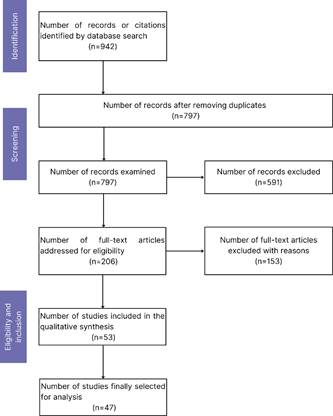
As inclusion criteria, only studies whose main focus was the use of water hyacinth as a phytoremediation agent were selected, while those conducted outside Mexico were excluded. The PRISMA approach was structured into four phases: 1) Identification, 2) Screening, 3) Eligibility, and 4) Inclusion (Liberati, 2009; Moher et al., 2010; Page et al., 2021). In the identification phase, articles were searched from scientific databases (Elsevier, Redalyc, SciELO, Springer, Web of Science and Google Scholar) using keywords such as “Lirio acuático”, “Eichhornia crassipes”, “Fitorremediación”, “México”, “Water hyacinth”, “Phytoremediation” and “Mexico”, which yielded a total of 942 records. In the screening phase, duplicates and irrelevant articles were removed. In the eligibility phase, a total of 206 full-text articles were evaluated to ensure compliance with the established criteria. Finally, in the inclusion phase, the studies that met the criteria and provided significant data on the use of water hyacinth in wastewater phytoremediation in Mexico were selected. The detailed flow of the selection process is presented in Figure 1.
PRISMA Flow Diagram for the selection of articles on the use of water hyacinth as a phytoremediation agent in Mexico.
Once the articles were selected, they were classified into four main categories according to the approach of each study:
Removal of heavy metals, including research on the ability of water hyacinth to adsorb and accumulate these types of contaminants.
Treatment of water with high organic content, in which the elimination of compounds from domestic and industrial wastewater was evaluated.
Studies focused on the adsorption of industrial dyes, mainly textiles, by biosorption processes were analyzed.
Other uses of water hyacinth for treatment, including the removal of pesticides and other compounds.
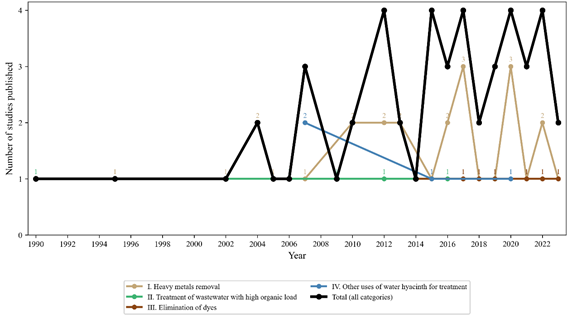
This classification allowed the results to be structured in order to identify patterns and trends in Mexico. Figure 2 shows the trend in water hyacinth research as a phytoremediation agent between 1990 and 2023 in Mexico. As can be observed, during the first fifteen years (1990-2005) the studies were scarce, with less than one study per year; but from 2005 onward a gradual increase occurs, reaching peaks of 3 to 4 studies per year. In the following decade (2010 to 2020) interest remained constant with fewer variations. This behavior reflects a sustained growth in research on phytoremediation.

On the other hand, Figure 3 shows the percentage distribution of the studies carried out on the water hyacinth in different phytoremediation applications. The largest proportion, 54%, corresponds to research focused on the removal of heavy metals, which reflects the predominant interest in the use of the plant to mitigate these toxic elements. The treatment of water with high organic load represented 15% of the studies; on the other hand, 18% focused on the elimination of dyes and, to a lesser extent, other uses of water hyacinth for water treatment and phytoremediation models, with 9% and 4%, respectively.
Likewise, based on the previously established categorical classification, the information regarding the geographical origin of the water hyacinth used in the phytoremediation studies included in this research was analyzed for each group of studies. The analysis considered whether the study explicitly reported the location of the water body where the plant (biomass) was collected. This level of detail is highly relevant to evaluate the local applicability of the studies, as well as to identify regional patterns in the use of water hyacinth as a remedial agent.
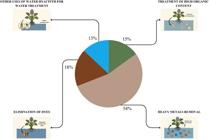
Distribution of studies on the use of water hyacinth in different phytoremediation applications.
The results of the categorical classification and statistical analysis of the geographical distribution by states of the Mexican Republic where the biomass collection for phytoremediation purposes was reported are presented next. Likewise, the documentation around the different applications of phytoremediation with water hyacinth is integrated, organized into the 4 established categories, with the aim of identifying research patterns and areas of opportunity.
3. RESULTS AND DISCUSSION
Based on the articles included in this systematic review, a categorization was established according to the type of contaminant addressed by using water hyacinth as phytoremediation. Studies were organized into four main categories: 1. Heavy metal removal, 2. Treatment of water with high organic content, 3. Removal of dyes, and 4. Other uses of water hyacinth associated with emerging pollutants or unconventional parameters.
Analysis of the geographical distribution of reported collection sites of aquatic lily used for different phytoremediation applications in Mexico discovered the following areas (see Figure 4).
The "heavy metal removal" category accounted for 54% of all studies, of which 87.5% explicitly documented the place of collection of the plant, with the State of Mexico being the most represented, with 50% of the total. This can be attributed to the high presence of water hyacinth in contaminated water bodies, dams and urban canals of this region, followed by Mexico City and Puebla with 12.5%, Guanajuato and San Luis Potosí with 8.33%, and finally Veracruz and Zacatecas with 4.16%. On the other hand, in the category "Treatment of water with high organic content" using Eichhornia crassipes, 66.66% reported the biomass collection, while 33.34% did not specify this information in their methodology. Among the studies that specified the information, the data referred to the site and timing of water hyacinth harvesting as part of the experimental setup, an equitable distribution was identified between the states of Baja California Norte, Sinaloa, Tabasco and Tlaxcala, with 25% of the total. This geographical dispersion suggests cross-sectional exploration and growing interest in various regions of the country to implement nature-based environmental solutions.

Geographical distribution of reported collection sites of Eichhornia crassipes for different phytoremediation applications in Mexico.
For the category of "Removal of dyes", 87.5% reported extraction of water bodies, while 12.5% did not specify information. Within the subset that, when the source of biomass is reported, Mexico City stands out predominantly, representing 71.42% of studies in this category. The states of Veracruz and Guanajuato follow with 14.28%. This concentration suggests that, in urban contexts, particularly in metropolitan areas such as the Valle de México, research has focused on the treatment of wastewater stained with synthetic dyes, typically for the textile or food sector. Finally, in the category "Uses of water hyacinth in the field of phytoremediation", 50% of the studies reported the state of origin of the biomass. The studies that reported the place of extraction were located exclusively in Mexico City, representing 100% of the total, again highlighting the role of this region as a strategic hub for environmental studies.
Based on the categorization established in the results section, the following discussion addresses each group of studies to interpret their environmental significance and research scope. This approach allows linking the quantitative trends with the scientific context of phytoremediation using Eichhornia crassipes in Mexico.
3.1. Removal of heavy metals
Heavy metals have been defined as chemical elements characterized by a high density above 4 g/cm3 and an atomic weight above 20 u. These elements, even in low concentrations, can be highly toxic and harmful to the environment and health. Among the metals grouped in this category are lead (Pb), cadmium (Cd), manganese (Mn), aluminum (Al), copper (Cu), beryllium (Be), iron (Fe), mercury (Hg), among others (Londoño Franco et al., 2016).
The increasing rates of heavy metal pollution from industrial sources and anthropogenic activities are a critical problem on a global scale (Akar et al., 2009; Cartaya et al., 2008). As mentioned above, the presence of these pollutants in effluents and water bodies represents a latent threat, due to their indefinite persistence in the environment and their toxicity, compromising the population’s health and causing disturbances in the balance of ecosystems, affecting fauna and flora as well as trophic levels. In addition, heavy metal contamination has had significant economic impacts by increasing medical treatment costs, reducing economic productivity at local and national levels (García Villegas et al., 2011; Pabón et al., 2020; Tejada-Tovar et al., 2015).
Water hyacinth is an effective and promising tool in the field of phytoremediation (Carreño-Sayago and Rodríguez-Parra, 2019; Moya et al., 2023a; Ramírez-Rodríguez et al., 2023; Sierra-Carmona et al., 2022; Tabla-Hernández, 2019). Several investigations have focused on determining the capacity of the plant to remove heavy metals from contaminated water bodies, through its use in controlled assessments and natural systems, as well as in comparison with other plant species, through the biosorption process, which is a physico-chemical process that can be defined as the removal of substances from aqueous solutions using biological materials such as water hyacinth. Studies of biosorption mechanisms such as adsorption, absorption, surface complexation, precipitation and ion exchange have been intensified by the need to remove heavy metals from industrial effluents (Cuizano et al., 2009; Sala et al., 2010).
From an environmental engineering perspective, percentage removal is informative but not always sufficient to understand transport behavior within the plant. For this reason, several studies complement removal efficiencies with bioaccumulation/bioconcentration indicators (commonly reported as BCF/BF/BAC/FBA depending on the author) and with the translocation factor (TF/FT). In practical terms, bioaccumulation/bioconcentration metrics are interpreted as plant-to-water concentration ratios (often using the submerged compartment as reference), whereas TF describes internal transport from submerged tissues (roots and stolons) to aerial tissues (stems and leaves), commonly expressed as Caerial/Csubmerged. Importantly, TF provides a direct basis to define the harvesting scope: TF < 1 generally indicates preferential retention in submerged structures, supporting root-focused removal, while TF ≥ 1 suggests greater metal presence in aerial biomass, supporting whole-plant harvesting or, at minimum, inclusion of aerial tissues for the target metal(s) (Tabla-Hernández et al., 2019). Accordingly, Table 2 compiles representative BF/BCF/BAC/FBA and TF/FT values reported for Mexican case studies of Eichhornia crassipes, providing an engineering-oriented overview that complements removal percentages and supports decisions on harvesting and subsequent biomass handling.
The following studies have focused on the potential of water hyacinth for heavy metal removal in contaminated water bodies in Mexico, as well as on the determination of plant bioaccumulation and translocation factors:
Ávila (1995) determined concentrations of heavy metals in sediment, water and water hyacinth at the José Antonio Alzate Dam (State of Mexico), focusing on Cr, Fe, Ni, Cu, Zn, Cd, Pb and Hg by chemical analysis. They identified that the largest accumulations of metals in the plant were in the roots, with a decreasing order of accumulation: Zn> Cr> Fe> Ni> Cu> Pb> Hg and Cd; significant correlations were found between the metals. Subsequently, Hernández-San Agustín (2005) addressed the quantification of heavy metals such as Hg, Cd, Cu, Zn, Se and As present in water and soil of the Mortero Dam, located in the municipality of El Oro de Hidalgo, northwest of the State of Mexico, in an area associated with mining activity. In this context, water hyacinth was used as a bioindicator; its results showed that the plant could retain concentrations of Hg up to 1.3 mg/kg in its tissues, confirming its capacity for the accumulation of toxic metals. For their part Ramos et al. (2007) analyzed the ability of water hyacinth to retain contaminants in its structure, and evaluated its ability to absorb metals in its tissues without using external chemical reagents. In that study, an absorption efficiency of up to 50% of Zn in the medium was observed, indicating that the plant can incorporate half of the Zn present in the water column when it accumulates in its biomass, in contrast to other metals, such as Pb, where an absorption efficiency of 7% was achieved, suggesting a selective capacity for certain metals.
Reported bioaccumulation/bioconcentration (BF/BCF/BAC/FBA) and translocation (TF/FT) values for Eichhornia crassipes in Mexico.
Carrión et al. (2012) evaluated aquatic lilies for the removal of 14 metals and 1 metalloid (As) in the canals of Xochimilco (State of Mexico). They applied calculations and statistical analyses to determine the factors of bioaccumulation and plant translocation in different areas of the canals with urban, tourist and agricultural influence. The results showed that the submerged part of the plant had the ability to reduce initial concentrations of metals such as Cr and Pb, with decreases from 0.056 mg/l to 0.022 mg/l and from 0.069 mg/l to 0.015 mg/l, as well as removal efficiencies of 73% and 78%, respectively.
For their part Martínez-Sánchez et al. (2013) evaluated the adsorption of Zn2+ and Cd2+ in roots of vegetative species Eichhornia crassipes and Typha latifolia by kinetic modeling and thermodynamic analysis under laboratory conditions. Through potentiometric measurements in solutions containing one or both ions, they determined that the adsorption kinetics followed a pseudo - second order model, suggesting a chemical interaction controlled by the availability of active sites. Eichhornia crassipes showed a higher accumulation rate and efficiency in the removal of both metals, highlighting the elimination of 85% of the Cd2+ ion. In addition, it was concluded that the adsorption process was spontaneous and endothermic, reinforcing its viability as a bio-adsorbent under controlled conditions. Related to the use of the plant with other materials to improve the remediation process, García Albortante et al. (2015) studied the individual and mixed capacity of natural bio-adsorbents, water hyacinth (W-H) and eggshell (E-S), for Cu removal (II) in aqueous solutions. Three mixture ratios were evaluated: 75% W-H - 25% E-S (mixture 1), 50% W-H-E-S% CH (mixture 2) and W-H% L - 75% E-S (mixture 3), all with initial concentrations of 40 mg/l copper. The results, analyzed by isotherms of Freundlich and Langmuir indicated that the mixtures slightly reduced adsorption efficiency compared to the individual use of each material; however, mixture 1 achieved a removal efficiency of 82%, standing out as the most effective among the evaluated combinations.
Martínez-Sánchez et al. (2016) evaluated the biosorption of Thallium (Tl+) and Cadmium (Cd2+) ions in solution using water hyacinth roots as a modifier on carbon paste electrodes. Experimental data were analyzed and adjusted to Langmuir isotherms and pseudo-second order kinetic models, obtaining removal efficiencies of 90% for Cd2+ ion and 88% for Tl+ ion. These results highlight the capacity of roots as an effective biomaterial for heavy metal adsorption in electrochemical applications.
On the other hand, according to the study carried out by (Extocapan, 2017), 77.4% of phytoremediation analyses have focused on the elimination of metals such as Cd, As, Pb, Cu and Zn, most of which were carried out at pilot plant scale with reliable results, which could be used for large-scale implementation. This is the study presented by (Peralta-Castillo, 2017), which reported the bioaccumulation of metals such as Cr, Mn, Fe, Ni, Cu, Zn and Pb in water hyacinth from the Laguna de Chimaliapa in San Mateo Atenco (State of Mexico). It quantified the bioaccumulation and translocation factors and identified a high Mn concentration of 5496.43 mg/kg. Likewise, Tabla-Hernández et al. (2019) studied water hyacinth with a remediation approach in Ramsar sites, i.e., wetlands of international importance protected by an international treaty for the conservation of these ecosystems. In those places, they determined the factors of bioaccumulation and translocation by elemental analysis of 26 metals and metalloids, and found the highest concentrations in the submerged part of the plant (roots), quantifying high accumulation levels for Cu and Pb at concentrations of 93 mg/kg and 53 mg/kg, respectively, confirming the effectiveness of the plant in bioaccumulation. On the other hand, Reyes-Vásquez (2020), quantified the initial and final concentrations by spectrophotometry of Pb and Cd in surface water from the Olmeca Lagoon (Veracruz), focusing on structural tissue (leaves, stems and roots) of aquatic lily, as well as on the factors of bioconcentration and translocation, identifying the effectiveness of the plant to decrease the concentration of these metals and its capacity as a bio accumulator. According to the results, a reduction of 90% for Pb and 85% for Cd was achieved, which enabled the establishment of a research baseline for integral development in the field of phytoremediation. In this same sense, Miguel-Barrera et al. (2020) evaluated the plant’s capacity to accumulate Pb in a 15-day experiment. The methodology included the collection of samples and studying their adaptation to controlled experimental conditions. The results showed an increase of 91.84% in the content of Pb in their tissues, while the water treated with the plant showed a removal of 13.05%, demonstrating its capacity to absorb 90 times its weight in water.
Another interesting report was published by Gutiérrez et al. (2021), in which they evaluated the potential of Eichhornia crassipes as a natural adsorbent for the removal of Cd in contaminated solutions, analyzing the effect for the following variables: pH, temperature, initial metal and biomass concentration and incubation time. The concentrations of Cd were quantified by the colorimetric method of Dithizone. The findings indicated that optimal removal conditions are 28°C, initial metal concentration 50 mg/l, 5 g of biomass and incubation time 32 hours. Under these conditions, after 7 days of treatment in water with 100 mg/l of Cd, a removal of 54.2% was achieved, reducing the concentration to 45.8 mg/l.
Subsequently, Barroso Rangel et al. (2022) determined bioaccumulation and translocation behavior for metals in vegetative samples of water hyacinth from the Ramsar wetlands, quantifying concentrations by atomic absorption techniques. In their study, bioaccumulation ratios (BAC) reported by organ indicate markedly higher values in roots for some metals (e.g. PbBAC_root = 2479.81, compared with PbBAC_leaf = 172.45 and PbBAC_stem = 12.83), while translocation factors (TF) show metal specific patterns: Pb exhibits low TF (TFleaf/root = 0.07; TFstem/root = 0.01), consistent with preferential retention in submerged tissues; whereas Al presents TF > 1 (TFleaf/root = 1.80; TFstem/root = 3.80) and Ni shows TF > 1 in leaves (TFleaf/root = 1.71). López-Velásquez (2022) evaluated the absorption effectiveness of two plant species Chrysopogon zizanioides and Eichhornia crassipes for the removal of Pb, Zn and Ni by placing them in floating supports during a period of 8 months in the Prieto River (Puebla). Initial and final concentrations were determined by spectrophotometry at different points in the water body. The results showed that Eichhornia crassipes is ideal for the elimination of Zn and Pb, with removal of 98.6% and 90.9% respectively; the species Chrysopogon zizanioides proved to be more efficient in media contaminated by Ni. Finally, Moya et al. (2023b), evaluated the phytoextraction potential of Al and Fe in the Madín Dam of the Municipality of Atizapán de Zaragoza (State of Mexico), using water hyacinth using batches of young and adult plants extracted every 15 days. After a 60-day exposure period, they achieved 72% metal removal with the batch of young plants. The plant turned out to be tolerant to both metals; however, it was unable to move them from root to leaf.
From an engineering perspective, combining removal efficiencies with bioaccumulation/bioconcentration indicators and translocation factors strengthens interpretation beyond percent removal by clarifying tissue partitioning and internal transport. This provides a clearer basis to define the harvesting scope (root-focused versus whole-plant removal) and to plan safe post-harvest biomass handling. Overall, the reviewed evidence supports water hyacinth as a highly capable option for heavy-metal removal in Mexico, both under field conditions and controlled laboratory assessments. Its bioaccumulation capacity, environmental adaptability, and rapid, low-cost propagation make it an accessible phytoremediation alternative for contaminated water bodies.
3.2. Treatment of water with high organic content
Dissolved organic matter (DOM) can be defined as a heterogeneous and complex mixture of components such as colloid macroscopic particles and macromolecules, among which, in freshwater, humic substances, carbohydrates and amino acids stand out (Baker and Spencer, 2004; Engelhaupt and Bianchi, 2001). The presence of organic matter in water may result from discharges from urban areas, livestock practices and industrial and agricultural runoff. In Mexico, declining groundwater quality, mainly due to high organic loads, has become a frequent problem, particularly in aquifers located near anthropogenic activities (Esteller and Diaz-Delgado, 2002).
Organic matter in wastewater poses a high risk to water quality and users' health. Water hyacinth has been widely used in systems designed to address this problem. In the study by Arellano Ortíz (1990), a water treatment system was implemented, complemented with an additional phase based on the cultivation of water hyacinth for the treatment of domestic wastewater. The results indicated a removal of more than 70% in Biochemical Oxygen Demand over 5 days (BOD₅), as well as an 80% reduction in Total Suspended Solids (TSS), and a 60% decrease in Total Nitrogen (TN) levels. (Mejía et al., 2009) analyzed the capacity of Eichhornia crassipes to remove organic contaminants in livestock effluents, specifically from pig farms, through constructed wetland systems, comparing its performance with Cyperus spp. According to the report, the plant achieved removals greater than 60% of COD during the first three days at concentrations up to 1500 mg/L; however, at higher concentrations (2500 mg/L), its performance was inferior to that of Cyperus spp. The results indicated that the efficiency of water hyacinth in contaminant removal depends on both the contaminant concentration and the wetland design.
In another study, the adsorption potential of aquatic lily was evaluated and compared with other biomasses (moss and cane bagasse) by Méndez-Tovar et al. (2012). In this report, the plant was subjected to short (15 minutes) and long (24 hours) tests to measure its adsorption capacity on three types of hydrocarbons: diesel, a mixture of crude oil and motor oil. It found that the plant could adsorb 3.6 g of diesel, 5.4 g of crude oil and 4 g of motor oil per g of material in the short tests, whereas in the long tests it showed a maximum adsorption capacity of 3.3 g of diesel, 6.7 g of crude oil and 4.6 g of oil per g. Although its performance was lower than that of the moss, the water hyacinth stood out for its efficiency in the adsorption of crude at prolonged exposures.
In the study conducted by (Silván et al., 2016) lily performance was also evaluated for wastewater treatment using free-flowing artificial wetlands and compared with other treatments such as controls without vegetation and gravel. The results showed that this plant achieved a 93.1% reduction in BOD5, 93% in Chemical Oxygen Demand (COD) and 93.6% in Total Nitrogen (TN), plus a decrease of 91.1% in Total Phosphorus (TP) and 92.6% in Total Suspended Solids (TSS). These results obtained with a relatively short hydraulic retention time of 5.5 days position the lily as an effective and sustainable alternative, especially in regions where the species is abundant. (Rangel-Peraza et al., 2019) evaluated water hyacinth in a free surface flow artificial moisture system designed for wastewater treatment optimization. The results found that this species achieved a removal of 92.39% of the initial load of COD, under optimal operating conditions, likewise the plant showed high efficiency in the elimination of nutrients, achieving reductions of 99.28% and 87.78% of TN and PT, respectively.
The study conducted by Ramírez-Loreto et al. (2020) evaluated the potential of lily as a plant remediation agent for the treatment of municipal wastewater from a lagoon in Cundacán (Tabasco). The analysis focused on the plant’s ability to reduce COD and ST. Their results showed that lily is particularly efficient in long-term treatments, achieving 67% reductions in COD after 72 hours of exposure; it also presented high capacity for TS removal, reducing to 50.4% in only 32 hours.
From an engineering perspective, these results highlight that organic-load removal in wetland-based systems is strongly conditioned by hydraulic retention time (HRT) and, when available, flow rate/hydraulic loading, because these parameters govern contact time and overall exposure of wastewater to plant-microbial processes. Here, HRT is understood as the average time that water remains in the system, commonly approximated as HRT ≈ V/Q (mean volume divided by mean flow rate), noting that effective HRT may deviate under short-circuiting (Davis, 1995; Riffat, 2013). In the reviewed Mexican studies, time is reported either as HRT (days) in wetland configurations (e.g., HRT operation of 5.5-7.5 days) (Silván et al., 2016) or as exposure time (hours/days) in batch/greenhouse type evaluations (e.g., kinetics with marked differences at day 3) (Mejía et al., 2009). Accordingly, to support engineering design (e.g., estimating the time required to achieve ~90% organic-load removal), primary studies should report HRT and flow/hydraulic loading together with performance metrics, and explicitly relate target removals to defined operating times and hydraulic conditions. To illustrate this information, Table 3 summarizes the reported HRT/exposure times and the removal levels achieved in the available national studies.
According to the findings, further research is needed to establish optimal operating conditions and more accurately determine plant performance at different organic matter concentrations.
Reported hydraulic/exposure time and organic-load removal performance in Mexican studies using Eichhornia crassipes.
3.3. Removal of dyes
Dyes can be defined as natural or synthetic substances with the ability to impart color to other materials. They are often classified on the basis of their chemical structure or origin, and their presence in water is usually of industrial origin (largely in the textile industry), agricultural or domestic. In particular, synthetic dyes, commonly used in the textile, cosmetic and food industries, have generated concerns due to their low biodegradability, potential toxicity and high stability. The presence of dyes in water alters the visual quality of the water, generates dangerous by-products during its degradation and inhibits aquatic photosynthesis (Marcano, 2018; Sigurdson et al., 2017; Yusuf et al., 2017; Zaruma Arias et al., 2018).
The dye-focused literature reviewed in this section predominantly uses Eichhornia crassipes as a non-living sorbent material (harvested, dried, and/or chemically conditioned tissues) to remove colorants from aqueous solutions. Under this approach, biosorption is treated as a metabolism-independent, physico-chemical surface phenomenon (e.g., adsorption/ion exchange/complexation) rather than a bioactive wetland process driven by living plants. Consequently, performance is typically evaluated and scaled using adsorption-unit geometries (batch contact tests and/or packed-bed columns) instead of wetland hydraulic design parameters (Fomina and Gadd, 2014; Gadd, 2009).
Due to the growing interest in the development of sustainable wastewater remediation technologies, the potential of water hyacinth biomass as a low-cost biosorbent for dye removal has been addressed. Guerrero-Coronilla et al. (2014) evaluated the biosorption capacity of amaranth dye by different structural parts of water hyacinth (aerial and submerged), finding that leaves have the highest adsorption efficiency. In addition, they compared the efficacy of two plant biomasses, Eichhornia crassipes and Pistia stratiotes, both treated with acid in the color removal of sugarcane vinegars obtained by anaerobic digestion. The experiment included variations in biomass concentration, pH and particle size, showing that treated biomass achieved a removal efficiency of 56%, higher than untreated biomass. Also, Lara González (2017) managed to reduce by 90% the concentration of methylene blue dye using water hyacinth, to reach the permissible limits of pollutants established in wastewater discharges. On the other hand, Ramírez-Rodríguez et al. (2018; 2023) focused their attention on the cyclic biosorption of red acid 27 (AR27) dye by water hyacinth biomass, specifically its leaves; in both studies multiple successive cycles of biosorption/desorption were performed. In the initial 2018 study, complete dye desorption (100% desorption efficiency) of charged biomass was achieved within 5 to 6 hours, allowing reuse of the same bio absorbent for 147.5 days. In the most recent study (2023), it was observed that biosorption efficiency remained close to 100% for at least 5 cycles, slightly decreasing; the system operated stably for 80 days without plant material replacement.
In contrast to biosorption studies using non-living biomass, Velasco Vite and Contreras Contreras (2019) proposed the use of phytoremediation systems as a sustainable alternative for the treatment of textile effluents through the design of experimental reactors with the incorporation of two biomasses: Eichhornia crassipes and Phragmites australis. The results showed that water lily can achieve colorant removal efficiencies of between 60% and 80% in contrast to reed, which achieved higher efficiencies of between 80% and 90%, with all this depending on the optimal operating conditions of the system. In the same line, Abbas and Kareem (2025) reported that the removal of basic fuchsin and coomassie brilliant blue R-250 by Eichhornia crassipes depended on pH, dye concentration, plant biomass, and aeration period. Their results showed favorable adsorption under controlled conditions, with coomassie brilliant blue R-250 being more readily removed than basic fuchsin, thus reinforcing the potential ofEichhornia crassipes for the treatment of dye-bearing wastewaters. Finally, Hernández-Origel et al. (2022) focused their attention on the removal of methylene blue and methyl orange through adsorption in aqueous solutions at different temperatures, usingEichhornia crassipesas a bioadsorbent treated with water and NaOH. Their results showed that the adsorption process reached equilibrium and required two active sites for each dye molecule. The chemisorption process using water-treated water hyacinth was exothermic, whereas the process using NaOH-treated water hyacinth was endothermic. The maximum adsorption capacities for methylene blue and methyl orange using NaOH-treated water hyacinth were 228.9 mg/g at 60°C and 155.38 mg/g at 30°C, respectively, using NaOH treatment.
All these studies emphasized the relevance of the use of water hyacinth as a natural and effective resource for the remediation of waters contaminated with dyes, highlighting its biosorption properties and its potential in large-scale applications.
3.4. Other uses of water hyacinth in phytoremediation
Water hyacinth has been the subject of a large number of studies, which highlight its potential in environmental, industrial and agricultural applications. A study by Ramos-Espinosa et al., 2007) evaluated the use of this macrophyte along with reed and tulle in artificial wetland systems for the treatment of end-use water for sorghum and maize irrigation systems. The system achieved a 71% decrease in COD and total and fecal coliforms of 94.17% and 91.25%, respectively, as well as an ammonium removal of 99.9%.
In turn, some studies have addressed the ability of aquatic lilies to remove pesticides from the aquatic environment. Mercado-Borrayo et al., (2015) evaluated the ability of aquatic lilies to accumulate organophosphorus and organochlorine pesticides in urban irrigation channels used in agriculture. Using gas chromatography and mathematical modelling, the authors determined that the plant accumulated compounds such as methoxychlor, aldrin and heptachlor, with an overall removal efficiency of up to 85% in natural wetlands. In addition, the study proposes a prediction equation to estimate the rate of removal as a function of time and plant biomass, highlighting the potential of lilies to improve the management of water bodies affected by agricultural waste.
In the field of advanced materials generation, water hyacinth has proved to be an effective and potential agent in the synthesis of metal nanoparticles. Lozano-Camargo et al. (2020) employed the process of bio reduction on water hyacinth for the synthesis of nanoparticles, using waste zinc - carbon batteries. The plant served as a biocatalyst for synthesizing nanoparticles of manganese oxides (MnO) and zinc (ZnO). Likewise, Rosano-Ortega et al. (2007) investigated the ability of water hyacinth to perform selective absorption of metals present in water bodies and soils, showing the presence of small metallic aggregates of about 2 nm at the roots, where particles of Zn, Cu and Ni were recognized. This finding confirms the use of water hyacinth for the generation of metallic nanoparticles with industrial applications.
These studies indicated that lily is not only an effective tool for the removal of pollutants, but also as a potential source for the development of technologies in the field of nanotechnology and sustainable agriculture, with innovative and low-cost solutions.
3.5. Mass balance and contaminant fate
In phytoremediation systems using floating macrophytes such as Eichhornia crassipes, apparent removal from the aqueous phase should be interpreted as transfer and partitioning of contaminant mass across system compartments (water, plant biomass, and the solid phase: suspended solids and/or sediments), rather than as elimination from the system. Mass-balance evidence from constructed wetlands planted with water hyacinth shows that, for metals (e.g. Fe), pathways out of the water phase include both plant-associated retention (e.g., rhizofiltration in submerged tissues) and inorganic routes ending in solids, such as precipitation followed by flocculation and sedimentation (Jayaweera et al., 2008). Consistently, for Al-rich waters, an early dominance of Al(OH)₃ precipitation has been reported, with adsorption of Al³⁺ to sediments becoming predominant as operation progresses, while plant contributions remain relevant during early stages (Jayaweera et al., 2007). Also, for nutrients (nitrogen and phosphorus), mass balance has been applied to identify destination routes, showing that "removal" can be distributed between biomass uptake, biogeochemical transformations and solid retention, which reinforces the need to report compartments for interpreting performance (Jayaweera and Kasturiarachchi, 2004). In design/scale applications, mass balance has been used explicitly to size biomass treatment systems for E. crassipes: e.g., in biofilters for Cr(VI), a mass balance was formulated to obtain a design equation and estimate the required biomass mass at pilot scale (Carreño Sayago, 2021). In field conditions in Mexico, this compartment - based approach is reinforced when water, plant and sediment are evaluated simultaneously and indicators such as BF and TF are reported to interpret the behavior of potentially toxic metals, also discussed the association between sediments and biomass presence/deposition (Tabla-Hernández, 2019). Overall, integrating this mass-balance perspective clarifies contaminant disposition across water, biomass, and solids/sediments, providing a practical basis for defining harvesting scope and post-treatment biomass handling.
3.6. Post-treatment biomass management and valorization
Beyond removal efficiency, engineering-oriented applications of water hyacinth phytoremediation should explicitly address the management of harvested biomass after treatment to avoid secondary pollution and reinfestation (Feng et al., 2017). In Mexico, the Xochimilco case has shown that the submerged fraction of water hyacinth (particularly roots) can concentrate higher metal levels, making periodic biomass removal essential. This reinforces that harvested-biomass management must be treated as an integral part of the treatment-system design, not an afterthought (Carrión et al., 2012).
A practical decision framework is to select the end-of-life route according to the contaminant profile and intended use of residuals (Feng et al., 2017). First, anaerobic digestion (AD) is a primary valorization option for recovering biogas from water hyacinth (Carlini et al., 2018; Karouach et al., 2024; Moorheada and Nordstedt, 1993; O’Sullivan et al., 2010; Patil et al., 2012); however, operational performance must be assessed and optimized, and the management of the co-product (digestate) should be defined (e.g., as biofertilizer only under quality control) (Karouach et al., 2024; Simbayi et al., 2023). Second, composting can be considered as a nutrient-recycling pathway (Barleló Quintal et al., 2019; Begum Rasmiya et al., 2022; Jiménez Moleón et al., 2015; Jiménez Moleón et al., 2016; Singh et al., 2012; Tello-Andrade et al., 2015), but it must be treated as a conditional option because composting studies report changes in total concentrations and chemical forms (speciation) of heavy metals during water hyacinth composting. Therefore, compost use should rely on verified metal concentrations/speciation and monitoring plans aligned with applicable regulations (Singh and Kalamdhad, 2012).
When harvested biomass carries elevated contaminant loads or when risk constraints limit land-application routes, thermochemical conversion, particularly pyrolysis, becomes a technically viable alternative for Eichhornia crassipes, supported by published thermal/pyrolysis behavior and kinetic evidence (Alves et al., 2019; Hihu Muigai et al., 2021; Huang et al., 2020; Malagón Romero et al., 2023; Wauton and Ogbeide, 2021). Moreover, integrated frameworks have been proposed in which water hyacinth is first used for phytoremediation and the exhausted biomass is then managed through (i) controlled disposal or (ii) pyrolysis to produce biochar with potential use as an adsorbent in post-treatment steps, evaluated under combined techno economic and life-cycle perspectives (Azabo et al., 2025). Finally, because Eichhornia crassipes is an invasive species capable of spreading through both vegetative fragments and long-lived seeds, containment should be treated as an explicit engineering requirement and not only as a post-harvest precaution (EUROPEAN AND MEDITERRANEAN PLANT PROTECTION ORGANIZATION, 2008; García-De-Lomas et al., 2022). Treatment units should therefore remain hydraulically isolated from natural waterways and include outlet-retention measures, such as screens or floating barriers, to reduce downstream escape of plants and fragments and to facilitate their recovery during control operations (García-De-Lomas et al., 2022; Coetzee et al., 2021). In addition, harvesting should be periodic and followed by complete removal of visible regrowth, since reinvasion may occur from both residual plants and the seed bank if follow-up actions are not maintained (García-De-Lomas et al., 2022; Hussner, 2017). Removed biomass should be transported to controlled land-based processing or disposal sites outside natural water bodies, as has been reported in successful eradication and containment experiences (Laranjeira and Nadais, 2008). Moreover, because seeds can remain viable in sediments for up to 20 years, post-treatment monitoring should be maintained to detect reinfestation and verify the long-term effectiveness of containment measures (EUROPEAN AND MEDITERRANEAN PLANT PROTECTION ORGANIZATION, 2008).
3.7. Economic considerations and comparative feasibility in Mexico
In Mexico, ecological wastewater treatment systems have been proposed as relevant alternatives to conventional plants because many municipal facilities have historically operated below capacity due to maintenance limitations and insufficient trained personnel. In addition, decentralized and nature-based systems are especially attractive in communities where conventional treatment becomes difficult to sustain because of high energy, operation, and maintenance demands. Recent reviews on treatment wetlands in Mexico also indicate that these systems are robust, relatively simple to operate, and associated with low operation and maintenance costs, although they require larger installation areas and greater migration toward full-scale implementation to address real pollution problems (De Anda Sánchez, 2017; Marín-Muñiz et al., 2023; Zurita et al., 2012). For water hyacinth-based systems, the most relevant comparative evidence linked to the Mexican context was reported by Laitinen et al. (2017), who evaluated a constructed wetland using Eichhornia crassipes against an activated sludge process in Matamoros, Mexico. Their analysis states that if harvested water hyacinth is used in anaerobic digestion to produce energy and fertilizer, the constructed-wetland alternative performs better in economic terms and also generates significant net climate benefits. The same study also emphasizes that careful management is required because the rapid growth of water hyacinth can cause uncontrolled spreading. Accordingly, in the Mexican context, Eichhornia crassipes should be presented as a potentially cost-competitive option under suitable site conditions and with appropriate biomass management, rather than as an inherently cheaper solution in all cases (Laitinen et al., 2017).
As comparative background only, international evidence also supports a cautious interpretation. Mannino et al. (2008) reported that free-water-surface wetlands can be economically competitive with activated sludge systems when treatment performance is equivalent. Likewise, Kato and Kansha (2024) summarize that coagulation-flocculation is simple and effective for removing colloids and suspended particles, but it entails continuous chemical addition, large sludge generation, and sludge-disposal costs, while activated sludge can achieve high effluent quality and a low footprint but is also associated with high operating costs, sludge disposal, and sensitivity to influent characteristics. Therefore, for the purposes of this review, water hyacinth-based phytoremediation in Mexico is best framed as a low-input and potentially competitive alternative for decentralized applications, while recognizing that direct economic comparisons with conventional technologies remain strongly dependent on local design, land availability, biomass handling, and operational conditions (Kato and Kansha, 2024; Mannino et al., 2008).
4. CONCLUSIONS
This paper presents a systematic review of studies conducted in Mexico on the use of Eichhornia crassipes as a phytoremediation tool in contaminated water bodies and wastewater, describing its application in the removal of heavy metals, reduction of organic and colorant loads, as well as other uses within this area, for field work as well as under controlled laboratory conditions. The collected evidence allowed us to identify relevant results, trends and areas of opportunity for the integral use of this species as a remediation agent in different environmental contexts. The main findings of this review work are summarized below:
-
Water hyacinth showed a high capacity for bioaccumulation of heavy metals such as Pb, Cd, Zn, Cu and Cr, mainly in its submerged structural parts (roots).
-
Studies reported removal efficiencies of more than 90% on various indicators such as COD, BOD5, TN and TP in wastewater by implementing artificial wetland systems.
-
The species showed good removal efficiency of contaminants under controlled conditions, with the ability to adapt to the variability of temperature, pH and concentrations of pollutants, showing its synergistic potential when used in combination with other bio-adsorbents.
-
Water hyacinth not only contributes to water and soil remediation, but also provides opportunities in the field of technological development, such as nanotechnology and agricultural applications; however, further research and other studies are needed to optimize the operation and synthesis processes as well as the evaluation of long-term applications and scale up bioadsorbent materials.
For all the above, water hyacinth is positioned as a sustainable, comprehensive, effective and economically viable alternative to other conventional methods of wastewater remediation. Based on the analysis carried out, its use in the field of phytoremediation is considered useful and necessary, especially in regions where the plant is highly distributed in abundant form and represents an environmental challenge. This presents opportunities for the development of integrated solutions in regional and local contexts.
5. DATA AVAILABILITY STATEMENT
Data availability not informed.
6. ACKNOWLEDGEMENTS
The authors would like to express their sincere gratitude to the Secretaría de Ciencia, Tecnología e Innovación (SECIHTI) for the financial and institutional support provided for this research. Special thanks are also extended to the Universidad Michoacana de San Nicolás de Hidalgo, the Universidad Autónoma de Querétaro and the Universidad Veracruzana for their academic collaboration and continuous encouragement.
Declaration of interest statement: The authors declare that they have no known competing financial interests or personal relationships that could have appeared to influence the work reported in this paper.
7. REFERENCES
-
ABBAS, Z. R.; KAREEM, S. L. Dye removal from synthetic wastewater by Eichhornia crassipes: a phytoremediation approach for basic fuchsin and coomassie brilliant blue R-250. Bioremediation Journal, p. 1-23, 2025. https://doi.org/10.1080/10889868.2025.2585871
» https://doi.org/10.1080/10889868.2025.2585871 -
AGUDELO BETANCUR, L. M.; MAZO MACIAS, I. K.; SUÁREZ MENDOZA, J. A. Fitorremediación: la alternativa para absorber metales pesados de los biosólidos. Revista Lasallista de Investigación, v. 2, n. 1, p. 57-60, 2005. http://www.redalyc.org/articulo.oa?id=69520110
» http://www.redalyc.org/articulo.oa?id=69520110 -
AHMED, S. F.; MOFIJUR, M.; NUZHAT, S.; CHOWDHURY, A. T.; RAFA, N.; UDDIN, MD. A. et al. Recent developments in physical, biological, chemical, and hybrid treatment techniques for removing emerging contaminants from wastewater. Journal of Hazardous Materials, v. 416, 125912, 2021. https://doi.org/10.1016/j.jhazmat.2021.125912
» https://doi.org/10.1016/j.jhazmat.2021.125912 -
AKAR, T.; TOSUN, İ.; KAYNAK, Z.; KAVAS, E.; INCIRKUS, G.; AKAR, S. T. Assessment of the biosorption characteristics of a macro-fungus for the decolorization of Acid Red 44 (AR44) dye. Journal of Hazardous Materials, v. 171, n. 1-3, p. 865-871, 2009. https://doi.org/10.1016/j.jhazmat.2009.06.085
» https://doi.org/10.1016/j.jhazmat.2009.06.085 -
ALVES, J. L. F.; DA SILVA, J. C. G.; DA SILVA FILHO, V. F.; ALVES, R. F.; DE ARAUJO GALDINO, W. V.; DE SENA, R. F. Kinetics and thermodynamics parameters evaluation of pyrolysis of invasive aquatic macrophytes to determine their bioenergy potentials. Biomass and Bioenergy, v. 121, p. 28-40, 2019. https://doi.org/10.1016/j.biombioe.2018.12.015
» https://doi.org/10.1016/j.biombioe.2018.12.015 - ARELLANO ORTÍZ, R. Tratamiento de agua residual doméstica mediante cultivo de lirio acuático (Eichhornia crassipes (Mart) Solms). 1990. Tesis (Licenciatura) - Universidad Autónoma de Baja California, Mexicali, 1990.
-
ARTHUR, E. L.; RICE, P. J.; RICE, P. J.; ANDERSON, T. A.; BALADI, S. M.; HENDERSON, K. L. D. et al. Phytoremediation-An Overview. Critical Reviews in Plant Sciences, v. 24, n. 2, p. 109-122, 2005. https://doi.org/10.1080/07352680590952496
» https://doi.org/10.1080/07352680590952496 - ÁVILA, P. Evaluación de los metales pesados Cr, Fe, Ni, Cu, Zn, Cd, Pb y Hg en agua, sedimento lirio acuático (Eichhornia crassipes) de la presa José Antonio Álzate, Estado de Mexico. 1995. Tesis (Maestría) - Universidad Autónoma del Estado de México, Toluca, 1995.
-
AZABO, M.; ABDELHALEEM, A.; NASR, M. Feasibility of phytoremediation/pyrolysis/adsorption framework for valorization of water hyacinth: Life cycle assessment, techno-economics, and sustainability pillars. Journal of Water Process Engineering, v. 71, 107146, 2025. https://doi.org/10.1016/j.jwpe.2025.107146
» https://doi.org/10.1016/j.jwpe.2025.107146 -
BAKER, A.; SPENCER, R. G. M. Characterization of dissolved organic matter from source to sea using fluorescence and absorbance spectroscopy. Science of The Total Environment, v. 333, n. 1-3, p. 217-232, 2004. https://doi.org/10.1016/j.scitotenv.2004.04.013
» https://doi.org/10.1016/j.scitotenv.2004.04.013 - BARLELÓ QUINTAL, I.; CETINA ALCALÁ, V. M.; NOYOLA MARTÍNEZ, L.; GARCÍA ALBORTANTE, J.; TELLO ESPINOZA, P.; SALAZAR PELÁEZ, M. L. Aprovechamiento de residuos de lirio acuático y excretas de borrego para preparar compost. Aidisnet, v. 1, p. 1-8, 2019.
- BARROSO RANGEL, D. A.; LÓPEZ ALVARADO, H.; GUTIÉRREZ VARGAS, S.; ÁLVAREZ VARGA, A.; SERAFIN MUÑOZ, A. H. Guanajuato Rumbo al Desarrollo Sustentable, Etapa-2.0: Caracterización del material lignocelulósico proveniente de Eichhornia crassipes dentro del rol de biorremediación en aguas contaminadas. Jóvenes en la Ciencia, v. 16, p. 1-10, 2022.
-
BEGUM RASMIYA, S. L.; HIMAYA, S. M. M. S.; AFREEN, S. M. M. S. Potential of water hyacinth (Eichhornia crassipes) as compost and its effect on soil and plant properties: A review. Agricultural Reviews, v. 43, n. 1, p. 20-28, 2022. https://doi.org/10.18805/ag.R-184
» https://doi.org/10.18805/ag.R-184 - CABRERA, F.; MADEJÓN, P.; XIONG, J.; MADEJÓN, E. Uso combinado de enmiendas orgánicas y paulownia fortunei en suelos moderadamente contaminados con elementos traza. In: BERNAL CALDERÓN, M. P. et al. (eds.). De residuo a recurso: estrategias de gestión, tratamiento y valorización. Red Española de Compostaje, 2014. p. 191-195.
-
CARLINI, M.; CASTELLUCCI, S.; MENNUNI, A. Water hyacinth biomass: Chemical and thermal pre-treatment for energetic utilization in anaerobic digestion process. Energy Procedia, v. 148, p. 431-438, 2018. https://doi.org/10.1016/j.egypro.2018.08.106
» https://doi.org/10.1016/j.egypro.2018.08.106 -
COETZEE, J. A. et al. A review of the biocontrol programmes against aquatic weeds in South Africa. African Entomology, 29, 3, 935-964, 2021. https://hdl.handle.net/10520/ejc-ento_v29_n3_a18
» https://hdl.handle.net/10520/ejc-ento_v29_n3_a18 -
CARREÑO SAYAGO, U. F. Design, scaling, and development of biofilters with E crassipes for treatment of water contaminated with Cr (VI). Water, v. 13, n. 9, 2021. https://doi.org/10.3390/w13091317
» https://doi.org/10.3390/w13091317 -
CARREÑO-SAYAGO, U. F.; RODRÍGUEZ-PARRA, C. Eichhornia crassipes (Mart.) Solms: un sistema integral de fitorremediación y bioenergía. Revista Chapingo Serie Ciencias Forestales y Del Ambiente, v. 25, n. 3, p. 399-411, 2019. https://doi.org/10.5154/r.rchscfa.2018.06.051
» https://doi.org/10.5154/r.rchscfa.2018.06.051 - CARRIÓN, C.; PONCE-DE LEÓN HILL, C. A.; CRAM, S.; SOMMER, I.; HERNÁNDEZ, M.; VANEGAS, C. Aprovechamiento potencial del lirio acuático (Eichhornia crassipes) en Xochimilco para fitorremediación de metales. Agrociencia, v. 46, n. 6, p. 609-620, 2012.
- CARTAYA, O.; REYNALDO, I.; PENICHE, C. Cinética de adsorción de iones cobre (II) por una mezcla de oligogalacturónidos. Revista Iberoamericana de Polímeros, v. 9, n. 5, 2008.
-
CERVANTES-SÁNCHEZ, J. M.; ROJAS-RABIELA, T. Introducción del lirio acuático (Eichhornia crassipes) a México durante el porfiriato. Quipu, v. 13, n. 2, p. 177-190, 2000. https://hdl.handle.net/20.500.14330/CLA01000176366
» https://hdl.handle.net/20.500.14330/CLA01000176366 -
CONABIO Método de Evaluación Rápida de Invasividad (MERI) para especies exóticas en México. Eichhornia crassipes (Mart.) Solms, 1883, 2025. Available: https://www.gob.mx/cms/uploads/attachment/file/222545/Eichhornia_crassipes.pdf
» https://www.gob.mx/cms/uploads/attachment/file/222545/Eichhornia_crassipes.pdf - CORCORAN, E.; NELLEMANN, E.; BAKER, R.; BOS, D.; OSBORN, H. (eds.). Sick water?: The central role of wastewater management in sustainable development. A rapid response assessment. UNEP/Earthprint, 2010.
- CUIZANO, N. A.; LLANOS, B. P.; NAVARRO, A. E. Aplicaciones ambientales de la adsorción mediante biopolímeros naturales: parte 1-compuestos fenólicos environmental applications of adsorption by natural biopolymers. Parte I-phenolic compounds. Revista de la Sociedad Química del Perú, v. 75, n. 4, 2009.
- DAVIS, L. A handbook of constructed wetlands. v. 1. Washington: USDA, 1995.
- DE ANDA SÁNCHEZ, J. Saneamiento descentralizado y reutilización sustentable de las aguas residuales municipales en México. Sociedad & Ambiente, v. 5, n. 14, 2017.
- DELGADILLO-LÓPEZ, A. E.; GONZÁLEZ-RAMÍREZ, C. A.; PRIETO-GARCÍA, F.; VILLAGÓMEZ-IBARRA, J. R.; ACEVEDO-SANDOVAL, O. Phytoremediation: an alternative to eliminate pollution. Tropical and Subtropical Agroecosystems, v. 14, p. 597-612, 2011.
-
ENGELHAUPT, E.; BIANCHI, T. S. Sources and composition of high‐molecular‐weight dissolved organic carbon in a southern Louisiana tidal stream (Bayou Trepagnier). Limnology and Oceanography, v. 46, n. 4, p. 917-926, 2001. https://doi.org/10.4319/lo.2001.46.4.0917
» https://doi.org/10.4319/lo.2001.46.4.0917 -
ESTELLER, M. V.; DIAZ-DELGADO, C. Environmental effects of aquifer overexploitation: A case study in the highlands of Mexico. Environmental Management, v. 29, n. 2, p. 266-278, 2002. https://doi.org/10.1007/s00267-001-0024-0
» https://doi.org/10.1007/s00267-001-0024-0 -
EUROPEAN AND MEDITERRANEAN PLANT PROTECTION ORGANIZATION Data sheets on quarantine pests Fiches informatives sur les organismes de quarantaine Eichhornia crassipes. OEPP/EPPO Bulletin, v. 38, p. 441-449, 2008. https://gd.eppo.int/download/doc/360_ds_EICCR_en.pdf
» https://gd.eppo.int/download/doc/360_ds_EICCR_en.pdf - EXTOCAPAN MOLINA, J. Tendencias en los trabajos de investigación del tema de fitorremediación. 2017. Tesis (Maestría) - Universidad Veracruzana, Tuxpan, 2017.
- FARRAJI, H.; ZAMAN, N. Q.; TAJUDDIN, R.; FARAJI, H. Advantages and disadvantages of phytoremediation: A concise review. International Journal of Environmental Technological Sciences, v. 2, p. 69-75, 2016.
-
FENG, W.; XIAO, K.; ZHOU, W.; ZHU, D.; ZHOU, Y.; YUAN, Y. et al. Analysis of utilization technologies for Eichhornia crassipes biomass harvested after restoration of wastewater. Bioresource Technology, v. 223, p. 287-295, 2017. https://doi.org/10.1016/j.biortech.2016.10.047
» https://doi.org/10.1016/j.biortech.2016.10.047 -
FERREIRA, A. R.; COUTO, N.; GUEDES, P. R.; MATEUS, E. P.; RIBEIRO, A. B. Removal of pharmaceutical and personal care products in aquatic plant-based systems. In: RIBEIRO, A. B.; MATEUS, E. P.; COUTO, N. (eds.). Electrokinetics Across Disciplines and Continents: New Strategies for Sustainable Development. Springer, 2016. p. 351-372. https://doi.org/10.1007/978-3-319-20179-5
» https://doi.org/10.1007/978-3-319-20179-5 -
FOMINA, M.; GADD, G. M. Biosorption: current perspectives on concept, definition and application. Bioresource Technology, v. 160, p. 3-14, 2014. https://doi.org/10.1016/j.biortech.2013.12.102
» https://doi.org/10.1016/j.biortech.2013.12.102 -
GADD, G. M. Biosorption: critical review of scientific rationale, environmental importance and significance for pollution treatment. Journal of Chemical Technology & Biotechnology, v. 84, n. 1, p. 13-28, 2009. https://doi.org/10.1002/jctb.1999
» https://doi.org/10.1002/jctb.1999 - GARCÍA ALBORTANTE, J.; BARCELÓ QUINTAL, I. D.; SALAZAR PELÁEZ, M. L.; SOLÍS CORREA, H. E.; ERNÁNDEZ MORENO, A. Adsorción de iones cobre (II) utilizando tres mezclas de adsorbentes (bagazo de lirio acuático (Eichhornia crassipes) y cáscara de huevo). Revista Tendencias en Docencia e Investigación en Química, 2015.
- GARCÍA VILLEGAS, V. R.; YIPMANTIN OJEDA, A. G.; GUZMÁN LEZAMA, E. G.; PUMACHAGUA HUERTAS, R.; MALDONADO GARCÍA, H. J. Estudio de la cinética de biosorción de iones plomo en pectina reticulada proveniente de cáscaras de cítricos. Revista de La Sociedad Química Del Perú, v. 77, n. 3, p. 173-181, 2011.
- GARCÍA-DE-LOMAS, J.; DANA, E. D.; BORRERO, J.; YUSTE, J.; CORPAS, A.; BONIQUITO, J. M. et al. Rapid response to water hyacinth (Eichhornia crassipes) invasion in the Guadalquivir river branch in Seville (southern Spain). Management of Biological Invasions, v. 13, 2022.
-
GUERRERO-CORONILLA, I.; MORALES, L.; VILLEGAS-GARRIDO, T. L.; CRISTIANI-URBINA, E. Biosorption of amaranth dye from aqueous solution by roots, leaves, stems and the whole plant of E. crassipes. Environmental Engineering and Management Journal, v. 13, n. 8, p. 1917-1926, 2014. https://doi.org/10.30638/eemj.2014.212
» https://doi.org/10.30638/eemj.2014.212 - GUTIÉRREZ, P.; ARADILLAS, D.; ACOSTA, I. Aplicación de la biomasa de Eichhornia crassipes en la remoción de Cd+2 en aguas contaminadas por desechos industriales. Avances En Ciencias e Ingeniería, v. 12, n. 3, p. 17-29, 2021.
-
HERNÁNDEZ-ORIGEL, C. D.; PATIÑO-SALDIVAR, L.; SALAZAR-HERNÁNDEZ, M.; ARDILA, A. N.; TALAVERA-LÓPEZ, A.; HERNÁNDEZ-SOTO, R. et al. Use of Eichhornia Crassipes as a Bioadsorbent for the Removal of Methyl Orange and Methylene Blue Present in Residual Solutions. Journal of Ecological Engineering, v. 23, n. 9, p. 193-211, 2022. https://doi.org/10.12911/22998993/151916
» https://doi.org/10.12911/22998993/151916 - HERNÁNDEZ-SAN AGUSTÍN, M. A. Diagnóstico del impacto ambiental de jales mineros sobre terrenos del municipio El Oro de Hidalgo, estado de México. 2005. Tesis (Maestría) - Instituto Tecnológico y de Estudios Superiores de Monterrey, Monterrey, 2005.
-
HIHU MUIGAI, H.; CHOUDHURY, B. J.; KALITA, P.; MOHOLKAR, V. S. Physico-chemical characterization and pyrolysis kinetics of Eichhornia Crassipes, Thevetia Peruviana, and Saccharum Officinarum. Fuel, v. 289, n. 119949, 2021. https://doi.org/10.1016/j.fuel.2020.119949
» https://doi.org/10.1016/j.fuel.2020.119949 -
HU, H.; LI, X.; WU, S.; YANG, C. Sustainable livestock wastewater treatment via phytoremediation: Current status and future perspectives. Bioresource Technology, v. 315, 2020. https://doi.org/10.1016/j.biortech.2020.123809
» https://doi.org/10.1016/j.biortech.2020.123809 -
HUANG, H.; LIU, J.; LIU, H.; EVRENDILEK, F.; BUYUKADA, M. Pyrolysis of water hyacinth biomass parts: Bioenergy, gas emissions, and by-products using TG-FTIR and Py-GC/MS analyses. Energy Conversion and Management, v. 207, 2020. https://doi.org/10.1016/j.enconman.2020.112552
» https://doi.org/10.1016/j.enconman.2020.112552 -
HUSSNER, A. Information on measures and related costs in relation to species considered for inclusion on the Union list: Pistia stratiotes. Technical note prepared by IUCN for the European Commission, 2017. Available at: Available at: https://circabc.europa.eu/sd/a/83dc932c-cf7b-4cac-b2ac-faa01e13dace/TSSR-2016-003%20Measures%20and%20Costs%20-%20Pistia%20stratiotes.pdf Access: April, 2026.
» https://circabc.europa.eu/sd/a/83dc932c-cf7b-4cac-b2ac-faa01e13dace/TSSR-2016-003%20Measures%20and%20Costs%20-%20Pistia%20stratiotes.pdf -
ISMAIL, Z.; BEDDRI, A. M. Potential of water hyacinth as a removal agent for heavy metals from petroleum refinery effluents. Water, Air, and Soil Pollution, v. 199, n. 1-4, p. 57-65, 2009. https://doi.org/10.1007/s11270-008-9859-9
» https://doi.org/10.1007/s11270-008-9859-9 - JAYAWEERA, M. W.; KASTURIARACHCHI, J. C. Removal of nitrogen and phosphorus from industrial wastewaters by phytoremediation using water hyacinth (Eichhornia crassipes (Mart.) Solms). Water Science and Technology, v. 50, n. 6, p. 217-225, 2004.
-
JAYAWEERA, M. W.; KASTURIARACHCHI, J. C.; KULARATNE, R. K. A.; WIJEYEKOON, S. L. J. Removal of aluminium by constructed wetlands with water hyacinth (Eichhornia crassipes (Mart.) Solms) grown under different nutritional conditions. Journal of Environmental Science and Health, Part A, v. 42, n. 2, p. 185-193, 2007. https://doi.org/10.1080/10934520601011361
» https://doi.org/10.1080/10934520601011361 -
JAYAWEERA, M. W.; KASTURIARACHCHI, J. C.; KULARATNE, R. K. A.; WIJEYEKOON, S. L. J. Contribution of water hyacinth (Eichhornia crassipes (Mart.) Solms) grown under different nutrient conditions to Fe-removal mechanisms in constructed wetlands. Journal of Environmental Management, v. 87, n. 3, p. 450-460, 2008. https://doi.org/10.1016/j.jenvman.2007.01.013
» https://doi.org/10.1016/j.jenvman.2007.01.013 - JIMÉNEZ-MOLEÓN, M. C.; LUCERO CHAVEZ, M.; PEÑA PICHARDO, P. Compostaje de lodo residual y lirio acuático seco. Revista Latinoamericana El Ambiente y Las Ciencias, v. 6, n. 12, p. 2585-2589, 2015.
- JIMÉNEZ-MOLEÓN, M. C.; CABALLERO-VIÑAS, J.; LUCERO-CHÁVEZ, M. Estudios sobre diversas compostas de lirio acuático (E. crassipes) y lodo residual. In: Ingeniería en Desarrollo Sustentable. Universidad Autónoma del Estado de México, 2016. p. 51-55.
-
KAROUACH, F.; BEN BAKRIM, W.; EZZARIAI, A.; MNAOUER, I.; IBOURKI, M.; KIBRET, M. Valorization of water hyacinth to biomethane and biofertilizer through anaerobic digestion technology. Fuel, v. 358, 2024. https://doi.org/10.1016/j.fuel.2023.130008
» https://doi.org/10.1016/j.fuel.2023.130008 -
KASMURI, N.; MALIK, S. A. A.; YAACOB, Z.; MISKON, M. F.; RAMLI, N. H.; ZAINI, N. Application of Water Hyacinth in Phytoremediation of Wastewater. IOP Conference Series: Earth and Environmental Science, v. 1135, n. 1, 2023. https://doi.org/10.1088/1755-1315/1135/1/012008
» https://doi.org/10.1088/1755-1315/1135/1/012008 -
KATO, S.; KANSHA, Y. Comprehensive review of industrial wastewater treatment techniques. Environmental Science and Pollution Research, v. 31, n. 39, p. 51064-51097, 2024. https://doi.org/10.1007/s11356-024-34584-0
» https://doi.org/10.1007/s11356-024-34584-0 -
LAITINEN, J.; MOLIIS, K.; SURAKKA, M. Resource efficient wastewater treatment in a developing area-Climate change impacts and economic feasibility. Ecological Engineering, v. 103, p. 217-225, 2017. https://doi.org/10.1016/j.ecoleng.2017.04.017
» https://doi.org/10.1016/j.ecoleng.2017.04.017 -
LAKSHMI, K. S.; SAILAJA, V. H.; REDDY, M. A. Phytoremediation - A Promising Technique in Waste Water Treatment. International Journal of Scientific Research and Management, 2017. https://doi.org/10.18535/ijsrm/v5i6.20
» https://doi.org/10.18535/ijsrm/v5i6.20 -
LARA GONZÁLEZ, L. Fitorremediación para la extracción del colorante “azul de metileno” mediante el uso de Eichhornia crassipes. 2017. Tesis (Licenciatura) - Universidad Autónoma del Estado de México, Toluca, 2017. http://hdl.handle.net/20.500.11799/67471
» http://hdl.handle.net/20.500.11799/67471 -
LARANJEIRA, C. M.; NADAIS, G. Eichhornia crassipes control in the largest Portuguese natural freshwater lagoon. EPPO Bulletin, v. 38, n. 3, p. 487-495, 2008. https://doi.org/10.1111/j.1365-2338.2008.01268.x
» https://doi.org/10.1111/j.1365-2338.2008.01268.x -
LIBERATI, A. et al. The PRISMA Statement for Reporting Systematic Reviews and Meta-Analyses of Studies That Evaluate Health Care Interventions: Explanation and Elaboration. Annals of Internal Medicine, v. 151, n. 4, 2009. https://doi.org/10.7326/0003-4819-151-4-200908180-00136
» https://doi.org/10.7326/0003-4819-151-4-200908180-00136 -
LONDOÑO FRANCO, L. F.; LONDOÑO MUÑOZ, P. T.; MUÑOZ GARCIA, F. G. Los riesgos de los metales pesados en la salud humana y animal. Biotecnología En El Sector Agropecuario y Agroindustrial, v. 14, n. 2, p. 145-153, 2016. https://doi.org/10.18684/bsaa(14)145-153
» https://doi.org/10.18684/bsaa(14)145-153 - LÓPEZ-VELÁSQUEZ, A. Eficiencia de la fitoextracción de metales pesados de aguas del río Prieto, Santa Bárbara Almoloya, Puebla. Benemérita Universidad Autónoma de Puebla, 2022.
-
LOZANO-CAMARGO, M. L.; LORENZILLA-GARCÍA, J.; GALICIA-LUIS, L.; BARRERA-CALVA, E. Biosíntesis de Nano Partículas Metálicas. In: MARROQUÍN-DE JESÚS, Á. et al. (coords.). CIERMMI Mujeres en la Ciencia Ciencias ambientales, uso de recursos. Querétaro: ECORFAN, 2020. p. 69-85. https://doi.org/10.35429/h.2020.8.69.85
» https://doi.org/10.35429/h.2020.8.69.85 -
MALAGÓN ROMERO, D.; GÓMEZ JUNCA, J. S.; TINOCO NAVARRO, L. K.; ARRUBLA VÉLEZ, J. P. Elucidating the pyrolysis properties of water hyacinth (Eichhornia crassipes) biomass and characterisation of its pyrolysis products. International Journal of Sustainable Energy, v. 42, n. 1, p. 72-90, 2023. https://doi.org/10.1080/14786451.2023.2167997
» https://doi.org/10.1080/14786451.2023.2167997 -
MANNINO, I.; FRANCO, D.; PICCIONI, E.; FAVERO, L.; MATTIUZZO, E.; ZANETTO, G. A cost-effectiveness analysis of seminatural wetlands and activated sludge wastewater-treatment systems. Environmental Management, v. 41, n. 1, p. 118-129, 2008. https://doi.org/10.1007/s00267-007-9001-6
» https://doi.org/10.1007/s00267-007-9001-6 - MARCANO, D. Introducción a la Química de los Colorantes. 2. ed. Academia de Ciencias Físicas, Matemáticas y Naturales, 2018.
-
MARÍN-MUÑIZ, J. L.; SANDOVAL HERAZO, L. C.; LÓPEZ-MÉNDEZ, M. C.; SANDOVAL-HERAZO, M.; MELÉNDEZ-ARMENTA, R. Á.; GONZÁLEZ-MORENO, H. R. et al. Treatment Wetlands in Mexico for Control of Wastewater Contaminants: A Review of Experiences during the Last Twenty-Two Years. Processes, v. 11, n. 2, 2023. https://doi.org/10.3390/pr11020359
» https://doi.org/10.3390/pr11020359 - MARRERO-COTO, J.; AMORES-SÁNCHEZ, I.; COTO-PÉREZ, O. Fitorremediación, una tecnología que involucra a plantas y microorganismos en el saneamiento ambiental. ICIDCA. Sobre Los Derivados de La Caña de Azúcar, v. 46, n. 3, p. 52-61, 2012.
-
MARTÍNEZ-SÁNCHEZ, C.; TORRES-RODRÍGUEZ, L. M.; CRUZ, R. F. G. la. A Kinetic, Equilibrium, and Thermodynamic Study on the Biosorption of Tl+ and Cd 2+ by Eichhornia crassipes Roots Using Carbon Paste Electrode. Journal of the Brazilian Chemical Society, v. 27, p. 1667-1678, 2016. https://doi.org/10.5935/0103-5053.20160046
» https://doi.org/10.5935/0103-5053.20160046 -
MARTÍNEZ-SÁNCHEZ, C.; TORRES-RODRÍGUEZ, L. M.; GARCÍA DE LA CRUZ, R. F. Kinetic modeling of the biosorption of Cd2+ ions from aqueous solutions onto Eichhornia crassipes roots using potentiometry: low-cost alternative to conventional methods. Química Nova, v. 36, n. 8, p. 1227-1231, 2013. https://doi.org/10.1590/S0100-40422013000800022
» https://doi.org/10.1590/S0100-40422013000800022 - MEJÍA, V.; MORENO-CASASOLA, P.; AGUILAR, R.; RODRÍGUEZ, R. Remoción de la carga orgánica de efluentes de granjas porcinas en humedales artificiales utilizando dos especies vegetales: Eichhornia Crassipes y Cyperus Spp. In: CONGRESO NACIONAL DE BIOTECNOLOGIA Y BIOENGENIERIA,13.; SIMPOSIO INTERNACIONAL DE PRODUCCIÓN DE ALCOHOLES Y LEVADURAS, 7., 2009, Acapulco, Mexico. Anales [...] SMBB, 2009.
- MÉNDEZ-TOVAR, M.; MACHADO-SOBERANES, J. A.; GUERRA SÁNCHEZ, R. Estudio comparativo de la capacidad de adsorción de hidrocarburos sobre cinco materiales adsorbentes tipo II utilizando un método estandarizado internacional. Tecnología, Ciencia, Educación, v. 27, n. 2, p. 94-100, 2012.
-
MERCADO-BORRAYO, B. M.; CRAM HEYDRICH, S.; ROSAS PEREZ, I.; HERNANDEZ QUIROZ, M.; PONCE DE LEÓN HILL, C. Organophosphorus and organochlorine pesticides bioaccumulation by Eichhornia crassipes in irrigation canals in an urban agricultural system. International Journal of Phytoremediation, v. 17, n. 7, p. 701-708, 2015. https://dx.doi.org/10.1080/15226514.2014.964841
» https://dx.doi.org/10.1080/15226514.2014.964841 -
MIGUEL-BARRERA, A.; CASTAÑEDA-ANTONIO, D.; SANTAMARÍA-JUÁREZ, J. D.; MUNIVE-HERNÁNDEZ, J. A.; RIVERA-TAPIA, A.; RAMOS-CASSELLIS, M. E. Modelo de biorremediación de plomo con lirio acuático. Alianzas y Tendencias BUAP, v. 5, n. 17, p. 15-28, 2020. http://doi.org/10.5281/zenodo.5093045
» http://doi.org/10.5281/zenodo.5093045 - MIRANDA, A.; MARÍA, G.; LOT HELGUERAS, A. El lirio acuático, ¿una planta nativa de México?. Ciencias, v. 53, p. 50-54, 1999.
-
MOHER, D.; LIBERATI, A.; TETZLAFF, J.; ALTMAN, D. G. Preferred reporting items for systematic reviews and meta-analyses: The PRISMA statement. International Journal of Surgery, v. 8, n. 5, p. 336-341, 2010. https://doi.org/10.1016/j.ijsu.2010.02.007
» https://doi.org/10.1016/j.ijsu.2010.02.007 - MOLERO MONTOYA, A. M. Revisión crítica de la fitoremediación como una biotecnología de descontaminación de suelo y agua, su potencial aplicación en la región Arequipa. Universidad Católica de Santa María, 2023.
-
MOORHEADA, K. K.; NORDSTEDT, R. A. Batch anaerobic digestion of water hyacinth: effects of particle size, plant nitrogen content, and inoculum volume. Bioresource Technology, v. 44, p. 71-76, 1993. https://doi.org/10.1016/0960-8524(93)90211-S
» https://doi.org/10.1016/0960-8524(93)90211-S -
MOYA, A. M. M.; MIER, M. V.; CALLEJAS, R. L.; RAMOS, A. L. Phytoextraction of al and fe using Eichhornia crassipes in contaminated water from the madín dam. South Florida Journal of Development, v. 4, n. 2, p. 890-904, 2023. https://doi.org/10.46932/sfjdv4n2-021
» https://doi.org/10.46932/sfjdv4n2-021 -
NEWETE, S. W.; BYRNE, M. J. The capacity of aquatic macrophytes for phytoremediation and their disposal with specific reference to water hyacinth. Environmental Science and Pollution Research, v. 23, n. 11, p. 10630-10643, 2016. https://doi.org/10.1007/s11356-016-6329-6
» https://doi.org/10.1007/s11356-016-6329-6 - NÚÑEZ LÓPEZ, R. A.; MEAS VONG, Y.; ORTEGA BORGES, R.; OLGUÍN, E. J. Fitorremediación: fundamentos y aplicaciones. Revista Ciencia, p. 69-83, 2004.
-
O’SULLIVAN, C.; ROUNSEFELL, B.; GRINHAM, A.; CLARKE, W.; UDY, J. Anaerobic digestion of harvested aquatic weeds: Water hyacinth (Eichhornia crassipes), cabomba (Cabomba Caroliniana) and salvinia (Salvinia molesta). Ecological Engineering, v. 36, n. 10, p. 1459-1468, 2010. https://doi.org/10.1016/j.ecoleng.2010.06.027
» https://doi.org/10.1016/j.ecoleng.2010.06.027 - PABÓN, S. E.; BENÍTEZ, R.; SARRIA-VILLA, R. A.; GALLO, J. A. Contaminación del agua por metales pesados, métodos de análisis y tecnologías de remoción. Una revisión. Entre Ciencia e Ingeniería, v. 14, n. 27, p. 9-18, 2020.
-
PAGE, M. J.; MCKENZIE, J. E.; BOSSUYT, P. M.; BOUTRON, I.; HOFFMANN, T. C.; MULROW, C. D. et al. Declaración PRISMA 2020: una guía actualizada para la publicación de revisiones sistemáticas. Revista Española de Cardiología, v. 74, n. 9, p. 790-799, 2021. https://doi.org/10.1016/j.recesp.2021.06.016
» https://doi.org/10.1016/j.recesp.2021.06.016 -
PATEL, S. Threats, management and envisaged utilizations of aquatic weed Eichhornia crassipes: An overview. Reviews in Environmental Science and Biotechnology, v. 11, n. 3, p. 249-259, 2012. https://doi.org/10.1007/s11157-012-9289-4
» https://doi.org/10.1007/s11157-012-9289-4 -
PATIL, J. H.; RAJ, M. A.; MURALIDHARA, P. L.; DESAI, S. M.; RAJU, G. M. Kinetics of Anaerobic Digestion of Water Hyacinth Using Poultry Litter As Inoculum. International Journal of Environmental Science and Development, v. 3, n. 2, p. 94-98, 2012. https://doi.org/10.7763/IJESD.2012.V3.195
» https://doi.org/10.7763/IJESD.2012.V3.195 - PERALTA-CASTILLO, L. Evaluación de la bioacumulación de metales pesados en la vegetación acuática flotante de la laguna de Chimaliapan, estado de México. 2017. Tesis (Maestría) - Instituto Tecnológico de Toluca, Toluca, 2017.
- RAMÍREZ-LORETO, M. A.; DEL ANGEL-MERAZ, E.; PANTOJA-CASTRO, M. A.; RIVERA-RUEDAS, M. G.; CRUZ-PÉREZ, A. E. Capacidad fitorremediadora de plantas acuáticas, la Salvinia auriculata y la Eichhornia crassipes para tratamiento de agua residuales. Revista Internacional de Desarrollo Regional Sustentable, v. 5, n. 1, 2020.
-
RAMÍREZ-RODRÍGUEZ, A. E.; CRISTIANI-URBINA, E.; MORALES-BARRERA, L.; ARANDA-GARCÍA, E. Continuous successive cycles of biosorption and desorption of acid red 27 dye using water hyacinth leaves as an effective, economic, and ecofriendly biosorbent. Bioprocess and Biosystems Engineering, v. 46, n. 2, p. 183-193, 2023. https://doi.org/10.1007/s00449-022-02822-9
» https://doi.org/10.1007/s00449-022-02822-9 -
RAMÍREZ-RODRÍGUEZ, A. E.; REYES-LEDEZMA, J. L.; CHÁVEZ-CAMARILLO, G. M.; CRISTIANI-URBINA, E.; MORALES-BARRERA, L. Cyclic biosorption and desorption of acid red 27 onto eichhornia crassipes leaves. Revista Mexicana de Ingeniería Química, v. 17, n. 3, p. 1121-1134, 2018. https://doi.org/10.24275/uam/izt/dcbi/revmexingquim/2018v17n3/Ramirez
» https://doi.org/10.24275/uam/izt/dcbi/revmexingquim/2018v17n3/Ramirez - RAMOS, R. A.; RODRÍGUEZ, G.; ROSAS, A. Macrofitas acuáticas: ¿contaminantes o soluciones de la contaminación por metales pesados?. In: GALLARDO LANCHO, J. F. (coord.). Medioambiente En Iberoamérica: Visión Desde La Física y La Química En Los Albores Del Siglo XX. Sociedad Iberoamericana de Física y Química Ambiental, 2007. p. 113-120.
- RAMOS-ESPINOSA, M. G.; RODRÍGUEZ-SÁNCHEZ, L. M.; MARTÍNEZ-CRUZ, P. Uso de macrófitas acuáticas en el tratamiento de aguas para el cultivo de maíz y sorgo. Hidrobiológica, v. 17, p. 7-15, 2007.
-
RANGEL-PERAZA, J. G.; MENDIVIL-GARCÍA, K.; CEDILLO-HERRERA, C. I. G.; ROCHÍN-MEDINA, J. J.; RODRÍGUEZ-MATA, A. E.; BUSTOS-TERRONES, Y. A. Optimization of organic matter degradation kinetics and nutrient removal on artificial wetlands using Eichhornia crassipes and Typha domingensis. Environmental Technology, v. 40, n. 5, p. 633-641, 2019. https://doi.org/10.1080/09593330.2017.1400111
» https://doi.org/10.1080/09593330.2017.1400111 - RASKIN, I.; ENSLEY, B. D. Phytoremediation of toxic metals. New York: John Wiley & Sons, 2000.
- REYES-VÁSQUEZ, M. P. Factor de bioconcentración y traslocación de metales pesados en Eichhornia crassipes de la Laguna Olmeca en Veracruz. 2020. Tesis (Maestría) - Instituto Tecnológico de Boca del Rio, Veracruz, 2020.
-
REZANIA, S.; DIN, M. F. M.; TAIB, S. M.; DAHALAN, F. A.; SONGIP, A. R.; SINGH, L. et al. The efficient role of aquatic plants (water hyacinth) in treating domestic wastewater in continuous system. International Journal of Phytoremediation, v. 18, n. 7, p. 679-685, 2016. https://doi.org/10.1080/15226514.2015.1130018
» https://doi.org/10.1080/15226514.2015.1130018 - RIFFAT, R. Fundamentals of wastewater treatment and engineering. CRC Press & IWA Publishing, 2013.
-
RODRÍGUEZ-LARA, J. W.; CERVANTES-ORTIZ, F.; ARÁMBULA-VILLA, G.; MARISCAL-AMARO, L. A.; AGUIRRE-MANCILLA, C. L.; ANDRIO-ENRÍQUEZ, E. Water hyacinth (Eichhornia crassipes): A review. Agronomia Mesoamericana, v. 33, n. 1, 2022. https://doi.org/10.15517/am.v33i1.44201
» https://doi.org/10.15517/am.v33i1.44201 - ROSANO-ORTEGA, G.; AVILA-PÉREZ, P.; ZAVALA, G.; SANTIAGO, P.; CANIZAL, G.; ASCENCIO, J. A. Inorganic nanoparticles induced naturally in water hyacinth: Structural and chemical study. Journal of Bionanoscience, v. 1, n. 1, p. 51-59, 2007.
- SALA, L. F.; GARCÍA, S. I.; GONZÁLEZ, J. C.; FASCAROLI, M. I.; BELLÚ, S. Biosorción para la eliminación de metales pesados en aguas de desecho. Anales de Química de La RSEQ, v. 2, p. 114-120, 2010.
-
SALT, D. E.; BLAYLOCK, M.; KUMAR, N. P.; DUSHENKOV, V.; ENSLEY, B.; CHET, I.; RASKIN, I. Phytoremediation: a novel strategy for the removal of toxic metals from the environment using plants. Bio/Technology, v. 13, n. 5, p. 468-474, 1995. https://doi.org/10.1038/nbt0595-468
» https://doi.org/10.1038/nbt0595-468 - SEGRETIN, M. E.; BEY, P.; MENTABERRY, A. Fitorremediación. In: LEVITUS, G. et al. (eds.). Biotecnología y Mejoramiento Vegetal II. Instituto Nacional de Tecnología Agropecuaria, 2010. p. 545-557.
-
SHRIMALI, M.; SINGH, K. P. New methods of nitrate removal from water. Environmental Pollution, v. 112, n. 3, p. 351-359, 2001. https://doi.org/10.1016/S0269-7491(00)00147-0
» https://doi.org/10.1016/S0269-7491(00)00147-0 -
SIERRA-CARMONA, C. G.; HERNÁNDEZ-ORDUÑA, M. G.; MURRIETA-GALINDO, R. Alternative Uses of Water Hyacinth (Pontederia crassipes) from a Sustainable Perspective: A Systematic Literature Review. Sustainability, v. 14, n. 7, 2022. https://doi.org/10.3390/su14073931
» https://doi.org/10.3390/su14073931 -
SIGURDSON, G. T.; TANG, P.; GIUSTI, M. M. Natural Colorants: Food Colorants from Natural Sources. Annual Review of Food Science and Technology, v. 8, p. 261-280, 2017. https://doi.org/10.1146/annurev-food-030216-025923
» https://doi.org/10.1146/annurev-food-030216-025923 -
SIMBAYI, T. M.; RASHAMA, C.; AWOSUSI, A. A.; NKUNA, R.; CHRISTIAN, R.; MATAMBO, T. S. Investigating the Anaerobic Digestion of Water Hyacinth (Eichhornia crassipes) Sourced from Hartbeespoort Dam in South Africa. Fermentation, v. 9, n. 7, 2023. https://doi.org/10.3390/fermentation9070685
» https://doi.org/10.3390/fermentation9070685 -
SINGH, J.; KALAMDHAD, A. Concentration and speciation of heavy metals during water hyacinth composting. Bioresource Technology, v. 124, p. 169-179, 2012. https://doi.org/10.1016/j.biortech.2012.08.043
» https://doi.org/10.1016/j.biortech.2012.08.043 -
SINGH, O. V.; JAIN, R. K. Phytoremediation of toxic aromatic pollutants from soil. Applied and Microbiology Biotechnology, v. 63, p. 128-135, 2003. https://doi.org/10.1007/s00253-003-1425-1
» https://doi.org/10.1007/s00253-003-1425-1 -
SINGH, W. R.; DAS, A.; KALAMDHAD, A. Composting of water hyacinth using a pilot scale rotary drum composter. Environmental Engineering Research, v. 17, n. 2, p. 69-75, 2012. https://doi.org/10.4491/eer.2012.17.2.069
» https://doi.org/10.4491/eer.2012.17.2.069 - SILVÁN, R. S.; OCAÑA, G. L.; MARGULIS, R. G. B.; BARAJAS, J. R. H.; CERINO, M. J. R. Evaluación de humedales artificiales de flujo libre y subsuperficial en la remoción de contaminantes de aguas residuales utilizando diferentes especies de vegetación macrófita. Interciencia, v. 41, n. 1, p. 40-47, 2016.
- TABLA-HERNÁNDEZ, J. Estudio de la optimización del proceso de biofiltración en la presa Valsequillo, Puebla, México para la restauración parcial del Paisaje de la zona. Instituto Politécnico Nacional, 2019.
-
TABLA-HERNÁNDEZ, J.; RODRIGUEZ-ESPINOSA, P. F.; MENDOZA-PÉREZ, J. A.; SÁNCHEZ-ORTÍZ, E.; MARTINEZ-TAVERA, E.; HERNANDEZ-RAMIREZ, A. G. Assessment of potential toxic metals in a ramsar wetland, Central Mexico and its self-depuration through Eichhornia crassipes. Water, v. 11, n. 6, 2019. https://doi.org/10.3390/w11061248
» https://doi.org/10.3390/w11061248 - TEJADA-TOVAR, C.; VILLABONA-ORTIZ, A.; GARCÉS-JARABA, L. Adsorción de metales pesados en aguas residuales usando materiales de origen biológico. Tecno Lógicas, v. 18, p. 109-123, 2015.
-
TELLO-ANDRADE, A. F.; JIMÉNEZ-MOLEÓN, M. C.; SÁNCHEZ-GALVÁN, G. Management of sewage sludge by composting using fermented water hyacinth. Environmental Science and Pollution Research, v. 22, n. 19, p. 14781-14792, 2015. https://doi.org/10.1007/s11356-015-4683-4
» https://doi.org/10.1007/s11356-015-4683-4 - THANGAVEL, P.; SUBBHURAAM, C. V. Phytoextraction: role of hyperaccumulators in metal contaminated soils. Proceedings of the Indian National Science Academy. Part B, Reviews and Tracts - Biological Sciences, v. 70, n. 1, 2004.
- VELASCO VITE, J. C.; CONTRERAS CONTRERAS, R. Alternativa para el tratamiento de efluentes de la Escuela Superior de Ingeniería Textil (ESIT-IPN) mediante fitorremediación. Revista Tendencias En Docencia e Investigación Química, v. 5, 2019.
-
WAUTON, I.; OGBEIDE, S. E. Characterization of pyrolytic bio-oil from water hyacinth (Eichhornia crassipes) pyrolysis in a fixed bed reactor. Biofuels, v. 12, n. 8, p. 899-904, 2021. https://doi.org/10.1080/17597269.2018.1558838
» https://doi.org/10.1080/17597269.2018.1558838 -
YUSUF, M.; SHABBIR, M.; MOHAMMAD, F. Natural Colorants: Historical, Processing and Sustainable Prospects. Natural Products and Bioprospecting, v. 7, n. 1, p. 123-145, 2017. https://doi.org/10.1007/s13659-017-0119-9
» https://doi.org/10.1007/s13659-017-0119-9 - ZARUMA ARIAS, P. E.; PROAL NÁJERA, J. B.; CHAIRES HERNÁNDEZ, I.; IVÁN SALAS, H. Los Colorantes Textiles Industriales Y Tratamientos Óptimos De Sus Efluentes De Agua Residual: Una Breve Revisión. Revista de La Facultad de Ciencias Químicas, v. 19, p. 38-47, 2018.
-
ZURITA, F.; ROY, E. D.; WHITE, J. R. Municipal wastewater treatment in Mexico: current status and opportunities for employing ecological treatment systems. Environmental Technology, v. 33, n. 10, p. 1151-1158, 2012. https://doi.org/10.1080/09593330.2011.610364
» https://doi.org/10.1080/09593330.2011.610364
Edited by
-
Editor-in-Chief:
Nelson Wellausen Dias https://orcid.org/0000-0002-9507-9211