 POTENTIALS OF USING SONG IN TEACHING-LEARNING PORTUGUESE AS A FOREIGN LANGUAGE
ABSTRACT
This study aims to present and discuss the development of a Portuguese as a Foreign Language (PFL) course at a French university, consisting of eight didactic units with themes chosen by the students. In the referred course, Brazilian songs are used as the main tool to trigger the PFL teaching-learning process. Designed from an intercultural perspective, the course was developed to explore the potential of tasks using songs. The course sessions were recorded and transcribed, allowing us to select and analyze the students’ statements. We observed identity and intercultural constructions at the moment of interactions, revealing both connections and affinities with other cultures, as well as distance and incompatibility, depending on the contextual and ideological positioning of the participants; thus, it brings into focus the ‘culture of the other’. It was possible to analyze the main reflections that teaching through songs from an intercultural perspective can bring in this context: reflections on identity/alterity, discussions on stereotypes and prejudice, historical and social issues, motivation, exchanges, and connections.
KEYWORDS
PLE; Song; Potentialities; Teaching-learning
RESUMO
Este estudo visa apresentar e discutir o desenvolvimento de um curso de português língua estrangeira (PLE) em uma Universidade Francesa. O curso possui oito unidades didáticas, compostas por temáticas selecionadas pelos estudantes. O instrumento desencadeador do processo de ensino-aprendizagem de PLE são diversas canções brasileiras. O curso, elaborado a partir de uma perspectiva intercultural, foi desenvolvido com o objetivo de verificar as potencialidades das tarefas com canções propostas. O curso foi gravado e transcrito, assim, selecionamos e analisamos as falas dos estudantes. Observamos as construções identitárias e interculturais no momento do discurso, revelando-se a aproximação e a afinidade com a cultura do outro, bem como o distanciamento e a incompatibilidade (Bourdieu, 1987), de acordo com o posicionamento contextual e ideológico em que o sujeito está inserido; assim, lança-se o olhar para a cultura do outro (Zarate, 1993). Foi possível analisar as principais reflexões que o ensino com canção sob uma perspectiva intercultural pode trazer neste contexto: reflexões sobre identidade/alteridade, discussões sobre estereótipos e preconceitos, questões históricas e sociais, motivação, trocas e aproximações.
PALAVRAS-CHAVE
PLE; Canção; Potencialidades; Ensino-aprendizagem
Introduction
This research is an excerpt from the doctoral thesis. The thesis aimed to discuss and contribute to the teaching and learning of Portuguese as a Foreign Language (PFL) by exploring the interrelation between language and culture, promoting didactic-methodological actions using Brazilian songs. This excerpt focuses on the design and development of a PFL course using songs at a French university. For the course development, a diagnostic study was conducted through teletandem interactions with French learners of Portuguese to identify their main topics of interest to students. Based on these themes, songs were selected, objectives were defined, and the course was structured according to the students’ needs.
Aimed at intermediate-level learners, the course consisted of eight didactic units, each developed over an average of three hours, totaling 24 hours of instruction. This course was designed and delivered with the goal of understanding the potential of songs in teaching Portuguese as a foreign language.
The course sessions were recorded and transcribed, and selected excerpts of student speech were analyzed to identify the potential of songs in this context. Through the analysis of the discourse of French-speaking learners of PFL, this research highlights the contributions of songs to the teaching and learning process of a foreign language (FL). The findings reveal the contributions of activities developed through songs in PFL classrooms, identifying their potential to enhance the teaching and learning of a FL – in this case, Portuguese as a Foreign Language – within an intercultural perspective.
Thus, in the first part of this article, we outline the course methodology, the steps followed, and the theoretical and methodological frameworks adopted for its design. In the second part, we present the data analysis and, based on the students’ statements, highlight the potential of songs in the teaching and learning of Portuguese as a Foreign Language (PFL).We were able to analyze key reflections that song-based teaching, from an intercultural perspective, can bring to this context, including reflections on identity and otherness, discussions on stereotypes and prejudices, historical and social issues, motivation, exchanges, and connections. The study concludes by reviewing the positive aspects and areas for improvement in future activities, considering the perspectives of both the researcher and the course participants.
Theoretical and Methodological Aspects of the PFL Course
The course was designed following the framework proposed by Viana (1997), which consists of three main stages: understanding the learners (achieved through questionnaires to assess their profiles and prior knowledge), defining objectives (establishing specific goals for each lesson and the overall PFL course), and creating tasks. Additionally, an evaluation component was integrated as a continuous, meaningful, reflective, and retroactive process rather than a final step. Thus, we align with Felice (2011) in asserting that the evaluation of the course, the teacher, and the student is part of the development of constructive criticism, with the aim of monitoring the progress of the course, the teacher, and the student. These principles are consistent with Almeida Filho’s (2008) approach, which emphasizes that language teaching involves course planning, material development, experiential learning, and evaluation of the teaching-learning process.
We follow some principles of the Intercultural Communicative Approach (ACIN), both in the preparation of the material and in its execution. The characteristics of ACIN are: (1) language as culture, that is, language is culture and it does not exist outside of it; (2) focus on meaning, thinking about the communicative use of language aiming at new experiences, without prioritizing the structure of the decontextualized language; (3) materials as a resource, selection of authentic materials with significant cultural content that contemplates the accomplishment of significant tasks; (4) the integration of skills, in order to develop “communicative competence as a global competence that includes different sub-competences: grammatical or formal competence, sociolinguistic competence, discursive competence, strategic competence and intercultural competence”; (5) the dialogue of cultures, which presupposes, with the use of the FL, a citizenship formation in which the individual integrates with the world around them in a dialogic way, at the same time that they are capable of developing themselves; (6) human agency, which involves the action of teachers and students as intercultural agents who think about the production of knowledge guided by respect for differences, cooperation and criticality; (7) the evaluation is procedural and retroactive critique, a critical way of analyzing the student, the teacher, the teaching-learning process, the approach, the materials (Santos, 2004, p. 173).
To design the lessons based on themes gathered through a questionnaire, we followed the theoretical and methodological principles of Intercultural Education as proposed by Bizarro and Braga (2005, p. 831).
First, we focused on “sensitization/identification”, exploring the cognitive and affective dimensions of knowledge, perceptions, and prior experiences revealed by the learners. This involved creating a comprehensive overview of the learners’ prior knowledge and experiences through the analysis of the questionnaire responses. This stage aimed to establish a foundation for understanding the learners’ cultural and linguistic backgrounds, enabling the subsequent development of meaningful and contextually relevant lesson plans.
Secondly, we rely on “[...] the observation/analysis of predetermined cultural content, using authentic documents”. Therefore, the song was chosen as an authentic didactic resource that guided classroom discussions, recognizing that it conveys cultural content embedded in the lyrics being discussed. Thirdly, we consider the “interpretation/interrelation of what learners discovered in relation to their prior knowledge, acting upon new acquisitions”. The activities included in the material were designed to reflect on prior knowledge while also seeking to acquire new knowledge.
Fourthly, it involves “cultural understanding/awareness, through the interpretative confrontation of the different with the respective cultural code, fostering attitudes of mutual appreciation and respect”. Accordingly, the discussions in the material aimed at self-recognition, as students positioned themselves on a given topic, as well as understanding the other in a process of alterity. This occurs as they comprehend the other’s stance on a specific subject and may even reframe their own identity in relation to the other.
This leads to “[...] empathy, facilitated by reflective mediation, enabling learners to put themselves in the other’s place and reason from that perspective, without creating myths and/or complexes about themselves or others”. By reflecting, students can often place themselves in the position of the other, understanding their perspectives and representations. This process fosters the development of empathy, promoting the deconstruction of prejudices and negative representations. However, it is important to note that, depending on how the activities are conducted, there is also the potential for the construction of prejudices and negative representations.
The material developed aims to propose an approach “[...] substantiated by the synthesis and transfer of the learning achieved and, if possible, by the development of positive representations and attitudes of openness toward linguistic and cultural diversity” (Bizarro; Braga, 2005, p. 831). All this theoretical-methodological reflection on intercultural education aims not only at linguistic learning but also at humanitarian learning, which encourages and proposes an understanding of oneself and the other, where diversity is not seen as a problem.
We align ourselves with some theoretical aspects of literary-musical proposed by the applied linguist and PFL Professor Coelho de Souza (2014). Litero-musical literacy stems from the concepts of language, literacy, and genre. For Coelho de Souza (2014), language is social and it is a means of intervening in the world. The song is a syncretic genre that combines linguistic and musical elements, exhibiting more or less stable characteristics depending on each genre, such as style and compositional form.
By associating these conceptions, we understand litero-musical literacy as a set of practices that enables individuals to reflect on the song, considering its dual languages, as well as the discourses constructed through it. This facilitates the ability to critically position oneself in relation to these discourses.
In the context of litero-musical literacy, the notion of language is understood, according to Camargos (2009), as a social, historical, and cognitive activity – a means of action and intervention in the world. This conception of language is linked to Bakhtin’s (2003) perspective on the genre of discourse. According to Bakhtin (2003), genres of discourse encompass all verbal manifestations arising from various human activities, resulting in relatively stable, socially and historically determined forms of utterances. These genres serve as modes of social participation, whether everyday (familiar) or more elaborate (artistic, religious, etc.), mediated through text (oral or written). They are shaped by factors such as who speaks, to whom, for what purpose, in what modality, and using what medium.
From this perspective, Coelho de Souza (2014) considers the song as a discursive genre with thematic content, style, and compositional construction, taking into account its musical and linguistic aspects, as well as its dialogical nature in contexts of reception and circulation.
We also follow the guidelines of Coelho de Souza (2014), who references Schlatter (2009), to define the criteria for material development. First, we must select themes relevant to students. Then, we identify the genres of discourse related to the theme. Subsequently, the teacher should define the skills targeted by the tasks. The sequence proposed by Schlatter is then followed: preparatory tasks, comprehension tasks, text-response tasks, and tasks responding to the students’ own texts.
Similarly, we address the conceptions of litero-musical literacy in this process.
[...] the state or condition of someone who, by constructing and reflecting on the meanings of a song through its two constitutive languages and their articulation, and by (re)cognizing what it represents for their musical community, participates in the social practices and discourses built around songs and critically positions themselves in relation to them (Coelho de Souza, 2015, p. 175, our translation).
Literacy within a genre is understood here as a social practice involving oral, social, and written interaction. Thus, litero-musical literacy combines the verbal and the musical (creation and aesthetics), integrated to comprehend the discourses constructed in songs. Based on this understanding, students are expected to adopt a critical stance.
The song, therefore, is a genre that merges orality and writing, possessing both musical and textual materiality. Additionally, its context is considered: how, why, in what form, and where songs circulate. In this regard, Coelho de Souza (2016) also develops pedagogical objectives for the use of songs in the classroom, aiming to promote litero-musical literacy:
-
Develop an understanding of the song under study in relation to the musical genre to which it belongs (constitutive elements of the lyrics and music, sound, interlocution, social uses and functions, musical community, and associated values).
-
Cultivate more competent listeners, that is, more critical and attentive to the specificities of the litero-musical discourse, through the development of linguistic, literary, musical, and litero-musical knowledge, and enhance the skills involved in constructing the meanings of the song under study.
-
Expand students’ linguistic, musical, and cultural repertoire by exposing them to and studying songs from different musical genres, broadening their listening horizons and enabling them to choose to explore genres beyond those they are already familiar with in their spheres of interaction.
-
Promote appreciation and enjoyment of songs through the practice of guided listening sessions to build a community of listeners who can share impressions and interpretations of the song under study.
-
Encourage the practice of litero-musical competence to produce and recognize meaning effects created by the interplay between lyrics and music (Coelho de Souza, 2016, p. 118, our translation).
Regarding litero-musical literacy, the song serves as the trigger for problematization in the classroom, fostering intercultural constructions and reflections. However, other genres can also serve as theoretical-pedagogical resources in the classroom and are equally important for shaping learners’ development. We selected songs from various genres and historical periods, aiming to broaden knowledge and diversify discussions, aligning with the description of litero-musical literacy: “Expand students’ linguistic, musical, and cultural repertoire through the exposure to and study of songs from different musical genres” (Coelho de Souza, 2016, p. 118). Additionally, the songs were chosen with the intention of addressing specific objectives, as outlined in Table 1, which explains the structure of the lessons developed.
We agree with Almeida Filho and Moutinho (2011) when they state that no teaching material is capable of fully addressing the linguistic and cultural diversity of a language. Thus, the role of the teacher is essential in mediating the information presented in the materials and, when necessary, adapting or modifying it. Therefore, the activities presented in the developed material are didactic propositions that do not need to be followed strictly; their purpose is to foster a debate around a proposed theme. The intercultural constructions during the lesson depend on the stances of both the teacher and the student.
The songs were selected based on the themes most discussed by the students. It was proposed that the students should first listen to the song, after which some questions could be posed. These questions might include what the theme of the song was, its general meanings, what it evoked in the student, what the rhythm and genre were, whether it was sad or joyful, and how the rhythm of the music aligned with the genre and the theme it addressed. Later, the student has access to the lyrics and the song, and guiding questions for discussing the song are presented in the material. It is emphasized that these questions were not rigidly followed and can be adjusted according to the development of the interaction in the classroom.
Methodology: Organization of the Analyses
The lessons designed with Brazilian songs were taught at a French university to intermediate-level learners of Portuguese as a Foreign Language. In total, ten hours of lessons were conducted, recorded, and later transcribed. Given the complexity and diversity in the constitution of the corpus of this study, we chose to categorize the most recurrent themes. The categories are not quantified but described through words. In qualitative research, it is recommended to define categories after data collection. In light of the collected data, it is necessary to use a process of selection, focusing, simplifying, and summarizing, separating the data into blocks with similar content (Leffa, 2017, n.p.). In this regard, André (2001) suggests that the most important step is the creation of categories, with no fixed standard for categorizing data. Therefore, it is suggested that
[...] to go through the data in search of regularities and patterns, as well as topics present in the data, and then write words and phrases that represent these same topics and patterns. These words and phrases are coding categories. The categories serve as a means of classifying the descriptive data collected (the symbols by which the toys would be organized), so that the material contained in a specific topic can be physically separated from the other data. (Bogdan; Biklen, 1994 p. 221, our translation).
However, Ludke and André (1986) also state that the construction of categories is not simple. In an initial reading of the data, it can be inferred through the theoretical framework of the research; however, the construction of the categories can be modified as the research progresses and as needed.
Bogdan and Biklen (1994) argue that there are no fixed rules for categorization, but they offer some suggestions for selecting categories, which align with Ludke and André (1986). First, it is recommended to analyze the data by identifying recurring aspects, recognizing patterns, and examining those elements that cannot be grouped, without discarding them. Next, the established categories are assessed in accordance with the research objectives. The categories must meet the following criteria: “internal homogeneity, external heterogeneity, inclusivity, coherence, and plausibility” (Ludke; André, 1986, p. 43). It is important to highlight that internal homogeneity refers to the similarity of items within each category, while external heterogeneity indicates that the categories should be sufficiently distinct to be separated. Additionally, the classification system and data organization must be coherent and make sense to others, while maintaining flexibility for potential revisions.
We agree with Dervin (2017) when he points out that research participants are social actors, not a “cultural state”, and that the researcher is an important element who, in constructing both self and other, analyzes the encounters that happen. Therefore, we view participants not as static beings belonging to a culture or country but as dynamic, hybrid individuals; the researcher, in turn, as they construct the research, does not have a neutral perspective but analyzes from their viewpoint and reflects on the data collected, attempting to reframe their own identity.
We also emphasize that identity and intercultural constructions are fluid. In conducting the analysis for this research, certain terms were highlighted in the dialogues, emerging during the interaction. These revealed both the closeness and affinity with the other’s culture and the distance and incompatibility (Bourdieu, 1987), based on the contextual and ideological positioning in which the individual is situated, thus casting a gaze toward the other’s culture (Zarate, 1993). Zanchetta (2015) used the terms recognition, seen as an awareness of the other’s conceptions (Byram, 1997), and estrangement, understood as a shock in response to the other’s conceptions (Welsch, 1994).
Thus, part of the data was generated from teletandem interactions carried out in 2017. Through these interactions and the reflective journals written afterward, we identified the most recurring themes students discussed in their conversations. Based on these themes, we developed didactic material using songs from an intercultural perspective, which was applied to Portuguese language students at a French university. The course was fully recorded and transcribed; afterward, we analyzed the transcriptions and categorized the students’ speech according to the most recurring topics. This second part is what we present in this excerpt.
Below, we present a table to aid in understanding the data analysis. The table indicates when the classes were conducted, with each class corresponding to a specific transcription, as well as the participants involved in each session. The abbreviations A1, A2, A3, and A4 refer to the students, while P refers to the researcher. Starting from class 4, each session included two participants due to a university strike: E (Elis) and G (Gustavo), both pseudonyms.
In the next section, we present and interpret the students’ statements, taking into account social, contextual and ideological factors, with the aim of highlighting the potential of using songs in the language teaching-learning process.
Analysis: Potentialities of Songs in Portuguese as a Foreign Language Classes
In this subsection, we discuss the contributions of using songs in the teaching of Portuguese as a Foreign Language (PFL) based on the data collected. We analyze the students’ statements during the classes taught at the French university to understand the most relevant aspects that contributed to PFL learning through activities involving songs.
We emphasize that the contributions of songs in teaching can be varied, occurring simultaneously, with one usually being a consequence of the other. However, we selected some of the more clearly illustrated contributions with examples from the classroom dialogues to explain them. In this research, the contributions are categorized into the following representations, which were promoted through reflections in the classroom during the PFL course: identity/otherness, stereotypes (prejudices), intercultural exchanges and/or approximations, socio-historical issues and motivation to learn PFL.
Identity and Otherness
The first point we find relevant for the discussion of using songs from an intercultural perspective concerns identity aspects – those that reflect one’s own identity and that of the other, understanding oneself while also understanding and comparing oneself to the other. The process of teaching and learning a foreign language can trigger identity movements, new ways of seeing and representing one’s own world and the world of others. This leads us to consider the processes of otherness, as we reflect on the relationship between the self, the student and their language, with the other and the foreign language (Auger, 2007).
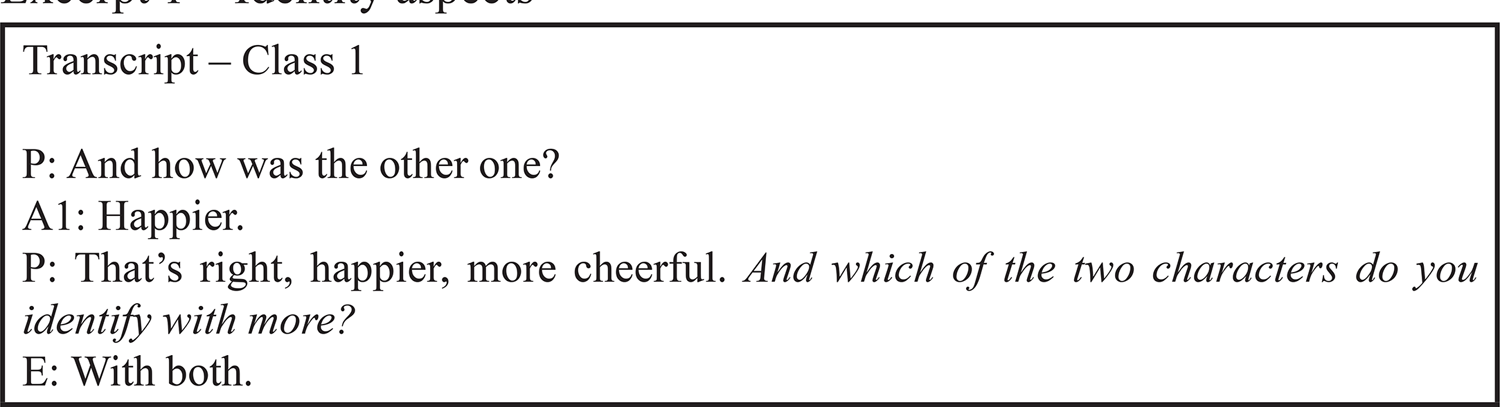
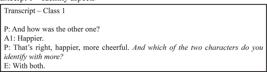
The students interpreted the songs País tropical3 e Lamento sertanejo4 and were asked about their identification with the characters in the songs.
When reflecting on the student identifying with both characters, we can perceive the constitution of multiple identities in the subject (Silva, 2002). As Auger and Clerc (2006) point out, it is important to verbalize representations, reflect on their sources, to think about one’s own identity. The first song studied in this class, País tropical, provides knowledge of a character with ethnonymic representations of Brazilians, according to the students’ representations, as a happy and festive people. In the second song, we have an opposing view: a sad, silent character who does not like parties and has no friends. This seemingly made the student realize that we are mutable beings; at one moment, we feel happy, and at others, sad. That is, generalizations that determine a culture of closed-off or always-happy people can be something labeling, which is not in line with the principles of intercultural education. In this case, it is not possible to cling to a single example as a typical representation of a particular group.
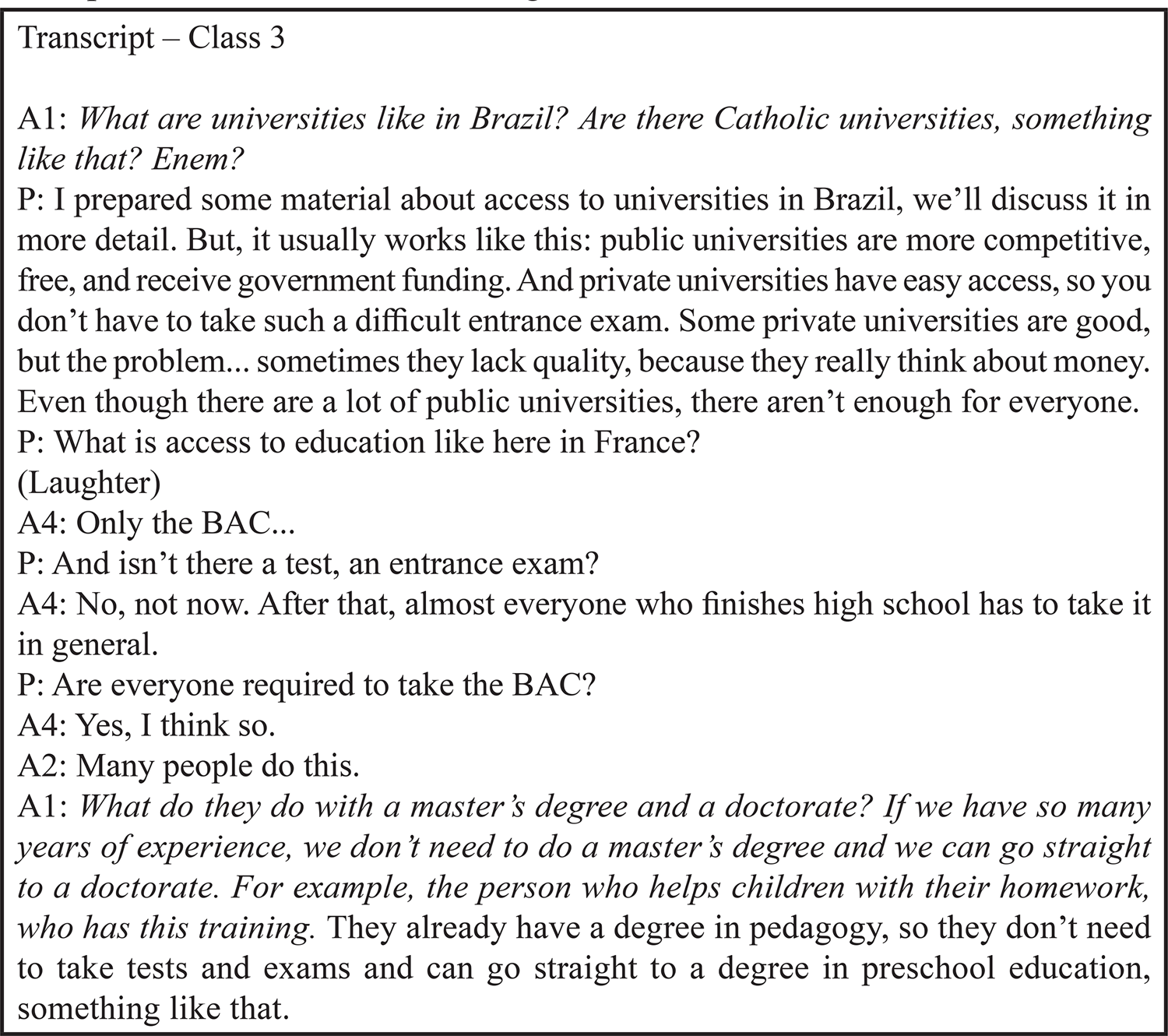
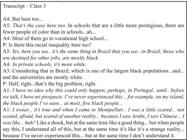
In class 3, we focused on understanding the song Cota não é esmola5, which portrays the daily routine of a poor black student. This allowed us to reflect on the structure of Brazilian society, while the students also reflected on their own societies, in this case, France and Portugal.
In this excerpt, we have the encounter of several identities, as each student conceives the world through their experiences. Brazilian and French realities seem to be similar in relation to prejudice and marginalization of black people in both societies; there is an intercultural recognition (Bizarro; Braga, 2005) of a Frenchman, when understanding the Brazilian reality through the song, in which black people occupy inferior positions at work and attend less prestigious schools. He states that the same thing happens in France: through the song, the student reflected on his own reality.
At the university in question, there were many different ethnicities, contacting other individuals and cultures was possible. For the Portuguese student, a mixed-race society can be seen or understood as a cultural shock (Zanchetta, 2015). Following the initial shock of the unknown, the new representation of a mixed society apparently stabilized. The student wanted to understand this new reality, and the classes were a time for him to understand other cultures, given that intercultural relations are a point of negotiation in a constant process of reconstruction and renegotiation (Belz, 2003). Likewise, there was an awakening of reflective and questioning attitudes that also contributed to the development of intercultural competence.
Even the teacher was able to reflect on her identity constructions, as we can see in the following excerpt.
The songs studied in Class 4 were Não é proibido proibir6 (2008), Comida7 (1987). Specifically, in the previous excerpt, we were interpreting the song Comida. We concluded that the song talks about finding an exit or an alternative way of viewing life; even when facing difficulties, one must find a solution; seek an escape from the situation. The student used expressions from her native language, such as “porta de saída” (exit door), to express herself. We observed the influence of the native language in the expressions used in the foreign language: “o assunto é largo” (the subject is broad) – the student creates an interlanguage to try to express herself. We noted that this was productive because she managed to think about the topic so effectively that it allowed her to go beyond just understanding the song. We discussed that although there are difficulties, there is no art, fun, or space for everyone, but they can find a way out, and that the art of living would be to find an escape, despite life’s diversities. She exemplified this conversation with a story about a friend, saying that money is not the most important thing in life.
Although the teacher-researcher knew the song and had a personal interpretation of the lyrics, she could see it differently because the student showed a positive side of the song, which she viewed more as a critique of the Brazilian society. Additionally, the teacher reflected on her own culture, reinterpreted it, and was able to gain a different perspective through the student’s view – a positive characteristic of Brazilian people that, as a foreigner, she was able to perceive and present. Thus, the intercultural approach requires an open perspective from the teacher as well, to engage with the plurality of the classroom. The teacher would not only be a mediator between cultures but also an active and significant part of the intercultural process. She redefines her own identity or may transmit and reinforce stereotypical representations of a culture, which is why her training should always be ongoing.
In this sense, we can observe in this research that the participants’ identities operate within an identity based plurality, as they were able to recognize the cultural aspects of the other and reflect on their own identity processes, insofar as they considered the sociocultural aspects of other societies.Thus, the process of language teaching and learning also represents identity movements of estrangement, affinity, and identification, which can lead to a shift in oneself, because learning a language can (re)signify and (re)recognize other ways of seeing the world and reevaluating one’s own world, language, culture, and identity. These identity movements were evident in other moments of the class analysis. The next section, stereotypes, is also constituted by identity processes related to how we see others and themselves.
Stereotypes
Stereotypes represent rigid characteristics that can label a person or thing; they are a simplified, generalized, and fixed representation of a social group, attributed uniformly and inflexibly to all its members. These stereotypes, which form a category of representation, are a generalizing idea applied to all members of a group. The term “stereotype” comes from the Greek, composed of the words stereos (rigid) and typos (mark, trait, type), which reinforces its fixed nature and resistance to change.
Stereotypes are heavily influenced by cultural norms, historical context, and power relations, serving both to maintain social hierarchies and justify discriminatory attitudes. They are present in nearly all intercultural situations due to the human psychological need to categorize and classify the world around them, a need that arises from the processes of perception and socialization (Ianesko, 2013, p. 123).
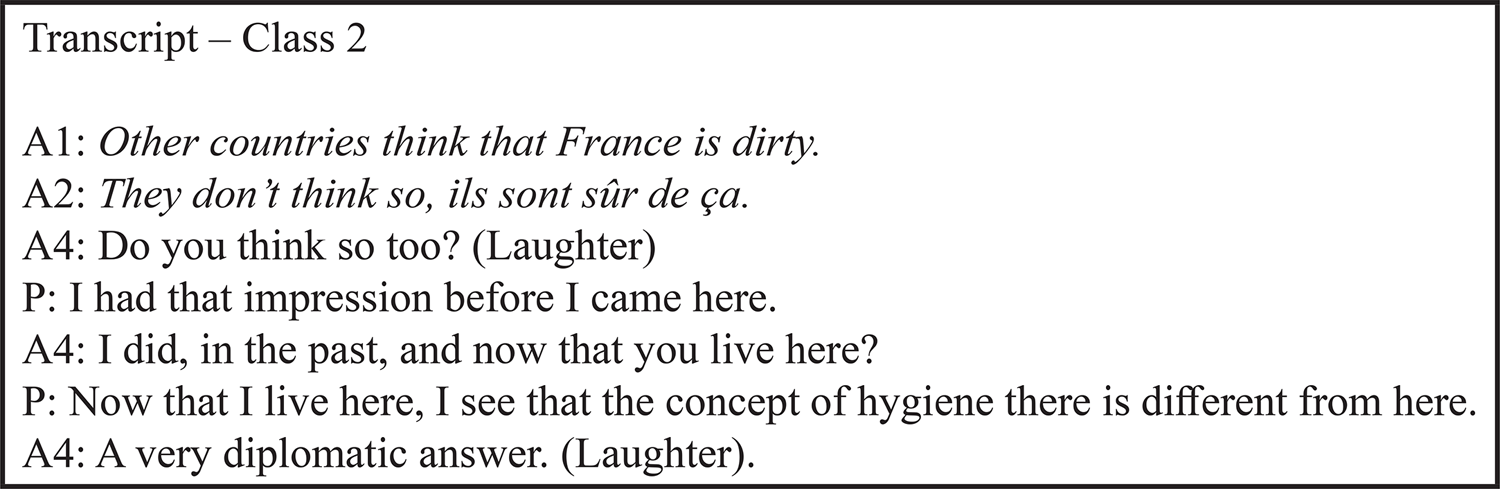
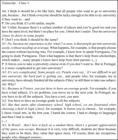
In class 2, students discussed the images associated with their country of origin, engaging in the following questions: “4) What are the images associated with your country of origin? Why? Talk to your classmate and see their opinion on the subject. 5) Can stereotypes lead to prejudice? Why? Discuss with your classmates and write your opinion.”
The students believe that the French are dirty or do not like to take baths, and they question the teacher, being a foreigner, to understand if she shares this view. The students show interest in knowing what a foreigner thinks about their country, what image is projected, and whether living in the country was able to change the stereotype constructed. The tasks led to reflections, and according to Transcript 2, the students discussed where these different images of others come from. The students comment that these views are constructed based on the education each person receives at home. We discussed that there is also an influence from the media, and that perceptions can be subjective, arising from interactions between people, such as through travel. The aim is not to label whether these images are true or false, but to understand that they are not enough to characterize a culture.
We debated these views in a pleasant, relaxed, and even humorous way. We took into consideration that the teacher can convey distorted representations of fact or generalized stereotypes, as, as a teacher-researcher, we are starting from our own representations, and we do not speak from an ideological void. In the classroom, the teacher’s power of speech can often influence the student to construct an inaccurate representation. Despite doubts and uncertainties about presenting a single point of view, we found that the lesson fulfilled its objective, as the students were able to critically reflect on the construction of stereotypes – whether related to individuals, nations, or the underlying reasons for their emergence – and we had the opportunity to engage in a reflective exercise of considering alternative perspectives, thereby reexamining our own identity processes.
Thus, we observed that the tasks with songs helped reflect on stereotypes (Griffe, 2010). We aimed to work on the heterogeneous acceptance of the studied societies, mainly France and Brazil, and there was also a reflection on the possibility of deconstructing prejudices.
These same reflections were seen in other classes.
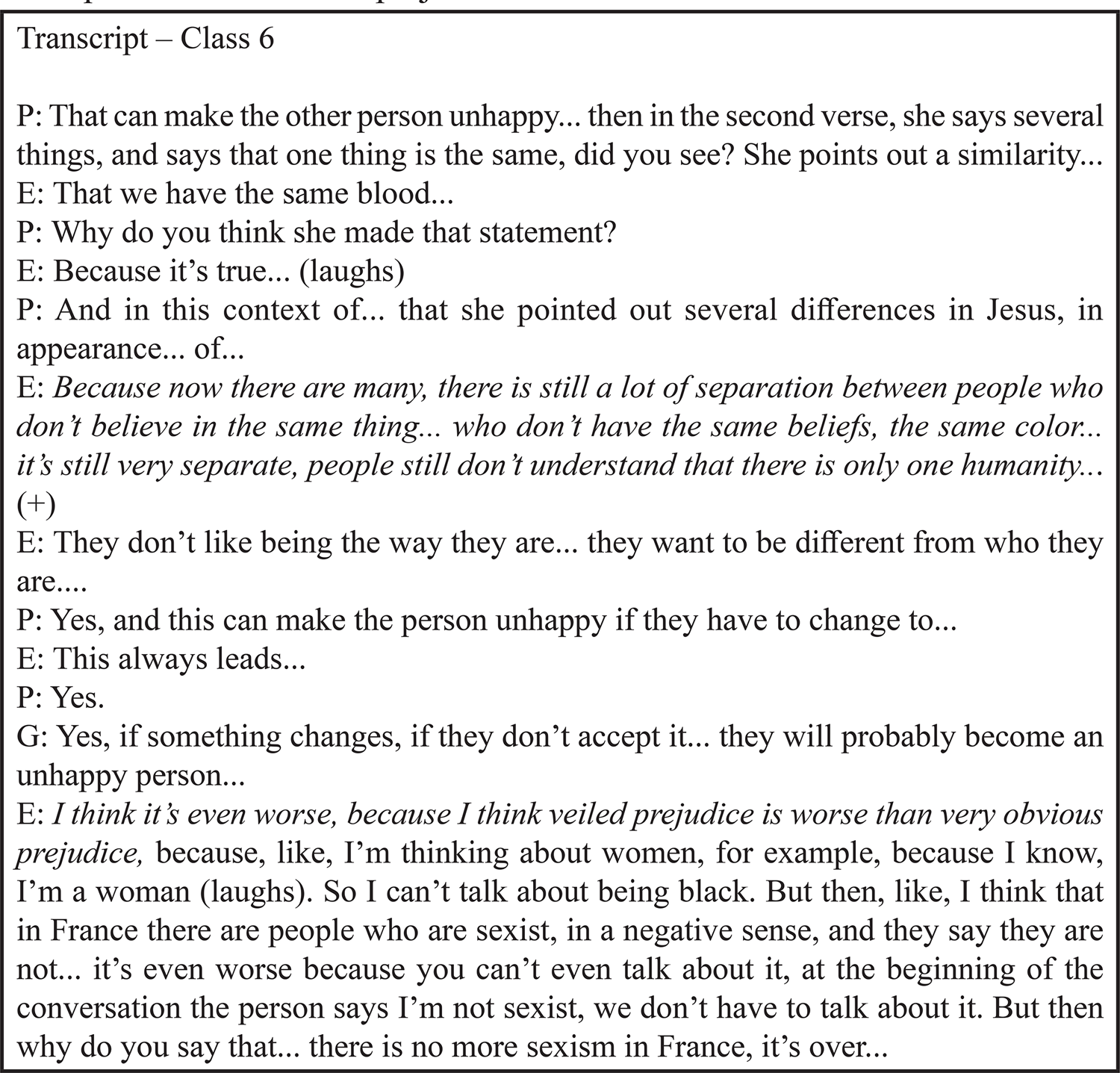
In the sixth lesson, the proposal was to develop communicative tasks using songs as a pedagogical support; specifically, the songs Bate a poeira8 (2017) e Inclassificáveis9 (1996). In the transcribed excerpt, we interpreted the song Bate a Poeira, which speaks about the importance of accepting ourselves as we are, guided by the following questions: b) What could happen in a “world where appearance is valued more? c) In the second verse, the author cites various differences and points out one similarity; what is it? Explain why she made this statement. d) According to the song, what can make people unhappy? e) What does the statement “Covert prejudice / Has the same effect, the same damage” mean?
The students make sense of the song and, by interpreting the lyrics, understand that we are all equal, but the differences between us can be an obstacle, as there is a standard to follow, imposed by the media and society, and those who are outside this standard risk not being accepted. Thus, individuals will do everything to be accepted, making all sorts of changes to fit in with the standard. One student provides an example in which, in her role as a woman, she assumes a marked ideological position and states that, in France, there is sexism, and the big problem is that people do not admit it. This covert prejudice becomes worse because it is harder to combat; people think there is no sexism, but it manifests itself in other ways, in speech, gestures, and actions.
As per the transcription of lesson 6, we discussed the various prejudices and how they can manifest: “E; je suis pas raciste, mais...(laughs). P: yes... but I even have black friends... yes... that.” We observed that the students showed critical thinking regarding the themes discussed, and they were able to perceive power relations. That is, we can say that intercultural education is not always based on peaceful or respectful coexistence; it also needs to recognize and highlight power relations so that students can develop critical thinking. This can also be seen in the following excerpt.
In this part, the students interpreted the following quote from the singer, connecting it to the song they had listened to: “I became Black through rap. Before that, to feel less like a little monkey, as I was called a few times, I used to straighten my hair” (from the documentary Preto no Branco: Negros em Curitiba, 2004). The students understood that the singer found her place in rap, since there is usually a stereotype about people who sing rap: they are black, from the outskirts, and talk about that reality. The singer probably fits all these stereotypes, so she feels like she belongs to a group that is often marginalized.
We noticed that the song is a product of society and shows diversity and identification with each group. We emphasized the sociocultural characteristics presented in the song; it is a snapshot of a situation, promoting a culture, highlighting social problems, and a movement of struggle and resistance, with which the students come into contact and reflect on these aspects.
These same characteristics can be observed in the following excerpt:
From the previous excerpt, the P learners interpreted the song Cota não é esmola by reflecting on the following lyrics: “You’ll have to pay for college, because black and poor people don’t go to USP”. That’s what the teacher said, teaching at school. That everyone is equal and that quota is charity,” and established a critical analysis, associating it with a lived situation. The learner highlighted the importance of the teacher in shaping the student, the role of the school in the formation of citizens. In the song, the character receives criticism from her own teacher, who makes racist comments and emphasizes that quotas are charity, thus she didn’t deserve to enter university through this system.
Therefore, the learner understood the situation in the song, which made sense to him, as he connected it to a personal experience that marked him. He shared that in school there were two students who were labeled by the teacher as incapable of studying, one of whom was affected by this and didn’t study what he wished, eventually becoming a disappointed professional. Thus, in addition to forming more competent and critical listeners, the students were able to describe and question their own culture (Beacco, 2004).
Some songs may convey stereotypical ideas, so understanding them and grasping the reasons behind these discourses becomes essential for a productive discussion of stereotypes, as every discourse originates from an ideological bias. We observed that the students identified various stereotypes: an image of the French that they believe others have how black individuals can be stereotyped in various societies, and the role of the teacher in stereotyping students. In many cases, these stereotypes lead to prejudice. Thus, we consider that the tasks with songs contributed to reflection on stereotypes and prejudices, enabling awareness for accepting others.
In the next section, we present representations that reflect intercultural exchanges and connections.
Intercultural exchanges and/or approximations
Tasks with songs also facilitated the exchange of knowledge and cultural awareness as we reflected on the culture of the other, in the interpretive confrontation of the different with its respective cultural code, fostering attitudes of mutual appreciation and respect (Bizarro; Braga, 2005).
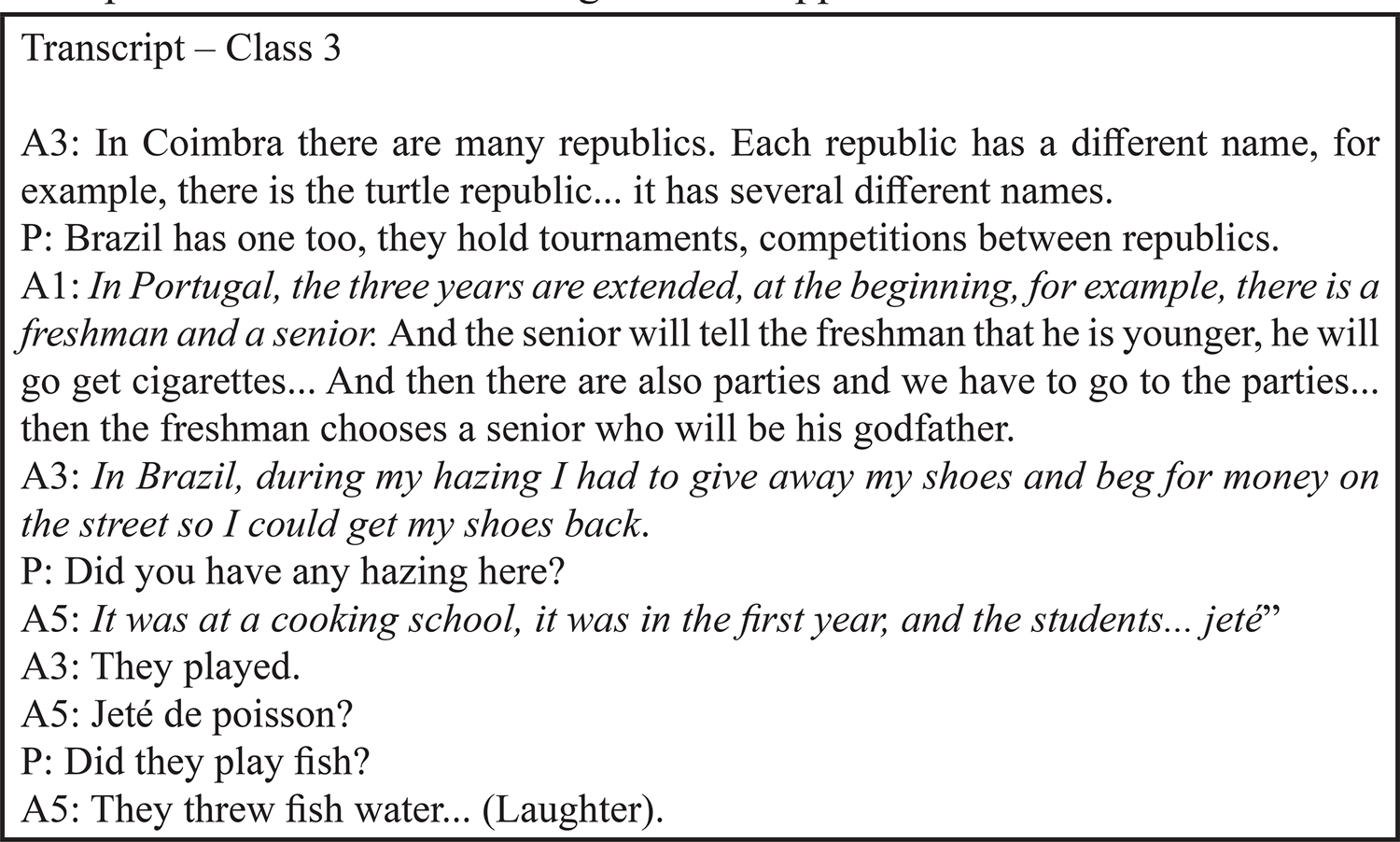
In this excerpt, the students shared experiences they had in their respective countries, socialized their references, and listened to each other’s opinions. In Unit 2, “Everyday Life,” and the transcriptions from lesson 3, the students discussed the first exercise of the class, which was about “experiencing university life.” Apparently, the “trote” (is a traditional initiation activity intended to welcome new students to the university. While it can be a positive and welcoming experience, in some cases it may involve practices that are considered violent or harmful.) is an activity known to the learners. Referring to Tost (2017), we noted that languages of the same origin often share linguistic, identity, and cultural similarities, which can make learning a foreign language easier. Therefore, students from different countries (Portugal, Brazil, and France) go through the same ritual when entering university, but each in their own way.
These intercultural exchanges were evident in the next excerpts, as students exchanged information, talked about academic events in their countries, and understood their particular dynamics in a different society.
In the previous excerpt, we observed that the learners were curious to understand the Brazilian educational system. These discussions were prompted through activities involving the songs Vida universitária10 e Cota não é esmola from lesson 3. We emphasized that songs are reflections and products of culture (Figueroa, 2011), and these particular songs describe the everyday life of university students from different social classes.
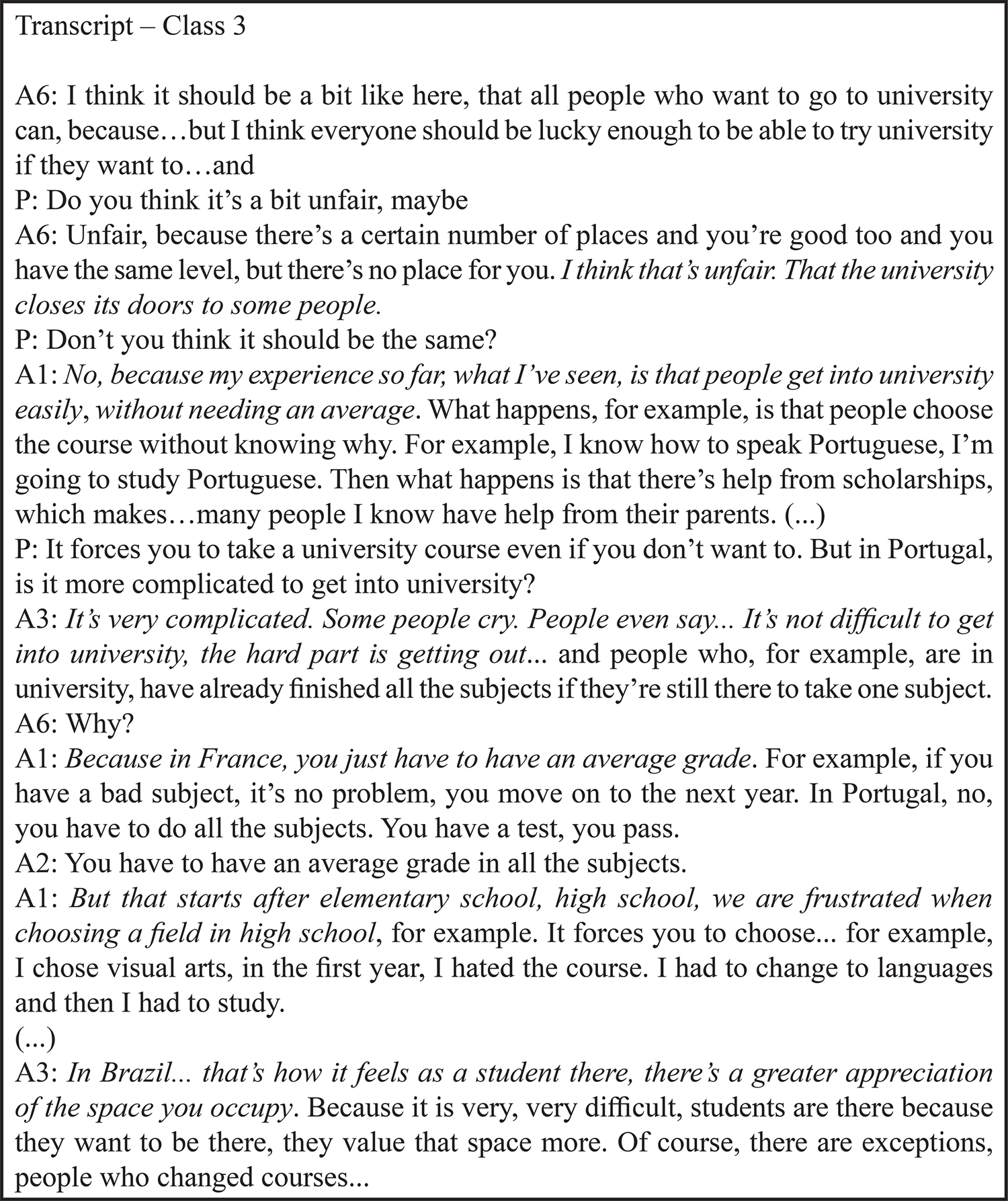
The students learned about the routine of a Brazilian university student, which raised other questions, such as access to university in each society. We can say that it is a conventional cultural phenomenon, as there is a convention in the practice. What we can do is discuss, form opinions, understand, and recognize that these systems come from the historical processes of each country. Moreover, understanding the system of another society can help reflect on one’s own system. We saw that this reflection extended over many moments of the lessons, as observed in the next excerpt, where students discuss and offer opinions on the positive and negative aspects of each country’s university admission system.
In this excerpt, we have three opinions about different experiences and customs in each country. The French learner comments that the system designed to select students for university entry, such as the vestibular in Brazil, can be unfair, as everyone should have the right to attend higher education. The Portuguese learner, based on his experience, says that students enter university easily and use the scholarships available, but soon drop out or fail to value the educational opportunities offered. He further mentions that in Portugal it is harder to graduate than to enter the university. Comparing this with the grading system in France, he believes it is easier to study in France, since in Portugal, students must work harder to maintain averages in all subjects, something that does not happen in France. A Brazilian learner also shares his opinion about the university system, arguing that students place more value on their place in university, likely because entry is more difficult due to the selection system in public universities, which leads them to take their role as students more seriously.
In the next subsection, we present the historical and social reflections promoted by the tasks involving songs.
Historical and social reflections
In this session, we will reflect on some historical events that are present in the song. Students often draw connections between these events and current times, understanding how they contribute to the construction of social representations.
In this excerpt, we see the importance of the arts, specifically music and literature, as ways to think about historical aspects and even propose reflection on other possible realities, other interpretations, and other representations. We observe that the study of the song “Cota não é esmola” sparked a discussion in which students reflected on historical representations constructed through teachings from school and books. The students reflected on how they learned about the history of European colonization, both in France and Portugal, from an ethnocentric perspective, where only positive aspects of colonization were taught.
Thus, the students were able to think about other representations coming from other subjects regarding colonization – the negative and bloody side of it – which they had almost no contact with in school. As Auger (2007) argues, knowledge of cultural aspects through art provided intercultural awareness, enabling students to reflect on an ethnocentric, entirely European view of what they had learned, and to think about other points of view on foreign culture, pluralizing representations.
We continue to observe the song as an element that promotes historical-social reflections provided by the activities developed with the song in an intercultural perspective. This same discussion, relating the song to the historical context, can be seen in the next excerpt.
In excerpt 12, we discussed the song Vital e sua Moto, a 1983 track released during the final years of the military dictatorship in Brazil. We developed an interpretation in which the motorcycle represents the freedom of a new government; the father symbolizes those who resisted change and preferred to remain under the old regime, out of fear or insecurity; and the son represents the youth who desired transformation. Relating the song to the movements and historical contexts seemed very productive for the students, as they better understood the song by comparing it with the events in both the target language-speaking countries and their own native countries.
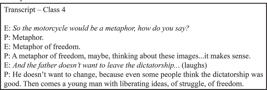
We found that the understanding of the historical context extended to other songs as well.
We observed that the student was able to connect the knowledge discussed in class to the historical aspects of other songs she knew. According to the transcriptions from lesson 4, we reflected on the historical meanings in songs and noted that during the dictatorship, most songs, especially MPB (Brazilian Popular Music), often have some connection to the context of that time. Some students recognize that songs are related to the dictatorship, but in other songs, it is harder to identify the connection due to censorship, which led to many metaphorical associations. Even with the rock music mentioned in the previous excerpt, we were able to make a connection, which is why it is important to link the historical moment reflected in the song. According to Coelho de Souza (2016), it seems that, at this moment, we developed literomusical competence, where we have more competent, critical, attentive listeners, capable of constructing meanings based on the specificities of the literomusical discourse.
Motivation to learn PFL
In this subsection, we present a dialogue excerpt between the student and the teacher, which we understand as a form of motivation to continue and progress in PFL (Portuguese as a Foreign Language) studies.
According to the cited excerpt, we consider that the learner, through the expression “I liked it”, showed interest in the song, appreciating the lyrics as “social-type”. There is encouragement from the teacher for him to search for more songs since he identified with the one studied. Thus, there is motivation for the student to seek out other songs, learn, and engage with the Portuguese language.
Barbosa (2014) argues that music can motivate learning, in addition to stimulating connections between language and culture; in this way, the student can think about autonomous learning, as suggested by Khaghaninejad and Fahandejsaadi (2016). Given the easy access to songs nowadays, a student who identifies with a song can later try to understand it without looking at the lyrics and, subsequently, listen to the song while reading along, making sense of it, listening, and singing. There is motivation for autonomous and individual study.
In addition to this, on another excerpt, we can see the student’s motivation to continue attending classes even during a strike period.
According to excerpt 15, the student seemingly enjoyed the class discussions and would participate in future ones. Even with the general demotivation caused by the strike context and the suspension of classes, some lessons were still held because the students who felt more motivated, based on their personal availability, attended, even in an informal context where attendance was not mandatory, nor would it generate grades or credits. Thus, we observed that the students were motivated to learn Portuguese.

From the theoretical perspective of this research, we see more positive than negative points when working with song-based activities in language classes. These include: the song as an authentic document (Santos Asensi, 1997), which allows for linguistic authenticity that can be used to explore phonetic, syntactic, lexical-semantic, and textual aspects. Additionally, there are cognitive and affective aspects: it increases memorization capacity (Figueiroa, 2011), provides a relaxed environment, reduces anxiety, and stimulates creativity and imagination (Griffee, 2010). We emphasize that we use the song as a didactic tool from an intercultural perspective, so we understand songs as reflections and products of culture (Figueiroa, 2011), making them an important material for developing intercultural communicative competence (Shayakhmetova et al., 2017).
We can add, based on the data analyzed in this research, that the song was relevant in contributing to students’ motivation, their sense of identity, while also enabling reflection on otherness, stereotypes that musical discourses may perpetuate, as well as students’ own stereotypes. Moreover, it sparked reflections on prejudices in both societies.
The song was identified as a representation of culture, as evidenced by various contributions to intercultural exchanges that led to recognition and awareness of the other’s culture. We reflected on representations of both teachers and students. In this way, students were able to critically position themselves regarding these aspects.
General considerations about the course
In this article, we analyzed the PFL lesson transcripts of French-speaking students with the aim of understanding the potential of using songs in foreign language classes. The course was taught and designed by the researcher, and some potentialities of songs in teaching were observed, addressing reflective aspects of identity/otherness, stereotypes, prejudices, historical and social issues, motivation, exchanges, and approaches. Each item was selected based on the recurrence observed in the classes; that is, the classes were not analyzed individually, but thematic categories were created based on the recurring items.
After the course, the students wrote reflective journals to express their opinions on the lessons taught. We received two journals from learners Elis and Gustavo (the most frequent students in the course), which confirm the contributions of songs to PFL teaching from an intercultural perspective:
- Historical, social, and cultural reflections: “The classes given by the teacher were very interesting because the songs chosen were a way to discuss political and social events in Brazil [...]”. “Besides, I learned new things about Brazil. (G)”; “I was able to better understand parts of Brazilian culture that the teacher made accessible” (E).
- Critical thinking: “We could develop a conversation with different points of view to think about the subject, as well as practice speaking and listening in Portuguese” (G).
- Development of oral expression: “Since we had an intermediate level in Portuguese, I think the way we were taught was good because it focused more on oral expression. In general, this is what is lacking in language classes here [...]”. “I really liked the classes because they allowed me to develop my speaking and listening in Portuguese” (G); “I learned words and expressions; I felt confident to speak and ask questions” (E).
- Development of literary-musical literacy: “The teacher’s classes were very interesting to me. I discovered songs and singers I didn’t know” (E); “I liked the variety of musical styles and themes” (E).
- Written expression: “I couldn’t do any written activity because of lack of time, but the possibility of writing texts on the subject discussed in class and receiving corrections later is something that helped me a lot during my Portuguese classes” (G).
Phonetics: “A suggestion would be to take advantage of the musical support to work on pronunciation” (E).
From the journals, we observed that the students were motivated to participate in the classes, reflections on Brazilian and French societies were developed, and we discussed various musical genres that allowed students to debate different themes. The learners felt comfortable in the classroom, enabling the development of oral skills. There were also many gaps in the PFL course that can also be confirmed by the journals.
Due to the course and research time constraints, we chose to analyze the oral interactions in class, rather than written expression, except in the case of the journals. Similarly, our goal was not to work on phonetic and phonological aspects, although we acknowledge the potential that song-based tasks can provide in the classroom. Including tasks that develop Portuguese practice from this perspective can be productive for PLE teaching.
The present study could have taken alternative thematic approaches, such as exploring the song’s linguistic and musical dimensions — including its sound and rhythmic elements. Furthermore, after the course was conducted, it would have been possible to examine the didactic material in greater depth, with the aim of expanding or reworking it, reflecting on any missing components, and considering the development of additional units or a different musical selection. It is important to note that our research focuses primarily on the linguistic-communicative level, interwoven with intercultural issues. In future studies, we intend to explore the aforementioned aspects in greater detail.




Acknowledgements
Thanks to the supervising professor Nildicéia Aparecida Rocha and the funding agency Fapesp.
References
- ALMEIDA FILHO, J. C. P. Dimensões comunicativas no ensino de línguas. 5. ed. Campinas: Pontes, 2008.
- ALMEIDA FILHO, J. C. P.; MOUTINHO, R. Sentidos de ensinar PLE no mundo. In: ALMEIDA FILHO, J. C. P. Fundamentos de Abordagem e Formação no Ensino de PLE e de Outras Línguas. Campinas: Pontes, 2011. p. 39-50.
- ANDRÉ, M. E. D. Etnografia da prática escolar. 6. ed. Campinas: Papirus, 2001.
- AUGER, N. Dépasser les représentations. Cahiers pédagogiques, étudier la langue, n. 453, p. 44-47, 2007.
- AUGER, N.; CLERC, S. Les représentations de l’hispanité chez des élèves français: constat et urgence d’une pédagogie interculturelle. Actes du colloque La cultura del otro: espanol en Francia, francés en España. Universidad de Sevilla, 29 novembre-2 décembre 2005, Espagne. BRUÑA CUEVAS, M. et al. (ed.). publicação em CD-ROM, 2006. p. 980-992.
- BARBOSA, V. P. A Canção nas aulas de Português Língua Estrangeira aliada à compreensão e produção orais. 2014. Dissertação (Mestrado em Português Língua Segunda/Língua Estrangeira) - Faculdade de Letras, Universidade do Porto, Porto, 2014.
- BAKHTIN, M. Estética da criação verbal. São Paulo: Martins Fontes, 2003.
- BEACCO. J. C. Guide pour l'élaboration des politiques linguistiques éducatives en Europe: de la diversité linguistique à l'éducation plurilingue. Strasbourg: Conseil de l'Europe. Division de politiques linguistiques, 2004.
- BELZ, J. A. Linguistic Perspectives on the development of intercultural competence in tellecollaboration. Language Learning & Technology, v. 7, n. 2, p. 69-99, 2003
-
BIZARRO, R.; BRAGA, F. (org.). Da(s) cultura(s) de ensino ao ensino da(s) cultura(s) na aula de língua Estrangeira. Secção de Linguística do Departamento de Estudos Portugueses e Estudos Românicos (FLUP), v. II, p. 823-835, 2005. Disponível em: http://ler.letras.up.pt/uploads/ficheiros/4609.pdf Acesso em: 1 fev. 2017.
» http://ler.letras.up.pt/uploads/ficheiros/4609.pdf - BOGDAN, R.; BIKLEN, S. Investigação Qualitativa em Educação: uma introdução à teoria e aos métodos. Porto: Porto Editora, 1994.
- BOURDIEU, P. Choses dites. Collection le sens commun. Paris: Les Editions de Minuit, 1987.
- BYRAM, M. Teaching and Assessing Intercultural Communicative Competence. England: Multilingual Matters LTD, 1997.
- CAMARGOS, G. T. P. Letra e música um gênero de grafia e som. In: DELL'ISOLA, R. L. P. (org.). Nos domínios dos Gêneros Textuais Belo Horizonte: FALE/UFMG, v. 1, p. 14-18, 2009.
-
COELHO DE SOUZA, P. J. Implicações das noções de canção como constelação de gêneros e de letramento literomusical para o ensino de português como língua adicional. Revista Brasileira de Linguística Aplicada, Belo Horizonte, v. 16, n. 4, p. 651-677, 2016. Disponível em: http://www.scielo.br/scielo.php?script=sci_arttext&pid=S1984-63982016000400651&lng=pt&tlng=pt Acesso em: 5 jan. 2017.
» http://www.scielo.br/scielo.php?script=sci_arttext&pid=S1984-63982016000400651&lng=pt&tlng=pt - COELHO DE SOUZA, J. P. Letra e música: uma proposta para o ensino de canção na aula de Português Língua Adicional. 2014. Tese (Doutorado em Linguística Aplicada) - Programa de Pós-Graduação em Letras, Universidade Federal do Rio Grande do Sul, Porto Alegre, 2014.
- DERVIN, F. Critical Interculturality: lectures and notes. British: Cambridge Scholars Publishing, 2017.
- FELICE, M. I. V. A avaliação da aprendizagem na formação do professor de línguas no Ensino. In: SILVEIRA, E. M. (org.). As bordas da linguagem. Anais do XII Simpósio Nacional de Letras e Linguística - II Simpósio Internacional de Letras e Linguística Uberlândia, MG, EDUFU - Universidade Federal de Uberlândia, 2011.
- FIGUEIROA, C. F. M. A canção: um objeto (inter) cultural de aprendizagem na aula de PLE. 2011. Dissertação (Mestrado em Português Língua Segunda/Língua Estrangeira) - Faculdade de Letras, Universidade do Porto, Porto, 2011.
- GRIFFEE, D. Personal communication with the author. New York: Prentice Hall, 2010.
- IANESKO, R. A. Crenças e Estereótipos: o papel do professor nesse contexto. In: BURGEILE, O. Práticas educacionais no ensino de línguas e literaturas. Florianópolis: Pandion, 2013. P. 115-131.
- KHAGHANINEJAD, M. S.; FAHANDEJSAADI, R. Music and Language Learning Shiraz: Shiraz University, 2016.
-
LEFFA, V. J. O processo de categorização na pesquisa qualitativa. In: PORTAL ELO, Ensino de Línguas online Disponível em: http://www.elo.pro.br/cloud/aluno/atividade.php?id=112&etapa=2 Acesso em: 10 maio 2017.
» http://www.elo.pro.br/cloud/aluno/atividade.php?id=112&etapa=2 - LÜDKE, M.; ANDRÉ, M. E. D. A. Pesquisa em educação: abordagens qualitativas. São Paulo: EPU, 1986.
- MARCUSCHI, L. A. Análise da Conversação. 2. ed. São Paulo: Ática, 2000
- SANTOS ASENSI, J. Música maestro ... Trabajando con música y canciones en el aula de español. Carabela, Madrid: SGEL, n. 41. p. 129-152, 1997.
- SANTOS, E. M. O. A abordagem comunicativa intercultural: uma proposta para ensinar e aprender língua no diálogo de culturas. 2004. Tese (Doutorado em Linguística Aplicada) - Instituto de Estudos da Linguagem, Universidade Estadual de Campinas, Campinas, 2004.
- SCHLATTER, M. O ensino de língua estrangeira na escola: uma proposta de letramento. Calidoscópio, v. 7, n. 1, p. 11-23, jan./fev. 2009.
- SILVA, T. T. Documentos de identidade: uma introdução às teorias do currículo. 2. ed. Belo Horizonte: Autêntica, 2002.
- SHAYAKHMETOVA, L. et al. Using Songs in Developing Intercultural Competence. Journal of History Culture and Art Research, v. 6, n. 4, p. 639-646, 2017.
-
TOST, M. La diversité linguistique et culturelle du monde romanophone. Disponível em: http://clom-ic.francophonie.org/ Acesso em: 10 maio 2017.
» http://clom-ic.francophonie.org/ - VIANA, N. Planejamento de unidades em cursos de Português. In: ALMEIDA FILHO, J. C. P. (org.). Parâmetros atuais no Ensino de Português Língua Estrangeira Campinas: Editora Pontes, 1997
- WELSCH, W. Transculturality: The puzzling form of cultures today. California Sociologist, v. 17, n. 18, p. 19-39, 1994.
- ZANCHETTA, H. B. Aspectos Culturais como fios condutores de interações em Tandem na aprendizagem de português língua estrangeira: Interculturalidade, Estereótipo e Identidade(s). 2015. 122 f. Dissertação (Mestrado em Linguística e Língua Portuguesa) - Faculdade de Ciências e Letras, Universidade Estadual Paulista, Araraquara, 2015.
- ZARATE G. Représentation de l'étranger et didactique des langues. Paris: Didier, 1993.
-
1
The acronym MPB stands for Música Popular Brasileira (Brazilian Popular Music). This musical genre emerged in the 1960s, in a context of resistance to the military dictatorship in Brazil. Initially, MPB stood out as a form of protest music, with strong political and social engagement. Over time, it also began to incorporate international influences, exploring new sounds, broader themes, and varied styles.
- 2
- 3
- 4
- 5
- 6
- 7
- 8
- 9