 A New Lobster (Crustacea, Decapoda, Achelata) from the Riachuelo Formation, Albian of Sergipe-Alagoas Basin, NE Brazil
Abstract
In this paper, we describe the second fossil lobster discovered from the Brazilian Cretaceous. The fossil was yielded in marine greyish shale, associated with fishes and ammonite mollusks of the Taquari Member of Riachuelo Formation, Sergipe State. The material was collected in the 1980s from the subsurface (by “shaft”) at the Rosário do Catete locality by a team of the extinct PETROMISA (Petrobrás Mineração S.A.). The sole specimen measures 4.5 cm length and ~2 cm width, corresponding to a wide and slightly flattened, well-calcified pleonal region, with six separate somites, ending in a tail fan. The placement of this new lobster within Achelata is supported by the presence of six dorsoventrally flattened pleonalsomites ending with well-developed uropods, with lateral rami lacking transverse division. Pleurae of somites are short, rounded, and continuous, separated fromtergites by a distinct longitudinal carina. Due to the absence of the cephalothorax and swimmerets, it is not possible to assign the lobster to any major subclade with certainty, and it is not formally named because the specimen is insufficient to serve as a type. It differs from the lobster previously described from the Brejo Quarry (Angico Member) by the absence of alongitudinal median carina on the tail, the presence of smooth somites of subequal width, rounded and continuous pleurae, and punctate ornamentation (finely pits on cuticle). Besides the associated fauna is practically the same, particularly the fish assemblage, the occurrence of lobsters together with ammonites and certain fishes corroborates the interpretation of a neritic marine environment for the Riachuelo Formation.
Keywords:
Invertebrate Fossil; Lower Cretaceous; Taquari Member
Resumo
Neste artigo descrevemos o segundo fóssil de lagosta do Cretáceo brasileiro. Foi encontrado em folhelho acinzentado marinho em associação a peixes e moluscos amonoides do Membro Taquari da Formação Riachuelo, Estado de Sergipe. O material estudado foi obtido na década de 1980 em subsuperfície (por “shaft”) na localidade de Rosário do Catete por uma equipe da extinta PETROMISA (Petrobrás Mineração S.A.). O único espécime possui 4,5 cm de comprimento e 2 cm de largura, e corresponde a uma região pleonal larga e ligeiramente achatada, bem calcificada, com seis somitos separados terminando em um leque caudal. O posicionamento da nova lagosta dentro de Achelata é baseado na presença de seis somitos abdominais achatados dorsoventralmente terminando com uropoditos bem desenvolvidos e ramo lateral sem divisão transversal. As pleuras dos somitos são curtas, arredondadas e contínuas, separadas dos tergitos por uma carena longitudinal distinta. Devido à ausência de cefalotórax e apêndices bucais e locomotores, não é possível atribuir a lagosta a nenhum subclado maior com certeza e não é formalmente nomeada porque o espécime não poderia servir adequadamente como o tipo. Difere da lagosta descrita anteriormente para a Pedreira Brejo (Membro Angico) pela ausência de carena mediana longitudinal na cauda, presença de somitos lisos de largura subigual, pleura arredondada e contínua e ornamentação pontilhada (finas pontuações na cutícula). Apesar da fauna ser praticamente a mesma (particularmente a de peixes), a presença de lagostas em associação com amonoides e certos peixes corrobora um ambiente marinho nerítico para a Formação Riachuelo.
Palavras-chave:
Invertebrate Fossil; Cretáceo Inferior; Taquari Member
1 Introduction
Santos (1981, 1985) recorded the presence of a decapod crustacean represented by a complete and articulated tail, associated with fish and mollusks, in the calciferous shale of the Taquari Member (Riachuelo Formation). The material was obtained from an exploratory vertical drill (“shaft”) by technicians from PETROMISA (a former subsidiary of PETROBRAS S.A., 1963-1990), in the city of Rosário do Catete, Sergipe. However, he neither described nor illustrated the material, and the group of decapod crustaceans to which the specimen belonged was not explicitly stated.
Turbay, Cesero and Koutsoukos (2002), while studying the paleoenvironment and fossil content of Pedreira Brejo (an outcrop located in the town of Pedra Branca, municipality of Laranjeiras, Sergipe; UTM coordinates: 0701754; 8807678), registered the presence of a poorly preserved reptant decapod crustacean in white sandstone from the Angico Member. The material studied was represented by part of the cephalothorax and five pleonal somites, whose chitinous cuticle was fossilized by carbonization.
Reis, Turbay and Cesero (2005) provided additional data on the geology of Pedreira Brejo, alongwith a brief description of this material, classifying it as a palinuran decapod, possibly related to Scyllaridae, but without providing a substantial attempt to assign it to a genus or species level. The specimen, which currently belongs to the Phoenix Paleontological Collection, is registered as PBR-18-177.
Fossils of decapod crustaceans have been known from geological formations in Brazil since the beginning of the century [i.e., Palaeoxanthopsiscretacea (Rathbun 1902), from the Gramame Formation (Rathbun 1902)]. Cretaceous northeastern basins contribute with more than half of all decapods described from Brazil (i.e., 26 species) (Barros et al. 2021a , 2021b; Barros & Oliveira 2023). Among better known taxa, there are palemonid shrimps (e.g., Beurlenia araripensisMartins-Neto & Mezzalira, 1991; Kellnerius jamacaruensisSantana, Pinheiro, Silva & Saraiva 2013; Araripenaeus timidusPinheiro, Saraiva & Santana 2014) in the Aptian-Albian of Santana Group (cf. Barros et al. 2020; Barros et al. 2021b; Barros et al. 2025; Martins-Neto & Mezzalira 1991; Santana et al. 2013; Pinheiro, Saraiva & Santana 2014) and sergestids (Paleomattea deliciosaMaisey & Carvalho 1995) has been described and redescribed. Pleocyemata shrimps [e.g., Bahiacaris roxoi (Beurlen 1950), Bechleja bahiaensis (Beurlen 1950)] were found in Marizal Formation, Albian of Tucano Basin (Beurlen 1950; Roxo 1940) and Gramame and Beberibe formations of Pernambuco-Paraíba Basin (Beurlen 1958; Maury 1930; e.g., Callianassa beberidaeBeurlen 1950). Recently, hymenosomatid crabs were found in the Lower Cretaceous (Barremian) of Morro do Chaves Formation, Sergipe-Alagoas Basin (Mendes, Santana & Carvalho 2022).
On the other hand, the occurrence of fossil crustaceans in the Sergipe Sub-basin is restricted to fragments of carapaces and isolated appendages of decapods, particularly in the Cenomanian calcilutites of the Cotinguiba Formation (Távora & Souza-Lima 2001).
Since the survey undertaken by Martins-Neto (2005), several studies (e.g., Barros et al. 2020; Barros et al. 2021b; Barros, Oliveira & Saraiva 2025; Luque et al. 2017; Mendes, Santana & Carvalho 2022; Pinheiro, Saraiva & Santana 2014; Santana, Pinheiro & Saraiva 2013; Saraiva, Pinheiro & Santana 2018) have addressed taxonomic and ecological aspects of fossil decapod crustaceans from Brazil. However, while shrimp are relatively common in Cretaceous and Oligocene deposits, records of lobsters are rare.
Certain authors (e.g., Feldmann & Pole 1994) assume that the preservation of shrimp and lobsters are difficult to occur in the fossil record due to their rapid decomposition. As a result, it is common to lose information on characters relevant to the identification of taxa and the evaluation of phylogenetic relationships (Garassino & Teruzzi 1996). The aim of this study is to describe the fossil lobster found in the Riachuelo Formation (Albian, Sergipe Basin, Northeastern Brazil) and to compare it with the specimen previously described by Reis, Turbay and Cesero (2005).
1.1 Geological Setting
The Sergipe-Alagoas Basin is one of the coastal marginal basins of eastern Brazil, covering an area of 32,760 km² with a bathymetric deep of ~3000 m. Only one-third of this area is emerged (13,000 km²), forming an elongated belt of ~350 km along the eastern Brazilian coast. It is oriented N45°E, between the parallels 09° to 11°30` south and the meridians 35°30` to 37° west (Feijó 1994; Schaller 1969; Turbay et al. 2013). The basin corresponds to an asymmetric rift, limited to the north by the Pernambuco-Paraíba Basin, by the Maragoji Ridge, and to the south by the Jacuípe Basin, by the Vaza-Barris fault system (Bengtson 1983; Koutsoukos & Bengtson 1993; Schaller 1969). From a paleontological perspective, the basin is characterized by an abundant and diverse fossil assemblage, notably ammonites and foraminifera, whose stratigraphic positioning has allowed fine adjustment of the correlation of the exposed layers with the international chronostratigraphic scale (Bengtson 1983; Koutsoukos & Bengtson 1993).
Noteworthy, there is divergence in the specialized literature regarding the basin’s nomenclature and boundaries. For instance, Feijó (1994), based on structural and stratigraphic features, proposed dividing it into two distinct basins: the Sergipe Basin and the Alagoas Basin. According to this author, the boundary between them lies at the Japoatã-Penedo structural high, near the São Francisco River. However, Campos Neto et al. (2007) treated the Sergipe-Alagoas Basin as a single unit, considering that the of Japoatã-Penedohigh does not constitute a true basin divide. As a result, the Sergipe Basin cameto be treated as a sub-basin, corresponding to southern portion of what is collectively known as the Sergipe-Alagoas Basin. Its sedimentary record ranges from the Neo-Jurassic to Post-Miocene rocks, generally fossiliferous.
The evolutionary history of the Sergipe-Alagoas Basin is closely associated to the opening of the South Atlantic and the fragmentation of the Gondwana supercontinent (Milani et al. 2007). On both sides of the Atlantic margin (eastern South America and western Africa), tectonic and sedimentary development followed distinct phases: pre-rift (continental), rift, transitional (proto-oceanic), and drift (oceanic),each associated with five major depositional megasequences,i.e., continental, in the pre-rift and rift phases; evaporitic, in the proto-oceanic phase; carbonate, in the shallow shelf phase; transgressive marine and, finally, regressive marine (Ponte & Asmus 1978).
During the Albian, marine sequences developed in the Brazilian marginal basins, marked by the formation of carbonate platforms. Among these basins, the Sergipe-Alagoas Basin has the most complete exposed Albian carbonate section, particularly represented by the Riachuelo and Cotinguiba formations (Turbay et al. 2013). The Riachuelo Formation outcrops in a ~20 km-wide strip between the municipalities of Itaporanga and Pacatuba in the state of Sergipe. In this strip, the Carapeba and Brejo quarries provide the best onshore outcrops of the drift-phase carbonate section of the Brazilian continental margin.
In this context, Turbay (2002) investigated petrological, facies, and stratigraphic aspects of carbonate rocks, focusing on paleoenvironmental conditions based on studies of the Carapeba and Brejo quarries. The latter, which is more informative, includes a main wall ~16 m high and 40 m wide, located along the road between Laranjeiras and BR-235. Based on ammonites biostratigraphy, the exposed sedimentary package was placed in the Mortoniceras biozone, as defined by Beurlen (1968), and is considered Upper Albian in age. Furthermore, Camacho (2009) studied the Albian carbonate rocks of the Riachuelo Formation at these and other locations, producing a petrographic atlas and providing further information on bioclasts.
The Riachuelo Formation stands out for its clear marine sedimentation, resulting from the sea-level rise at the beginning of the Albian (Schobbenhaus et al. 2003). This transgressive marine phase led to the deposition of three distinct sedimentary bands: proximal sandstones, platform carbonates, and distal shales. The deposition would have occurred in a shallow neritic marine environment. It encompasses a mixed siliciclastic-carbonate platform complex composed of three members: Angico, Taquari, and Maruim.
The Angico Member is characterized by light-colored, fine-grained to conglomeratic sandstone deposited near the basin edges. In this context, subaqueous fans formed by a mixture of carbonates and coarse clastics produced proximal turbidite deposits (Cainelli et al. 1987; Cainelli & Mohriak 1999; Koutsoukos et al. 1993).
The Taquari Member consists of interbedded calcilutite and gray shale, with the calcilutite deposited in the troughs of the basin’s hemi-grabens.
Finally, the Maruim Member is characterized by cream-colored oncolitic and oolitic calcarenite and calcirudite, associated with algal biolithites, deposited particularly on structural highs withinthe basin (Koutsoukos et al. 1993).
By the end of the Albian, the southwestern part of the basin began to experience a reduction in water depth, probably due to the uplift of the crystalline basement (Koutsoukos et al. 1993). This event led to erosion and dolomitization of much of the Maruim Member (Cainelli et al. 1987).
The sedimentary deposits of the Riachuelo Formation extended from the Neoaptian to the Neoalbian. At the beginning of the Cenomanian, there was a huge marine transgression on the east coast that culminated in the drowning of the carbonate platform of the Riachuelo Formation. By the end of the Albian, deposition of the Cotinguiba Formation, of Neocenomanian-Coniacian age, had begun, characterized by carbonates and clastic interstratifications (Campos Neto et al. 2007).
2 Methodology and Data
2.1 Material and Methods
The specimen studied is deposited in the Paleozoological Collection of the Zoology Department of the State University of Rio de Janeiro and referred as Pz.UERJ 601.
According to information recorded by paleontologist Rubens da Silva Santos, the material was obtained during field activities carried out by technicians from PETROMISA (an ancient subsidiary of PETROBRAS S.A.) in the execution of the “Potassio de Sergipe” project, coordinated by the then mining engineer Antonio Sérgio Ferrari Vargas. The goal was to obtain potassium chloride from the subsurface in the State of Sergipe in 1980.
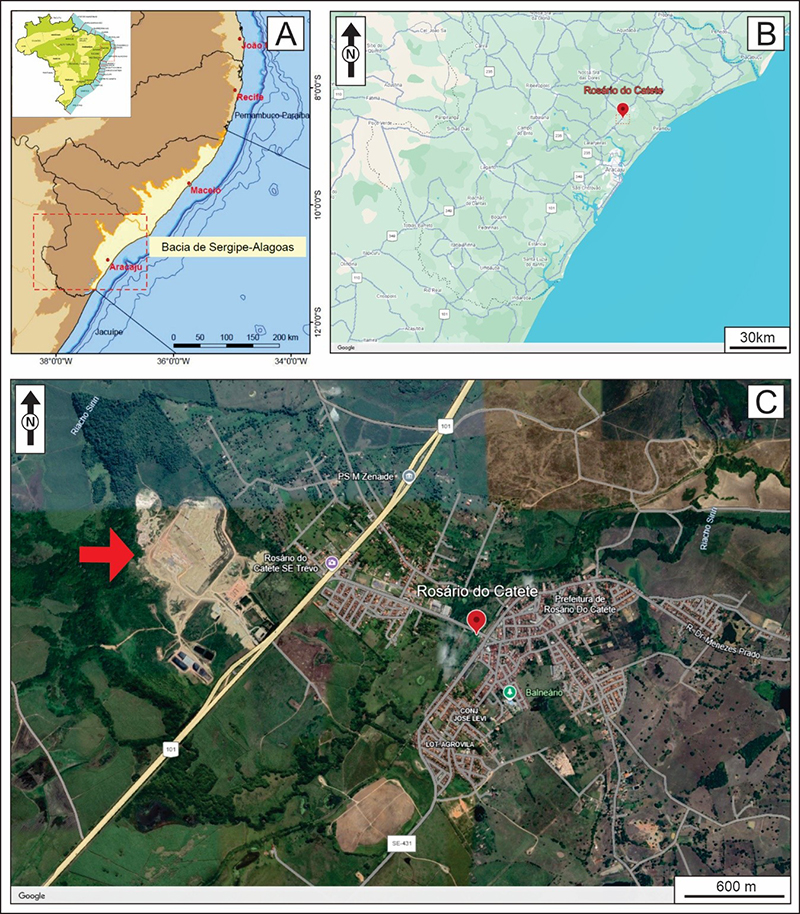
The material was obtained from one of two wells (Ro-1-SE or Ro-2-SE; 47-262 m deep) dug at km zero of Highway SE-208, 45 km from Aracajú (Figure 1). The depth of the sedimentary column in which the fish, ammonites and lobster were found was between 45 and 120 m.
The specimen, although fragile, is well calcified, except for uropods. It was protected with PARALOID B-67 acrylic resin dissolved in ethyl acetate.
The morphometric measurements (taken in millimeters) were collected with a digital caliper and following the prospects of Beikirch & Feldmann (1980).
The photograph was taken with a Nikon D7500 camera and interpretative line drawing was produced using a Motic binocular equipped with camera lucida attachment.
Higher-level classification follows Scholtz & Richter (1995) and anatomical nomenclature is mainly according to Beikirch & Feldmann (1980), McLaughlin (1980), Schram (1986) and Holthuis (1991).
Fossil collection site: A. Map of Sergipe-Alagoas basin (modified from Alves & Barbosa 2013); B. Map showing the location of the fossil deposit; C. The Arrow shows Potassium mine.
2.2 Anatomical and Morphometric Abbreviations
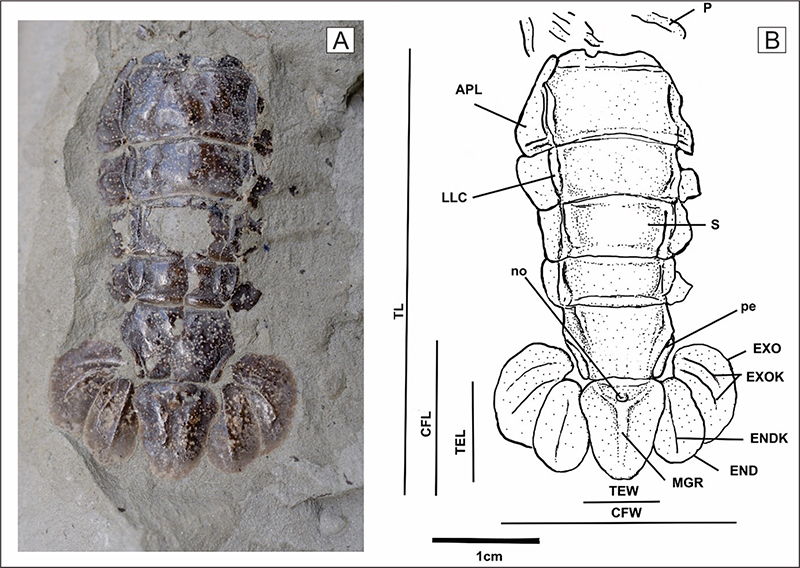
APL, abdominal pleura; CFL, caudal fan length; CFW, caudal fan width; END, endopodite; ENDK, straight chitinous keel of endopodite; EXO, exopodite; EXOK, oblique chitinous keel of exopodite; LLC, lateral longitudinal carina; MGR, median groove; no, node; P, pereiopod fragment; pe, peduncle (=protopod); S, abdominal somite; T, telson; TEL, telson length; TEW, telson width; TL, total length, from the first abdominal somite to the tip of the telson.
2.3 Systematic Paleontology
Order DecapodaLatreille, 1802
Suborder PleocyemataBurkenroad, 1963
Infraorder AchelataScholtz and Richter, 1995
Family ?ScyllaridaeLatreille, 1825
Gen. et sp. indet.
Material. - Pz.UERJ-601. Tail, represented by articulated pleonal somites and complete caudal fan preserved in greyish calciferous shale.
Provenance. -km zero of Highway SE-208, Rosário do Catete, 45 km from Aracajú, obtained from exploratory shaft Ro-1-SE by PETROMISA, in 1980.
Description. - The specimen presents six smooth, articulated pleonites, wider than long, without transverse grooves and ornamented with fine cuticular punctuations. No longitudinal median carina on the tergites. Posterior region of each somite strengthened by a thin transverse line of thicker cuticle. The total length of the tail (including the caudal fan) is 45 mm; the greatest width of an abdominal somite is that of the second segment, ~21mm. The sixth abdominal somite is well developed, hexagonal in shape, 8 mm long and 12 mm wide.
It has a short and elongated articular peduncle (=protopod) to receive the uropodites. The pleonal pleurae are rounded, well developed and continuous, separated from the tergite by a conspicuous lateral longitudinal carina that extends to the peduncle (=protopod). The width of the caudal fan corresponds to 28 mm. The caudal fan is less calcified than the pleonal somites and has a markedly convex edge. It is composed of a spatulate telson with a conspicuous median nodal excrescence followed by a deep median longitudinal groove in the shape of a “Y” whose branches align with the edge of the peduncle. The telson does not have a dieresis; it is 10 mm length and 9 mm width. Length of the set of uropodites: 13 mm. The uropodites are leaf-like, smooth and without marginal hairiness, probably due to loss during preservation. The exopodite lacks a dieresis and is slightly larger than the endopodite; it is inserted further forward into the peduncular area. There are two elongated and curved chitinous keels on its main body that do not reach the edge. The endopodite has a single medial straight keel. Fragments of locomotor appendages (pereiopods) have been preserved but are not informative (Figure 2).
Remarks. - The lobster from the Taquari Member exhibits a combination of features that allows it to be readily separated from other known Cretaceous decapods as well as from extant forms. The ornamentation pattern of the telson is unique among achelate crustaceans, with a median nodular projection followed by a “Y”-shaped groove. The caudal segments are wide with well-developed and aligned abdominal pleurae, similar to those of the crabs (e.g., Scyllarides Gill 1898) and different from the spiny lobsters of the genus Panulirus White 1847 (Figure 2). Unlike the lobster from Pedreira Brejo, the pleonalsomites do not decrease thickness toward the telson and a median keel crossing the abdomen longitudinally is absent. The cuticle is ornamented with irregular punctuations. The pleonal pleura of the lobster from Pedreira Brejo exhibits discontinuity, while that of the Taquari Member is continuous, as in some species of Scyllarides.

Specimen Pz.UERJ-601: A. Lobster of the Riachuelo Formation, Taquari Member, Sergipe; B. Line drawing of the specimen.
3 Discussion
Almost all living true lobsters are marine, with a few secondary invading estuarine environments. They are found in tropical and temperate waters (between 65°N and 60°S) (Holthuis 1991). They can be found from the intertidal zone to great ocean depths (up to 3,000 m). Some prefer rocky environments where they can protect themselves from predators, while others prefer muddy environments, with the possibility of digging holes and burrows. In general, spiny lobsters of the Palinuridae family prefer rocky environments, while slipper lobsters of the Scyllaridae family prefer muddy environments.
The systematic status of palinuroideans is debatable (Scholtz & Richter 1995; Dixon, Ahyong & Schram 2003). Palinura is probably a paraphyletic group so that recent studies use Achelata instead. Phylogenetic analyses based on morphological data have been set aside in favor of robust phylogenies using molecular data. However, fossils have been neglected in these analyses or only used for calibration purposes of the proposed tree of the clades to which they belong.
Schweitzer et al. (2010) updated the list of fossil decapods at the global level and point out that lobsters are much rarer than shrimps. At least 75 nominal species of Palinuroidea (Palinuridae+Scyllaridae) are known.
Mostly known, Palinuridae includes about 12 genera (e.g., Jasus, Justitia, Linuparus, Nupalirus, Palinurellus, Palinustus, Palinurus, Panulirus, Linuparus) that encompass some species known from fossils (Chan 2010). At least 60 nominal species are known from fossils. In this, fossil lobsters of Palinurus are known from marine deposits of the Early Cretaceous (Barremian, Aptian, Albian), Late Cretaceous (Turonian, Senonian), and Eocene of Europe and the Cenomanian of Lebanon (Garassino 1994). The oldest records (Barremian-Aptian) are from Italy (Bravi & Garassino 1998; Garassino 2000; Garassino & De Angeli 2003). Vega et al. (2006) reported the presence of lobsters of the genus Panulirus (i.e., Palinurus palaciosi) in the Albian of the Sierra Madre Formation, Mexico, in a marginal estuarine or shallow lagoon paleoenvironment.
The classification of decapods known from fossils into classifications involving living forms has been a constant undertaking among carcinologists, particularly those dealing with Cenozoic taxa, which exhibit morphological similarities with living forms. However, as we advance into the deep time of the fossil record, taxa with immense morphological disparity in relation to known forms are noted, generating inevitable problems in classification (Schweitzer et al. 2010). In the case of decapods, it has been noted that modern classifications based on morphology depend on anatomical characters that are difficult to preserve in fossils.
For this reason, the use of so-called proxy characters (Schweitzer 2003) has been chosen, that is, those that are preserved in fossils and are comparable to living forms. Details of the tail and, particularly, the caudal fan fit into this concept. For instance, Beikirch and Feldmann (1980) distinguished two species of crayfish (Erymidae) of the genus Enoploclytia, from the Campanian of the Austin Formation (Cretaceous of Texas) by the ornamentation of the caudal fan. The same criterion allowed them to separate them from Astacodes maxwelli Stenzel 1945, a species of palinuran found in the same locality. Therefore, diagnostic aspects other than those conventionally used with cephalothorax and swimmerets can be taken into account, as long as they are solely derived.
Reis, Turbay and Cesero (2005) suggested that the lobster of the Pedreira Brejo could be a member of Scyllaridae, a group of palinuroid decapods that includes the so-called slipper lobsters. The group includes 20 living genera (e.g., Acanthophoenicides, Ibacus, Llajassus, Parsacus, Scyllarus, Scyllarides, Scyllarella, Parribacus, Palibacus) and 89 species with doubtful fossil species (De Grave, Pentcheff & Ahyong 2009). The slipper lobsters are characterized by a marked modification of the antennal flagellum into a flattened plate, used as a “steering wheel” during escape from predators. Based on differences in the carapace and mouth appendages, four subfamilies are traditionally recognized: Arctidinae, Scyllarinae, Theninae and Ibacinae (Holthuis 1985). The monophyletic status of these families was recently supported in molecular phylogeny studies, except for Ibacinae (Yang et al. 2011).
The lobster from the Taquari Member also shares similarities with the Scyllaridae, but these apparently do not constitute derived aspects. The lobster from the Taquari Member also shares similarities with the Scyllaridae concerning overall morphology of pleonal region, but these apparently do not constitute derived aspects. More recent phylogenetic analyses (e.g., Yang et al. 2011) using molecular data and selected morphological aspects of the carapace and appendages do not allow progress in deciphering the systematic positioning of the lobsters from Pedreira Brejo and the Taquari Member.
In the case of fossil lobsters being representatives of Scyllaridae, the phylogenetic history of the group indicates that the oldest forms occurred in shallow waters of the continental shelf, secondarily invading estuarine environments. Arctidinae has the oldest fossil record among Scyllaridae: ~120 Ma Early Cretaceous (Holthuis 1991; Webber & Booth 2007; Woods 1925; Yang et al. 2011). Scyllarides and Arctides are extant genera of the family with a wide geographic distribution, consequently supporting the antiquity of the group. Almost all representatives occur in shallow waters of the shelf. Only two of the 14 species of Scyllarides (i.e., S. elisabethae and S. herklotsii) have a vertical bathymetric distribution that involves deeper water habitats (<200 m, Holthuis 1991). Molecular genetic studies support the evolutionary hypothesis for these lobsters from shallow water (inshore) to deep water (offshore) environments (Yang et al. 2011).
The good preservation of the lobster tail from the Taquari Member, with calcified cuticle and articulated and intact somites, suggests that it is an autochthonous record and was apparently preserved in situ, in calciferous mud, having been subjected to little or no transport. The fish that accompany it are, in general, complete and articulated, as in life. They are the same ones found in the epicontinental Albian Sea of Romualdo Formation, Araripe Sedimentary Basin. They were accumulated in a low-energy environment, with the contribution of fine sediments. All fish recorded for the Taquari Member are typical forms of open ocean waters in the continental shelf domain (e.g., Cladocyclus gardneri Agassiz 1841, Vinctifer comptoni (Agassiz 1834), Mercediella riachuelensis (Figueiredo & Silva Santos 1991), Tharrias araripis Jordan & Branner 1908 Neoproscinetes penalvai (Silva Santos 1970), Beurlenichthys ouricuriensisFigueiredo & Gallo 2004, Nolfia brasiliensisFigueiredo 2009, Notelops brama (Agassiz 1841), Rhacolepis buccalis Agassiz 1841) (Santos 1981; Figueiredo & Santos 1991; Figueiredo & Gallo 2004; Figueiredo 2009). The presence of certain gastropods and neritic bivalves corroborates a shallow water environment. Forms adapted to the estuarine environment, such as Araripelepidotes temnurus (Agassiz 1841), Lepidotes wenzae Brito and Gallo 2003, Calamopleurus cylindricus Agassiz 1841, and Paraelops cearensis Silva Santos 1971 were not registered in the Taquari Member.
Some demersal fishes, such as the pycnodonts Neoproscinetes penalvai and Mercediell ariachuelensis, occurred in shallow coastal environments and had buccal apparatus mouthparts consistent with durophagous habits, with lobsters as potential food items.
4 Conclusions
The specimen herein described shows a tail with calcified cuticle and entirely articulated somites, indicating in situ preservation in a calciferous mud, with little or no transport. The fan tail has a combination of characters that allows ready separation from other known reptant decapods from the Cretaceous, as well as from living forms. The structural pattern of the pleonal region and fan tail permit assigned to Achelata. Furthermore, the caudal segments are more similar to those of the slipper lobsters (Scyllarides) that those of spiny lobsters (Panulirus and allies).The specimen studied differs from the lobster form the Pedreira Brejo described by Reis, Turbay and Cesero (2005), since the abdominal somites do not decrease in thickness towards the telson, absence of median keel crossing the abdomen longitudinally, the cuticle is ornamented with irregular punctuations and the abdominal pleura is continuous, as in some species of Scyllarides.
5 Acknowledgements
FJF received financial support from the project "Prociência" by UERJ (prot. 1370) and INCT Paleovert 406902/2022-4. APL received support in the form of an IC grant by INCT Paleovert 406902/2022-4.
6 References
-
Alves, M.A.R. & Barbosa, G.S. 2013, ‘Bacia de Sergipe-Alagoas. Brasil 12º Rodada - Licitações de Petróleo e Gás’, viewed 27 Feb. 2025, < 2025, https://www.gov.br/anp/pt-br/rodadas-anp/rodadas-concluidas/concessao-de-blocos-exploratorios/12a-rodada-licitacoes-blocos/arquivos/seminarios/sergipe-alagoas.pdf >.
» https://www.gov.br/anp/pt-br/rodadas-anp/rodadas-concluidas/concessao-de-blocos-exploratorios/12a-rodada-licitacoes-blocos/arquivos/seminarios/sergipe-alagoas.pdf - Barros, O.A. & Oliveira, P.V. 2023, ‘New Dendrobranchiata fossil preserved in the Brazilian Cretaceous (Aptian/Albian) from the Araripe Basin, Piauí State’, Zootaxa, vol. 5264, pp. 545-563.
- Barros, O.A., Viana, M.S.S., Saraiva, A.A.F. & Silva, J.H. 2020, ‘The first occurrence of fossil shrimps (Crustacea, Decapoda) in the Ipubi Formation (Lower Cretaceous, Araripe Basin)’, Research, Society and Development 9, e251985576.
- Barros, O.A., Viana, M.S.S., Silva, J.H., Saraiva, A.A.F. & Oliveira, P.V., 2021a, ‘O Estudo de Camarões Fósseis no Brasil’, Anuário do Instituto de Geociências, vol. 44, 39063.
-
Barros, O.A., Viana, M.S.S., Viana, B.C., Silva, J.H., Paschoal, A.R. & Oliveira, P.V. 2021b, ‘New data on Beurlenia araripensis Martins-Neto & Mezzalira, 1991, a lacustrine shrimp from Crato Formation, and its morphological variations based on the shape and the number of rostral spines’, PLOS One, vol. 16, no. 3, e0247497, DOI:10.1371/journal. pone.0247497
» https://doi.org/10.1371/journal. pone.0247497 -
Barros, O.A., Oliveira, P.V. & Saraiva, A.A. 2025, ‘New data and redescription of Kellnerius jamacaruensis Santana et al., 2013, a Palaemonidae shrimp from the Araripe Basin in northeastern Brazil’, Palaeoworld, vol. 34, no. 2025, 100859, DOI:10.1016/j.palwor.2024.05.005
» https://doi.org/10.1016/j.palwor.2024.05.005 - Beikirch, D.W & Feldmann, R.M.1980, ‘Decapod crustaceans from the Pflugerville Member, Austin Formation (late Cretaceous: Campanian) of Texas’, Journal of Paleontology, vol. 54, no. 2, pp. 309-24.
- Bengtson, P. 1983, ‘The Cenomanian-Coniacian of Sergipe Basin, Brazil’, Fossils and Strata, vol. 12, pp.1-78.
- Beurlen, G. 1968, ‘A fauna do complexo Riachuelo-Maruim, I- Ammonoidea’, Boletim Técnico da Petrobras, vol. 11, pp. 437 -82.
- Beurlen K. 1950, ‘Alguns restos de crustáceos decápodes d´água doce fósseis no Brasil’, Anais da Academia Brasileira de Ciências, vol. 22, no. 4, pp. 453 -59.
- Beurlen, K. 1958, ‘Dois crustáceos do Cretáceo Superior do Nordeste do Brasil (Decapoda, Brachyura)’, Boletim do Museu Nacional, Nova Série Geológica, Rio de Janeiro, Brasil, vol. 26, pp. 1 -23.
- Bravi, S. & Garassino, A. 1998, ‘Plattenkalk of the Lower Cretaceous (Albian) of Petina, in the Alburni Mounts (Campania, S Italy) and its decapod crustacean assemblage’, Atti dela Societá italiana di Scienze naturali e del Museo cívico di Storia naturale in Milano, vol. 138, pp. 89 -118.
- Burkenroad, M.D. 1963, ‘The evolution of the Eucarida (Crustacea, Eumalacostraca) in relation to the fossil record’, Tulane Studies in Geology, vol. 2, pp. 3 -16.
- Cainelli, C., Babinski, N.A., Santos, R.C.R. & Uesugui, N. 1987, ‘Sedimentos albo-santonianos da Bacia SergipeAlagoas: ambientes de sedimentação e perspectivas petrolífera’, Revista Brasileira de Geociências, vol. 17, no. 2, pp. 135-38.
- Cainelli, C. & Mohriak, W.U. 1999, ‘Some remarks on the evolution of sedimentary basins along the Eastern Brazilian continental margin’, Episodes, vol. 22, no. 3, pp. 206-16.
- Camacho, D.G.F. 2009, ‘Aspectos petrográficos dos carbonatos da Formação Riachuelo - Albiano, Bacia de Sergipe’, Undergraduate thesis, Universidade Estadual Paulista, Rio Claro.
- Campos Neto, O.P.A., Lima, W.S. & Cruz, F.E.G. 2007, ‘Bacia de Sergipe-Alagoas’, Boletim de Geociências da Petrobras, vol. 15, no. 2, pp. 405 -15.
- Chan, T.-Y. 2010, ‘Annotated Checklist of the World’s Marine Lobsters (Crustacea: Decapoda: Astacidea, Glypheidea, Achelata, Polychelida)’, Raffles Bulletin of Zoology, suppl. 23: pp. 153-181.
- De Grave, S.; Pentcheff, N.D. & Ahyong, S.T. 2009, ‘A classification of living and fossil genera of decapod crustaceans’, Raffes Bulletin of Zoology, suppl. 21(2009): pp. 1-109.
- Dixon, C.J., Ahyong, S.T. & Schram, F.R. 2003, ‘A new hypothesis of decapod phylogeny’, Crustaceana, vol.76, no. 8, pp. 935 -75.
- Feijó, F.J. 1994, ‘Bacias de Sergipe-Alagoas’, Boletim de Geociências da Petrobras , vol. 8, no. 1, pp. 149 -61.
- Feldmann, R.M. & Pole, M. 1994, ‘A new species of ParanephropsWhite, 1842: a fossil freshwater crayfish (Decapoda: Parastacidae) from the Manuherikia Group (Miocene), Central Otago, New Zealand’, New Zealand Journal of Geology and Geophysics, vol. 37, pp. 163-67.
- Figueiredo, F.J. 2009, ‘A new marine clupeoid fish from the Lower Cretaceous of the Sergipe-Alagoas Basin, northeastern Brazil’, Zootaxa, vol. 2164, no. 1: pp. 21-32.
- Figueiredo, F.J. & Gallo, V. 2004, ‘A new teleost fish from the early Cretaceous of Northeastern Brazil’, Boletim do Museu Nacional, Geologia, vol. 73, pp. 1 -23.
- Figueiredo, F.J. & Santos, R.S. 1991, ‘Picnodontes da Formação Riachuelo, Membro Taquari, Estado de Sergipe, Nordeste do Brasil’, Anais da Academia brasileira de Ciências, vol. 63, pp. 369 -79.
- Garassino, A. 1994, ‘The macruran decapod crustaceans of the Upper Cretaceous of Lebanon’, Paleontologia Lombarda, Nuova Serie, vol. 3, pp.1-27.
- Garassino, A. 2000, ‘Palinurus sp. (Crustacea, Decapoda) del Cretacico inferiore (Barremiano superiore-Aptiano) della Valle del Torrente Cornappo (Udine, NE Italia), Gortania: Udiine’, Atti del Museo Friulano di Storia Naturale, vol. 22, pp. 65 -68.
- Garassino, A. & De Angeli, A., 2003, ‘Justitia Holthuis, 1946, (Crustacea, Decapoda, Palinuridea) from the Middle Eocene of Verona and Vicenza (northern Italy)’, Contributions to Zoology, vol. 72, no. 2/3, pp. 131 -32.
- Garassino, A. & Teruzzi, G. 1996, ‘The genera Longitergite nov. and Bannikovia nov. in the Lower Miocene of N Caucasus (Russia) (Crustacea, Decapoda)’, Atti Societa italiana Scienze naturali Museo cívico Storia naturale Milano, vol. 136, no. 1, pp. 3-14.
- Holthuis, L.B. 1985, ‘A revision of the family Scyllaridae (Crustacea: Decapoda: Macrura). I. Subfamily Ibacinae’, ZoologischeVerhandelingen (Leiden), vol. 218, pp. 1-130.
- Holthuis, L.B. 1991, ‘Marine Lobsters of the World. An Annotated and Illustrated Catalogue of Species of Interest to Fisheries Known to Date ’, FAO Species Catalogue, FAO Fisheries & Synopsis, vol. 13, FAO-UN, Rome.
- Koutsoukos, E.A.M., Azambuja Filho, N.C., Spadini, A.R. & Destro, N. 1993, ‘Upper Aptian: Lower Coniacian carbonate sequences in the Sergipe Basin, northeastern Brazil’, in T., Simo, R.W., Scott & J.P., Masse (eds), Cretaceous Carbonate Platforms, Tulsa: AAPG. pp. 127-43.
- Koutsoukos, E.A.M. & Bengtson, P. 1993, ‘Towards an integrated biostratigraphy of the Upper Aptian-Maastrichtian of the Sergipe Basin, Brazil’, Document Laboratoire Géologique de Lion, vol. 125, pp. 241-62.
- Latreille, P.A. 1802, ‘Histoire naturelle, Générale et particulière, des Crustacés et des Insectes’, F. Dufart, Paris. 413p.
- Latreille, P.A. 1825, ‘Famillesnaturelles du regne animal, exposé succinctement et dans un ordreanalytique avec l’indication de leurs genres ’, J.B. Bailliere, Paris, 570p.
- Luque, J.; Schweitzer, C.E.; Santana, W.; Portell, R.W.; Vega, F.J. & Klompmaker, A.A. 2017, ‘Checklist of fossil decapod crustaceans from Tropical America. Part I: AnomuraandBrachyura’, Nauplius, vol. 25, pp. e2017025.
- Martins- Neto, R.G. 2005, ‘Estágio atual da paleoartropodologia brasileira: hexápodes, miriápodes, crustáceos (Isopoda, Decapoda, Eucrustacea e Copepoda) e quelicerados’, Arquivos do Museu Nacional, Rio de Janeiro, vol. 63, no. 3, pp. 471-494.
- Martins- Neto, R.G. & Mezzalira, S. 1991, ‘Descrição de novos crustáceos (Caridea) da Formacão Santana, Cretáceo Inferior do Nordeste do Brasil’, Anais da Academia Brasileira de Ciências, vol. 63, no. 2, pp. 155- 60.
- Maisey, J.G. & Carvalho, M.G. 1995, ‘First records of fossil sergestid decapods and fóssil brachyuran crab larvae (Arthropoda, Crustacea), with remarks on some supposed palaemonid fossil, from the Santana Formation (Aptian-Albian, NE Brazil)’, American Museum Novitates, vol. 3132, pp. 1 -20.
- Maury, C.J. 1930, ‘O Cretáceo da Parahyba do Norte’, Monografia do Serviço Geológico e Mineralógico do Brasil, 8, 305p.
- McLaughlin, P.A. 1980, Comparative Morphology of Recent Crustacea, W.H. Freemann and Co., San Francisco, 177p.
- Mendes, I.D., Santana, W. & Carvalho, I.S. 2022, ‘Fossil hymenosamatid crabs (Decapoda) from the Lower Cretaceous of NE Brazil’, Cretaceous Research, vol. 134, 105174.
- Milani, E.J., Rangel, H.D., Bueno, G.V., Stica, J.M., Winter, W.R., Caixeta, J.M. & Pessoa Neto, O.C. 2007, ‘Bacias Sedimentares Brasileiras - Cartas Estratigráficas: Introdução’, Boletim de Geociências da Petrobras , Rio de Janeiro, vol. 15, no. 2, pp. 183 -205.
- Pinheiro, A.P., Saraiva, A.A. & Santana, W. 2014, ‘Shrimps from the Santana Group (Cretaceous: Albian): new species (Crustacea: Decapoda: Dendrobranchiata) and new record (Crustacea: Decapoda: Caridea)’, Anais da Academia Brasileira de Ciências , vol. 86, no. 2, pp. 663 -70.
- Ponte, F.C. & Asmus, H.E. 1978, ‘Geologic framework of the Brazilian continental margin’, Geologische Rundschan, vol. 68, no. 1, pp. 201 -35.
- Rathbun, M.J. 1902, ‘Description of a new species of Zanthopsis from Parahyba do Norte’, Bulletin of the Geological Society of America, vol. 13, pp. 43-44.
- Reis, M.A.F.; Turbay, C.V. & Cesero, P. 2005, ‘Descrição de um Novo Decapoda (Natantia, Malacostraca, Crustacea) da Formação Riachuelo, Albiano da Bacia de Sergipe’, Anuário do Instituto de Geociências- UFRJ , vol. 28, no. 1, pp. 80 -91.
- Roxo, M.G.O. 1940, ‘Preliminary note on fossil Crustacea from The Bahia, Brazil’, Anais da Academia Brasileira de Ciências , vol. 12, pp. 279 -80.
- Santana, W.A.P., Pinheiro, A.P., Silva, C.M.R.S. & Saraiva, A. 2013, ‘A new fossil caridean shrimnp (Crustacea: Decapoda) from the Cretaceous (Albian) of the Romualdo Formation, Araripe Basin, northeastern Brazil’, Zootaxa, vol. 3620, pp. 293 -300.
- Santos, R.S. 1981, ‘Sobre ocorrência de uma fáunula de peixes na Formação Riachuelo, Estado de Sergipe’, Anais da Academia Brasileira de Ciências , vol. 53, no. 1, pp. 203.
- Santos, R.S. 1985, ‘A Ictiofáunula da Formação Riachuelo, Estado de Sergipe’, in D.A., Campos, C.S., Ferreira, I.M., Brito & C.F., Viana (eds), Coletânea de Trabalhos Paleontológicos , Departamento Nacional da Produção Mineral, Série Geologia, Brasília, vol. 27, no. 2, pp. 141-45.
-
Saraiva, A.A.F., Pinheiro, A.P. & Santana, W. 2018, ‘A remarkable new genus and species of the planktonic shrimp family Luciferidae (Crustacea, Decapoda) from the Cretaceous (Aptian/Albian) of the Araripe Sedimentary Basin, Brazil’, Journal of Paleontology , vol. 93, no. 3, pp. 1 -7, DOI: 10.1017/jpa2018.5
» https://doi.org/10.1017/jpa2018.5 - Schaller, H. 1969, ‘Revisão estratigráfica da Bacia de Sergipe-Alagoas’, Boletim Técnico da Petrobras , vol. 12, no. 1, pp. 21-86.
- Schobbenhaus, C.; Bizzi, L.A.; Vidotti, R.M. & Goncalves, J.H. 2003, ‘Geologia, Tectônica e Recursos Minerais do Brasil’, 1 ed., Universidade de Brasília, Brasília.
- Scholtz, G. & Richter, S. 1995, ‘Phylogenetic systematics of the reptantian Decapoda (Crustacea, Malacostraca)’, Zoological Journal of the Linnean Society, vol. 113, pp. 289-328.
- Schram, F.R. 1986, ‘Crustacea ’, Oxford University Press, New York, 606 p.
- Schweitzer, C.E. 2003, ‘Utility of proxy characters for classification of fossils an example from the fossil Xanthoidea (Crustacea: Decapoda: Brachyura)’, Journal of Paleontology , vol. 77, no. 6, pp. 1107-1128.
- Schweitzer, C.E., Feldmann, R.M., Garassino, A., Karasawa, H. & Schweigert, G. 2010, ‘Systematic list of fossil decapod crustacean species ’, Crustaceana Monographs , 10: Brill, Leiden.
- Távora, V.A. & Souza-Lima, W. 2001, ‘Os fósseis da Bacia de Sergipe-Alagoas’, Informativo da Fundação Paleontológica Phoenix, 27.
- Turbay, C.V.G. 2002, ‘Estudo paleoambiental dos carbonatos do Albiano Superior na Bacia de Sergipe - uma abordagem microfaciológica’, Master Thesis, Universidade do Estado do Rio de Janeiro, Rio de Janeiro.
- Turbay, C.V.G., Cesero, P. & Koutsoukos, E.A. 2002, ‘On a fossil lobster (Decapoda, Malacostraca, Crustacea) from Riachuelo Formation, Albianofthe Sergipe Basin, Brazil’, Anais da Academia Brasileira de Ciências , vol. 74, no. 2, pp. 363.
- Turbay, C.V.G., Cesero, P., Garcia, A.J.V. & Silva, R.C. 2013, ‘Depositional, diagenetic and stratigraphic aspects of microfacies from Riachuelo Formation, Albian, Sergipe Basin, Brazil’, Revista do Instituto de Geociências da USP, Geol. USP, Sér. cient., São Paulo, vol. 13, no. 4, pp. 2 -48.
- Vega, F.J., García-Barrera, P., Perrilliat, M.C., Coutiño, M.A. & Mariño-Pérez, R. 2006, ‘El Espinal, a new plattenkalk facies locality from the Lower Cretaceous Sierra Madre Formation, Chiapas, southeastern Mexico’, Revista Mexicana de Ciencias Geológicas, vol. 23, no. 3, pp. 323-33.
- Webber, W.R. & Booth, J.D. 2007, ‘Taxonomy and evolution’, in K.L. Lavalli & E. Spanier (eds), The Biology and Fisheries of the Slipper Lobster, CRC press, USA, pp. 22-52.
- Woods, H. 1925, ‘A Monograph on the Fossil Macrurous Crustacea of England’, Adlard & Son Ltd., London.
-
Yang, C-H, Bracken-Grissomb, H., Kimb, D., Crandallb, K.A. & Chan, T-Y. 2011, ‘Phylogenetic relationships, character evolution, and taxonomic implications within the slipper lobsters (Crustacea: Decapoda: Scyllaridae)’, Molecular Phylogenetic Evolution, vol. 62, no. 1, pp. 237-50, DOI: 10.1016/j.ympev.2011.09.019
» https://doi.org/10.1016/j.ympev.2011.09.019
All data included in this study are publicly available in the literature.