 New Insights into Nd-Hf Isotopic Data and U-Pb Ages from the Tanguá Massif: Implications for the Magmatic Evolution
Abstract
The Tanguá Massif (TM) is an alkaline intrusion that is part of the Poços de Caldas-Cabo Frio Alignment (PCCFA), which comprises more than 25 intrusive bodies and extends over 1000 km along a WNW-ESE trend in southeastern Brazil. This study presents new insights into the evolution and genesis of the TM based on updated geological mapping, combined with mineralogical, petrographic, lithogeochemical, geochronological, and isotopic analyses. A new lithofacies map is proposed for the Tanguá Massif, subdividing the massif into five main units: i) central nepheline syenite; ii) intermediate nepheline syenite; iii) syenite; iv) breccias; v) undivided nepheline syenite. Additionally, phonolites and trachytes occur as dikes crosscutting the massif. U-Pb geochronological data reveal two distinct age groups: an older Cenomanian phase (94.8 Ma) and a younger Danian-Maastrichtian phase (ca. 60-70 Ma). The presence of an older syenite aged than previously reported - the oldest age for the PCCFA - suggests that the conventional mantle plume model may not adequately explain the origin of this province. Sr-Nd and Lu-Hf isotopic signatures indicate that the syenites and nepheline-syenites plot in the DMM-EMI array, whereas phonolite in the DMM-EMII array, suggesting mixing of different mantle components according to other studies. Geochemical and isotopic parameters (e.g., SSI, Zr/TiO2, REE sum, and εNd) highlight the significant role of crustal assimilation during the evolution of the TM, a process also proposed for other PCCFA bodies. Furthermore, ratios such as Th/Yb and Ba/La, combined with Nd-Hf isotopic decoupling, suggest the involvement of oceanic sediments associated with subducted slabs in the genesis of the magmas. These findings provide new insights into the magmatic evolution of the Tanguá Massif and contribute to a broader understanding of the processes controlling the formation of the PCCFA alkaline province.
Keywords:
Poços de Caldas-Cabo Frio Alignment; Mantle sources; Isotopic decoupling
Resumo
O Maciço Tanguá (MT) é uma intrusão alcalina que faz parte do Alinhamento Poços de Caldas-Cabo Frio (APCCF), que possui mais de 25 corpos intrusivos e segue uma direção WNW-ESE, estendendo-se por mais de 1000 km no sudeste do Brasil. Este trabalho apresenta novas interpretações sobre a evolução e a gênese do MT com base em mapeamento geológico atualizado, análises mineralógicas, petrográficas, litogeoquímicas, geocronológicas e isotópicas. Esse trabalho permitiu propor um novo mapa litofaciológico para o Maciço Tanguá, dividido em cinco unidades principais: i) nefelina sienito central; ii) nefelina sienito intermediário; iii) sienito; iv) brechas; v) nefelina sienito indivisível. Adicionalmente, fonolitos e traquitos ocorrem como diques cortando o maciço. Os dados U-Pb revelam dois grupos distintos: um mais antigo, com idade Cenomaniana (94,8 Ma), e um mais novo, com idade Daniano-Maastrichtiana (ca. 60-70 Ma). A presença de uma idade mais antiga (sienito) do que a reportada em estudos anteriores, a mais antiga já registrada para o APCCF, sugere que o modelo de pluma convencional pode não explicar adequadamente a gênese da província. As assinaturas isotópicas Sr-Nd e Lu-Hf mostram que os sienitos e nefelina-sienitos são plotados no trend DMM-EMI, enquanto os fonolitos no trend DMM-EMII, sugerindo a mistura de diferentes componentes de acordo com outros trabalhos. Parâmetros geoquímicos e isotópicos (como SSI, Zr/TiO2, soma de REE e εNd) reforçam a importância da assimilação crustal durante a evolução do MT, processo também proposto para corpos do Alinhamento. Além disso, razões como Th/Yb e Ba/La, combinadas ao desacoplamento isotópico Nd-Hf, sugerem a participação de sedimentos oceânicos associados a slabs subduzidos na gênese dos magmas. Os resultados obtidos fornecem novos elementos para compreender a evolução magmática do MT e contribuem para a discussão sobre os processos responsáveis pela formação da província alcalina do APCCF.
Palavras-chave:
Alinhamento Poços de Caldas-Cabo Frio; Fontes mantélicas; Desacoplamento isotópico
1 Introduction
The Brazilian Platform hosts over a hundred alkaline massifs ranging from the Permian-Triassic to the Paleogene, mostly located along mobile belts at the Paraná Basin margins, such as the Brasília and Ribeira Belts (Enrich et al. 2005; Heilbron, Eirado & Almeira 2016; Riccomini, Velázquez & Gomes 2005; Rosa & Ruberti 2018). Within this tectonic context, the Serra do Mar Province (SMP, Almeida 1983) hosts numerous alkaline massifs and dike swarms intruding the Proterozoic Ribeira Belt terrains, which are associated with the Brasiliano Cycle fault-related magmatism (Almeida 1983; Brotzu et al. 2005; Hackspacher & Godoy 1999; Machado et al. 1996; Heilbron, Eirado & Almeira 2016).
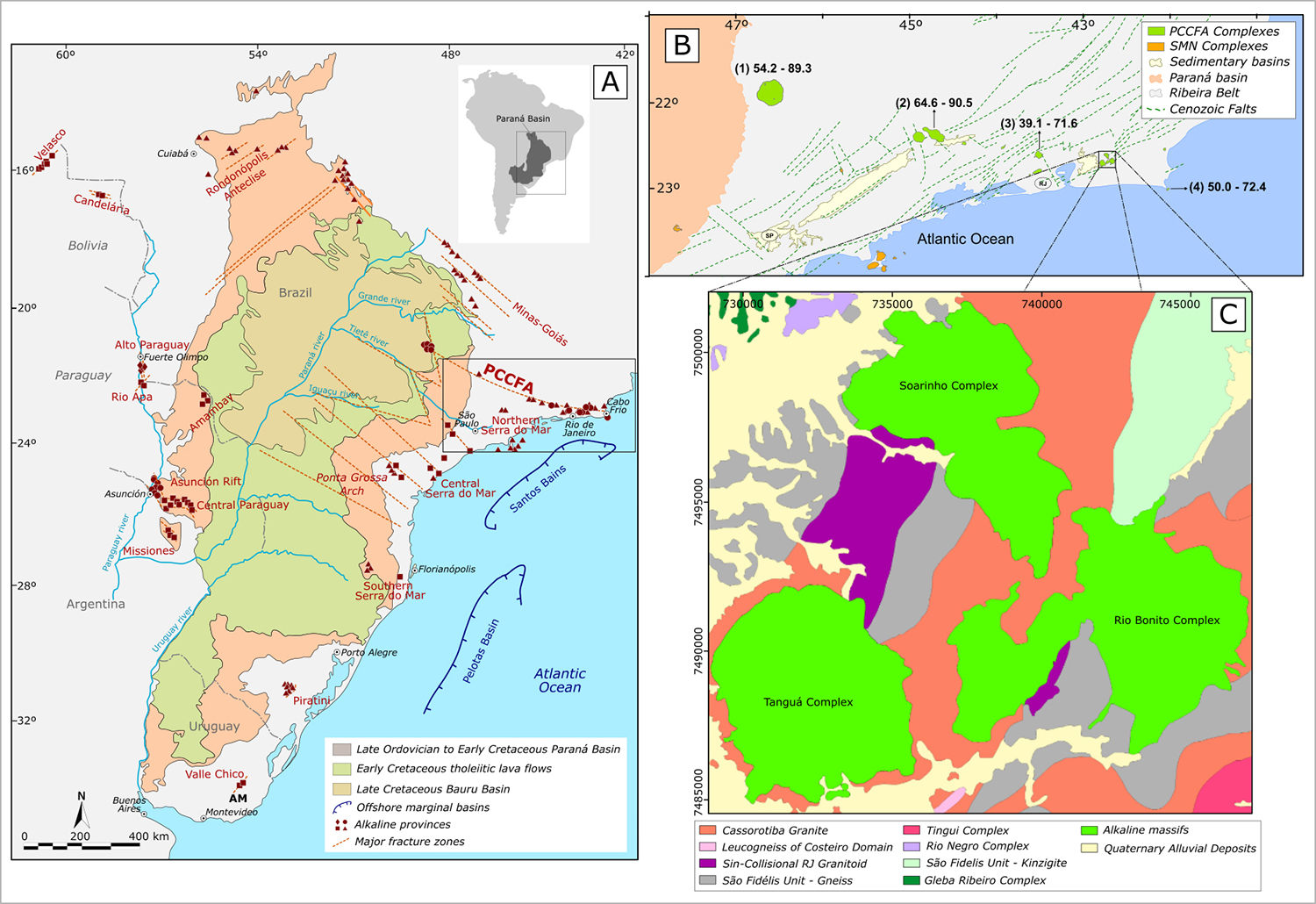
Riccomini, Velázquez & Gomes (2005) redefined the northern portion of SMP as Poços de Caldas - Cabo Frio Alignment (PCCFA), a magmatic alignment of approximately 1,150 km long with 26 intrusive (Figure 1A-B), composed of stocks, plugs, and dikes (Almeida 1983, 1986; Almeida, Carneiro & Mizusaki 1996; Melluso et al. 2017; Motoki et al. 2008; Riccomini, Velázquez & Gomes 2005; Rosa & Ruberti 2018; Silva et al. 2018; Thomaz Filho & Rodrigues 1999). Its origin remains debated, with models proposing either partial melting triggered by fault reactivation (e.g., Riccomini, Velázquez & Gomes 2005) or magmatism related to mantle plume activity (e.g., Thompson et al. 1998). Recent isotopic datasets from PCCFA massifs indicate contributions from depleted mantle (DMM), enriched mantle components (EMI, EMII), and metasomatized lithospheric mantle, suggesting complex and heterogeneous magmatic sources (Gordon et al. 2023; Guarino et al. 2021; Ulbrich et al. 2003).
The Tanguá Massif (TM), located in the easternmost PCCFA, consists mainly of syenites and nepheline syenites, with local occurrences of breccias, and phonolite and trachyte dikes (Motoki et al. 2010). Geochronological studies place the TM rocks in the Maastrichtian to Danian interval (65 - 68.4 Ma; Cordani & Teixeira 1979; Silva, Potratz & Geraldes 2023; Sonoki & Garda 1988). Previous studies suggested significant crustal assimilation during magma evolution (Motoki et al. 2015b), and proposed a predominantly mantle-derived source based on Lu-Hf isotopic data (Silva 2019).
This paper presents a detailed study of the Tanguá Massif, aiming to strengthen and expand previous petrographic and lithogeochemical investigations. It integrates petrographic and mineralogical analyses with satellite imagery interpretation to delineate lineaments to propose a new lithofacies map for the massif. Additionally, this study provides a new perspective on the massif’s evolution through lithogeochemistry characterization, new U-Pb geochronological constraints, and Sr-Nd-Hf isotopic analyses. The results offer insights into the magmatic processes controlling the genesis of the Tanguá Massif and their implications for the PCCFA. Furthermore, the study explores the possible influence metasomatized melts derived from subducted oceanic sediments.
2 Tectonic Framework
The Ribeira Belt, along with the Brasília and Araçuaí Belts, lies along the margins of the São Francisco Craton. It comprises a series of Brasiliano folds linked with granitogenesis and regional metamorphism that affected Meso- to Neoproterozoic sedimentary sequences and the Paleoproterozoic basement (Almeida 1976; Heilbron, Eirado & Almeira 2016). The Ribeira Orogen developed through diachronous collisions of microcontinents between 620 Ma and 510 Ma, producing NW-verging structures (Heilbron, Eirado & Almeira 2016). Ribeira Belt and part of the Brasília Belt are affected by intrusions of alkaline bodies and dikes from the PCCFA.
The PCCFA comprises nepheline syenites, syenites, quartz syenites, phonolites, and trachytes, which generally have a potassium affinity (Melluso et al. 2017; Riccomini, Velázquez & Gomes 2005; Rosa & Ruberti 2018; Silva et al. 2018). These intrusions (massif and dike swarms), dated between 84 and 39 Ma, form a curved WNW-ESE shape alignment (Riccomini, Velázquez & Gomes 2005; Rosa & Ruberti 2018), are spatially associated with ENE-EW fault systems (Brotzu et al. 2005) and have also been related to oceanic fracture zones (FZ; Santos & Hackspacher 2021 and references therein).
Two main models have been proposed to explain the origin of the PCCFA complexes and associated dikes. The first model relates their origin to the activity of a conventional mantle plume, migrating relatively from west to east, which would explain the progressive decrease in ages towards the east (Gibson et al. 1995; Herz 1977; Sadowski & Dias Netto 1981; Thomaz Filho et al. 2005; Thompson et al. 1998; VanDecar, James & Assumpção 1995). In this proposal, a plume with a head approximately 600 km in diameter would have been located beneath the continental lithosphere of southeastern Brazil, impinging it during the Cretaceous Period (Ceuleneer et al. 1993; Courtney & White 1986; Watson & McKenzie 1991). The relative movement between the plume and the lithosphere would have caused the eastward migration of intrusions, resulting in the formation of the PCCFA, which extends towards the Cabo Frio region (VanDecar, James & Assumpção 1995; Thompson et al. 1998).
The second model attributes the genesis of these magmatic bodies to partial melting triggered by the reactivation of pre-existing fault systems (Almeida 1991; Alves et al. 2006; Ferrari 2001; Riccomini, Velázquez & Gomes 2005; Zalán & Oliveira 2005). These studies emphasize the importance of structural control on magmatism and concluded that geochronological data do not support the existence of a conventional mantle plume. In addition, Thomaz Filho et al. (2005) highlighted the relationship between alkaline magmatism and the main onshore sedimentary basins of southeastern Brazil, such as the Taubaté, Resende and Volta Redonda basins.

A. Regional map of the southeast part of South America highlighting the link between the Paraná Basin and Alkaline occurrences and indicating the PCCFA positioning. Modified from Riccomini, Velázquez & Gomes (2005); B. PCCFA map with the associated regional geological structures. Alkaline massifs: 1 - Poços de Caldas; 2 - Itatiaia; 3 - Tinguá; 4 - Cabo Frio Island. Modified from Rosa & Ruberti (2018) and Thompson et al. (1998); C. Geological map associated with Tanguá, Soarinho, and Rio Bonito massifs (modified from Heilbron, Eirado & Almeira 2016)
2.1 Tanguá Massif Geological Setting
The Tanguá Massif is composed predominantly of leucocratic, feldspathic syenites, with local occurrences of magmatic breccias, phonolite, and trachyte dikes. These lithotypes share a similar mineralogy but differ in modal content and grain size. Although in situ outcrops are present, rounded syenite fragments of various sizes are also common across the massif.
Valença (1980) proposed a concentric zoning for the massif, subdividing it into three sectors. The central zone (upper syenite) is characterized by higher pseudoleucite and nepheline contents and a coarse-grained texture, both of which decrease toward the margins. In contrast, the lower syenite zone, in direct contact with the host rocks, is nearly devoid of pseudoleucite and contains scarce nepheline.
In addition to these main lithotypes, the massif contains phonolite and trachyte dikes that crosscut the syenitic rocks (Geraldes et al. 2009; Motoki et al. 2010). Magmatic breccias occur mainly along the massif's edges, where they cut both syenitic rocks and basement units, and are associated with late-stage magmatic conduits (Geraldes et al. 2013; Heineck & Raposo 1981; Motoki et al. 2015a). Other minor lithologies are present but do not display any evident organization within the massif.
3 Materials and Methods
Samples from the Tanguá Massif were collected during two field campaigns and their selection for the analyses considered the rock representativeness, spatial distribution, and low weathering. Sample preparation followed the analytical requirements and was conduct in two laboratories: i) the Geological Sample Processing Laboratory (LGPA) at the State University of Rio de Janeiro (UERJ) for petrography, geochemistry of the first set of samples, geochronology and isotopic analyses; ii) the Sample Preparation Laboratory of the SENAI Institute of Innovation in Mineral Processing (ISIPM) at the Innovation and Technology Center (CIT) SENAI, for X-ray diffractometry, zircon selection and mounting for U-Pb dating, and geochemistry of the second set samples.
3.1 Lithogeochemistry
The analyzed samples were divided into two sets based on the field campaigns. Geochemical analyses were conducted at ALS Laboratory (Canada) using Inductively Coupled Plasma-Atomic Emission Spectrometry (ICP-AES), following internal QA/QC procedures, with the analyzed oxides/elements and their detection summarized in Table 1. Base metals were not analyzed for the samples from the second set. In total, 26 samples representing different lithologies were analyzed: 17 from the first field campaign and 9 from the second.
3.2 Optical Microscopy
For optical microscopy, 11 samples were analyzed to identify mineral phases, textures, and structures at the ISIPM Microscopy Laboratory. Petrographic thin sections were prepared at LGPA, with polishing adjustments performed at ISIPM when necessary. Analyses were conducted using Leica microscope, model DM-LP, equipped with various objectives and both transmitted and reflected illumination system. Photomicrographs were captured using a Moticam 10.0 digital camera with its dedicated software.
3.3 X-ray Diffraction
X-ray diffraction (XRD) analyses were performed at ISIPM X-ray Laboratory using the powder method on Shimadzu/LabX6000 diffractometer equipped with a CuKα radiation (λ = 1.5418 Å) and a θ-2θ system. Operating conditions were 40 kV, 30 mA, and a scan range of 5º-80º (2θ), with a 0.01º step (2θ), 0.5º/min speed. Mineral phases were identified and quantified using the Rietveld method with Match! software.
3.4 Sr- and Nd- Isotopic Analyses
Sr-Nd isotopic analyses were performed at the Laboratory of Geochronology and Radiogenic Isotopes (LAGIR), UERJ, on five syenite samples and one phonolite. Powdered samples (25-50 g) were digested with HCl and HF in a cleanroom under controlled conditions. Measurements were conducted using a TRITON multicollector Thermal Ionization Mass Spectrometry (TIMS - see Valeriano et al. 2003). Sr and Nd separation followed the procedures described in Heilbron et al. (2013). BRP-1 was used as reference material (143Nd/144Nd = 0,512420 ± 0.000004 and 87Sr/86Sr = 0,706031 ± 0.000004 - Neto et al. 2023), besides procedures blank (Nd = 307 pg and Sm = 23 pg). Data reduction and processing were carried out using the GeoChemical Data ToolKit (GCDkit)
3.5 U-Pb and Lu-Hf Analyses
For the U-Pb analyses, samples underwent particle size reduction and magnetic separation using Frantz equipment at LAGIR (UERJ). Zircon grains hand-picked under a Leica EZ4 microscope (ISIPM) and mounted on 25 mm epoxy disks, then ground and polished to expose the crystal surfaces. Imaging was performed using a Hitachi FlexSEM 1000 II scanning electron microscope with a Bruker EDS detector, at ISIPM/CIT.
The analyses were conducted at the Multi-User Environment and Materials Laboratory (Multilab) in Rio de Janeiro, using LA-ICP-MS (Thermo Scientific Neptune Plus). According to internal procedures, the initial analytical stage examined 14 zircon grains; in a subsequent stage, following a protocol change, 15 grains were analyzed. Reference materials used for calibration were BB, Plesovice (Pleso), and 91500 for U-Pb analyses, and GJ-1 and procedural blanks for Lu-Hf analyses. Analytical conditions included continuous ablation mode, 6 Hz laser frequency, and 40 µm spot size. Data were processed using Glitter software, and Concordia diagrams were constructed using ISOPLOT, both in the Excel extension and in the R-based online platform (Ludwig 2003; Vermeesch 2018).
4 Results
4.1 Preliminary Surveys and Correlation with Previous Work
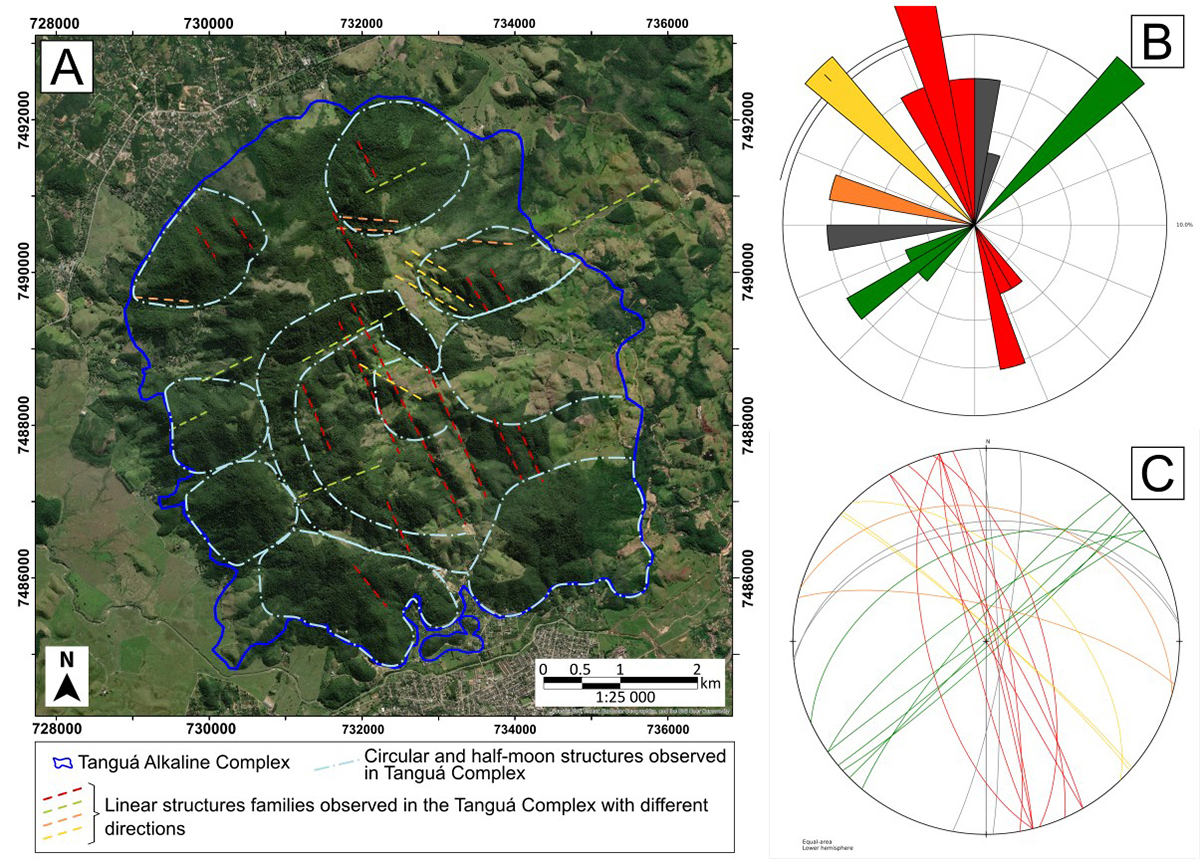
A preliminary assessment of the structures was carried out based on previous TM works (e.g., Heineck & Raposo 1981; Motoki et al. 2015a; Silva 2019; Valença 1980) and from other PCCFA massifs, such as Itatiaia (Rosa & Ruberti 2018) and Mendanha (Mota 2012; Motoki et al. 2008). Rosa & Ruberti (2018) suggested that the alkaline massifs from PCCFA may have circular or half-moon structures associated with different lithotypes or even distinct magmatic pulses. By analyzing satellite images using ArcGIS world imagery, circular or half-moon structures were identified in the Tanguá Massif, which helps in the initial massif categorization (Figure 2 A ). Additionally, repetitive linear structures corresponded to the four fracture families observed during the field campaign (Figure 2A-C ).

A. Map delimiting the Tanguá Massif contour on a satellite image (Base World Imagery) indicating the presence of half-moon, circular (light blue lines), and linear structures in the massif. Datum: WGS 1984 (UTM - Zone 23S). The linear structures indicating the presence of four families of fractures: i) NNW-SSE (red); ii) NW-SE (yellow); iii) WNW-ESSE (orange); and iv) NE-SW (green); B. Ros diagram indicating families of fractures that coincide with regional structures according to colors; C. Schmidt great circles diagram with the same families of fractures indicating the directions and dips.
4.2 New Lithofacies Division Proposal for the Tanguá Massif
Based on previous massif structures and results from petrography and X-ray diffractometry studies, it is possible to propose a new lithofacies map for the Tanguá Massif (Figure 3). The classification comprises five units: 1) central nepheline syenite, 2) intermediate nepheline syenite, 3) syenite, 4) breccias, and 5) undivided nepheline syenite. Generally, the breccias are mostly found on the southern and eastern edges of the massif. The syenitic zones are almost concentric, with syenite at the edge and nepheline syenite in the central portion. It is worth highlighting the presence of a nepheline syenite zone with a half-moon-shape between the most central and outermost zones. The undivided nepheline-bearing syenite zone is identified in the NW portion of the massif. The details of the lithotypes observed in the massif are present in the further items.
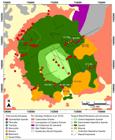
Lithofacies map of the Tanguá Alkaline Massif, showing the outcropping lithotypes at each surveyed point and linear structures. Datum: WGS 1984 (UTM - Zone 23S).
4.3 Petrography
4.3.1 Magmatic Breccias
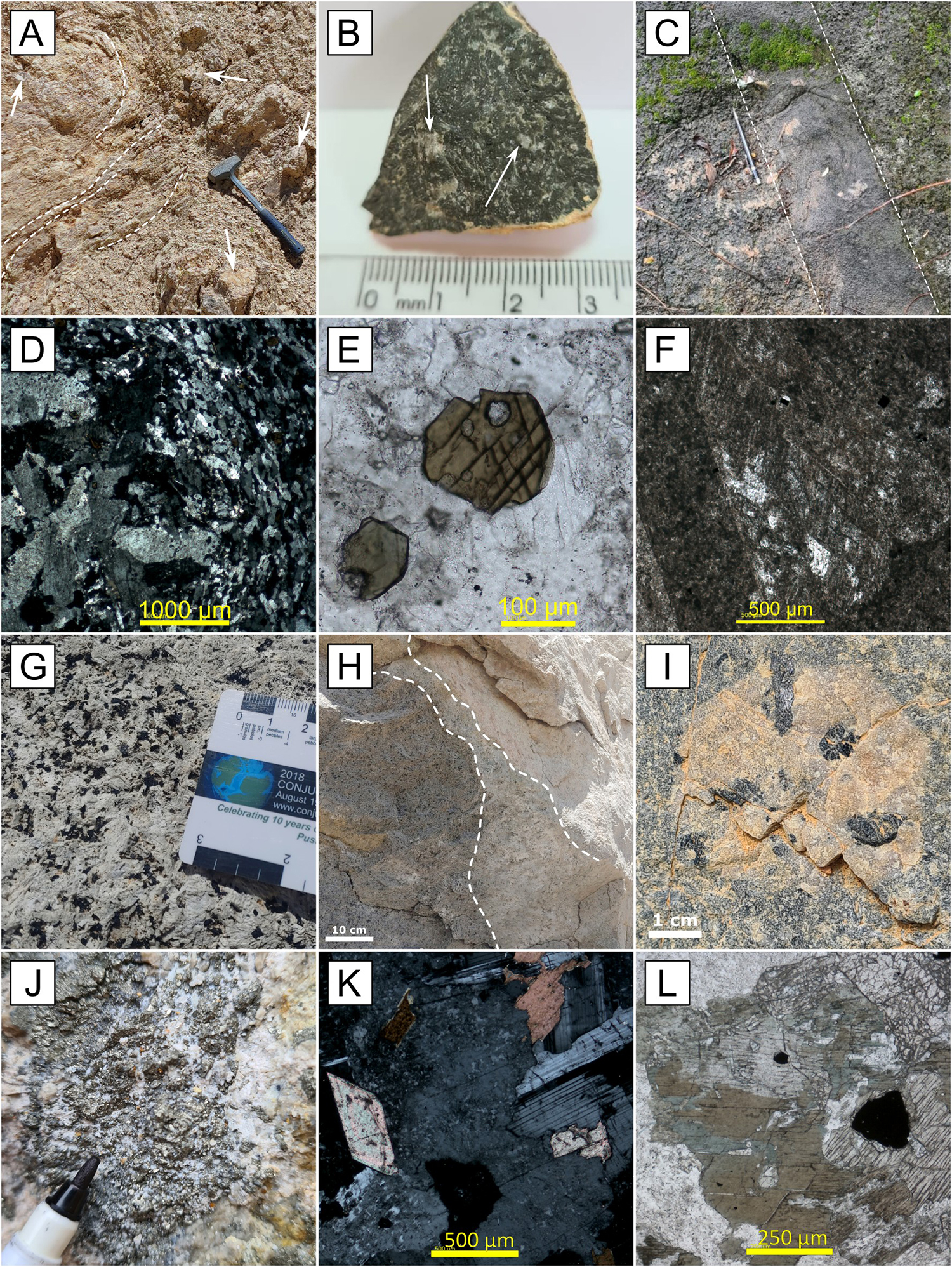
The breccias (Figure 3 - lithofacies 4) are yellowish ocher and weathered. They are matrix-supported, with polymictic clasts of various sizes and shapes, mostly rounded. In the east, they are fine-grained and may show fractures and foliation (Figure 4A). The fine matrix contains ripiform K-feldspar, sometimes altered to sericite. Coarse feldspar and limonite/iron hydroxide are also present.
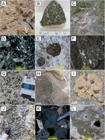
A. Outcrop of foliated polymict breccia with thick clasts (white arrows) in a matrix-supported structure from the southern portion of the massif; B. Fragment of phonolite with dark color, fine grain, and phenocrysts indicated by white arrows; C. Syenite fragment in contact with phonolite highlighted by a dashed white line; D. Phonolite sample photomicrograph of a feldspathic phaneritic matrix with crystal orientation and different phenocrysts under transmitted light (TL) and crossed nicols (CN), 2.5x and 1000 µm; E. Basal section of clinoamphibole (possible arfvedsonite) of phonolite sample under TL and parallel nicols (PN), 20x and 100 µm; F. Photomicrograph of a trachyte sample showing a fine and altered matrix with altered feldspar phenocrysts under transmitted light (TL) and PN, 5x and 500 µm; G. Detail of syenite granulation and typical texture; H. Contact between syenite (left) and trachyte (right) in a quarry outcrop; I. Pinkish pseudoleucites set within a pinkish granular matrix; J. Fractured portion filled by pyrite, in detail; K. Photomicrograph of a syenite sample showing an overview of the rock with potassium feldspar (central portion), associated with plagioclase (polysynthetic extinction on the right), titanite, and biotite. The relationship between plagioclase and potassium feldspar may indicate an anti-rapakivi texture under TL and CN, 5x and 500 µm; L. Detail photomicrograph of a clinopyroxene crystal associated with biotite and amphibole, indicating possible alteration between these minerals under TL and PN, 10x and 250 µm.
4.3.2 Phonolites
The lithotype occurs as dikes along massif lineaments (Figure 3 - structure 6), and as centimetric- to metric sized fragments (Figure 4B-C). It is dark gray to black, with an aphanitic to fine-grained phaneritic matrix with a porphyritic texture. The matrix comprises K-feldspar (Figure 4D), and K-feldspar phenocrysts occur locally altered to sericite. Other minerals include clinopyroxenes, nepheline, titanite, amphibole (possible arfvedsonite - Figure 4E), sodalite, and opaques.
4.3.3 Trachyte
This leucocratic lithotype is rare, occurring in contact with syenite or phonolite. It is beige, commonly weathered, and is aphanitic with porphyritic texture. The fine matrix is dominated by K-feldspar, as in the large euhedral phenocrysts (Figure 4F). Microphenocrysts of feldspar or feldspathoid are observed, as well as carbonate and euhedral pyrite crystals.
4.3.4 Syenitic Rocks
These rocks represent the main lithological massif component (Figure 3 - lithofacies 1, 2, 3 and 5), occurring as rounded fragments, fine- to coarse-grained, locally pegmatitic, and white to medium-gray (Figure 4G-H). They are mainly composed of feldspars (alkaline and plagioclase), nepheline, clinopyroxene, amphibole, and titanite (Figure 4K-L), with biotite, sodalite, and leucite as accessories. K-feldspar is the dominant phase, usually anhedral, rarely euhedral, and may alter to sericite and clay minerals. Nepheline distinguishes syenite from nepheline syenite. Syenitic rocks are commonly crosscut by millimeter - to centimeter-scale fractures filled with leucocratic material, similar to aplites, and locally the presence of pseudoleucites is observed (Figure 4I). Some fractures are filled by black or yellowish material, silica, and pyrite (Figure 4J), and the latter also occurs disseminated in the host rocks.
4.4 X-ray Diffraction
Thirty-nine samples were analyzed by X-ray diffraction to investigate the mineralogical composition of the rocks associated with the massif. The results show that the syenitic rocks are predominantly composed of feldspars, nepheline, and analcime. Based on these results and on the spatial distribution of the samples within the massif (used to define the new lithofacies map), this group, previously studied only by petrography, can be subdivided into two subgroups: nepheline syenite and syenite. The nepheline syenite, in turn, can be further subdivided into two facies according to mineralogical composition: 1) central nepheline syenite, with samples mainly located in the central portion of the massif and composed of nepheline- and analcime-rich rocks; 2) intermediate nepheline syenite, with samples preferentially occurring between the central portion and the syenites, consisting mainly of nepheline- and albite-bearing rocks, with little or no analcime. An undivided nepheline syenite group includes of samples from the NW portion of the massif, characterized by feldspar contents >80 wt% (sanidine or orthoclase) and nepheline. These rocks are spatially associated with nepheline-free syenites, which prevents the separation of this portion into distinct facies.
The phonolites present three main variants: i) high sanidine and nepheline contents, (ii) high microcline and albite contents, or (iii) high albite contents without nepheline. However, this subdivision was not applied due to the limited number of samples. Trachyte, composed of feldspar and quartz, was the only rock with this composition. Monzonite was identified exclusively by XRD, was not analyzed by optical microscopy, and shows mineralogy similar to the syenitic facies (Figure 3 - lithofacies 3) comprising albite, orthoclase, and microcline. This rock was not represented in the lithofacies map due to its low abundance (only one sample). Detailed results are available in the Supplementary Material.
4.5 Whole-Rock Geochemistry
Twenty-six samples from the Tanguá Massif were selected for whole-rock analysis, and all results, including the ratios discussed in this work, are provided in the Supplementary Material. The lithogeochemical data are presented here according to the lithotypes identified through petrography and X-ray diffraction analyses. Thus, the lithotypes were classified as syenite, nepheline-syenites (without subdivision), phonolites, trachytes, and monzonite.
The syenite ranges between 56.8 and 59.2 wt.% SiO2, whereas nepheline syenites contain 54.9-59.1 wt.%. Phonolites vary between 50.5 and 59.8 wt.%, trachyte from 57.5 to 58.9 wt.%, and monzonite reaches 60.7 wt.%. All rocks are alkaline and intermediate in character (Figure 5A), except for one phonolite sample (TG42B), which plots in the basalt field and is classified as subalkaline with basic composition. In the TAS diagram (Le Bas et al. 1986 -Figure 9), the rocks are classified as phonolite or trachyte. In the R1-R2 diagram (De la Roche et al. 1980 - Figure 5B), they plot in the phonolite, trachy-phonolite, trachyte, or quartz-trachyte fields, the latter associated with trachyte samples. The lithotypes are mostly metaluminous, though some are peraluminous (Figure 5D). In the K2O-Na2O diagram (Figure 5C), most samples fall within the ultrapotassic field, with fewer samples in the potassic field. These results are consistent with previous TM data and with samples from the Soarinho and Rio Bonito massifs.
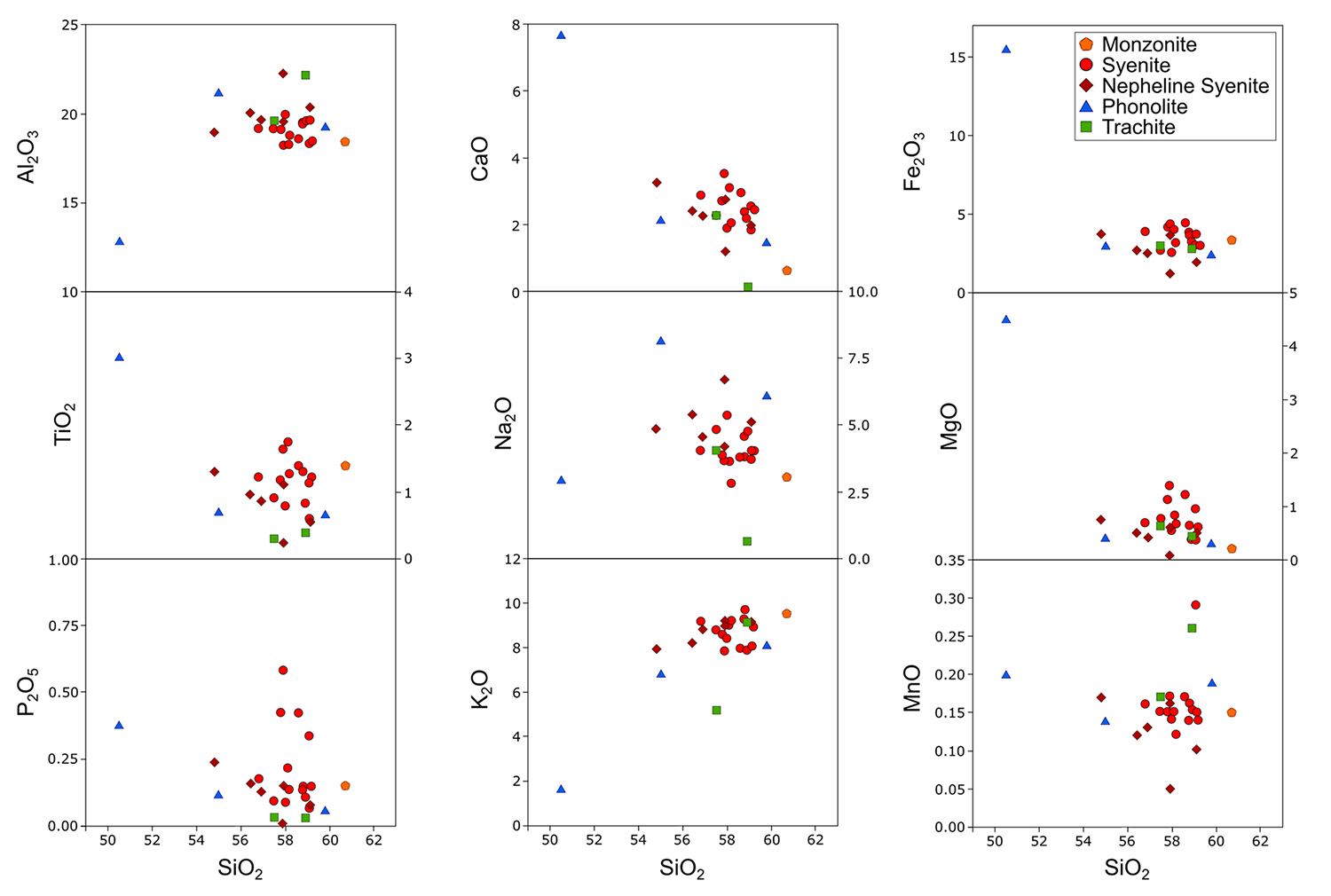
Harker variation diagrams (Figure 6) illustrate the behavior of major oxides relative to SiO2. In nepheline syenites Al2O3, K2O, and Na2O increase with SiO2, while others display negative trends. CaO shows only a weak correlation, and syenite data are more scattered. Despite the limited dataset, phonolite display correlations for P2O5 and K2O.
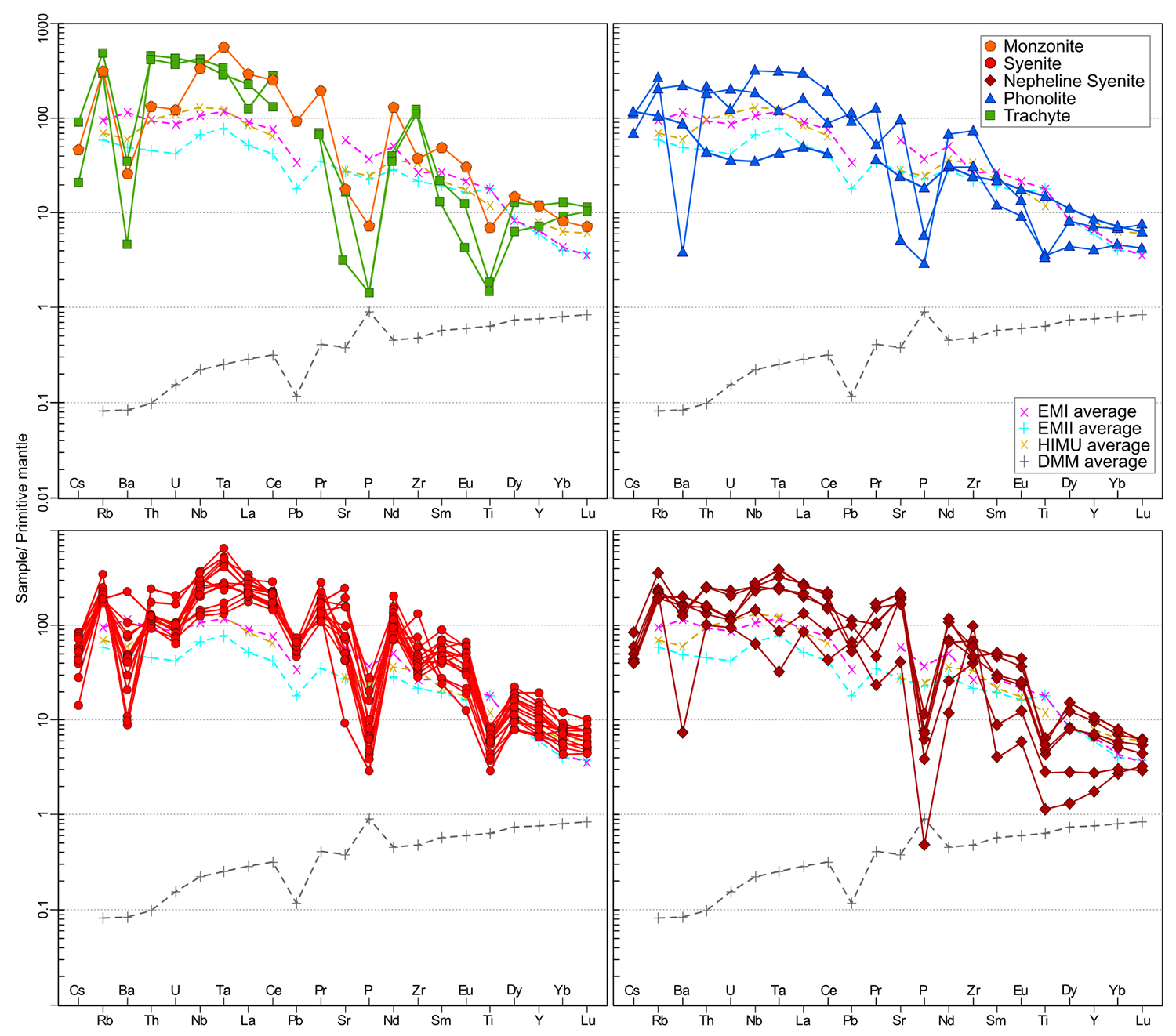
The incompatible elements normalized by primitive mantle (Figure 7 - McDonough & Sun 1995) reveal decreasing trends towards the most incompatible elements across all lithotypes. Systematic negative Ba, P, and Ti anomalies are observed for all rocks, while Sr anomalies occur in all lithotypes except nepheline syenites.
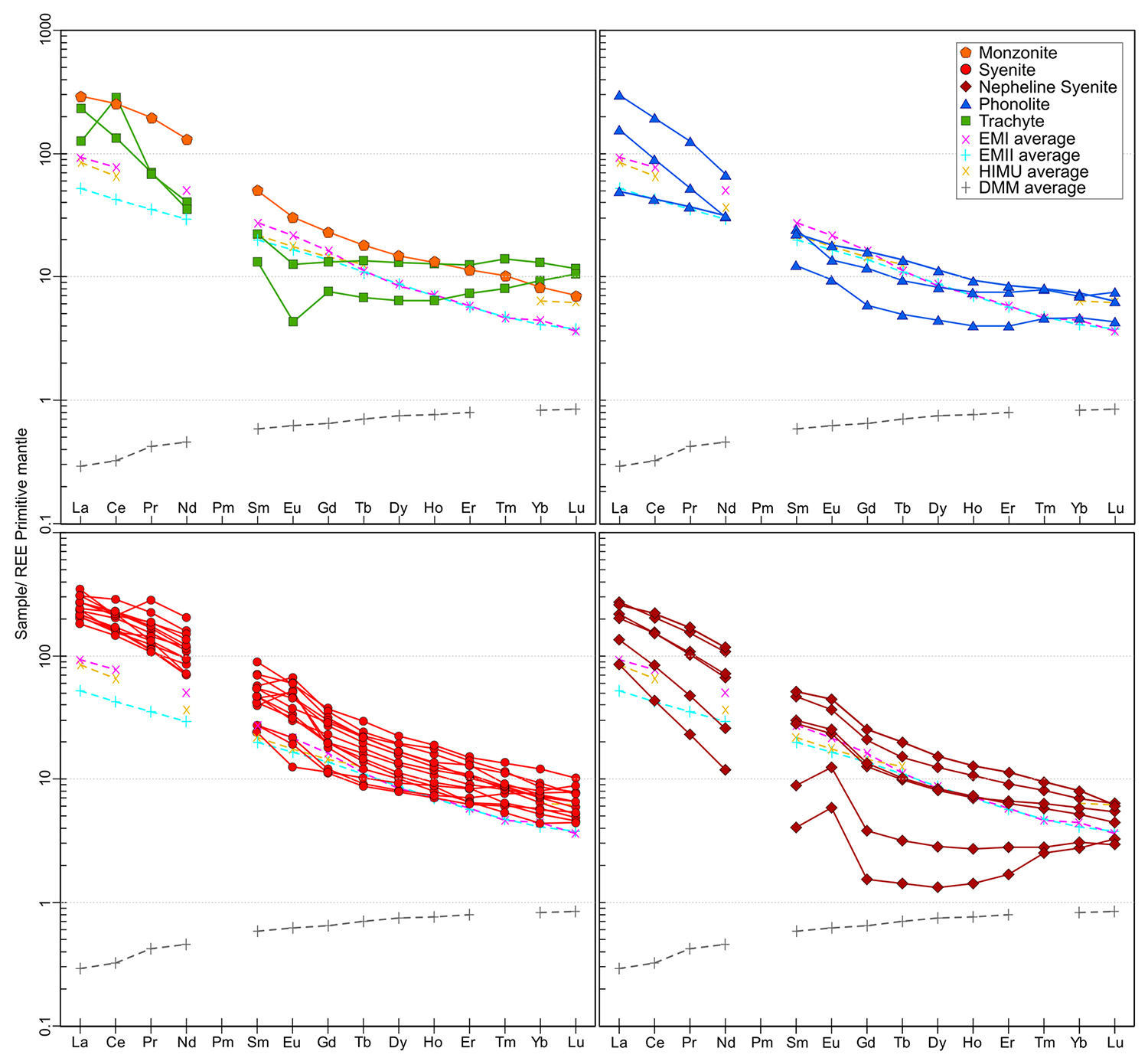
Rare earth element patterns normalized to primitive mantle (Figure 8 - McDonough & Sun 1995), display an enrichment relative to the mantle and show descending patterns (LaN/YbN = 6.7-44.3). Syenites and nepheline syenites mainly exhibit positive Eu anomalies (Eu/Eu* = 0.76-1.96 and 1.17-2.35, respectively), whereas trachytes record negative anomalies (0.43-0.73). Phonolites (0.82-1.11) and monzonite (0.89) show only slightly Eu anomalies. A positive Ce anomaly is also graphically visible in trachyte. Flattening of the HREE pattern occurs in phonolite, trachytes, and some nepheline syenites.
CIPW normative calculations indicate feldspars as the dominant normative minerals, with orthoclase (Or) being the most abundant. Nepheline syenites invariably contain normative nepheline (Ne), while the syenites may contain Ne, normative quartz (Q), or neither. Trachytes show the highest normative Q values (19.4%), followed by one phonolite sample and the monzonite. Detailed CIPW results are provided in the Supplementary Material.

A. TAS diagram (Total alkali versus SiO2) by Le Bas et al. (1986) for the samples from the Tanguá Massif: 1 - Phonolite; 2 - Foidite; 3 - Tefri-phonolite; 4 - Trachyte/Trachydacite; 5 - Phonotephrite; 6 - Trachyandesite; 7 - Tephrite-basanite; 8 - Trachy basalt; 9 - Trachyandesite-basalt; 10 - Picrobasalt; 11 - Basalt; 12 - Basaltic Andesite; 13 - Andesite; 14 - Dacite; 15 - Riolite; B. R1-R2 diagram by De La Roche et al. (1980) for the samples from the Tanguá Massif: 1 - Ankaratrite; 2 - Nephelinite; 3 - Basanite; 4 - Picrite; 5 - Tephrite; 6 - Alkali-basalt; 7 - Basalt; 8 - Toleiitite; 9 - Phono-tephrite; 10 - Hwaiite; 11 - Lato-basalt; 12 - Andesi-basalt; 13 - Mugearite; 14 - Latite; 15 - Lati-andesito; 16 - Andesite; 17 - Phonolite; 18 - Trachy-phonolite; 19 - Trachyte; 20 - Quatz traqchyte; 21 - Quartz lalite; 22 - Dacite; 23 - Alkali rhyolite; 24 - Rhyolite; 25 - Rhyodacite. R1 = 4Si - 11(Na + K) - 2Fe + Ti); R2 = 6Ca + 2 Mg + Al; C. K2O versus Na2O diagram by Middlemost (1975) for the samples from the Tanguá Massif; D. A/NK versus A/CNK diagram by Shand (1943) for the samples from the Tanguá Massif. The TG42A sample plots outside the diagram boundaries.


Primitive Mantle normalized elements (McDonough & Sun 1995) for the samples from the Tanguá Massif. Mantle sources average: DMM - Workman & Stanley (2005); EMI - Salters et al. (2011); EMII - Workman et al. (2004); HIMU - Chaffey, Cliff & Wilson (1989).
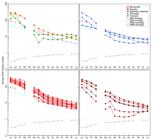
Primitive mantle normalized rare earth elements (McDonough & Sun 1995). Mantle sources average: DMM - Workman & Stanley (2005); EMI - Salters et al. (2011); EMII - Workman et al. (2004); HIMU - Chaffey, Cliff & Wilson (1989).
4.6 U-Pb Geochronology
The obtained results are presented in the Supplementary Material. Figure 9 shows the Tera-Wasserburg concordia diagrams (Tera & Wasserburg 1972), backscattered electron zircon images, and the LA-ICP-MS analytical spots. U-Pb and Lu-Hf analyses were performed on five syenite samples, one nepheline syenite, one monzonite, and one phonolite.
Syenite TG-02C yielded a concordia age of 66.08 ± 0.47 Ma (11 grains; MSWD = 0.55; probability = 95%). The zircons are mostly anhedral to subhedral and equidimensional, except for grain 4. Syenite TG-04D gave a concordia age of 64.40 ± 0.40 Ma (14 grains; MSWD = 1.6; probability = 2.9%), with grains varying from anhedral to subhedral, and preferentially equidimensional, except for grains 1, 5, and 10, which are more prismatic. Syenite TG-18 yielded an age of 64.82 ± 0.38 Ma (13 grains; MSWD = 0.44; probability = 99%), with a mix of prismatic and equidimensional crystals. Syenite TG-27 returned a concordia age of 67.06 ± 0.48 Ma (11 grains; MSWD = 0.89; probability =60%), with predominantly anhedral and equidimensional zircons. Finally, syenite TG-03 yielded the oldest concordia age, 94.82 ± 1.02 Ma (10 grains; MSWD = 0.29; probability = 100%), with prismatic but mostly anhedral or subhedral morphologies.
The nepheline-syenite TG-19 yielded a concordia age of 61.27 ± 0.48 Ma (7 grains; MSWD = 1.2; probability = 30%), with anhedral to subhedral, equidimensional zircons. Monzonite TG-02 gave 65.89 ± 0.50 Ma (10 grains; MSWD = 0.49; probability = 97%), with zircons ranging from anhedral to euhedral, mostly non-prismatic.
Phonolite TG-16 was analyzed in two mounts. The first (TG-D) contained only six zircon grains large enough for analysis and yielded a concordia age of 69.37 ± 0.58 Ma (5 grains; MSWD = 1.3; probability = 22%), with grains 2 and 4 being more euhedral and prismatic. The second mount (TG-E), with a larger set of zircons (15 grains), provided a concordia age of 68.11 ± 1.38 Ma (MSWD = 0.64; probability 93%).
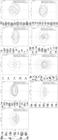
Zircon U-Pb concordia diagram for the samples from Tanguá Massif and the analyzed zircon grains showing the area of analysis (red circle in the grains with 40 µm).
4.7 Lu-Hf Isotopic Geochemistry
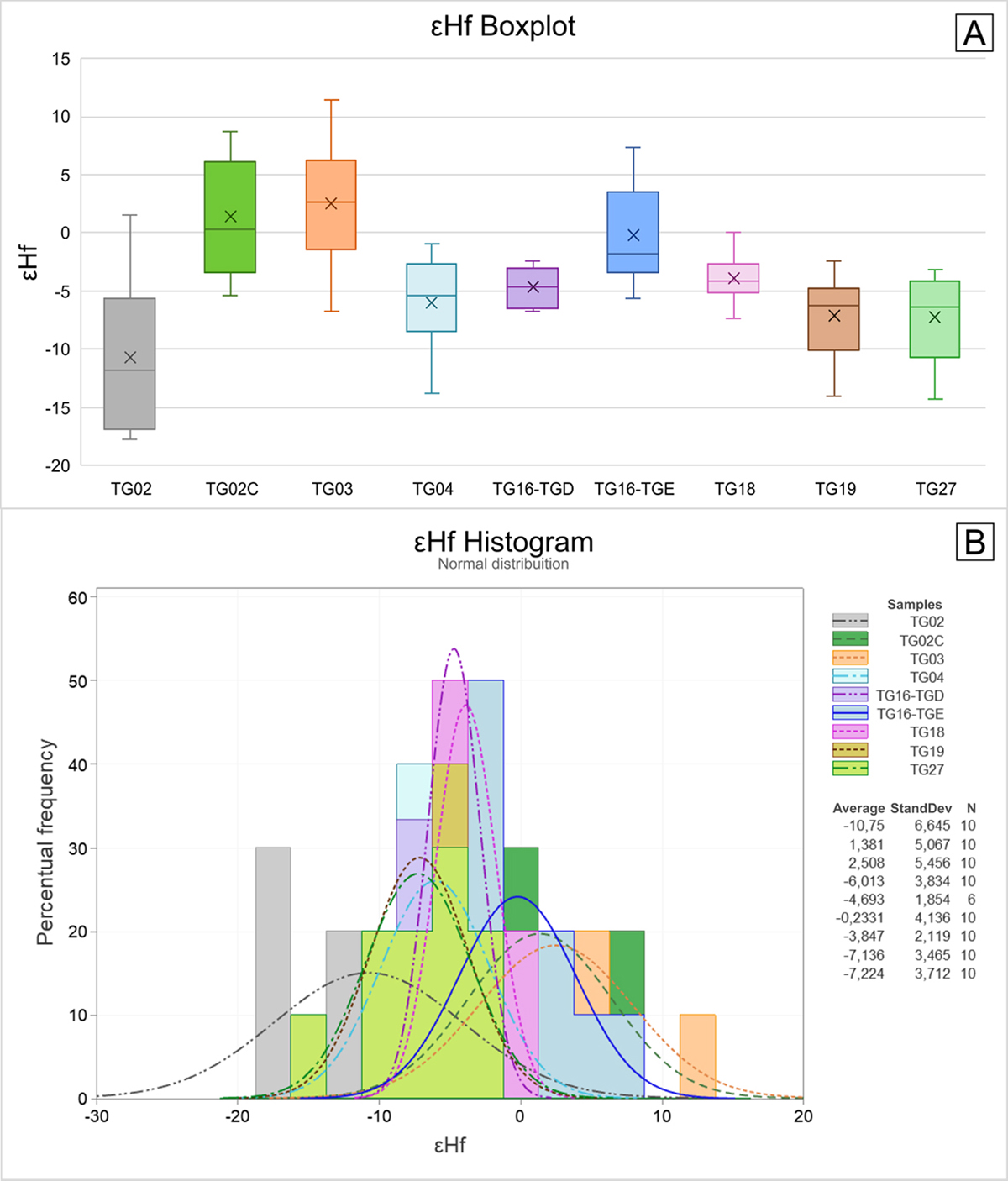
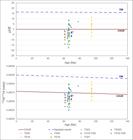
The main results are presented in Table 2, and the complete results are available in the Supplementary material. Figure 10 illustrates the 176Hf/177Hf(i) ratios and εHf values plotted agaist the U-Pb ages. The syenites exhibit 176Hf/177Hf(i) ratios ranging from 0.282340 to 0.283050 and εHf values ranging from - 14.26 and + 11.49, with TDM ages between 282 and 1338 Ma. The nepheline syenite sample shows 176Hf/177Hf(i) ratios ranging from 0.282350 to 0.282680 and εHf values between - 14.01 and - 2.36, with TDM ages from 820 to 1341 Ma. The monzonite exhibits 176Hf/177Hf(i) ratios ranging from 0.282241 to 0.282786 and εHf values between - 17.78 and + 1.51, with TDM ages spanning 665 to 1571 Ma. Finally, the phonolite displays 176Hf/177Hf(i) ratios ranging between 0.282551 and 0.282942, and εHf values between - 6.76 and + 7.30, and TDM ages from 430 to 976 Ma.
Isotopic geochemistry data using the Lu-Hf method by LA-ICP-MS on zircons of different samples from Tanguá Massif.
4.8 Sr-Nd Isotopic Geochemistry
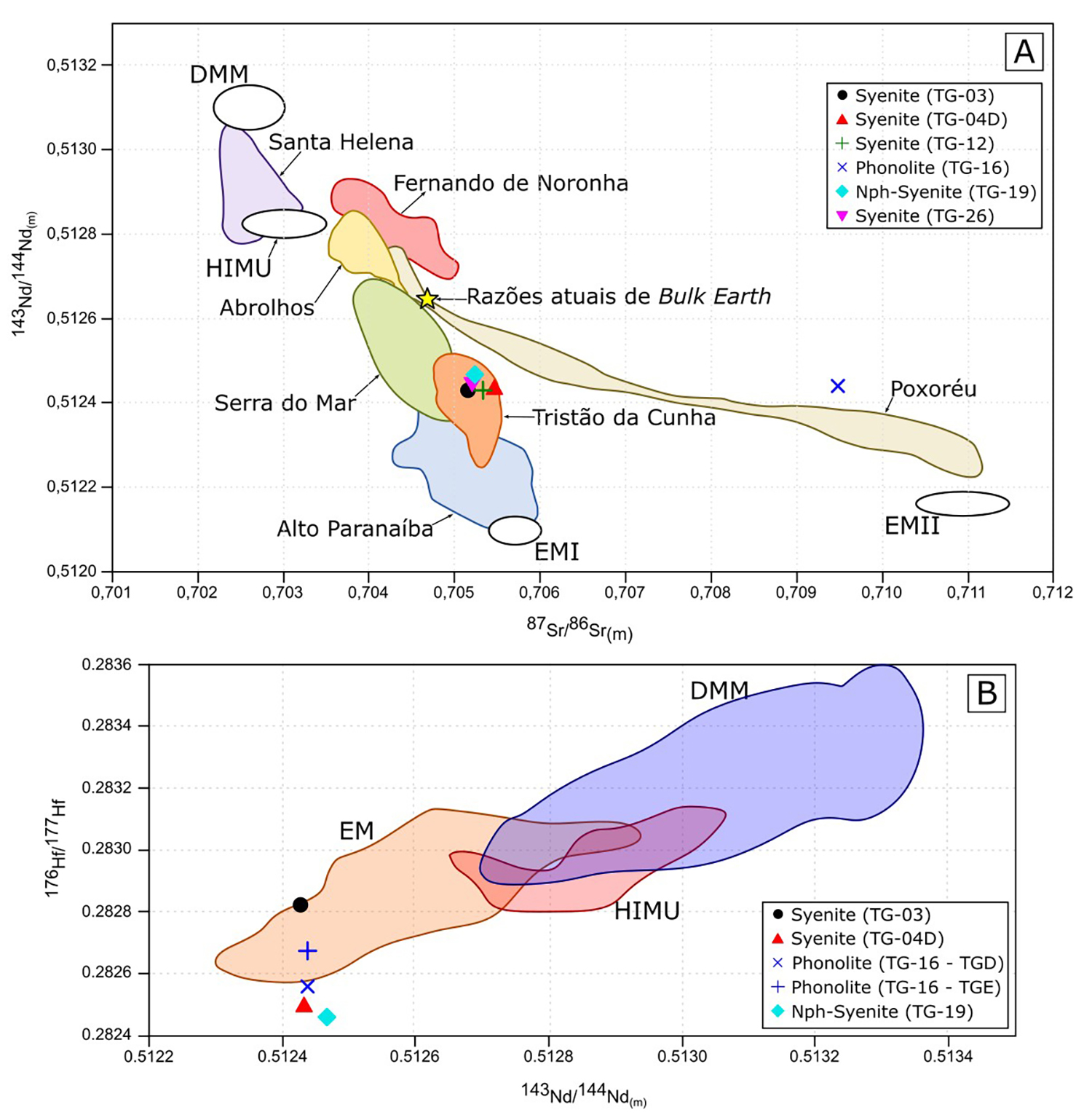
For this study, six samples were selected. Table 3 and Figure 11 show the results of isotopic analyses for Sr and Nd. The syenites exhibit 87Sr/86Sr(m) ratios ranging from 0.705155 and 0.705478, 143Nd/144Nd(m) ratios between 0.512429 and 0.512443, and εNd values ranging from - 3.17 to - 2.62, whit TDM ages between 772 and 862 Ma. The nepheline syenite has 87Sr/86Sr(m) and 143Nd/144Nd(m) ratios of 0.705237 and 0.512467, respectively, yielding an εNd value of - 2.31, and a TDM age of 677 Ma. Finally, the phonolite presents 87Sr/86Sr(m) and 143Nd/144Nd(m) ratios of 0.709476 and 0.512439, respectively, with εNd value of - 2.77, and the TDM age of 725 Ma.

εNd plotted versus U-Pb age (Ma) diagram for samples from Tanguá Massif. The Model Ages (TDM) were calculated using GCDKit according to Liew and Hofmann (1988).
5 Discussions
5.1 Massif Lithofacies Division and their Petrografic Features
As explained in section 4.2, the new lithofacies map of the Tanguá Massif (Figure 3) identifies three distinct syenitic units with a nearly concentric shape, as well as an undivided nepheline syenite zone in the NW portion of the massif. From the edge to center, the concentric units are defined as syenite, intermediate nepheline syenite, and central nepheline syenite.
The nepheline syenite zone typically contains more homogenous and less leucocratic rocks compared to syenites, making it easier to distinguish feldspar and mafic minerals. According to Dumańska-Słowik et al. (2023), the presence of analcime may be related to the alteration of feldspathoids, such as nepheline and sodalite, into nepheline syenites, suggesting a correlation between these more central zones of the massif. In contrast, the syenite unit consists of syenitic rocks without nepheline and cannot be further subdivided.
A more unsaturated zone in the central position may indicate reduced interactions with the surrounding rocks than the less unsaturated rocks (without nepheline) at the edges. These mineralogical segregations and concentric arrangements suggest a process of crustal contamination, reflecting stronger interactions with the host rocks during the emplacement of the massif, which increased the silica content while reducing nepheline. This crustal contamination is suggested by Motoki et al. (2015b) for some massifs of PCCFA, such as Tanguá.
The suggested NW zone could comprise syenitic rocks with nepheline and analcime contents, similar to the nepheline zones, but it is not yet possible to indicate a segregation. Thus, this portion shares similarities with the central part of the massif, which may indicate a distinct intrusion. This feature, together with the existence of circular and half-moon structures, may be associated with multiple magmatic pulses during the emplacement of the massif, which will be discussed in the following section.
Monzonite does not have a distinct characteristic structure in the massif to indicate a specific unit for this rock, and it was identified within the syenite zone. The lithology's positioning in the syenitic zone, its higher SiO2 content, and the presence of normative quartz could indicate potential crustal contamination for this sample. The breccias are located along the margins of the massif, specifically on the southern and eastern edges, as Valença (1980) and Heineck & Raposo (1981) suggested. According to Geraldes et al. (2013) and Motoki et al. (2015a), the breccias are associated with late-stage subvolcanic conduits, which crosscut the basement and the alkaline stocks on the edges of the massif. Similar conduits have been identified in several PCCFA massifs, including Itatiaia, Mendanha, Itaúna, Tanguá, Morro dos Gatos, and Cabo Frio Island (Motoki et al. 2008; Motoki & Sichel 2008; Sichel et al. 2008). Breccia was found in the northwestern portion of the massif during the survey but could not be defined as a specific area. The breccias occur in a weathered state, which makes it difficult to recognize some features; nevertheless, foliation and fractures can be observed, although a subdivision has not yet been possible.
Trachyte outcrops in two areas on the Massif (NW and SE), suggesting it is relatively rare. It commonly occurs in association with other lithotypes and often develops an alteration zone at the contact with syenite (Figure 4H). This feature, together with the alteration zone, supports previous interpretations that trachyte occurs mainly as dikes (Motoki et al. 2015a).
The phonolite mainly occurs as dikes intruding into syenite. However, the presence of syenitic veins crosscutting the phonolite may indicate a syn-genetic emplacement. The positioning of this lithotype within the massif is associated with families of structures observed both at field scale and in aerial imagery. In addition, the differences observed in phonolite, based on mineralogy and grain size characteristics, may suggest different magmatic processes during its emplacement.
5.2 Geochronology of the Tanguá Massif and Implications for Genetic Models of the PCCFA
The U-Pb ages obtained in this work suggest that the rocks of the Tanguá massif can be divided into two groups: 1) a younger group (ranging from 61.27 and 69.37 Ma), represented by different samples and lithotypes (nepheline syenite, syenite, monzonite, and phonolite); and 2) an older group (94.82 ± 1.02 Ma), represented by a single syenite sample (Figure 3).
The ages of the first group are consistent with those reported by Silva, Potratz & Geraldes (2023), who obtained an age of 65.5 ± 1 Ma (U-Pb age of nepheline syenite), as well as other studies using K-Ar and Rb-Sr methods, which yielded ages ranging from 66.8 to 70.5 Ma (Biondi 2005; Motoki et al. 2010; Sonoki & Garda 1988). This interval is typically interpreted as the primary emplacement period of the massif.
In contrast, the second group is ca. 25 Ma older than the oldest rock of the first group. Based on the geochronological compilation carried out for this work, the Poços de Caldas - Cabo Frio Alignment has ages between 39.1 Ma (Tinguá Massif - Sonoki & Garda 1988) and 90.5 Ma (Itatiaia Massif - Sonoki & Garda 1988), which are massifs located about 110 Km apart (Figure 1B). Thus, the 94.82 Ma age of the Tanguá syenite represents the oldest geochronological record in the entire Alignment. Fagundes et al. (2025) also reported similar ages for the Morro de São João Massif, with one nepheline-bearing alkali-feldspar syenite sample yielding 65.9 Ma, and a second malignite sample showing two distinct ages, 70.6 Ma and 89.7 Ma, reinforcing the presence of different magmatic pulses in the Tanguá Massif.
As previously mentioned, two genetic models are currently suggested for the Poços de Caldas - Cabo Frio Alignment: 1) magmatism linked to the Trindade Mantle Plume, predicting decreasing ages from west to east (Gibson et al. 1995; Herz 1977; Sadowski & Dias Netto 1981; Thomaz Filho et al. 2005; Thompson et al. 1998; VanDecar, James & Assumpção 1995); and 2) magmatism associated with the reactivation of regional geological structures, generating partial melting and producing ages distributed more randomly (Almeida 1991; Alves et al. 2006; Ferrari 2001; Riccomini, Velázquez & Gomes 2005; Zalán & Oliveira 2005). According to the plume model, the oldest ages of the alignment should be on the west side. However, the new geochronological data from Tanguá, a massif located further east (Figure 1B-C), confirm the lack of an age-decreasing trend and raises questions about the plume model. Several works, such as Almeida (1991), Riccomini, Velázquez & Gomes (2005) and Teodoro et al (2025), present similar understandings regarding the alignment ages, and this view is further supported by the new results of Fagundes et al. (2025) for the Morro de São João Massif.
Most of the geochronological results from previous studies and the current one yielded age between 60 and 70 Ma for the Tanguá Massif, suggesting a main period of emplacement. The youngest age obtained for the nepheline syenite (61.27 ± 0.48 Ma) indicates that the massif preserves evidence of more recent magmatic activity than previously documented. These ages are similar to those of the nearby Soarinho Massif (58 and 60 Ma, as suggested by Silva, Potratz & Geraldes 2023). Phonolitic rocks crosscutting the syenitic bodies yielded the oldest ages of this period (68.11 Ma and 69.37 Ma), confirming the syngenetic emplacement of these two rocks as suggested by field mapping. This strengthens the idea of different magmatic pulses associated with the formation of the massif.
The combination of the younger ages, the much older age of ca. 95 Ma obtained for syenite, and the distribution of geochronological data from the other PCCFA massifs, indicate that the genesis of this alignment cannot be explained by a conventional and stationary mantle plume. However, studies such as Riccomini, Velázquez & Gomes (2005) and Teodoro et al. (2025) emphasize the importance of pre-existing structures in the formation of the alignment.
Finally, the presence of circular and half-moon structures in the Tanguá Massif provides additional evidence for episodic magmatism. Similar features in the Itatiaia Massif have been associated with distinct magmatic pulses (Rosa 2017; Rosa & Ruberti 2018). In Tanguá, one possible explanation is that the undivided nepheline syenite in the northwestern portion of the massif, directly associated with a circular structure (Figure 2A), may represent a magmatic pulse distinct from that of the central portion. However, additional geochronological data are required to confirm this interpretation.
5.3 Isotopic Results and the Mantle Sources Components
The Lu-Hf and Sr-Nd isotopic systems exhibit broadly comparable behavior during the mantle differentiation processes, allowing us to infer the magma sources involved in the emplacement of these rocks. According to Faure & Mensing (2005) and Jones et al. (2019), rocks characterized by negative εNd and εHf values are associated with enriched mantle sources or are derived from continental crust, whereas positive values are linked to depleted mantle sources.
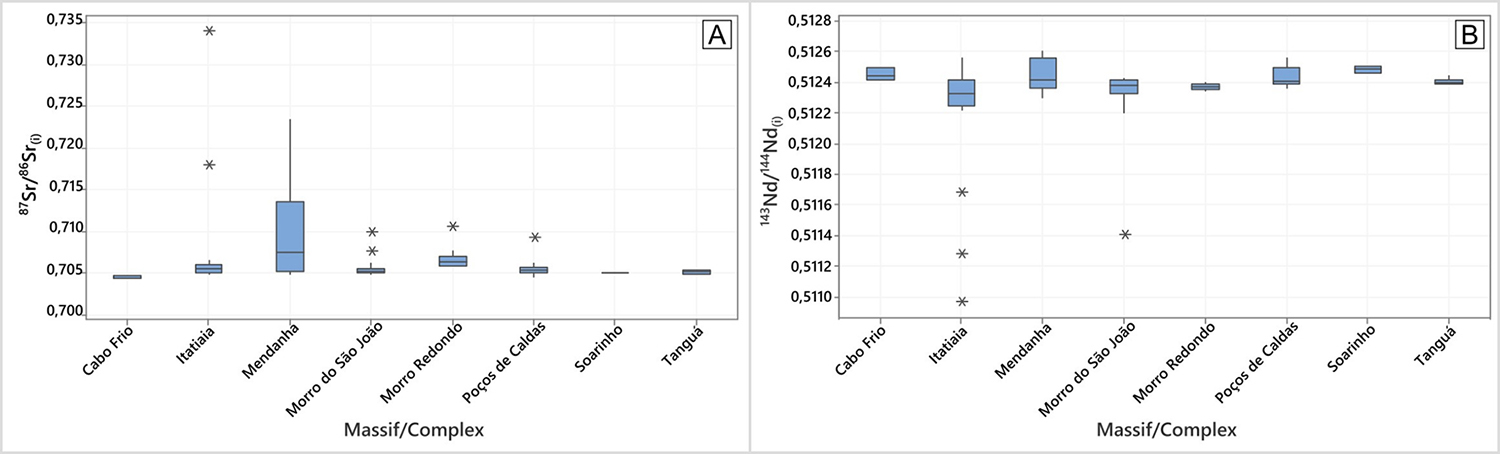
Syenites and nepheline syenites from Tanguá Massif plot between the Depleted Mantle (DMM) and Enriched Mantle I (EMI) - DMM-EMI array - in the 143Nd/144Nd versus 87Sr/86Sr diagram (Figure 12A), where these ratios display relatively restricted variations. On the other hand, the phonolite sample exhibits a distinct isotopic behavior, falling within the DMM and Enriched Mantle II (EMII) - DMM-EMII array. These contrasting patterns suggest different emplacement processes and contribution from mantle sources for these rocks. As demonstrated by Teodoro et al. (2025), who compiled 143Nd/144Nd and 87Sr/86Sr data for alkaline massifs along the PCCFA, the isotopic behavior of the Tanguá Massif obtained in this study is broadly consistent with other occurrences in the alignment (Figure 13), including Poços de Caldas, Mendanha, Itatiaia, Morro Redondo, Soarinho, and Morro de São João (Fagundes et al. 2025; Mota 2012; Rosa 2017; Thompson et al. 1998; Ulbrich et al. 2003). .
The positioning of Tanguá’s samples within the DMM-EMI and DMM-EMII arrays has been interpreted by several authors as reflecting a mixture of distinct mantle components, as proposed for the Vitória Seamount (Maia et al. 2021), the Soarinho Massif (Silva, Potratz & Geraldes 2023) and Morro de São João Massif (MSJ - Fagundes et al. 2025). For the MSJ, these authors modeled mixing between DMM, HIMU, and EMI end-members in variable proportions, with EMI being the dominant component (up to ca. 72%). However, Pb isotopic data are still required to confirm a similar mixing model for the Tanguá Massif.
From the primitive mantle-normalized diagrams the Tanguá Massif rocks do not exhibit patterns similar to a single mantle source, further supporting the hypothesis of multiple source contributions. The normalized trace elements diagrams (Figure 7) reveal a pronounced P anomaly, consistent with enriched mantle sources. In contrast, the ascending patterns of highly incompatible elements in some rocks (trachyte, phonolite, and nepheline syenite) are similar to the DMM sources. Similarly, primitive mantle-normalized REE patterns (Figure 8), show that most results have a similar pattern to the enriched sources, displaying a characteristic LREE-enriched, downward-sloping pattern. On the other hand, some samples (trachyte, phonolite, and nepheline syenite) show an upward-sloping HREE-enriched pattern, suggesting contributions from a DMM component.
All studied lithotypes exhibit negative εNd values ranging from - 3.17 to - 2.62, associating these rocks with enriched mantle sources or continental crust. In contrast, εHf values vary widely, from - 17.78 to + 11.4, with some lithotypes presenting both negative and positive values, while others are exclusively negative (Figure 14). This latter behavior reinforces the participation of depleted mantle sources, as already suggested by εNd.

A. Nd-Sr isotopic ratio correlation diagram. The isotopic ratio data presented are: Abrolhos (Fodor et al. 1989), Alto Paranaíba (Gibson et al. 1995), Alkaline rocks from Serra do Mar igneous complexes (Thompson et al. 1998), Poxoréu (Gibson et al. 1997), Fernando de Noronha (Gerlach et al. 1987), Tristan da Cunha (Le Roex et al. 1990), and Santa Helena (Chaffey, Cliff & Wilson 1989). Mantle components: Bulk Earth (Zindler & Hart 1986), EMI (Eisele et al. 2002; Hoffman 2014), DMM (Zindler & Hart 1986; Salters & Stracke 2004; Workman & Hart 2005), EMII (Zindler & Hart 1986; Hart 1988) and HIMU (Hart 1988; Jackson & Dasgupta 2008). Modified from Maia et al. 2021; B. Correlation diagram of 143Nd/144Nd(m) versus 176Hf/177Hf. Modified from Stracke (2012), from which the ranges of mantle components were determined.
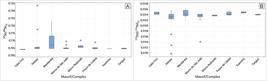
Boxplots showing the variation in isotopic ratios for selected alkaline massifs associated with the PCCFA: A. 87Sr/86Sr(i); B. 143Nd/144Nd(i). Data compiled from Brotzu et al. (2007), Fagundes et al. (2025), Guarino et al. (2021), Mota (2012), Motoki et al. (2010), Rosa (2017), Sichel et al. (2012), Thompson et al. (1998), Ulbrich et al. (2003), and this study (Tanguá Massif).
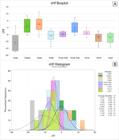
A. εHf boxplot diagram for samples from Tanguá Massif; B. εHf histogram diagram for samples from Tanguá Massif.
5.4 Tanguá Massif Genetic Models
The integration of isotopic data, trace-element signatures, and lithogeochemical patterns provides key insights into the genetic processes associated with the Tanguá Massif. Low Zr/TiO2 ratios (< 0.5) indicate the presence of relatively primitive magma, particularly those related to nepheline syenite (Motoki et al. 2015b). According to Motoki et al. (2010), the Silica Saturation Index (SSI) is a useful parameter for distinguishing between nepheline and quartz crystallization, and is calculated using the following equation: SSI= 1000*(SiO2/60.0835-Al2O3/101.9601-5*(Na2O/61.9785+K2O/94.1956)-CaO/56.077-MgO/40.304-MnO/70.937-FeO/71.844+2*Fe2O3/159.687).
Nepheline syenites and phonolites from Tanguá Massif exhibit negative SSI values indicating nepheline crystallization, whereas syenites display both negative and positive SSI values, suggesting variable crystallization pathways involving either nepheline or quartz. Monzonite and one phonolite sample record the highest value (ca. 100), associated with quartz crystallization, possibly reflecting crustal contamination in undersaturated magmas (Andersen & Sorensen 1993; Motoki et al. 2010, 2015b). These interpretations are consistent with the lithogeochemical and CIPW norms, which show the highest SiO2 content and normative quartz for syenite and monzonite.
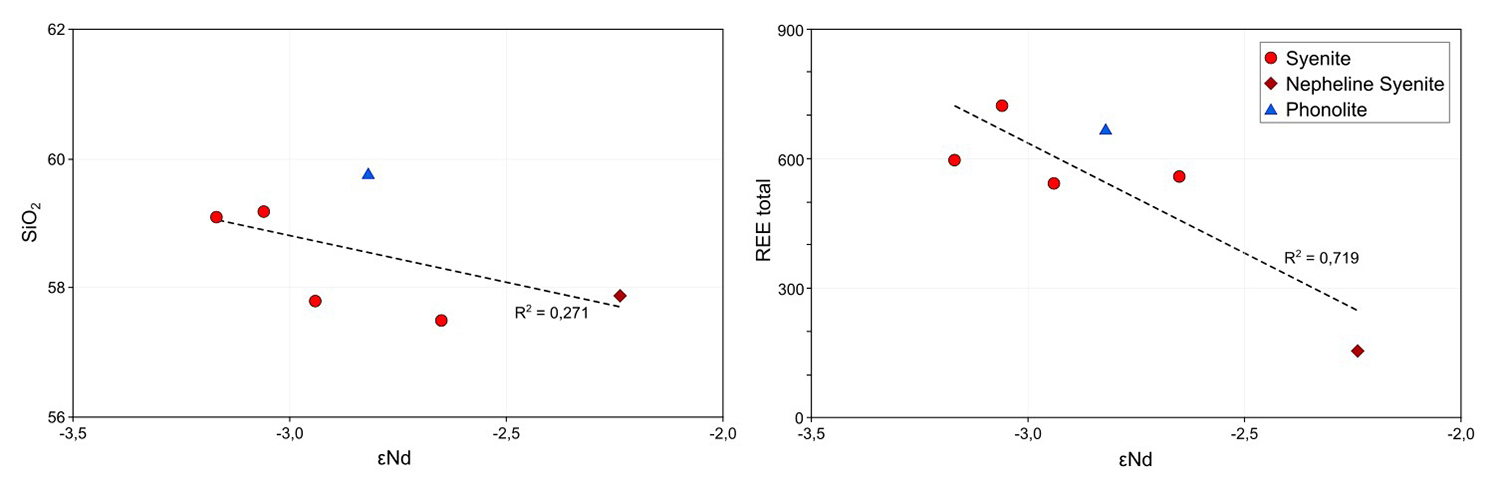
Concave patterns in the primitive mantle-normalized REE diagrams (Figure 8) observed in nepheline syenite samples (TG-19 and TG-114), trachytes, and phonolites, are interpreted as evidence of garnet fractionation (e.g.,Kay & Gast 1973; Hawkesworth, O'nions & Arculus 1979; Terakado 1980). Conversely, Motoki et al. (2015b) report that crustal contamination tends to produce linear to convex REE patterns, a phenomenon observed in all syenites, the monzonite, one phonolite sample, and the remaining nepheline syenite. The samples TG-19 and TG-114 (nepheline syenite) also present the lowest total REE concentrations and the lowest SSI values, suggesting that they are closer to the composition of the parental magma. According to Rosa (2018 and references therein), supersaturated alkaline rocks influenced by crustal assimilation show decreasing εNd values as silica content increases. Similarly, an increase in the total REE concentrations correlates with greater degrees of crustal assimilation (Motoki et al. 2015b). Both trends are clearly recorded in the Tanguá Massif samples (Figure 15).
Crustal assimilation is further supported by the Sr-Nd isotopic data. According to Azzone et al. (2018), magmatic systems affected by crustal assimilation display broad variations in 87Sr/86Sr(i) and 143Nd/144Nd(i) combined with an increasing of Ba/Sr, Rb/Sr ratios, and a decreasing of (Ce/Pb)N ratios. In the present study, the (Ce/Pb)N range from 0.65 to 5.42, Ba/Sr from 0.18 to 2.33, and Rb/Sr from 0.95 to 51.13. The isotopic ratios 87Sr/86Sr(i) range between 0.704832 and 0.705241, whereas 143Nd/144Nd(i) varies from 0.512382 and 0.512404. Although these isotopic ranges are narrower than those reported by Azzone et al. 2018, the Ba/Sr and Rb/Sr ratios provide the most compelling evidence for crustal assimilation.
Trachytes occur as late-stage dikes and are characterized by higher silica contents, normative quartz and the presence of modal quartz as a constituent mineral, indicating that these magmas reached silica saturation. Other massifs along the Alignment also contain silica-supersatured rocks, such as Itatiaia Massif (Rosa & Ruberti 2018) and Soarinho Massif (Silva, Potratz & Geraldes 2023). According to Rosa (2017) and references, the transition from silica-undersaturated to supersaturated magmas may occur in open magmatic systems by progressive crustal assimilation, a process that, in the Itatiaia Massif is associated with to the point of breaking the thermal barrier. Crustal assimilation has also been documented at the Morro de São João Massif, where xenoliths of the country rocks are incorporated into the alkaline magmas (Fagundes et al. 2025). For the Tanguá Massif, Motoki et al. (2015b) estimated crustal assimilation between 20% and 30%, a process similarly inferred for nearby massifs such as Soarinho and Rio Bonito.
Fractional crystallization and partial melting processes may also have contributed to the formation of the alkaline rocks, and the La/Yb versus La relationship helps identify which process played the dominant role during their genesis (Dumánska-Słowik et al. 2023; Gao et al. 2007; Yan & Jiang 2019). According to this analysis, the syenitic rocks display a nearly horizontal pattern in the La/Yb versus La diagram (see Figure 16A), suggesting that their evolution was predominantly controlled by fractional crystallization rather than partial melting, and indicating prolonged cooling of magma during the formation of this alkaline rock. On the other hand, the genesis of the phonolites follows a more partial melting dominant trend, reinforcing the distinct origins of these lithologies. According to Laporte et al. (2014), phonolites and their plutonic equivalents (nepheline syenites) could have formed either through fractional crystallization of basanites or alkaline basalts, or alternatively through partial melting of the upper mantle. Isotopic data supports the second hypothesis, as phonolites plot within the DMM-EMII array.
According to Riccomini, Velázquez & Gomes (2005), Brazilian alkaline intrusions are predominantly derived from a lithospheric mantle source, which is supported by isotopic signatures of the Tanguá Massif. In this context, LILE-bearing minerals are associated with volatile-bearing metasomatic minerals like phlogopite and amphibole. The presence of phlogopite in the source is evidenced by Rb/Sr ratios (> 0.1), whereas Ba/Rb ratio (> 20) suggest an amphibole presence (Yan & Jiang 2019). Although all lithologies show geochemical signatures consistent with phlogopite, the evidence for amphibole remains inconclusive. Nevertheless, the Rb/Sr and Ba/Rb diagram (Figure 16B) reveals a strong correlation with phlogopite-rich sources and a subtle affinity with amphibole, supported by some samples showing Ba/Rb ratios near to 20. This inference is further corroborated by Figure 16C. According to Yan & Jiang (2019), these minerals are linked with higher K and Ba contents, as observed in the Tanguá Massif. Laporte et al. (2014) also emphasize that K enrichment in subcontinental lithospheric mantle context is commonly related to the occurrence of these minerals. The presence of both minerals supports the interpretation that the mantle source associated with the formation of these rocks was metasomatized (Yan & Jiang 2019 and references therein), as previously suggested by the isotopic data.
For the 176Hf/177Hf versus 143Nd/144Nd(m) diagram (Figure 12B), the samples plot close to the Enriched Mantle (EM) field, reinforcing the presence of this magma component during the Tanguá Massif genesis. Similar to interpretations proposed for the Vitória-Trindade Ridge, EMI-type sources could be linked to recycled oceanic sediments associated with subducted slabs (Maia et al. 2021; Quaresma et al. 2023). In this context, Tanguá Massif samples exhibit narrower εNd ranges compared to εHf, followed by the 143Nd/144Nd(m) and 176Hf/177Hf ratios (Figure 14). Zhang et al. (2019) and Dahlquist et al. (2020) linked these signatures to inherited zircons derived from oceanic sediments incorporated during subduction. The melts generated by this process promote metasomatism, increasing 176Hf/177Hf ratios due to 177Hf retention in the residual grains, generating decoupling from the 143Nd/144Nd ratio. According to Chauvel et al. (2008), zircon-rich detrital sediments may reflect low-εHf reservoir, representing either continental crust contributions or Enriched Mantle sources.
Enriched mantle components can be associated with recycled sediments in the mantle, with EMI representing oceanic-derived contributions and EMII linked to the continental-derived inputs (Condie 2016). Based on isotopic data, this model is consistent with the Tanguá Massif, and the observed isotopic decoupling further supports the possible involvement of these sediments (see Figure 14). According to Woodhead et al. (2001), high Th/Yb ratios are associated with the melting of subducted sediments. Pearce (2008) also supports this interpretation, noting that elevated Th/Yb values may reflect the involvement of recycled crustal material in the genesis of alkaline basalts. In the Th/Yb-Nb/Yb diagram (Figure 16D), the MORB-OIB array defines a reference trend. Samples that plotting above this array indicate interaction with the upper crustal and/or the mantle lithosphere influenced by a subduction component (Pearce 2008). The Tanguá Massif samples display a relatively high Th/Yb and Nb/Yb ratios, suggesting the contribution of enriched mantle sources (Pearce 2008) and, possibly of subducted sediments. However, although a few samples plot above the MORB-OIB array, Pearce (2008) points out that the influence of subducted sediments tends to have a limited impact on enriched mantle sources.
According to Dumánska-Słowik et al. (2023), mantle metasomatism linked to subduction may involve slab-derived or sediments melts. The Th/Yb versus Ba/La (Figure 16E) and U/Th versus Th (Figure 16F) diagrams for the Tanguá Massif reveal distinct geochemical trends consistent with sediments contributions or sediment-derived melts, highlighting their important role in the source modification. Additionally, the presence of sediments is also suggested by the Th/La vs Sm/La diagram (Figure 16G - Plank (2005)) and isotopic data (Figure 14). However, it is important to note that Cl- and/or F- fluids responsible for source metasomatism can produce geochemical signatures similar to sediment melts, potentially leading to overestimating of sediment involvement.
It is worth emphasizing, however, that although the geochemical and isotopic data suggest a connection with subducted oceanic sediments, the observed isotopic decoupling could also result from mixing between mantle sources with contrasting isotopic ratios or from crustal assimilation processes. These mechanisms are also reported for other massifs of the alignment, such as the Soarinho Massif, which displays εHf values ranging from -32 to +5.6 (Silva, Potratz & Geraldes 2023), and may similarly have influenced the petrogenesis of the Tanguá Massif. Therefore, confirming the processes responsible for the isotopic behavior observed here requires further investigation, including Pb isotopic studies and analyses of fluid inclusions in zircon, if available. Based on the results of this study, together with recently published data, we recommend the development of quantitative magma-mixing models to better constrain the relative contributions of these processes to the genesis of the Tanguá Massif.
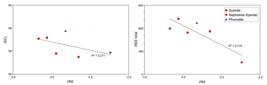
SiO2 versus εNd (left) and REE sum versus εNd (right) diagrams indicating negative correlations between the parameters.
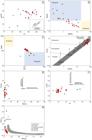
Petrogenic diagrams for the rocks of Tanguá Massif; A. La/Yb versus La diagram; B. Rb/Sr versus Ba/Rb diagram; C. K/Rb versus Rb diagram; D. Th/Yb versus Nb/Yb diagram; E. Th/Yb versus Ba/La diagram; F. U/Th versus Th diagram; G. Th/La versus Sm/La diagram. The A-F diagrams were modified from Yan & Jiang (2019 and references therein). The G diagram was modified from Plank (2005 and references therein).
6 Concluding Remarks
Based on the results and discussions presented, it is possible to draw the following conclusions regarding the Tanguá Massif:
-
According to fieldwork observations and petrographic analyses, the TM is composed of syenite, nepheline syenite, breccia, phonolite, and trachyte. The nepheline syenite predominates in the central portion, while the less undersaturated syenite occurs along the outer margins, forming a roughly concentric structure. Distinct nepheline syenite zones can be identified: a central zone richer in analcime and an intermediate richer in albite; however, an undivided nepheline syenite zone also occurs in the NW portion of the massif. Breccias are observed on the southern and eastern edges of the intrusion, and no further internal subdivisions have yet been recognized. Phonolites and trachytes occur as dikes associated with fractures, which are coincident with the regional lineaments.
-
Based on the field relationships and U-Pb geochronological data, the intrusion of syenitic rocks and phonolites is interpreted as broadly syngenetic, with ages of 61.3 - 67.1 Ma and 68.1 - 69.4 Ma, respectively. Together with the oldest age (ca. 95 Ma), these results indicate the occurrence of multiple magmatic pulses during the evolution of the massif. This may explain the presence of the nepheline syenite zone in the NW portion of the TM, although additional data are needed to confirm this interpretation.
-
Despite the limited isotopic data, the Lu-Hf isotopic geochemistry data indicates that the TM rocks are linked to both enriched and depleted mantle sources. The lithotypes display distinct isotopic signatures, suggesting contributions from different sources. Syenites and nepheline syenites share similar behaviors, suggesting a mixture between DMM and EMI components, whereas phonolites exhibit a distinct pattern involving a possible mixture of DMM and EMII sources. To confirm these interpretations, additional Pb isotopic data and the construction of mixing models are required.
-
The geochemical and isotopic data suggest a restricted influence of fractional crystallization and a significant contribution from crustal assimilation, corroborating interpretations proposed for other PCCFA massifs, including the Tanguá Massif. This inference is supported by the spatial distribution of lithotypes, with more undersaturated rocks (nepheline syenites) concentrated in the central zones of the massif and less undersaturated syenites in the outer portion. The results also suggest that the initial magma was compositionally similar to nepheline syenite, even though syenites, nepheline syenites, and phonolites derive from distinct mantle sources. Furthermore, geochemical and isotopic evidence may indicate that TM magmas interacted with oceanic sediments from subducted slabs and with metasomatized magmas. However, additional investigations - such as Pb isotope analyses and fluid inclusion studies in zircon - are required to confirm this proposed genetic model for the Tanguá Massif.
-
Geochronological U-Pb data reveal that the TM was formed during two magmatic events: i) Cenomanian magmatism, of 94.82 Ma; ii) Danian-Maastrichtian magmatism, ca. 60-70 Ma. These results suggest that the TM intruded earlier than previously reported. During the second magmatic pulse, nepheline syenites were emplaced and subsequently crosscut by phonolite and trachyte dikes. Following Motoki et al. (2015a) and Geraldes et al. (2013), trachytes and breccias were likely formed during this younger phase or even later, although new analyses are required to confirm this interpretation. Additionally, samples from the NW portion of the massif should be investigated to better constrain its correlation with the remaining lithologies of the TM.
-
A syenite from the Tanguá Massif yielded an age of 94.8 Ma, representing the oldest known magmatic episode in the PCCFA. Together with the age reported by Fagundes et al. (2025) and the geochronological synthesis by Teodoro et al. (2025), these findings challenge the plume-related model for PCCFA genesis, particularly because the TM is located in the easternmost part of the alignment. Several authors have also questioned the plume model hypothesis, proposing instead that the formation of massifs may be related to partial melting triggered by the reactivation of pre-existing faults (e.g., Azzone et al. 2018; Riccomini, Velázquez & Gomes 2005). Considering both previously published ages and the new U-Pb results presented here, it is suggested that the conventional mantle plume model does not adequately explain the genesis of the PCCFA. Nevertheless, additional geochronological and geochemical studies within the TM and neighboring massifs are needed to confirm this interpretation.
7 Acknowledgments
This paper was supported by CNPq (ProTrindade Program) [Process number. 557146/2009-7]; the MCT/CNPq project [number 26/2009]; and FAPERJ [Entidades Estaduais 2018 number 210.297/2018; APQ1 2019 number 210.179/2019; JCNE 2022 number 201.469/2022]. The corresponding author thanks Rio de Janeiro State University for supporting his research and FAPERJ for the doctoral fellowship. The authors thank the laboratories and collaborators of ISIPM (CIT SENAI), LGPA, LAGIR, and Multilab (all from UERJ) for the support offered during sample preparation, analysis, and data processing. The authors would like to take this opportunity to thank the journal's editors and reviewers for their critical review.
8 References
- Almeida, F.D. 1976, ‘The system of continental rifts bordering the Santos Basin, Brazil’, Anais da Academia Brasileira de Ciências, vol. 48, pp 15-26.
-
Almeida, F.F.M. 1983, ‘Relações tectônicas das rochas alcalinas Mesozóicas da região meridional da Plataforma Sul-Americana’, Revista Brasileira de Geociências, vol. 13, pp 139-158, DOI:10.25249/0375-7536.1983133139158
» https://doi.org/10.25249/0375-7536.1983133139158 - Almeida, F.F.M. 1986, ‘Distribuição regional e relações tectônicas do magmatismo pós-paleozóico no Brasil’, Revista Brasileira de Geociências, vol. 16, pp 325-349.
- Almeida, F.F.M. 1991, ‘O alinhamento magmático de Cabo Frio’, II Simpósio de Geologia Do Sudeste, SBG/Núcleos SP e RJ, Atas. pp. 423-428.
-
Almeida, F.F.M., Carneiro, C.D.R. & Mizusaki, A.M.P. 1996, ‘Correlação do magmatismo das bacias da margem continental brasileira com o das áreas emersas adjacentes’, Brazilian Journal of Geology, vol. 26, pp. 125-138, DOI:10.25249/0375-7536.19963125138
» https://doi.org/10.25249/0375-7536.19963125138 -
Alves, E. da C., Maia, M., Sichel, S.E. & Campos, C.M.P. 2006, ‘Zona de fratura de Vitória-Trindade no Oceano Atlântico sudeste e suas implicações tectônicas’, Revista Brasileira de Geofísica, vol. 24, pp. 117-127, DOI:10.1590/S0102-261X2006000100009
» https://doi.org/10.1590/S0102-261X2006000100009 - Andersen, T. & Sørensen, H. 1993, ‘Crystallization and metasomatism of nepheline syenite xenoliths in quartz-bearing intrusive rocks in the Permian Oslo rift, SE Norway’, Norsk geologisk tidsskrift, vol. 73, no. 4, pp. 250-266.
-
Azzone, R.G., Ruberti, E., Da Silva, J.C.L., De Barros Gomes, C., Rojas, G.E.E., De Hollanda, M.H.B.M. & Tassinari, C.C.G. 2018, ‘Upper Cretaceous weakly to strongly silica-undersaturated alkaline dike series of the Mantiqueira Range, Serra do Mar alkaline province: Crustal assimilation processes and mantle source signatures’, Brazilian Journal of Geology, vol. 48, pp. 373-390, DOI:10.1590/2317-4889201820170089
» https://doi.org/10.1590/2317-4889201820170089 -
Biondi, J.C. 2005, ‘Brazilian mineral deposits associated with alkaline and alkaline-carbonatite complexes’ in P. Comin-Chiaramonti & C.B. Gomes (eds), Mesozoic to Cenozoic Alkaline Magmatism in the Brazilian Platform, EDUSP/FAPESP, São Paulo, Brazil, pp. 707-750, DOI:10.2138/am.2007.485
» https://doi.org/10.2138/am.2007.485 -
Brotzu, P., Melluso, L., Bennio, L., Gomes, C.B., Lustrino, M., Morbidelli, L., Morra, V., Ruberti, E., Tassinari, C. & D’Antonio, M. 2007, ‘Petrogenesis of the Early Cenozoic potassic alkaline complex of Morro de São João, southeastern Brazil’, Journal of South American Earth Sciences, vol. 24, pp. 93-115, DOI:10.1016/j.jsames.2007.02.006
» https://doi.org/10.1016/j.jsames.2007.02.006 -
Brotzu, P., Melluso, L., D’Amelio, F., Lustrino, M., Comin-Chiaramonti, P. & Gomes, C.B. 2005, ‘Potassic dikes and intrusions of the Serra do Mar Igneous Province (SE Brazil)’, in P. Comin-Chiaramonti & C.B. Gomes (eds), Mesozoic to Cenozoic Alkaline Magmatism in the Brazilian Platform, EDUSP/FAPESP, São Paulo, Brazil, pp. 443-472, DOI:10.2138/am.2007.485
» https://doi.org/10.2138/am.2007.485 -
Ceuleneer, G., Monnereau, M., Rabinowicz, M. & Rosemberg, C. 1993, ‘Thermal and petrological consequences of melt migration within mantle plumes’, Philosophical Transactions of the Royal Society of London, Series A: Physical and Engineering Sciences, vol. 342, pp. 53-64, DOI:10.1098/rsta.1993.0004
» https://doi.org/10.1098/rsta.1993.0004 -
Chaffey, D.J., Cliff, R.A. & Wilson, B.M. 1989, ‘Characterization of the St. Helena source’, Geological Society, London, Special Publications, vol. 42, pp. 257-276, DOI:10.1144/GSL.SP.1989.042.01.16
» https://doi.org/10.1144/GSL.SP.1989.042.01.16 - Chauvel, C., Lewin, E., Carpentier, M., Arndt, N.T. & Marini, J.C. 2008, ‘Role of recycled oceanic basalt and sediment in generating the Hf-Nd mantle array’, Nature Geoscience, vol. 1, pp. 64-67.
- Condie, K.C. 2016, Earth as an evolving planetary system, Academic Press.
- Cordani, U.G. & Teixeira, W. 1979, ‘Comentários sobre as determinações geocronológicas existentes para as regiões das folhas Rio de Janeiro, Vitória e Iguape’, Folhas Rio de Janeiro/Vitória (Iguapé SF23/24/SG 23. Carta Geológica do Brasil ao Milionésimo-Texto explicativo. DNPM, Brasília.
-
Courtney, R.C. & White, R.S. 1986, ‘Anomalous heat flow and geoid across the Cape Verde Rise: evidence for dynamic support from a thermal plume in the mantle’, Geophysical Journal International, vol. 87, pp. 815-867, DOI:10.1111/j.1365-246X.1986.tb01973.x
» https://doi.org/10.1111/j.1365-246X.1986.tb01973.x -
Dahlquist, J.A., Galindo, C., Cámera, M.M.M., Moreno, J.A., Alasino, P.H., Basei, M.A. & Grande, M.M. 2020, ‘A combined zircon Hf isotope and whole-rock Nd and Sr isotopes study of Carboniferous A-type granites, Sierras Pampeanas of Argentina’, Journal of South American Earth Sciences, vol. 100, 102545, DOI:10.1016/j.jsames.2020.102545
» https://doi.org/10.1016/j.jsames.2020.102545 - De la Roche, H.D., Leterrier, J. T., Grandclaude, P. & Marchal, M. 1980, ‘A classification of volcanic and plutonic rocks using R1R2-diagram and major-element analyses-its relationships with current nomenclature’ Chemical geology, vol. 29, no. 1-4, pp. 183-210.
- Dumańska-Słowik, M., Powolny, T., & Nguyen Khac, G. 2023, ‘Mineralogy and Geochemistry of Nepheline Syenite From the Bang Phuc Massif of the Alkaline Cho Don Complex in North-Eastern Vietnam-Implications for Magma Evolution and Fluid-Rock Interactions’, Journal of Petrology, vol. 64, no. 7.
-
Eisele, J., Sharma, M., Galer, S.J.G., Blichert-Toft, J., Devey, C.W. & Hofmann, A.W. 2002, ‘The role of sediment recycling in EM-1 inferred from Os, Pb, Hf, Nd, Sr isotope and trace element systematics of the Pitcairn hotspot’, Earth and Planetary Science Letters, vol. 196, pp. 197-212, DOI:10.1016/S0012-821X(01)00601-X
» https://doi.org/10.1016/S0012-821X(01)00601-X -
Enrich, G.E.R., Azzone, R.G., Ruberti, E., Gomes, C.B. & Comin Chiaramonti, P. 2005, ‘Itatiaia, Passa Quatro and São Sebastião Island, the major alkaline syenitic complexes from the Serra do Mar region’, in P. Comin-Chiaramonti & C.B. Gomes (eds), Mesozoic to Cenozoic Alkaline Magmatism in the Brazilian Platform, EDUSP/FAPESP, São Paulo, Brazil, pp. 419-442, DOI:10.2138/am.2007.485
» https://doi.org/10.2138/am.2007.485 -
Fagundes, M.B., dos Santos, A.C., Geraldes, M., de Castro Valente, S., Caitano, G.R. & Rocha- Júnior, E.R.V. 2025, ‘Petrogenesis, magmatic evolution of the Morro de São João Alkaline Massif, southeastern Brazil, and implications for the evolution of the South American Platform’, Journal of South American Earth Sciences, vol. 156, 105456, DOI:10.1016/j.jsames.2025.105456
» https://doi.org/10.1016/j.jsames.2025.105456 - Faure, G. & Mensing, T.M. 2005, Principles and applications, John Wiley & Sons, Inc., p. 897.
-
Ferrari, A.L. 2001, ‘Evolução Tectônica do Graben da Guanabara’, PhD Thesis, Universidade de São Paulo, DOI:10.11606/T.44.2001.tde-29082013-152530
» https://doi.org/10.11606/T.44.2001.tde-29082013-152530 -
Fodor, R.V., Mukasa, S.B., Gomes, C.B. & Cordani, U.G. 1989, ‘Ti-rich Eocene basaltic rocks, Abrolhos platform, offshore Brazil, 18° S: petrology with respect to South Atlantic magmatism’, Journal of Petrology, vol. 30, no. 3, pp. 763-786, DOI:10.1093/petrology/30.3.763
» https://doi.org/10.1093/petrology/30.3.763 - Gao, Y., Hou, Z., Kamber, B. S., Wei, R., Meng, X. & Zhao, R. 2007, ‘Adakite-like porphyries from the southern Tibetan continental collision zones: evidence for slab melt metasomatism’, Contributions to Mineralogy and Petrology, vol. 153, pp. 105-120.
- Geraldes, M.C., Motoki, A., Vargas, T., Iwanuch, W., Balmant, A. & Motoki, K.F. 2013, ‘Geology, petrography and emplacement mode of the Morro dos Gatos alkaline intrusive Complex, state of Rio de Janeiro, Brazil’, Geociências, vol. 32, no. 4, pp. 625-639.
- Geraldes, M.C., Vargas, T.C., Evans, N. & Nummer, A.R. 2009, ‘Idades U-Th/He das mineralizações de fluorita da Intrusão Alcalina de Tanguá’, Congresso Brasileiro de Geoquímica.
-
Gerlach, D.C., Stormer, J.C. & Mueller, P.A. 1987, ‘Isotopic geochemistry of Fernando de Noronha’, Earth and Planetary Science Letters, vol. 85, pp. 129-144, DOI:10.1016/0012-821X(87)90027-6
» https://doi.org/10.1016/0012-821X(87)90027-6 -
Gibson, S.A., Thompson, R.N., Leonardos, O.H., Dickin, A.P., Mitchell, J.G. 1995, ‘The Late Cretaceous impact of the Trindade mantle plume: evidence from large-volume, mafic, potassic magmatism in SE Brazil’, Journal of Petrology vol. 36, pp. 189-229, DOI:10.1093/petrology/36.1.189
» https://doi.org/10.1093/petrology/36.1.189 -
Gibson, S.A., Thompson, R.N., Weska, R.K., Dickin, A.P. & Leonardos, O.H. 1997, ‘Late Cretaceous rift-related upwelling and melting of the Trindade starting mantle plume head beneath western Brazil’, Contributions to Mineralogy and Petrology, vol. 126, pp. 303-314, DOI:10.1007/s004100050252
» https://doi.org/10.1007/s004100050252 - Gordon, A.C., Santos, A.C., Caitano, G.R., Stanton, N. & Mohriak, W. U. 2023, ‘Magmatic cycles in Santos Basin (SE Brazil): Geochemical characterization and magmatic sources’, Journal of South American Earth Sciences, vol. 126, 104323.
-
Guarino, V., Lustrino, M., Zanetti, A., Tassinari, C.C.G., Ruberti, E., Gennaro, R. & Melluso, L. 2021, ‘Mineralogy and geochemistry of a giant agpaitic magma reservoir: The Late Cretaceous Poços de Caldas potassic alkaline complex (SE Brazil)’, Lithos, vol. 398-399, 106330, DOI:10.1016/j.lithos.2021.106330
» https://doi.org/10.1016/j.lithos.2021.106330 -
Hackspacher, P.C. & Godoy, A.M. 1999, ‘Vertical displacement during late-collisional escape tectonics (Brasiliano Orogeny) in the Ribeira Belt, São Paulo State, Brazil’, Journal of African Earth Sciences, vol. 29, pp. 25-32, DOI:10.1016/S0899-5362(99)00077-9
» https://doi.org/10.1016/S0899-5362(99)00077-9 -
Hart, S.R. 1988, ‘Heterogeneous mantle domains: signatures, genesis and mixing chronologies’, Earth and Planetary Science Letters, vol. 90, pp. 272-296, DOI:10.1016/0012-821X(88)90131-8
» https://doi.org/10.1016/0012-821X(88)90131-8 -
Hawkesworth, C.J., O'nions, R. K. & Arculus, R. J. 1979, ‘Nd and Sr isotope geochemistry of island arc volcanics, Grenada, Lesser Antilles’, Earth and Planetary Science Letters, vol 45, no. 2, pp. 237-248, DOI:10.1016/0012-821X(79)90126-2
» https://doi.org/10.1016/0012-821X(79)90126-2 -
Heilbron, M., Eirado, L.G. & Almeida, J. 2016, ‘Mapa geológico e de recursos minerais do estado do Rio de Janeiro’, https://rigeo.sgb.gov.br/handle/doc/18458
» https://rigeo.sgb.gov.br/handle/doc/18458 -
Heilbron, M., Tupinamba, M., Valeriano, C.M., Armstrong, R., Eirado, L.G.S., Melo, R.S., Simonetti, A., Soares, A.C.P. & Machado, N. 2013, ‘The Serra da Bolívia Complex: the record of a new Neoproterozoic arc-related unit at Ribeira belt’, Precambrian Research, vol. 238, pp. 158-175, DOI:10.1016/j.precamres.2013.09.014.
» https://doi.org/10.1016/j.precamres.2013.09.014 - Heineck, C. A. & Raposo, F.O. 1981, Projeto Fluorita, CPRM.
-
Herz, N. 1977, ‘Timing of spreading in the South Atlantic: Information from Brazilian alkalic rocks’, Geological Society of America Bulletin, vol. 88, pp. 101-112, DOI:10.1130/0016-7606(1977)88<101:TOSITS>2.0.CO;2
» https://doi.org/10.1130/0016-7606(1977)88<101:TOSITS>2.0.CO;2 -
Hoffman, A.W. 2014, ‘Sampling mantle heterogeneity through oceanic basalts: Isotopes and trace elements’, Treatise on geochemistry, vol. 3, pp. 67-101, DOI:10.1016/B978-0-08-095975-7.00203-5
» https://doi.org/10.1016/B978-0-08-095975-7.00203-5 -
Jackson, M.G. & Dasgupta, R. 2008, ‘Compositions of HIMU, EM1, and EM2 from global trends between radiogenic isotopes and major elements in ocean island basalts’, Earth and Planetary Science Letters, vol. 276, pp. 175-186, DOI:10.1016/j.epsl.2008.09.023
» https://doi.org/10.1016/j.epsl.2008.09.023 -
Jones, R.E., van Keken, P.E., Hauri, E.H., Tucker, J.M., Vervoort, J. & Ballentine, C.J. 2019, ‘Origins of the terrestrial Hf-Nd mantle array: evidence from a combined geodynamical-geochemical approach’, Earth and Planetary Science Letters, vol. 518, pp. 26-39, DOI:10.1016/j.epsl.2019.04.015
» https://doi.org/10.1016/j.epsl.2019.04.015 -
Kay, R.W. & Gast, P.W. 1973, ‘The rare earth content and origin of alkali-rich basalts’, The Journal of Geology, vol. 81, no. 6, pp. 653-682, DOI:10.1086/627919
» https://doi.org/10.1086/627919 - Laporte, D., Lambart, S., Schiano, P. & Ottolini, L. 2014, ‘Experimental derivation of nepheline syenite and phonolite liquids by partial melting of upper mantle peridotites’, Earth and Planetary Science Letters, vol. 404, pp. 319-331.
-
Le Bas, M.J., Maitre, R.L., Streckeisen, A., Zanettin, B. & IUGS Subcommission on the Systematics of Igneous Rocks. 1986, ‘A chemical classification of volcanic rocks based on the total alkali-silica diagram’, Journal of petrology, vol. 27(3), pp. 745-750, DOI:10.1093/petrology/27.3.745
» https://doi.org/10.1093/petrology/27.3.745 -
Le Roex, A.P., Cliff, R.A. & Adair, B.J.I. 1990, ‘Tristan da Cunha, South Atlantic: geochemistry and Petrogenesis of a Basanite-Phonolite Lava Series’, Journal of Petrology, vol. 31, pp. 779-812, DOI:10.1093/petrology/31.4.779
» https://doi.org/10.1093/petrology/31.4.779 - Liew, T.C. & Hofmann, A.W. 1988, ‘Precambrian crustal components, plutonic associations, plate environment of the Hercynian Fold Belt of central Europe: indications from a Nd and Sr isotopic study’, Contributions to Mineralogy and Petrology, vol. 98, pp. 129-138.
- Ludwig, K. R. 2003, ‘User's manual for IsoPlot 3.0. A geochronological toolkit for Microsoft Excel’, v. 71.
-
Machado, N., Valladares, C., Heilbron, M. & Valeriano, C. 1996, ‘U-Pb geochronology of the central Ribeira belt (Brazil) and implications for the evolution of the Brazilian Orogeny’, Precambrian Research, vol. 79, pp. 347-361, DOI:10.1016/0301-9268(95)00103-4
» https://doi.org/10.1016/0301-9268(95)00103-4 -
Maia, T.M., dos Santos, A.C., Rocha- Júnior, E.R.V., Valeriano, C. de M., Mendes, J.C., Jeck, I.K., dos Santos, W.H., de Oliveira, A.L. & Mohriak, W.U. 2021, ‘First petrologic data for Vitória Seamount, Vitória-Trindade Ridge, South Atlantic: a contribution to the Trindade mantle plume evolution’, Journal of South American Earth Sciences, vol. 109, DOI:10.1016/j.jsames.2021.103304
» https://doi.org/10.1016/j.jsames.2021.103304 -
McDonough, W.F. & Sun, S.S. 1995, ‘The composition of the Earth’, Chemical geology, vol. 120, no. 3-4, pp. 223-253, DOI:10.1016/0009-2541(94)00140-4
» https://doi.org/10.1016/0009-2541(94)00140-4 -
Melluso, L., Guarino, V., Lustrino, M., Morra, V. & de’ Gennaro, R. 2017, ‘The REE- and HFSE-bearing phases in the Itatiaia alkaline complex (Brazil) and geochemical evolution of feldspar-rich felsic melts’, Mineralogical Magazine, vol. 81, pp. 217-250, DOI:10.1180/minmag.2016.080.122
» https://doi.org/10.1180/minmag.2016.080.122 - Middlemost, E.A. 1975, ‘The basalt clan’, Earth-science reviews, vol. 11, no. 4, pp. 337-364.
- Mota, C.E.M. 2012, ‘Petrogênese e geocronologia das intrusões alcalinas de Morro Redondo, Mendanha e Morro de São João: caracterização do magmatismo alcalino no estado do Rio de Janeiro e implicações geodinâmicas’, PhD Thesis, Universidade do Estado do Rio de Janeiro, Brazil.
- Motoki, A., Sichel, S.E., Silva, S. & Motoki, K.F. 2015a, ‘Morphologic characteristics and erosive resistance of felsic alkaline intrusive massif of Tanguá, State of Rio de Janeiro, Brazil, based on the aster gdem’, Geociências, vol. 34, pp. 19-31.
- Motoki, A., Sichel, S.E., Soares, R., Aires, J.R., Savi, C., Petrakis, G.H. & Motoki, K.F. 2008, ‘Rochas piroclásticas de preenchimento de condutos subvulcânicos do Mendanha, Itaúna e Ilha de Cabo Frio, RJ, e seu processo de formação com base no modelo de implosão de conduto’, Geociências, vol. 27, pp. 451-467.
- Motoki, A., Sichel, S.E., Vargas, T., Aires, J.R., Iwanuch, W., Mello, S.L.M., Motoki, K.F., da Silva, S., Balmant, A. & Gonçalves, J. 2010, ‘Geochemical evolution of the felsic alkaline rocks of Tanguá and Rio Bonito intrusive bodies, state of Rio de Janeiro, Brazil’, Geociências, vol. 29, pp. 291-310.
-
Motoki, A., Sichel, S.E., Vargas, T., Melo, D.P. & Motoki, K.F. 2015b, ‘Geochemical behaviour of trace elements during fractional crystallization and crustal assimilation of the felsic alkaline magmas of the state of Rio de Janeiro, Brazil’, Anais da Academia Brasileira de Ciências, vol 87, pp. 1959-1979, DOI: 10.1590/0001-3765201520130385
» https://doi.org/10.1590/0001-3765201520130385 -
Neto, C., Valeriano, C. M., Enzweiler, J., Paravidini, G., Carvalho, M., Heilbron, M., Lana, C. & Larizzatti, J.H. 2023, ‘ID‐TIMS Sm‐Nd and Sr Isotope Ratios of Reference Material Basalt Ribeirão Preto (BRP‐1)’, Geostandards and Geoanalytical Research, vol. 47, no. 4, pp. 841-854, DOI:10.1111/ggr.12498
» https://doi.org/10.1111/ggr.12498 - Pearce, J. A. 2008, ‘Geochemical fingerprinting of oceanic basalts with applications to ophiolite classification and the search for Archean oceanic crust’, Lithos, vol. 100, no. 1-4, pp. 14-48.
-
Plank, T. 2005, ‘Constraints from thorium/lanthanum on sediment recycling at subduction zones and the evolution of the continents’, Journal of Petrology, vol. 46, no. 5, pp. 921-944, DOI:10.1093/petrology/egi005
» https://doi.org/10.1093/petrology/egi005 -
Quaresma, G.D.O.A., dos Santos, A.C., Rocha- Júnior, E.R.V., Bonifácio, J., Rego, C.A.Q., Mata, J., Valeriano, C. de M., Jourdan, F., Mattielli, N. & Geraldes, M.C. 2023, ‘Isotopic constraints on Davis bank, Vitória-Trindade Ridge: A Revised Petrogenetic Model’, Journal of South American Earth Sciences, vol. 122, 104099, DOI:10.1016/j.jsames.2022.104099
» https://doi.org/10.1016/j.jsames.2022.104099 -
Riccomini, C., Velázquez, V.F. & Gomes, C.B. 2005, ‘Tectonic controls of the Mesozoic and Cenozoic alkaline magmatism in central-southeastern Brazilian Platform’, in P. Comin-Chiaramonti & C.B. Gomes (eds), Mesozoic to Cenozoic Alkaline Magmatism in the Brazilian Platform, Edusp, pp. 31-56, DOI:10.2138/am.2007.485
» https://doi.org/10.2138/am.2007.485 -
Rosa, P.A. da S. & Ruberti, E. 2018, ‘Nepheline syenites to syenites and granitic rocks of the Itatiaia Alkaline Massif, Southeastern Brazil: new geological insights into a migratory ring Complex’, Brazilian Journal of Geology, vol. 48, pp. 347-372. DOI:10.1590/2317-4889201820170092
» https://doi.org/10.1590/2317-4889201820170092 -
Rosa, P.A.S. 2017, ‘Geologia e evolução petrogenética do maciço alcalino de Itatiaia, MG-RJ’, Master dissertation, USP, São Paulo, DOI:10.11606/T.44.2018.tde-10072018-152847
» https://doi.org/10.11606/T.44.2018.tde-10072018-152847 - Sadowski, G.R. & Dias Netto, C. de M. 1981, ‘O Lineamento Sismotectônico de Cabo Frio’, Revista Brasileira de Geociências, vol. 11, no. 4, pp. 209-212.
-
Salters, V.J., Mallick, S., Hart, S.R., Langmuir, C.E. & Stracke, A. 2011, ‘Domains of depleted mantle: New evidence from hafnium and neodymium isotopes’, Geochemistry, Geophysics, Geosystems, vol. 12, no. 8, DOI: 10.1029/2011GC003617
» https://doi.org/10.1029/2011GC003617 -
Salters, V.J.M. & Stracke, A. 2004, ‘Composition of the depleted mantle’, Geochemistry, Geophysics, Geosystems, vol. 5, no. 5, DOI:10.1029/2003GC000597
» https://doi.org/10.1029/2003GC000597 - Santos, A.C. & Hackspacher, P.C. 2021, Meso-Cenozoic Brazilian Offshore Magmatism: Geochemistry, Petrology, and Tectonics, Academic Press.
- Shand, S.J. 1943, Eruptive Rocks. Their Genesis Composition. Classification, and Their Relation to Ore-Deposits with a Chapter on Meteorite, John Wiley & Sons, New York
-
Sichel, S.E., Motoki, A., Iwanuch, W., Vargas, T., Aires, J.R., de Melo, D.P., Motoki, K.F., Balmant, A. & Rodrigues, J.G. 2012, ‘Cristalização fracionada e assimilação da crosta continental pelos magmas de rochas alcalinas félsicas do estado do Rio de Janeiro’, Anuário do Instituto de Geociências, vol. 35, no. 2, pp. 84-104, DOI:10.11137/2012_2_84_104
» https://doi.org/10.11137/2012_2_84_104 - Silva, D.A, 2019, ‘Geoquímica e geocronologia (U-Pb e Lu-Hf) das intrusões alcalinas félsicas de Soarinho, Tanguá, Rio Bonito e Tinguá: Implicações sobre as fontes do magmatismo alcalino no Estado do Rio de Janeiro’, PhD Thesis, Universidade do Estado do Rio de Janeiro, Brazil.
-
Silva, D.A., Geraldes, M.C., Rodrigues, S.W.O., McMaster, M., Evans, N., Nummer, A.R. & Vargas, T. 2018, ‘ (U-Th)/He Ages from the Fluorite Mineralization of the Tanguá Alkaline Intrusion Idades’, Anuário do Instituto de Geociências - UFRJ, vol. 41, pp. 14-21, DOI:10.11137/2018_2_14_21
» https://doi.org/10.11137/2018_2_14_21 -
Silva, D.A., Potratz, G.L. & Geraldes, M.C. 2023, ‘Geochemistry and Geochronology (U-Pb and Lu-Hf) of the Soarinho Alkaline Massif (Brazil): Implications on mantle versus crustal signature of syenitic magma’, Minerals, vol. 13, no. 7, p. 904, DOI:10.3390/min13070904
» https://doi.org/10.3390/min13070904 -
Sonoki, I.K. & Garda, G.M. 1988, ‘Idades K-Ar de rochas alcalinas do Brasil Meridional e Paraguai Oriental: compilação e adaptação as novas constantes de decaimento’, Boletim IG- USP, Série Científica, vol. 19, pp. 63-85, DOI:10.11606/issn.2316-8986.v19i0p63-85
» https://doi.org/10.11606/issn.2316-8986.v19i0p63-85 -
Stracke, A. 2012, ‘Earth's heterogeneous mantle: A product of convection-driven interaction between crust and mantle’, Chemical Geology, vol. 330, pp. 274-299, DOI:10.1016/j.chemgeo.2012.08.007
» https://doi.org/10.1016/j.chemgeo.2012.08.007 -
Teodoro, M.A.M., Santos, A.C.D., Bertolino, L.C., Rosa, P.A.D.S., Bezerra, C.R., Monteiro, L.G.P., Silva, J.C.L., Fagundes, M.B., Geraldes, M.C., Cardoso, L.M.C., & Jourdan, F. 2025, ‘Poços de Caldas-Cabo Frio Alignment: a Petrochronological Review of an Unconventional Plume Model’, Anuário do Instituto de Geociências, vol. 48, e65281, DOI:10.11137/1982-3908_2025_48_65281
» https://doi.org/10.11137/1982-3908_2025_48_65281 - Tera, F. & Wasserburg, G. J. 1972, ‘U-Th-Pb systematics in three Apollo 14 basalts and the problem of initial Pb in lunar rocks’, Earth and Planetary Science Letters, vol. 14, no. 3, pp. 281-304.
-
Terakado, Y. 1980, ‘Fine structures of rare earth element patterns of Tahitian rocks’, Geochemical Journal, vol. 14, no. 4, pp. 155-166, DOI:10.2343/geochemj.14.155
» https://doi.org/10.2343/geochemj.14.155 -
Thomaz Filho, A. & Rodrigues, A.L. 1999, ‘O Alinhamento De Rochas Alcalinas Poços De Caldas-Cabo Frio (RJ) E Sua Continuidade Na Cadeia Vitória-Trindade’, Revista Brasileira de Geociências, vol. 29, pp. 189-194, DOI:10.25249/0375-7536.199929189194
» https://doi.org/10.25249/0375-7536.199929189194 -
Thomaz Filho, A., de Cesero, P., Mizusaki, A.M. & Leão, J.G. 2005, ‘Hot spot volcanic tracks and their implications for South American plate motion, Campos basin (Rio de Janeiro state), Brazil’, Journal of South American Earth Sciences, vol. 18, pp. 383-389, DOI:10.1016/j.jsames.2004.11.006
» https://doi.org/10.1016/j.jsames.2004.11.006 -
Thompson, R.N., Gibson, S.A., Mitchell, J.G., Dickin, A.P., Leonardos, O.H., Brod, J.A. & Greenwood, J.C. 1998, ‘Migrating Cretaceous-Eocene Magmatism in the Serra do Mar Alkaline Province, SE Brazil: Melts from the Deflected Trindade Mantle Plume?’, Journal of Petrology, vol. 39, pp. 1493-1526, DOI:10.1093/petroj/39.8.1493
» https://doi.org/10.1093/petroj/39.8.1493 - Ulbrich, H., Demaiffe, D., Vlach, S.R.F. & Ulbrich, M.N.C. 2003, ‘Geochemical and Sr, Nd and Pb isotope signatures of phonolites and nepheline syenites from the Poços de Caldas alkaline massif, southeastern Brazil’, Proceedings of South American Symposium of Isotope Geology, pp. 698-701.
- Valença, J.G. 1980, ‘Geology, petrography and petrogenesis of some alkaline igneous complexes of Rio de Janeiro State, Brazil’, PhD Thesis, West Ontario University, Canada.
- Valeriano, C.M., Ragatky, D., Geraldes, M.C., Heilbron, M., Valladares, C.S., Schmitt, R., Tupinambá, M., Palermo, N., Almeida, J.C.H., Duarte, B.P., Martins Jr., E.C. & Nogueira, J.R. 2003, ‘A new TIMS laboratory under construction in Rio de Janeiro, Brazil’, Proceedings of Symposium on Isotope Geology.
-
VanDecar, J.C., James, D.E. & Assumpção, M., 1995, ‘Seismic evidence for a fossil mantle plume beneath South America and implications for plate driving forces’, Nature, vol. 378, pp. 25-31, DOI:10.1038/378025a0
» https://doi.org/10.1038/378025a0 -
Vermeesch, P. 2018, ‘IsoplotR: A free and open toolbox for geochronology’, Geoscience Frontiers, vol. 9, no. 5, pp. 1479-1493, DOI:10.1016/j.gsf.2018.04.001
» https://doi.org/10.1016/j.gsf.2018.04.001 -
Watson, S. & McKenzie, D. 1991, ‘Melt generation by plumes: a study of Hawaiian volcanism’, Journal of Petrology, vol. 32, pp. 501-537, DOI:10.1093/petrology/32.3.501
» https://doi.org/10.1093/petrology/32.3.501 -
Woodhead, J.D., Hergt, J.M., Davidson, J.P. & Eggins, S.M. 2001, ‘Hafnium isotope evidence for ‘conservative’ element mobility during subduction zone processes’, Earth and Planetary Science Letters, vol. 192, no. 3, pp. 331-346, DOI:10.1016/S0012-821X(01)00453-8
» https://doi.org/10.1016/S0012-821X(01)00453-8 -
Workman, R.K. & Hart, S.R., 2005, ‘Major and trace element composition of the depleted MORB mantle (DMM)’, Earth and Planetary Science Letters, vol. 231, pp. 53-72, DOI:10.1016/j.epsl.2004.12.005
» https://doi.org/10.1016/j.epsl.2004.12.005 -
Workman, R.K., Hart, S.R., Jackson, M., Regelous, M., Farley, K.A., Blusztajn, J., Kurz, M. & Staudigel, H. 2004, ‘Recycled metasomatized lithosphere as the origin of the Enriched Mantle II (EM2) end‐member: Evidence from the Samoan Volcanic Chain’, Geochemistry, Geophysics, Geosystems, vol. 5, no. 4, DOI:10.1029/2003GC000623
» https://doi.org/10.1029/2003GC000623 -
Yan, X. & Jiang, S.Y. 2019, ‘Petrogenesis and tectonic implications of Early Cretaceous shoshonitic syenites in the northern Wuyi Mt Range, Southeast China’, Journal of Asian Earth Sciences, vol. 180, 103877, DOI:10.1016/j.jseaes.2019.103877
» https://doi.org/10.1016/j.jseaes.2019.103877 - Zalán, P.V. & Oliveira, J.A.B. 2005, ‘Origem e evolução estrutural do Sistema de Riftes Cenozóicos do Sudeste do Brasil’, Boletim de Geociências da PETROBRAS, vol. 13, pp. 269-300.
-
Zhang, C., Santosh, M., Luo, Q., Jiang, S., Liu, L. & Liu, D. 2019, ‘Impact of residual zircon on Nd-Hf isotope decoupling during sediment recycling in subduction zone’, Geoscience Frontiers, vol. 10, no. 1, pp. 241-251, DOI:10.1016/j.gsf.2018.03.015
» https://doi.org/10.1016/j.gsf.2018.03.015 -
Zindler, A. & Hart, S.R. 1986, ‘Chemical geodynamics’, Annual Review of Earth and Planetary Sciences, vol. 14, pp. 493-571, DOI:10.1146/annurev.ea.14.050186.002425
» https://doi.org/10.1146/annurev.ea.14.050186.002425
-
Funding information
CNPq (ProTrindade Program) [Process number. 557146/2009-7]; MCT/CNPq project [number 26/2009]; and FAPERJ [Entidades Estaduais 2018 number 210.297/2018; APQ1 2019 number 210.179/2019; JCNE 2022 number 201.469/2022].
-
Data availability statement
All data included in this study are publicly available in the literature.
All data included in this study are publicly available in the literature.