 Biological parameters and life table of Lipaphis pseudobrassicae (Hemiptera: Aphididae) (Davis, 1914) on kale (Brassica oleracea L. var. acephala)
ABSTRACT
Kale (Brassica oleracea L. var. acephala) is one of the main Brassicaceae crops cultivated in Brazil. Among the major pests of this crop in the country, there are the aphids Brevicoryne brassicae, Myzus persicae, and Lipaphis erysimi. Although Lipaphis pseudobrassicae has been reported on kale, no studies have investigated its bioecology on this host yet. Successful pest management requires knowledge of the biological and population parameters of the species in the environment where it occurs. Therefore, the objective of this study was to evaluate the biological and population parameters of the aphid that infests kale. Aphids were collected, screened, and mounted on permanent slides for taxonomic identification. Subsequently, a laboratory colony was established for biological studies and for the construction of the life table. For the life table, kale leaf discs were infested with two nymphs (0–24 h old) and monitored throughout the biological cycle. The parameters evaluated were the net reproductive rate (Ro), mean generation time (T), intrinsic rate of increase (rm), finite rate of increase (λ), and doubling time (DT). L. pseudobrassicae was the only species collected, showing a high biotic potential and population growth rate on B.oleracea under the studied conditions, with Ro = 92.61, T = 11.32, rm = 0.39, and λ = 1.49.
Keywords
taxonomy; bioecology; aphid;
Brassica oleracea
; insect–plant interaction
INTRODUCTION
Leaf kale (Brassica oleracea L. var. acephala) is one of the most widely cultivated Brassicaceae species in Brazil, and its consumption has been increasing due to its nutritional and medicinal properties (Trani et al., 2015). Aphid species that become agricultural pests are generally cosmopolitan, occurring in both temperate and tropical regions (Pal; Sing, 2013). This is the case of Brevicoryne brassicae L., 1758, and Myzus persicae S., 1776, which stand out as the main pests of kale in Brazil (Trani et al., 2015; Valbon et al., 2015). Another species frequently mentioned in scientific literature as a pest of brassicas is Lipaphis erysimi, which is reported as one of the main pests of mustard (Brassica juncea L.) (Patel et al., 2004) and is also associated with other brassicas (Godoy; Cividanes, 2002; Rana, 2005; Campos et al., 2011; Queiroz et al., 2012; Broglio et al., 2014).
Lipaphis pseudobrassicae (Davis, 1914) was first recorded in Brazil in 2006, associated with kale (Resende et al., 2006). This aphid is considered one of the main pests of Indian mustard (B. juncea L.) and uses wild host plants in Europe and Africa (Ahuja et al., 2009). Despite being cited in several scientific publications as associated with brassicas (Resende et al., 2006; Ahuja et al., 2009; Sampaio et al., 2017; Marsaro Júnior et al., 2021), it has not been listed in Brazilian technical literature as an important pest of these crops yet.
For this reason, obtaining data and information on the biological parameters of the species is essential, as there are still no records of its occurrence in the state of Piauí, Brazil. Therefore, the purpose of this study was to conduct biological observations and construct the life and fertility table of L. pseudobrassicae, which was identified by the authors as the main aphid associated with kale (B. oleracea).
MATERIAL AND METHODS
The study was carried out at the Phytosanitary Laboratory, located at the Socopo Campus of the Universidade Federal do Piauí, Department of Crop Science, Center for Agricultural Sciences. It was divided into two stages: the first involved collecting aphids from urban vegetable gardens, identifying them at the species level, and establishing an initial laboratory colony; the second involved conducting experiments to obtain biological data, which were then used to construct the life and fertility table.
Urban community vegetable gardens in Teresina, Piauí, were visited, where kale plants infested with aphids were collected. Ten random sampling points were established, following a zigzag path through the gardens. At each point, one infested leaf was collected and placed in a paper bag, separated according to the collection point. Samples were then taken to the Entomology Laboratory for screening and taxonomic identification. Subsequently, the selected aphids were mounted on permanent slides and sent to Dr. Regina Célia Zonta de Carvalho, from the “Marcos Enrietti” Diagnostic Center, Plant Parasitology and Entomology Laboratory, Universidade Federal do Paraná, for species confirmation.
Once the species was confirmed, the initial colony was established according to the methodology adapted from Oliveira et al. (2010). Kale plants (B. oleracea L. var. acephala) were cultivated in 5-L pots containing substrate and maintained inside 1-m2 cages covered with anti-aphid mesh. When the plants had four true leaves, they were infested with aphids previously identified from the field, using a fine brush. Every 30 days, ten new pots were planted, which were infested in due time when the previous plants showed signs of deterioration.
For the study of biological parameters, kale leaf discs (N = 100), 5 cm in diameter, were cut, washed under running water, and placed in a 1% sodium hypochlorite solution for 5 minutes for disinfection. They were then rinsed twice with distilled water and placed abaxial side up in plastic Petri dishes (8.5 cm in diameter) containing a 5-mm layer of 1% agar-water to maintain leaf turgidity. Three apterous adult females were placed on each leaf/disc. The dishes were sealed with lids containing a central 4-cm opening covered with voile fabric. After 24 hours, the adults were removed, and two nymphs were selected to evaluate the biological parameters (adapted from Valente et al., 2014). Daily observations were carried out under a stereomicroscope. The following parameters were recorded: duration of the nymphal and reproductive periods, total life cycle, nymph viability, daily and total fecundity per female, and daily mortality. The presence of exuviae was used to determine molting, and exuviae were removed daily after counting. The experimental design was completely randomized, consisting of one treatment with 50 replicates (dishes). The plates were kept in climate-controlled chambers set to 25 ± 1°C, 70 ± 10% relative humidity, and a 12-hour photophase.
The biological data were used to construct the life and fertility table. The population growth parameters estimated were: mean generation time (T), net reproductive rate (Ro), intrinsic rate of increase (rm), and finite rate of increase (λ), using the Bootstrap method implemented in the software TWOSEX-MSChart (Chi et al., 2020).
RESULTS AND DISCUSSION
Lipaphis pseudobrassicae was the only species collected from kale crops in urban vegetable gardens in Teresina. Brevicoryne brassicae and M. persicae are considered the main aphid pests of brassicas in Brazil (Valbon et al., 2015; Moura et al., 2019). Lipaphis pseudobrassicae is often confused with B. brassicae and L. erysimi, but it can be distinguished through chromosomal and detailed morphological analyses. Lipaphis erysimi has ten chromosomes, whereas L. pseudobrassicae has eight or nine. It is nowadays widely accepted that L. erysimi is restricted to Europe, and that records under this name in other regions of the world likely correspond to L. pseudobrassicae (Nafría, 2016; Blackman; Eastop, 2007).
Lipaphis pseudobrassicae underwent four instars during its nymphal period, which lasted 5.87 days, and had a reproductive period of 16.48 days (Table 1). On Brassica campestris and B. juncea at 20°C, the nymphal period of L. pseudobrassicae was reported as 7.0 ± 0.211 and 7.98 ± 0.171 days, respectively, and the reproductive period as 9.60 ± 1.392 and 13.80 ± 1.289 days (Agarwala et al., 2009). These results demonstrated that both the host plant and temperature influence insect development, particularly their life cycle duration, longevity, and fecundity.
Biological parameters of <i>Lipaphis pseudobrassicae</i> feeding on kale (<i>Brassica oleracea</i> L. var. <i>acephala</i>) under no-choice test conditions. Temperature = 25°C, relative humidity = 70 ± 10%, and photophase = 12 h.
The reproductive period of L. pseudobrassicae was 16.48 days, with an average daily fecundity of 5.56 nymphs per female per day (Table 1). Aphids, in general, are r-strategists, characterized by high fecundity rates that enable rapid population growth (ILHARCO, 1992). For instance, L. erysimi, under similar conditions, exhibited an average daily fecundity of 2.5 nymphs/female/day and a total fecundity of 47.9 nymphs/female (Godoy; Cividanes, 2002). The reproductive period of L. erysimi begins immediately after the fourth molt, when it becomes adult, and lasts for about 34 days (Godoy; Cividanes, 2002).
Thus, under the warm and humid climatic conditions of B. oleracea, L. pseudobrassicae exhibits a longer juvenile phase, a shorter reproductive period, and higher fecundity, resulting in greater reproductive potential and an increased number of generations within the crop cycle.
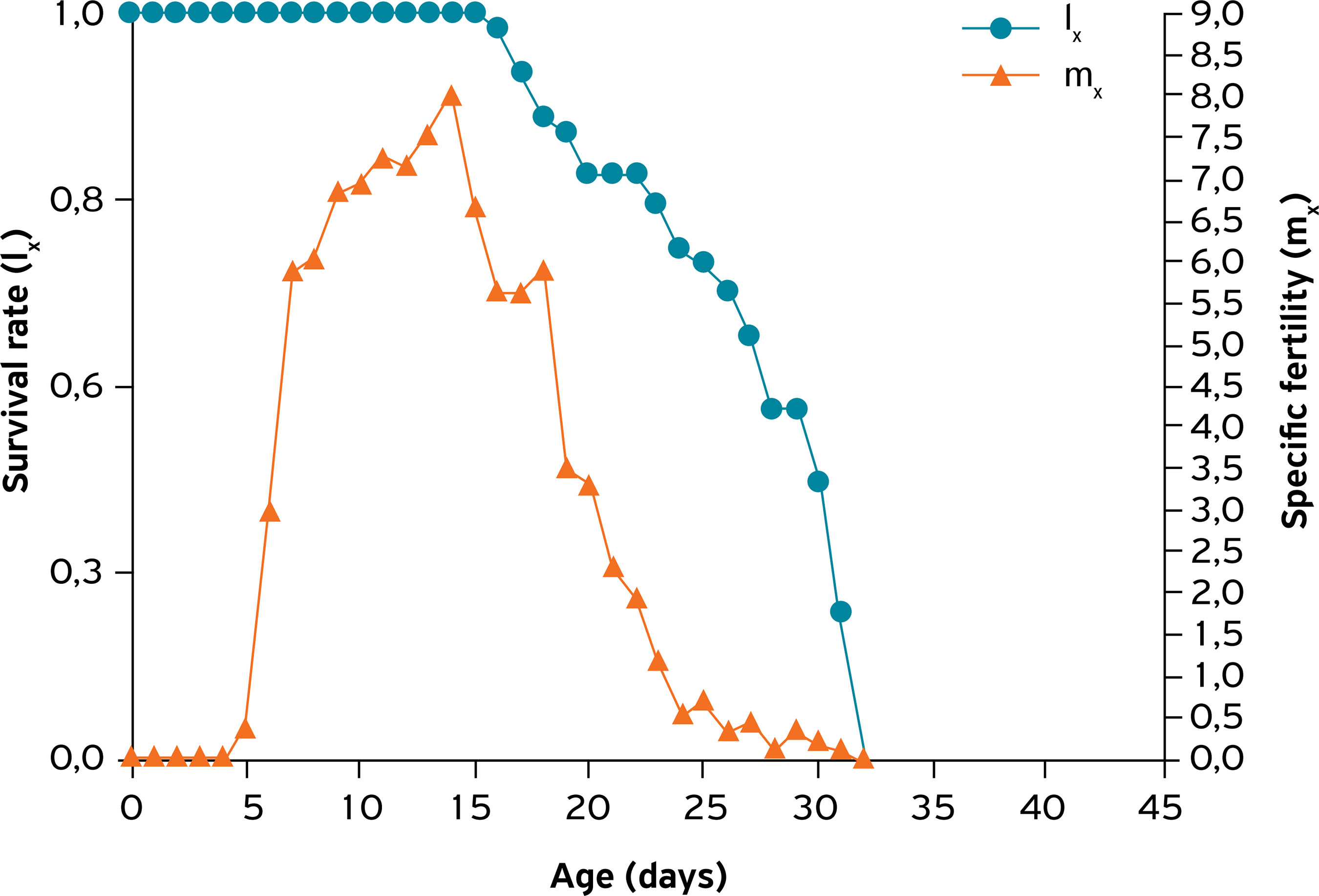
Daily fecundity and total fecundity are key parameters in population assessment, as they directly affect the fertility curve. In this study, the reproductive period of L. pseudobrassicae began, on average, on the fifth day of life and lasted until death at approximately 32 days of age. The reproductive peak occurred between the 10th and 14th days, and the maximum rate of increase was observed on the 14th day of life (Fig. 1), when the highest number of nymphs per female per day was recorded.

Survival rate (l<sub>x</sub>) and number of offspring per female per day (mx) of <i>Lipaphis pseudobrassicae</i> on cabbage leaves.
Biological parameters provide valuable insights into the life cycle of an insect. However, constructing a life table based on these data is even more informative, as it is the best tool for comparing the growth potential of two or more populations.
The life table of L. pseudobrassicae was calculated (n = 51) based on the biological data (Table 2). L. erysimi, feeding on B. oleracea under similar conditions, exhibited the following life table parameters: Ro = 38.29, rm = 0.28, λ = 1.33, and T = 12.81 (Godoy; Cividanes, 2002). When compared to the present results, L. pseudobrassicae showed a greater biological potential to become a pest, as all life table parameters were higher, particularly Ro and rm, which were 2.42 and 1.39 times higher, respectively (Table 2).
Population parameters of <i>Lipaphis pseudobrassicae</i> feeding on <i>Brassica oleracea</i> L. var. <i>acephala</i> under no-choice test conditions. Temperature = 25°C, relative humidity = 70 ± 10%, and photophase = 12 h.
Brassica brassicae and M. persicae are considered the main aphid pests of B. oleracea. At similar temperatures (25°C), their life table parameters are as follows: B. brassicae: Ro = 14.65, T = 14.94, rm = 0.18, λ = 1.19; and M. persicae: Ro = 26.33, T = 14.59, rm = 0.22, λ = 1.25 (Cividanes, 2002; Cividanes; Souza, 2003).
Compared to the values obtained for L. pseudobrassicae, although the experimental conditions were not identical, the markedly higher values observed in this study indicated that L. pseudobrassicae possesses a superior biotic potential. This suggests that the species may reach population disequilibrium more easily and cause significant economic damage to B. oleracea crops.
CONCLUSION
Lipaphis pseudobrassicae demonstrated a high potential to reach population disequilibrium and cause economic damage to B. oleracea L. var. acephala. B. oleracea L. var. acephala proved to be a suitable host for L. pseudobrassicae under the experimental conditions evaluated.
Lipaphis pseudobrassicae can therefore be considered an important aphid species associated with the cultivation of B. oleracea L. var. acephala in the state of Piauí, with the potential to cause greater damage than L. erysimi, B. brassicae, and M. persicae.
ACKNOWLEDGEMENTS
We thank Dr. Douglas Rafael e Silva Barbosa, from the Instituto Federal de Educação, Ciência e Tecnologia do Maranhão, for his enormous contribution to the life table calculations.
FUNDING
ETHICAL APPROVAL
DECLARATION OF USE OF ARTIFICIAL INTELLIGENCE TOOLS
Peer Review History:
AVAILABILITY OF DATA AND MATERIAL
The datasets generated and/or analyzed during the current study are available from the corresponding author on reasonable request.
REFERENCES
-
AGARWALA, B.K.; DAS, K.; RAYCHOUDHURY, P. Morphological, ecological and biological variations in the mustard aphid, Lipaphis pseudobrassicae (Kaltenbach) (Hemiptera: Aphididae) from different host plants. Journal of Asia-Pacific Entomology, v.12, p.169-173, 2009. https://doi.org/10.1016/j.aspen.2009.03.002
» https://doi.org/10.1016/j.aspen.2009.03.002 -
AHUJA, D.B.; AHUJA, U.R.; KALYAN, R.K.; SHARMA, Y.K.; DHANDAPANI, A.; MEENA, P.C. Evaluation of different management strategies for Lipaphis pseudobrassicae (Davis) on Brassica juncea International Journal of Pest Management, v.55, n.1, p.11-18, 2009. https://doi.org/10.1080/09670870802422580
» https://doi.org/10.1080/09670870802422580 - BLACKMAN, R.L.; EASTOP, V. Growth and development. In: EMDEN, H.F.V.; HARRINGTON, R. (org.). Aphids as crop pests. Cambridgeshire: CAB International, 2007. v.1. p.1-29.
- BROGLIO, S.M.F.; SANTOS, A.J.N.; DIAS-PINI, N.S.; VALENTE, E.C.N.; MICHELETTI, L.B. Utilização de substâncias naturais para o manejo de Lipaphiserysimi (Kaltenbach, 1843) (Hemiptera: Aphididae) em cultivo orgânico de brócolis, Brassica oleracea var. italica (Brassicaceae). Revista Brasileira de Agroecologia, v.1, n.9, p.232-239, 2014.
- CAMPOS, A.P.; BOIÇA JUNIOR, A.L.; RIBEIRO, Z.A.; ITO, L.A. Atratividade de Lipaphis erysimi (Hemiptera: Aphididae) por cultivares de couve. Horticultura Brasileira, v.29, n.2, 2011.
-
CHI, H.; YOU, M.; ATLIHAN, R.; SMITH, C.L.; KAVOUSI, A.; ÖZGÖKÇE, M.S.; GÜNCAN, A.; TUAN, S.J.; FU, J.W.; XU, Y.Y.; ZHENG, F.Q.; YE, B.H.; CHU, D.; YU, Y.; GHAREKHANI, G.; SASKA, P.; GOTOH, T.; SCHNEIDER, M.I.; BUSSAMAN, P.; GÖKÇE, A.; LIU, T.X., Age-Stage, two-sex lifetable: anintroductiontotheory, data analysis, andapplication. Entomologia Generalis, v.40, n.2, p.103-124, 2020. https://doi.org/10.1127/entomologia/2020/0936
» https://doi.org/10.1127/entomologia/2020/0936 -
CIVIDANES, F.J. Tabelas de vida de fertilidade de Brevicoryne brassicae (L.) (Hemiptera: Aphididae) em condições de campo. Neotropical Entomology, v.31, n.3, p.419-426, 2002. https://doi.org/10.1590/S1519-566X2002000300011
» https://doi.org/10.1590/S1519-566X2002000300011 -
CIVIDANES, F.J.; SOUZA, V.P. Exigências térmicas e tabelas de vida de fertilidade de Myzuspersicae (Sulzer) (Hemiptera: Aphididae) em laboratório. Neotropical Entomology, v.32, n.3, p.413-419, 2003. https://doi.org/10.1590/S1519-566X2003000300005
» https://doi.org/10.1590/S1519-566X2003000300005 -
GODOY, K.B.; CIVIDANES, F.J. Tabelas de esperança de vida e fertilidade para Lipaphiserysimi (Kalt.) (Hemiptera: Aphididae) em condições de laboratório e campo. Neotropical Entomology, v.31, n.1, p.41-48, 2002. https://doi.org/10.1590/S1519-566X2002000100006
» https://doi.org/10.1590/S1519-566X2002000100006 - ILHARCO, F.A. Biologia e ciclos biológicos. In: ILHARCO, F.A. Equilíbrio biológico de afídeos Lisboa: [s.n.], 1992. p.127-136.
- MARSARO JÚNIOR, A.L.; PEREIRA, P.R.V.S.; SCARPARO, A.R.; CARVALHO, C.Z. Flutuação populacional de afídeos na cultura da canola, em Passo Fundo - RS. Revista Científica Intelletto, v.6, n.1, p.1-6, 2021.
- MOURA, A.P.; GUIMARÃES, J.A.; SILVA, J.; GUEDES, I.M.R.; LEAL, D.C.P. Recomendações técnicas para o manejo de pragas em brassicáceas com vistas à produção integrada de hortaliças folhosas. Embrapa Hortaliças, p.32, 2019.
-
NAFRÍA, J.M.N.; FUENTES-CONTRERAS, E.; COLMENERO, M.C.; PIERA, M.A.; ORTEGO, J.; DURANTE, M.P.M. Catálogo de los áfidos (Hemiptera, Aphididae) de Chile, con plantas hospedadoras y distribuciones regional y provincial. Graellsia, v.72, n.2, e050, 2016. https://doi.org/10.3989/graellsia.2016.v72.167
» https://doi.org/10.3989/graellsia.2016.v72.167 - OLIVEIRA, J.E.D.M.; BORTOLI, S.A.; SANTOS, R.F.; MOREIRA, A.N. Desenvolvimento de metodologia de criação e multiplicação de Aphis gossypii: avanços e sucessos. ComunicataScientiae, v.1, p.65-68, 2010.
- PAL, M.; SING, R. Biology and ecology of the cabbage aphid, Brevicoryne brassicae (Linn.) (Homoptera: Aphididae): A review. Journal of Aphidology, v.27, p.59-78, 2013.
- PATEL, S.R.; AWASTHI, A.K.; TOMAR, R.K.S. Assessment of yield losses in mustard (Brassica Juncea L.) due to mustard aphid (Lipaphis Erysimi Kalt.) under different thermal environments in Eastern Central India. Applied Ecology and Environmental Research, v.2, n.1, p.1-15, 2004.
- QUEIROZ, O.S.; MORAES, E.G.F.; PICANÇO, M.C.; SILVA, G.A.; SOUZA, T.C.; SOARES, J.R.S. Variação sazonal do ataque de Lipaphis erysimi no repolho. Horticultura Brasileira, v.30, n.2, 2012.
-
RANA, J.S. Performance of Lipaphis erysimi (Homoptera: Aphididae) on different Brassica species in a tropical environment. Journal of Pest Science, v.38, p.155-160, 2005. https://doi.org/10.1007/s10340-005-0088-3
» https://doi.org/10.1007/s10340-005-0088-3 -
RESENDE, A.L.S.; SILVA, E.E.; SILVA, V.B.; RIBEIRO, R.L.D.; GUERRA, J.G.M.; MENEZES, E.L.A. Primeiro registro de Liphis pseudobrassicae Davis (Hemiptera: Aphididae) e sua associação com insetos predadores, parasitóides e formigas em couve (Cruciferae) no Brasil. Neotropical Entomology, v.35, n.4, p.551-555, 2006. https://doi.org/10.1590/S1519-566X2006000400019
» https://doi.org/10.1590/S1519-566X2006000400019 -
SAMPAIO, M.V.; KORNDÖRFER, A.P.; PUJADE-VILLAR, J.; HUBAIDE, J.E.A.; FERREIRA, S.E.; ARANTES, S.O.; BORTOLETTO, D.M.; GUIMARÃES, C.M.; SÁNCHEZ-ESPIGARES, J.A.; CABALLERO-LÓPEZ, B. Brassica aphid (Hemiptera: Aphididae) populations are conditioned by climatic variables and parasitism level: a study case of Triângulo Mineiro, Brazil. Bulletin of Entomological Research, v.107, n.3, p.410-418, 2017. https://doi.org/10.1017/S0007485317000220
» https://doi.org/10.1017/S0007485317000220 - TRANI, P.E.; TIVELLI, S.W.; BLAT, S.F.; PRELA-PANTANO, A.; TEIXEIRA, É.P.; ARAÚJO, H.S.; FELTRAN, J.C.; PASSOS, F.A.; FIGUEIREDO, G.J.B.; NOVO, M.C.S.S. Couve de folha: do plantio a pós-colheita. Boletim Técnico IAC, n.214, p.3-20, 2015.
- VALBON, W.R.; RONDELLI, V.M.; MACHADO, L.C.; FRANZIN, M.L. Pulgões. In: HOLTZ, A.M.; RONDELLI, V.M.; CELESTINO, F.N.; BESTETE, L.R.; CARVALHO, J.R. (Eds.). Pragas das brassicas. Colatina: IFES, 2015. cap.3, p.74-94.
-
VALENTE, E.C.N.; TRINDADE, R.C.P.; BROGLIO, S.M.F.; DUARTE, A.G.; RODRIGUES, V. de M.; LIMA, H.M.A.; BATISTA, N.S.; SANTOS, J.R. Biological aspects of Aphis craccivora Koch (Hemiptera: Aphididae) in cultivars of cowpea Vigna unguiculata (L.) Walp. Ciência Agrícola, v.12, n.1, p.17-20, 2014. https://doi.org/10.28998/rca.v12i1.1072
» https://doi.org/10.28998/rca.v12i1.1072
*
Corresponding author: luizcarlos.melo@ifpi.edu.brAssociate Editor:
CONFLICTS OF INTEREST
History
-
Received
03 June 2022 -
Accepted
08 Dec 2025 -
Preprint posted on
19 Nov 2025
10.1590/SciELOPreprints.1408