
 Physiological adaptability of Lasiodiplodia spp. associated with acerola in the Brazilian semi-arid region
ABSTRACT
Dieback caused by fungi of the genus Lasiodiplodia is a significant disease of acerola in the semi-arid region of Brazil. Information regarding the influence of fungicides on Lasiodiplodia species associated with acerola remains unknown. Therefore, the effective concentration to reduce mycelial growth by 50% (EC50) of seven Lasiodiplodia species was estimated in vitro for the fungicide thiophanate-methyl. The optimal temperature, salinity, and fitness components were also measured for these species. The EC50 for the fungicide ranged from 0.742 to 2.702 µg·mL-1. Among the seven species studied, L. pseudotheobromae and L. iraniensis showed the highest sensitivity to thiophanate-methyl, followed by L. brasiliense, L. gonubiensis, L. euphorbicola, and L. hormozganensis, which are classified as moderately sensitive on a relative sensitivity scale; finally, L. theobromae was the species least sensitive to the fungicide. At extreme temperatures (10 and 40 °C), the Lasiodiplodia species did not develop. The optimal temperature for the mycelial growth of Lasiodiplodia species isolated from acerola was 25.3 °C. The species L. brasiliense, which is moderately sensitive to thiophanate-methyl, exhibited greater adaptability under salt-stress conditions.
Keywords
fitness;
Malpighia emarginata
; thiophanate-methyl; Botryosphaeriaceae
INTRODUCTION
The genus Lasiodiplodia, one of the causal agents of dieback in acerola (Malpighia emarginata), comprises more than 40 known species, seven of which were first reported in acerola in 2017 within commercial orchards in Northeastern Brazil (Cabral, 2017). Species of this genus affect woody hosts of agricultural importance (Crous, 2017), causing a wide range of symptoms. These include external signs such as branch cankers, chlorosis, and resinosis, as well as internal symptoms like black streaking in vascular tissues.
The expression of these fungi is generally associated with or triggered by stress conditions (Crous, 2017; Mehl et al., 2016), often linked to climate change and anthropogenic actions, which increasingly impact agriculture (Zlaticovic et al., 2016). Climate change models, soil salinization due to irrigation water, and the limited availability of fungicide active ingredients (a.i.) are stress factors that, combined with the biological pressure on these pathogens, can trigger disease epidemics in the field (Arnold; Herre, 2003; Slippers; Wingfield, 2007).
The fitness of plant pathogens can be defined as the relative ability of a pathogen to survive and reproduce over a period of time while exposed to a specific environment. In this context, mutations associated with fungicide resistance are highly dependent on environmental stress fitness, as this affects the competition dynamics between resistant and sensitive strains, with direct implications for disease management (Karaoglanadis et al., 2011; Parnell et al., 2005). The evolution of fungicide resistance is slowed if subpopulations exhibit lower saprophytic fitness.
A series of factors can lead to unfavorable outcomes when diseases are treated with fungicides, such as inadequate spraying, dosage errors, and unfavorable weather conditions (Pereira et al., 2012). One of the most critical factors is the loss of efficacy, leading to pathogen resistance against fungicides with specific modes of action (Milgroom, 2015). In Brazil, only three fungicides are registered for acerola: one based on boscalid (anilide), a second consisting of a mixture of boscalid (anilide) + kresoxim-methyl (strobilurin), and a third featuring a mixture of thiophanate-methyl and fluazinam. All these fungicides have specific modes of action, such as inhibiting cellular respiration or fungal cell mitosis and division (Agrofit, 2026). Although in vitro studies have evaluated the efficacy of fungicides in managing Lasiodiplodia (Al-Jabri et al., 2017; Cavalcante et al., 2014; Pereira et al., 2012; Vieira et al., 2017), there are no studies evaluating the sensitivity of Botryosphaeriaceae species obtained specifically from acerola.
The ability of these fungi to infect multiple hosts increases their threat as potential pathogens of economic and ecological importance; some species may be associated with different crops located in proximity to one another (Mehl et al., 2016). Developing strategies that ensure the durability of host resistance against a plant pathogen involves addressing questions related to adaptation to new environments (Fournet et al., 2012). Indeed, for highly specialized parasites like Lasiodiplodia, the genetic composition of cultivars represents an essential environmental factor for adaptation (Thagavelu et al., 2007).
Despite the abundance of information on the direct consequences of selecting resistant host plants on parasite populations, little is known about the consequences at the intra- and inter-species scales, specifically regarding genotype-specific adaptation and cross-pathogenicity (Fournet et al., 2012). Several studies indicate Lasiodiplodia species infect and cause damage to mango, grapevine, cashew, passion fruit, coconut, and acerola in the Brazilian Northeast (Marques et al., 2013; Correia et al., 2016; Netto et al., 2017; Lima et al., 2012; Pereira et al., 2006). The objectives of this study were: (i) to determine the sensitivity of seven Lasiodiplodia species to the fungicide thiophanate-methyl and (ii) to evaluate the fitness components “temperature” and “salinity” for these fungal species.
MATERIALS AND METHODS
Lasiodiplodia species
Seven Lasiodiplodia isolates collected from acerola orchards were used in this study (Table 1). Species were determined by phylogenetic inference based on partial sequences of the translation elongation factor 1-alpha gene and the internal transcribed spacer region, as described by Cabral (2017). The isolates were maintained in the phytopathological culture collection of the Laboratório de Fitopatologia, Universidade Federal do Vale do São Francisco, Submédio Vale do São Francisco. Working cultures were stored in test tubes containing slanted potato dextrose agar (PDA) medium and kept at 25 °C in the dark.
Initially, the pathogenicity of the species was restored by inoculation using the stem-slit method on acerola seedlings (cv. Junco). After the onset of symptoms, stem fragments were used to re-isolate each pathogen species on PDA medium under the same incubation conditions.
Sensitivity to thiophanate-methyl
A commercial product containing only thiophanate-methyl (Support, 500 g/L of active ingredients) was used to quantify the sensitivity of the Lasiodiplodia species. The fungicide was added to molten PDA medium at 45 °C. The evaluated concentrations were 0, 0.01, 0.05, 0.1, 0.5, 1.0, 3.0, and 10.0 µg of active ingredients.mL-1. Mycelial plugs (4.76 mm in diameter) were taken from the colony margins of each species after 7 days of growth on PDA in the dark at 25 °C and transferred to the center of 9-cm diameter Petri dishes containing PDA supplemented with each fungicide dose. The plates were incubated at 25 °C in the dark until evaluation. Petri dishes containing PDA without the fungicide were used as controls.
Temperature
The seven Lasiodiplodia isolates were used to evaluate the effect of temperature on fungal growth in vitro. Mycelial plugs (4.76 mm) were removed from the edges of 7-day-old PDA plates incubated at 25 °C in the dark. Subsequently, each species was transferred to the center of plates containing PDA and incubated at temperatures of 10, 15, 20, 25, 30, and 40 °C.
Osmotic sensitivity
Osmotic sensitivity was evaluated by measuring the mycelial growth of the fungi on PDA medium, under the same conditions as the previous experiment, containing different concentrations of NaCl. Similarly, mycelial plugs were taken from the margins of 7-day-old cultures of each species and transferred to the center of 9-cm diameter Petri dishes supplemented with 1, 2, 4, 6, and 8% (w/v) NaCl. Petri dishes containing PDA without NaCl were used as controls.
Statistical analysis
For each evaluation of mycelial growth regarding fitness components, the experiment was repeated twice using a completely randomized design in a factorial scheme with five replicates. The experimental unit consisted of one Petri dish containing each concentration-fungus combination for each fitness component evaluated. For the thiophanate-methyl sensitivity component, Factor 1 consisted of eight fungicide concentrations, and Factor 2 consisted of the mycelial growth of the seven Lasiodiplodia species. For the temperature component, Factor 1 consisted of the eight incubation temperatures and Factor 2 of the mycelial growth of the seven species. For the osmotic sensitivity assessment, Factor 1 consisted of seven NaCl concentrations and Factor 2 of the mycelial growth of the seven species.
For all variables analyzed, colony diameter was measured in two perpendicular directions as soon as the diameter of any fungal species reached 75% of the plate diameter, subtracting the initial diameter of the mycelial plug. Scatter plots relating mycelial growth to fungicide active ingredient concentration, temperature ranges, and NaCl concentration were generated. Regression functions were fitted to determine the effective concentration to reduce mycelial growth by 50% (EC50) and the saline concentration required to inhibit 50% of growth (NaCl50). This procedure was performed for each fungal species using SigmaPlot 10.0 software.
Colony diameter data related to mycelial growth for thiophanate-methyl sensitivity, EC50, temperature, and osmotic sensitivity (NaCl50) were subjected to normality tests (Kolmogorov-Smirnov), analysis of variance (ANOVA), and means grouping (Scott-Knott, α = 0.05) using Sisvar version 5.4 software (Ferreira, 2014). Based on EC50 values, the fungal species were grouped as sensitive, moderately sensitive, or slightly sensitive to the fungicide, as well as for the determination of NaCl50 values regarding osmotic sensitivity.
RESULTS AND DISCUSSION
This is the first study on the fungicide sensitivity of Lasiodiplodia isolates obtained from acerola. The studied isolates showed significant differences in sensitivity to thiophanate-methyl (Fig. 1). Regarding the EC50, values ranged from 0.742 to 2.702 µg.mL-1(Fig. 2). Significant differences were also observed among the seven species for this variable. As expected, increasing concentrations of the fungicide active ingredients in the culture medium led to a reduction in the in vitro mycelial growth of the fungi. The field-recommended dose of the commercial product Support (500 g.L-1 a.i.) was included in the evaluated treatments.

Effect of thiophanate-methyl concentrations on the mycelial growth of seven Lasiodiplodia species isolated from acerola (M. emarginata), 72 h after incubation.

Variation in the effective concentration of thiophanate-methyl required to inhibit 50% (EC50) of mycelial growth in different Lasiodiplodia species isolated from acerola (M. emarginata).
The isolates of L. pseudotheobromae and L. iraniensis exhibited the highest sensitivity to thiophanate-methyl, followed by L. brasiliense, L. gonubiensis, L. euphorbicola, and L. hormozganensis, which were classified as moderately sensitive on a relative scale. L. theobromae was the least sensitive species. These sensitivity differences may be associated with natural characteristics of the species/isolates or may stem from populations that have developed fungicide resistance.
Analyzing the isolates of L. pseudotheobromae, L. iraniensis, and L. hormozganensis, the first two showed lower EC50 values (below 0.882 µg.mL-1). Cabral (2017), working with the same isolates, observed that L. pseudotheobromae was the most frequent species in field samples from acerola, accounting for 33% of the collected isolates. The fact that this crop does not require frequent fungicide applications suggests that this lower EC50 value may have contributed to the increased frequency of this sensitive species in the field.
These three species were also evaluated in mango crops, where the highest EC50 value was 2.82 µg.mL-1 (Santos et al., 2019). Given that fungicide use, including benzimidazoles, is more common in mango than in acerola, the sensitivity associated with acerola isolates likely corresponds to a natural characteristic due to a lack of exposure to the active ingredients
The L. theobromae isolate from acerola presented an EC50 of 2.702 µg.mL-1. While this makes it the least sensitive isolate in this study, it does not classify it as insensitive. In the Submédio Vale do São Francisco, this species has been reported in papaya (Cavalcante et al., 2014), mango (Santos et al., 2019), banana (Vieira et al., 2017), and grapevine (Peixinho, 2017). Cavalcante et al. (2014) found L. theobromae isolates in intensive fungicide-use papaya orchards with EC50 ranges from 0.88 to 496.51 µg.mL-1. Since this species can infect a wide range of hosts (> 500 species), a “host-jump” phenomenon may be occurring; the isolate collected from acerola may have previously infected another host where fungicide use is intensive, such as grapes or mangoes. Thus, it might have already been heavily exposed to the tested active ingredients.
This hypothesis is reinforced by the regional planting patterns, where different host crops are in proximity. This has been proven in other pathosystems, such as Phytophthora infestans in potatoes and Magnaporthe oryzae in rice (Stukenbrock; Mcdonald, 2008). Therefore, complementary studies are necessary to confirm host-jumping in this pathosystem.
The EC50 analysis suggests interspecific differences in thiophanate-methyl sensitivity. Consequently, identifying which fungal species is causing field damage is essential for efficient fungicide management. Regardless of the Lasiodiplodia species present, caution is recommended regarding the use of identical active ingredients, as single-point mutations in the β-tubulin gene (e.g., codon 198) already confer resistance to benzimidazoles (Santos et al., 2019).
Regarding the “temperature” fitness component, all species showed a quadratic growth pattern (Fig. 3), with no mycelial growth at extreme temperatures (10 °C and 40 °C). The ideal temperature range (Table 2), obtained from regression derivatives, was between 23.91 °C and 25.81 °C. This optimal range correlates with the regional average annual temperature where isolates were collected (approx. 25-28 °C).

Influence of temperature on the mycelial growth of seven Lasiodiplodia species isolated from acerola (M. emarginata).A) L. pseudotheobromae. B) L. gonubiensis. C) L. euphorbicola. D) L. theobromae. E) L. hormozganensis. F) L. iraniensis. G) L. brasiliense.
Optimal temperature obtained through the derivative of the regression equation for the development of seven Lasiodiplodia species isolated from acerola (M. emarginata).
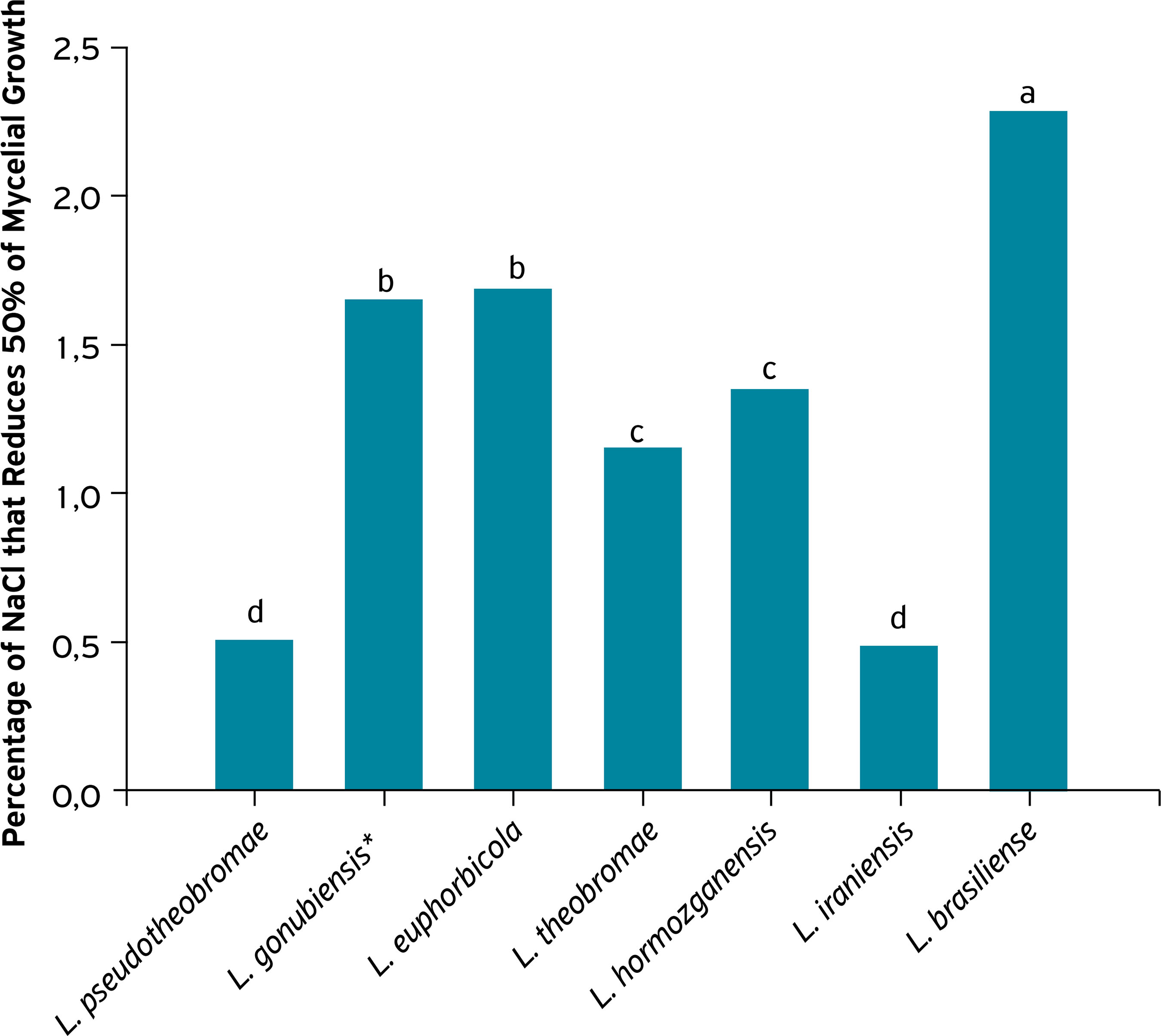
Regarding “salinity,” in vitro mycelial growth was maximal in the absence of salt (Fig. 4). As expected, increasing NaCl concentrations significantly reduced growth. L. brasiliense demonstrated high relative adaptability to salt, requiring approximately 2.3% NaCl to reduce growth by 50% (NaCl50) (Figs. 4 and 5). This value is approximately 153% higher than that of the species with the second-highest value. In contrast, L. pseudotheobromae and L. iraniensis were the most sensitive to salt (NaCl50 of 0.5%).

Effect of NaCl concentrations in PDA culture medium on the mycelial growth of seven Lasiodiplodia species isolated from acerola (Malpighia emarginata). Legend: A) L. pseudotheobromae, B) L. gonubiensis, C) L. euphorbicola, D) L. theobromae,E) L. hormozganensis, F) L. iraniensis, G) L. brasiliense.

Variation in the NaCl concentration in PDA culture medium required to inhibit 50% of the mycelial growth in different Lasiodiplodia species isolated from acerola (M. emarginata).
Fitness components, such as mycelial growth rate and virulence, reflect the pathogenic potential of isolates to colonize and disseminate new infections, making them fundamental for predicting resistance evolution and outlining management strategies (Brent; Hollomon, 2007; Ishi; Hollomon, 2015). In the present study, the evaluated species did not exhibit a fitness cost associated with reduced thiophanate-methyl sensitivity. However, L. brasiliense, although moderately sensitive to the fungicide, displayed superior physiological plasticity under osmotic stress. This behavior corroborates the findings of Santos et al. (2019), reinforcing that salinity resilience is a hallmark adaptive trait in Lasiodiplodia species, potentially favoring their persistence in salinized soils of the semi-arid region.
CONCLUSIONS
This study provides an unprecedented characterization of the sensitivity to the fungicide thiophanate-methyl and the fitness components of seven Lasiodiplodia species, the causal agents of dieback in acerola within the Brazilian semi-arid region.
There is significant variation in sensitivity to thiophanate-methyl among the species. L. pseudotheobromae and L. iraniensis are the most sensitive (lowest EC50), while L. theobromae exhibits the lowest relative sensitivity, likely due to the “host-jump” phenomenon and a history of exposure to the active ingredients in neighboring crops.
Lasiodiplodia species from acerola are thermophilic, with an optimal mycelial growth temperature around 25.3 °C and an inability to develop at thermal extremes (10 °C and 40 °C), making them highly adapted to the climatic conditions of the Brazilian Northeast.
Mycelial growth is inversely proportional to the salinity of the medium. However, the species L. brasiliense stands out for its high osmotic adaptability (NaCl50 of 2.3%), suggesting that orchards under salinization stress, common in irrigated areas of the semi-arid region, may favor the establishment and prevalence of this species.
The absence of fitness costs associated with lower fungicide sensitivity indicates that resistance can stabilize rapidly in field populations. Therefore, management of dieback in acerola requires the correct identification of prevalent species and the rotation of active ingredients to prevent the selection of isolates that are less sensitive and more resilient to environmental stresses.
ACKNOWLEDGEMENTS
Not applicable.
AVAILABILITY OF DATA AND MATERIAL
The datasets generated and/or analyzed during the current study are available from the corresponding author on reasonable request.
REFERENCES
-
AGROFIT. Agrofit: sistema de agrotóxicos fitossanitários Available at: http://agrofit.agricultura.gov.br/agrofit_cons/principal_agrofit_cons Access on: 20 jan. 2026.
» http://agrofit.agricultura.gov.br/agrofit_cons/principal_agrofit_cons -
AL-JABRI, M. K.; AL-SHAILI, M.; AL-HASHMI, A.; NASEHI, A.; AL-MAHMOOLI, I. H.; AL-SADI, A. M. Characterization and evaluation of fungicide resistance among Lasiodiplodia theobromae isolates associated with mango dieback in Oman. Journal of Plant Pathology, v. 99, n. 3, p. 753-759, 2017. Available at: https://www.jstor.org/stable/44687148 Access on: 03 mar. 2025.
» https://www.jstor.org/stable/44687148 -
ARNOLD, A. E.; HERRE, E. A. Canopy cover and leaf age affect colonization by tropical fungal endophytes: ecological pattern and process in Theobroma cacao (Malvaceae). Mycologia, v. 95, p. 388-398, 2003. https://doi.org/10.1080/15572536.2004.11833083
» https://doi.org/10.1080/15572536.2004.11833083 - BRENT, K. J.; HOLLOMON, D. Fungicide resistance in crop pathogens: how can it be managed? Brussels: CropLife International; Fungicide Resistance Action Committee, 2003. 60 p.
- CABRAL, P. G. Botryosphaeriales associated with acerola dieback in Brazil and stem-end rot, gummosis, leaf blight and dieback of ornamental, fruit and native trees cultivated near to orchards in Northeastern Brazil 2017. 100 f. Thesis (Doctorate) - Universidade Federal de Viçosa, Viçosa, 2017.
-
CAVALCANTE, R. D. C.; GUERREIRO LIMA, W.; MARTINS, B.; TOVAR-PEDRAZA, J. M.; MICHEREFF, S. J.; CÂMARA, M. P. S. Thiophanate-methyl sensitivity and fitness in Lasiodiplodia theobromae populations from papaya in Brazil. European Journal of Plant Pathology, v. 140, p. 241-259, 2014. https://doi.org/10.1007/s10658-014-0459-9
» https://doi.org/10.1007/s10658-014-0459-9 -
CORREIA, K. C.; SILVA, M.; MORAIS JUNIOR, M. A.; ARMENGOL, J.; PHILLIPS, A. J. L. Phylogeny, distribution and pathogenicity of Lasiodiplodia species associated with dieback of table grape in the main Brazilian exporting region. Plant Pathology, v. 65, p. 92-103, 2016. https://doi.org/10.1111/ppa.12388
» https://doi.org/10.1111/ppa.12388 -
CROUS, P. W. Botryosphaeriaceae: systematics, pathology, and genetics. Fungal Biology, v. 121, p. 305-306, 2017. https://doi.org/10.1016/j.funbio.2017.01.003
» https://doi.org/10.1016/j.funbio.2017.01.003 -
FERREIRA, D. F. Sisvar: a guide for its bootstrap procedures in multiple comparisons. Ciência e Agrotecnologia, v. 38, p. 109-112, 2014. http://doi.org/10.1590/S1413-70542014000200001
» https://doi.org/10.1590/S1413-70542014000200001 -
FOURNET, S.; KERLAN, L. R.; RENAULT, L.; DANTEC, J. P.; ROUAUX, C.; MONTARRY, J. Selection of nematodes by resistant plants has implications for local adaptation and cross-virulence. Plant Pathology, v. 62, p. 1-10, 2012. https://doi.org/10.1111/j.1365-3059.2012.02617.x
» https://doi.org/10.1111/j.1365-3059.2012.02617.x - ISHII, H.; HOLLOMON, D. W. Fungicide resistance in plant pathogens Tokyo: Springer, 2015. 485 p.
-
KARAOGLANIDIS, G. S.; LUO, Y.; MICHAILIDES, T. J. Competitive ability and fitness of Alternaria alternata isolates resistant to QoI fungicides. Plant Disease, v. 92, n. 2, p. 178-182, 2011. https://doi.org/10.1094/PDIS-07-10-0510
» https://doi.org/10.1094/PDIS-07-10-0510 -
LIMA, J. S.; CARDOSO, J. E.; MOREIRA, R. C.; ALVES, E. S.; MELO, J. G. M. Caracterização cultural de isolados de Lasiodiplodia theobromae e patogenicidade em plantas de aceroleira. Revista Trópica - Ciências Agrárias e Biológicas, v. 6, n. 1, p. 10, 2012. Available at: https://periodicoseletronicos.ufma.br/index.php/ccaatropica/article/view/714 Access on: 03 mar. 2025.
» https://periodicoseletronicos.ufma.br/index.php/ccaatropica/article/view/714 -
MARQUES, M. W.; LIMA, N. B.; MORAIS, M. A.; BARBOSA, M. A.; MICHEREFF, S. J.; PHILLIPS, A. J. L.; CÂMARA, M. P. S. Species of Lasiodiplodia associated with mango. Fungal Diversity, v. 61, p. 181-193, 2013. https://doi.org/10.1007/s13225-013-0231-z
» https://doi.org/10.1007/s13225-013-0231-z -
MEHL, J. W. M.; SLIPPERS, B.; ROUX, J.; WINGFIELD, M. J. Overlap of latent pathogens in the Botryosphaeriaceae on a native and agricultural host. Fungal Biology, 2016. https://doi.org/10.1016/j.funbio.2016.07.015
» https://doi.org/10.1016/j.funbio.2016.07.015 -
MICHEL, B. E.; RADCLIFFE, D. A computer program relating solute potential to solution composition for five solutes. Agronomy Journal, v. 87, p. 126-130, 1995. https://doi.org/10.2134/agronj1995.00021962008700010022x
» https://doi.org/10.2134/agronj1995.00021962008700010022x - MILGROOM, M. G. Population biology of plant pathogens: genetics, ecology, and evolution St. Paul: APS Press, 2013. 399 p.
-
NETTO, M. S. B.; LIMA, W. G.; CORREIA, K. C.; SILVA, C. F. B.; THON, M.; MARTINS, R. N. G.; MICHEREFF, S. J.; CÂMARA, M. P. S. Analysis of phylogeny, distribution and pathogenicity of Botryosphaeriaceae species associated with gummosis of Anacardium in Brazil, with a new species of Lasiodiplodia Fungal Biology, v. 121, p. 1-46, 2017. https://doi.org/10.1016/j.funbio.2016.07.006
» https://doi.org/10.1016/j.funbio.2016.07.006 -
PARNELL, S.; GILLIGAN, C. A.; VAN DEN BOSCH, F. Small-scale fungicide spray heterogeneity and the coexistence of resistant and sensitive pathogen strains. Phytopathology, v. 95, p. 632-639, 2005. https://doi.org/10.1094/PHYTO-95-0632
» https://doi.org/10.1094/PHYTO-95-0632 -
PEIXINHO, G. de S.; RIBEIRO, V. G.; AMORIM, E. P. da R. Controle da podridão seca (Lasiodiplodia theobromae) em cachos de videira cv. Itália por óleos essenciais e quitosana. Summa Phytopathologica, v. 43, n. 1, p. 26-31, 2017. https://doi.org/10.1590/0100-5405/2201
» https://doi.org/10.1590/0100-5405/2201 -
PEREIRA, A. L.; SILVA, G. S. S.; RIBEIRO, V. B. Caracterização fisiológica, cultural e patogênica de diferentes isolados de Lasiodiplodia theobromae Fitopatologia Brasileira, v. 31, p. 6, 2006. https://doi.org/10.1590/S0100-41582006000600006
» https://doi.org/10.1590/S0100-41582006000600006 -
PEREIRA, A. V. S.; MARTINS, R. B.; MICHEREFF, S. J.; SILVA, M. B.; CÂMARA, M. P. S. Sensitivity of Lasiodiplodia theobromae from Brazilian papaya orchards to MBC and DMI fungicides. European Journal of Plant Pathology, v. 132, p. 489-498, 2012. https://doi.org/10.1007/s10658-011-9891-2
» https://doi.org/10.1007/s10658-011-9891-2 -
SANTOS, K. M.; TSUJI, S. S.; CÂMARA, M. P. S.; MICHEREFF, S. J.; LOPES, U. P. Sensitivity to methyl benzimidazole carbamate fungicides of Botryosphaeriaceae species from mango orchards in the Northeast of Brazil. European Journal of Plant Pathology, v. 153, p. 209-222, 2019. https://doi.org/10.1007/s10658-018-1556-y
» https://doi.org/10.1007/s10658-018-1556-y -
SLIPPERS, B.; WINGFIELD, M. J. Botryosphaeriaceae as endophytes and latent pathogens of woody plants: diversity, ecology and impact. Fungal Biology Reviews, v. 21, p. 90-106, 2007. https://doi.org/10.1016/j.fbr.2007.06.002
» https://doi.org/10.1016/j.fbr.2007.06.002 -
STUKENBROCK, E. H.; MCDONALD, B. A. The origins of plant pathogens in agro-ecosystems. Annual Review of Phytopathology, v. 46, p. 75-100, 2008. https://doi.org/10.1146/annurev.phyto.010708.154114
» https://doi.org/10.1146/annurev.phyto.010708.154114 -
THAGAVELU, R.; SANGEETHA, G.; MUSTAFFA, M. M. Cross-infection potential of crown rot pathogen (Lasiodiplodia theobromae) isolates and their management using potential native bioagents in banana. Australasian Plant Pathology, v. 36, p. 595-600, 2007. https://doi.org/10.1071/AP07072
» https://doi.org/10.1071/AP07072 -
VIEIRA, W. A. S. V.; LIMA, W. G.; NASCIMENTO, E. S.; MICHEREFF, S. J.; REIS, A.; DOYLE, V. P.; CÂMARA, M. P. S. Thiophanate-methyl resistance and fitness components of Colletotrichum musae isolates from banana in Brazil. Plant Disease, v. 101, n. 9, p. 1660-1665, 2017. https://doi.org/10.1094/PDIS-11-16-1594-RE
» https://doi.org/10.1094/PDIS-11-16-1594-RE - ZLATICOVIC, M.; KECA, N.; WINGFIELD, M. J.; SLIPPERS, B. Botryosphaeriaceae associated with the dieback of ornamental trees in the Western Balkans. Antonie van Leeuwenhoek, 2016.
Edited by
-
Associate Editor:
Silvia Galleti https://orcid.org/0000-0002-0745-5716
History
-
Received
20 Mar 2025 -
Accepted
09 Mar 2026 -
Preprint posted on
04 Dec 2025
10.1590/SciELOPreprints.14376

 Source: Elaborated by the authors.
 Source: Elaborated by the authors.
 Source: Elaborated by the authors.
 Source: Elaborated by the authors.
 Source: Elaborated by the authors.