 EFFECTIVENESS AND SAFETY OF SELECTIVE IL-12/23 RECEPTOR ANTAGONISTS IN MODERATE TO SEVERE ULCERATIVE COLITIS: A SYSTEMATIC REVIEW, META-ANALYSIS AND TRIAL SEQUENTIAL ANALYSIS
ABSTRACT
Background and objective: Selective IL-12/23p40 receptor antagonists (IL-12/23RA) show promise for treating moderate to severe ulcerative colitis (UC), but their efficacy and safety are not fully understood. Objective: This systematic review and meta-analysis assess the effectiveness and safety of IL-12/23RA in UC.
Methods: A systematic search of PubMed, Embase, Cochrane, and ClinicalTrials.gov was performed in December 2024. Randomized controlled trials (RCTs) comparing IL-12/23RA to placebo in moderate to severe UC were included. Outcomes included clinical and endoscopic remission, response rates, and adverse events (AEs). Risk ratios (RR) and mean differences (MD) with 95% confidence intervals (CI) were pooled using a random-effects model.
Results: Nine RCTs (3,808 patients in the induction phase; 1,734 in the maintenance phase) were analyzed. IL-12/23RA enhanced clinical remission (induction: RR 2.63; 95%CI 2.05-3.36; maintenance: RR 1.99; 95%CI 1.63-2.44; all P<0.01) and endoscopic remission (induction: RR 2.36; 95%CI 1.70-2.20; maintenance: RR 1.96; 95%CI 1.63-2.37; all P<0.01). IL-12/23RA reduced serious AE in the induction phase (RR 0.40; 95%CI 0.27-0.69; P<0.01), while there was no difference during maintenance (RR 0.75; 95%CI 0.31-1.84; P=0.53). No differences were observed in overall AEs or specific AEs like headache or nasopharyngitis. Trial sequential analysis confirmed sufficient sample size for clinical endpoints.
Conclusions: IL-12/23RA showed superior effectiveness and similar safety when compared to placebo in moderate to severe UC.
Keywords:
Ulcerative colitis; interleukin-12/23 receptor antagonist; effectiveness; safety
RESUMO
Contexto e Objetivo: Antagonistas seletivos do receptor da interleucina-12/23 (IL-12/23RA) demonstram potencial no tratamento da retocolite ulcerativa (RCU) moderada a grave, mas sua eficácia e segurança ainda não estão completamente esclarecidas. Assim, esta revisão sistemática e meta-análise avaliou a efetividade e segurança dos 12/23 (IL-12/23RA) na RCU.
Métodos: Foi realizada uma busca sistemática nas bases PubMed, Embase, Cochrane e ClinicalTrials.gov em dezembro de 2024. Foram incluídos ensaios clínicos randomizados (ECRs) que compararam 12/23 (IL-12/23RA) com placebo em pacientes com RCU moderada a grave. Os desfechos incluíram remissão clínica e endoscópica, taxas de resposta e eventos adversos (EAs). Razões de risco (RR) e diferenças médias (DM) com intervalos de confiança (IC) de 95% foram combinadas utilizando um modelo de efeitos aleatórios no software R.
Resultados: Foram analisados nove ECRs (3.808 pacientes na fase de indução; 1.734 na fase de manutenção). O uso de 12/23 (IL-12/23RA) aumentou a remissão clínica (indução: RR 2,63; IC95% 2,05-3,36; manutenção: RR 1,99; IC95% 1,63-2,44; todos P<0,01) e a remissão endoscópica (indução: RR 2,36; IC95% 1,70-2,20; manutenção: RR 1,96; IC95% 1,63-2,37; todos P<0,01). Os 12/23 (IL-12/23RA) reduziram os EAs graves na fase de indução (RR 0,40; IC95% 0,27-0,69; P<0,01), sem diferença significativa na fase de manutenção (RR 0,75; IC95% 0,31-1,84; P=0,53). Não foram observadas diferenças nos EAs gerais ou em EAs específicos como cefaleia ou nasofaringite. A análise sequencial de ensaios confirmou amostra suficiente para os desfechos clínicos.
Conclusão: Os 12/23 (IL-12/23RA) demonstraram eficácia superior e segurança semelhante ao placebo em pacientes com RCU.
Palavras-chave:
Retocolite ulcerativa; interleucina-23; eficácia; segurança
INTRODUCTION
Ulcerative colitis (UC) is a chronic inflammatory condition of the colon characterized by periods of exacerbation and remission, which significantly impactspatients’ quality of life1-4. In North America, the prevalence of UC is 0.4% and it affects approximately 1.5 million people4. While tumor necrosis factor (TNF) inhibitors, including infliximab and adalimumab, are widely used as first-line therapies, nearly one-third of patients fail to achieve clinical remission5. Additionally, other available treatments, such as immunomodulators and corticosteroids, often have limited effectiveness and carry considerable risk of adverse events, underscoring the need for more effective and safer therapeutic options1,6.
While the pathogenesis of UC is multifactorial, it is increasingly understood that interleukin-23 (IL-23) plays a critical role in driving the pro-inflammatory responses central to disease progression7-9. As a result, selective "IL-12/23 (p40) receptor antagonists (IL-12/23RA) have emerged as a promising class of therapies, targeting a key cytokine pathway involved in inflammation while minimizing off-target effects7,9. These agents are effective in inducing and maintaining remission in moderate to severe UC, with a favorable safety profile10,11.
Despite promising results from randomized controlled trials (RCTs), key gaps persist in understanding the comparative effectiveness, long-term safety, and class-wide consistency of selective IL-12/23RA in moderate to severe UC. Previous network meta-analyses (NMA) have evaluated biologics and small molecules for UC, but these primarily emphasized efficacy outcomes and did not focus specifically on the IL-23 inhibitor class12,13. To address these gaps, this systematic review and meta-analysis evaluates both the effectiveness and safety of IL-12/23RA, incorporating trial sequential analysis (TSA) to strengthen result reliability, bridge gaps in the literature, and provide actionable evidence to optimize treatment strategies for UC patients.
METHODS
This systematic review followed the recommendations of the Cochrane Collaboration14 and the Preferred Reporting Items for Systematic Reviews and Meta-Analysis (PRISMA) guidelines15, including the design, implementation of the steps, analysis, and description of the results. The study protocol was registered in the International Prospective Register of Systematic Reviews (PROSPERO) under registration number CRD42024618348.
Search strategy
A systematic search on PubMed (MEDLINE), Embase, Cochrane Central, and Clinical Trial databases was conducted on December 25, 2024. The following medical subject heading terms were included: ‘ulcerative colitis’, ‘il-23’, ‘interleukin-23’, ‘guselkumab’, ‘tildrakizumab’, ‘mirikizumab’, ‘ustekinumab’, ‘risankizumab’, ‘randomized controlled trial’, ‘controlled clinical trial’, ‘randomized’, ‘placebo’, ‘drug therapy’, ‘randomly’, ‘trial’, and ‘groups’. The search strategy is detailed in SUPPLEMENTARY TABLE 1 45.
Data extraction
After removing duplicates, two authors (I.V. and W.A.) screened the titles and abstracts, independently evaluating the full-text articles for inclusion based on pre-specified criteria. Discrepancies were discussed and resolved by a third reviewer (M.T.). Data extraction was conducted independently by I.V. and W.A., prioritizing information relevant to the study’s objective.
Eligibility criteria
Eligible studies for this systematic review met the following criteria: (1) randomized trials evaluating efficacy or safety without time restrictions; (2) inclusion of patients with moderate to severe ulcerative colitis; (3) interventions involving selective IL-12/23 (p40) receptor antagonists; (4) use of placebo as the control; and (5) reporting at least one relevant outcome. Exclusion criteria were: (1) overlapping populations, defined by shared institutions and recruitment periods; (2) populations outside the scope of interest; (3) republished literature; (4) protocols without reported results; (5) reviews, case reports, case series, background articles, expert opinions, or in vivo/in vitro studies; (6) duplicate data from the same clinical trial; or (7) absence of a comparator group.
Outcomes measures and subgroup analysis
The effectiveness outcomes included clinical remission, clinical response, endoscopic remission, and endoscopic response during both the induction and maintenance periods. In the induction phase, additional outcomes included clinical remission in patients with previous failure of Janus kinase inhibitors (JAKi) or other biologic therapies, histologic, endoscopic, and mucosal healing, symptomatic remission, and change in Inflammatory Bowel Disease Questionnaire (IBDQ) total score. For the maintenance phase, additional outcomes included glucocorticoid-free remission and maintenance of clinical remission. Safety outcomes encompassed the overall safety profile for both induction and maintenance periods, including any adverse events (AEs), serious AEs, and specific AEs such as anemia, headache, nasopharyngitis, and arthralgia. The endpoints’ definitions are detailed in SUPPLEMENTARY TABLE 2 45. A subgroup analysis was also conducted to evaluate clinical remission outcomes during both phases, stratified by the specific type of drug administered.
Risk of bias
We assessed the risk of bias for RCTs using the Cochrane Risk of Bias 2 (RoB 2) tool16. The evaluation of bias was performed by two independent reviewers (M.T. and I.V.). The RoB 2.0 tool rates the risk of bias as either high, some concerns, or low across five domains: selection, performance, detection, attrition, and reporting biases. The layout was produced by RobVis17.
Certainty of evidence
The Grading of Recommendations, Assessment, Development, and Evaluation (GRADE) tool was employed by two independent authors (W.A. and M.T.) using the GRADE pro guideline development tool18 to evaluate the level of certainty of the evidence in this meta-analysis, with categorizations ranging from high to very low19. Any disagreements were discussed and resolved through a consensus.
Sensitivity analysis
The stability of the pooled estimates was assessed through a leave-one-out analysis, where data from each study were sequentially removed, and the remaining dataset re-analyzed. This helped ensure that the aggregated effect sizes were not unduly influenced by any single study.
Statistical analysis and publication bias
Statistical analysis was performed using R software and RStudio (version 2024.04.1+748; R Core Team, Vienna, Austria), employing DerSimonian and Laird’s random-effects model to calculate pooled analyses with 95% confidence intervals (CI)20. Binary outcomes were assessed with risk ratios (RRs), continuous outcomes with mean differences (MDs), and results were displayed in forest plots. Heterogeneity was evaluated using the Cochrane Q chi-square test and I² statistic, with P-values <0.10 and I² >30% indicating significant heterogeneity21. Publication bias was assessed with funnel plots.
Meta-regression analysis
To explore the impact of a history of biologic failure on clinical remission and response during induction therapy with IL-23 receptor antagonists, we conducted meta-regression analyses. The percentage of patients with a history of biologic failure was included as a covariate in the model to assess its potential influence on clinical outcomes. Clinical remission and clinical response were used as dependent variables. The analysis was performed using R software 4.4, and results were reported as estimates with 95% confidence intervals. A significance level of P<0.05 was considered for statistical significance.
Trial sequential analysis
TSA was performed using TSA software (version 0.9.5.10 beta)22 to assess sample size adequacy and determine the need for further research. Diversity-adjusted information size was calculated, accounting for variability between trials and sampling error, with a 5% type I error risk (α=5%) and 20% type II error risk (β=20%)23,24. Crossing the trial sequential monitoring boundary before reaching the required information size indicates conclusive evidence, whereas failure to cross it suggests the need for additional trials.
RESULTS
Study selection
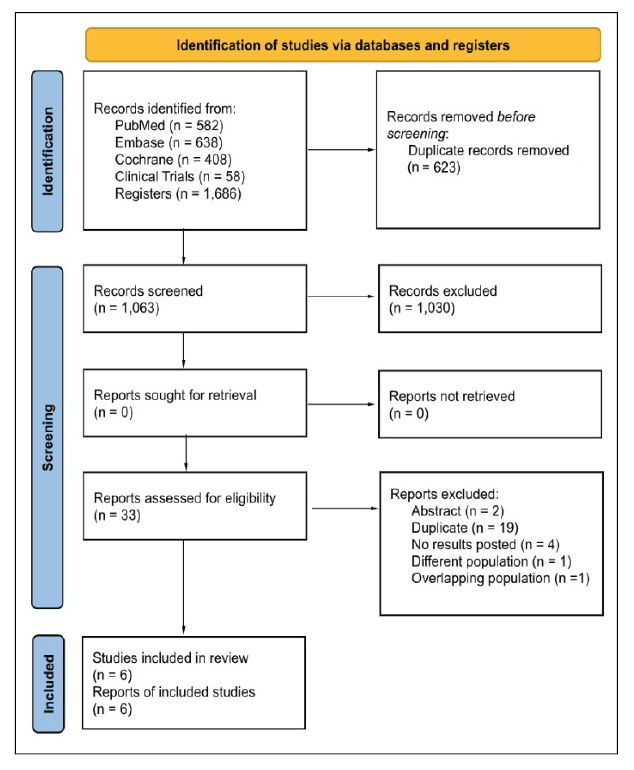
The initial search strategy yielded 1,686 results (Figure 1). After the removal of duplicates and full-text screening, nine double-blind, placebo-controlled RCTs reported in six studies11,25-29 were included in this meta-analysis. The studies reviewed during full-text screening are presented in SUPPLEMENTARY TABLE 3 45.
Preferred Reporting Items for Systematic Reviews and Meta-Analysis (PRISMA) flow diagram of study screening and selection.
Baseline characteristics of included studies
During the induction period, six studies comprised a total of 3.808 patients, of whom 2,422 (64%) received intravenous IL-12/23RA (ustekinumab, mirikizumab, guselkumab, or risankizumab). The follow-up period ranged from 8 to 12 weeks. The mean age ranged from 40.5 to 42.5 years, with 2,266 (60%) being male. In addition, 1,849 (49%) of the participants had a history of failure with biologic therapies. Baseline characteristics of the induction period are detailed in Table 1.
Regarding the maintenance period (Table 2), five studies included 1,734 patients, of whom 981 (57%) received subcutaneous IL-12/23RA. The follow-up duration ranged from 44 to 52 weeks, and the mean age varied between 40 and 42.6 years. Among the participants, 965 (58%) were male.
Effectiveness and safety of the induction phase
A pooled analysis of six studies revealed that clinical remission (21.8% vs 8%; RR 2.63; 95%CI 2.05-3.36; P<0.01; I²=31% [Figure 2A]) and clinical response (47.5% vs 27.1%; RR 1.94; 95%CI 1.70-2.20; P<0.01; I²=39% [Figure 2B]) were significantly higher in the intervention group. Regarding subgroup analysis based on type of drug, there was no difference between groups for clinical remission (pinteraction=0.9 [SUPPLEMENTARY FIGURE 1 45]). However, among those who had a previous failure with JAKi or other biologic therapies, clinical remission was much higher with IL-12/23RA (RR 3.74; 95%CI 1.60-8.76; P<0.01; I²=0% [SUPPLEMENTARY FIGURE 2 45]).
Additionally, IL-12/23RA were associated with significantly higher rates of endoscopic remission (RR 2.36; 95%CI 1.63-3.41; P<0.01; I²=51%) [Figure 2C]), endoscopic response (RR 2.51; 95%CI 1.99-3.16; P<0.01; I²=31% [Figure 2D]), and histologic, endoscopic, and mucosal healing (RR 2.49; 95%CI 2.01-3.08; P<0.01; I²=22% [SUPPLEMENTARY FIGURE 3 45]). Furthermore, symptomatic remission (RR 2.16; 95%CI 1.66-2.82; P<0.01; I²=64% [SUPPLEMENTARY FIGURE 4 45]) and change in the IBDQ total score (MD 16.3; 95%CI 12.2-20.4; P<0.001; I²=99% [SUPPLEMENTARY FIGURE 5 45]) also significantly favored the IL-12/23RA.
Forest plots for (A) clinical remission, (B) clinical response, (C) endoscopic remission, and (D) endoscopic response in the induction phase.
No significant difference was observed in the rate of overall adverse events (RR 0.91; 95%CI 0.85-0.98; P=0.01; I²=0% [SUPPLEMENTARY FIGURE 6 45]). However, serious adverse events were more common with placebo (RR 0.40; 95%CI 0.27-0.69; P<0.01; I²=25% [SUPPLEMENTARY FIGURE 7 45]), as was the incidence of anemia (RR 0.61; 95%CI 0.46-0.82; P<0.01; I²=0% [SUPPLEMENTARY FIGURE 8 45]) and worsening of ulcerative colitis (RR 0.27; 95%CI 0.18-0.38; P<0.01; I²=13% [SUPPLEMENTARY FIGURE 9 45]). No differences were observed for headache (RR 1.17; 95%CI 0.82-1.68; P=0.39; I²=0% [SUPPLEMENTARY FIGURE 10 45]), nasopharyngitis (RR 1.09; 95%CI 0.67-1.76; P=0.73; I²=0% [SUPPLEMENTARY FIGURE 11 45]), or arthralgia (RR 1.34; 95%CI 0.77-2.32; P=0.29; I²=0% [SUPPLEMENTARY FIGURE 12 45]).
Effectiveness and safety of the maintenance period
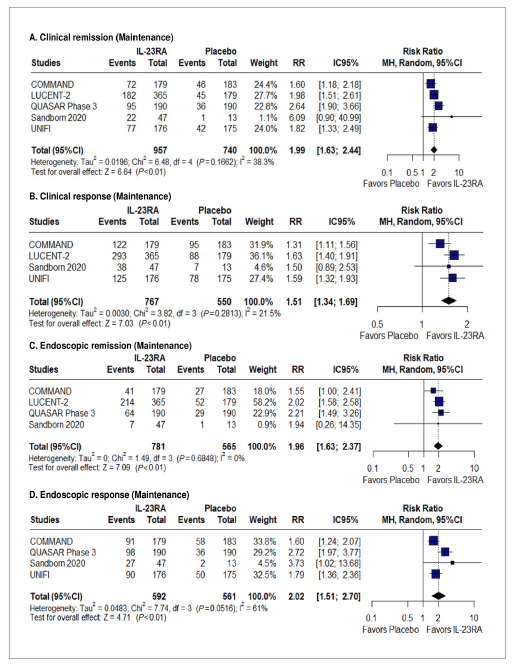
A pooled analysis of five studies demonstrated a higher clinical remission (46.8% vs 23%; RR 1.99; 95%CI 1.63-2.44; P<0.01; I²=38% [Figure 3A]) and clinical response (75.4% vs 48.7%; RR 1.51; 95%CI 1.34-1.69; P<0.01; I²=21% [Figure 3B]) with IL-12/23RA. Subgroup analysis showed no difference regarding type of drug for clinical remission (p interaction=0.15 [SUPPLEMENTARY FIGURE 13 45]).
IL-12/23RA demonstrated superior efficacy in achieving endoscopic remission (RR: 1.96; 95%CI: 1.63-2.37; P<0.01; I²=0% [Figure 3C]) and endoscopic response (RR: 2.20; 95%CI: 1.51-2.70; P<0.01; I²=61% [Figure 3D]). Furthermore, IL-12/23RA significantly improved glucocorticoid-free remission rates (RR: 1.98; 95%CI: 1.60-2.45; P<0.01; I²=46% [SUPPLEMENTARY FIGURE 14 45]) and was associated with a higher maintenance of clinical remission (RR: 1.80; 95%CI: 1.48-2.18; P<0.01; I²=0% [SUPPLEMENTARY FIGURE 15 45]).
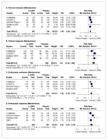
Forest plots for (A) clinical remission, (B) clinical response, (C) endoscopic remission, and (D) endoscopic response in the maintenance phase.
The safety profile was comparable between groups. There was no difference regarding the overall incidence of adverse events (RR 0.97; 95%CI 0.92-1.03; P=0.32; I²=0% [SUPPLEMENTARY FIGURE 16 45]), nasopharyngitis (RR 1.07; 95%CI 0.77-1.50; P=0.68; I²=0% [SUPPLEMENTARY FIGURE 17 45]), arthralgia (RR 1.10; 95%CI 0.72-1.70; P=0.66; I²=15% [SUPPLEMENTARY FIGURE 18 45]), headache (RR 1.29; 95%CI 0.60-2.78; P=0.51; I²=61%) [SUPPLEMENTARY FIGURE 19 45]), serious adverse events (RR 0.75; 95%CI 0.31-1.84; P=0.53; I²=64%) [SUPPLEMENTARY FIGURE 20 45]), or anemia (RR 0.62; 95%CI 0.35-1.07; P=0.09; I²=0% [SUPPLEMENTARY FIG. S21 45]). However, worsening of ulcerative colitis (RR 0.41; 95%CI 0.25-0.66; P<0.01; I²=73% [SUPPLEMENTARY FIGURE 22 45]) was higher in the placebo group.
Risk of bias within studies
As presented in SUPPLEMENTARY FIGURE 23 45, six RCTs were assessed as having a low risk of bias11,25-27,29. Conversely, three studies were categorized as having some concerns of bias, mainly due to issues related to the randomization process11,28 or deviations from intended intervention26.
Certainty of evidence and publication bias
According to the GRADE criteria (SUPPLEMENTARY TABLE 4 45), the certainty of evidence was high for the outcomes of clinical remission/response and endoscopic remission/response during the induction phase. In the maintenance phase, certainty of evidence was moderate for clinical remission/response and low for endoscopic remission/response. Funnel plot analysis (SUPPLEMENTARY FIGURES S24-S27 45) showed no indications of publication bias, with symmetrical plots observed for outcomes.
Sensitivity analysis
We performed leave-one-out sensitivity analysis to assess the influence of individual studies on the pooled results. When any single study was omitted, the P-values did not cross the threshold for statistical significance, indicating that the results were robust and not sensitive to the exclusion of individual studies. Leave-one-out sensitivity analyses are detailed in SUPPLEMENTARY FIGURE 28-S31 45.
Meta-regression analysis
The analysis (SUPPLEMENTARY FIGURE 32 45) identified a significant association between a history of biologic failure and clinical remission (P=0.008) but not with clinical response (P=0.59). Minimal residual heterogeneity was observed, with tau²=0 and I²=0% for clinical remission, indicating that moderators explained nearly all variability. The model’s R² value of 100% highlighted its effectiveness in accounting for differences in clinical remission outcomes across studies.
Trial sequential analysis
The required information size (RIS), calculated to target a 5% risk of type I error and a 20% risk of type II error, was 345 patients for clinical remission in the induction phase (SUPPLEMENTARY FIGURE 33 45) and 229 patients for the maintenance phase (SUPPLEMENTARY FIGURE 34 45). For clinical response, the RIS was 336 patients in the induction phase (SUPPLEMENTARY FIGURE 35 45) and 144 patients in the maintenance phase (SUPPLEMENTARY FIGURE 36 45). The cumulative Z-curve crossed the monitoring boundary for all endpoints, indicating that the number of included studies was adequate to provide robust evidence.
DISCUSSION
In this systematic review and meta-analysis of 9 RCTs involving 3,808 patients, we evaluated the effectiveness and safety of IL-12/23RA in the induction and maintenance treatment phases for UC. The main findings from the pooled analysis were: (1) IL-12/23RA significantly improved clinical remission, clinical response, and endoscopic remission compared to placebo in the induction phase; (2) similar benefits were observed during the maintenance phase, with IL-12/23RA continuing to show superior clinical and endoscopic outcomes; and (3) IL-12/23RA demonstrated a comparable safety profile to placebo, with a lower incidence of disease worsening.
To our knowledge, this is the first pooled analysis to comprehensively assess the efficacy and safety of selective IL-12/23RA in patients with moderate to severe UC. While other systematic reviews and NMA have evaluated biologic therapies and small molecules for UC, they are limited in scope, often focusing solely on efficacy outcomes and lacking direct comparisons of IL-12/23RA as a class12,12,30,31. Therefore, this meta-analysis provides a more focused assessment of the IL-12/23 (p40) receptor antagonists class, incorporating the latest updated data and employing robust methodological approaches.
The effectiveness of IL-12/23RA in UC may be attributed to their mechanism of action, targeting the IL-23/Th17 pathway, which plays a critical role in the pathogenesis of UC7. IL-23 is involved in the differentiation and maintenance of Th17 cells, which are implicated in driving the inflammatory process in UC7,9. By inhibiting the interaction between IL-23 and its receptor, these antagonists may effectively reduce inflammation and mucosal damage, leading to both clinical improvement and endoscopic healing9,32. Specific "IL-12/23RA include ustekinumab, a fully human monoclonal antibody that targets both IL-23 and IL-12; mirikizumab, a monoclonal antibody targeting the p19 subunit of IL-23, shown to reduce inflammation and improve symptoms; guselkumab, another monoclonal antibody that selectively targets the p19 subunit of IL-23, primarily studied in psoriasis; and risankizumab, which binds to the p19 subunit of IL-23 and has demonstrated promising results in UC trials, with potential for inducing long-term remission33. These agents, by selectively modulating the IL-23/Th17 axis, provide targeted therapeutic options for managing UC.
This meta-analysis demonstrates that IL-12/23RA are highly effective in both inducing and maintaining clinical remission in patients with UC. During the induction phase, pooled analyses showed significantly higher rates of clinical remission, clinical response, and endoscopic remission in the IL-12/23RA group compared to placebo. In the maintenance phase, these benefits were sustained, with increased rates of clinical remission and response, as well as continued endoscopic improvements, supporting the long-term efficacy of IL-12/23RA. These findings align with current treatment goals in UC34-36, which emphasize achieving not only symptomatic relief but also durable endoscopic and clinical outcomes, further underscoring the value of IL-12/23RA in comprehensive disease management.
In our meta-analysis, clinical remission during both the induction and maintenance phases was not significantly affected by any specific IL-12/23RA, as subgroup analysis showed no statistical significant differences between the drugs. This contrasts with a recent NMA that ranked risankizumab second in clinical remission, followed by guselkumab, and highlighted their strong performance in histological remission induction12. While drugs like risankizumab and guselkumab may excel in certain contexts, our findings suggest that the clinical remission achieved with IL-12/23RAs is likely a class effect, rather than driven by a single agent, challenging the NMA’s emphasis on individual drug efficacy.
We performed meta-regression analyses to assess how a history of biologic failure affects clinical remission and response during induction therapy with IL-12/23RA. The results showed a significant link between biologic failure and clinical remission, indicating that populations with a higher rate of biologic failure may achieve clinical remission more effectively with IL-12/23RA. Additionally, we found that clinical remission rates were considerably higher with IL-12/23RA among patients with a history of biologic failure. However, we did not find a significant association for clinical response. One possible explanation is that IL-12/23RA may be more effective in achieving stringent outcomes like remission, while response, as a broader measure, may be less affected by prior biologic therapy failure. These findings contrast with existing literature, which suggests that patients with a history of biologic failure typically experience diminished responses to treatment due to factors like uncontrolled inflammation and structural or immunological changes in the colon37. Our results should be interpreted cautiously, as they highlight the complexity of treatment outcomes and the need for further research to reconcile these findings and refine therapeutic strategies.
Additionally, this study highlights significant improvements in both histologic and symptomatic relief in patients with UC. While the primary goals of UC treatment should focus on endoscopic and clinical improvements, histologic remission is regarded as a marker of deep remission, which plays a crucial role in achieving long-term disease control38. Additionally, patients experienced significant symptomatic relief, as measured by the IBDQ score, which evaluates bowel, social, emotional, and systemic functions that impact quality of life39. However, the interpretation of the IBDQ score improvements should be approached with caution due to the high heterogeneity observed (I²=99%), indicating variability in patient responses across studies.
This meta-analysis underscores the favorable safety profile of IL-12/23RA in ulcerative colitis. During induction, these agents significantly reduced serious AE, disease worsening, and anemia, without increasing overall adverse events. In the maintenance phase, IL-12/23RA lowered the incidence of disease worsening while demonstrating comparable rates of AE and anemia. Notably, IL-12/23RA did not elevate risks of common adverse events such as headache, nasopharyngitis, or arthralgia, highlighting their safety compared to other therapeutic options. Traditional treatments like corticosteroids and immunomodulators are first-line therapies, but with limited efficacy1,6. Although advanced therapies such as TNF-α inhibitors and JAKi are effective, their use is often restricted due to concerns about severe infections and thromboembolic events, especially with JAKi40,41. These findings reinforce the role of IL-12/23RA as a safe and more targeted therapeutic option for patients with moderate to severe UC.
This meta-analysis shows consistent effectiveness of IL-12/23RA in both the induction and maintenance phases. Long-term extension data from the LUCENT-3 study42 with mirikizumab (up to week 152) and the UNIFI study43 with ustekinumab (up to week 200) further support sustained efficacy, with significant clinical response and endoscopic improvement over time. These findings highlight the ability of IL-12/23RA to provide long-term therapeutic benefits in ulcerative colitis.
Additionally, IL-12/23RA significantly improved glucocorticoid-free remission rates and enhanced the maintenance of clinical remission. Achieving glucocorticoid-free remission is particularly significant, as it reduces the risks associated with long-term corticosteroid use, such as weight gain, diabetes, osteoporosis, bone damage, and a higher risk of infections44. The continued improvement in clinical remission further highlights the long-term benefits of IL-12/23RA in reducing steroid dependence and optimizing disease management.
The TSA in this meta-analysis confirms the robustness of the findings on clinical remission/response during both induction and maintenance phases. The Z-curve crossing the monitoring boundary indicates substantial evidence supporting the efficacy of IL-12/23RA, strengthening confidence in their effectiveness for inducing and maintaining clinical remission and response in UC.
Future research should focus on identifying patient populations most likely to benefit from IL-12/23RA by stratifying them based on biomarkers, disease severity, and prior treatments. This would help optimize treatment selection and improve outcomes. Additionally, head-to-head trials comparing IL-12/23RA with other biologics could provide valuable insights into their relative efficacy and safety.
This study has several limitations that warrant consideration. First, there was slight variability in the definitions of primary outcomes across the included studies, which may influence the consistency of the results. To mitigate this, we performed sensitivity analyses to ensure that the conclusions were not disproportionately affected by any single study. Second, some degree of heterogeneity was observed in certain outcomes. However, this was accounted for by employing a random-effects model to adjust for the variability observed across the studies. Finally, although the analysis included a relatively small number of studies, the TSA demonstrated that the sample size was sufficient to support the robustness of the findings.
CONCLUSION
Selective IL-12/23RA are a promising new treatment for moderate to severe UC, showing superior effectiveness over placebo in achieving clinical, endoscopic, histologic and symptomatic improvements with a favorable safety profile. These findings highlight the potential of IL-12/23RA as a key therapeutic target for UC, offering an effective and safe option for managing this challenging condition.
REFERENCES
- 1 Le Berre C, Honap S, Peyrin-Biroulet L. Ulcerative colitis. Lancet. 2023;402:571-84.
- 2 Segal JP, LeBlanc JF, Hart AL. Ulcerative colitis: an update. Clin Med (Lond). 2021;21:135-9.
- 3 Han SW, McColl E, Barton JR, James P, Steen IN, Welfare MR. Predictors of quality of life in ulcerative colitis: the importance of symptoms and illness representations. Inflamm Bowel Dis. 2005;11:24-34.
- 4 Gros B, Kaplan GG. Ulcerative Colitis in Adults: A Review. JAMA. 2023;330:951-65.
- 5 Gisbert JP, Chaparro M. Primary Failure to an Anti-TNF Agent in Inflammatory Bowel Disease: Switch (to a Second Anti-TNF Agent) or Swap (for Another Mechanism of Action)? J Clin Med. 2021;10:5318.
- 6 Chhibba T, Ma C. Is there room for immunomodulators in ulcerative colitis? Expert Opin Biol Ther. 2020;20:379-90.
- 7 Vuyyuru SK, Shackelton LM, Hanzel J, Ma C, Jairath V, Feagan BG. Targeting IL-23 for IBD: Rationale and Progress to Date. Drugs. 2023;83:873-91.
- 8 Parigi TL, Iacucci M, Ghosh S. Blockade of IL-23: What is in the Pipeline?. J Crohns Colitis. 2022;16(Supplement_2):ii64-72.
- 9 Verstockt B, Salas A, Sands BE, Abraham C, Leibovitzh H, Neurath MF, et al. IL-12 and IL-23 pathway inhibition in inflammatory bowel disease. Nat Rev Gastroenterol Hepatol. 2023;20:433-46.
- 10 Almradi A, Hanzel J, Sedano R, Parker CE, Feagan BG, Ma C, et al. Clinical Trials of IL-12/IL-23 Inhibitors in Inflammatory Bowel Disease. BioDrugs. 2020;34:713-21.
- 11 D’Haens G, Dubinsky M, Kobayashi T, Irving PM, Howaldt S, Pokrotnieks J, et al. Mirikizumab as Induction and Maintenance Therapy for Ulcerative Colitis. N Engl J Med. 2023;388:2444-55.
- 12 Shehab M, Alrashed F, Alsayegh A, Aldallal U, Ma C, Narula N, et al. Comparative Efficacy of Biologics and Small Molecule in Ulcerative Colitis: A Systematic Review and Network Meta-analysis. Clin Gastroenterol Hepatol. 2024;S1542-356500767-5.
- 13 Ahuja D, Murad MH, Ma C, Jairath V, Singh S. Comparative Speed of Early Symptomatic Remission With Advanced Therapies for Moderate-to-Severe Ulcerative Colitis: A Systematic Review and Network Meta-Analysis. Am J Gastroenterol. 2023;118:1618-25.
-
14 Cochrane Handbook for Systematic Reviews of Interventions [Internet]. 2024. Available from: https://training.cochrane.org/handbook
» https://training.cochrane.org/handbook - 15 Page MJ, McKenzie JE, Bossuyt PM, Boutron I, Hoffmann TC, Mulrow CD, et al. The PRISMA 2020 statement: an updated guideline for reporting systematic reviews. BMJ. 2021;372:n71.
- 16 Sterne JAC, Savović J, Page MJ, Elbers RG, Blencowe NS, Boutron I, et al. RoB 2: a revised tool for assessing risk of bias in randomised trials. BMJ. 2019;366:l4898.
- 17 McGuinness LA, Higgins JPT. Risk-of-bias VISualization (robvis): An R package and Shiny web app for visualizing risk-of-bias assessments. Res Synth Methods. 2021;12:55-61.
-
18 GRADEpro [Internet]. 2024. Available from: https://www.gradepro.org/
» https://www.gradepro.org/ - 19 Schünemann HJ, Oxman AD, Brozek J, Glasziou P, Jaeschke R, Vist GE, et al. Grading quality of evidence and strength of recommendations for diagnostic tests and strategies. BMJ. 2008;336:1106-10.
- 20 DerSimonian R, Laird N. Meta-analysis in clinical trials. Control Clin Trials. 1986;7:177-88.
- 21 Higgins JPT, Thompson SG, Deeks JJ, Altman DG. Measuring inconsistency in meta-analyses. BMJ. 2003;327:557-60.
- 22 Kang H. Trial sequential analysis: novel approach for meta-analysis. Anesth Pain Med (Seoul). 2021;16:138-50.
- 23 Brok J, Thorlund K, Gluud C, Wetterslev J. Trial sequential analysis reveals insufficient information size and potentially false positive results in many meta-analyses. J Clin Epidemiol. 2008;61:763-9.
- 24 Wetterslev J, Thorlund K, Brok J, Gluud C. Trial sequential analysis may establish when firm evidence is reached in cumulative meta-analysis. J Clin Epidemiol. 2008;61:64-75.
- 25 Rubin DT, Allegretti JR, Panés J, Shipitofsky N, Yarandi SS, Huang KHG, et al. Guselkumab in patients with moderately to severely active ulcerative colitis (QUASAR): phase 3 double-blind, randomised, placebo-controlled induction and maintenance studies. Lancet. 2024;S0140-673601927-5.
- 26 Louis E, Schreiber S, Panaccione R, Bossuyt P, Biedermann L, Colombel JF, et al. Risankizumab for Ulcerative Colitis: Two Randomized Clinical Trials. JAMA. 2024;332:881-97.
- 27 Peyrin-Biroulet L, Allegretti JR, Rubin DT, Bressler B, Germinaro M, Huang KHG, et al. Guselkumab in Patients With Moderately to Severely Active Ulcerative Colitis: QUASAR Phase 2b Induction Study. Gastroenterology. 2023;165:1443-57.
- 28 Sandborn WJ, Ferrante M, Bhandari BR, Berliba E, Feagan BG, Hibi T, et al. Efficacy and Safety of Mirikizumab in a Randomized Phase 2 Study of Patients With Ulcerative Colitis. Gastroenterology. 2020;158:537-549.e10.
- 29 Sands BE, Sandborn WJ, Panaccione R, O’Brien CD, Zhang H, Johanns J, et al. Ustekinumab as Induction and Maintenance Therapy for Ulcerative Colitis. N Engl J Med. 2019;381:1201-14.
- 30 Gao J, Nie R, Chen Y, Yang W, Ren Q. Comparative of the effectiveness and safety of biological agents, small molecule drugs, and microbiome therapies in ulcerative colitis: Systematic review and network meta-analysis. Medicine (Baltimore). 2023;102:e35689.
- 31 Lasa JS, Olivera PA, Danese S, Peyrin-Biroulet L. Efficacy and safety of biologics and small molecule drugs for patients with moderate-to-severe ulcerative colitis: a systematic review and network meta-analysis. Lancet Gastroenterol Hepatol. 2022;7:161-70.
- 32 Noviello D, Mager R, Roda G, Borroni RG, Fiorino G, Vetrano S. The IL23-IL17 Immune Axis in the Treatment of Ulcerative Colitis: Successes, Defeats, and Ongoing Challenges. Front Immunol. 2021;12:611256.
- 33 Bourgonje AR, Ungaro RC, Mehandru S, Colombel JF. Targeting the Interleukin 23 Pathway in Inflammatory Bowel Disease. Gastroenterology. 2025;168:29-52.e3.
- 34 Rubin DT, Ananthakrishnan AN, Siegel CA, Sauer BG, Long MD. ACG Clinical Guideline: Ulcerative Colitis in Adults. Am J Gastroenterol. 2019 Mar;114:384-413.
- 35 Danese S, Roda G, Peyrin-Biroulet L. Evolving therapeutic goals in ulcerative colitis: towards disease clearance. Nat Rev Gastroenterol Hepatol. 2020;17:1-2.
-
36 Ulcerative Colitis: Developing Drugs for Treatment. [Internet]. 2022. Available from: https://www.fda.gov/regulatory-information/search-fda-guidance-documents/ulcerative-colitis-developing-drugs-treatment
» https://www.fda.gov/regulatory-information/search-fda-guidance-documents/ulcerative-colitis-developing-drugs-treatment - 37 Friedrich M, Pohin M, Jackson MA, Korsunsky I, Bullers SJ, Rue-Albrecht K, et al. IL-1-driven stromal-neutrophil interactions define a subset of patients with inflammatory bowel disease that does not respond to therapies. Nat Med. 2021;27:1970-81.
- 38 Knyazev OV, Kagramanova AV, Khomeriki SG, Parfenov AI. [Is histological remission of ulcerative colitis achievable?]. Ter Arkh. 2021;93:975-81.
- 39 Dubinsky M, Rice A, Yarlas A, Hur P, Cappelleri JC, Kulisek N, et al. Systematic Literature Review: Ability of the IBDQ-32 to Detect Meaningful Change in Ulcerative Colitis Health Indicators. Inflamm Bowel Dis. 2024;30:2115-26.
- 40 Law CCY, Kayal M, Mehandru S, Colombel JF. A critical review of upadacitinib for the treatment of adults with moderately to severely active ulcerative colitis. Expert Rev Gastroenterol Hepatol. 2023;17:109-17.
- 41 Sedano R, Ma C, Jairath V, Feagan BG. Janus Kinase Inhibitors for the Management of Patients With Inflammatory Bowel Disease. Gastroenterol Hepatol (N Y). 2022;18:14-27.
- 42 Sands BE, D’Haens G, Clemow DB, Irving PM, Johns JT, Gibble TH, et al. Three-Year Efficacy and Safety of Mirikizumab Following 152 Weeks of Continuous Treatment for Ulcerative Colitis: Results From the LUCENT-3 Open-Label Extension Study. Inflamm Bowel Dis. 2024 Oct 25;izae253.
- 43 Afif W, Arasaradnam RP, Abreu MT, Danese S, Sandborn WJ, Miao Y, et al. Efficacy and Safety of Ustekinumab for Ulcerative Colitis Through 4 Years: Final Results of the UNIFI Long-Term Maintenance Study. Am J Gastroenterol. 2024;119:910-21.
- 44 da Silva BC. Corticosteroid-Free Remission in Patients With Inflammatory Bowel Disease. Gastroenterol Hepatol (N Y). 2024;20:169-71.
-
45 Amador WF, Vitor IC, Tome MR, Dotta DD, Motta RV. Effectiveness and Safety of Selective IL-23 Receptor Antagonists in Moderate to Severe Ulcerative Colitis: A Systematic Review, Meta-Analysis and Trial Sequential Analysis. arXiv [q-bio.TO]. 2025 Sep 29. doi:10.48550/arXiv.2509.25069. Available from: https://doi.org/10.48550/arXiv.2509.25069
» https://doi.org/10.48550/arXiv.2509.25069» https://doi.org/10.48550/arXiv.2509.25069
Data-available-upon-request