 Childhood apraxia of speech: analysis of speech-language pathologists' perception and conduct regarding the assessment process
ABSTRACT
Purpose To analyze the perception and conduct of speech-language pathologists regarding the assessment process in the differential diagnosis of childhood apraxia of speech.
Methods This was a cross-sectional observational analytical study with data collection conducted virtually via the Google Forms platform. Initially, 100 speech-language pathologists were recruited through content sharing via WhatsApp and email. Speech-language pathologists from across Brazil who were currently treating or had previously treated children with speech and/or language disorders were included. Undergraduate students were excluded. The questionnaire contained 26 questions regarding the assessment process for suspected cases of apraxia of speech. Data collection took place from September 2023 to July 2024.
Results Sixty speech-language pathologists from the South, Southeast, and Northeast regions, most of whom held a specialization degree, responded to the questionnaire. The majority used standardized assessment instruments, the most frequently applied was the ABFW Child Language Test – phonology subtest and checklists for childhood apraxia of speech. They observed that apraxia of speech is accompanied by other comorbidities and that more than five sessions were necessary to confirm the diagnosis. They also observed at least three clinical markers and mentioned referrals to other professionals. There was no significant correlation between the variable number of years of professional experience and the number of sessions required to confirm the diagnosis.
Conclusion In the perception of the professionals participating in the study, there is difficulty in performing a differential diagnosis and insecurity regarding the conduct and methods used in the assessment process.
Keywords:
Apraxias; Speech; Speech disorders; Child; Speech therapy
RESUMO
Objetivo analisar a percepção e conduta dos fonoaudiólogos sobre o processo de avaliação no diagnóstico diferencial de apraxia de fala na infância.
Métodos estudo analítico observacional transversal com coleta de dados realizada virtualmente pela plataforma Google Forms. Inicialmente, foram recrutados 100 fonoaudiólogos, por meio do compartilhamento do conteúdo via WhatsApp e e-mails. Foram incluídos fonoaudiólogos de todo o Brasil que atendiam ou já haviam atendido crianças com alteração de fala e/ou linguagem. Estudantes de graduação foram excluídos. O questionário continha 26 perguntas sobre o processo avaliativo dos casos suspeitos de apraxia de fala. A coleta ocorreu no período de setembro de 2023 a julho de 2024.
Resultados sessenta fonoaudiólogos das regiões Sul, Sudeste e Nordeste, a maioria com especialização, responderam ao questionário. Grande parte utilizava instrumentos padronizados de avaliação, sendo os mais aplicados o Teste de Linguagem Infantil ABFW - prova de fonologia e checklists para apraxia de fala na infância. Observaram que a apraxia de fala vem acompanhada de outras comorbidades e que eram necessárias mais de cinco sessões para confirmar o diagnóstico. Observaram também pelo menos três marcadores clínicos e mencionaram o encaminhamento para outros profissionais. Não houve correlação significativa entre a variável quantidade de aperfeiçoamentos e número de sessões para confirmar o diagnóstico.
Conclusão na percepção dos profissionais participantes do estudo, existe dificuldade em realizar o diagnóstico diferencial e insegurança em relação à conduta e aos métodos utilizados no processo de avaliação.
Palavras-chave:
Apraxias; Fala; Distúrbios da fala; Criança; Fonoaudiologia
INTRODUCTION
Speech sound disorder (SSD) is a broad term referring to any difficulty with the perception, motor production, or phonological representation of speech sounds and segments(1,2). The classification system for speech disorders developed by authors(1,3) divides these disorders into Speech Delay, Speech Errors, and Motor Speech Disorders (MSD). The latter includes four subtypes: Childhood Apraxia of Speech (CAS), Speech Motor Delay (SMD), Childhood Dysarthria, and the combination of CAS and Childhood Dysarthria (CD).
Individuals with SSD may be idiopathic, i.e., without known developmental impairments or with an association with complex neurodevelopmental disorders, such as cognitive, structural, sensory and/or motor alterations(1,4).
Among cases of idiopathic speech disorders, approximately 17.8% have a motor origin(1). Of these, CAS is the least frequent alteration (2.4%), followed by Childhood Dysarthria (3.4%) and SMD (12%)(1). Among children with complex neurodevelopmental disorders, almost half (47.7%) present some motor speech disorder. Yet, CAS is the least frequent alteration (4.3%), followed by CAS and Childhood Dysarthria concomitantly (4.9%), Childhood Dysarthria (13.3%) and SMD (25.1%)(1).
According to the American Speech-Language-Hearing Association (ASHA)(5), CAS is defined as a neurological speech disorder in which consistency and precision of movements are impaired in the absence of neuromuscular changes. This disorder affects the planning and programming of the sequential articulatory gestures, resulting in errors in speech sound production and prosody(5). Its main diagnostic marker is the pause that occurs at an inappropriate linguistic point during speech(6).
Clinically, CAS manifests as inconsistent consonant and vowel errors in repeated productions, inadequate coarticulation between sounds and syllables, altered prosody, especially in lexical and/or phrasal stress, and increased errors in larger units of speech(5,7). Difficulties in imitating words and phrases and the predominant use of simple syllabic structures are also frequent(5).
Recent studies point to CAS’s genetic basis, suggesting that some signs may be evident from a very early age, manifesting as early as the pre-linguistic period, at the beginning of speech development(7-9). However, the lack of consensus on diagnostic criteria( 10,11) has led to disagreements among speech-language pathologists regarding the methods used for assessment. Additionally, the scarcity of translated and transculturally adapted instruments for Brazilian Portuguese(12) represents a challenge.
The literature indicates that diagnostic criteria are often subjective(11,12) and the described characteristics are diverse. CAS is a dynamic disorder and the signs have diverse degrees of severity and can vary over time(12).
Thus, one of the great challenges for speech-language pathologists is to perform the differential diagnosis of individuals with SSD, correctly identifying its manifestations(12). This complexity can lead to diagnostic errors, confusing CAS with other disorders, or inadequate interventions, without following the principles of motor learning may take place, prolonging therapy time(13).
Recently, research has sought to define sensitive clinical markers to differentiate CAS from other clinical conditions such as speech delays and phonological disorders(3,6). However, signs may differ between inter- and intra-individual at different periods over time(5), which maximizes the difficulties in defining clinical markers.
Given this context, the objective of this study was to analyze the perception and conduct of speech-language pathologists regarding the assessment process in the differential diagnosis of childhood apraxia of speech.
METHODS
This analytical, observational, cross-sectional study was approved by the Research Ethics Committee of the State University of Health Sciences of Alagoas – CEP/UNCISAL, under number 6.127.723.
The sampling was by convenience and speech-language pathologists from the five Brazilian regions were invited to participate in the study, regardless of sex. The sample size was calculated for a finite population where Z = reduced variable (1.96 for 95% confidence), α = type I error (0.05), N = population size (52,518 speech-language pathologists in January 2023, according to the website of the Federal Council of Speech-Language Pathology), standard deviation = 5.8, tolerable error = 1.5, using the formula:
Thus, the sample size calculation indicated 60 participants and was performed for inferential statistical analysis. Participants were recruited through invitations, via WhatsApp and emails to groups and universities from various Brazilian regions, with a brief explanation of the research. The Informed Consent Form (ICF) and a request to complete the structured online questionnaire (Appendix 1) were also used. Developed by the authors and made available through the Google Forms platform, the forms were sent along with the invitation.
The study included speech-language pathologists who treated children with speech and/or language disorders as inclusion criteria, and undergraduate students as exclusion criteria.
The questionnaire was developed by the authors based on a literature review on CAS. No previously validated instrument was identified that specifically investigated the perception and conduct of speech-language pathologists in the process of CAS differential assessment and diagnosis, especially in the Brazilian context.
Therefore, the construction of a specific instrument with 26 questions (Q), nine open-ended and 17 multiple-choice was organized into two blocks. The first block consists of the sociodemographic and professional characterization of the participants, with questions such as sex, age and region of the country they reside, years of education, predominant area of work and level of education.
The second section contains specific aspects of clinical practice related to CAS to understand the degree of difficulty during the assessment of children suspected of having CAS, the most evident manifestations, the frequency with which the professional receives these children for assessment, whether they have specific training in CAS, the referrals made, the correlation of CAS with other neurodevelopmental disorders, the ideal number of clinical markers to make a diagnosis, whether there is difficulty in concluding the diagnosis, and whether the length of training favors the assessment process and therapeutic conduct.
Six multiple-choice questions used a Likert scale. (Q11, Q12, Q14, Q16, Q24, Q26), whose values range from 1 to 5, where 1 would be "never" and 5 would be "very frequently".
Statistical analysis was performed using the application Statistical Package for the Social Sciences (SPSS) version 25.0. The data were described using tables and graphs, presenting means, standard deviations, and frequencies.
Non-numerical variables were analyzed only descriptively, based on absolute frequencies and percentages. Subsequently, Excel Office version 2024 was used to graphically represent the non-numerical variables and the responses to the open-ended questions, expressed as percentages in the graphs. The Likert scale scoring, as well as the analysis of the open-ended and multiple-choice questions, followed the same parameter, whose principle was guided by the frequency of responses.
The numerical variables corresponding to questions Q4, Q19, and Q21 were subjected to an assessment of adherence to a normal distribution using the Kolmogorov-Smirnov test. Spearman's correlation test was used to analyze the association between the following variables: training time and approximate time to complete the CAS diagnosis; approximate time to complete the CAS diagnosis and number of training courses completed; training time and number of training courses completed. Values were considered significant for p<0.05, and the admitted alpha was 0.1.
RESULTS
The results of this study, obtained from the responses of the 60 participants, were organized and tabulated according to the adopted methodology. They are presented in graphs along with a description of the data. Table 1 presents the general information of the participants.
Among the areas of speech-language pathology practice, the following predominated: Language (57–95.0%) and Speech (40–66.7%). Other areas of speech-language pathology were also mentioned, such as: Orofacial motor skills (26–44.3%), Fluency (14–23.3%), Voice (9–15.0%), Educational speech-language pathology (8–13.3%), Neurofunctional speech-language pathology (8–13.3%), Audiology (6–10.0%), Gerontology (6–10.0%), Public health (4–6.7%), and Occupational speech-language pathology (2–3.3%).
Regarding the most commonly used assessment instruments in clinical practice for differential diagnosis of CAS, the following stood out: Child Language Test (ABFW) - phonology subtest(14) (13 – 21.6%), Checklists for childhood apraxia of speech(15) (10 – 16.6%), Red Flags for MSD(16) (8 – 13.3%), Language Development Assessment (ADL-2)(17) (5 – 8.3%), System Analysis Observation (SAO)(18) (5 – 8.3%), Behavioral Observation Protocol (PROC)(19) (4 – 6.7%) and Diadochokinetic Test(20) (4 – 6.7%). Twenty-nine participants (48.3%) did not respond the question on assessment instruments.
Other assessment parameters, such as speech inconsistency (4 – 6.7%), articulatory, buccofacial, and orofacial praxes (4 – 6.7%)(21), Assessment Protocol for Verbal and Non-Verbal Apraxia of Speech(22) (3 – 5%), Orofacial Myofunctional Evaluation with Scores (OMES)(23) (2 – 3.3%), Orofacial Myofunctional Evaluation (MBGR )(24) (2 – 3.3%) and Assessment of Oral and Verbal Praxes(25) (1 – 1.6%), were also mentioned.
According to the research participants, the most evident manifestations of CAS in clinical practice were: impairment in expressive skills compared to receptive skills, speech unintelligibility, reduced mobility of the speech articulators, limited consonant inventory, increased vowel production error, decreased speech performance as utterance length increases, and sound omissions and substitutions.
The interface between speech therapy and other health specialties proved to be relevant, considering that 38 participants (63.33%) responded they made referrals to other professionals.
The following referrals were cited: occupational therapists (25 - 41.6%), audiologists (3 - 5%), pediatric neurologists (12 - 20%), psychologists (10 - 16.6%), otolaryngologists (7 - 11.6%), pediatric dentists (2 - 3.3%), and educational psychologists (2 - 3.3%). Twenty-two participants (36.6%) did not respond.
Table 2 presents the professional development courses completed by the participants. Data analysis showed that some participants completed more than one professional development course.
Table 3 presents the disorders observed in clinical practice, in general, and which the participants considered as associated with CAS.
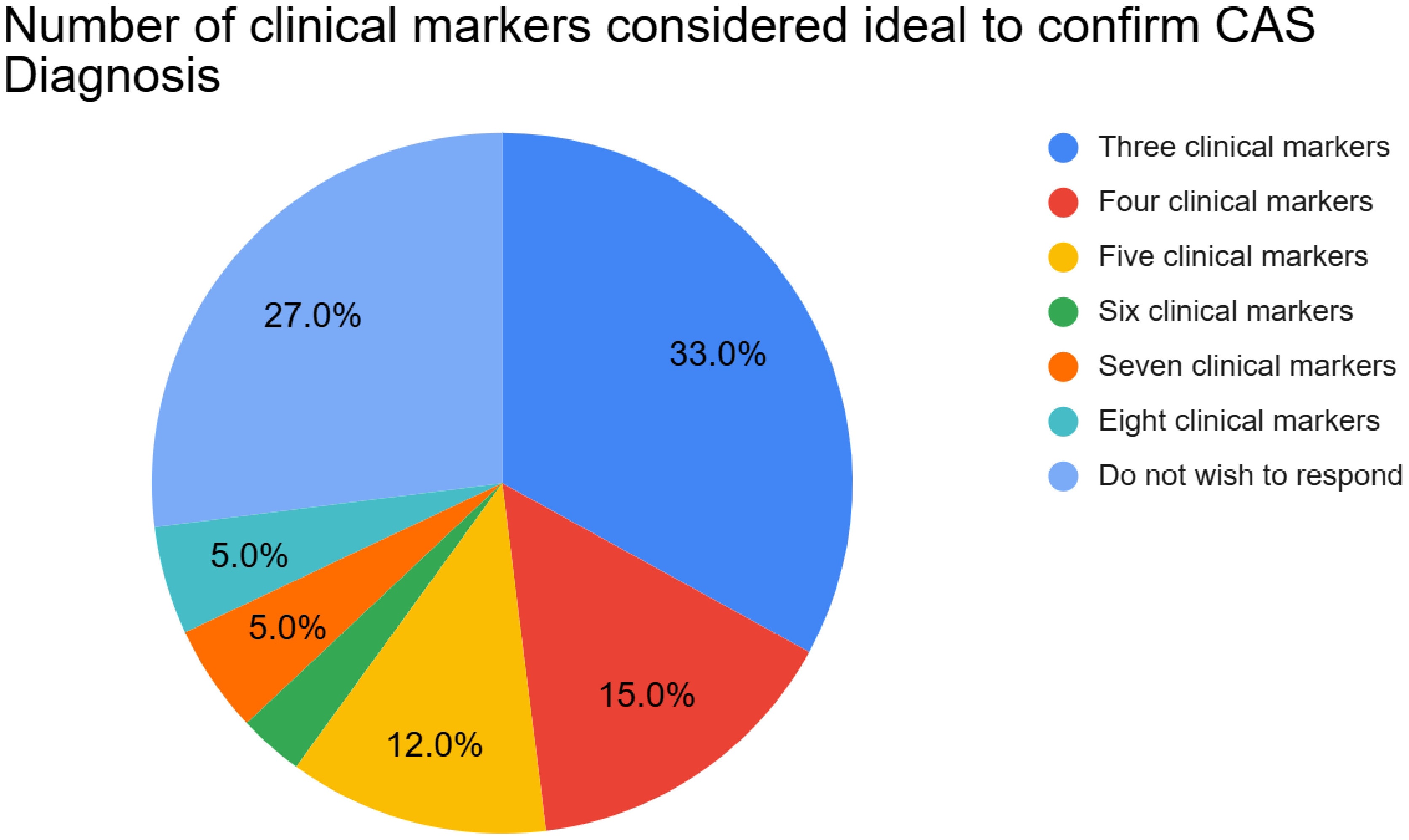
Figures 1, 2, and 3 present the clinical markers, the number of sessions the participants considered ideal to confirm the diagnosis of CAS, and whether they had undergone complementary examinations.


The Likert frequency scale quantitatively showed that 80% of the speech-language pathologists who responded to the questionnaire reported that they frequently treated or had treated children with MSD, and only 5% stated that they had never treated patients with this disorder. To perform the differential diagnosis of CAS in clinical practice, 92% of participants reported they frequently experience difficulties, and 80% stated that their training time and experience in the field of speech and language contributed to more precise assessments.
Analysis using Spearman's correlation test indicated no statistically significant correlation between professional training time and the approximate time required to complete the CAS diagnosis, neither between the number of training courses completed and the approximate time to complete the CAS diagnosis (p = 0.814 and p = 0.725, respectively).
A moderate correlation was found between training time and the number of professional development courses completed, according to Spearman's correlation test, indicating that longer training times were associated with a higher number of professional development courses (p = 0.511; p < 0.001).
DISCUSSION
The results showed that assessments to investigate a possible case of CAS may be a gap in the field of speech-language pathology due to its complex etiology and the lack of sufficiently sensitive markers to outline this disorder. Participants' responses varied significantly, suggesting differences in assessment and diagnostic procedures. The literature highlights that confirming the CAS diagnosis is complex and involves a series of specific steps to differentiate it from other speech-language disorders(25).
It was observed that a significant portion of the participants in this study required more than five sessions to complete the diagnosis of CAS, and nearly half preferred not to respond to this question, suggesting gaps in this aspect. This difficulty may be related to the overlap of characteristics with other disorders and the absence of precise biological markers(10).
The diagnosis of CAS requires at least three characteristics: inconsistency between words and syllables, lengthened and disrupted coarticulatory transitions, and inappropriate prosody(5,11). In the present study, the most prevalent initial signs that caught the professionals' attention were: inconsistent speech errors, coarticulatory breaks, prosodic alterations, undifferentiated babbling, and articulatory groping, which confirms findings in the literature(5,26).
The speech-language pathologists interviewed in this study frequently referred their patients with suspected CAS to other professionals and requested complementary tests, which favor more accurate diagnoses. Given the lack of available validated instruments translated into Brazilian Portuguese, participants reported using a variety of tests to fill this gap. For a more precise diagnosis, the combined application of assessments that integrate motor, articulatory, segmental, and suprasegmental aspects is recommended(27), which contributes to a more detailed understanding of the child's speech performance and guides more effective interventions(12).
Another important factor was the specialized courses taken. The professionals followed current treatment lines with scientific evidence, such as Prompts for Restructuring Oral Muscular Phonetic Target (PROMPT)(18), Dynamic Temporal and Tactile Cueing (DTTC)(28) and Rapid Syllable Transition Treatment (ReST)(29). These therapies, supported by motor learning principles, demonstrate effectiveness in articulatory accuracy and generalization of gains(30).
The correlation between professional training time, clinical experience and the number of CAS diagnoses showed that, although there is consensus that years of clinical experience and the level of specialization in a given area provide the professional with more confidence and greater assertiveness in therapeutic conduct, this does not translate into greater diagnostic accuracy, especially in disorders of a complex nature such as CAS(5).
The variables training time and number of professional development courses completed showed a significant correlation. This data reveals that speech-language pathologists sought specialization as they gained more years of experience, a natural path followed by most professionals.
A striking finding was the low frequency of referrals for audiological assessment. Hearing plays a crucial role in language acquisition, and hearing deficits can negatively impact this process. This highlights that such an assessment is essential for children with speech and language disorders, as it allows for the identification of potential hearing loss that may contribute to the clinical presentation(30).
It is noteworthy that the study showed low participation from professionals with more clinical experience, and a small contribution from speech-language pathologists from the North, Midwest, Southeast, and South regions of the country, although contact had been established. A broader and more diverse sample is essential to generate dialogue among professionals and promote discussions about issues in diagnosis.
The results highlighted advances and challenges in CAS assessment practices. The absence of standardized instruments and consistent diagnostic markers reinforces the need for future research to develop more precise assessment and diagnostic methods, as well as clearer clinical guidelines applicable to the Brazilian context.
CONCLUSION
The findings showed that, although professionals demonstrate knowledge of the main clinical markers and adopt evidence-based practices, there remains heterogeneity in the procedures utilized and uncertainty regarding diagnostic confirmation.
Appendix 1 Data collection instrument: Structured questionnaire developed by the authors for this research
This section will present questions related to sociodemographic and professional information
| 1. Are you registered with the Federal Council of Speech-Language Pathology? | ( ) Yes |
| ( ) No | |
| 2. Date of birth | / / |
| 3. Sex | ( ) Feminine ( ) Masculine ( ) I do not wish to answer . |
| 4. Year of graduation in speech therapy (If you do not wish to respond, leave the space blank) | |
| 5. How long have you been at the speech therapy clinic? | ( ) Less than five years ( ) Between five and ten years ( ) Between ten and twenty years ( ) More than twenty years ( ) I do not wish to respond. |
| 6. Level of education | ( ) Graduation ( ) Specialization - duration exceeding 360 hours ( ) Residence |
| ( ) Master's degree ( ) Doctorate ( ) Postdoctoral studies | |
| 7. What region do you work in? | ( ) North – Acre, Amazonas, Tocantins, Pará, Rondônia, Roraima |
| ( ) Northeast - Alagoas, Bahia, Ceará, Maranhão, Paraíba, Pernambuco, Piauí, Rio Grande do Norte, Sergipe | |
| ( ) Central-West - Goiás, Mato Grosso, Mato Grosso do Sul, Federal District | |
| ( ) Southeast - Espírito Santo, Rio de Janeiro, São Paulo, Minas Gerais | |
| ( ) South - Paraná, Santa Catarina, Rio Grande do Sul | |
| ( ) I do not wish to respond | |
| 8. Predominant employment relationship | ( ) Private sector |
| ( ) Public sector | |
| ( ) I do not wish to respond. | |
| 9. What type(s) of assistance do you provide? (Consider the highest weekly workload) | ( ) Outpatient care – Outpatient clinics or offices/clinics |
| ( ) Hospital care - Infirmary or Inpatient | |
| ( ) Assistance in intensive care - Intensive Care Unit | |
| ( ) Home care | |
| ( ) Assistance provided in a pedagogical environment - Schools or Universities | |
| ( ) I do not wish to respond. | |
| 10. Select your area(s) of expertise. | ( ) Dysphagia |
| ( ) Language | |
| ( ) Orofacial motor skills | |
| ( ) Fluency | |
| ( ) Public health | |
| ( ) Voice | |
| ( ) Audiology | |
| ( ) Occupational Speech Therapy | |
| ( ) Neurofunctional Speech Therapy | |
| ( ) Educational speech therapy | |
| ( ) Gerontology | |
| ( ) Speech | |
| ( ) I do not wish to respond | |
| Specific questions | |
| This section will address specific questions about speech-language pathology practice in the area of language/speech, especially regarding suspected cases of Childhood Apraxia of Speech. | |
| 1. Do you work with, or have you worked with children with motor speech disorders? | ( ) Very frequently |
| ( ) Often | |
| ( ) Occasionally | |
| ( ) Rarely | |
| ( ) Never | |
| ( ) I do not wish to respond. | |
| 2. In your clinical practice, are there difficulties in making a differential diagnosis of these disorders? | ( ) Very frequently |
| ( ) Often | |
| ( ) Occasionally | |
| ( ) Rarely | |
| ( ) Never | |
| ( ) I do not wish to respond. | |
| 3. What is the first sign that draws your attention to a possible diagnosis of childhood apraxia of speech? (If you do not wish to answer, leave the space blank) | |
| 4. Is it common for you to receive patients with suspected CAS for assessment? | ( ) Very frequently |
| ( ) Often | |
| ( ) Occasionally | |
| ( ) Rarely | |
| ( ) Never | |
| ( ) I do not wish to respond. | |
| 5. Which manifestations are most evident in patients with suspected CAS during assessments? (Leave the space blank if you do not wish to respond) | |
| 6. Do you perform additional tests when CAS is suspected? | ( ) Very frequently |
| ( ) Often | |
| ( ) Occasionally | |
| ( ) Rarely | |
| ( ) Never | |
| ( ) I do not wish to respond. | |
| 7. If the previous answer is yes, what additional tests are requested? (If you do not wish to respond, leave the space blank) | |
| 8. Do you refer these patients to other professionals? If so, usually which ones? (If you do not wish to respond, leave the space blank) | |
| 9. What professional development/course(s) focused on CAS have you already completed? | ( ) Prompt |
| ( ) SpeechEz | |
| ( ) Principles of motor learning | |
| ( ) Speech sound disorders | |
| ( ) DTTC | |
| ( ) ReST | |
| ( ) I do not wish to respond | |
| ( ) Other | |
| 10. Which instrument(s)/protocol(s) do you most commonly use in the assessment of children suspected of having apraxia of speech? (If you do not wish to respond, leave the space blank) | |
| 11. Approximately how long does it take you to conclude a CAS diagnosis? | ( ) Less than three sessions |
| ( ) Between three and five sessions | |
| ( ) More than five sessions | |
| ( ) I do not wish to respond. | |
| 12. How many clinical markers do you consider ideal to confirm a CAS diagnosis? | ( ) Three markers |
| ( ) Four markers | |
| ( ) Five markers | |
| ( ) Six markers | |
| ( ) Seven markers | |
| ( ) Eight or more markers | |
| ( ) I do not wish to respond. | |
| 13. What markers do you consider when diagnosing CAS, and based on what evidence do you consider them ideal for diagnosing CAS? (If you do not wish to respond, leave the space blank) | |
| 14. Considering the CAS cases you have assessed, were they usually accompanied by another disorder? | ( ) Very frequently |
| ( ) Often | |
| ( ) Occasionally | |
| ( ) Rarely | |
| ( ) Never | |
| ( ) I do not wish to respond. | |
| 15. If the previous answer is yes, list which disorders associated with CAS are most frequently observed in your clinical practice? (If you do not wish to respond, leave the space blank) | |
| 16. Does your training and experience in the field of language/speech contribute to your improved perception and accuracy in assessing suspected cases of CAS? | ( ) Very frequently |
| ( ) Often | |
| ( ) Occasionally | |
| ( ) Rarely | |
| ( ) Never | |
| ( ) I do not wish to respond. | |
-
Study carried out at Universidade Estadual de Ciências da Saúde de Alagoas – UNCISAL – Maceió (AL), Brasil.
-
Data Availability Statement:
Research data is available in the body of the article.
-
Funding:
None.
References
-
1 Shriberg LD, Kwiatkowski J, Mabie HL. Estimates of the prevalence of motor speech disorders in children with idiopathic speech delay. Clin Linguist Phon. 2019;33(8):679-706. https://doi.org/10.1080/02699206.2019.1595731 PMid:30987467.
» https://doi.org/10.1080/02699206.2019.1595731 -
2 Namasivayam AK, Pukonen M, Goshulak D, Granata F, Le DJ, Kroll R, et al. Investigating intervention dose frequency for children with speech sound disorders and motor speech involvement. Int J Lang Commun Disord. 2019;54(4):673-86. https://doi.org/10.1111/1460-6984.12472 PMid:30941860.
» https://doi.org/10.1111/1460-6984.12472 -
3 Shriberg LD, Mabie HL. Speech and motor speech assessment findings in eight complex neurodevelopmental disorders [Internet]. Madison: University of Wisconsin; 2017 [citado em 2025 Fev 1]. (Technical Report; no. 24). Disponível em: http://www.waisman.wisc.edu/phonology/
» http://www.waisman.wisc.edu/phonology/ -
4 Shriberg LD, Strand EA, Jakielski KJ, Mabie HL. Estimates of the prevalence of speech and motor speech disorders in persons with complex neurodevelopmental disorders. Clin Linguist Phon. 2019;33(8):707-36. https://doi.org/10.1080/02699206.2019.1595732 PMid:31221012.
» https://doi.org/10.1080/02699206.2019.1595732 -
5 ASHA: American-Speech-Language-Hearing Association. Childhood apraxia of speech [Internet]. Rockville: ASHA; 2007 [citado em 2025 Fev 1]. Disponível em: https://www.asha.org/policy
» https://www.asha.org/policy -
6 Shriberg LD, Strand EA, Fourakis M, Jakielski KJ, Hall SD, Karlsson HB, et al. A diagnostic marker to discriminate childhood apraxia of speech from speech delay: I. Development and description of the pause marker. J Speech Lang Hear Res. 2017 Apr 14;60(4):S1096-117. https://doi.org/10.1044/2016_JSLHR-S-15-0296 PMid:28384779.
» https://doi.org/10.1044/2016_JSLHR-S-15-0296 - 7 Fish MA, Skinder-Meredith A. Here’s how to treat childhood apraxia of speech. 3rd ed. San Diego: Plural Publishing; 2023.
-
8 Braz CH, Gonçalves LF, Oliveira AM, Haas P. Sinais de risco para apraxia de fala infantil: revisão sistemática / Risksigns for children’s speech apraxis: systematic review. Braz J Develop. 2020;6(9):71593-608. https://doi.org/10.34117/bjdv6n9-561
» https://doi.org/10.34117/bjdv6n9-561 -
9 Machado YV, Costa JRL, Facundo JL, Silva MG. Alterações de linguagem oral na apraxia de fala idiopática infanto-juvenil: uma revisão integrativa. Rev CPAQV. 2020;12(3):2. https://doi.org/10.36692/v12n3-22r
» https://doi.org/10.36692/v12n3-22r -
10 Keske-Soares M, Uberti LB, Gubiani MB, Gubiani MB, Ceron MI, Pagliarin KC. Desempenho de crianças com distúrbios dos sons da fala no instrumento “Avaliação dinâmica das habilidades motoras da fala”. CoDAS. 2018;30(2):e20170037. https://doi.org/10.1590/2317-1782/20182017037 PMid:29791618.
» https://doi.org/10.1590/2317-1782/20182017037 -
11 McCabe P, Thomas D, Murray E. CAS evidence brief 2020. In: McCabe P, Murray E, Thomas D, editors. Evidence summary - Childhood apraxia of speech [Internet]. Sydney: The University of Sydney Australia; 2022 [citado em 2025 Fev 1]. Disponível em: https://rest.sydney.edu.au/wp-content/uploads/2022/07/CAS_evidence_brief_2022.pdf
» https://rest.sydney.edu.au/wp-content/uploads/2022/07/CAS_evidence_brief_2022.pdf -
12 Oliveira AM, Nunes I, da Cruz GS, Gurgel LG. Métodos de avaliação da apraxia de fala na infância: revisão sistemática. Audiol Commun Res. 2021;26:e2524. https://doi.org/10.1590/2317-6431-2021-2524
» https://doi.org/10.1590/2317-6431-2021-2524 -
13 Iuzzini-Seigel J, Hogan TP, Green JR. Speech inconsistency in children with childhood apraxia of speech, language impairment, and speech delay: depends on the Stimuli. J Speech Lang Hear Res. 2017;60(5):1194-210. https://doi.org/10.1044/2016_JSLHR-S-15-0184 PMid:28395359.
» https://doi.org/10.1044/2016_JSLHR-S-15-0184 - 14 Andrade CRF, Befi-Lopes DM, Fernandes FDM, Wertzner HF. ABFW: teste de linguagem infantil nas áreas de fonologia, vocabulário, fluência e pragmática. Barueri: Pró-Fono; 2023.
- 15 Fish MA. Como tratar a apraxia de fala na infância. Barueri: Pró-Fono; 2019.
-
16 Namasivayam AK, Pukonen M, Goshulak D, Hard J, Rudzicz F, van Lieshout PH, et al. Motor speech treatment protocol for developmental motor speech disorders. Dev Neurorehabil. 2013;18(5):2015. https://doi.org/10.3109/17518423.2013.832431 PMid:24088085.
» https://doi.org/10.3109/17518423.2013.832431 - 17 Menezes MLN. Avaliação do Desenvolvimento da Linguagem - ADL-2. Ribeirão Preto: Booktoy - Livraria e Editora; 2021.
- 18 Hayden D. PROMPT: Prompts for restructuring oral muscular phonetictargets, introductiontotechnique: A manual. Santa Fe, NM: The PromptInstitute; 2008.
-
19 Hage SRV, Pereira TC, Zorzi JL. Protocolo de observação comportamental - PROC: valores de referência para uma análise quantitativa. Rev CEFAC. 2012 Aug;14(4):651-61. https://doi.org/10.1590/S1516-18462012005000068
» https://doi.org/10.1590/S1516-18462012005000068 -
20 Prathanee B, Thanaviratananich S, Pongjanyakul A. Oral diadochokinetic rates for normal Thaichildren. Int J Lang Commun Disord. 2003;38(4):417-28. https://doi.org/10.1080/1368282031000154042 PMid:14578054.
» https://doi.org/10.1080/1368282031000154042 - 21 Hage SRV. Dispraxia articulatória: correlações com o desenvolvimento da linguagem. In: Marchesan I, Zorzi J, organizadores. Anuário CEFAC de Fonoaudiologia 1999/2000. Rio de Janeiro: Revinter; 2000.
- 22 Martins FC, Ortiz KZ. Proposta de protocolo para avaliação da apraxia de fala. Fono Atual. 2004;7(30):53-61.
-
23 Felício CM, Folha GA, Ferreira CLP, Medeiros AM. Expanded protocol of orofacial myofunctional evaluation with scores: validity and reliability. Int J Pediatr Otorhinolaryngol. 2010;74(11):1230-9. https://doi.org/10.1016/j.ijporl.2010.07.021 PMid:20800294.
» https://doi.org/10.1016/j.ijporl.2010.07.021 -
24 Genaro KF, Berretin-Félix G, Rehder MIBC, Marchesan IQ. Avaliação miofuncional orofacial - protocolo MBGR. Rev CEFAC. 2009;11(2):237-55. https://doi.org/10.1590/S1516-18462009000200009
» https://doi.org/10.1590/S1516-18462009000200009 -
25 Morgan AT, Murray E, Liégeois FJ. Interventions for childhood apraxia of speech. Cochrane Database Syst Rev. 2018;5(5):CD006278. https://doi.org/10.1002/14651858.CD006278.pub3 PMid:29845607.
» https://doi.org/10.1002/14651858.CD006278.pub3 -
26 Santos T. Elaboração de um checklist para identificação de sinais de apraxia de fala na infância [dissertação]. Bauru: Universidade de São Paulo; 2019. https://doi.org/10.11606/D.25.2019.tde-27082019-175301
» https://doi.org/10.11606/D.25.2019.tde-27082019-175301 -
27 Murray E, Iuzzini-Seigel J, Maas E, Terband H, Ballard KJ. Differential diagnosis of childhood apraxia of speech compared to other speech sound disorders: A systematic review. Am J Speech Lang Pathol. 2021;30(1):279-300. https://doi.org/10.1044/2020_AJSLP-20-00063 PMid:33151751.
» https://doi.org/10.1044/2020_AJSLP-20-00063 -
28 Strand E. Dynamic temporal and tactile cueing: A treatment strategy for childhood apraxia of speech. Am J Speech Lang Pathol. 2020;29(1):30-48. https://doi.org/10.1044/2019_AJSLP-19-0005 PMid:31846588.
» https://doi.org/10.1044/2019_AJSLP-19-0005 - 29 McCabe P, Thomas D, Murray E, Crocco L, Madill C. Rapid syllable transition treatment (ReST). Sydney: The University of Sydney; 2017.
-
30 Giacheti CM, Ferrari C. Roteiro descritivo da avaliação fonoaudiológica da criança. In: Giacheti CM, organizadora. Avaliação da fala e da linguagem: perspectivas interdisciplinares. Marília: Oficina Universitária; São Paulo: Cultura Acadêmica; 2016. p. 245-61. https://doi.org/10.36311/2016.978-85-7983-782-1.p245-261
» https://doi.org/10.36311/2016.978-85-7983-782-1.p245-261
Edited by
-
Editor-in-Chief:
Maria Cecilia Martinelli Iorio.
-
Associate Editor:
Clara Regina Brandão de Ávila.
Research data is available in the body of the article.

 Subtitle: CAS = Childhood Apraxia of Speech; % = percentage. Source: Authors, 2024
 Subtitle: CAS = Childhood Apraxia of Speech; % = percentage. Source: Authors, 2024
 Subtitle: CAS = Childhood Apraxia of Speech; % = percentage. Source: Authors, 2024