 Morphometric and molecular studies on a diplectanid monogenean parasite infecting the twobar seabream (Acanthopagrus bifasciatus) in Saudi Arabia
ABSTRACT
Specimens of the genus Lamellodiscus Johnston and Tiegs, 1922 (Monogenea, Diplectanidae) were collected from the gills of the twobar seabream, Acanthopagrus bifasciatus (Sparidae), in the Arabian Gulf (Saudi Arabia). The overall prevalence and mean intensity were 12.5% (5 out of 40) and 14, respectively. All these parasite specimens belonged to the same species, which is morphologically very close to Lamellodiscus spari Zhukov, 1970 (Lamellodiscinae) belongs to the “elegans” group, characterized by rows of lamellodisc arranged as the 1st closed, 2nd - 9th paired elements, 10th of a single element, a “polymorphous” shaped male copulatory organ type, and the presence of the chitinous vaginal opening. A different host fish species, distant geographic locality, and small morphometric differences compared with the original description of L. spari acted as a stimulus for the taxonomic confirmation of this parasite species. Molecular identification of this Lamellodiscus species was conducted through sequencing of the nuclear large subunit of the ribosomal RNA (28S rRNA) gene. Lamellodiscus species reported in the present study formed a sister group with L. spari, and it was different from L. spari in 6 or 7 nucleotide bases. Findings obtained from the molecular analysis are concordant with data drawn from morphological identification, where the parasite recorded was morphologically similar to L. spari with a first record in Saudi marine fish. Further studies are recommended to include more genes for this monogenean parasite.
Keywords:
fish; Monogenea; Lamellodiscinae; morphology; 28s rrna
RESUMO
Espécimes do gênero Lamellodiscus Johnston e Tiegs, 1922 (Monogenea, Diplectanidae) foram coletados das guelras do pargo-de-duas-barras, Acanthopagrus bifasciatus (Sparidae), no Golfo Árabe (Arábia Saudita). A prevalência geral e a intensidade média foram de 12,5% (5 em 40) e 14, respectivamente. Todos esses espécimes de parasitas pertenciam à mesma espécie, que é morfologicamente muito próxima do Lamellodiscus spari Zhukov, 1970 (Lamellodiscinae) pertence ao grupo “elegans”, caracterizado por fileiras de lamellodiscos dispostos como o primeiro elemento fechado, o segundo ao nono emparelhados, o décimo como um único elemento, um órgão copulador masculino de forma “polimórfica” e a presença de uma abertura vaginal quitinosa. Uma espécie de peixe hospedeiro diferente, localização geográfica distante e pequenas diferenças morfométricas em comparação com a descrição original de L. spari serviram de estímulo para a confirmação taxonômica desta espécie de parasita. A identificação molecular desta espécie de Lamellodiscus foi realizada através do sequenciamento da subunidade nuclear grande do gene do RNA ribossômico (28S rRNA). As espécies Lamellodiscus relatadas no presente estudo formaram um grupo irmão com L. spari e eram diferentes de L. spari em 6 ou 7 bases nucleotídicas. As descobertas obtidas a partir da análise molecular são concordantes com os dados extraídos da identificação morfológica, em que o parasita registrado era morfologicamente semelhante a L. spari, com um primeiro registro em peixes marinhos da Arábia Saudita. Recomenda-se a realização de estudos adicionais para incluir mais genes para este parasita monogeneano.
Palavras-chave:
peixes; Monogenea; Lamellodiscinae; morfologia; 28S rRNA
INTRODUCTION
Monogeneans are the most numerous parasitic groups infecting fish, amphibians, and reptiles (Mladineo, 2004). They tend to select many specific microhabitats (i.e., skin, fins, gills, mouth cavity, and nostrils) on their hosts (Euzet and Combes, 1998). According to the morphology and accessory adhesive organs of the opisthohaptor, monogeneans are classified into two major groups, Group I monopisthocotylea and Group II polyopisthocotylea (Öztürk and Özer, 2014). The former group contains five accepted orders: Capsalidea, Dactylogyridea, Gyrodactylidea, Monocotylidea, and Montchadskyellidea. WoRMS (2023) recognized thirteen families based on morphological characters of haptor within Dactylogyridea (i.e., two pairs of main hooks joined by medial bars, 14 peripheral marginal hooks, and one or two groups of sclerotized rodlets or lamellae called ‘squamodiscs’ or ‘lamellodiscs’).
Diplectanidae Monticelli, 1903 is a family of monopisthocotylean monogeneans that parasitize the gills of marine or freshwater fish. Diplectanids often show strict host-specificity (Oliver, 1992). As parasites, they can be extremely numerous, up to several thousand on an individual fish. Diplectanids from the genus LamellodiscusJohnston and Tiegs, 1922 have one or two lamellodiscs that are formed by several overlapping sclerotized plates (lamellae). This genus includes 61 accepted species, 2 nomen nudum, 6 synonyms, 1 pre-occupied, 2 superseded combinations, and 1 misspelling species (WoRMS, 2023). Lamellodiscus from sparid fish has been used as a model for the study of co-evolution and speciation (Desdevises et al., 2002; Kaci-Chaouch et al., 2008). Members of Lamellodiscus are generally classified into three morphological groups, the ’ignoratus’, the ‘elegans’, and the ‘tubulicornis’, according to the structure of the lamellodisc (Justine and Briand, 2010). Similarly, Diamanka et al. (2011a) distinguished among Lamellodiscus four different types based on the morphology of the male copulatory organ (MCO), the ‘lyre’, the ‘forked’, the ‘polymorphous’, and ‘elongatus’.
Many attempts have been made to resolve phylogenetic relationships among Lamellodiscus species based on species-specific variability in the nuclear small subunit ribosomal RNA (ss rRNA) (Desdevises et al., 2000, 2002; Desdevises, 2001; Poisot et al., 2011), large subunit ribosomal RNA (lsrRNA) (Tingbao et al., 2006; Nitta, 2021), internal transcribed spacer (ITS) region (Desdevises et al., 2000; Kaci-Chaouch et al., 2008; Poisot et al., 2011), and mitochondrial cytochrome c oxidase subunit I (COI) gene (Poisot et al., 2011) which shown to be useful for precise monogeneans identification.
Previous studies were carried out on the monogeneans of fish in the Arabian Gulf (Al-Mathal, 2002; Kardousha, 2016; Kardousha et al., 2002; Mohamad and Razak, 2011; Bayoumy et al., 2012, 2015; Bayoumy and Baghdadi, 2013; Jawad, 2013; Bannai and Muhammad, 2015; Bayoumy et al., 2015; Hassan et al., 2015; Khosheghbal et al., 2017; Jassim and Al-Salim, 2020; Morsy et al., 2021; Baghdadi et al., 2022). Therefore, this study aims to study the natural occurrence of monogeneans infecting Acanthopagrus bifasciatus fish that inhabit the Arabian Gulf (Saudi Arabia), and the taxonomic status of these parasites was determined through morphometric features and confirmed molecularly.
MATERIALS AND METHODS
During the period of this study, forty specimens of Acanthopagrus bifasciatus (Sparidae) were collected from the fish market in Dammam province (along the coast of the Arabian Gulf), Saudi Arabia. Fish were identified using the external morphological standards set out by Abu Shusha et al. (2010). The gills of the host specimens were separated, submerged in 0.9% saline solution, and examined for monogeneans under a stereomicroscope (Mendoza-Franco et al., 2018). Definitions of prevalence and mean intensity were calculated according to Bush et al. (1997). Monogeneans were removed from the gills using a delicate dissection needle and then fixed in 4% formalin for species identification by the morphology of the body parts or in 96% ethanol for molecular genetic study. To remove excess fixatives, the fixed specimens were rinsed in distilled water. Some monogeneans were stained with Mayer-Schuberg’s Aceto carmine, dehydrated in a series of ethanol (70, 80, 90, and 100% for 2 min/each), and then mounted in Canada balsam. For the study of the sclerotized structures, some unstained specimens were flattened with coverslips on slides with a mixture of ammonium picrate glycerin, and then mounted in Canada balsam (Ergens, 1969). The parasites were examined using a light microscope (Leica DM 2500, Leica Microsystems). Using the ImageJ 1.53e software, measurements were taken in micrometers (μm) as a mean, followed by the range in parentheses.
Monogenea samples were digested overnight in the DNA buffer (100µg/ml proteinase K) at 55ºC. DNA was extracted using QIAamp® DNA Mini Kit (Qiagen, Germany), according to the manufacturer’s protocol. The partial 28S rRNA gene region was amplified by polymerase chain reaction (PCR) using U178 (Forward: 5′-GCA CCC GCT GAA YTT AAG -3′) and L1642 (Reverse: 5′-CCA GCG CCA TCC ATT TTC A-3′) primers designed by Lockyer et al. (2003). The PCR profile was set as follows: at 94°C was performed for 5min, followed by 35 cycles of denaturation at 94°C for 30sec, annealing at 56°C for 30sec, extension at 72°C for 1min, and final elongation at 72°C for 10min. Amplicons were electrophoresed in a 1.5% agarose gel in 1×TAE buffer (Tris 40 mM, Acetic Acid 20mM, EDTA 1mM), stained with SYBRsafe® (Thermo Fischer Scientific, Massachusetts, USA) alongside 100bp DNA Ladder, and then visualized under UV light. Representative monogenean samples were subjected to Sanger sequencing at the facility unit of Macrogen (Seoul, South Korea), using the same primer sets as for PCR. A BLAST search was conducted to verify the similarity of the obtained sequences with those of monogeneans available in the NCBI BioSystems database. Ambiguous sequence alignment was edited manually using BioEdit 4.8.9 software (Hall, 1999). Phylogenetic analysis was inferred with the help of appropriate models in MEGA X (Kumar et al., 2018), employing Maximum Likelihood and Neighbor-Joining methods using 1000 replicates.
RESULTS
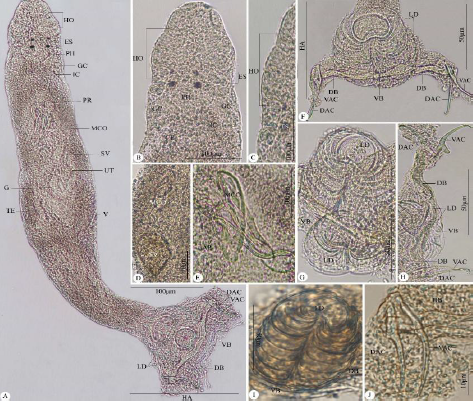
Five (12.5%) out of 40 twobar seabream fish, Acanthopagrus bifasciatus, were found to have a monogenean parasite infecting the gill region with an infection intensity that did not exceed 20. This parasite was identified based on the morphological features of Lamellodiscus spariZhukov, 1970.
(Figure 1 and Table 1). The body was elongated and measured 451 (412-504)×110 (98-129). The anterior region has three pairs of head organs, two pairs of eye spots, and two groups of glandular cells lateral to the pharynx. The mouth was situated between two pairs of eyespots. The pharynx was oval and measured 39 (35-46)×37 (35-47). The oesophagus was short and followed by an intestinal bifurcation, simple caeca. Vitellaria coextensive with caeca and filling the intercaecal region posterior to the testis.

Photomicrographs of Lamellodiscus spari infecting Acanthopagrus bifasciatus. (A) Whole-mount preparation. (B-J) High magnifications for different body parts, as follows: (B-E) Anterior portion of the prohaptor. (F-H) Haptor and related structures. (I) Lamellodisc. (J) Ventral and dorsal anchors. Note: Ho, head organs; ES, eye spots; PH, pharynx; IC, intestinal ceca; GC, glandular cells; MCO, male copulatory organ; SV, seminal vesicle; UT, uterus; G, germarium; TE, testis; DA, dorsal anchor; VA, ventral anchor; VB, ventral bar; DB, dorsal bar; LD, lamellodiscs; HA, haptor; AP, accessory piece.
A single post-ovarian testis was observed intercaecally and measured 95 (84-115) × 76 (69-86). The vas deferens arises from the antero-sinistral portion of the testis, enlarges into a broad seminal vesicle, and then simply dilates to form a saccate prostatic reservoir that is located anterior to the copulatory complex. The male copulatory organ is of a polymorphous type, with two articulated sclerites and a simple one of 25 (21-33) in length. Germarium was pyriform, intercaecal, pre-testicular, and measured 88 (79-113) × 25 (20-29). The oviduct extends anteriorly from the receptaculum seminis. The vagina consists of a chitinous opening on the right lateral margin of the body and a very lightly chitinous duct that leads into the posterior part of the receptaculum seminis. The uterus extends anteriorly to the gonopore located ventrally to the copulatory sclerites.
Haptor measured 164 (156-178) in width and was associated with a truncated posterior margin. Dorsal and ventral lamellodiscs large of the “elegans” group measured 81 (79-89)×73 (69-98), each covering the entire median section of the haptor and extending slightly onto the body proper. Ten concentric lamellae make up lamellodiscs, with the anterior one forming a complete ring 201 (196-208) in width, and others crescentic. Seven pairs of hooks are present in the lateral margins of the haptor, and each measured 9 (8-11) long.
Two pairs of anchors situated posterolaterally of the haptor, connected by three crossbars. The ventral pair of anchors measured 44 (40-47) long, with internal and external processes of 13 (10-14) and 5 (4-7) long, respectively. Dorsal anchors measured 39 (34-42) long. The ventral bar was plate-like with an anterior median groove and tapered ends and measured 70 (68-81) long. Paired dorsal bars were slightly curved, with the inner end distinctly wider than the outer, and prominent anterior process slightly curved towards the lateral extremity of the bar, and measured 30 (27-31).
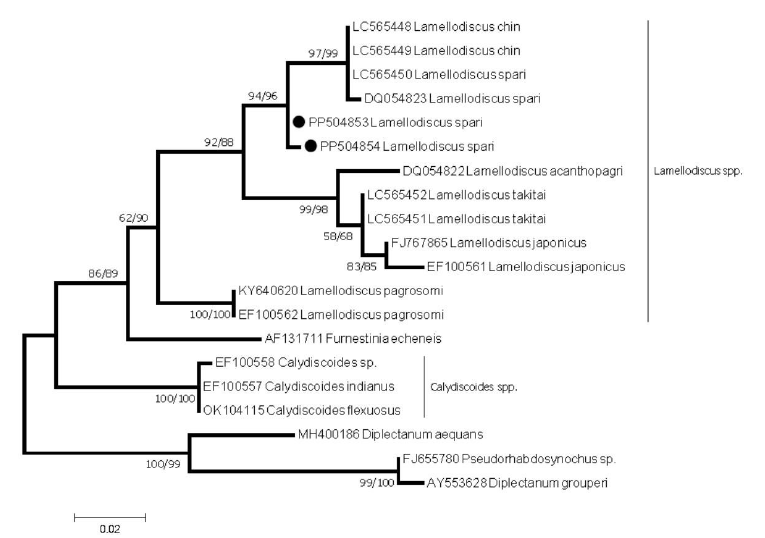
(Figures 2 and Table 2). Partial 28S rRNA region amplification from L. spari revealed a PCR product of ~350 bp. Two sequences were generated from the organism under study, which showed morphological and morphometric data related to L. spari described from Japan (Ogawa and Egusa, 1978; Nitta, 2021). The two sequences were homologous with two mutations at positions 193 and 212 on the alignment. The two sequences were deposited in GenBank and were given the accession numbers PP504853 and PP505854. There were 11 sequences related to members of the genus Lamelodiscus, two of which are from L. spari (DQ054823 and LC565450). The sequences from the present study showed differences in 6-7 bases. They also showed the same difference in 2 sequences from L. chin (LC565448 and LC565449). Phylogenetic analysis using both Maximum Likelihood (ML) and Neighbor Joining (NJ) revealed the same topology, placing the sequences obtained in the present study in a sister group for the clade that grouped L. spari and L. chin with significant bootstrap values of 94 and 96, respectively (Figure 2). Sequences from L. spari detected in the present study were different in 23 bases from L. pagrosomi (KY640620 and EF100562). Sequences from L. spari (DQ054823 and LC565450) and L. chin (LC565448 and LC565449) showed 99.7% similarity (Table 2).
A consensus phylogenetic tree generated with maximum likelihood (ML) and Neighbor Joining (NJ) methods, showing phylogenetic relationships between Labellodiscus spari (2 sequences) and 18 related taxa in the family Diplectanidae at NCBI GenBank. The ML and NJ trees are inferred from the partial 28S rDNA sequence data (338 bp) generated from the L. spari detected from the gills of Acanthopagrus bifasciatus (PP504853 and PP505854 shown with solid circles) and 18 related taxa from GenBank. Numbers indicated at branch nodes are bootstrap values (ML/NJ).
The number of base differences per sequence between sequences is shown. This analysis involved 20 nucleotide sequences, including sequences from the present study (given in bold). All ambiguous positions were removed for each sequence pair (pairwise deletion option)
DISCUSSION
Although many studies are available about the parasitofauna of marine fish, little is known about Lamellodiscinae (Alghamdi et al., 2023). In the present study, the gills of five twobar seabreams (12.5%) with a mean intensity of 14 were found to be infected with the monopisthocotylean parasite within the Lamellodiscus genus. Based on previous studies on the specificity of Lamellodiscus species to the host type, these species parasitized mainly sparids and lethrinids, with few cases reported from centracanthids, pomacanthids, and pomacentrids (Amine and Euzet, 2005; Machkewskyi et al., 2014; Kritsky and Bakenhaster, 2019; Nitta, 2021). The present prevalence is similar to the previous data of L. dentexi reported by Diamanka et al. (2011b) in Dentex macrophthalmus (Northwest coast of Africa) (prevalence = 12%). Also, this prevalence is lower than the previous data of L. elegans reported by Mladineo (2004) in sharp-snout bream (Diplodus puntazzo) (Adriatic Sea) (prevalence = 64.95%); L. crampus reported by Neifar (2008) in D. maroccanus (Tunisia) (prevalence = 65%); Justine and Briand (2010) reported that Gymnocranius grandoculis (New Caledonis) infected with 100% of L. magnicornis and L. parvicornis; Diamanka et al. (2011a,b) reported that D. macrophthalmus (Senegal) infected with 94% of L. toguebayei, 27% of L. vicinus, 56% of L. triacies, and D. gibbosus (Senegal) infected with 70% of L. euzeti; L. elegans and L. fraternus reported by Özer et al. (2015) in Diplodus annularis (Turkish Black Sea coast) (prevalence = 83.3%); L. iraqensis reported by Jassim and Al-Salim (2020) in Acanthopagrus arabicus (Iraq) (prevalence = 25%); L. indicus reported by Al-Darwesh et al. (2022) in Rhabdosargus haffara (Iraq) (prevalence = 97%) and R. sarba (Iraq) (prevalence = 95%).
Members of the Lamellodiscus genus are distinguished from other diplectanids by the morphology of the vagina opening, the sclerites of the copulatory complex, and the type and shape of haptorial lamellodiscs, as mentioned in Machkewskyi et al. (2014). The present specimen has all the morphological features of L. spari, which was isolated previously from Sparus macrocephalus czerskii (Japan) by Zhukov (1970) and Acanthopagrus schlegeli (Japan) by Ogawa and Egusa (1978). Although the shapes of the chitinous parts are much the same between the present specimen and those of Zhukov (1970) and Ogawa and Egusa (1978), the former is considerably smaller in their measurements. Taking this into consideration, the difference in the body size and its associated parts is not a reliable feature to be used for discriminating this Lamellodiscus species, especially in the presence of various fish species (type host) in different habitats, and this agreed with Ogawa and Egusa (1978) reported that Lamellodiscus measurements lie within the limits of specific variations.
Moreover, there is a high similarity with Lamellodiscus vaginalis isolated from Australian fish of Acanthopagrus australis and Acanthopagrus butcheri by Byrnes (1968) due to the presence of large lamellodiscs in both samples, which are considered the most important morphological features for identification. As well as it is sufficient to note that the vagina opens on the right side of the body, which seems to be an exceptional case in the Lamellodiscus genus as well as in L. corallinus and L. minousi. According to the morphology of the haptoral structures within the “elegans” group, the present specimen is similar to some Lamellodiscus species (i.e. L. dentexi, L. coronatus, L. drummondi, L. furcosus, L. gracilis, L. mirandus, L. obeliae, L. parisi, L. virgula, L. echeneis, L. mormyrid, L. verberis, L. elegans, L. flagellates, L. impervious, L. bidens, L. hilii, L. acanthopagri, L. caballeroi, L. indicus, L. butcheri, L. cirrusspiralis, L. major, L. squamosus, L. vaginalis, L. typicus, L. niedashui, L. japonicus, and L. takitai) in which rows of lamellodisc arranged as the row 1 closed, rows 2-9 paired elements, row 10 of a single element, this agreed with Justine and Briand (2010) and Machkewskyi et al. (2014). The current specimen is similar to other Lamellodiscus species in the polymorphous type of male copulatory organ (i.e., L. dentexi, L. drummondi, L. impervious, L. hilii, L. caballeroi, L. indicus, L. butcheri, L. cirrusspiralis, L. major, L. squamosus, L. vaginalis, L. typicus, L. takitai, and L. epsilon), which agrees with Machkewskyi et al. (2014).
Moreover, L. spari could be differentiated from other Lamellodiscus species, as follows: (I) The sclerites in the male copulatory organ (two articulated sclerites and a simple one in L. spari vs. hooked in L. squamosus, long spiral sclerite in L. cirrusspiralis and L. drummondi), which agreed with the finding of Byrnes (1968). (II) The morphology of the male copulatory organ (polymorphous type in L. spari vs. “lyre” type within L. toguebayei, L. triacies, L. vicinus, L. knoffleri, L. rastellus, L. sarculus, L. sigilatus, L. ergensi, L. erythrini, L. ignoratus, L. euzeti, L. aff. euzeti, L. baeri, L. confusus, L. crampus, L. falcus, L. kechemirae, L. neifari, L. sanfilippoi, L. theroni, L. tomentosus, L. fraternus, L. donatellae, L. furcillatus, and L. pagrosomi, “furca” type within L. coronatus, L. furcosus, L. gracilis, L. mirandus, L. obeliae, L. parisi, L. virgula, L. echeneis, L. mormyrid, L. verberis, L. elegans, L. flagellates, L. bidens, L. acanthopagri, L. japonicus; and without accessory piece in L. corallinus), which consistent with Machkewskyi et al. (2014). (III) The shape of the vaginal opening (chitinous opening in L. spari vs. flower-like in L. vaginalis, cup-like in L. bucheri, funnel-shaped in L. japonicus), which agrees finding of Byrnes (1968). (IV) The size of haptorial lamellodiscs (larger size in L. spari vs. smaller one in other Lamellodiscus species, which is consistent with data of Ogawa and Egusa (1978) and Machkewskyi et al. (2014). (V) The morphology of haptoral structures (“elegans” groups in L. spari vs. ignoratus group within L. toguebayei, L. triacies, L. vicinus, L. knoeffleri, L. rastellus, L. sarculus, L. sigilatus, L. ergensi, L. erythrini, L. ignoratus, L. euzeti, L. aff. euzeti, L. baeri, L. confusus, L. crampus, L. falcus, L. Kechemirae, L. neifari, L. sanfilippoi, L. theroni, L. tomentosus, L. fraternus, L. corallinus, L. donatellae, L. furcillatus, and L. pagrosomi) in which rows of lamellodisc arranged as the row 1 closed, rows 2-10 single elements, this agreed with Justine and Briand (2010), as well as “tubulicornis” group within L. parvicornis, L. magnicornis, and L. tubulicornis) in which rows of lamellodisc arranged as the row 1 closed, row 2 almost closed, rows 3-9 paired elements, row 10 a single element, which agreed with data of Justine and Briand (2010) and Machkewskyi et al. (2014).
For the classification of the Lamellodiscus species, molecular studies should support the degree of morphological variation between the current parasite and other taxa within Lamellodiscinae. The phylogenetic position of Lamellodiscus species identified from Saudi Arabia was validated in this study using the partial genetic sequences of the 28S rRNA gene. Sequences obtained from the partial 28S rRNA region from L. spari collected in the present study from Acanthogarus bifaciatus showed a strong relationship with sequences obtained from L. spari and L. chin from Japan (Nitta, 2021). The phylogenetic position of the samples investigated in the present study fits well with the morphological description of L. spari. Intraspecific variation between L. spari sequences was noticed previously, as two sequences described by Nitta (2021) were different from each other in a single base. In the present study, it was found that the two sequences obtained were different from each other in two sites. Furthermore, variation at the interspecific level was noticed between L. spari and L. chin, where in four sequences, two from the first and two from the latter have shown 99.7% to 100% similarity. This suggests that they are highly related despite significant morphological differences. Therefore, it is suggested to study different genes, including the 28S rRNA gene, when studying the phylogenetic relationships of Lamellodiscus spp. Although Furnestinia echeneis was grouped with Lamellodiscus spp. in the phylogenetic tree generated from the partial 28S rDNA data, morphological data suggested that it is a unique genus. According to the World Register of Marine Species (https://www.marinespecies.org/ aphia.php?p=taxdetails&id=119523), the identity of F. echeneis is considered unaccepted and suspended. In a study by Desdevises (2001), it was suggested that the hypertrophy of its unique lamellodisc is probably a morphological adaptation for attachment to the host. Therefore, the feature of having one lamellodisc rather than 2, as in the case of members of Lamellodiscus spp., is an adaptation to attach to its host. The difference in nucleotides between F. echeneis and the sequences from L. spari reported in the present study was similar to that between L. pargrosomi and L. spari. Additional molecular studies may resolve the situation of the monospecific genus Furnestinia.
CONCLUSION
A parasitological investigation of Lamellodiscinae parasites of Acanthopagrus bifasciatus (Sparidae) in Saudi marine waters, herein, was carried out for the first time. Moreover, the exploration of the 28S rRNA genetic sequences of the recovered Lamellodiscus species revealed that it belongs to L. spari. There was intraspecific variation with the 28S rRNA studied. Additional molecular studies investigating more genes are required to clarify the classification of this group of parasites.
ACKNOWLEDGMENTS
This study was supported by Ongoing Research Funding Program (ORF-2025-94), King Saud University, Riyadh, Saudi Arabia. .
REFERENCES
- ABU SHUSHA, T.L.; KALANTAN, M.Z.; AL-NAZRY, H.H.; AL-GHAMDI, Y.A. Fishes from territorial Saudi Red Sea waters. Saudi Arabia: Marine Research Centre-Jeddah, Deputy Ministry of fisheries affairs, Ministry of Agriculture, Saudi Arabia, 2010.
- AL-DARWESH, A.A.R.; ALI, A.H.; SAUD, H.A. First record of two diplectanid monogenoids from three sparid fishes in iraqi marine waters. Bull. Iraq. Nat. Hist. Mus., v.17, p.203-218, 2022.
- ALGHAMDI, M.; AL-QURAISHY, S.; AL-SHAEBI, E.M.; ABDEL-GABER, R. Morphological and molecular analyses Protolamellodiscus senilobatus (Monogenea: Diplectanidae), a gill parasite infecting the solider bream Argyrops filamentosus (Sparidae). J. K. Saud Uni. Sci., v.35, p.102417, 2023.
- AL-MATHAL, E.M. Identification of some monogenetic treamatodes from some Arabian Gulf fish in Saudi Arabia. J. Egypt. Soc. Parasitol., v.32, p.959-967, 2002.
- AMINE, F.; EUZET, L. Deux espèces nouvelles du genre Lamellodiscus Johnston & Tiegs, 1922 (Monogenea: Diplectanidae) parasites de Sparidae (Teleostei) des côtes de l’Algérie. Syst. Parasitol., v.60, p.187-196, 2005.
- BAGHDADI, H.B.; AL-SALEM, A.A.; IBRAHIM, M.M. et al. Morphomolecular identification and considerations of the infestation site adaptations of Pricea multae (Thoracocotylidae: Priceinae) from Scomberomorus commerson, off Arabian Gulf, Saudi Arabia. Rev. Bras. Parasitol. Vet., v.31, p.e007122, 2022.
- BANNAI, M.A.A.; MUHAMMAD, E.T. Sprostoniella teria sp. nov. (Monogenea: Capsalidae Baird, 1853: Trochopodinae) parasite of Platax teira, from Iraqi Marine Water, Arab Gulf. Int. J. Mar. Sci., v.6, p.127, 2015.
- BAYOUMY, E.M.; ABOU-EL-DOBAL, S.K.A.; HASSANAIN, M.A. Assessment of heavy metal pollution and fish parasites as biological indicators at Arabian Gulf off Dammam Coast, Saudi Arabia. Int. J. Zoo Res., v.11, p.198-206, 2015.
- BAYOUMY, E.M.; ABU-TAWEEL, G.M.; ALZAHABY, M.A. Metazoan parasites of some Arabian Gulf fish, off Dammam, Saudi Arabia: 1- External and internal parasite-host associations. Global Vet., v.9, p.600-605, 2012.
- BAYOUMY, E.M.; BAGHDADI, H.B. Pseudorhabdosynochus dammami sp. nov. (Monogenea: Diplectanidae) from greasy grouper, Epinephelus tauvina from the Arabian Gulf, off Dammam, Saudi Arabia. Global Vet., v.10, p.630-635, 2013.
- BUSH, A.O.; LAFFERTY, K.D.; LOTZ, J.M.; SHOSTAK, A.W. Parasitology meets ecology on its own terms: Margolis et al. revisited. J. Parasitol., v.83, p.575-583, 1997.
- BYRNES, T. Six species of Lamellodiscus (Monogenea: Diplectanidae) collected from Australian Bream (Acanthopagrus spp.). Pub. Seto Mar. Biol. Lab., v.31, p.169-190, 1968.
- DESDEVISES, Y. The phylogenetic position of Furnestinia echeneis (Monogenea, Diplectanidae) based on molecular data: a case of morphological adaptation?. Int. J. Parasitol., v.31, p.205-208, 2001.
- DESDEVISES, Y.; JOVELIN, R.; JOUSSON, O.; MORAND, S. Comparison of ribosomal DNA sequences of Lamellodiscus spp. (Monogenea, Diplectanidae) parasitizing Pagellus (Sparidae, Teleostei) in the North Mediterranean Sea: species divergence and coevolutionary interactions. Int. J. Parasitol., v.30, p.741-746, 2000.
- DESDEVISES, Y.; MORAND, S.; JOUSSON, O.; LEGENDRE, P. Coevolution between Lamellodiscus (Monogenea: Diplectanidae) and Sparidae (Teleostei): the study of a complex host-parasite system. Evolution, v.56, p.2459-2471, 2002.
- DIAMANKA, A.; BOUDAYA, L.; TOGUEBAYE, B.S.; PARISELLE, A. Lamellodiscus euzeti n. sp. (Monogenea: Diplectanidae), a parasite from Dentex canariensis and D. gibbosus (Teleostei: Sparidae) in the Atlantic Ocean and Mediterranean Sea. Parasite, v.18, p.145-150, 2011a.
- DIAMANKA, A.; NEIFAR, L.; PARISELLE, A.; EUZET, L. Lamellodiscus (Monogenea: Diplectanidae) parasites of Dentex macrophthalmus (Teleostei: Sparidae) from the North Atlantic coast of Africa, with a redescription of L. dentexi Aljoshkina, 1984, and description of three new species. Folia Parasitol., v.58, p.17-26, 2011b.
- ERGENS, R. The suitability of ammonium picrate-glycerin in preparing slides of lower Monogenoidea. Folia Parasitol., v.16, p.320, 1969.
- EUZET, L.; COMBES, C. The selection of habitats among the monogenea. Int. J. Parasitol., v.28, p.1645-1652, 1998.
- HALL, T.A. BioEdit: a user-friendly biological sequence alignment editor and analysis program for Windows 95/98/NT. Nucleic Acids Symp. Ser., v.41, p.95-98, 1999.
- HASSAN, M.A.; OSMAN, H.A.M.; ASWATHAN, M. et al.; AL-SHWARED, W.A.; FITA, N.A. Infestation of Cage-Cultured Marine Fish with Benedenia acanthopagri (Monogenea; Capsalidae) in Eastern Province of Saudi Arabia. Global Vet., v.14, p.219-227, 2015.
- JASSIM, A.R.; AL-SALIM, N.K. Lamellodiscus iraqensis sp. nov. (Monogenea: Diplectanidae) from gills of Acanthopagrus arabicus (Teleostei: Sparidae) from Iraqi marine waters. Biol. Appl. Environ. Res., v.4, p.1-6, 2020.
- JAWAD, L.A. Confirmed record of Monodactylus argenteus (Linnaeus, 1758) (Family Monodactylidae) from Jubail, Saudi Arabia, Arabian Gulf. Arxius de Miscellània Zool., v.11, p.158-162, 2013.
- JOHNSTON, T.H.; TIEGS, O.W. New gyrodactylid trematodes from Australian fishes together with a reclassification of the superfamily Gyrodactyloidea. Proc. Linn. Soc. N. South Wales, v.67, p.83-131, 1922.
- JUSTINE, J.L.; BRIAND, M.J. Three new species, Lamellodiscus tubulicornis n. sp., L. magnicornis n. sp. and L. parvicornis n. sp. (Monogenea: Diplectanidae) from Gymnocranius spp. (Lethrinidae: Monotaxinae) off New Caledonia, with the proposal of the new morphological group ‘tubulicornis’ within Lamellodiscus Johnston & Tiegs, 1922. Syst. Parasitol., v.75 p.159-179, 2010.
- KACI-CHAOUCH, T.; VERNEAU, O.; DESDEVISES, Y. Host specificity is linked to intraspecific variability in the genus Lamellodiscus (Monogenea). Parasitology, v.135, p.607-616, 2008.
- KARDOUSHA, M.M. Fish parasites of Qatari waters of the Arabian Gulf: current status with an annotated checklist. Int. J. Rec. Sci. Res., v.7, p.12388-12393, 2016.
- KARDOUSHA, M.M.; ALANSI, M.; AL-KHAYAT, J. Monogenea of Arabian Gulf fishes. 3. Encotyllabe spari and E. kuwaitensis (Capsalidae) from Qatari waters. Riv. Parassitol., v.3, p.227-235, 2002.
- KHOSHEGHBAL, M.; PAZOOKI, J.; SHOKRI, M.R. Metazoan parasites of Otolithes ruber (Perciforme: Sciaenidae) of the Persian Gulf off Hendijan Region, Iran. Indian J. Geo-Mar. Sci., v.46, p.1175-1182, 2017.
- KRITSKY, D.C.; BAKENHASTER, M.D. Lamellodiscus spp. (Monogenoidea: Diplectanidae) Infecting the Gill Lamellae of Porgies (Perciformes: Sparidae) in the Gulf of Mexico off Florida, U.S.A., with Descriptions of Lamellodiscus occiduus n. sp. and Lamellodiscus vesperus n. sp. from Calamus spp. Comp. Parasitol., v.86, p.79, 2019.
- KUMAR, S.; STECHER, G.; LI, M.; KNYAZ, C.; TAMURA, K. MEGA X: molecular evolutionary genetics analysis across computing platforms. Mol. Biol. Evol., v.35, p.1547-1549, 2018.
- LOCKYER, A.E.; OLSON, P.D.; LITTLEWOOD, D.T.J. Utility of complete large and small subunit rRNA genes resolving the phylogeny of the Neodermata (Platyhelminthes): implications and a review of the cercomer theory. Biol. J. Linn. Soc., v.78, p.155-171, 2003.
- MACHKEWSKYI, V.K.; DMITRIEVA, E.V.; GIBSON, D.I.; AL-JUFAILI, S. Lamellodiscus aff. Euzeti Diamanka, Boudaya, Toguebaye & Pariselle, 2011 (Monogenea: Diplectanidae) from the gills of Cheimerius nufar (Valenciennes) (Pisces: Sparidae) collected in the Arabian Sea, with comments on the distribution, specificity and historical biogeography of Lamellodiscus spp. Syst. Parasitol., v.89, p.215-236, 2014.
- MENDOZA-FRANCO, E.F.; CASPETA-MANDUJANO, J.M.; RAMÍREZ-MARTÍNEZ, C. New species of Paracolpenteron n. gen. and Ancyrocephalus (Monogenea, dactylogyridae) inhabiting the urinary bladder and gills of the Maya needlefish Strongylura hubbsi (Beloniformes, Belonidae) from Chiapas, Mexico. Parasite, v.25, p.55, 2018.
- MLADINEO, I. Monogenean parasites in Adriatic cage-reared fish. Acta Adriat., v.45, p.65-73, 2004.
- MOHAMAD, E.T.; RAZAK, S.J. Diplectanid parasite from the gills of the triacanthid fish (Triacanthus biaculeatus) captured from Khor Abdullah, Northwest Arabian Gulf, Iraq. J. Basra Res., v.37, p.48-53, 2011.
- MONTICELLI, F.C. Per una nuova classificazione degli "Heterocotylea". Monit. Zool. Ital., v.14, p.334-336, 1903.
- MORSY, K.; AL-MALKI, J.S.; DAJEM, S.B. et al. Morphology and molecular phylogeny of Heterobothrium lamothei (Monogenea: Diclidophoridae), a gill parasite infecting the tiger puffer fish Lagocephalus sceleratus (Tetraodontidae). Arq. Bras. Med. Vet. Zootec., v.73, p.1117-1127, 2021.
- NEIFAR, L. Lamellodiscus crampus sp. nov. (Monogenea, Diplectanidae), a parasite of Dentex maroccanus (Teleostei, Sparidae) from off Tunisia. Acta Parasitol., v.53, p.258-262, 2008.
- NITTA, M. Lamellodiscus (Monogenea: Diplectanidae) species parasitic on Japanese Acanthopagrus Peters, with proposals of L. chin n. sp. infecting A. sivicolus Akazaki and L. egusai nom. nov. for L. japonicus Ogawa & Egusa, 1978, a junior homonym of L. japonicus Pillai & Pillai, 1974. Syst. Parasitol., v.98, p.177-188, 2021.
- OGAWA, K.; EGUSA, S. Three species of Lamellodiscus (Monogenea: Diplectanidae) from the gills of the Japanese Black Sea Bream, Acanthopagrus schlegeli (Bleeker). Bull. Jpn Soc. Sci.Fish., v.44, p.607-612, 1978.
- OLIVER, G. La spe’cificite’ parasitaire des Diplectanidae Bychowsky, 1957 (Monogenea, Monopisthocotylea): un facteur pour la connaissance des poissonshotes. Cybium, v.16, p.361-366, 1992.
- ÖZER, A.; ÖZKAN, H.; GÜNEYDAĞ; YURAKHNO, V. First report of several myxosporean (Myxozoa) and monogenean parasites from fish species off Sinop Coasts of the Black Sea. Turk. J. Fish. Aquat. Sci., v.15, p.737-744, 2015.
- ÖZTÜRK, T.; ÖZER, A. Monogenean fish parasites, their host preferences and seasonal distributions in the lower Kızılırmak Delta (Turkey). Turk. J. Fish. Aquat. Sci., v.14, p.367-378, 2014.
- POISOT, T.; VERNEAU, O.; DESDEVISES, Y. Morphological and molecular evolution are not linked in Lamellodiscus (Plathyhelminthes, Monogenea). PLoS One, v.6, p.e26252, 2011.
- TINGBAO, Y.; KRITSKY, D.C.; YUAN, S. et al. Diplectanids infesting the gills of the barramundi Lates calcarifer (Bloch) (Perciformes: Centropomidae), with the proposal of Laticola n. g. (Monogenoidea: Diplectanidae). Syst. Parasitol., v.63, p.127-141, 2006.
-
WORMS Lamellodiscus Johnston & Tiegs, 1922. 2023 Available in: https://www.marinespecies.org/aphia.php?p= taxdetails&id=119293 Accessed in: 26 Dec. 2023.
» https://www.marinespecies.org/aphia.php?p= taxdetails&id=119293 - ZHUKOV, E.V. New species of trematodes and monogeneans from marine fishes of Posjet Bay (the Sea of Japan). Parazitology, v.4, p.321-326, 1970.