Crawford 2 Thoracoabdominal Aneurysm Associated with Bicarotid Trunk and Aberrant Right Subclavian Artery
Keywords
Aneurysm; Anatomic Variation; Cardiovascular Abnormalities
Palavras-chave
Aneurisma; Variação Anatômica; Anormalidades Cardiovasculares
Keywords
Aneurysm; Anatomic Variation; Cardiovascular Abnormalities
Palavras-chave
Aneurisma; Variação Anatômica; Anormalidades Cardiovasculares
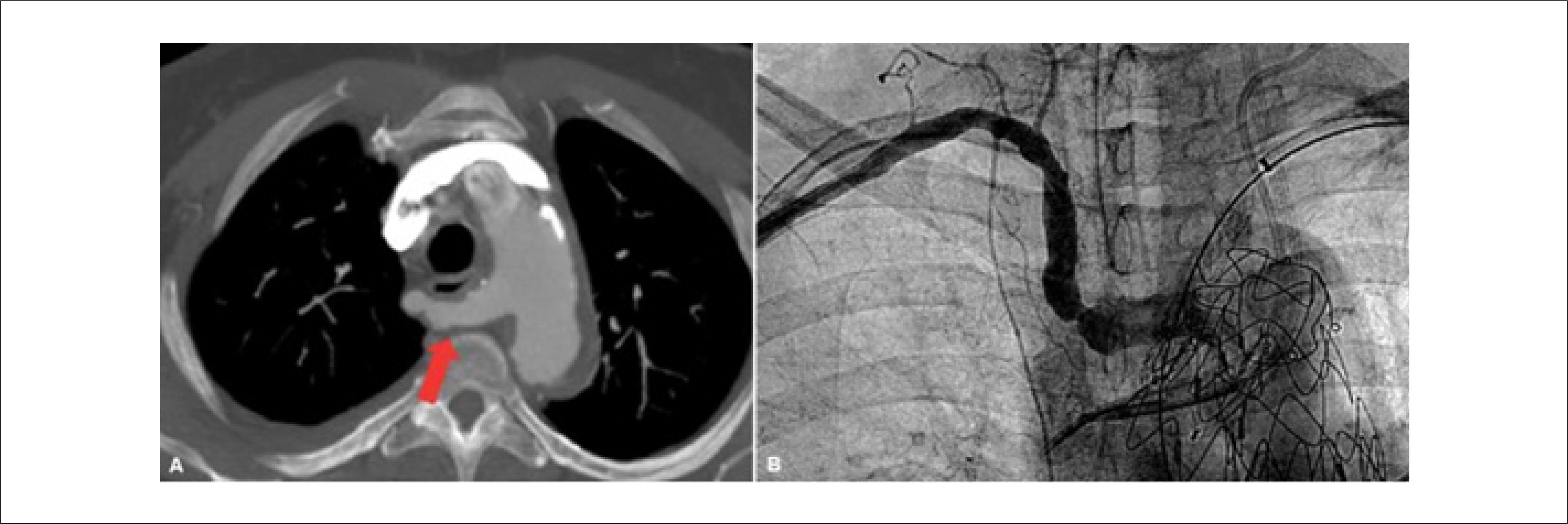
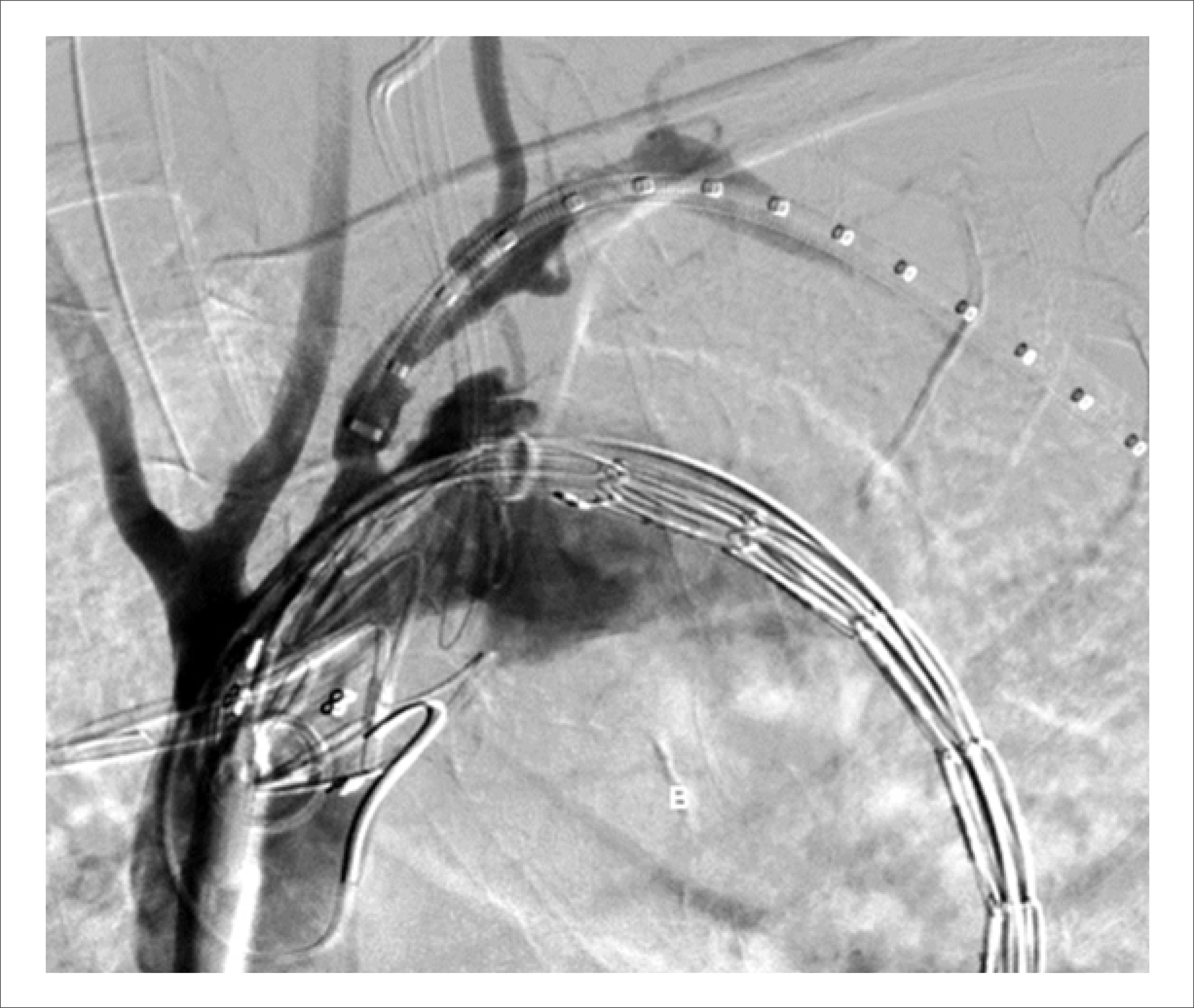
A 73-year-old woman with a history of hypertension was referred to the vascular surgery department for severe chest pain and signs of shock, including tachycardia and a tendency toward hypotension. An angiotomography revealed a thoracoabdominal aneurysm (Crawford Classification type 2 – Figure 1 ) with rupture signs ( Figures 2A and 2B ) and anatomical variations in the supra-aortic trunks, including an aberrant right subclavian artery (ARSA) ( Figures 3A and 3B ) and a bicarotid trunk ( Figure 4 ). She underwent emergency surgery with a hybrid approach, which included visceral branching via laparotomy and endovascular repair of the aneurysm. Unfortunately, she developed hemodynamic instability and refractory shock during the procedure, resulting in death. Her family authorized the publication and signed the consent form.

Angiotomography with 3D reconstruction. Overview of the thoracoabdominal aneurysm and variations of the supra-aortic trunks in anteroposterior (A) and lateral (B) views.

Axial angiotomography. A – Rupture of a Crawford 2 aneurysm with contrast extravasation (red arrow) and hemothorax (*); B – Rupture of a Crawford 2 aneurysm with retroperitoneal hematoma (*).
Demonstration of the ARSA in axial angiotomography (A; red arrow) and intraoperative angiography (B).
An ARSA is a rare anomaly with a 0.2% to 13.3% prevalence.1 , 2 It is more common among females, individuals with congenital anomalies (up to 3%), and those with Down syndrome (up to 35%).3 ARSA may be associated with a bicarotid trunk in 0.8% to 20% of cases, where common carotid arteries originate from the same point on the aortic arch.2 Thoracoabdominal Aortic Aneurysms (TAAAs) represent 10% of all aortic aneurysms. These aneurysms are potentially fatal if not treated early, as they may progress to rupture or dissection.4 In a São Paulo epidemiological study, the mortality rate for emergency TAAA repairs was nearly double that of elective repairs (42.10% vs. 26.78%). This difference is often attributed to the hemodynamic instability of ruptured aneurysms and the lack of timely preoperative preparation in urgent cases.5 Anatomical assessment is essential for treating TAAAs, whether through open surgery, endovascular surgery, or hybrid techniques. Anatomical variations in the supra-aortic trunks increase surgical complexity, regardless of the chosen technique.6
This "hybrid" approach, was first proposed by Quinones-Baldrich et al . in 1999 and involves a sequential revascularization of the visceral vessels, followed by endovascular aortic repair. Blood supply to the visceral organs is maintained by connecting an uncovered donor artery (often the iliac arteries).7 This approach limits open surgery time to laparotomy, theoretically reducing the physiological stress associated with a larger thoracoabdominal incision and repair. By sparing patients from some disadvantages of open surgeries, such as thoracotomy, one-lung ventilation, extracorporeal pump perfusion, aortic cross-clamping, and ischemia of the visceral organs, spine, and limbs, it can be a valuable option.8 In emergencies, there is insufficient time to customize stents for a fully endovascular repair in complex cases. Therefore, one alternative is surgeon-modified stents to create scallops or fenestrae. Yang et al . compared outcomes for TAAA patients treated with surgeon-modified stents and the hybrid technique, and reported low overall mortality (3.4% at 30 days) but a higher reintervention rate in patients who underwent endovascular surgery (13% vs. 0%).9 Here, we report a rare case of anatomic variations in the supra-aortic trunks associated with a ruptured Crawford type 2 thoracoabdominal aneurysm.
-
Sources of Funding
There were no external funding sources for this study.
-
Study Association
This study is not associated with any thesis or dissertation work.
-
Ethics Approval and Consent to Participate
This study was approved by the Ethics Committee of the CEP-FAMERP under the protocol number 567/9522300005415/Report 6778289. All the procedures in this study were in accordance with the 1975 Helsinki Declaration, updated in 2013. Informed consent was obtained from all participants included in the study.
References
-
1 Polednak AP. Prevalence of the Aberrant Right Subclavian Artery Reported in a Published Systematic Review of Cadaveric Studies: The Impact of an Outlier. Clin Anat. 2017;30(8):1024-28. doi: 10.1002/ca.22905.
» https://doi.org/10.1002/ca.22905 -
2 Hanžič N, Čizmarević U, Lesjak V, Caf P. Aberrant Right Subclavian Artery with a Bicarotid Trunk: The Importance of Diagnosing This Rare Incidental Anomaly. Cureus. 2019;11(11):e6094. doi: 10.7759/cureus.6094.
» https://doi.org/10.7759/cureus.6094 -
3 Buffoli B, Verzeletti V, Hirtler L, Rezzani R, Rodella LF. Retroesophageal Right Subclavian Artery Associated with a Bicarotid Trunk and an Ectopic Origin of Vertebral Arteries. Surg Radiol Anat. 2021;43(9):1491-5. doi: 10.1007/s00276-021-02746-1.
» https://doi.org/10.1007/s00276-021-02746-1 -
4 Rocha RV, Friedrich JO, Elbatarny M, Yanagawa B, Al-Omran M, Forbes TL, et al. A Systematic Review and Meta-analysis of Early Outcomes after Endovascular Versus Open Repair of Thoracoabdominal Aortic Aneurysms. J Vasc Surg. 2018;68(6):1936-45. doi: 10.1016/j.jvs.2018.08.147.
» https://doi.org/10.1016/j.jvs.2018.08.147 -
5 Anacleto AM, Morales MM, Teivelis MP, Silva MFAD, Portugal MFC, Stabellini N, et al. Epidemiological Analysis of 556 Procedures of Open Thoracoabdominal Aortic Aneurysm Repair in the Public Health System in the Largest Brazilian city. Einstein. 2022;20:eAO6724. doi: 10.31744/einstein_journal/2022AO6724.
» https://doi.org/10.31744/einstein_journal/2022AO6724 -
6 Pandalai U, Pillay M, Moorthy S, Sukumaran TT, Ramakrishnan S, Gopalakrishnan A, et al. Anatomical Variations of the Aortic Arch: A Computerized Tomography-Based Study. Cureus. 2021;13(2):e13115. doi: 10.7759/cureus.13115.
» https://doi.org/10.7759/cureus.13115 -
7 Quiñones-Baldrich WJ, Panetta TF, Vescera CL, Kashyap VS. Repair of Type IV Thoracoabdominal Aneurysm with a Combined Endovascular and Surgical Approach. J Vasc Surg. 1999;30(3):555-60. doi: 10.1016/s0741-5214(99)70084-4.
» https://doi.org/10.1016/s0741-5214(99)70084-4 -
8 Escobar GA, Oderich GS, Farber MA, Souza LR, Quinones-Baldrich WJ, Patel HJ, et al. Results of the North American Complex Abdominal Aortic Debranching (NACAAD) Registry. Circulation. 2022;146(15):1149-58. doi: 10.1161/CIRCULATIONAHA.120.045894.
» https://doi.org/10.1161/CIRCULATIONAHA.120.045894 -
9 Yang G, Zhang M, Muzepper M, Du X, Wang W, Liu C, et al. Comparison of Physician-Modified Fenestrated/Branched Stent-Grafts and Hybrid Visceral Debranching Plus Stent-Graft Placement for Complex Thoracoabdominal Aortic Aneurysm Repair. J Endovasc Ther. 2020;27(5):749-56. doi: 10.1177/1526602820934466.
» https://doi.org/10.1177/1526602820934466
Edited by
-
Editor responsible for the review:
Tiago Magalhães