Misinterpretation of Indeterminate Diastolic Function: Awareness and Insights from a Survey among Brazilian Cardiologists
Abstract
Background: Diastolic dysfunction (DD) is highly prevalent and is associated with significant morbidity and mortality. More recent guidelines have introduced the classification of Indeterminate Diastolic Function or Indeterminate Diastolic Dysfunction (IDF or IDD). Nevertheless, both diagnoses are still poorly understood in clinical practice, with variable prevalence.
Objectives: Assess the understanding of IDF and IDD among non-echocardiographer cardiologists in Brazil.
Methods: A nationwide online survey was conducted among non-echocardiography readers cardiologists via mobile messaging platforms. A brief and anonymous questionnaire on knowledge and interpretation of Diastolic Function.
Results: A total of 570 cardiologists from all regions of Brazil participated in the study. Most participants (64.21%) had more than ten years of clinical experience. While 71% correctly identified grades 2 or 3 as indicative of elevated filling pressures, only 34.21% accurately understood the diagnostic criteria for IDF or IDD. Among the mistakes associated with the indeterminate classification, the following stand out: attribution of this status to conditions that interfere with the assessment of diastole (49.12%), technical limitations of the echocardiography equipment (3.33%), and alleged lack of knowledge by echocardiographers (4.91%). In addition, 46.7% reported finding this diagnosis rarely in the reports, 33.5% believed that this classification influenced clinical conduct, and 43.5% considered that the examination could have been better performed.
Conclusion: Despite knowledge about diastolic function, misinterpretation of IDF or IDD is still common among non-echocardiographer cardiologists. Investment in education, sharing these concepts with clinicians, and clear guidelines are essential to optimize the use and diagnostic accuracy of echocardiography.
Keywords
Diastole; Echocardiography; Practice Guidelines as Topic

Resumo
Fundamento: A disfunção diastólica (DD) é altamente prevalente e está associada a alta taxa de morbidade e mortalidade. Diretrizes mais recentes introduziram a classificação de Função ou Disfunção Diastólica Indeterminada (FDI ou DDI), mas ambos os diagnósticos ainda são pouco compreendidos na prática clínica, com prevalência variável.
Objetivos: Avaliar o entendimento sobre FDI e DDI entre cardiologistas não ecocardiografistas no Brasil.
Métodos: Pesquisa online de abrangência nacional distribuída por plataformas de mensagens móveis, com um questionário breve e anônimo sobre conhecimento e interpretação da Função Diastólica.
Resultados: Um total de 570 cardiologistas de todas as regiões do Brasil participaram do estudo. A maioria dos participantes (64,21%) possuía mais de dez anos de experiência clínica. Enquanto 71% identificaram corretamente os graus 2 ou 3 como indicativos de pressões de enchimento elevadas, apenas 34,21% compreendiam com precisão os critérios diagnósticos para FDI ou DDI. Entre os equívocos associados à classificação indeterminada, destacam-se atribuição desse status a condições que interferem na avaliação da diástole (49,12%), limitações técnicas dos equipamentos de ecocardiografia (3,33%) e suposta falta de conhecimento dos ecocardiografistas (4,91%). Além disso, 46,7% relataram encontrar esse diagnóstico raramente nos laudos, 33,5% acreditavam que essa classificação influenciava a conduta clínica e 43,5% consideravam que o exame poderia ter sido melhor realizado.
Conclusão: Apesar do conhecimento sobre a função diastólica, a interpretação equivocada de FDI ou DDI ainda é comum entre cardiologistas não ecocardiografistas. Investimentos em educação, com compartilhamento desses conceitos aos clínicos, e diretrizes claras são essenciais para otimizar o uso e a precisão diagnóstica na ecocardiografia.
Palavras-chave
Diástole; Ecocardiografia; Guias de Prática Clínica como Assunto
Introduction
The analysis of left ventricular (LV) diastolic function is key in an echocardiographic examination and is performed using echocardiography, which has been established as the main imaging tool for this evaluation.1 Although invasive methods for measuring ventricular relaxation and filling pressures are considered the gold standard, echocardiography is widely preferred due to its high temporal resolution, reproducibility, validation of measurements, and wide availability at the bedside, and because it does not require invasive procedures or does not expose the patient to ionizing radiation.2
Left Ventricular Diastolic Dysfunction (LVDD) is highly prevalent, especially among the elderly, and is associated with significant morbidity and mortality. Furthermore, DD may contribute to the development and progression of Heart Failure with preserved Ejection Fraction (HFpEF), a condition characterized by increased LV filling pressures.3 , 4
Ventricular Diastole can be classified as normal or presenting Diastolic Dysfunction (DD) in grades 1, 2, or 3, or even as indeterminate, when it is not possible to establish its presence or severity. The guidelines of the American Society of Echocardiography (ASE) and the European Association of Cardiovascular Imaging (EACVI), published in 2016, sought to simplify this assessment, with clearer and more objective criteria, compared to the previous version.5
However, the analysis of Diastolic Function and Left Ventricular Filling Pressures (LVFP) by echocardiography can be challenging, especially in patients with preserved LV ejection fraction, due to the need to evaluate multiple parameters for an accurate diagnosis. Despite all diagnostic efforts, a considerable proportion of patients are still classified as having indeterminate diastolic function (IDF), with prevalence ranging from 10% to 20% of the cases, according to previous studies.6 This can be frustrating both for the professionals who perform the examination and for clinical cardiologists, who often depend on this diagnosis to define a therapeutic approach for the patient.
Thus, the objective of this study was to evaluate the understanding of the diastolic function or indeterminate diastolic dysfunction (IDD) classification in echocardiography reports by cardiologists not specialized in echocardiography in Brazil and analyze the knowledge these professionals have about diastolic function classification.
Methods
A nationwide, voluntary, online survey applied to cardiologists not specialized in echocardiography was conducted via mobile messaging platforms from June 1 to June 30. A brief online questionnaire was applied using the SurveyMonkey platform, anonymously, with no option for personal identification. There was no financial or material compensation for the participation in the research. The questionnaire consisted of seven questions ( https://pt.surveymonkey.com/r/Y8NN97F ), which were mandatory to complete, about time since medical training, region of practice, general knowledge about Diastolic Function, and how the result of a report impacts medical practice. The questions were multiple choice, with no possibility of open answers.
The complete questionnaire can be found in "Supplementary Material". Under the recommendation of Resolution 510 of the National Health Council, this questionnaire was not forwarded for evaluation by the CEP/CONEP system, as it is a public opinion survey with unidentified participants. The data obtained were described as categorical variables, with their absolute values, percentages, or proportions.
Results
General data
A total of 570 cardiologists accessed and answered the questionnaire, with the following distribution across the regions of Brazil: Southeast (29.65%), Midwest (23.80%), Northeast (18.77%), South (16.14%), and North (11.58%).
The participants were distributed according to their time since medical training: up to 5 years (23.33%), 6 to 10 years (12.46%), 11 to 20 years (26.14%), and more than 20 years (38.07%).
Knowledge about diastolic function analysis
Regarding diastolic function grading in which the patient has elevated LVEP, 1.75% responded that this would occur when diastole was classified as indeterminate, 22.16% as grade 1, 70% as grade 2 or 3, and 5.09% did not know how to respond.
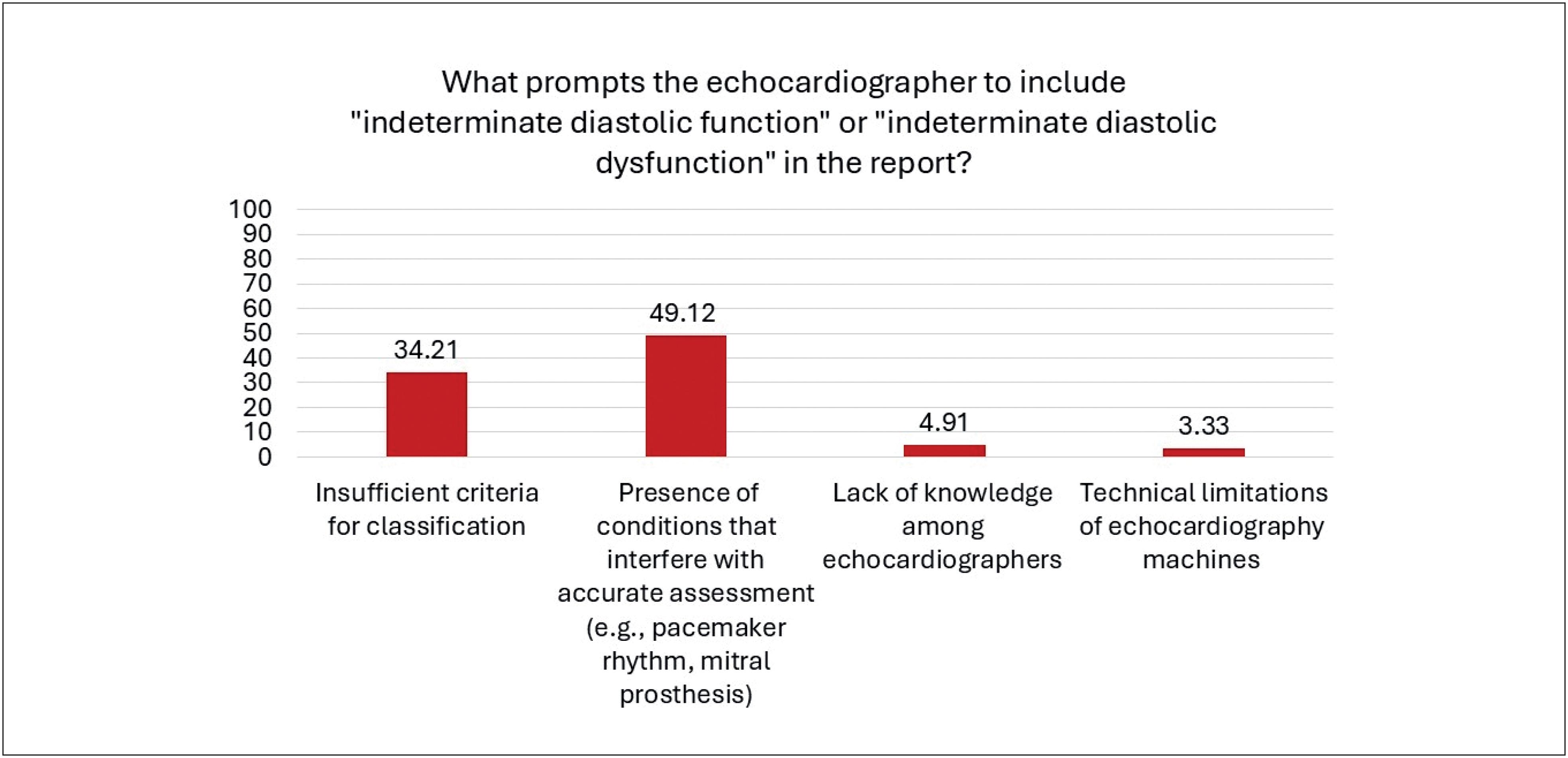
Regarding the understanding of what leads an echocardiographer to classify IDF or IDD in the report, the majority (49.12%) chose an inadequate option, which indicated that an indeterminate classification would be caused by pathologies that interfere with the correct assessment (e.g.: pacemaker rhythm, mitral prosthesis). The second most chosen option (34.21%) was the correct answer, which indicated that it was not possible to determine diastolic function due to the absence of sufficient criteria for classification ( Figure 1 ).

The cardiologist's understanding of the echocardiographic criteria used for the report of indeterminate diastolic function or indeterminate diastolic dysfunction.
Observed frequency of diagnosis in reports and impact on clinical management
Regarding the frequency observed in echocardiography reports, concerning the report of IDF or IDD, 29.30% said they had never seen this phrase in the report, 46.67% said they rarely see it, and 24.04% said they frequently see it.
Regarding the impact of this diagnosis on adequate patient management, 33.51% responded that it had an impact, 21.23% that it did not, 33.86% occasionally, and 11.40% considered the diagnosis to be a source of confusion.
Faced with the diagnosis of IDF or IDD, 45.82% of the participants feel satisfied. However, a significant percentage of cardiologists, 44.51%, suspect that the exam could have been conducted in a more effective way ( Figure 2 ).

How the cardiologist feels about the report of indeterminate diastolic function or indeterminate diastolic dysfunction.
Discussion
This study provides important and unprecedented information on the interpretation, understanding, observed frequency, impact on patient management, and the perception of cardiologists when faced with an IDF or IDD diagnosis.
There was good representation among the five regions of Brazil, which contributes to a more balanced assessment of this perception, minimizing the risk of bias associated with the concentration of knowledge in areas with greater access to resources and updates, compared to regions with more limitations in this regard.
Most of the cardiologists surveyed had more than 10 years of training, which reflects good experience in reading essential cardiological exams, such as echocardiography, and in patient management care.
When grading Diastolic Function in which the patient has elevated LV filling pressures, the vast majority confirmed that this occurs in grades 2 and 3 of DD according to the guidelines of the ASE and the EACVI.5
These guidelines are the most widely used to analyze Diastolic Function. In the absence of a myocardial disease, four echocardiographic signs are evaluated: the early diastolic tissue velocity of the septal and lateral mitral annulus (e’), the indexed left atrial volume, the ratio between the maximum mitral E velocity (early diastolic) and the mean of the velocities of the septal and lateral e’ wave, and the maximum velocity of tricuspid regurgitation. If most available data are within the normal range, LV Diastolic Function is considered normal. Otherwise, DD is observed and LV filling pressure can be estimated. If the criteria are insufficient or there is disagreement in the classification, the diastolic function is considered indeterminate.4 , 5 , 7
If there is a myocardial disease or DD after the evaluation described above, filling pressures should be estimated and DD classified. The algorithm for assessing LV filling pressure first measures mitral wave velocities. If the mitral E wave velocity is < 0.5 m/s and the E/A ratio is ≤ 0.8, LV filling pressure is likely normal or low, so DD is classified as grade 1, whereas a tall E wave and E/A ≥ 2 indicates elevated LV filling pressure and is classified as grade 3 DD. When the mitral E/A ratio is between 0.8 and 2.0, additional criteria are needed to assess LV filling pressure. These include mean E/e’ ratio > 14, peak tricuspid regurgitation velocity > 2.8 m/s, and indexed LA volume > 34 mL/m². If ≥ 2 of the criteria are above the cutoff value, LV filling pressure is most likely elevated, classifying DD as grade 2. If ≥ 2 of the criteria are below the cutoff value, LV filling pressure is most likely normal and is therefore classified as grade 1. However, if all of these additional measurements, especially tricuspid regurgitation, are not available and there is discordance between the two existing measurements, DD is considered indeterminate.4 , 5 , 7
The proportion of cases with IDF is reduced when specific Doppler findings are carefully considered, including changes in mitral inflow velocities and E/A ratio with the Valsalva maneuver, flow velocity and duration in the pulmonary veins, including the reversed wave, and the presence of an L wave in mitral inflow with velocity ≥ 50 cm/s.7
Therefore, it is clear that the diagnosis of IDF or IDD is associated with the lack of sufficient criteria or discordance between criteria.
However, most cardiologists attribute this diagnosis to conditions that make it impossible to adequately analyze diastolic function, mainly because they interfere with the velocities of the mitral E waves and the tissue waves of the mitral annulus. Among these conditions, the following stand out: pacemaker rhythm, the presence of a mitral valve prosthesis, significant mitral valve diseases (stenosis or insufficiency), and left bundle branch block.4 , 5
The perception of the frequency of this diagnosis in echocardiography reports was low, with almost a third of cardiologists never having observed this description. However, this contrasts with the reported prevalence of this finding in reports, which ranges from 10% to 20%.3
Furthermore, there is an important bias: several echocardiographers hesitate to classify diastole as indeterminate for fear that this definition would be misinterpreted by the clinical cardiologist. There is concern that this may create distrust about the examination quality, especially since the diagnosis of IDF or IDD is still not widely understood by cardiologists who do not specialize in echocardiography. This can lead to an underdiagnosis of this pattern of DD, with a tendency to classify the patient differently in a way that does not correspond to their true classification. On the other hand, Left Atrial strain has been suggested as a useful method in reclassifying cases of DD considered indeterminate by the traditional ASE-EACVI algorithm.1 , 2 , 8 , 9
This reasoning is in line with the perception of cardiologists when faced with the diagnosis of IDF or IDD. Most of them accept this classification, recognizing that determining all aspects of medicine is not always possible. However, a significant percentage, numerically close to that of the previous response, expresses distrust, suspecting that the exam could have been performed in a more effective way.
Although most people are unaware of the real reason for including this diagnosis in the report, the general perception is that IDF or IDD compromises, even occasionally, effective patient management. This highlights the importance of better interaction and understanding between the echocardiography report, echocardiographers, and clinical cardiologists.
Study limitations
This research involved a relatively small sample of cardiologists, which may limit the generalizability of the results. Furthermore, based on the alternatives chosen, it was not possible to assess regional differences and training time differences, which could offer a more detailed analysis of the results obtained.
Conclusion
Despite general knowledge about Diastolic Function, misinterpretation of IDF or IDD persists among non-echocardiographer cardiologists. Investments in education, sharing these concepts with clinicians, and clear guidelines are essential to optimize the use of the exam and diagnostic accuracy of echocardiography.
-
Sources of Funding
There were no external funding sources for this study.
-
Study Association
This study is not associated with any thesis or dissertation work.
-
Ethics Approval and Consent to Participate
This article does not contain any studies with human participants or animals performed by any of the authors.
*Supplemental Materials
For additional information, please click here .
References
-
1 Barberato SH, Romano MMD, Beck ALS, Rodrigues ACT, Almeida ALC, Assunção BMBL, et al. Position Statement on Indications of Echocardiography in Adults - 2019. Arq Bras Cardiol. 2019;113(1):135-81. doi: 10.5935/abc.20190129.
» https://doi.org/10.5935/abc.20190129 -
2 Robinson S, Ring L, Oxborough D, Harkness A, Bennett S, Rana B, et al. The Assessment of Left Ventricular Diastolic Function: Guidance and Recommendations from the British Society of Echocardiography. Echo Res Pract. 2024;11(1):16. doi: 10.1186/s44156-024-00051-2.
» https://doi.org/10.1186/s44156-024-00051-2 -
3 Kumar S, Desai N, Gona OJ, Kumar VK, Madbu B M. Impact of Updated 2016 ASE/EACVI VIS-À-VIS 2009 ASE Recommendation on the Prevalence of Diastolic Dysfunction and LV Filling Pressures in Patients with Preserved Ejection Fraction. J Cardiovasc Imaging. 2021;29(1):31-43. doi: 10.4250/jcvi.2020.0117.
» https://doi.org/10.4250/jcvi.2020.0117 -
4 Smiseth OA, Morris DA, Cardim N, Cikes M, Delgado V, Donal E, et al. Multimodality Imaging in Patients with Heart Failure and Preserved Ejection Fraction: An Expert Consensus Document of the European Association of Cardiovascular Imaging. Eur Heart J Cardiovasc Imaging. 2022;23(2):e34-e61. doi: 10.1093/ehjci/jeab154.
» https://doi.org/10.1093/ehjci/jeab154 -
5 Nagueh SF, Smiseth OA, Appleton CP, Byrd BF 3rd, Dokainish H, Edvardsen T, et al. Recommendations for the Evaluation of Left Ventricular Diastolic Function by Echocardiography: An Update from the American Society of Echocardiography and the European Association of Cardiovascular Imaging. J Am Soc Echocardiogr. 2016;29(4):277-314. doi: 10.1016/j.echo.2016.01.011.
» https://doi.org/10.1016/j.echo.2016.01.011 -
6 Chung YJ, Choi KH, Lee SH, Shin D, Hong D, Park S, et al. Prognostic Impact of Indeterminate Diastolic Function in Patients with Functionally Insignificant Coronary Stenosis. J Am Soc Echocardiogr. 2023;36(3):295-306.e5. doi: 10.1016/j.echo.2022.11.014.
» https://doi.org/10.1016/j.echo.2022.11.014 -
7 Nagueh SF. Diastology: 2020-A Practical Guide. Echocardiography. 2020;37(11):1919-25. doi: 10.1111/echo.14742.
» https://doi.org/10.1111/echo.14742 -
8 Singh A, Addetia K, Maffessanti F, Mor-Avi V, Lang RM. LA Strain for Categorization of LV Diastolic Dysfunction. JACC Cardiovasc Imaging. 2017;10(7):735-43. doi: 10.1016/j.jcmg.2016.08.014.
» https://doi.org/10.1016/j.jcmg.2016.08.014 -
9 Barberato SH, Borsoi R. Left Atrial Reserve Function in Assessing Indeterminate Diastolic Function. Arq Bras Cardiol: Imagem Cardiovasc. 2021;34(2):eabc196. doi: 10.47593/2675-312X/20213402eabc196 .
» https://doi.org/10.47593/2675-312X/20213402eabc196
Edited by
-
Editor responsible for the review:
Marcelo Tavares

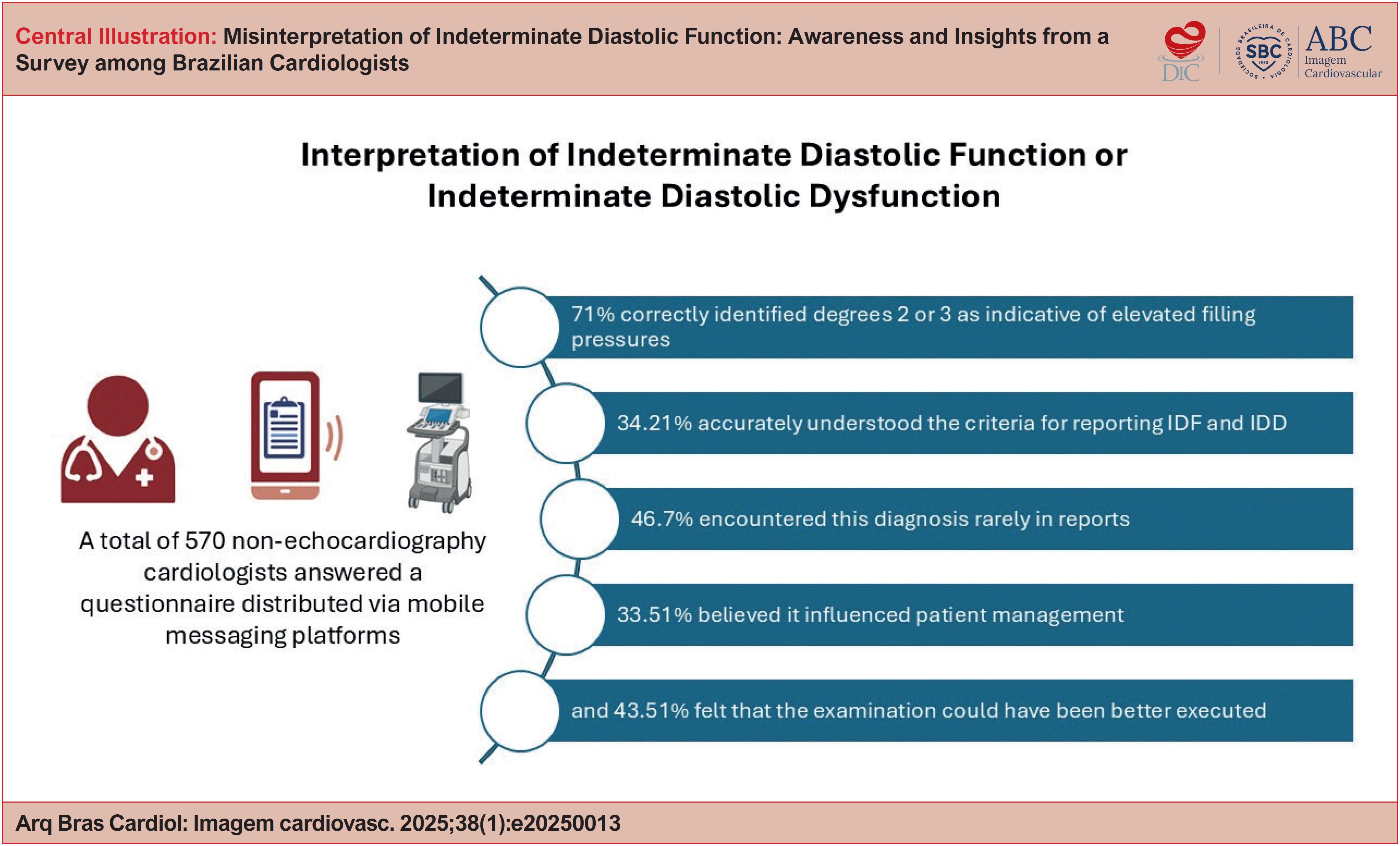 IDF: Indeterminate Diastolic Function; IDD: Indeterminate Diastolic Dysfunction.