 Impact of Contrast Volume Used After Percutaneous Coronary Procedures in Patients at Risk for Contrast-Induced Nephropathy
Abstract
Background Contrast-induced nephropathy (CIN) is a common complication following angiographic procedures, potentially related to the volume of contrast agent administered. However, it is unclear whether the type of contrast also influences its occurrence.
Objective To evaluate the interaction between contrast volume and contrast type (iso-osmolar vs low-osmolar) in the development of CIN.
Methods A post hoc subanalysis was performed on patients undergoing diagnostic or therapeutic coronary procedures who were randomized 1:1 to receive low-osmolar or iso-osmolar contrast media. The overall sample (n = 2,268) was stratified by contrast volume: Group I (< 150 mL; n = 1,985) and Group II (≥ 150 mL; n = 283), and groups were compared by contrast type. The primary endpoint was CIN at 48- and 96-hours post-procedure. CIN was defined as a ≥ 25% or ≥ 0.5 mg/dL increase in serum creatinine from baseline at 48 hours. The effects of contrast type and volume were tested with logistic regression including an interaction term, adjusted for acute coronary syndrome, ventricular dysfunction, baseline creatinine, sex, and age (p < 0.05).
Results We included 2,268 consecutive patients; two-thirds were male; hypertension was present in 85%, diabetes in 52%, and chronic kidney disease in 31%. Mean contrast volume was 75.3 ± 28.0 mL in Group I and 188.6 ± 46.9 mL in Group II. The incidence of CIN was higher with greater volume (14.8% vs 17.7%) but not statistically significant (adjusted odds ratio = 1.25; 95% CI = 0.89-1.73; p = 0.191). The model with the interaction term showed no evidence of an interaction between the type of contrast and volume (p > 0.999).
Conclusion The type of contrast was not associated with CIN, even among patients exposed to higher contrast volumes.
Keywords
Kidney Diseases; Contrast Media; Percutaneous Coronary Intervention
Resumo
Fundamento A nefropatia induzida por contraste (NIC) é complicação frequente após procedimentos angiográficos e pode estar relacionada ao volume de contraste administrado. Permanece incerto se o tipo de contraste também influencia sua ocorrência.
Objetivo Avaliar a interação entre volume e tipo de contraste (iso-osmolar ou de baixa osmolaridade) no desenvolvimento de NIC.
Métodos Subanálise post hoc de pacientes submetidos a procedimentos coronários diagnósticos e terapêuticos, randomizados 1:1 para contraste de baixa osmolaridade ou iso-osmolaridade. A amostra total (n = 2.268) foi estratificada por volume: Grupo I (< 150 ml; n = 1.985) e Grupo II (≥ 150 ml; n = 283), e comparada segundo o tipo de contraste. O desfecho primário foi NIC em 48 e 96 horas após o procedimento. NIC foi definida como elevação da creatinina sérica > 25% ou ≥ 0,5 mg/dl em relação ao nível basal após 48 horas. O efeito do tipo e do volume de contraste foi testado por regressão logística com termo de interação, ajustada para síndrome coronária aguda, disfunção ventricular, creatinina basal, sexo e idade (valor p < 0,05).
Resultados Foram incluídos 2.268 pacientes consecutivos; dois terços do sexo masculino; hipertensão arterial sistêmica em 85%, diabetes melito em 52% e doença renal crônica em 31%. No Grupo I, o volume médio de contraste foi 75,3 ± 28,0 ml; no Grupo II, 188,6 ± 46,9 ml. A incidência de NIC foi maior no grupo com maior volume (14,8% vs. 17,7%), sem significância estatística (odds ratio ajustado = 1,25; intervalo de confiança de 95% 0,89-1,73; p = 0,191). O modelo com termo de interação não evidenciou correlação entre tipo de contraste e volume (p > 0,999).
Conclusão Não houve associação entre o tipo de contraste e a ocorrência de NIC, mesmo entre pacientes expostos a maiores volumes de contraste.
Palavras-chave
Nefropatias; Meios de Contraste; Intervenção Coronária Percutânea

Introduction
Contrast-induced nephropathy (CIN) is defined as acute kidney dysfunction that occurs after the intravenous administration of iodinated contrast agents, in the absence of other known causes of acute kidney injury (AKI).1,2 CIN is the third most common cause of AKI among hospitalized patients, and it is associated with higher rates of morbidity and mortality as well as a longer hospital stay.3
Among the main determinants of CIN are contrast osmolarity and administered volume.4 Although the pathophysiology is not fully elucidated, both direct and indirect effects of contrast media — as well as procedure-related hemodynamic alterations — are implicated.5 CIN arises from the synergy between tubular toxicity and ischemia of the renal medulla.5 In addition to direct tubular toxicity, contrast injection perturbs renal hemodynamic mediators — such as prostaglandins, nitric oxide, and adenosine — thereby precipitating ischemia.5 The outer renal medulla, which operates at relatively low oxygen tension and high metabolic demand, is particularly vulnerable to these hemodynamic effects.5
The Ioxaglate Versus IoDixanol for the Prevention of Contrast-Induced Nephropathy (IDPC; ClinicalTrials.gov NCT02991742) trial is, to date, the largest randomized study (n = 2,268) comparing iso-osmolar (iodixanol) versus low-osmolar (ioxaglate) contrast media for preventing CIN after percutaneous coronary intervention (PCI) or diagnostic catheterization. Its primary finding was the absence of a significant difference between contrast types in the incidence of CIN in a high-risk population undergoing diagnostic or therapeutic procedures in a tertiary catheterization laboratory. Likewise, there were no significant differences in the composite adverse outcomes (death and hemodialysis) during hospitalization or within 30 days post-procedure.
A notable feature of our center is the consistently low average contrast volume used—a local practice—comparable to the 5 years preceding the trial (89.0 ± 48.6 mL), with no significant variation.6 All patients, because of their high risk for CIN, received hydration according to the protocol described in the original study.
In this post hoc subanalysis, we evaluated whether the volume of contrast used during percutaneous procedures interacts with contrast type (low- vs iso-osmolar) in the development of CIN.
Methods
Study design and population
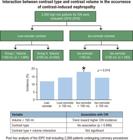
This post hoc subanalysis derives from the IDPC trial, whose design has been detailed previously and is summarized in Central Illustration.6 From 2016 to 2018, all high-risk patients for CIN undergoing diagnostic coronary angiography or PCI at a single tertiary public center were enrolled and randomized (1:1) to iso-osmolar (iodixanol) or low-osmolar (ioxaglate) contrast. During the period, 16,244 percutaneous coronary procedures were performed, including 4,874 interventions; the present sample accounted for 14% of all procedures. High-risk criteria for CIN were age ≥ 70 years, chronic kidney disease (estimated glomerular filtration rate [eGFR] < 60 mL/min), diabetes, congestive heart failure, shock or use of intra-aortic balloon, and urgency/emergency procedures.6,7
Study procedures
Data were collected at three time points. On the procedure day, we recorded iodinated contrast administration, the hydration regimen, and angiographic procedural details. Between 48 and 96 hours after the procedure, vital signs, dialysis requirement, and serum creatinine levels were assessed at an outpatient visit or, when applicable, during hospitalization; when multiple measurements were available within this window, the highest value was used for analysis. At 30 days, clinic staff contacted patients to ascertain health status, including dialysis requirement and vital status. Immediately after randomization, baseline demographic and clinical characteristics and the most recent serum creatinine value measured within the prior 48-96 hours were obtained.
eGFR was calculated using the equation developed by the Chronic Kidney Disease Epidemiology Collaboration (CKD-EPI).8 Patients with eGFR ≤ 45 mL/min were admitted 1 day before the procedure for intravenous hydration with 0.9% saline at 0.5-1 mL/kg per hour (according to left ventricular function), continued for 12 hours post-procedure; those with renal dysfunction received 5 mL/kg and the remainder 1 mL/kg. Patients with eGFR 45-60 mL/min also received hydration for 4 hours before and 4 hours after the procedure without pre-procedure admission. The hydration protocol was applied uniformly to all patients and similarly across randomized groups.
Primary endpoint
This analysis evaluated the interaction between contrast type (iso-osmolar vs low-osmolar) and the contrast volume used during procedures. The overall cohort was stratified into two prespecified groups: Group I (< 150 mL) and Group II (≥ 150 mL). The 150-mL cutoff was defined a priori to delineate a group with higher exposure and to enable clearer assessment of volume effects. For reference, in the ACT study the median contrast volume was 100 mL and the third quartile 130 mL.7
Outcome definitions
The primary endpoint was the occurrence of CIN, defined as an increase in serum creatinine of > 25% or ≥ 0.5 mg/dL from baseline, measured 48 hours after the procedure.6,9-11 Secondary endpoints included a composite of all-cause death or the need for dialysis (as determined by the nephrology team) occurring during hospitalization or within 30 days post-procedure as well as all-cause mortality within the same period.
Statistical analysis
As this was a post hoc analysis, no formal sample size calculation was performed; however, this study represents the largest contemporary assessment comparing contrast types in a high-volume exposure scenario. A descriptive analysis was conducted according to the presence or absence of CIN. Continuous variables were summarized as means and standard deviations or as medians and interquartile ranges, depending on their distribution; categorical variables were presented as absolute and relative frequencies. Between-group comparisons used the Student’s t-test for continuous variables and the chi-square test for categorical variables, except for creatinine, Cockcroft, and eGFR, which were compared using the Mann-Whitney test. Normality was evaluated through histogram inspection and Q-Q plots of residuals.
To estimate the effects of contrast type and volume on CIN occurrence, logistic regression including an interaction term was used, adjusted for acute coronary syndrome (ACS), ventricular dysfunction, baseline creatinine, sex, and age. A two-sided p-value < 0.05 was considered statistically significant for all analyses.
Results
Table 1 summarizes baseline characteristics by contrast volume and type. Tables 2 and 3 present, respectively, baseline comparisons by outcome (CIN vs no CIN) and by contrast volume (< 150 mL vs ≥ 150 mL).
In Table 2, CIN occurred more often among patients with prior left ventricular dysfunction, pre-existing renal dysfunction, and cardiogenic shock. In Table 3, use of ≥ 150 mL was more frequent in women (70.0% vs 62.5%; p = 0.015) and in patients with ACS (44.3% vs 38.0%; p = 0.043), likely reflecting ad hoc procedures (diagnostic catheterization followed by PCI). Conversely, lower volumes were more common in patients with diabetes mellitus (44.5% vs 53.8%; p = 0.040), suggesting additional caution in this very-high-risk group.
We fit a logistic regression model including an interaction between contrast type and volume to test whether the effect of contrast type depended on administered volume. The model was adjusted for age, sex, baseline creatinine, congestive heart failure, and ACS (Table 4). The interaction term was not significant (p > 0.05), indicating no effect modification by volume.
After removing the interaction term, neither contrast type nor volume showed an independent association with CIN. As shown in Table 5, there was a non-significant trend toward higher risk with volumes ≥ 150 mL in the unadjusted model (odds ratio [OR] = 1.24; 95% CI 0.88-1.71; p = 0.202) and in the adjusted model (OR = 1.25; 95% CI 0.89-1.73; p = 0.191). Additional analyses treating volume as a continuous variable likewise demonstrated no significant association with CIN.
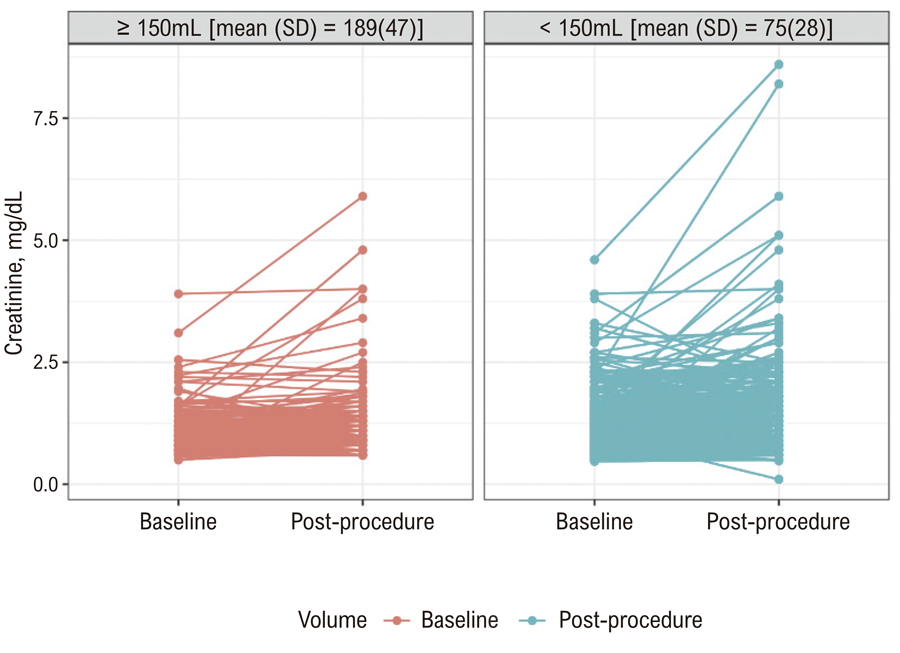
Figures 1 and 2 depict the lack of relationship between contrast volume and change in serum creatinine. Figure 3 shows the volume-by-type interaction effect on CIN, which was non-significant in both the unadjusted (OR = 1.33; 95% CI 0.69-2.60; p = 0.397) and adjusted models (OR = 1.35; 95% CI 0.70-2.65; p = 0.377).


– Incidence of CIN by contrast type and volume category. CIN: contrast-induced nephropathy; OR: odds ratio.
Discussion
CIN remains a relevant concern in diagnostic and therapeutic procedures that use iodinated contrast, particularly PCI.9 In this study, contrast type (iso-osmolar vs low-osmolar) was not associated with CIN; in high-risk populations the critical elements appear to be minimizing administered volume and using pre-procedure hydration.
Prior research suggests important roles for both contrast type and volume in CIN risk.9,10 However, we observed no significant differences between iso-osmolar and low-osmolar agents, regardless of volume, noting that only a minority received truly high volumes in this cohort. Earlier studies posited a potential advantage of iso-osmolar agents due to less hemodynamic and renal stress,11,12 but more recent evidence indicates that, in carefully selected patients managed with standardized hydration protocols, agent selection may not meaningfully alter the incidence of CIN. Moreover, osmolarity is not the sole determinant of renal response to contrast.
The absence of between-group differences may reflect the effectiveness of preventive strategies. Intravenous hydration — broadly recommended in guidelines — combined with lower contrast volumes likely attenuated any effect of contrast type on renal function.
Clinical heterogeneity also warrants consideration. Factors such as diabetes, advanced age, and pre-existing kidney disease — although adjusted for — can modulate individual risk of CIN and may contribute to the lack of a global effect.
In practice, contrast agent selection should be individualized, considering clinical conditions, risk profile, and local resource availability. Prospective studies with larger samples and robust designs are needed to confirm these findings and explore potential differences within specific subgroups.
Limitations of study
Beyond osmolarity and volume, other physicochemical properties of contrast media may influence the development of CIN; therefore, these results should not be extrapolated to agents other than the two evaluated here. In addition, this was a single-center trial, which limits generalizability — particularly to settings that use higher contrast volumes or serve different patient populations.
Conclusion
Contrast type was not significantly associated with CIN, even among patients exposed to higher contrast volumes.
References
-
1 Seeliger E, Sendeski M, Rihal CS, Persson PB. Contrast-Induced Kidney Injury: Mechanisms, Risk Factors, and Prevention. Eur Heart J. 2012;33(16):2007-15. doi: 10.1093/eurheartj/ehr494.
» https://doi.org/10.1093/eurheartj/ehr494 -
2 Rear R, Bell RM, Hausenloy DJ. Contrast-Induced Nephropathy Following Angiography and Cardiac Interventions. Heart. 2016;102(8):638-48. doi: 10.1136/heartjnl-2014-306962.
» https://doi.org/10.1136/heartjnl-2014-306962 -
3 Solomon R. Contrast-Medium-Induced Acute Renal Failure. Kidney Int. 1998;53(1):230-42. doi: 10.1038/sj.ki.4495510.
» https://doi.org/10.1038/sj.ki.4495510 -
4 Budano C, Levis M, D'Amico M, Usmiani T, Fava A, Sbarra P, et al. Impact of Contrast-Induced Acute Kidney Injury Definition on Clinical Outcomes. Am Heart J. 2011;161(5):963-71. doi: 10.1016/j.ahj.2011.02.004.
» https://doi.org/10.1016/j.ahj.2011.02.004 -
5 Mehran R, Dangas GD, Weisbord SD. Contrast-Associated Acute Kidney Injury. N Engl J Med. 2019;380(22):2146-55. doi: 10.1056/NEJMra1805256.
» https://doi.org/10.1056/NEJMra1805256 -
6 Freitas RAP, Tanajura LF, Mehran R, Chamié D, Chaves A, Centemero M, et al. Ioxaglate versus IoDixanol for the Prevention of Contrast-Induced Nephropathy: The IDPC Trial. J Invasive Cardiol. 2023;35(6):E281-E290. doi: 10.25270/jic/21.00249.
» https://doi.org/10.25270/jic/21.00249 -
7 ACT Investigators. Acetylcysteine for Prevention of Renal Outcomes in Patients Undergoing Coronary and Peripheral Vascular Angiography: Main Results from the Randomized Acetylcysteine for Contrast-Induced Nephropathy Trial (ACT). Circulation. 2011;124(11):1250-9. doi: 10.1161/CIRCULATIONAHA.111.038943.
» https://doi.org/10.1161/CIRCULATIONAHA.111.038943 -
8 Levey AS, Stevens LA, Schmid CH, Zhang YL, Castro AF 3rd, Feldman HI, et al. A New Equation to Estimate Glomerular Filtration Rate. Ann Intern Med. 2009;150(9):604-12. doi: 10.7326/0003-4819-150-9-200905050-00006.
» https://doi.org/10.7326/0003-4819-150-9-200905050-00006 -
9 Zhang F, Lu Z, Wang F. Advances in the Pathogenesis and Prevention of Contrast-Induced Nephropathy. Life Sci. 2020;259:118379. doi: 10.1016/j.lfs.2020.118379.
» https://doi.org/10.1016/j.lfs.2020.118379 -
10 Aspelin P, Aubry P, Fransson SG, Strasser R, Willenbrock R, Berg KJ, et al. Nephrotoxic Effects in High-Risk Patients Undergoing Angiography. N Engl J Med. 2003;348(6):491-9. doi: 10.1056/NEJMoa021833.
» https://doi.org/10.1056/NEJMoa021833 -
11 Mehran R, Aymong ED, Nikolsky E, Lasic Z, Iakovou I, Fahy M, et al. A Simple Risk Score for Prediction of Contrast-Induced Nephropathy after Percutaneous Coronary Intervention: Development and Initial Validation. J Am Coll Cardiol. 2004;44(7):1393-9. doi: 10.1016/j.jacc.2004.06.068.
» https://doi.org/10.1016/j.jacc.2004.06.068 -
12 Biondi-Zoccai G, Lotrionte M, Thomsen HS, Romagnoli E, D'Ascenzo F, Giordano A, et al. Nephropathy after Administration of Iso-Osmolar and Low-Osmolar Contrast Media: Evidence from a Network Meta-Analysis. Int J Cardiol. 2014;172(2):375-80. doi: 10.1016/j.ijcard.2014.01.075.
» https://doi.org/10.1016/j.ijcard.2014.01.075
-
Study association:
This article is part of the thesis of post-doctoral submitted by Rafaela Andrade Penalva Freitas, from Instituto Dante Pazzanese de Cardiologia.
-
Ethics approval and consent to participate:
This study was approved by the Ethics Committee of the Instituto Dante Pazzanese de Cardiologia under the protocol number 5859 3116.2.0000.5462. All the procedures in this study were in accordance with the 1975 Helsinki Declaration, updated in 2013. Informed consent was obtained from all participants included in the study.
-
Use of Artificial Intelligence:
The authors did not use any artificial intelligence tools in the development of this work.
-
Data Availability Statement:
The content is available at the link PMID: 37220640 DOI: 1025270.1jic/21.00249 NCT 02991742
-
Sources of funding:
There were no external funding sources for this study.
Edited by
-
Editor responsible for the review:
Henrique Ribeiro
The content is available at the link PMID: 37220640 DOI: 1025270.1jic/21.00249 NCT 02991742

 Impacto do Volume de Contraste Utilizado Após Procedimentos Coronários Percutâneos em Pacientes Predispostos à Nefropatia Induzida por Contraste.
 Impact of Contrast Volume Used After Percutaneous Coronary Procedures in Patients at Risk for Contrast-Induced Nephropathy.