 Social Vulnerability Index and Mortality from Ischemic Heart Diseases and Cerebrovascular Diseases in Brazil from 2000 to 2021
Abstract
Background: Previous studies have observed a correlation between mortality rates from ischemic heart diseases (IHDs), cerebrovascular diseases (CBVDs), and the Social Vulnerability Index (SVI). However, doubts persist about the association between the overall SVI and its dimensions and mortality stratified by sex, ethnicity, and population clusters.
Objective: To analyze the evolution of the overall SVI and its dimensions and correlate it with mortality rates due to IHD and CBVD in Brazil and its Federative Units (FUs) from 2000 to 2021.
Methods: Ecological study of time series of standardized mortality rates (using the direct method with the Brazilian population in 2000) due to IHD and CBVD categorized by age, sex, and FUs between 2000 and 2021, correlated with the SVI and its dimensions. Data on the underlying causes of death were obtained from the Mortality Information System, while SVI data were sourced from the Social Vulnerability Atlas. Spearman correlation (considered significant if p<0.05) was employed to calculate each analyzed stratum.
Results: The SVI and its Human Capital (SVI-HC) dimension and Income and Employment (SVI-IE) dimension in 2010 showed a strong correlation with variations in mortality rates due to CBVD and IHD (SVI x CBVD: Rho(p)=0.85; SVI x IHD: Rho(p)=0.75; SVI-HC x CBVD: Rho(p)=0.84; SVI-HC x IHD: Rho(p)=0.84; SVI-IE x CBVD: Rho(p)=0.81; SVI-IE x IHD: Rho(p)=0.71). The Urban Infrastructure dimension (SVI-UI) showed a weak correlation with CBVD and IHD, respectively (SVI-UI x CBVD: Rho(p)=0.33; SVI-UI x IHD: Rho(p)=0.25).
Conclusion: Both SVI-HC and SVI-IE demonstrated strong correlations with variations in mortality rates from IHD and CBVD.
Keywords
Myocardial Ischemia; Cerebrovascular Disorders; Cardiovascular Diseases; Social Vulnerability; Epidemiology

Resumo
Fundamento Estudos prévios observaram correlação entre as taxas de mortalidade por doenças isquêmicas do coração (DIC), doenças cerebrovasculares (DCBV) e o Índice de Vulnerabilidade Social (IVS). Porém, persistem dúvidas sobre a associação do IVS total e dimensões com a mortalidade estratificada por sexo, etnia e aglomerados populacionais.
Objetivo Analisar a evolução do IVS total e dimensões, e correlacionar com as taxas de mortalidade por DIC e DCBV no Brasil e Unidades da Federação (UF), de 2000 a 2021.
Métodos Estudo ecológico de séries temporais das taxas de mortalidade padronizada (método direto com a população brasileira de 2000) por DIC e DCBV por idade, sexo e UF entre 2000 e 2021 correlacionadas com o IVS e suas dimensões. Os dados das causas básicas de morte foram obtidos do Sistema de Informação de Mortalidade e os do IVS provieram do Atlas da Vulnerabilidade Social. Calculou-se correlação de Spearman (significativo se p<0,05) para cada estrato analisado.
Resultados O IVS, a dimensão capital humano (IVS-CH) e a dimensão renda e trabalho (IVS-RT) em 2010 apresentaram correlação forte com as variações das taxas de mortalidade por DCBV e DIC (IVS x DCBV: Rho(p)=0,85; IVS x DIC: Rho(p)=0,75; IVS-CH x DCVB: Rho(p)=0,84; IVS-CH x DIC: Rho(p)=0,84; IVS-RT x DCBV: Rho(p)=0,81; IVS-RT x DIC: Rho(p)=0,71. A dimensão infraestrutura urbana IVS-IU apresentou correlação fraca para DCBV e DIC, respectivamente (IVS-IU x DCBV: Rho(p)=0,33; IVS-IU x DIC: Rho(p)=0,25).
Conclusão O IVS-CH e IVS-RT apresentaram maior grau de correlação com as variações das taxas de mortalidade por DIC e DCBV.
Palavras-chave
Isquemia Miocárdica; Transtornos Cerebrovasculares; Doenças Cardiovasculares; Vulnerabilidade Social; Epidemiologia

Introduction
In 2021, more than 9 million deaths were estimated to have occurred due to ischemic heart diseases (IHDs), and nearly 4 million deaths were attributed to ischemic stroke worldwide.1
Approximately 75% of these deaths were recorded in developing countries.2-3 In Brazil, cardiovascular diseases are also the leading cause of death, primarily represented by IHDs and cerebrovascular diseases (CBVDs).2-6 At the end of the 20th century, there was a faster reduction in mortality from these conditions in regions with improved socioeconomic indicators, such as Western Europe and North America.7 In Brazil, the Federative Units (FUs) in the South, Southeast, and Central-West regions, which have the best socioeconomic indicators, showed greater reductions in mortality rates from IHD and CBVD.6,8,9
In recent years, there has been an increase in the number of studies associating socioeconomic indicators with mortality rates due to cardiovascular diseases; however, few studies have used vulnerability indicators in this analysis.6,8,10-13 Despite this, these studies have in common the identification of higher mortality rates in more vulnerable populations.6,8,10-13
The term social vulnerability has several definitions; one of the most accepted is "the absence or insufficiency of assets that can be provided by the state."14 On a global level, there is no standardization of the Social Vulnerability Index (SVI). In Brazil, the index is calculated by the Institute for Applied Economic Research (Instituto de Pesquisa Econômica Aplicada, IPEA), which quantifies 16 indicators grouped into three dimensions: Urban Infrastructure, Human Capital, and Income and Employment (including the form of integration, whether formal or informal). Finally, the arithmetic mean of these three dimensions is calculated to yield the overall SVI value.14 The Urban Infrastructure dimension reflects access to basic sanitation and urban transportation. The Human Capital dimension assesses a population's health conditions and access to education. Lastly, the Income and Employment dimension (including the form of insertion) identifies insufficient income and income flow.14 The IPEA also provides calculations of the overall SVI and its dimensions for specific population segments, including women, men, Black and White individuals, and rural and urban populations. These data may help identify the most fragile characteristics in the most vulnerable populations.
The aim of this article was to analyze the evolution of the overall SVI and its dimensions, as well as its association with mortality rates due to IHD and CBVD in Brazil and its FUs from 2000 to 2021.
Methods
Ecological and descriptive study of variations in mortality rates due to IHDs and CBVDs across both sexes and age groups between 2000 and 2021. The overall SVI and its dimensions in Brazil and its FUs between 2000 and 2021 were also analyzed.
Data on the underlying causes of death were obtained from the Mortality Information System (Sistema de Informações sobre Mortalidade; SIM) website maintained by the Information Technology Department of the Unified Health System (Departamento de Informática do Sistema Único de Saúde; DATASUS) within the Ministry of Health.15 Mortality information for Brazil and its FUs was selected. Age group, sex, and deaths per residence were used as variables. For the research, the population was stratified into age groups as follows: 0–19 years, 20–29 years, and subsequently into 10-year bands up to the 80+ age group.
To select deaths with underlying causes of IHDs, International Classification of Diseases (ICD-10) codes I20–I25 were used. For CBVDs, the I60–I69.16 codes were used. Subsequently, files in a CSV format were downloaded and converted into XLS using Microsoft Excel for data analysis and construction of graphs and tables.
Information on the population residing in Brazil and its FUs was obtained from the DATASUS website,15 which uses official census data from the Brazilian Institute of Geography and Statistics (Instituto Brasileiro de Geografia e Estatística; IBGE) for 1980, 1991, 2000, and 2010, along with intercensal projections up to 2012, and population projections from 2013 onwards.
Information on SVI was obtained from the Atlas of Social Vulnerability provided by IPEA,14 where the values of the SVI and its dimensions for both the overall population and the available population strata were collected. The SVI was considered very low when below 0.2, low when between 0.2 and 0.3, medium when between 0.3 and 0.4, high when between 0.4 and 0.5, and very high when greater than 0.5.14 These values served as references for coloring the maps and tables in the supplementary material.
The crude and standardized mortality rates17 were calculated by age group and sex using the direct method, with the Brazilian population of the year 2000 serving as the standard population for IHD and CBVD. The temporal trend of mortality rates standardized by age group and sex from 2000 to 2021 was evaluated, as well as the association with the SVI and its dimensions in 2010. The year 2021 was chosen as the cutoff because it is the most recent year for which data are available for all variables analyzed.
Tables were constructed using data from the overall SVI and its dimensions for the years 2000 and 2021. To construct the graphs, the percentage variations in standardized mortality rates for IHD and CBVD and the 2010 SVI were used. A time lag of approximately 10 years was adopted between the indicators and mortality rates, as per previous studies on this topic.8,18,19 To analyze the degree of correlation, Spearman's correlation was calculated for each stratum analyzed, with significance set at p < 0.05. Correlations were considered weak when ≤ 0.3, moderate when > 0.3 and < 0.7, and strong when ≥ 0.7.20
Results
From 2000 to 2021, there were 2,127,662 deaths from CBVDs and 2,193,405 deaths from IHDs in Brazil, with 50.58% and 58.29%, respectively, attributed to the male sex. During the same period, the SVI in Brazil ranged from 0.446 in 2000 to 0.249 in 2021.
The analysis of the SVI and its dimensions within the overall population and across the available population strata revealed improvements in this indicator in nearly all FUs. However, throughout the entire period, the best indicators were concentrated in the FUs of the South, Southeast, and Central-West regions (Supplementary Figures 1 and 2 and Tables 1, 2, 3, and 4). It was also clear that, in 2000, almost all FUs with very high vulnerability were situated in the North and Northeast regions of the country (Supplementary Figure 1 and Tables 1, 2, 3, and 4). Another key fact to highlight is that the Black and rural populations exhibited the highest vulnerability compared with the other segments analyzed (Supplementary Tables 1, 2, 3, and 4).
The Urban Infrastructure (SVI-UI) dimension exhibited lower vulnerability than the overall SVI and demonstrated the highest number of FUs classified as having low and very low vulnerability in 2021 (Supplementary Table 2). A greater number of FUs were classified as having very high vulnerability in the Human Capital (SVI-HC) dimension, primarily in the year 2000, encompassing all FUs in the North and Northeast. Furthermore, Black and rural populations presented greater vulnerability than other population segments (Supplementary Table 3). Finally, the Income and Employment (SVI-IE) dimension highlighted greater vulnerability in the female population compared with the male population (Supplementary Table 4).
As shown in Figure 1, the populations of the FUs in the North and Northeast regions exhibited greater vulnerability and either a worsening or less substantial reduction in mortality rates due to IHD and CBVD. Notably, the FUs in the South region demonstrated lower vulnerability with a more significant reduction in mortality from IHD and CBVD. Spearman's correlation was calculated for all scenarios, revealing a moderate to strong correlation. The correlation coefficients found were: SVI x CBVD, Rho(p)=0.85; SVI x IHD, Rho(p)=0.75.

Comparison of the SVI in the year 2010 and the percentage variation in the mortality rate due to cerebrovascular diseases and ischemic heart diseases in Brazil and its Federative Units, for both sexes, from 2000 to 2021. (1A) - 2010 SVI and percentage variation in mortality from CBVD, for both sexes, in Brazil, from 2000 to 2021. (1B) - 2010 SVI and percentage variation in mortality from IHD, for both sexes, in Brazil, from 2000 to 2021.
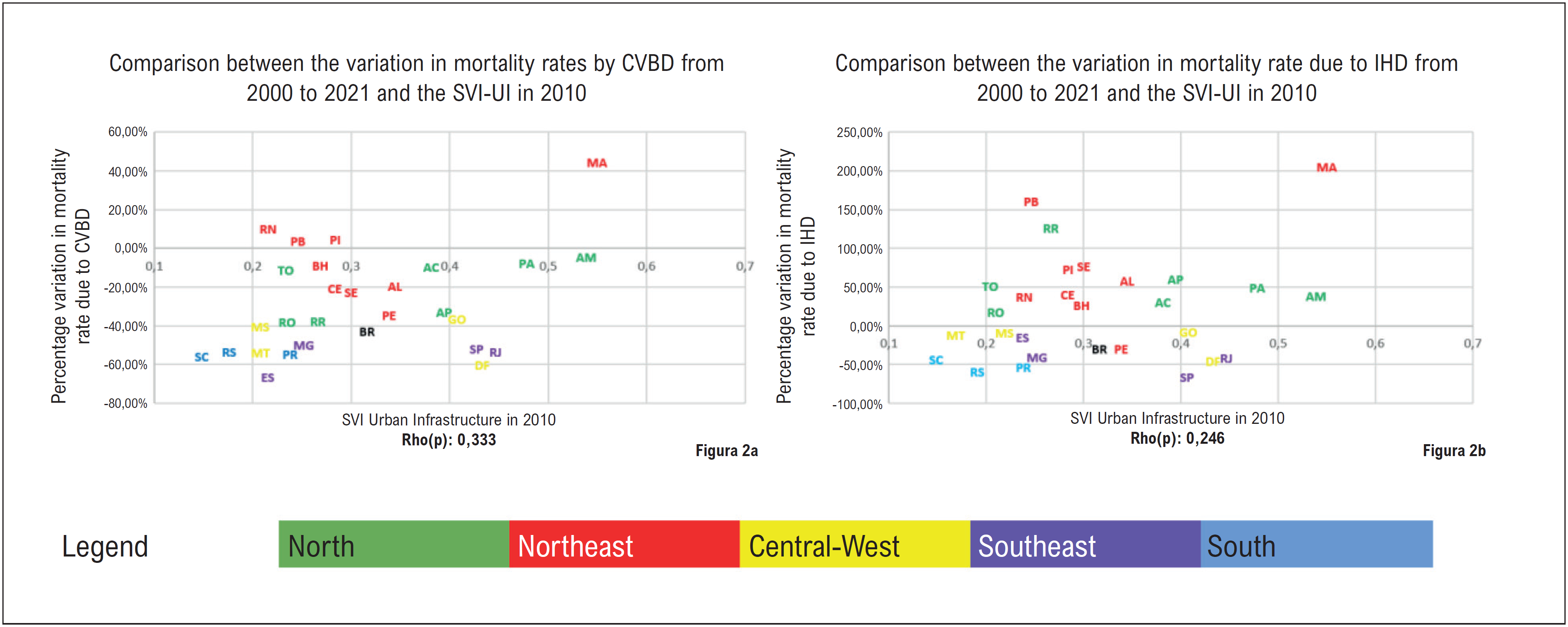
Figure 2 illustrates that the FUs in the North and Northeast regions displayed higher vulnerability in the SVI-UI dimension than the FUs in the South region. Furthermore, the FUs in the North and Northeast regions exhibited a worsening or less expressive reduction in mortality due to IHD and CBVD. However, when the Central-West and Southeast regions were evaluated, it was observed that the Federal District, Goiás, Rio de Janeiro, and São Paulo exhibited greater vulnerability than most of the FUs in the North and Northeast regions. Spearman's correlation revealed a weak correlation. The correlation coefficients found were: SVI-UI x CBVD, Rho(p)=0.33; SVI-UI x IHD, Rho(p)=0.25.

Comparison of the Urban Infrastructure dimension of the 2010 Social Vulnerability Index and the percentage variation in the mortality rate from cerebrovascular diseases and ischemic heart diseases in Brazil and its Federative Units, for both sexes, from 2000 to 2021. (2A) - 2010 SVI-UI and percentage variation in mortality due to CBVD, in both sexes, in Brazil, from 2000 to 2021. (2B) - 2010 SVI-UI and percentage variation in mortality rates due to IHD, for both sexes, in Brazil, from 2000 to 2021.
In Figure 3, the pattern was similar to that observed in Figure 1, where the FUs in the North and Northeast regions exhibited greater vulnerability in terms of human capital, alongside a worsening or less pronounced reduction in mortality due to IHD and CBVD compared with the other regions. Notably, Spearman's correlation identified a strong correlation between SVI-HC and the others. The correlation coefficients were: SVI-HC x CBVD, Rho(p)=0.84; SVI-HC x IHD, Rho(p)=0.84.

Comparison of the Human Capital dimension of the 2010 Social Vulnerability Index and the percentage variation in mortality rate from cerebrovascular diseases and ischemic heart diseases in Brazil and its Federative Units, for both sexes, from 2000 to 2021. (3A) – 2010 SVI-HC and percentage variation in mortality due to CBVD, for both sexes, in Brazil, from 2000 to 2021. (3B) - 2010 SVI-HC and percentage variation in mortality due to IHD, for both sexes, in Brazil, from 2000 to 2021.
In Figure 4, the pattern observed in Figures 1 and 3 reappears. The FUs in the North and Northeast regions exhibited higher vulnerability in the SVI-IE dimension and demonstrated either an increase in mortality due to IHD and CBVD, or, in the case of a decrease, this was less pronounced compared with other FUs in the other regions. Spearman's correlation identified a strong correlation, although it was less pronounced than the values obtained for SVI-HC and the SVI. The correlation coefficients were: SVI-IE x CBVD, Rho(p)=0.81; SVI-IE x IHD, Rho(p)=0.71.

Comparison of the Income and Employment dimension of the 2010 Social Vulnerability Index and the percentage variation in mortality rate from cerebrovascular diseases and ischemic heart diseases in Brazil and its Federative Units, for both sexes, from 2000 to 2021. (4A) - 2010 SVI-IE and percentage variation in mortality due to CBVD, for both sexes, in Brazil, from 2000 to 2021. (4B) - 2010 SVI-IE and percentage variation in mortality rate due to IHD, for both sexes, in Brazil, from 2000 to 2021.
Discussion
In assessing the SVI dimensions, it was observed that despite improvements in indicators during the period, the vast majority of the FUs in the North and Northeast remained the most vulnerable in the country across all dimensions. Furthermore, there was a clear greater vulnerability among Black and rural populations, as well as increased vulnerability in the Human Capital dimension of the SVI. These findings were also described in other studies observing greater vulnerability among Black populations21-23 and rural populations24-26 in several areas, including access to healthcare.
It was observed that there was either an increase in mortality from IHD and CBVD, or any decrease observed was less pronounced in the FUs of the North and Northeast regions compared with the other FUs, despite the reduction in vulnerability observed during this period. The analysis of the correlations between the variation in mortality due to IHD and CBVD with the dimensions of the SVI alone revealed that the SVI-HC (> 0.83 – strong) achieved a stronger correlation than the SVI (> 0.75 – strong). Additionally, SVI-IE also showed a strong correlation, while SVI-UI exhibited a weak correlation (< 0.35). Previous studies have already identified an association between socioeconomic indicators of development and vulnerability and mortality from these conditions.6,8,9,18,27-31 However, no analysis has yet been conducted to identify which factors have the greatest influence.
Regarding vulnerability, studies from the United States suggest that vulnerability metrics may correlate well with public health outcomes.31 International studies have identified that populations with greater vulnerability are more likely to have cardiovascular risk factors such as hypertension, dyslipidemia, diabetes and smoking,10,32 greater difficulty in accessing healthcare services,33 less access to cardiac rehabilitation services,33,34 more hospital readmissions within 30 days due to heart failure,35 and increased mortality, including early mortality due to cardiovascular diseases.12,13
Previous studies analyzing the SVI in Brazil have identified improvements at a national level but greater vulnerability in the North and Northeast regions,6,8 which aligns with our findings. Concerning mortality due to CBVD, a decline in mortality was also observed in the FUs of the South, Southeast, and Central-West regions,6 which was similar for IHD.8 This study suggests the socioeconomic factors that may have the greatest impact on mortality from both IHD and CBVD.
The Urban Infrastructure dimension, which evaluates garbage collection, inadequate water and sewage supply, and commuting times, demonstrated a weaker correlation than the other dimensions. These findings are primarily due to the fact that the FUs of Federal District (DF), Goiás (GO), Rio de Janeiro (RJ), and São Paulo (SP) exhibited greater vulnerability, contrasting with the patterns observed in the other dimensions. It can be assumed that in RJ and SP, this phenomenon is attributed to the large migratory movements that began in the 1950s, which resulted in rapid and disorganized growth of the urban population, leading to the formation of slums (favelas).36,37 The FUs of GO and DF also experienced a similar process, though on a smaller scale, starting in the 1960s, motivated by the construction of the Federal Capital and later by the expansion of the agricultural frontier.38
Other possible explanations for the correlations not being strong for the SVI-UI dimension include the need for a longer time lag between the improvements in this dimension of social vulnerability and a reduction in mortality, or that this dimension may be represented by other SVI dimensions, such as the Human Capital, which measures infant mortality and years of schooling, or the Income and Employment, which assesses per capita household income, which has already shown isolated correlation in a previous study.18
The Human Capital dimension assesses eight factors related to education/schooling, infant mortality, and young mothers. Previous national studies have identified that populations with lower levels of education are more likely to exhibit risk factors for cardiovascular disease and have less access to healthcare services.39,40 Studies have also shown that higher infant mortality may be associated with more difficult access to healthcare services.18,41 This may justify the stronger correlation of this dimension with mortality from IHD and CBVD. It is likely that this dimension achieved a higher degree of correlation than the SVI itself, as the other dimensions influenced the latter.
Finally, the strong correlation observed in the Income and Employment dimension may be explained by the fact that greater purchasing power leads to access to healthcare services. Previous studies have identified that populations with lower purchasing power have more cardiovascular risk factors and higher mortality due to IHD.18,42 An inverse relationship has also been described, as cardiovascular diseases can leave sequelae and disabilities, affecting the individual's ability to work and increasing healthcare costs.42
The present study employs a novel methodology and enhances current knowledge of cardiovascular diseases by analyzing the dimensions of the SVI for the overall population and for the population strata provided by the IPEA. Additionally, it examines the degree of correlation between these indicators and the variation in the age-standardized mortality rates for IHD and CBVD in Brazil and its FUs.
The limitations of the study include the fact that it is an ecological study, which permits a preliminary population analysis that requires validation by future prospective studies with systematic data collection. The data were obtained from databases and may be susceptible to bias due to issues in data collection, including underreporting, poorly defined causes, or garbage codes. However, it is important to note that these limitations are systemic across all death certificates and databases and do not hinder the global analysis of the data.
The central hypothesis of a correlation between a reduction in social vulnerability and a decrease in mortality rates from IHDs and CBVDs was corroborated in this study. Analyzing the SVI by population strata allowed us to infer that the clusters of rural populations, women, and Black individuals, historically associated with greater social vulnerability, would experience smaller reductions in mortality rates due to IHD and CBVD. Future studies covering longer time periods may improve the understanding of which components of the SVI will have the greatest impact on reducing morbidity and mortality from cardiovascular diseases, helping to guide public policies focused on health.
Conclusion
The analysis of the SVI dimensions enabled the identification of a reduction in vulnerability in Brazil and in most of its FUs across all dimensions, despite the persistence of inequalities with greater vulnerability in the FUs in the North and Northeast. Additionally, increased vulnerability was identified among Black and rural populations. Despite the reduction in vulnerability in the North and Northeast FUs, a pronounced decrease in mortality from IHDs and CBVDs was not observed. A strong correlation was identified between the variation in SVI, SVI-HC, and SVI-IE and the variation in mortality from IHD and CBVD. These data may inform public investments aimed at reducing mortality from these conditions.
Data Availability
The underlying content of the research text is contained within the manuscript.
*Supplemental Materials
For additional information, please click here.
References
-
1 Vaduganathan M, Mensah GA, Turco JV, Fuster V, Roth GA. The Global Burden of Cardiovascular Diseases and Risk: A Compass for Future Health. J Am Coll Cardiol. 2022;80(25):2361-71. doi: 10.1016/j.jacc.2022.11.005.
» https://doi.org/10.1016/j.jacc.2022.11.005 -
2 World Health Organization. Newsroom. Fact Sheets. Details. Cardiovascular Diseases (CVDs) [Internet]. Geneva: World Health Organization; 2021 [cited 2025 Jul 03]. Avaialable from: https://www.who.int/news-room/fact-sheets/detail/cardiovascular-diseases-(cvds)
» https://www.who.int/news-room/fact-sheets/detail/cardiovascular-diseases-(cvds) -
3 World Health Organization. The top 10 Causes of Death. Geneva: World Health Organization; 2020 [cited 2025 Jul 03]. Avaialable from: https://www.who.int/news-room/fact-sheets/detail/the-top-10-causes-of-death#:~:text=The%20top%20global%20causes%20of,birth%20asphyxia%20and%20birth%20trauma%2C
» https://www.who.int/news-room/fact-sheets/detail/the-top-10-causes-of-death#:~:text=The%20top%20global%20causes%20of,birth%20asphyxia%20and%20birth%20trauma%2C -
4 Oliveira GMM, Brant LCC, Polanczyk CA, Biolo A, Nascimento BR, Malta DC, et al. Cardiovascular Statistics - Brazil 2020. Arq Bras Cardiol. 2020;115(3):308-439. doi: 10.36660/abc.20200812.
» https://doi.org/10.36660/abc.20200812 -
5 Oliveira GMM, Brant LCC, Polanczyk CA, Malta DC, Biolo A, Nascimento BR, et al. Cardiovascular Statistics - Brazil 2021. Arq Bras Cardiol. 2022;118(1):115-373. doi: 10.36660/abc.20211012.
» https://doi.org/10.36660/abc.20211012 -
6 Souza CDF, Oliveira DJ, Silva LFD, Santos CDD, Pereira MC, Paiva JPS, et al. Cerebrovascular Disease Mortality Trend in Brazil (1996 To 2015) and Association with Human Development Index and Social Vulnerability. Arq Bras Cardiol. 2021;116(1):89-99. doi: 10.36660/abc.20190532.
» https://doi.org/10.36660/abc.20190532 -
7 Moran AE, Forouzanfar MH, Roth GA, Mensah GA, Ezzati M, Murray CJ, et al. Temporal Trends in Ischemic Heart Disease Mortality in 21 World Regions, 1980 to 2010: The Global Burden of Disease 2010 Study. Circulation. 2014;129(14):1483-92. doi: 10.1161/CIRCULATIONAHA.113.004042.
» https://doi.org/10.1161/CIRCULATIONAHA.113.004042 -
8 Bastos LAVM, Bichara JLP, Nascimento GS, Villela PB, Oliveira GMM. Mortality from Diseases of the Circulatory System in Brazil and Its Relationship with Social Determinants Focusing on Vulnerability: An Ecological Study. BMC Public Health. 2022;22(1):1947. doi: 10.1186/s12889-022-14294-3.
» https://doi.org/10.1186/s12889-022-14294-3 -
9 Villela PB, Klein CH, Oliveira GMM. Socioeconomic Factors and Mortality Due to Cerebrovascular and Hypertensive Disease in Brazil. Rev Port Cardiol. 2019;38(3):205-12. doi: 10.1016/j.repc.2018.07.007.
» https://doi.org/10.1016/j.repc.2018.07.007 -
10 Sunderraj A, Rivera A, Gaddam M, Kim S, McCook J, O’Neal J, et al. Associations of Social Vulnerability Index with Pathologic Myocardial Findings at Autopsy. Front Cardiovasc Med. 2021;8:805278. doi: 10.3389/fcvm.2021.805278.
» https://doi.org/10.3389/fcvm.2021.805278 -
11 Jain V, Al Rifai M, Khan SU, Kalra A, Rodriguez F, Samad Z, et al. Association between Social Vulnerability Index and Cardiovascular Disease: A Behavioral Risk Factor Surveillance System Study. J Am Heart Assoc. 2022;11(15):e024414. doi: 10.1161/JAHA.121.024414.
» https://doi.org/10.1161/JAHA.121.024414 -
12 Ganatra S, Dani SS, Kumar A, Khan SU, Wadhera R, Neilan TG, et al. Impact of Social Vulnerability on Comorbid Cancer and Cardiovascular Disease Mortality in the United States. JACC CardioOncol. 2022;4(3):326-37. doi: 10.1016/j.jaccao.2022.06.005.
» https://doi.org/10.1016/j.jaccao.2022.06.005 -
13 Khan SU, Javed Z, Lone AN, Dani SS, Amin Z, Al-Kindi SG, et al. Social Vulnerability and Premature Cardiovascular Mortality Among US Counties, 2014 to 2018. Circulation. 2021;144(16):1272-9. doi: 10.1161/CIRCULATIONAHA.121.054516.
» https://doi.org/10.1161/CIRCULATIONAHA.121.054516 -
14 Instituto de Pesquisa Econômica Aplicada. Atlas da Vulnerabilidade Social [Internet]. Brasília: Instituto de Pesquisa Econômica Aplicada; 2025 [cited 2025 Jul 03]. Avaialable from: http://ivs.ipea.gov.br/index.php/pt/
» http://ivs.ipea.gov.br/index.php/pt/ -
15 Brasil. Ministério da Saúde. DATASUS. Informações de Saúde. Morbidade e Informações Epidemiológicas. Brasília: Ministério da Saúde; 2025 [cited 2025 Jul 03]. Avaialable from: http://www.datasus.gov.br
» http://www.datasus.gov.br - 16 Organização Mundial da Saúde. Classificação Estatística Internacional de Doenças e Problemas Relacionados à Saúde. 10th. ed. São Paulo: EDUSP; 1995.
- 17 Vermelho LL, Costa AJ, Kale PL. Indicadores de Saúde. In: Medronho RA. Epidemiologia. São Paulo: Atheneu; 2008. p. 33-56.
-
18 Soares GP, Brum JD, Oliveira GM, Klein CH, Silva NAS. Evolution of Socioeconomic Indicators and Cardiovascular Mortality in Three Brazilian States. Arq Bras Cardiol. 2013;100(2):147-56. doi: 10.5935/abc.20130028.
» https://doi.org/10.5935/abc.20130028 -
19 Bichara JL, Bastos LA, Villela PB, Oliveira GMM. Socioeconomic Indicators and Mortality from Ischemic Heart Disease and Cerebrovascular Disease in Brazil from 2000 to 2019. Arq Bras Cardiol. 2023;120(8):e20220832. doi: 10.36660/abc.20220832.
» https://doi.org/10.36660/abc.20220832 - 20 Rumsey DJ. Statistics for Dummies. 2nd ed. Hoboken: Wiley; 2016.
-
21 Sena A, Rodrigues M. Pandemia e Estado Necropolítico: Um Ensaio Sobre as Políticas Públicas e o Agravamento das Vulnerabilidades da População Negra Frente a COVID-19. Revista Fim do Mundo. 2021;2(4):133-54. doi: 10.36311/2675-3871.2021.v2n4.p133-154.
» https://doi.org/10.36311/2675-3871.2021.v2n4.p133-154 - 22 Amthauer C, Kaspary D, Stuelp M, Alves MDV, Balbinot M. A Vulnerabilidade em Saúde Enfrentada pela População Negra. Unoesc São Miguel do Oeste. 2020;5:e27062.
-
23 Hüning SM, Silva AK, Braga TL Netto. Vulnerability of the Black Population and Educational Policies in Brazil. Cad CEDES. 2021;41(114):110-9. doi: 10.1590/CC223650.
» https://doi.org/10.1590/CC223650 -
24 Behnke L. Rural and Indigenous Vulnerable Populations: A Case Study. Nurs Clin North Am. 2022;57(3):413-20. doi: 10.1016/j.cnur.2022.04.007.
» https://doi.org/10.1016/j.cnur.2022.04.007 -
25 Bettenhausen JL, Winterer CM, Colvin JD. Health and Poverty of Rural Children: An Under-Researched and Under-Resourced Vulnerable Population. Acad Pediatr. 2021;21(8S):S126-33. doi: 10.1016/j.acap.2021.08.001.
» https://doi.org/10.1016/j.acap.2021.08.001 -
26 Souza S, Pappen M, Krug SBF, Renner JDP, Reuter CP, Pohl HH. A Narrative Review Associating Health Vulnerability and Environmental Factors Among Rural Workers. Rev Bras Med Trab. 2020;16(4):503-8. doi: 10.5327/Z1679443520180250.
» https://doi.org/10.5327/Z1679443520180250 -
27 Clark AM, DesMeules M, Luo W, Duncan AS, Wielgosz A. Socioeconomic Status and Cardiovascular Disease: Risks and Implications for Care. Nat Rev Cardiol. 2009;6(11):712-22. doi: 10.1038/nrcardio.2009.163.
» https://doi.org/10.1038/nrcardio.2009.163 -
28 Zhu KF, Wang YM, Zhu JZ, Zhou QY, Wang NF. National Prevalence of Coronary Heart Disease and Its Relationship with Human Development Index: A Systematic Review. Eur J Prev Cardiol. 2016;23(5):530-43. doi: 10.1177/2047487315587402.
» https://doi.org/10.1177/2047487315587402 -
29 Wu SH, Woo J, Zhang XH. Worldwide Socioeconomic Status and Stroke Mortality: An Ecological Study. Int J Equity Health. 2013;12:42. doi: 10.1186/1475-9276-12-42.
» https://doi.org/10.1186/1475-9276-12-42 -
30 Kreatsoulas C, Anand SS. The Impact of Social Determinants on Cardiovascular Disease. Can J Cardiol. 2010;26(Suppl C):8C-13C. doi: 10.1016/s0828-282x(10)71075-8.
» https://doi.org/10.1016/s0828-282x(10)71075-8 -
31 Saulsberry L, Bhargava A, Zeng S, Gibbons JB, Brannan C, Lauderdale DS, et al. The Social Vulnerability Metric (SVM) as a New Tool for Public Health. Health Serv Res. 2023;58(4):873-81. doi: 10.1111/1475-6773.14102.
» https://doi.org/10.1111/1475-6773.14102 -
32 Ibrahim BB, Barcelona V, Condon EM, Crusto CA, Taylor JY. The Association between Neighborhood Social Vulnerability and Cardiovascular Health Risk Among Black/African American Women in the InterGEN Study. Nurs Res. 2021;70(5S Suppl 1):S3-S12. doi: 10.1097/NNR.0000000000000523.
» https://doi.org/10.1097/NNR.0000000000000523 -
33 Thompson ZM, Jain V, Chen YH, Kayani W, Patel A, Kianoush S, et al. State-Level Social Vulnerability Index and Healthcare Access in Patients with Atherosclerotic Cardiovascular Disease (from the BRFSS Survey). Am J Cardiol. 2022;178:149-53. doi: 10.1016/j.amjcard.2022.05.025.
» https://doi.org/10.1016/j.amjcard.2022.05.025 -
34 Kianoush S, Al Rifai M, Patel J, George J, Gulati M, Taub P, et al. Association of Participation in Cardiac Rehabilitation with Social Vulnerability Index: The Behavioral Risk Factor Surveillance System. Prog Cardiovasc Dis. 2022;71:86-91. doi: 10.1016/j.pcad.2022.02.003.
» https://doi.org/10.1016/j.pcad.2022.02.003 -
35 Regmi MR, Tandan N, Parajuli P, Bhattarai M, Maini R, Kulkarni A, et al. Social Vulnerability Indices as a Risk Factor for Heart Failure Readmissions. Clin Med Res. 2021;19(3):116-22. doi: 10.3121/cmr.2021.1603.
» https://doi.org/10.3121/cmr.2021.1603 - 36 Abreu M, Vaz LF. Sobre as Origens da Favela. Proceedings of the IV Encontro Nacional da ANPUR; 1991; Salvador. Salvador: Associação Nacional de Pós-graduação e Pesquisa em Planejamento Urbano e Regional; 1991. Belo Horizonte: ANPUR; 1991. p. 481–92.
- 37 Villaça F. Uma Contribuição para a História do Planejamento Urbano no Brasil. In: Deák, C, Schiffer SR, editors. O Processo de Urbanização no BRASIL. São Paulo: EdUSP; 1999. p. 169-243.
-
38 Amaral EFL, Rodrigues RN, Fígoli MGB. Síntese da Migração em Goiás e no Distrito Federal nas Últimas Décadas. Sociedade e Cultura. 2002;5(2):127-36. doi: 10.5216/sec.v5i2.565.
» https://doi.org/10.5216/sec.v5i2.565 -
39 Teixeira CNG, Pereira SMDS, Hilgert JB, Oliveira NMA, Ribeiro CCC, Neves M, et al The Use of Dental Services in the Past Year in the Brazilian Population: A Systematic Review with Meta-Analysis. Cien Saude Colet. 2023;28(4):1087-100. doi: 10.1590/1413-81232023284.11452022.
» https://doi.org/10.1590/1413-81232023284.11452022 -
40 Malta DC, Gomes CS, Stopa SR, Andrade FMD, Prates EJS, Oliveira PPV, et al. Desigualdades na Assistência à Saúde e no Acesso aos Serviços de Saúde em Adultos Brasileiros com Autorrelato de Hipertensão Arterial: Pesquisa Nacional de Saúde. Cadernos de Saúde Pública. 2022;38(13):e00125421. doi: 10.1590/0102-311xe00125421.
» https://doi.org/10.1590/0102-311xe00125421 -
41 Preslar JP, Worrell MC, Kaiser R, Cain CJ, Samura S, Jambai A, et al. Effect of Delays in Maternal Access to Healthcare on Neonatal Mortality in Sierra Leone: A Social Autopsy Case-Control Study at a Child Health and Mortality Prevention Surveillance (CHAMPS) Site. Matern Child Health J. 2021;25(8):1326-35. doi: 10.1007/s10995-021-03132-4.
» https://doi.org/10.1007/s10995-021-03132-4 -
42 Yusuf S, Rangarajan S, Teo K, Islam S, Li W, Liu L, et al. Cardiovascular Risk and Events in 17 Low-, Middle-, and High-Income Countries. N Engl J Med. 2014;371(9):818-27. doi: 10.1056/NEJMoa1311890.
» https://doi.org/10.1056/NEJMoa1311890
-
Sources of funding
There were no external funding sources for this study.
-
Study association
This article is part of the thesis of master submitted by José Lucas Bichara, from Universidade Federal do Rio de Janeiro.
-
Ethics approval and consent to participate
This article does not contain any studies with human participants or animals performed by any of the authors.
-
Use of Artificial Intelligence
The authors did not use any artificial intelligence tools in the development of this work.
Edited by
-
Editor responsible for the review:
Marcio Bittencourt

 IVS: Índice de vulnerabilidade social; IVS-IU: Dimensão infraestrutura urbana do Índice de Vulnerabilidade social; IVS-RT: Dimensão renda e trabalho do Índice de Vulnerabilidade social; IVS-CH: Dimensão capital humano do Índice de Vulnerabilidade social. Os dados expostos nos mapas são do ano de 2021.
 SVI: Social Vulnerability Index; SVI-UI: Urban Infrastructure dimension of the Social Vulnerability Index; SVI-IE: Income and Employment dimension of the Social Vulnerability Index; SVI-HC: Human Capital dimension of the Social Vulnerability Index. The data displayed on the maps are from the year 2021.