 Is This a Causal Relationship? Mendelian Randomization as a Statistical Method for Unraveling Connections
Keywords
Mendelian Randomization Analysis; Cardiovascular Diseases; Sedentary Behavior
Palavras-chave
Análise da Randomização Mendeliana; Doenças Cardiovasculares; Comportamento Sedentário
Keywords
Mendelian Randomization Analysis; Cardiovascular Diseases; Sedentary Behavior
Palavras-chave
Análise da Randomização Mendeliana; Doenças Cardiovasculares; Comportamento Sedentário
Mendelian Randomization (MR) is a powerful statistical tool to infer a causal relationship between the presence of genetic variants and different traits and phenotypes.1,2 It is particularly useful when trying to elucidate causal relationships between exposures and outcomes based on observational data. This method bases itself on the principle of randomness of how genetic variants might segregate during the process of meiosis, the Mendelian principle of independent assortment.2
Since past decades, as our knowledge about the genetic architecture of human beings has been enhanced, the challenge is to understand how genetic variants may contribute to the development of phenotypes and traits. We have learned from this growing comprehension that as the genetic complexity of a specific trait rises, it may be less inheritable, and our predictive power reduces.3
In response to that effect, several techniques have been developed, such as MR. This technique allows to mitigate the interference of confounder factors and biases commonly presented by observational studies.1,2 Indeed, the proper evaluation of all MR assumptions may ensure the validity of causal inferences caused by this kind of evaluation. In the past years, studies regarding MR have been published in several areas of medical studies besides the field of medical genetics and genomics (such as cardiology, nephrology, and hepatology).1,4,5
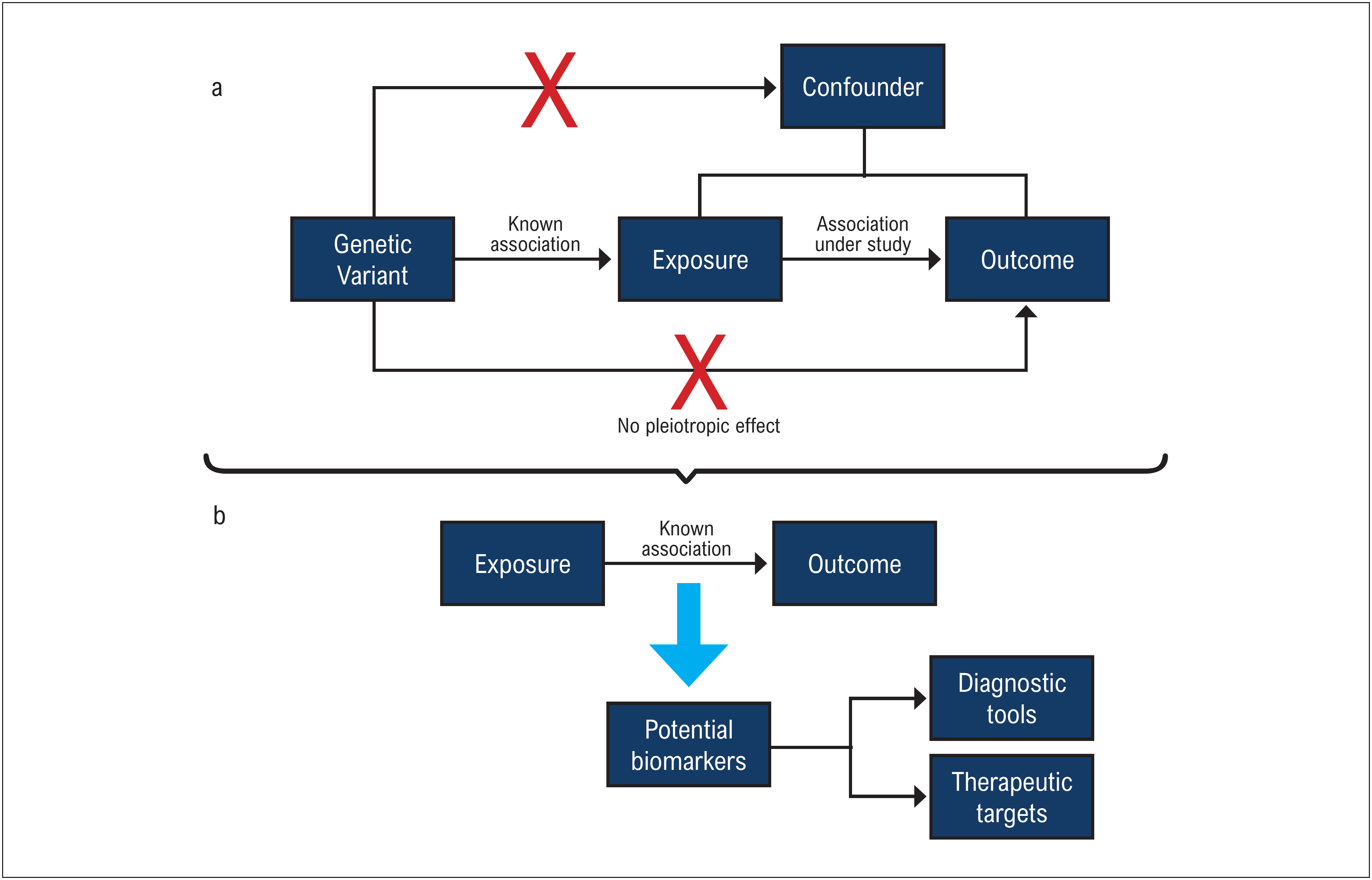
Three main pillars compound the assumptions of MR regarding a known genetic variant that can be applied to that kind of study: the known genetic variant is associated with the exposure of interest; the genetic variant is not associated with any confounder factor of the relationship exposure-outcome; and the genetic variant affects the outcome exclusively through the exposure, excluding any possibility of pleiotropy.2,5 Figure 1a resumes the main assumptions of an MR study.
Workflow architecture of an MR study. (a) Refers to the assumptions that must be respected to guarantee its validity to infer a causal relationship. (b) Indicates the results of a well-designed MR and potential insights that can come from the exposure-outcome association.
Moreover, an MR study can also infer and possibly identify potential biomarkers for diseases by leveraging genetic variants as instrumental variables. By identifying genetic variants that influence exposure events and subsequently assessing their impact on outcomes, MR can properly highlight biomarkers that can later be used to develop diagnostic tools and possible therapeutic targets.6-8 Figure 1b summarizes potential gains that can come from an MR study.
In that context, television viewing time, a particular measure of sedentary behavior which is already associated with increased risk of cardiovascular diseases, cardiometabolic risk, and increased mortality at all,9,10 MR emerges as an interesting approach not just to reinforce this connection but also to elucidate potential mechanisms and biological pathways that may be involved in.11
In this study, the authors used MR to identify not only an association between elevated television viewing time and several cardiometabolic diseases—consistent with existing literature—but also to uncover key inflammatory and metabolic markers potentially involved in this relationship. These markers include increased levels of interleukins, C-reactive protein, leptin, visceral and subcutaneous adipose tissue, as well as elevated body mass index, waist circumference, and triglyceride levels. These findings suggest potential mechanisms that could be explored in future research to improve diagnosis and treatment or to propose novel strategies for managing patients with cardiovascular disease.
Indeed, MR may be a powerful method; however, some limitations must be highlighted: the main factor that may reduce MR predictive power is a population bias. As most of the association between genetic variants and genetic traits is based on studies of European ancestry, sometimes the association cannot be exploited to non-European populations, especially in those with high inbreeding rates or with admixed genetic backgrounds such as Brazilians. Further populational genetic studies are needed to stratify and better understand the genetic role in developing traits. Also, it is important to notice that MR is a powerful tool to infer associations and only allows the generation of hypotheses about potential biomarkers and mechanisms; new studies must come over to certify these hypotheses.12,13
Short Editorial related to the article:
References
-
1 Larsson SC, Butterworth AS, Burgess S. Mendelian Randomization for Cardiovascular Diseases: Principles and Applications. Eur Heart J. 2023;44(47):4913-24. doi: 10.1093/eurheartj/ehad736.
» https://doi.org/10.1093/eurheartj/ehad736 -
2 Nguyen K, Mitchell BD. A Guide to Understanding Mendelian Randomization Studies. Arthritis Care Res. 2024(1):1-11. doi: 10.1002/acr.25400.
» https://doi.org/10.1002/acr.25400 -
3 Janssens AC, van Duijn CM. An Epidemiological Perspective on the Future of Direct-to-consumer Personal Genome Testing. Investig Genet. 2010;1(1):10. doi: 10.1186/2041-2223-1-10.
» https://doi.org/10.1186/2041-2223-1-10 -
4 Dobrijevic E, van Zwieten A, Kiryluk K, Grant AJ, Wong G, Teixeira-Pinto A. Mendelian Randomization for Nephrologists. Kidney Int. 2023;104(6):1113-23. doi: 10.1016/j.kint.2023.09.016.
» https://doi.org/10.1016/j.kint.2023.09.016 -
5 Song Y, Ye T, Roberts LR, Larson NB, Winham SJ. Mendelian Randomization in Hepatology: A Review of Principles, Opportunities, and Challenges. Hepatology. 2023. doi: 10.1097/HEP.0000000000000649.
» https://doi.org/10.1097/HEP.0000000000000649 -
6 Zuber V, Colijn JM, Klaver C, Burgess S. Selecting Likely Causal Risk Factors from High-throughput Experiments Using Multivariable Mendelian Randomization. Nat Commun. 2020;11(1):29. doi: 10.1038/s41467-019-13870-3.
» https://doi.org/10.1038/s41467-019-13870-3 -
7 Burgess S, Mason AM, Grant AJ, Slob EAW, Gkatzionis A, Zuber V, et al. Using Genetic Association Data to Guide Drug Discovery and Development: Review of Methods and Applications. Am J Hum Genet. 2023;110(2):195-214. doi: 10.1016/j.ajhg.2022.12.017.
» https://doi.org/10.1016/j.ajhg.2022.12.017 -
8 Jansen H, Samani NJ, Schunkert H. Mendelian Randomization Studies in Coronary Artery Disease. Eur Heart J. 2014;35(29):1917-24. doi: 10.1093/eurheartj/ehu208.
» https://doi.org/10.1093/eurheartj/ehu208 -
9 Grøntved A, Hu FB. Television Viewing and risk of Type 2 Diabetes, Cardiovascular Disease, and All-cause Mortality: A Meta-analysis. JAMA. 2011;305(23):2448-55. doi: 10.1001/jama.2011.812.
» https://doi.org/10.1001/jama.2011.812 -
10 Thorp AA, Healy GN, Owen N, Salmon J, Ball K, Shaw JE, et al. Deleterious Associations of Sitting Time and Television Viewing Time with Cardiometabolic Risk Biomarkers: Australian Diabetes, Obesity and Lifestyle (AusDiab) study 2004-2005. Diabetes Care. 2010;33(2):327-34. doi: 10.2337/dc09-0493.
» https://doi.org/10.2337/dc09-0493 -
11 Meng-jin H, Li B, Xia J, Yin C, Yang Y. Relação Causal entre Tempo de Exibição de Televisão, Doenças Cardiovasculares e Mecanismos Potenciais. Arq Bras Cardiol. 2024; 121(10):e20230796. DOI: https://doi.org/10.36660/abc.20230796
» https://doi.org/10.36660/abc.20230796 -
12 Cinelli C, La Pierre N, Hill BL, Sankararaman S, Eskin E. Robust Mendelian Randomization in the Presence of Residual Population Stratification, Batch Effects and Horizontal Pleiotropy. Nat Commun. 2022;13(1):1093. doi: 10.1038/s41467-022-28553-9.
» https://doi.org/10.1038/s41467-022-28553-9 -
13 Islam SN, Ahammed T, Anjum A, Albalawi O, Uddin MJ. Reporting Methodological Issues of the Mendelian Randomization Studies in Health and Medical Research: A Systematic Review. BMC Med Res Methodol. 2022;22(1):21. doi: 10.1186/s12874-022-01504-0.
» https://doi.org/10.1186/s12874-022-01504-0