 Sodium-Glucose Cotransporter 2 Inhibitors in Patients with Heart Failure and Transthyretin or Light Chain Amyloidosis: A Real-World Analysis
Abstract
Background: Evidence regarding the efficacy of sodium-glucose cotransporter 2 inhibitors (SGLT2i) in amyloidosis-related heart failure (HF) remains limited.
Objective: To evaluate the impact of SGLT2i in patients with amyloid transthyretin (ATTR) or amyloid light-chain (AL) amyloidosis and HF.
Methods: By using global electronic medical record data, we identified patients aged ≥ 18 years with ATTR or AL amyloidosis and HF. After matching, outcomes were compared between patients treated with SGLT2i and matched controls, including 2,036 patients with ATTR amyloidosis and 692 patients with AL amyloidosis. Endpoints included 12-month all-cause mortality, hospitalization, and kidney outcomes. Statistical significance was defined as a two-sided p < 0.05.
Results: A total of 96 (9.43%) deaths occurred among patients with ATTR amyloidosis in the SGLT2i group, compared to 196 (19.2%) in the control group (hazard ratio [HR], 0.52; 95% CI, 0.41-0.66). Hospitalization occurred in 387 (38.0%) patients receiving SGLT2i and in 505 (49.6%) controls (HR, 0.74; 95% CI, 0.65-0.84). Kidney outcomes were observed in 204 (20.0%) patients in the SGLT2i group and 298 (28.5%) in the control group (HR, 0.72; 95% CI, 0.60-0.86). Among patients with AL amyloidosis, 39 (11.2%) deaths occurred in the SGLT2i group and 80 (23.1%) in the control group (HR, 0.51; 95% CI, 0.34-0.74). Hospitalization occurred in 161 (46.5%) patients treated with SGLT2i and in 204 (58.96%) controls (HR, 0.71; 95% CI, 0.58-0.88). Kidney outcomes occurred in 86 (24.8%) patients in the SGLT2i group and 137 (39.6%) in the control group (HR, 0.60; 95% CI, 0.46-0.78).
Conclusion: In patients with HF due to ATTR or AL amyloidosis, the use of SGLT2i was associated with lower all-cause mortality, hospitalization, and kidney outcomes.
Keywords:
Amyloidosis; Heart Failure; Sodium-Glucose Transporter 2 Inhibitors; Mortality

Resumo
Fundamento: As evidências sobre a eficácia dos inibidores do cotransportador de sódio-glicose 2 (iSGLT2) na insuficiência cardíaca (IC) associada à amiloidose permanecem limitadas.
Objetivo: Avaliar o impacto dos iSGLT2 em pacientes com amiloidose por transtirretina amiloide (ATTR) ou por cadeias leves amiloides (AL) e IC.
Métodos: Utilizando dados globais de prontuários eletrônicos, identificamos pacientes com idade ≥ 18 anos com amiloidose por ATTR ou AL e IC. Após o pareamento, os desfechos foram comparados entre pacientes tratados com iSGLT2 e controles pareados, incluindo 2.036 pacientes com amiloidose por ATTR e 692 pacientes com amiloidose por AL. Os desfechos incluíram mortalidade por todas as causas em 12 meses, hospitalização e desfechos renais. A significância estatística foi definida como p bilateral < 0,05.
Resultados: Entre os pacientes com amiloidose por ATTR, ocorreram 96 (9,43%) óbitos no grupo iSGLT2, em comparação com 196 (19,2%) no grupo controle (hazard ratio [HR], 0,52; intervalo de confiança 95% [IC 95%], 0,41-0,66). Hospitalizações ocorreram em 387 (38,0%) pacientes em uso de iSGLT2 e em 505 (49,6%) controles (HR, 0,74; IC 95%, 0,65-0,84). Desfechos renais foram observados em 204 (20,0%) pacientes no grupo iSGLT2 e em 298 (28,5%) no grupo controle (HR, 0,72; IC 95%, 0,60-0,86). Entre os pacientes com amiloidose por AL, ocorreram 39 (11,2%) óbitos no grupo iSGLT2 e 80 (23,1%) no grupo controle (HR, 0,51; IC 95%, 0,34-0,74). Hospitalizações ocorreram em 161 (46,5%) pacientes tratados com iSGLT2 e em 204 (58,96%) controles (HR, 0,71; IC 95%, 0,58-0,88). Desfechos renais ocorreram em 86 (24,8%) pacientes no grupo iSGLT2 e em 137 (39,6%) no grupo controle (HR, 0,60; IC 95%, 0,46-0,78).
Conclusão: Em pacientes com IC decorrente de amiloidose por ATTR ou AL, o uso de iSGLT2 esteve associado a menor mortalidade por todas as causas, menor taxa de hospitalização e menor ocorrência de desfechos renais.
Palavras-chave:
Amiloidose; Insuficiência Cardíaca; Inibidores do Transportador 2 de Sódio-Glicose; Mortalidade

Introduction
Amyloidosis is a heterogeneous disease characterized by the extracellular deposition of amyloid fibrils in multiple tissues. To date, at least 36 distinct human proteins have been identified as precursors of amyloid fibrils. Among these, misfolded monoclonal immunoglobulin light chains resulting from abnormal clonal plasma cell proliferation and transthyretin, a protein synthesized in the liver, are the precursors most commonly associated with amyloidosis.1 Heart involvement is frequent in both amyloid light-chain (AL) and amyloid transthyretin (ATTR) amyloidosis and typically leads to restrictive cardiomyopathy and, consequently, heart failure (HF).2
Amyloid fibril deposition in the heart may involve the myocardium, pericardium, endocardium, and vasculature and is associated with poor prognosis and a marked reduction in overall survival. In untreated AL amyloidosis, heart involvement is associated with an average survival of fewer than 6 months.3 Among patients with wild-type ATTR amyloidosis, mean survival ranges of 3.6-4.7 years,4,5 whereas in hereditary ATTR amyloidosis related to the Val122Ile genetic variant, mean survival is estimated at 2.5 years.2,5 Recent advances have modified the natural history of amyloidosis, including daratumumab-bortezomib-based regimens and autologous stem cell transplantation for AL amyloidosis, as well as the transthyretin stabilizer tafamidis for ATTR amyloidosis.6,7 Despite these advances, HF secondary to cardiac amyloidosis remains a challenging condition, characterized by high mortality, poor treatment tolerance, and suboptimal response to conventional HF therapies, including angiotensin-converting enzyme inhibitors, angiotensin receptor-neprilysin inhibitors, and beta-blockers.8
Sodium-glucose cotransporter 2 inhibitors (SGLT2i) have been shown to reduce the combined risk of cardiovascular death and hospitalization in patients with HF across the spectrum of left ventricular ejection fraction (LVEF), including reduced, mildly reduced, and preserved LVEF.9,10 These findings suggest that SGLT2i may represent a potential therapeutic option for patients with amyloidosis-related HF. In clinical practice, SGLT2i have been used off label in this population, as patients with amyloidosis were excluded from pivotal SGLT2i trials. Consequently, robust scientific evidence regarding their impact in this specific setting remains limited. To address this gap, the present study aimed to evaluate the real-world impact of SGLT2i on mortality and hospitalization in patients with amyloidosis and HF, using data from a large, collaborative, multinational platform.
Methods
Data source
Data were obtained from the TriNetX network (TriNetX, Inc., Cambridge, MA), a global, collaborative clinical research platform that aggregates real-time electronic medical records, including demographics, diagnoses, procedures, medications, laboratory results, and vital status. The network comprises health care organizations worldwide and includes data from approximately 142 million individuals. TriNetX provides access to aggregated counts and statistical summaries of deidentified data; therefore, no protected health information or personal identifiers are available to users. Data were extracted and analyzed from the Global Collaborative Network on the TriNetX platform on March 15, 2024.
Study population
TriNetX was queried to identify patients of both sexes aged ≥ 18 years with familial or wild-type ATTR amyloidosis or AL amyloidosis as well as a diagnosis of HF or cardiomyopathy. Diagnoses were identified using International Classification of Diseases, 10th Revision (ICD-10) codes and TriNetX-specific codes recorded between March 14, 2014, and March 13, 2023. Patients receiving SGLT2i (e.g., empagliflozin, dapagliflozin, or canagliflozin) after the diagnosis of amyloidosis were identified, along with matched control patients not treated with SGLT2i. In total, 6,784 patients with ATTR amyloidosis and 2,839 patients with AL amyloidosis who were not treated with SGLT2i were identified as controls, whereas 1,099 patients with ATTR amyloidosis and 405 patients with AL amyloidosis were receiving SGLT2i therapy. After propensity score matching for demographic and clinical variables, 2,036 patients with ATTR amyloidosis (1,018 in each group) and 692 patients with AL amyloidosis (346 in each group) were included in the comparative analyses.
Study design
This was a retrospective cohort study using data from health care organizations participating in the TriNetX network. The impact of SGLT2i therapy was compared with that of matched controls in patients with amyloidosis and HF. The primary endpoint was all-cause mortality. Secondary outcomes included all-cause hospitalization and a composite kidney outcome defined as acute kidney injury (AKI) or the need for kidney replacement therapy (KRT) during a 12-month follow-up period. The study flowchart is presented in Figure 1.

Study flowchart of patient selection, propensity score matching, and clinical endpoints. AKI: acute kidney injury; AL: amyloid light-chain; ATTR: amyloid transthyretin; HF: heart failure; KRT: kidney replacement therapy; SGLT2i: sodium-glucose cotransporter 2 inhibitors.
Baseline covariates
Information regarding demographic characteristics, comorbidities, and medication use was extracted from electronic medical records for propensity score matching (PSM). Demographic and clinical covariates included i) age; ii) sex and race (White, Black or African American, and other races); iii) overweight or obesity; iv) hypertension; v) chronic kidney disease (CKD); vi) dyslipidemia; vii) diabetes mellitus; viii) ischemic heart disease (IHD); ix) smoking status. Medication data included cardiovascular therapies such as diuretics, beta-blockers, angiotensin inhibitors, platelet aggregation inhibitors, and antilipemic agents as well as disease-specific treatments for AL amyloidosis (daratumumab and bortezomib) and ATTR amyloidosis (tafamidis).
Statistical analysis
Continuous variables were assessed for normality using the Shapiro-Wilk test and are presented as mean ± standard deviation. Categorical variables are reported as absolute numbers and percentages. Comparisons of continuous variables were performed using the unpaired Student's t-test when normally distributed, whereas categorical variables were compared using the chi-square test or Fisher's exact test, as appropriate. Propensity score matching was used to balance baseline covariates between groups. Propensity scores were estimated using logistic regression implemented with the LogisticRegression function from the "scikit-learn" package in Python version 3.7. Kaplan-Meier analyses were conducted to estimate outcome probabilities from 1 day up to 12 months after the index date, and between-group comparisons were performed using the log-rank test. Time-dependent Cox proportional hazards models were used to calculate hazard ratios (HRs) and corresponding 95% CIs, with assessment of the proportional hazards assumption based on scaled Schoenfeld residuals, using the "survival" package for R (version 3.2-3). SGLT2i therapy was modeled as a time-varying exposure, whereby individuals not receiving SGLT2i at the time of amyloidosis diagnosis were classified as not exposed from time zero until the day before treatment initiation and as under treatment thereafter. Patients receiving SGLT2i at baseline remained classified as under treatment throughout follow-up, even if therapy was discontinued. Results were validated by comparison with outputs generated using SAS software, version 9.4. All statistical analyses were conducted within the TriNetX platform. Statistical significance was defined as a two-sided p < 0.05.
Ethical considerations
Studies derived from TriNetX data using deidentified information were approved by the Institutional Review Board of the participating hospital.
Results
Central Illustration summarizes the study design and the main findings.
Characteristics of the study population
Tables 1 and 2 present the baseline characteristics of patients with ATTR and AL amyloidosis before and after propensity score matching, respectively. Overall, patients with ATTR and AL amyloidosis were older adults with a high burden of comorbidities.
Baseline characteristics of patients with familial amyloidosis or wild-type ATTR amyloidosis before and after PSM
Before PSM, patients with ATTR amyloidosis in the SGLT2i group were older and more frequently male than those in the control group. They also had a higher prevalence of hypertension, IHD, diabetes mellitus, overweight or obesity, dyslipidemia, CKD, smoking history, and atrial fibrillation (AF).
Among patients with AL amyloidosis, those in the SGLT2i group had a similar age distribution and proportion of male patients compared with controls but included a lower proportion of White patients. Nevertheless, the SGLT2i group showed a higher prevalence of hypertension, IHD, diabetes mellitus, overweight or obesity, dyslipidemia, CKD, smoking history, and AF.
Endpoints in patients with transthyretin amyloidosis after propensity score matching
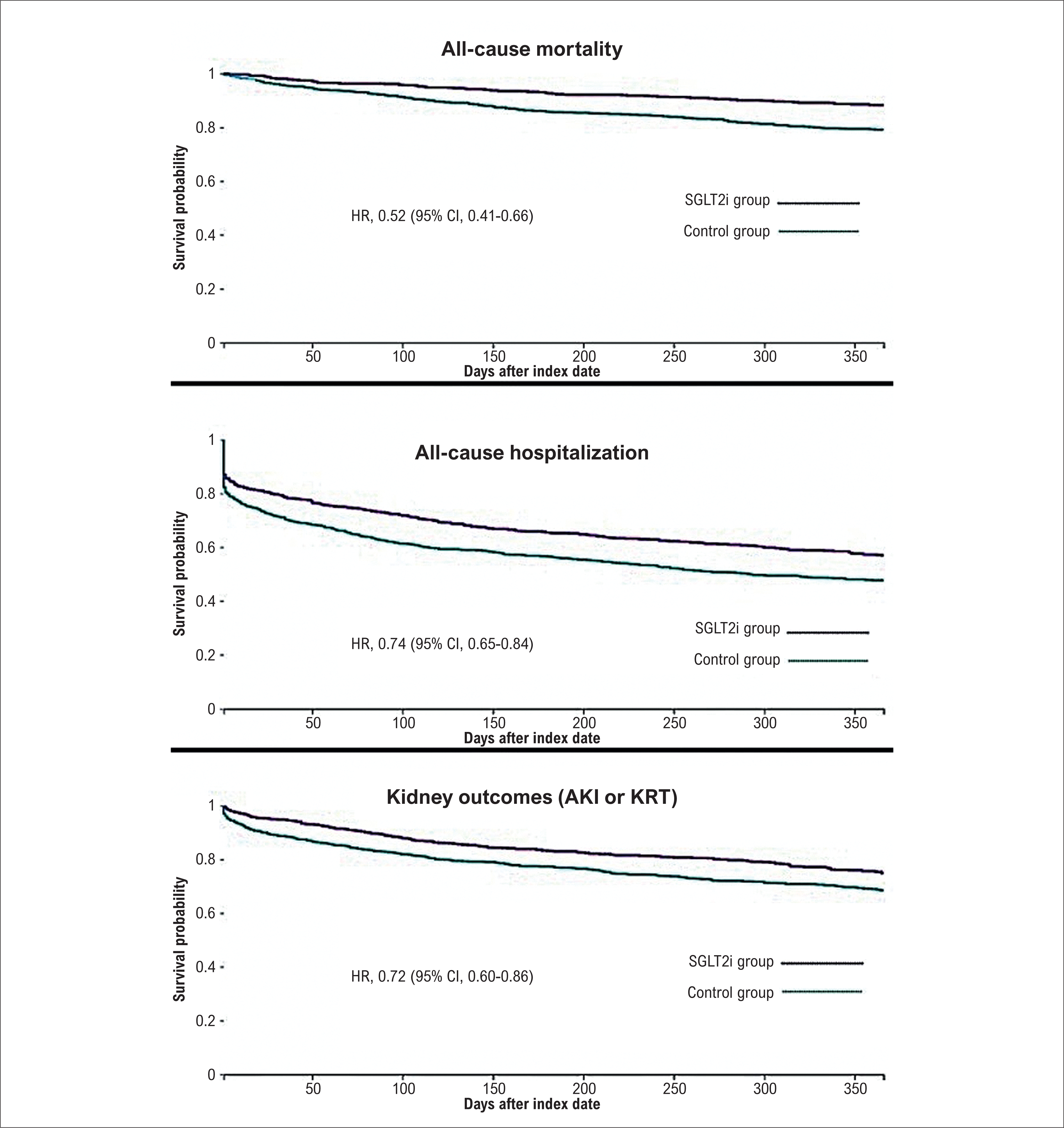
After PSM, 1,018 patients with ATTR amyloidosis were included in each group. During the 12-month follow-up, 96 patients (9.4%) in the SGLT2i group died, compared with 196 patients (19.2%) in the control group (HR, 0.52; 95% CI, 0.41-0.66). Hospitalization occurred in 387 patients (38.0%) in the SGLT2i group and in 505 patients (49.6%) in the control group (HR, 0.74; 95% CI, 0.65-0.84). Kidney outcomes, here defined as AKI or the need for KRT, occurred in 204 patients (20.0%) in the SGLT2i group and in 298 patients (28.5%) in the control group (HR, 0.72; 95% CI, 0.60-0.86). Kaplan-Meier curves for the primary and secondary endpoints over 12 months in patients with ATTR amyloidosis are shown in Figure 2.

12-month Kaplan-Meier survival curves in patients with ATTR amyloidosis after propensity score matching. ATTR: amyloid transthyretin; AKI: acute kidney injury; HR: hazard ratio; KRT: kidney replacement therapy; SGLT2i: sodium-glucose cotransporter 2 inhibitors.
Endpoints in patients with light-chain amyloidosis after propensity score matching
After PSM, 346 patients with AL amyloidosis were included in each group. During follow-up, 39 deaths (11.3%) occurred in the SGLT2i group and 80 deaths (23.1%) in the control group (HR, 0.51; 95% CI, 0.34-0.74). Hospitalization was observed in 161 patients (46.5%) in the SGLT2i group and in 204 patients (58.9%) in the control group (HR, 0.71; 95% CI, 0.58-0.88). Kidney outcomes occurred in 86 patients (24.8%) in the SGLT2i group and in 137 patients (39.5%) in the control group (HR, 0.60; 95% CI, 0.46-0.78). Kaplan-Meier curves for the primary and secondary endpoints in patients with AL amyloidosis over the 12-month follow-up are presented in Figure 3.

12-month Kaplan-Meier survival curves in patients with AL amyloidosis after propensity score matching. AKI: acute kidney injury; AL: amyloid light chain; HR: hazard ratio; KRT: kidney replacement therapy; SGLT2i: sodium-glucose cotransporter 2 inhibitors.
Discussion
In this retrospective cohort study, SGLT2i were associated with a lower risk of 12-month all-cause mortality, hospitalization, and kidney outcomes in patients with amyloidosis of different etiologies and HF.
The protective effects of SGLT2i in patients with amyloidosis and HF may be related to their myocardial actions, including reductions in oxidative stress and inflammation, improvements in heart ionic homeostasis, and enhanced myocardial energetics.11 In addition, noncardiac mechanisms may contribute to the observed benefits on kidney outcomes, particularly in the context of amyloid kidney involvement. These mechanisms include reductions in intraglomerular pressure, kidney metabolic changes, and decreased oxidative stress resulting from lower tubulointerstitial glucose levels, all of which may play a role in mitigating the adverse outcomes observed in this study.12
Several studies have evaluated the effects of SGLT2i in patients with amyloidosis, particularly those with ATTR amyloid cardiomyopathy (ATTR-CM). In a preclinical study using humanized RBP4/TTRVal50Met and RBP4/TTR mouse models, dapagliflozin treatment for 4 weeks was not associated with improvements in biomarker measurements, including plasma B-type natriuretic peptide (BNP) levels, heart inflammation, or pathological changes.13 In contrast, a small retrospective study of patients with ATTR amyloidosis and HF receiving tafamidis reported that initiation of dapagliflozin was well tolerated, associated with few adverse events, and led to reductions in N-terminal pro-BNP (NT-proBNP) levels in 13 of 17 patients.14 Another observational study involving 15 patients with ATTR amyloidosis and diabetes mellitus reported good tolerability and safety, although hard clinical endpoints were not assessed.15
More recently, observational studies and meta-analyses have further explored the effects of SGLT2i in patients with ATTR-CM. In a multicenter cohort study evaluating SGLT2i therapy versus standard care, 220 patients were included in each group after propensity score matching for clinical and laboratory variables, such as age and NT-proBNP levels. During a 28-month follow-up, patients treated with SGLT2i exhibited lower all-cause mortality, cardiovascular mortality, and HF hospitalization.16 Despite differences in population characteristics, covariates, and endpoints, these findings are consistent with the results of the present study. Using the same TriNetX platform, Jaiswal et al.17 evaluated outcomes at 1 month, 1 year, and 3 years in patients with ATTR-CM treated with SGLT2i compared with controls. The use of SGLT2i was associated with significant reductions in all-cause mortality, major adverse cardiovascular events, and ischemic stroke. While both studies demonstrated reductions in all-cause mortality, the present analysis extends these findings by including patients with AL cardiomyopathy, restricting the population to individuals with overt HF, and evaluating additional endpoints, including hospitalization and kidney outcomes.17
Meta-analyses have also supported these observations. In a meta-analysis of five observational studies involving 5,101 patients with ATTR-CM (2,528 treated with SGLT2i and 2,573 controls), using SGLT2i was associated with lower rates of all-cause and cardiovascular mortality, hospitalization, and decreased NT-proBNP levels.18 Another meta-analysis including five observational studies and 9,766 patients with ATTR-CM reported that SGLT2i were associated with a lower risk of all-cause and cardiovascular death, HF hospitalization, and arrhythmias.19 Notably, all recent publications emphasize the need for randomized clinical trials to confirm these findings in patients with amyloidosis.
Large, randomized trials of SGLT2i, including the EMPEROR-Preserved (Empagliflozin in Heart Failure with a Preserved Ejection Fraction) trial9 and the DELIVER (Dapagliflozin in Heart Failure with Mildly Reduced or Preserved Ejection Fraction) trial,10 demonstrated reductions in the composite outcome of cardiovascular death and HF hospitalization in patients with preserved LVEF, with reductions in hospitalization largely driving these effects. However, patients with infiltrative cardiomyopathies, including cardiac amyloidosis, were excluded from these trials, limiting the applicability of their results to this population. In this context, the present findings suggest that patients with amyloidosis and HF may derive similar benefits in terms of mortality, hospitalization, and kidney outcomes.
The kidney-protective effects of SGLT2i in patients with CKD, with or without type 2 diabetes, are well established and have been demonstrated in trials such as EMPA-REG OUTCOME (Empagliflozin, Cardiovascular Outcomes, and Mortality in Type 2 Diabetes) and DECLARE–TIMI 58 (Dapagliflozin and Cardiovascular Outcomes in Type 2 Diabetes).20,21 These effects are attributed to mechanisms including reductions in glomerular hyperfiltration and injury, decreased kidney energy consumption, and attenuation of inflammatory, fibrotic, and proapoptotic pathways.22 Kidney involvement in amyloidosis results from amyloid fibril deposition in glomeruli, vessels, and interstitium, leading to significant proteinuria and progression to kidney failure.23 Attenuation of these pathological processes may explain the improved kidney outcomes observed in patients with amyloidosis treated with SGLT2i in the present study.
This study has strengths and limitations inherent to its retrospective design and reliance on data from the TriNetX platform. Strengths include the large, multinational cohort of patients with ATTR-CM and AL cardiomyopathy and HF and adjustment for key demographic variables, comorbidities, and disease-modifying therapies, such as tafamidis, daratumumab, and bortezomib. Limitations include reliance on electronic medical record data and ICD-10 coding, without formal adjudication of diagnoses or outcomes. The high prevalence of concomitant cardiovascular conditions, such as hypertension and IHD, complicates the assessment of their individual contributions to HF in the setting of amyloidosis. Nevertheless, patients with amyloidosis are typically older and have a high burden of comorbidities, underscoring the importance of evaluating amyloidosis therapies within this clinical context. Additional limitations include incomplete information regarding treatment discontinuation during follow-up and the lack of data on LVEF in a substantial proportion of patients, precluding stratification by LVEF phenotype. As a retrospective analysis, these findings should be considered hypothesis-generating rather than definitive. However, because of the consistency of the observed associations, the results reinforce the need for prospective randomized controlled trials evaluating SGLT2i in patients with cardiac amyloidosis.
Conclusion
In this retrospective cohort study of patients with HF due to ATTR and AL amyloidosis, SGLT2i were associated with lower all-cause mortality, hospitalization, and kidney outcomes. Further evidence from randomized controlled trials is needed to confirm the efficacy of SGLT2i in patients with amyloidosis.
-
Sources of funding
There were no external funding sources for this study.
-
Study association
This study is not associated with any thesis or dissertation work.
-
Ethics approval and consent to participate
This article does not contain any studies with human participants or animals performed by any of the authors.
-
Use of Artificial Intelligence
The authors did not use any artificial intelligence tools in the development of this work.
Data Availability Statement
All datasets supporting the results of this study are available upon request from the corresponding author.
References
-
1 Muchtar E, Dispenzieri A, Magen H, Grogan M, Mauermann M, McPhail ED, et al. Systemic Amyloidosis from A (AA) to T (ATTR): A Review. J Intern Med. 2021;289(3):268-92. doi: 10.1111/joim.13169.
» https://doi.org/10.1111/joim.13169 -
2 Kittleson MM, Maurer MS, Ambardekar AV, Bullock-Palmer RP, Chang PP, Eisen HJ, et al. Cardiac Amyloidosis: Evolving Diagnosis and Management: A Scientific Statement from the American Heart Association. Circulation. 2020;142(1):e7-e22. doi: 10.1161/CIR.0000000000000792.
» https://doi.org/10.1161/CIR.0000000000000792 -
3 Tahir UA, Doros G, Kim JS, Connors LH, Seldin DC, Sam F. Predictors of Mortality in Light Chain Cardiac Amyloidosis with Heart Failure. Sci Rep. 2019;9(1):8552. doi: 10.1038/s41598-019-44912-x.
» https://doi.org/10.1038/s41598-019-44912-x -
4 Grogan M, Scott CG, Kyle RA, Zeldenrust SR, Gertz MA, Lin G, et al. Natural History of Wild-Type Transthyretin Cardiac Amyloidosis and Risk Stratification Using a Novel Staging System. J Am Coll Cardiol. 2016;68(10):1014-20. doi: 10.1016/j.jacc.2016.06.033.
» https://doi.org/10.1016/j.jacc.2016.06.033 -
5 Lane T, Fontana M, Martinez-Naharro A, Quarta CC, Whelan CJ, Petrie A, et al. Natural History, Quality of Life, and Outcome in Cardiac Transthyretin Amyloidosis. Circulation. 2019;140(1):16-26. doi: 10.1161/CIRCULATIONAHA.118.038169.
» https://doi.org/10.1161/CIRCULATIONAHA.118.038169 -
6 Palladini G, Merlini G. How I Treat AL Amyloidosis. Blood. 2022;139(19):2918-30. doi: 10.1182/blood.2020008737.
» https://doi.org/10.1182/blood.2020008737 -
7 Maurer MS, Schwartz JH, Gundapaneni B, Elliott PM, Merlini G, Waddington-Cruz M, et al. Tafamidis Treatment for Patients with Transthyretin Amyloid Cardiomyopathy. N Engl J Med. 2018;379(11):1007-16. doi: 10.1056/NEJMoa1805689.
» https://doi.org/10.1056/NEJMoa1805689 -
8 Stern LK, Patel J. Cardiac Amyloidosis Treatment. Methodist Debakey Cardiovasc J. 2022;18(2):59-72. doi: 10.14797/mdcvj.1050.
» https://doi.org/10.14797/mdcvj.1050 -
9 Anker SD, Butler J, Filippatos G, Ferreira JP, Bocchi E, Böhm M, et al. Empagliflozin in Heart Failure with a Preserved Ejection Fraction. N Engl J Med. 2021;385(16):1451-61. doi: 10.1056/NEJMoa2107038.
» https://doi.org/10.1056/NEJMoa2107038 -
10 Solomon SD, McMurray JJV, Claggett B, de Boer RA, DeMets D, Hernandez AF, et al. Dapagliflozin in Heart Failure with Mildly Reduced or Preserved Ejection Fraction. N Engl J Med. 2022;387(12):1089-98. doi: 10.1056/NEJMoa2206286.
» https://doi.org/10.1056/NEJMoa2206286 -
11 Joshi SS, Singh T, Newby DE, Singh J. Sodium-Glucose Co-Transporter 2 Inhibitor Therapy: Mechanisms of Action in Heart Failure. Heart. 2021;107(13):1032-8. doi: 10.1136/heartjnl-2020-318060.
» https://doi.org/10.1136/heartjnl-2020-318060 -
12 Nishiyama A, Kitada K. Possible Renoprotective Mechanisms of SGLT2 Inhibitors. Front Med. 2023;10:1115413. doi: 10.3389/fmed.2023.1115413.
» https://doi.org/10.3389/fmed.2023.1115413 -
13 Li Z, Lv F, Wen X, Guo C, Li L, Cai X, et al. Dapagliflozin Treatment and Cardiovascular Outcome in RBP4/TTRVal30Met (Transthyretin Cardiac Amyloidosis) Mice. ESC Heart Fail. 2024;11(1):179-88. doi: 10.1002/ehf2.14567.
» https://doi.org/10.1002/ehf2.14567 -
14 Dobner S, Bernhard B, Asatryan B, Windecker S, Stortecky S, Pilgrim T, et al. SGLT2 Inhibitor Therapy for Transthyretin Amyloid Cardiomyopathy: Early Tolerance and Clinical Response to Dapagliflozin. ESC Heart Fail. 2023;10(1):397-404. doi: 10.1002/ehf2.14188.
» https://doi.org/10.1002/ehf2.14188 -
15 Zampieri M, Argirò A, Allinovi M, Perfetto F, Cappelli F. SGLT2i in Patients with Transthyretin Cardiac Amyloidosis, a Well-Tolerated Option for Heart Failure Treatment? Results from a Small, Real-World, Patients Series. Intern Emerg Med. 2022;17(4):1243-5. doi: 10.1007/s11739-022-02944-8.
» https://doi.org/10.1007/s11739-022-02944-8 -
16 Porcari A, Cappelli F, Nitsche C, Tomasoni D, Sinigiani G, Longhi S, et al. SGLT2 Inhibitor Therapy in Patients with Transthyretin Amyloid Cardiomyopathy. J Am Coll Cardiol. 2024;83(24):2411-22. doi: 10.1016/j.jacc.2024.03.429.
» https://doi.org/10.1016/j.jacc.2024.03.429 -
17 Jaiswal V, Hanif M, Mashkoor Y, Jaiswal A, Prasad T, Rajak K, et al. Sodium-Glucose Cotransporter 2 Inhibitor Use and Outcomes in Transthyretin Amyloid Cardiomyopathy. JACC Adv. 2024;3(12):101405. doi: 10.1016/j.jacadv.2024.101405.
» https://doi.org/10.1016/j.jacadv.2024.101405 -
18 Santo C, Romero C, Bueno BVK, Dabarian A, Nicolau JN, Fernandes F. Impact of Sodium- Glucose Co-Transporter 2 Inhibitors in Mortality and Decongestion in Cardiac Amyloidosis: A Systematic Review and Meta-Analysis. Curr Probl Cardiol. 2025;50(9):103100. doi: 10.1016/j.cpcardiol.2025.103100.
» https://doi.org/10.1016/j.cpcardiol.2025.103100 -
19 Karakasis P, Theofilis P, Patoulias D, Schuermans A, Vlachakis PK, Klisic A, et al. Sodium-Glucose Cotransporter 2 Inhibitors and Outcomes in Transthyretin Amyloid Cardiomyopathy: Systematic Review and Meta-Analysis. Eur J Clin Invest. 2025;55(6):e14392. doi: 10.1111/eci.14392.
» https://doi.org/10.1111/eci.14392 -
20 Wanner C, Inzucchi SE, Lachin JM, Fitchett D, von Eynatten M, Mattheus M, et al. Empagliflozin and Progression of Kidney Disease in Type 2 Diabetes. N Engl J Med. 2016;375(4):323-34. doi: 10.1056/NEJMoa1515920.
» https://doi.org/10.1056/NEJMoa1515920 -
21 Mosenzon O, Wiviott SD, Cahn A, Rozenberg A, Yanuv I, Goodrich EL, et al. Effects of Dapagliflozin on Development and Progression of Kidney Disease in Patients with Type 2 Diabetes: An Analysis from the DECLARE-TIMI 58 Randomised Trial. Lancet Diabetes Endocrinol. 2019;7(8):606-17. doi: 10.1016/S2213-8587(19)30180-9.
» https://doi.org/10.1016/S2213-8587(19)30180-9 -
22 Skrabic R, Kumric M, Vrdoljak J, Rusic D, Skrabic I, Vilovic M, et al. SGLT2 Inhibitors in Chronic Kidney Disease: From Mechanisms to Clinical Practice. Biomedicines. 2022;10(10):2458. doi: 10.3390/biomedicines10102458.
» https://doi.org/10.3390/biomedicines10102458 -
23 Feitosa VA, Neves PDMM, Jorge LB, Noronha IL, Onuchic LF. Renal Amyloidosis: A New Time for a Complete Diagnosis. Braz J Med Biol Res. 2022;55:e12284. doi: 10.1590/1414-431X2022e12284.
» https://doi.org/10.1590/1414-431X2022e12284
Edited by
-
Editor responsible for the review:
Gláucia Maria Moraes de Oliveira