 Use of Manually Covered Stent with Tegaderm in Vascular Perforations: Case Series Report
Keywords
Stents; Intervenção Coronária Percutânea; Case Reports
Palavras-chave
Stents; Intervenção Coronária Percutânea; Relatos de Caso
Keywords
Stents; Intervenção Coronária Percutânea; Case Reports
Palavras-chave
Stents; Intervenção Coronária Percutânea; Relatos de Caso
Introduction
Coronary perforation during percutaneous coronary intervention (PCI) is a rare but potentially lethal complication, with an estimated incidence of 0.2% to 0.6% of angioplasties.1
Risk factors include advanced age, previous coronary artery bypass graft (CABG) surgery, complex coronary artery disease, tortuosity, calcification, or the presence of chronic total occlusions.2 The Ellis classification remains widely used to define severity and guide management.3
Established therapeutic strategies include prolonged balloon inflation, reversal of anticoagulation, distal embolization, pericardial drainage in cases of tamponade, and implantation of covered stents.4 However, in public health centers, access to industrial covered stents may be limited by cost, making it necessary to adopt emergency solutions.
In this context, the use of manually coated stents with Tegaderm film emerges as an extreme bailout option in cases where on-label strategies are unavailable.5–7 This paper describes three cases treated at a hospital in Rio Grande do Sul, in which the technique was used to control vascular perforations.
Clinical cases
Case 1
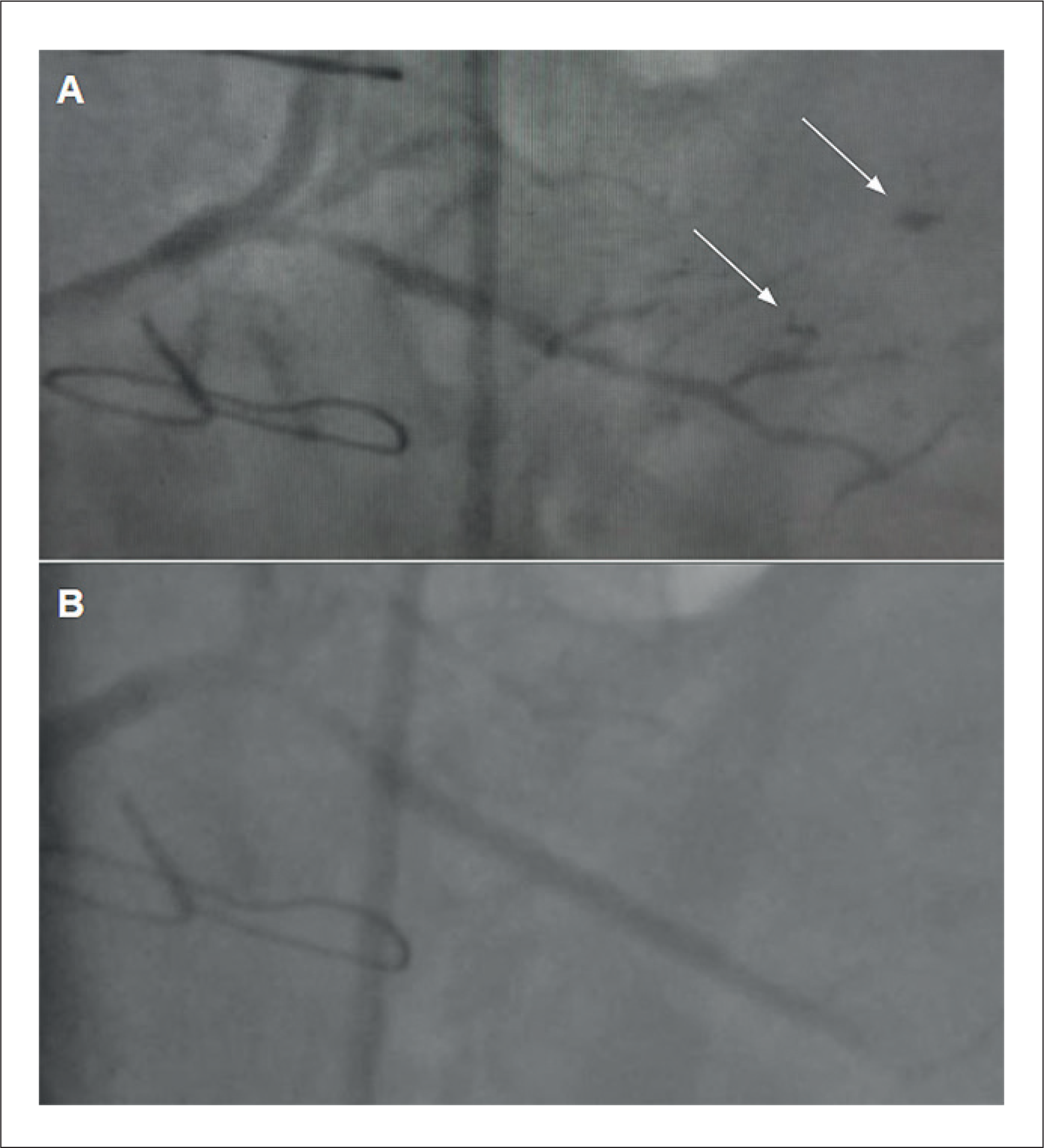
A 64-year-old man with a history of coronary artery disease underwent PCI for right coronary artery bypass grafting (RCA). (RCABG). After completion of the procedure, distal perforation of sub-branches of the posterior descending artery (PDA) was identified by the tip of the guidewire (Whisper and BHW were used) (Figure 1). Balloon inflation was performed for 40 minutes, without resolution. A 2.5 x 20 mm PK Papyrus covered stent with 8 ATMs was implanted, without resolution of the leakage. Due to the unavailability of another covered stent, a 2.5 x 22 mm Orsiro stent manually covered with Tegaderm with 14 ATMs was implanted. Final angiography demonstrated interruption of leakage and TIMI 3 flow, despite irregular stent expansion (probably due to the Tegaderm covering). The patient was discharged asymptomatic and without complications.

A) Perforation of sub-branches of the Ellis III type posterior descending artery (white arrow), showing contrast extravasation. B) Final result after implantation of a Tegaderm-coated stent with improvement in contrast extravasation.
Case 2
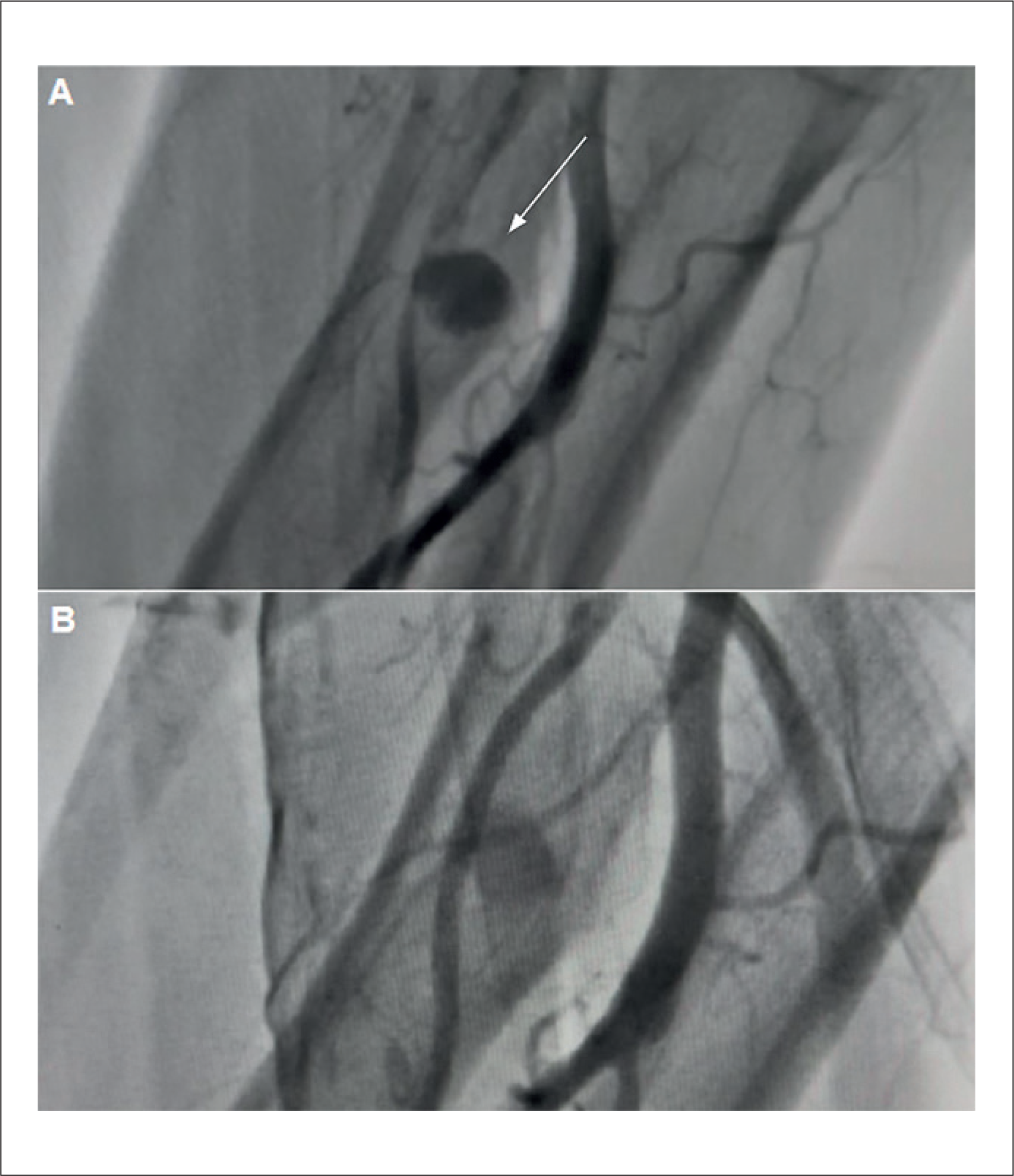
A 64-year-old man underwent PCI of the left anterior descending artery (LAD) and diagonal branch. After pre-dilation of the diagonal branch with a 2.5x20mm NC Trek Neo balloon with 18 ATMs, an Ellis III type perforation was observed (Figure 2). Balloon inflation was performed for 20 minutes without success. A 2.5 x 28mm SupraFlex stent covered with Tegaderm was implanted with 12 ATMs. Final angiography demonstrated interruption of extravasation and TIMI 3 flow. The patient was discharged asymptomatic and without complications.
A) Perforation of an accessory radial artery with contrast extravasation and pseudoaneurysm formation (white arrow). B) Final result with improved contrast extravasation, leaving only contrast blush trapped in subcutaneous tissue.
Case 3
A 76-year-old man underwent PCI of the RCA via a right radial approach. During the procedure, perforation of the accessory radial artery occurred due to the passage of the 0.035" guidewire, with subsequent formation of a pseudoaneurysm (Figure 3). Numerous attempts at local compression guided by ultrasound were unsuccessful. A 4.0 x 33 mm Xience stent covered with Tegaderm with 15 ATMs was implanted in the radial artery. Final angiography showed no leakage and preserved limb flow. The patient had a good recovery and was discharged asymptomatic and without complications.

A) Diagonal branch perforation type Ellis III with contrast extravasation (white arrow). B) Final result after implantation of a Tegaderm-coated stent with improvement in contrast extravasation.
Discussion
Coronary perforation is a serious complication, with mortality rates up to 20%.8 Initial management should prioritize hemodynamic stability and tamponade of the lesion with prolonged balloon inflation. If leakage persists, implantation of a covered stent is one of the recommended treatments.4,8 However, in the unavailability of this material, especially in public health centers in developing countries, alternative solutions may be necessary.
Recent reports demonstrate that manually coated stents with Tegaderm can be effective in sealing coronary perforations, with immediate technical success in over 90% of cases.5–7 In the three reported cases, contrast extravasation was stopped without complications during hospitalization (Table 1). The technique is based on direct occlusion of the vascular wall. Furthermore, the use of the technique in the radial artery further illustrates the peripheral applicability of the technique. Intravascular imaging was not used due to its unavailability in the public health system.
Tegaderm, although developed for topical use, is composed of polyurethane, the same material already used in industrial covered stents, but with different densities and chemical processing. In the reported cases, the stent was covered with two complete turns of Tegaderm, leaving a distance of approximately 1 mm from the edges of the metallic structure, as recommended (Figure 4).5

The main limitations of this technique are the higher risk of thrombosis and restenosis compared to industrial covered stents.9,10 The Tegaderm technique has structural disadvantages: lack of a uniform adhesion layer, potential internal roughness, and lack of regulatory validation. Therefore, it should be used primarily in life-threatening situations such as "extreme bailout" where no other "on-label" therapeutic option is available. Therefore, it is essential to maintain dual antiplatelet therapy and rigorous clinical monitoring.
Conclusion
Coronary perforation during PCI is a rare and potentially fatal complication. The emergency use of a Tegaderm-coated stent can be effective in immediately controlling extravasation and preserving vascular flow, constituting a possible alternative as an "extreme bailout" in contexts of imminent risk of death and absolute limitation of other established therapies. It is crucial to emphasize that this technique constitutes an off-label strategy, and there are no clinical trials or prospective studies evaluating the safety and efficacy of this technique.
-
Sources of Funding
There were no external funding sources for this study.
-
Study Association
This study is not associated with any thesis or dissertation work.
-
Ethics Approval and Consent to Participate
This study was approved by the Ethics Committee of the Instituto de Cardiologia de Porto Alegre under the protocol number 8.464.355. All the procedures in this study were in accordance with the 1975 Helsinki Declaration, updated in 2013.
-
Use of Artificial Intelligence
The authors did not use any artificial intelligence tools in the development of this work.
Availability of Research Data
The underlying content of the research text is contained within the manuscript.
References
-
1 Fasseas P, Orford JL, Panetta CJ, Bell MR, Denktas AE, Lennon RJ, et al. Incidence, Correlates, Management, and Clinical Outcome of Coronary Perforation: Analysis of 16,298 Procedures. Am Heart J. 2004;147(1):140-5. doi: 10.1016/s0002-8703(03)00505-2.
» https://doi.org/10.1016/s0002-8703(03)00505-2 - 2 Megaly M, Karatasakis A, Omer M, Brilakis E, Patel R, Rangan B, et al. Outcomes with coronary perforation during chronic total occlusion percutaneous coronary intervention. J Am Coll Cardiol Intv. 2020;13(1):15-23.
-
3 Ellis SG, Ajluni S, Arnold AZ, Popma JJ, Bittl JA, Eigler NL, et al. Increased Coronary Perforation in the New Device Era. Incidence, Classification, Management, and Outcome, Circulation. 1994;90(6):2725-30. doi: 10.1161/01.cir.90.6.2725.
» https://doi.org/10.1161/01.cir.90.6.2725 -
4 Shimony A, Joseph L, Mottillo S, Eisenberg MJ. Coronary Artery Perforation during Percutaneous Coronary Intervention: A Systematic Review and Meta-Analysis. Can J Cardiol. 2011;27(6):843-50. doi: 10.1016/j.cjca.2011.04.014.
» https://doi.org/10.1016/j.cjca.2011.04.014 -
5 An W, Ye J, Han B, Wang X, Han C, Gao J, et al. Efficacy and Safety of Self-Made Covered Coronary Stent in the Treatment of Coronary Artery Perforation. BMC Cardiovasc Disord. 2023;23(1):537. doi: 10.1186/s12872-023-03575-3.
» https://doi.org/10.1186/s12872-023-03575-3 -
6 Khaled FI, Mahmod MS, Rahman MA, Haque MM, Ahmed S. Sealing Coronary Perforation by Hand-Made Covered Stent: A Case Report. Bangabandhu Sheikh Mujib Med Univ J. 2023;16(4):246-9. doi: 10.3329/bsmmuj.v16i4.67399.
» https://doi.org/10.3329/bsmmuj.v16i4.67399 - 7 Khaled MFI, Rahman MA, Banerjee SK, Saha AK, Islam MS, Karim MA, et al. Use of Hand-Made Covered Stent to Seal Coronary Perforation: A Case Report of Escape from a Life-Threatening Complication in Catheterization Laboratory. In: Association of Corporate Counsel Middle East 2022 Together with 13th Emirates Cardiac Society Congress; 2022; United Arab Emirates.
-
8 Gunning MG, Williams IL, Jewitt DE, Shah AM, Wainwright RJ, Thomas MR. Coronary Artery Perforation during Percutaneous Intervention: Incidence and Outcome. Heart. 2002;88(5):495-8. doi: 10.1136/heart.88.5.495.
» https://doi.org/10.1136/heart.88.5.495 -
9 Voll F, Olivecronab G, Ferenc M, Hellig F, Schlundt C, Wöhrle J, et al. Comparative Safety and Efficacy of New-Generation Single-Layer Polytetrafluorethylene- versus Polyurethane-Covered Stents in Patients with Coronary Artery Perforation for the RECOVER (REsults after Percutaneous Interventions with COVERed Stents) Investigators. Cardiovasc Interv Ther. 2025;40(2):296-305. doi: 10.1007/s12928-025-01084-y.
» https://doi.org/10.1007/s12928-025-01084-y - 10 Lamba NMK, Woodhouse KA, Cooper SL. Polyurethanes in Biomedical Applications. Boca Raton: CRC Press; 2017.
Edited by
-
Editor responsible for the review:
Henrique Ribeiro