 NSTEMI and Ischemic Mitral Regurgitation: Incidence and Long-Term Clinical Outcomes with Respect to Management Strategy
Background The optimal treatment for ischemic mitral regurgitation (IMR) in patients of non-ST elevation myocardial infarction (NSTEMI) is a debated topic.
Objective To evaluate the long term outcome on patients with NSTEMI and IMR, particularly emphasizing the comparison of treatments in those with moderate to severe MR.
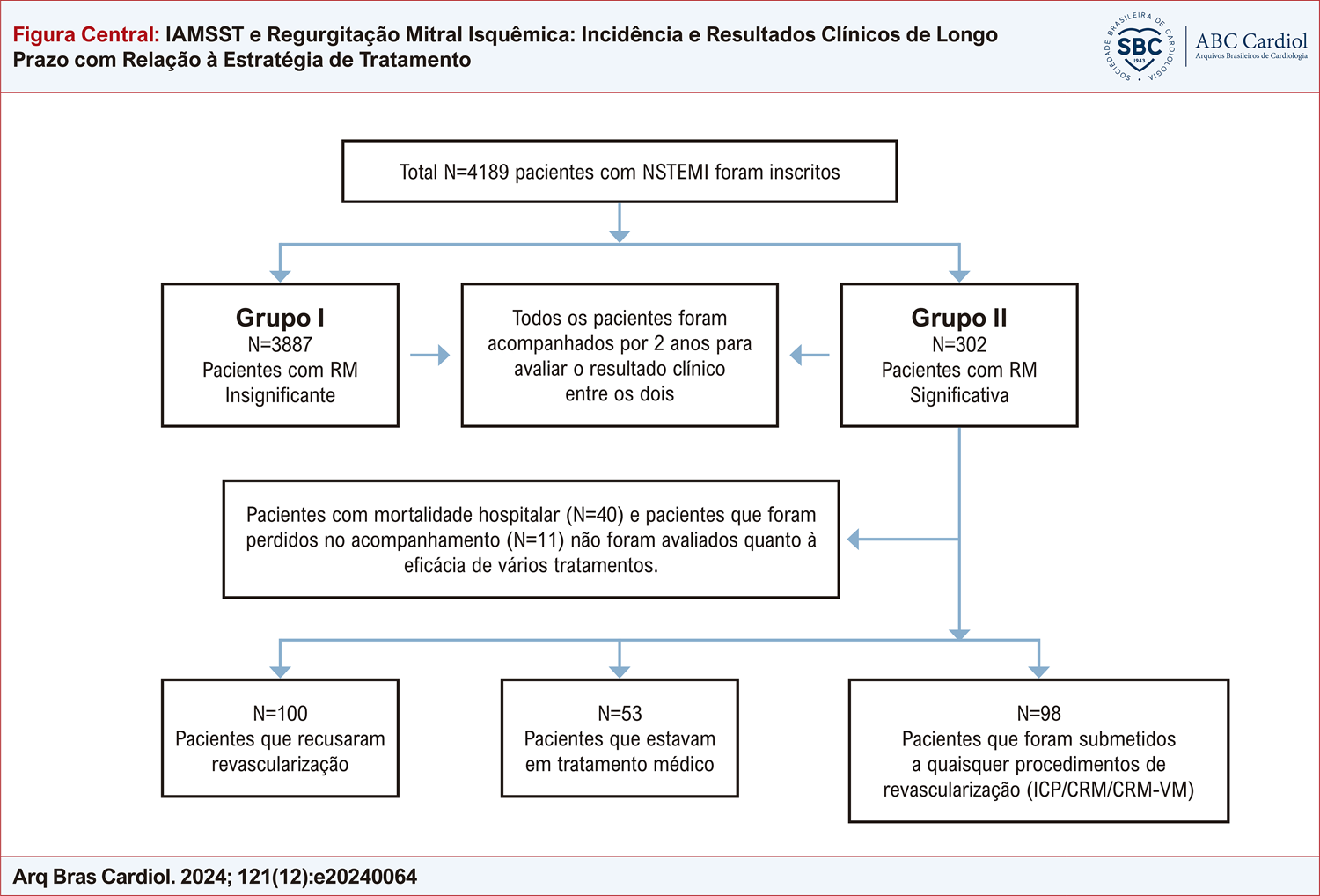
Methods We enrolled patients with NSTEMI and classified non/trivial to mild regurgitation as insignificant IMR and moderate to severe regurgitation as significant IMR. Furthermore, patients with substantial IMR were assessed for long-term clinical outcomes with respect to different management strategies. A test was considered statistically significant based on the probability value p<0.05.
Results From a total of 4,189 patients of NSTEMI, significant IMR was found in 7.21% of patients. A significantly higher number of patients with death (1.21% vs. 13.24%, p<0.0001), cardiogenic shock (0.46% vs. 13.24%, p<0.0001) and heart failure (1.03% vs. 11.59%, p<0.0001) were found during hospitalization in patients with significant IMR. At a 2-year follow-up, a higher event rate was observed in the significant IMR group. Patients with significant IMR re-vascularized either by percutaneous coronary intervention (PCI), coronary artery bypass grafting (CABG), or CABG+ mitral valve (MV) surgery showed substantial improvement in MR grade ( 32.65% vs. 6% vs. 16.98%, p<0.0001) and LVEF (27.55% vs. 1% vs. 1.89%, p<0.0001) at 1 year follow up and significantly improved outcomes were identified compared to refused revascularization and medical management group with (-5.10% vs. 15% vs. 13.21%, p=0.04) mortality, (-33.67% vs. 61% vs. 73.58%, p<0.0001) readmission, and (-15.31% vs. 27% vs. 33.96%, p=0.01) heart failure at 2 years follow up.
Conclusion Higher mortality and admission rates were observed in patients with significant IMR compared to those with in-significant IMR. Notably, significant IMR patients who underwent PCI, CABG, or CABG+MV surgery showed improved outcomes compared to non-revascularized counterparts.
Mitral Valve Insufficiency; ST Elevation Myocardial Infarction; Coronary Angioplasty Balloon
•The presence of significant MR in patients with NSTEMI leads to major complications in the short and long term.
•Significantly higher cardiovascular events and readmission rate was associated with patients with significant MR.
•Among patients with significant MR, those who underwent any revascularization procedure (PCI, CABG, and CABG+ MV surgery) exhibited a lower mortality rate in comparison to those who did not undergo any such procedure.

 Thumbnail