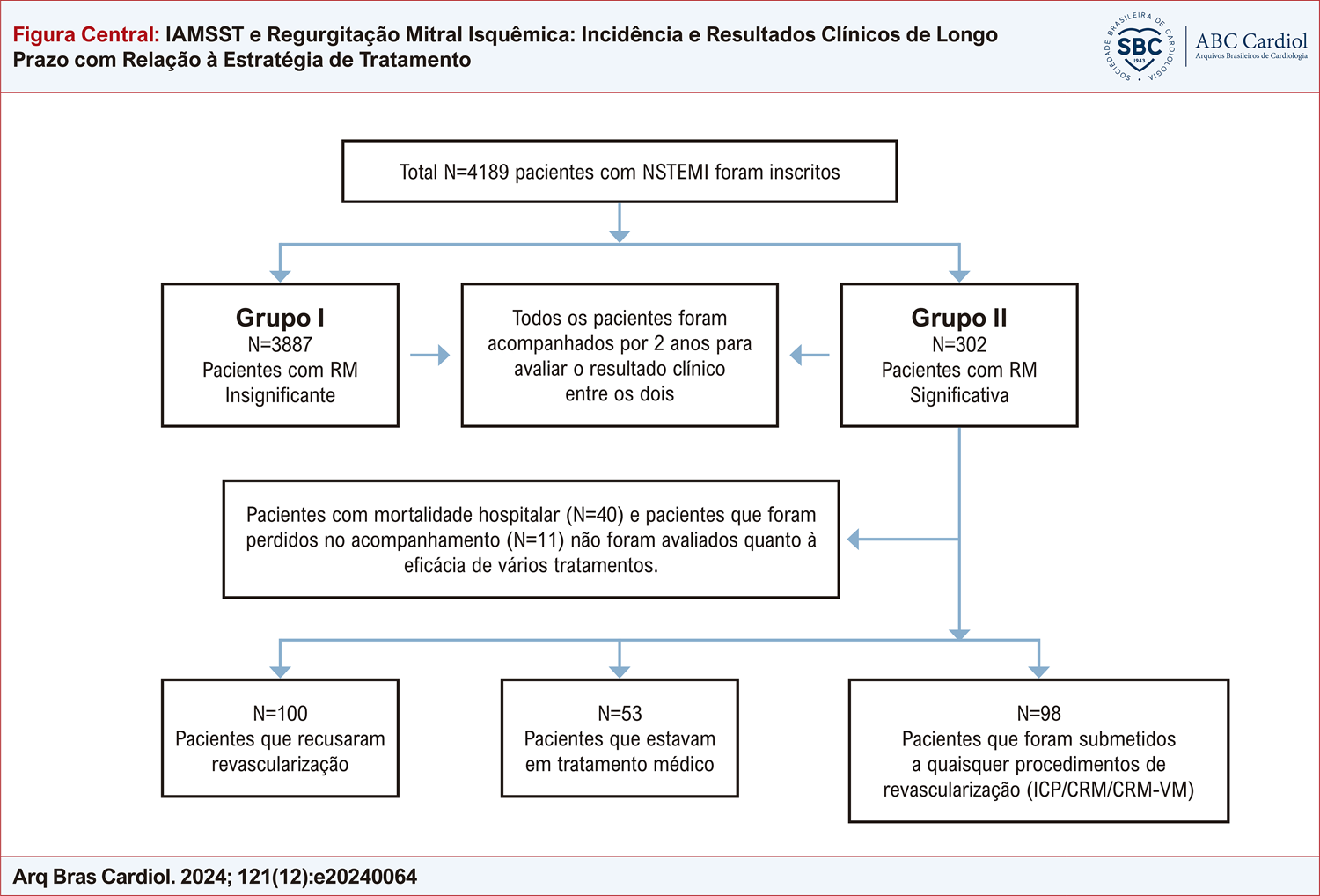
 NSTEMI and Ischemic Mitral Regurgitation: Incidence and Long-Term Clinical Outcomes with Respect to Management Strategy
Abstract
Background The optimal treatment for ischemic mitral regurgitation (IMR) in patients of non-ST elevation myocardial infarction (NSTEMI) is a debated topic.
Objective To evaluate the long term outcome on patients with NSTEMI and IMR, particularly emphasizing the comparison of treatments in those with moderate to severe MR.
Methods We enrolled patients with NSTEMI and classified non/trivial to mild regurgitation as insignificant IMR and moderate to severe regurgitation as significant IMR. Furthermore, patients with substantial IMR were assessed for long-term clinical outcomes with respect to different management strategies. A test was considered statistically significant based on the probability value p<0.05.
Results From a total of 4,189 patients of NSTEMI, significant IMR was found in 7.21% of patients. A significantly higher number of patients with death (1.21% vs. 13.24%, p<0.0001), cardiogenic shock (0.46% vs. 13.24%, p<0.0001) and heart failure (1.03% vs. 11.59%, p<0.0001) were found during hospitalization in patients with significant IMR. At a 2-year follow-up, a higher event rate was observed in the significant IMR group. Patients with significant IMR re-vascularized either by percutaneous coronary intervention (PCI), coronary artery bypass grafting (CABG), or CABG+ mitral valve (MV) surgery showed substantial improvement in MR grade ( 32.65% vs. 6% vs. 16.98%, p<0.0001) and LVEF (27.55% vs. 1% vs. 1.89%, p<0.0001) at 1 year follow up and significantly improved outcomes were identified compared to refused revascularization and medical management group with (-5.10% vs. 15% vs. 13.21%, p=0.04) mortality, (-33.67% vs. 61% vs. 73.58%, p<0.0001) readmission, and (-15.31% vs. 27% vs. 33.96%, p=0.01) heart failure at 2 years follow up.
Conclusion Higher mortality and admission rates were observed in patients with significant IMR compared to those with in-significant IMR. Notably, significant IMR patients who underwent PCI, CABG, or CABG+MV surgery showed improved outcomes compared to non-revascularized counterparts.
Mitral Valve Insufficiency; ST Elevation Myocardial Infarction; Coronary Angioplasty Balloon
Highlight:
•The presence of significant MR in patients with NSTEMI leads to major complications in the short and long term.
•Significantly higher cardiovascular events and readmission rate was associated with patients with significant MR.
•Among patients with significant MR, those who underwent any revascularization procedure (PCI, CABG, and CABG+ MV surgery) exhibited a lower mortality rate in comparison to those who did not undergo any such procedure.

Resumo
Fundamento O tratamento ideal para regurgitação mitral isquêmica (RMI) em pacientes com infarto do miocárdio sem supradesnivelamento do segmento ST (IAMSSST) é um tópico debatido.
Objetivo Avaliar o resultado a longo prazo em pacientes com IAMSSST e RMI, enfatizando particularmente a comparação de tratamentos naqueles com RM moderada a grave.
Métodos Inscrevemos pacientes com IAMSSST e classificamos regurgitação não/trivial a leve como RMI insignificante e regurgitação moderada a grave como RMI significativa. Além disso, pacientes com RMI substancial foram avaliados para desfechos clínicos de longo prazo com relação a diferentes estratégias de tratamento. Um teste foi considerado estatisticamente significativo com base no valor de probabilidade p<0,05.
Resultados De um total de 4.189 pacientes com IAMSSST, RMI significativa foi encontrada em 7,21% dos pacientes. Um número significativamente maior de pacientes com morte (1,21% vs. 13,24%, p<0,0001), choque cardiogênico (0,46% vs. 13,24%, p<0,0001) e insuficiência cardíaca (1,03% vs. 11,59%, p<0,0001) foram encontrados durante a hospitalização em pacientes com RMI significativa. Em um acompanhamento de 2 anos, uma taxa de evento maior foi observada no grupo RMI significativa. Pacientes com RMI significativa revascularizados por intervenção coronária percutânea (ICP), cirurgia de revascularização miocárdica (CRM) ou cirurgia CRM+ válvula mitral (VM) apresentaram melhora substancial no grau de RM (32,65% vs. 6% vs. 16,98%, p<0,0001) e fração de ejeção do ventrículo esquerdo (FEVE) (27,55% vs. 1% vs. 1,89%, p<0,0001) em 1 ano de acompanhamento e resultados significativamente melhores foram identificados em comparação ao grupo de revascularização recusada e tratamento médico com (-5,10% vs. 15% vs. 13,21%, p=0,04) mortalidade, (-33,67% vs. 61% vs. 73,58%, p<0,0001) readmissão e (- 15,31% vs. 27% vs. 33,96%, p=0,01) insuficiência cardíaca em 2 anos de acompanhamento.
Conclusão Maiores taxas de mortalidade e admissão foram observadas em pacientes com RMI significativa em comparação àqueles com RMI insignificante. Notavelmente, pacientes com RMI significativa que passaram por ICP, CRM ou cirurgia CRM+VM apresentaram melhores resultados em comparação com seus equivalentes não revascularizados.
Insuficiência da Valva Mitral; Infarto do Miocárdio com Supradesnível do Segmento ST; Angioplastia Coronária com Balão
Destaque:
• A presença de RM significativa em pacientes com IAMSSST leva a complicações importantes em curto e longo prazo.
• Taxas significativamente maiores de eventos cardiovasculares e readmissão foram associadas a pacientes com RM significativa.
• Entre os pacientes com RM significativa, aqueles que foram submetidos a qualquer procedimento de revascularização (ICP, CRM e CRM + cirurgia de VM) apresentaram uma taxa de mortalidade menor em comparação com aqueles que não foram submetidos a nenhum procedimento desse tipo.

Introduction
Non-ST elevation myocardial infarction (NSTEMI), characterized by myocardial damage without the classic ST-segment elevation, poses distinct challenges in its diagnosis and management.1 The aftermath of NSTEMI extends beyond the immediate ischemic event, often contributing to a cascade of cardiovascular complications.2 The prevalence of MR in this specific cohort warrants meticulous examination, as it introduces a layer of complexity that can influence the trajectory of recovery and long-term prognosis.
The development of Mitral regurgitation (MR) in patients with NSTEMI is multifactorial, involving complex interactions between various pathological processes. Development of MR in the context of NSTEMI could be due to pathologies like ischemic papillary muscle dysfunction, papillary muscle rupture, chordal rupture, or chordal stretching secondary to left ventricular dysfunction.3 The presence of hemodynamically significant MR with NSTEMI can lead to pulmonary venous hypertension, increased risk of heart failure, left ventricular dysfunction, increased risk of arrhythmias, worsening of ischemic events, and complications post-revascularization.4The presence of Mitral Regurgitation in patients of NSTEMI leads to additional challenges to the long-term prognosis, affecting cardiac function, heart failure risk, and overall cardiovascular health. Early identification and management of MR in these patients can significantly impact long-term outcomes.
The severity of MR, its impact on left ventricular function, and the success of interventions collectively shape the trajectory of patients’ outcomes in patients of NSTEMI. The objective of this study was to assess the prevalence of ischemic mitral regurgitation (IMR). It analyzed the long-term clinical outcomes in patients, with a specific focus on comparing those with and without significant mitral regurgitation in relation to their revascularization strategy.
Methods
Study design and study population
A total of 4189 patients diagnosed with NSTEMI were enrolled in the present observational study from January- 2016 to June 2021 at our tertiary cardiac care center. We conducted a retro-prospective cohort study; data were taken retrospectively from the year 2015 to 2018 and prospectively from 2019 to 2021 and followed up for two years. The study was approved by the institutional ethics committee (UNMICRC/CARDIO/2019/14). The informed consent was obtained from all participants. In the present study, we have not taken the help of any Artificial intelligence tools.
The demographic, clinical, echocardiographic, and in-hospital outcome data were taken from the patients who were diagnosed with NSTEMI based on cardiac biomarkers and electrocardiogram diagnosis. The retrospective data during hospitalization and follow-up was collected from the institute’s EMR (E-medical record) system. Patients with STEMI, unstable angina, hypertrophic cardiomyopathy, valvular or structural heart diseases, mitral prolapses and rheumatic heart diseases, known or suspected congenital heart disease, structural mitral abnormalities (valvular/subvalvular), primary disease of another cardiac valve, mitral prostheses, prior coronary artery bypass grafting (CABG) or prior percutaneous coronary intervention (PCI) were excluded from the study. From the retrospective cohort, patients with incomplete data and without follow-up echocardiography, at 1 year follow-up were excluded. Patients were grouped according to the severity of mitral regurgitation (IMR) assessed on 2D echocardiography. IMR was categorized as none/trivial and mild in group I of in-significant IMR and moderate to severe in group II of significant IMR.5All patients in the study underwent coronary angiography. Furthermore, the patients with moderate to severe mitral regurgitation (IMR) were classified into three subgroups based on their treatment approach: those who refused revascularization, those who were advised medical management, and those who underwent revascularization procedures (PCI/CABG/CABG-mitral valve [MV] surgery) and outcome between these three groups were compared. Patients with insignificant coronary artery disease with coronary obstruction less than 50% on visual estimation of coronary angiography, nonviable myocardium on Tc-99m sestamibi SPECT scan, and diffusely diseased narrow caliber vessel disease not suitable for revascularization were advised medical management. Eleven patients were lost to follow-up in a significant IMR group who were not re-vascularized.
Follow-up and Endpoints
All study patients were monitored over two years to assess major adverse cardiac events (MACE). The telephonic follow-up was taken for the patients who did not attend the outpatient department during the study period. The major adverse cardiac events (MACE) during the hospital and at follow-up times were defined as cardiovascular death, re-hospitalization, cardiogenic shock, cerebrovascular stroke, heart failure, and unstable angina.
Echocardiography
Echocardiography was conducted using a Philips Sonos 5500 equipped with 2.5-3.5 MHz probes. Measurements of left atrial and ventricular diameters were taken in the parasternal view on M mode. Ejection fraction calculations were performed in 2D mode, utilizing the apical 2- and 4-chamber views and employing the Simpson biplane method. To assess myocardial thickening, the left ventricle was divided into the 16-segment model, following the guidelines recommended by the American Society of Echocardiography.5 The assessment of myocardial regurgitation and its severity was evaluated. Patients with ≥ 1 grade improvement in IMR were considered as IMR grade improved, and ≥ 1 grade worsened was considered as worsened IMR grade on follow-up period. Left ventricular ejection fraction (LVEF) on follow-up with ≥5% increase was considered as improved, and ≤5% decrease was considered as worsened at follow-up.
Statistical analysis
Categories variables were expressed as absolute and relative frequencies and compared using chi-square analysis. Continuous variables presented normal distribution, being represented as mean ± standard deviation (SD) and compared using an independent sample t-test. Shapiro-Wilk tests were used to check normality. Variables influencing significant IMR were assessed using logistic regression analysis. A probability value (p-value) less than 0.05 was considered statistically significant. Patients with significant IMR (group II) were further analyzed for outcome at follow-up time according to the treatment of choice (Procedure vs. medication) at the time they enrolled, and patients with in-hospital mortality in group II were not included in the sub-group analysis. All statistical analysis was carried out using the SPSS (Statistical Package for the Social Science) program vs 20.
Results
Table 1 presents baseline demographic and clinical characteristics compared between two groups of IMR. Female gender -, presence of diabetes -, low systolic blood pressure, reduced LVEF<40% (24.62% vs. 50.3%, p<0.0001), and multivessel disease were found significantly higher in moderate to severe IMR group (Group-II) compared to insignificant IMR group (Group-I).
Table 2 shows the univariate and multivariate logistic regression analysis for Significant IMR. Higher age, presence of diabetes, and lower LVEF were found to be independent predictors of significant Mitral regurgitation.
Patients with significant IMR demonstrated a notably elevated in-hospital mortality rate, alongside a heightened occurrence of cardiogenic shock and heart failure, in comparison to patients with insignificant IMR throughout the course of hospitalization. At 1 year and 2 years follow-up, death, readmission rate (and incidence of heart failure were significantly higher in patients with significant IMR (Table 3).
Patients evaluated for left ventricular ejection fraction and IMR grade on Echocardiography at 1 year follow up. A significantly higher number of revascularized patients had a reduction in MR severity at 1-year follow-up as compared to patients on medical management and patients who refused revascularization. LVEF was found to be significantly improved in patients who underwent revascularization (Table 4).
Table 5 presents the cardiovascular events at 1 and 2 years of follow-up in patients with significant MR and grouped according to the treatment they received. At two-year follow-up, mortality rates were 15%, 13.21%, and 5.10% with p=0.04, while readmission rates were 61%, 73.58%, and 33.67% with p<0.0001, and rates of heart failure were 27%, 33.96%, and 15.31% with p=0.001, in patients who refused revascularization, patients on medical management and patients who underwent revascularization respectively.
Table 6 presents the predictors of MACE. Unadjusted odds of significant IMR showed significantly high (OR= 2.35), which was decreased when adjusted with age, diabetes, LVEF%, and multivessel disease (OR=1.09) however, it remained significant.
Table 7 represents the baseline characteristics of the three groups according to the management strategy. Patients with diabetes, addiction, old ACS, and multivessel disease were significantly higher in patients referred for medical management, while the values of LVEF and SBP were found to be lower compared to refused revascularization and revascularization.
Discussion
In the current observational study, significant IMR was observed in 7.21% of non-S-T elevation myocardial infarction patients. Higher age, presence of diabetes, and lower LVEF% were found to be associated with significant IMR in NSTEMI patients. During hospitalization, significantly higher incidences of death (1.21% vs. 13.24%), cardiogenic shock (0.46% vs. 3.31%), and heart failure (1.03% vs. 11.59%) were found in patients with significant IMR. In the sub-group outcome analysis in patients with significant MR, patients revascularized by any PCI, CABG, and CABG- mitral valve repair (MVR) showed significantly lower major adverse cardiac events and improved LVEF and MR grade compared to patients treated with medical management and patients who refused revascularization. Patients who refused revascularization showed significantly poor prognosis on follow-up. At two years follow-up, the incidence of mortality, readmission, and heart failure were significantly higher among patients who refused revascularization and patients with medical management.
Earlier investigations had -found an incidence rate of 29.4%6 for MR- in AMI patients and 40.08%7in NSTEMI patients. At the same time, the incidence of significant IMR was reported at 1.19%.8 and 21.73%.9 in NSTEMI patients. In the Villanueva et al.9 study 21.73% incidence for significant IMR was higher; that might be due to the survey enrolling only older patients ≥80 years of age. In the present study, we observed 7.21% of significant IMR incidence among NSTEMI patients.
In individuals with IMR, undergoing treatment with PCI, CABG, or a combination of CABG and MV surgery is linked to enhanced survival outcomes compared to the outcomes associated with medical therapy alone.10Ischemic MR causes changes in left ventricular structure and function due to ischemic heart disease, which worsens the prognosis in acute MI patients. Around 50% of the patients diagnosed with congestive heart failure and 20% of patients with acute myocardial infarction documented IMR.4The chronic volume overload caused by IMR triggers left ventricular remodeling, altering the structure and function of the heart. This remodeling process can lead to further cardiac dysfunction, increasing the susceptibility to adverse cardiovascular events. These symptoms, when left unaddressed, can contribute to a decline in overall health and an increased risk of mortality.
A study done by James et al. reported the mortality rates to be 24% at 30 days (95% CI, 12% to 36%), 42% at 6 months (CI, 28% to 56%), 52% at 1 year (CI, 38% to 66%) in acute ischemic moderately severe to severe IMR patients.11 A multivariable analysis suggested that moderately severe or severe mitral regurgitation may be a potential independent predictor of mortality (p=0.06).11 In a multivariate analysis after adjusting for baseline characteristics including age and EF, the relative risk for both all-cause and cardiac mortality were independently associated with the presence of IMR with RR=1.88 (p=0.003) and RR=1.83 (p=0.014), respectively.12 Previous prospective study involving individuals with chronic ischemic left ventricular dysfunction (ejection fraction ≤45%) and at least mild functional mitral regurgitation (IMR), the study found that the severity of IMR under basal conditions (ERO ≥20 mm2) independently predicted only cardiac death.13 In the present study, we observed 13.24% in-hospital death, 3.31% cardiogenic shock, and 11.59% participants with heart failure in patients with significant IMR, which was significantly higher compared to patients with in-significant IMR. At 2-year follow-up, the mortality rate was 22.18%, and 31.46% heart failure cases were observed in patients with significant IMR. Among patients with significant IMR, a readmission rate of 44.04% was observed at 2 years. Further, we categorized only significant IMR patients according to the treatment choices they made during admission time and compared outcomes at follow-up time; we found patients with revascularization (PCI or CABG or CABG + MVR) had improved IMR grade and LVEF at follow-up time compared to patients who refused revascularization and patients with medical management. Even these patients showed a higher incidence of death, heart failure, and readmission at 2 years follow-up. Consistent with the current study, previous findings10 indicated that patients receiving treatment either of any PCI, CABG, or CABG + MV surgery demonstrated enhanced survival compared to those managed with medical approaches. Both CTSN trials, one involving moderate IMR and the other involving severe IMR patients, showed no difference between CABG and CABG plus MV repair in terms of left ventricular reverse remodeling or survival at the two-year mark among patients with moderate and severe IMR which suggest that there will be no significant benefits for patients who choose to undergo MVR. While mitral valve repair offered a more enduring correction of mitral regurgitation, it did not demonstrate a significant enhancement in survival or a reduction in overall adverse events or readmissions.14,15 Recently reported data indicates that early treatment of IMR concomitant to coronary revascularization, either by CABG or PCI, improves long-term survival compared to delayed MV surgery after coronary revascularization. However, patients with Prior coronary revascularization generally experience better outcomes with PCI compared to CABG.16 These studies, along with the current research, highlight the importance of considering revascularization treatments for patients with severe IMR based on the severity of the disease and the recommendations of healthcare professionals rather than opting for medical management alone. However, the success of interventions depends on several key factors, including the severity of IMR, the extent of myocardial infarction, LVEF, the patient’s age, the presence of comorbidities, and the patient specific response. By alleviating the ischemic burden and restoring normal blood flow, PCI and CABG demonstrate valuable strategies to improve cardiac function and potentially improve mitral regurgitation.
In navigating the complexities of IMR management, personalized and evidence-based decision-making is paramount. The integration of these treatment modalities, tailored to individual patient characteristics, contributes to enhanced survival, improved quality of life, and a reduction in the overall burden of cardiovascular morbidity. As research advances and our understanding of IMR deepens, continued efforts to refine and tailor treatment strategies hold the promise of further improving outcomes for individuals grappling with this challenging cardiovascular condition.
Limitation
It was challenging to eliminate inter-observer variation in the assessment of mitral regurgitation (MR). It’s important to note that our study findings may be only applicable to non-ST-segment elevation myocardial infarction (NSTEMI) patients, but generalizing to all acute myocardial infarction (AMI) patients may not be warranted. The patients on the medical management were more severe (they had higher age, diabetes, addiction, old ACS, three-vessel disease, and less LVEF). These factors could contribute to worse outcomes independent of the revascularization. Because of this, this study did not allow to establish that revascularization is the better treatment option for significant IMR after NSTEMI.
Conclusion
In conclusion, addressing IMR is a multifaceted challenge with profound implications for patient outcomes. The detrimental impact of IMR on mortality and morbidity underscores the critical need for effective interventions. Treatments such as PCI, CABG, and the comprehensive CABG + MVR approach have demonstrated their potential to mitigate the adverse effects of IMR.
References
- 1 Basit H, Malik A, Huecker MR. Non-ST-Segment Elevation Myocardial Infarction. Treasure Island: StatPearls Publishing; 2024.
-
2 Vasquez-Rodriguez JF, Idrovo-Turbay C, Perez-Fernandez OM, Cruz-Tapias P, Isaza N, Navarro A, et al. Risk of Complications after a Non-ST Segment Elevation Acute Myocardial Infarction in a Latin-American Cohort: An Application of the ACTION ICU Score. Heart Lung. 2023;57:124-9. doi: 10.1016/j.hrtlng.2022.09.002.
» https://doi.org/10.1016/j.hrtlng.2022.09.002 -
3 Pambianchi G, Giannetti M, Marchitelli L, Cundari G, Maestrini V, Mancone M, et al. Papillary Muscle Involvement During Acute Myocardial Infarction: Detection by Cardiovascular Magnetic Resonance Using T1 Mapping Technique and Papillary Longitudinal Strain. J Clin Med. 2023;12(4):1497. doi: 10.3390/jcm12041497.
» https://doi.org/10.3390/jcm12041497 -
4 Varma PK, Krishna N, Jose RL, Madkaiker AN. Ischemic Mitral Regurgitation. Ann Card Anaesth. 2017;20(4):432-9. doi: 10.4103/aca.ACA_58_17.
» https://doi.org/10.4103/aca.ACA_58_17 -
5 Nishimura RA, Otto CM, Bonow RO, Carabello BA, Erwin JP 3rd, Guyton RA, et al. 2014 AHA/ACC Guideline for the Management of Patients with Valvular Heart Disease: A Report of the American College of Cardiology/American Heart Association Task Force on Practice Guidelines. Circulation. 2014;129(23):e521-643. doi: 10.1161/CIR.0000000000000031.
» https://doi.org/10.1161/CIR.0000000000000031 -
6 Sharma H, Radhakrishnan A, Nightingale P, Brown S, May J, O'Connor K, et al. The Characteristics of Mitral Regurgitation: Data from Patients Admitted Following Acute Myocardial Infarction. Data Brief. 2021;39:107451. doi: 10.1016/j.dib.2021.107451.
» https://doi.org/10.1016/j.dib.2021.107451 -
7 Gil IJN, Isla LP, García-Rubira JC, Fernández-Ortiz A, Ferrer JJG, Vivas D, et al. Ischemic Mitral Regurgitation and Non-ST-segment Elevation Acute Myocardial Infarction: Long-term Prognosis. Rev Esp Cardiol. 2009;62(11):1267-75. doi: 10.1016/s1885-5857(09)73354-7.
» https://doi.org/10.1016/s1885-5857(09)73354-7 -
8 Ladzinski S, Niedziela J, Witkowski A, Bartus S, Lesiak M, Milewski K, et al. The Influence of Severe Mitral Regurgitation on Major Adverse Cardiac and Cerebrovascular Events after Myocardial Infarction in 1-year Follow-up: Data from PL-ACS Registry. Kardiol Pol. 2023;81(6):572-9. doi: 10.33963/KP.a2023.0064.
» https://doi.org/10.33963/KP.a2023.0064 -
9 Díez-Villanueva P, Vera A, Ariza-Solé A, Alegre O, Formiga F, López-Palop R, et al. Mitral Regurgitation and Prognosis after Non-ST-segment Elevation Myocardial Infarction in Very Old Patients. J Am Geriatr Soc. 2019;67(8):1641-8. doi: 10.1111/jgs.15926.
» https://doi.org/10.1111/jgs.15926 -
10 Trichon BH, Glower DD, Shaw LK, Cabell CH, Anstrom KJ, Felker GM, et al. Survival after Coronary Revascularization, with and Without Mitral Valve Surgery, in Patients with Ischemic Mitral Regurgitation. Circulation. 2003;108 (Suppl 1):II103-10. doi: 10.1161/01.cir.0000087656.10829.df.
» https://doi.org/10.1161/01.cir.0000087656.10829.df -
11 Tcheng JE, Jackman JD Jr, Nelson CL, Gardner LH, Smith LR, Rankin JS, et al. Outcome of Patients Sustaining Acute Ischemic Mitral Regurgitation During Myocardial Infarction. Ann Intern Med. 1992;117(1):18-24. doi: 10.7326/0003-4819-117-1-18.
» https://doi.org/10.7326/0003-4819-117-1-18 -
12 Grigioni F, Enriquez-Sarano M, Zehr KJ, Bailey KR, Tajik AJ. Ischemic Mitral Regurgitation: Long-term Outcome and Prognostic Implications with Quantitative Doppler Assessment. Circulation. 2001;103(13):1759-64. doi: 10.1161/01.cir.103.13.1759.
» https://doi.org/10.1161/01.cir.103.13.1759 -
13 Lancellotti P, Gérard PL, Piérard LA. Long-term Outcome of Patients with Heart Failure and Dynamic Functional Mitral Regurgitation. Eur Heart J. 2005;26(15):1528-32. doi: 10.1093/eurheartj/ehi189.
» https://doi.org/10.1093/eurheartj/ehi189 -
14 Michler RE, Smith PK, Parides MK, Ailawadi G, Thourani V, Moskowitz AJ, et al. Two-year Outcomes of Surgical Treatment of Moderate Ischemic Mitral Regurgitation. N Engl J Med. 2016;374(20):1932-41. doi: 10.1056/NEJMoa1602003.
» https://doi.org/10.1056/NEJMoa1602003 -
15 Goldstein D, Moskowitz AJ, Gelijns AC, Ailawadi G, Parides MK, Perrault LP, et al. Two-year Outcomes of Surgical Treatment of Severe Ischemic Mitral Regurgitation. N Engl J Med. 2016;374(4):344-53. doi: 10.1056/NEJMoa1512913.
» https://doi.org/10.1056/NEJMoa1512913 -
16 Andrási TB, Glück AC, Taieb OB, Talipov I, Abudureheman N, Volevski L, et al. Outcome of Surgery for Ischemic Mitral Regurgitation Depends on the Type and Timing of the Coronary Revascularization. J Clin Med. 2023;12(9):3182. doi: 10.3390/jcm12093182.
» https://doi.org/10.3390/jcm12093182