 Survival Analysis and Factors Associated with Mortality in Heart Failure Patients in the ELSA-Brasil Cohort
Abstract
Background Heart failure (HF) is one of the leading causes of morbidity and mortality worldwide. Few studies have evaluated the survival and prognostic factors of patients with this condition in light of the therapeutic advances of recent decades.
Objectives To describe the survival, possible factors associated with mortality, and clinical characteristics of participants with HF in the Brazilian Longitudinal Study of Adult Health (ELSA-Brasil).
Methods The cohort followed 15105 participants from 2008 to 2023. Sociodemographic variables, laboratory tests, electrocardiogram, two-dimensional echocardiogram, lifestyle habits, comorbidities, and medication use were evaluated. Survival probability was estimated using Kaplan-Meier curves and log-rank tests. Cox regression modeling was used to calculate the crude and adjusted Hazard Ratios (HR) with their respective 95% confidence intervals. The significance criterion was p<0.05.
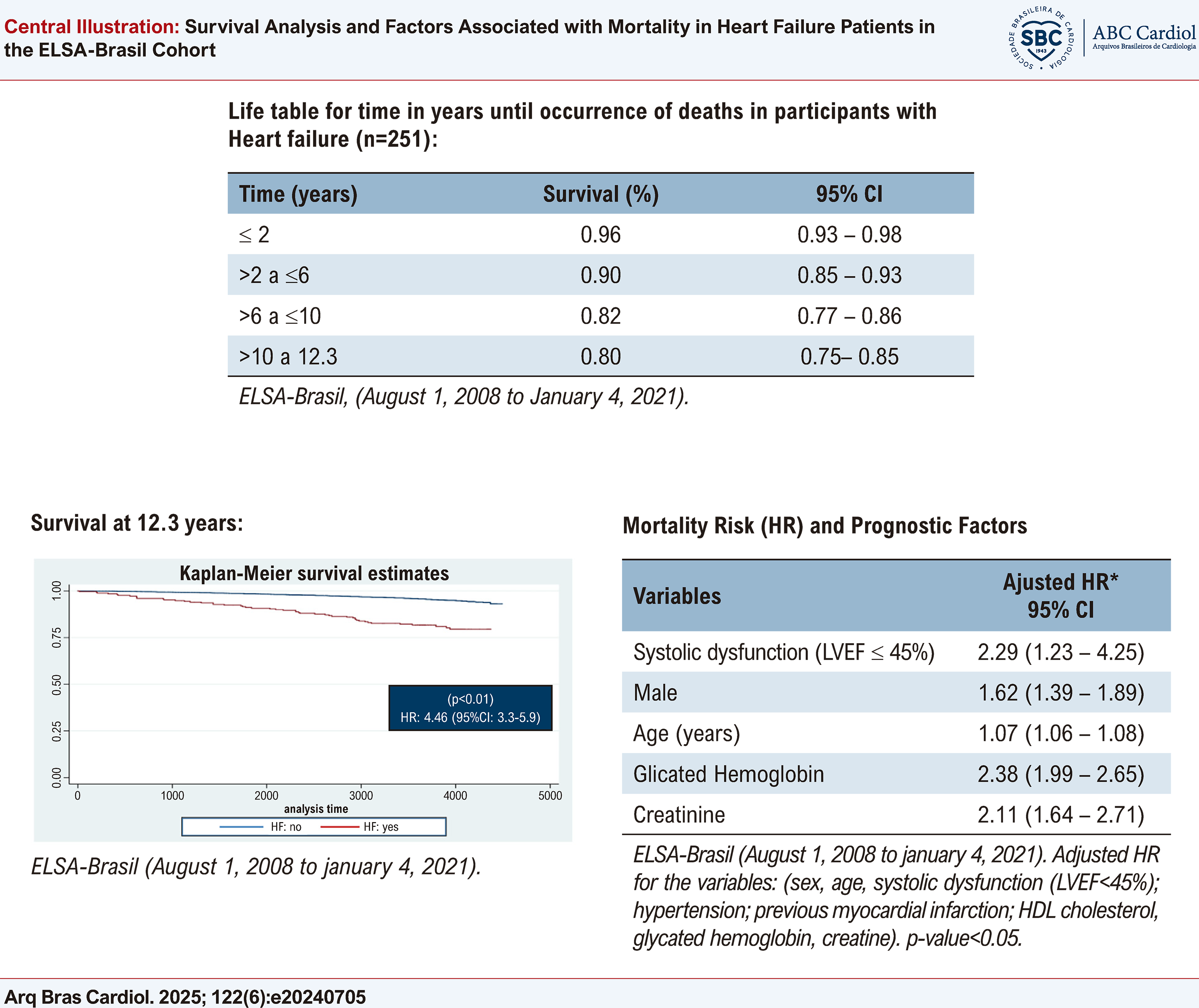
Results During the inclusion phase, 251 participants with an HF diagnosis were selected (2008-2010). Over approximately 12.3 years of follow-up, 48 (19%) died. The overall survival of participants with HF at 2, 6, 10, and 12.3 years of follow-up was 96%, 89%, 82%, and 80%, respectively. The mortality risk was 4.5 times higher (HR: 4.46; 95% CI: 3.3–5.9) compared to the unaffected group (p<0.01), and even after applying an adjusted model, the mortality risk remained twice as high (HR: 1.77; 95% CI: 1.3–2.4). Variables associated with a worse prognosis included male sex, advanced age, systolic dysfunction (LVEF<45%), hypertension, diabetes mellitus, and chronic kidney disease.
Conclusion We found high mortality among participants with HF in the ELSA-Brasil cohort.
Heart Failure; Prognosis; Survival; Mortality

Resumo
Fundamento A insuficiência cardíaca (IC) é uma das principais causas de morbidade e mortalidade no mundo. Poucos estudos avaliaram a sobrevida e fatores prognósticos de pacientes com esta condição frente aos avanços terapêuticos das últimas décadas.
Objetivos Descrever a sobrevida, possíveis fatores associados a mortalidade e características clínicas dos participantes com IC do Estudo Longitudinal de Saúde do Adulto (ELSA-Brasil).
Métodos A coorte acompanhou 15.105 participantes, entre 2008 e 2023. Foram avaliadas variáveis sociodemográficas, exames laboratoriais, eletrocardiograma, ecocardiograma bidimensional, hábitos de vida, comorbidades e tratamento medicamentoso. A probabilidade de sobrevida foi estimada através das curvas de Kaplan-Meier e testes de log-rank. Modelagem de regressão de Cox, permitiu calcular as Hazard Ratios (HR), brutas e ajustadas, com seus respectivos intervalos de confiança de 95%. Utilizou-se o critério de significância p<0,05.
Resultados Durante a etapa de inclusão, foram selecionados 251 participantes com diagnóstico de IC (2008-2010). No período aproximado de 12,3 anos de acompanhamento, 48(19%) faleceram. A sobrevida global dos participantes com IC nos 2, 6, 10 e 12,3 anos de seguimento, foi de 96%, 89%, 82% e 80% respectivamente. O risco de mortalidade foi 4,5 vezes maior (HR:4,46; IC95%: 3,3–5,9) em comparação com o grupo não acometido, (p<0,01) e mesmo após a aplicação de modelo ajustado, o risco de mortalidade permaneceu duas vezes mais elevado, (HR:1,77; IC95%:1,3–2,4). As variáveis associadas a pior prognóstico foram: sexo masculino, idade avançada, disfunção sistólica (FEVE<45%), hipertensão arterial, diabetes mellitus e doença renal crônica.
Conclusão Encontramos elevada mortalidade em participantes com IC na coorte ELSA-Brasil.
Insuficiência Cardíaca; Prognóstico; Sobrevida; Mortalidade
Introduction
Heart failure (HF) affects more than 23 million people worldwide, with high morbidity and mortality1 rates, and represents the final consequence of various cardiac conditions. The main causes include ischemic heart disease, hypertension, cardiomyopathies, valvular diseases, and particularly in South America, Chagas heart disease.1-3 Notable risk factors include coronary artery disease (CAD), hypertension (HTN), diabetes mellitus (DM), advanced age (≥65 years), obesity, chronic obstructive pulmonary disease (COPD), and renal dysfunction.4
Patient outcomes in HF are primarily based on data from North America and Europe. The INTER-CHF5 study showed a correlation between cultural, social, and economic factors and differences in HF mortality across different regions of the world, while the Rotterdam6 study revealed significant variations in five-year survival after diagnosis. Prognostic studies in HF more frequently explore reduced survival rates for acute admissions, such as the ADHERE7 risk model, making these estimates different from those of chronic HF patients.8,9 Additionally, despite the increased prevalence and correlation with higher mortality rates, survival after HF diagnosis has improved in recent years. This improvement has been attributed to early complementary and laboratory diagnosis, clinical management, and the implementation of new pharmacological therapies.10
In Brazil, it is estimated that more than 3 million people have HF.11 This condition has been identified as one of the main causes of hospital admissions and in-hospital mortality,4,12 generating a substantial financial impact on health services.13
The objectives of this study are to evaluate survival, mortality, and possible factors associated with worse prognosis in chronic HF patients participating in the ELSA-Brasil cohort.
Methods
This is a prospective observational study that utilized data from the ELSA-Brasil cohort, a multicenter cohort composed of 15105 Brazilian civil servants, both active and retired, aged between 35 and 74 years, from six higher education and research institutions in the country (Federal Universities of Bahia, Espírito Santo, Minas Gerais, and Rio Grande do Sul, University of São Paulo, and the Oswaldo Cruz Foundation), aimed at assessing the occurrence and evolution of non-communicable chronic diseases and the main risk factors.14,15 The population of this study consisted of 251 participants who reported a medical diagnosis of HF at baseline (2008-2010) through the Pre-existing Medical History questionnaire (PMH). The research protocol was approved by the Ethics and Research Committees of each institution, as well as the National Commission of Ethics in Research (Ethics Committee Registration: 027-06/CEP-ISC). All participants signed an informed consent form.16
Interviews and examinations were conducted in person by trained and qualified personnel, following strict quality control.17 Structured questionnaires addressed sociodemographic variables, lifestyle habits, previous comorbidities, and medication use. The examinations included laboratory analyses (blood and urine),18 anthropometric measurements,19 electrocardiograms (ECG),20 and imaging tests such as echocardiograms (ECHO),21 following a previously published standardized technique. Cardiovascular imaging tests like the ECHO were evaluated by an external committee of blinded observers for participant identification using the same model of equipment (Aplio XG; Toshiba Corporation, Tokyo, Japan) across the six ELSA-Brasil centers. The left ventricular ejection fraction (LVEF) was calculated using the Teicholz method.
The variables were categorized according to physical activity level, alcohol consumption, smoking, body mass index (BMI), education level, and serum triglyceride levels. For physical activity, participants were classified into three categories: vigorous activity (≥150 minutes of vigorous activity per week), moderate activity (≥150 minutes of moderate activity per week), and insufficiently active (10 minutes to <150 minutes of walking or moderate activity per week).22 Alcohol consumption was categorized as excessive (>210 g of alcohol per week for men and >140 g for women) or non-excessive (<210 g for men and <140 g for women). For triglycerides, categories were <150 mg/dL or ≥150 mg/dL. BMI categories included obese (≥30 kg/m2), overweight (≥25 and <30 kg/m2), and normal weight (<25 kg/m2).15 Education was divided into two categories: up to complete high school and higher education. Medications used and adherence to them were also examined using the Morisky Medication Adherence Scale.23
Participants’ health status was assessed through a self-rated health questionnaire. For cardiovascular risk analysis, the Global Risk Score (10 years) was used, categorized according to the 2013 guidelines of the American College of Cardiology/American Heart Association (ACC/AHA).24
The population of 251 participants with HF at baseline was followed for approximately 12.3 years. Information on mortality occurrence and the date was obtained through the human resources departments of the institutions hosting the study and the Mortality Information System (SIM-Ministry of Health), in addition to annual phone calls made by the study to check on participants’ general status and health.25
Statistical analysis
Descriptive analyses of the baseline profile of participants with HF were performed. Categorical variables were presented as absolute (n) and relative (%) frequencies. For the continuous variable age, the median and its corresponding interquartile range (Q1: 25th percentile – Q3: 75th percentile) were calculated due to the non-normal distribution of the data, as assessed by the Shapiro-Wilk test.
To estimate survival over 12.3 years and its respective 95% confidence interval, the life table and the Kaplan-Meier method were applied with the following criteria: a) initial event: HF at the first visit to the cohort; b) final event: outcome death, regardless of cause; c) survival time: time observed between events (initial and final), corresponding to (August 1, 2008, to January 4, 2021); d) censored cases: loss to follow-up during the study and alive cases at the end of the defined period, along with associated risk factors.
Subsequently, survival functions for participants with HF were estimated according to the study variables and their respective 95% confidence intervals. The log-rank test was used to determine the differences in the distributions of survival curves, considering a significant value of p<0.05. Cox regression models were then performed, which multivariate incorporated the variables: sex, age, hypertension (HTN), acute myocardial infarction (AMI), left ventricular systolic dysfunction with an ejection fraction of less than 45% (LVEF<45%), HDL cholesterol (mg/dL), hemoglobin A1c (%), and serum creatinine (mg/dL). The crude and adjusted Hazard Ratios (HR) were obtained, along with their respective 95% confidence intervals. The selected variables included in the multivariate analysis did not violate the proportional hazards assumption, assessed using the proportional hazards assumption test, with p<0.05 considered statistically significant. All analyses were performed using STATA software version 16.
Results
In the period from 2008 to 2010, 251 participants were evaluated, and their sociodemographic characteristics are presented in Table 1. Among individuals with HF at the first visit to ELSA-Brasil, 127 (51%) were male (p=0.11), and the median age was 59 years (interquartile range: 53-65 years).
Table 2 presents the clinical characteristics of the participants. About 172 (68%) were diagnosed with HF before the age of 55, with hypertension being the most prevalent comorbidity, affecting 192 (77%). Although many assessed their health as “good,” the Global Risk Score indicated a “borderline” cardiovascular risk.
Table 3 illustrates the examination characteristics of the participants with HF. In the echocardiogram, 15 (6%) showed systolic dysfunction (LVEF < 45%), while 7 (3%) were diagnosed with myocardial infarction on the electrocardiogram.
Among participants with HF, 33% were using angiotensin-converting enzyme inhibitors (ACE inhibitors), 37% were on beta-blockers, 19% were taking angiotensin II receptor blockers (ARBs), and 10% were using mineralocorticoid receptor antagonists (MRAs). Medication adherence was 90%.
Survival analysis
During 12.3 years of follow-up, 48 deaths (19%) and 203 censored cases were recorded among participants with HF in the ELSA-Brasil cohort. The censored group included 146 living participants, and 57 lost to follow-up during the period. Among the deceased, 31 (64%) were male, most were between 55 and 64 years old, 16 (33%) identified as white, and 33 (69%) had an education level up to high school. The results of the survival analysis are presented in Table 4.
During the 12.3 years of follow-up, the overall survival rate of participants with HF was 80% (95% CI: 75-85), with a mortality rate of 20%. In contrast, the control group (without HF) had a survival rate of 95% (95% CI: 94-95) and a mortality rate of 5%. As shown in Figure 1, survival times were shorter among participants with HF.

– Survival at 12.3 years. Kaplan-Meier curve displaying survival over 12.3 years for participants with heart failure at baseline (n=251), ELSA-Brasil, (August 1, 2008, to January 4, 2021); p-value <0.01.
Table 5 shows the 12.3-year survival probability for participants with HF. The survival rate was 86% (95% CI: 79-91) for women and 73% (95% CI: 63-80) for men. Among younger participants (<55 years), the survival rate reached 92% (95% CI: 82-97), while for older participants (≥65 years), it was 71% (95% CI: 58-80).
Table 6 presents the survival probability of participants with HF and systolic dysfunction (LVEF<45%) based on the use of home medications. Over the 12.3 years, those who used ACE inhibitors, statins, antiplatelet agents, metformin, and gliclazide showed higher survival, although without statistical significance.
Mortality
Table 7 presents the crude and adjusted hazard ratios (HR) estimated based on the Cox proportional hazards models.
Table 8 identifies the prognostic factors that influenced the risk of mortality over 12.3 years for participants with HF in the ELSA-Brasil cohort. Male sex, LVEF<45%, hypertension, and elevated levels of glycated hemoglobin and creatinine significantly increased the risk. Similarly, each additional year of age raised the risk of death by up to 7%. These results were consistent in both crude and adjusted models (p<0.05).
Discussion
We observed a reduction in survival, a high risk of mortality, and the identification of specific prognostic factors in patients with HF in the ELSA-Brasil cohort. The results show a progressive decline in the survival of participants with HF throughout the follow-up assessments (from 2 to 12.3 years), decreasing from 96% to 80%. This represents a fourfold greater impact on mortality compared to individuals without a diagnosis of HF, and even after applying an adjusted model, mortality remains twice as high.
Most studies on survival and outcomes in HF patients are derived from data on acutely hospitalized patients selected for unfavorable clinical evolution.7 This makes survival estimates for these cases not directly applicable to stable “chronic” HF patients, meaning those who have maintained prolonged periods of control and treatment for cardiovascular symptoms. Thus, previous studies not influenced by new pharmacological therapies indicated that one-year survival in “acute” HF ranged from 55% to 65%,6,26,27 compared to survival rates of 80% to 90% in “chronic” HF,8,9 as found in our population.
In the ELSA-Brasil cohort, female sex and younger age (<55 years) were identified as protective factors associated with a higher probability of survival among participants with HF. This contrasts with other studies that did not find differences in survival prognosis between sexes.6,28 Regarding age, it has been noted that individuals aged 60 and older are frequently included in HF research and are commonly associated with a lower probability of survival.6,9,29 Results from the THIN30 study in the UK demonstrate a five-year survival rate of 81% for participants with HF aged 45 to 54 years, in contrast to a 50% survival rate for those in older age brackets, between 75 and 84 years, which aligns with our findings.
As for the demographic and clinical characteristics, the majority of participants with HF at baseline in the cohort had low educational attainment, sedentary lifestyles, overweight, abdominal obesity, former smoking, and a high prevalence of cardiovascular risk factors such as hypertension (77%), diabetes mellitus (41%), ischemic heart disease (30%), and a history of acute myocardial infarction (21%).
Although these clinical manifestations align with other research,4,8,9 in this HF population, a higher risk of mortality was predominantly associated only with the following variables: male sex, presence of systolic dysfunction (LVEF < 45%), hypertension, elevated glycated hemoglobin levels, and elevated blood creatinine levels.
We did not find a relationship between mortality and black skin color, despite other series indicating a higher prevalence and worse prognosis.5,27,30,31 Furthermore, although most of our participants were diagnosed with HF before the age of 55, we found no significant evidence of an association for greater survival.8,30,32
On the other hand, consistent with the results reported by Park et al.,33 we observed that reduced glomerular filtration rate is a strong predictor of mortality, along with hypertension and glycated hemoglobina.33
In our study, the overall survival during approximately 12.3 years of follow-up for participants with HF who exhibited systolic dysfunction (LVEF<45%) was 44%. The mortality rate exceeded 50%, corresponding to a fourfold higher risk compared to the group without changes. These data resemble those of the ECHOES34 study, which revealed a five-year survival probability of 53% for HF patients with left ventricular systolic dysfunction.
Regarding medication use, the literature supports that neurohormonal antagonists (ACE inhibitors, MRAs, and beta-blockers) improve survival in patients with HF and reduced ejection fraction (HFrEF).9 Additionally, research indicates that the use of ARNI (sacubitril/valsartan)35 has been recommended in clinical practice guidelines to reduce morbidity and mortality in these patients with HFrEF. However, in our study, we observed a trend toward greater survival among participants with HF and LVEF<45% who were on continuous use of ACE inhibitors, statins, antiplatelet agents, metformin, and gliclazide over the 12.3 years of follow-up, although without statistical significance.
The main limitation of this study is that the selection of participants from the ELSA-Brasil cohort, composed of civil servants from public institutions, represents a specific segment of the Brazilian population. This reflects regional particularities and characteristics of a continental country, which may hinder the extrapolation of some findings to the general population. Furthermore, the survival assessment was not strictly disease-specific, as it was not possible to identify all the causes listed on the death certificates of the participants. The participants reported the diagnosis of HF without clinical confirmation, which may have caused some variations in the data. New cohort studies in the Brazilian population are needed to investigate whether these changes may provide additional prognostic information, as observed in the DIGITALIS36 study.
Conclusion
Our results demonstrated that HF was a significant factor in the reduction of overall survival in the ELSA-Brasil cohort. Female sex and age under 55 years were associated with better survival. Mortality remained high among male participants with HF, those with left ventricular systolic dysfunction, hypertension, diabetes mellitus, and chronic kidney disease.
Acknowledgments
We thank the participants of the cohort who agreed to collaborate in this study and the entire research team of ELSA-Brasil for their contributions.
References
-
1 Heidenreich PA, Bozkurt B, Aguilar D, Allen LA, Byun JJ, Colvin MM, et al. 2022 AHA/ACC/HFSA Guideline for the Management of Heart Failure: Executive Summary: A Report of the American College of Cardiology/American Heart Association Joint Committee on Clinical Practice Guidelines. Circulation. 2022;145(18):e876-e894. doi: 10.1161/CIR.0000000000001062.
» https://doi.org/10.1161/CIR.0000000000001062 -
2 Marcondes-Braga FG, Moura LAZ, Issa VS, Vieira JL, Rohde LE, Simões MV, et al. Emerging Topics Update of the Brazilian Heart Failure Guideline - 2021. Arq Bras Cardiol. 2021;116(6):1174-212. doi: 10.36660/abc.20210367.
» https://doi.org/10.36660/abc.20210367 -
3 Rohde LEP, Montera MW, Bocchi EA, Clausell NO, Albuquerque DC, Rassi S, et al. Diretriz Brasileira de Insuficiência Cardíaca Crônica e Aguda. Arq Bras Cardiol. 2018;111(3):436-539. doi: 10.5935/abc.20180190.
» https://doi.org/10.5935/abc.20180190 -
4 Komanduri S, Jadhao Y, Guduru SS, Cheriyath P, Wert Y. Prevalence and Risk Factors of Heart Failure in the USA: NHANES 2013 - 2014 Epidemiological Follow-Up Study. J Community Hosp Intern Med Perspect. 2017;7(1):15-20. doi: 10.1080/20009666.2016.1264696.
» https://doi.org/10.1080/20009666.2016.1264696 -
5 Dokainish H, Teo K, Zhu J, Roy A, AlHabib KF, El Sayed A, et al. Global Mortality Variations in Patients with Heart Failure: Results from the International Congestive Heart Failure (INTER-CHF) Prospective Cohort Study. Lancet Glob Health. 2017;5(7):665-72. doi: 10.1016/S2214-109X(17)30196-1.
» https://doi.org/10.1016/S2214-109X(17)30196-1 -
6 Bleumink GS, Knetsch AM, Sturkenboom MC, Straus SM, Hofman A, Deckers JW, et al. Quantifying the Heart Failure Epidemic: Prevalence, Incidence Rate, Lifetime Risk and Prognosis of Heart Failure the Rotterdam Study. Eur Heart J. 2004;25(18):1614-9. doi: 10.1016/j.ehj.2004.06.038.
» https://doi.org/10.1016/j.ehj.2004.06.038 -
7 Bernardes DS, Santos MS, Mantovani VM, Almeida OP Neto, Goldraich LA, Clausell N, et al. Use of the ADHERE Risk Model as a Predictor of Risk of in-Hospital Worsening Heart Failure in a Cohort. Arq Bras Cardiol. 2023;120(8):e20220584. doi: 10.36660/abc.20220584.
» https://doi.org/10.36660/abc.20220584 -
8 Jones NR, Roalfe AK, Adoki I, Hobbs FDR, Taylor CJ. Survival of Patients with Chronic Heart Failure in the Community: A Systematic Review and Meta-Analysis. Eur J Heart Fail. 2019;21(11):1306-25. doi: 10.1002/ejhf.1594.
» https://doi.org/10.1002/ejhf.1594 -
9 Ponikowski P, Voors AA, Anker SD, Bueno H, Cleland JGF, Coats AJS, et al. 2016 ESC Guidelines for the Diagnosis and Treatment of Acute and Chronic Heart Failure: The Task Force for the Diagnosis and Treatment of Acute and Chronic Heart Failure of the European Society of Cardiology (ESC) Developed with the Special Contribution of the Heart Failure Association (HFA) of the ESC. Eur Heart J. 2016;37(27):2129-200. doi: 10.1093/eurheartj/ehw128.
» https://doi.org/10.1093/eurheartj/ehw128 -
10 Castiglione V, Aimo A, Vergaro G, Saccaro L, Passino C, Emdin M. Biomarkers for the Diagnosis and Management of Heart Failure. Heart Fail Rev. 2022;27(2):625-43. doi: 10.1007/s10741-021-10105-w.
» https://doi.org/10.1007/s10741-021-10105-w -
11 Mesquita ET, Mendes AP, Moura L, Figueiredo JÁ Neto, Marcondes-Braga FG, Bacal F, et al. The Challenges of Heart Failure Yesterday, Today and Tomorrow and the 20 Years of DEIC. Arq Bras Cardiol. 2021;116(2):359-62. doi: 10.36660/abc.20201200.
» https://doi.org/10.36660/abc.20201200 -
12 Arruda VL, Machado LMG, Lima JC, Silva PRS. Trends in Mortality from Heart Failure in Brazil: 1998 to 2019. Rev Bras Epidemiol. 2022;25:E220021. doi: 10.1590/1980-549720220021.2.
» https://doi.org/10.1590/1980-549720220021.2 -
13 Stevens B, Pezzullo L, Verdian L, Tomlinson J, George A, Bacal F. The Economic Burden of Heart Conditions in Brazil. Arq Bras Cardiol. 2018;111(1):29-36. doi: 10.5935/abc.20180104.
» https://doi.org/10.5935/abc.20180104 -
14 Aquino EM, Barreto SM, Bensenor IM, Carvalho MS, Chor D, Duncan BB, et al. Brazilian Longitudinal Study of Adult Health (ELSA-Brasil): Objectives and Design. Am J Epidemiol. 2012;175(4):315-24. doi: 10.1093/aje/kwr294.
» https://doi.org/10.1093/aje/kwr294 -
15 Schmidt MI, Duncan BB, Mill JG, Lotufo PA, Chor D, Barreto SM, et al. Cohort Profile: Longitudinal Study of Adult Health (ELSA-Brasil). Int J Epidemiol. 2015;44(1):68-75. doi: 10.1093/ije/dyu027.
» https://doi.org/10.1093/ije/dyu027 -
16 Aquino EM, Araujo MJ, Almeida MC, Conceição P, Andrade CR, Cade NV, et al. Participants Recruitment in ELSA-Brasil (Brazilian Longitudinal Study for Adult Health). Rev Saude Publica. 2013;47(Suppl 2):10-8. doi: 10.1590/s0034-8910.2013047003953.
» https://doi.org/10.1590/s0034-8910.2013047003953 -
17 Schmidt MI, Griep RH, Passos VM, Luft VC, Goulart AC, Menezes GM, et al. Strategies and Development of Quality Assurance and Control in the ELSA-Brasil. Rev Saude Publica. 2013;47(Suppl 2):105-12. doi: 10.1590/s0034-8910.2013047003889.
» https://doi.org/10.1590/s0034-8910.2013047003889 -
18 Fedeli LG, Vidigal PG, Leite CM, Castilhos CD, Pimentel RA, Maniero VC, et al. Logistics of Collection and Transportation of Biological Samples and the Organization of the Central Laboratory in the ELSA-Brasil. Rev Saude Publica. 2013;47(Suppl 2):63-71. doi: 10.1590/s0034-8910.2013047003807.
» https://doi.org/10.1590/s0034-8910.2013047003807 -
19 Mill JG, Pinto K, Griep RH, Goulart A, Foppa M, Lotufo PA, et al. Medical Assessments and Measurements in ELSA-Brasil. Rev Saude Publica. 2013;47(Suppl 2):54-62. doi: 10.1590/s0034-8910.2013047003851.
» https://doi.org/10.1590/s0034-8910.2013047003851 -
20 Ribeiro ALP, Pereira SV, Bergmann K, Ladeira RM, Oliveira RA, Lotufo PA, et al. Challenges to Implementation of the ECG Reading Center in ELSA-Brasil. Rev Saude Publica. 2013;47(Suppl 2):87-94. doi: 10.1590/s0034-8910.2013047004406.
» https://doi.org/10.1590/s0034-8910.2013047004406 -
21 Fernandes LP, Almeida MDCC, Matos SA, Campos ACP, Câmara EJN, Foppa M, et al. Simple Echocardiographic Parameters are Strong Predictors of the Cardiovascular Risk in Asymptomatic Individuals: Elsa-Brasil Cohort. Arq Bras Cardiol. 2022;118(5):916-24. doi: 10.36660/abc.20210101.
» https://doi.org/10.36660/abc.20210101 -
22 Pitanga FJG, Matos SMA, Almeida MDC, Barreto SM, Aquino EML. Leisure-Time Physical Activity, but not Commuting Physical Activity, is Associated with Cardiovascular Risk among ELSA-Brasil Participants. Arq Bras Cardiol. 2018;110(1):36-43. doi: 10.5935/abc.20170178.
» https://doi.org/10.5935/abc.20170178 -
23 Morisky DE, Green LW, Levine DM. Concurrent and Predictive Validity of a Self-Reported Measure of Medication Adherence. Med Care. 1986;24(1):67-74. doi: 10.1097/00005650-198601000-00007.
» https://doi.org/10.1097/00005650-198601000-00007 -
24 Goff DC Jr, Lloyd-Jones DM, Bennett G, Coady S, D'Agostino RB Sr, Gibbons R, et al. 2013 ACC/AHA Guideline on the Assessment of Cardiovascular Risk: A Report of the American College of Cardiology/American Heart Association Task Force on Practice Guidelines. J Am Coll Cardiol. 2014;63(25 Pt B):2935-59. doi: 10.1016/j.jacc.2013.11.005.
» https://doi.org/10.1016/j.jacc.2013.11.005 -
25 Barreto SM, Ladeira RM, Bastos MS, Diniz MF, Jesus EA, Kelles SM, et al. ELSA-Brasil Strategies for Outcome Identification, Investigation and Ascertainment. Rev Saude Publica. 2013;47(Suppl 2):79-86. doi: 10.1590/s0034-8910.2013047003836.
» https://doi.org/10.1590/s0034-8910.2013047003836 -
26 Jhund PS, Macintyre K, Simpson CR, Lewsey JD, Stewart S, Redpath A, et al. Long-Term Trends in First Hospitalization for Heart Failure and Subsequent Survival between 1986 and 2003: A Population Study of 5.1 Million People. Circulation. 2009;119(4):515-23. doi: 10.1161/CIRCULATIONAHA.108.812172.
» https://doi.org/10.1161/CIRCULATIONAHA.108.812172 -
27 Ko DT, Alter DA, Austin PC, You JJ, Lee DS, Qiu F, et al. Life Expectancy after an Index Hospitalization for Patients with Heart Failure: A Population-Based Study. Am Heart J. 2008;155(2):324-31. doi: 10.1016/j.ahj.2007.08.036.
» https://doi.org/10.1016/j.ahj.2007.08.036 -
28 Gudiño-Gomezjurado AF, Buitrón-Andrade R. Survival Analysis of Patients with Heart Failure in the Ecuadorian Andean population. Medwave. 2021;21(7):e8440. doi: 10.5867/medwave.2021.07.8440.
» https://doi.org/10.5867/medwave.2021.07.8440 -
29 Bozkurt B, Ahmad T, Alexander KM, Baker WL, Bosak K, Breathett K, et al. Heart Failure Epidemiology and Outcomes Statistics: A Report of the Heart Failure Society of America. J Card Fail. 2023;29(10):1412-51. doi: 10.1016/j.cardfail.2023.07.006.
» https://doi.org/10.1016/j.cardfail.2023.07.006 -
30 Taylor CJ, Ordóñez-Mena JM, Roalfe AK, Lay-Flurrie S, Jones NR, Marshall T, et al. Trends in Survival after a Diagnosis of Heart Failure in the United Kingdom 2000-2017: Population based Cohort Study. BMJ. 2019;364:l223. doi: 10.1136/bmj.l223.
» https://doi.org/10.1136/bmj.l223 -
31 Piña IL, Jimenez S, Lewis EF, Morris AA, Onwuanyi A, Tam E, et al. Race and Ethnicity in Heart Failure: JACC Focus Seminar 8/9. J Am Coll Cardiol. 2021;78(25):2589-98. doi: 10.1016/j.jacc.2021.06.058.
» https://doi.org/10.1016/j.jacc.2021.06.058 -
32 Abdin A, Anker SD, Butler J, Coats AJS, Kindermann I, Lainscak M, et al 'Time is Prognosis' in Heart Failure: Time-to-Treatment Initiation as a Modifiable Risk Factor. ESC Heart Fail. 2021;8(6):4444-53. doi: 10.1002/ehf2.13646.
» https://doi.org/10.1002/ehf2.13646 -
33 Park CS, Park JJ, Oh IY, Yoon CH, Choi DJ, Park HA, et al. Relation of Renal Function with Left Ventricular Systolic Function and NT-proBNP Level and Its Prognostic Implication in Heart Failure with Preserved versus Reduced Ejection Fraction: An Analysis from the Korean Heart Failure (KorHF) Registry. Korean Circ J. 2017;47(5):727-41. doi: 10.4070/kcj.2017.0050.
» https://doi.org/10.4070/kcj.2017.0050 -
34 Hobbs FD, Roalfe AK, Davis RC, Davies MK, Hare R; Midlands Research Practices Consortium (MidReC). Prognosis of All-Cause Heart Failure and Borderline Left Ventricular Systolic Dysfunction: 5 Year Mortality Follow-Up of the Echocardiographic Heart of England Screening Study (ECHOES). Eur Heart J. 2007;28(9):1128-34. doi: 10.1093/eurheartj/ehm102.
» https://doi.org/10.1093/eurheartj/ehm102 -
35 Sauer AJ, Cole R, Jensen BC, Pal J, Sharma N, Yehya A, et al. Practical Guidance on the Use of Sacubitril/Valsartan for Heart Failure. Heart Fail Rev. 2019;24(2):167-76. doi: 10.1007/s10741-018-9757-1.
» https://doi.org/10.1007/s10741-018-9757-1 -
36 Jorge AL, Rosa ML, Martins WA, Correia DM, Fernandes LC, Costa JA, et al. The Prevalence of Stages of Heart Failure in Primary Care: A Population-Based Study. J Card Fail. 2016;22(2):153-7. doi: 10.1016/j.cardfail.2015.10.017.
» https://doi.org/10.1016/j.cardfail.2015.10.017
-
Study association:
This article is part of the thesis of master submitted by Ana Paula de Oliveira Lédo, from Programa de Pós-Graduação em Medicina e Saúde, Faculdade de Medicina da Bahia, Universidade Federal da Bahia, Salvador, Bahia, Brazil.
-
Ethics approval and consent to participate:
This study was approved by the he Research Ethics Committee of each institution, as well as by the National Research Ethics Commission (CONEP), under the protocol number 027-06/CEP-ISC. All the procedures in this study were in accordance with the 1975 Helsinki Declaration, updated in 2013. Informed consent was obtained from all participants included in the study.
-
Use of Artificial Intelligence:
The authors did not use any artificial intelligence tools in the development of this work.
-
Data Availability:
The underlying content of the research text is contained within the manuscript.
-
Sources of funding:
This study was partially funded by Ministério da Saúde do Brasil, Ministério de Ciência e Tecnologia do Brasil e CNPq (Conselho Nacional de Pesquisa), processos nº 01 06 0010.00RS, 01 06 0212.00BA, 01 06 0300.00ES, 01 06 0278.00MG, 01 06 0115.00SP, 01 06 0071.00RJ.
Edited by
-
Editor responsible for the review:
Gláucia Maria Moraes de Oliveira
The underlying content of the research text is contained within the manuscript.