 Unravelling Garcinia madruno (Kunth) Hammel (bacuri-de-espinho) (Clusiaceae) in the Amazon: a reestablishment of one species and three new species
Abstract
In this study, we present and discuss the recognition of Garcinia madruno as a species complex. The taxonomic limits of G. madruno are discussed with the related species, and the names and type collections of the respective synonyms were analyzed. Based on morphological data, three new species (Garcinia ieda-amaralae Mouzinho & M.L.Soares, G. guttifolia Mouzinho & L.Marinho and G. kaiabiana Mouzinho) are proposed, as well as the reestablishment of G. floribunda Miq. Descriptions, photographs, distribution maps and taxonomic comments are provided. In addition, a taxonomic identification key and comparative table for the morphological characters of the Garcinia species with ornate fruit are presented.
Keywords:
Amazonia; Guttiferae; Rheedia; species complex
Introduction
Garcinia L. (Clusiaceae: Garcinieae) is a genus of dioecious trees that includes approximately 250 species and has a pantropical distribution (Stevens, 2001 onwards). The diversity of the genus in the Neotropics is gradually revealed based on overlooked morphological characters, which have been proven to be useful for species delimitation (Mouzinho et al., 2022; 2023). Among the species, Garcinia madruno (Kunth) Hammel stands out for its wide distribution, which includes Costa Rica to the south of the Peruvian Amazon to Bolivia and Brazil (Medellín-Zabala, 2015). In Brazil, it is cited as occurring in the three largest phytogeographic domains, Amazonia, Cerrado and the Atlantic Forest, and generally occupies areas of riparian forest (Muniz, 2023). Garcinia madruno is also known for the commercial value of its fruits, popularly known as bacuri-de-espinho (Brazil), madroño (Colombia and Venezuela) and ocoró (Bolivia) [e.g., Rabelo, 2012; Medellín-Zabala, 2015]). The ornate fruit of G. madruno has been used as the main taxonomic character to distinguish it from other Garcinia species, and has been classified by authors as echinate (Muniz, 2023), muricate (van den Berg, 1979; Alencar & Marinho, 2017), rugose (Medellín-Zabala, 2015) or pointedly tuberculate (Hammel, 2010).
Prior to the current circumscription of Garcinia madruno proposed by Hammel (1989), which has an extensive list of synonyms, Ruiz & Pavon (1794) described Verticillaria acuminata Ruiz & Pav. based on specimens from Peru. Later, in 1821, Karl Kunth described Calophyllum madruno Kunth based on Colombian specimens. Planchon & Triana (1860) transferred the two species to the genus Rheedia L. and proposed the new combinations Rheedia acuminata (Ruiz & Pav.) Planch. & Triana and R. madruno (Kunth) Planch. & Triana.
In the review of Rheedia species for Brazil, van den Berg (1979) presented six synonyms for R. acuminata, namely: V. acuminata, G. floribunda Miq., R. floribunda (Miq.) Planch. & Triana, R. acuminata var. floribunda Vesque, R. rostrata (Miers) Vesque and R. kappleri Eyma. The author differentiated R. acuminata from R. madruno by the presence of longitudinal lines (exudate canals) on the abaxial face of the leaf blade and rostrate fruits of smaller than four centimeters in R. acuminata; while, in R. madruno, the exudate canals are inconspicuous and the fruits are larger and not rostrate.
Hammel (1989) transferred some Mesoamerican names in Rheedia to Garcinia and recognized R. acuminata and R. madruno as synonyms of G. madruno. Although the basionym of V. acuminata was prioritized, the name Garcinia acuminata was already taken (i.e., Garcinia acuminata Planch. & Triana, an Asian species). As such, Hammel (1989) established Garcinia madruno (Kunth) Hammel as the valid name for the species.
As a result of taxonomic studies of Garcinia species in the Brazilian Amazon, we verified morphological variations in specimens determined as G. madruno, which we recognize as distinct taxa. Thus, the objective of this work was to investigate the morphological and geographical aspects of synonyms and specimens determined as being G. madruno in the Amazon.
Materials and Methods
We analyzed the collections of Garcinia from the Amazon, with emphasis on Brazil, that are housed at INPA, IAN, MG and NY herbaria (acronyms according to Thiers, 2023). The databases of the websites JABOT (http://jabot.jbrj.gov.br/), REFLORA (http://reflora.jbrj.gov.br/), SPECIESLINK (https://specieslink.net/search/) (F, HSTM, HUEFS, MO, P, RB, U e US) and JSTOR Global Plants (https://plants.jstor.org/) were consulted.
The specimens were analyzed and dissected under a stereomicroscope in the laboratory of plant taxonomy of the Department of Botany at INPA. The terminologies adopted follow Hickey (1973) and Gonçalves & Lorenzi (2011). Pittier (1912) and Medellín-Zabala (2015) were adopted for the floral descriptions. The distribution map was prepared using the SimpleMappr website (Shorthouse, 2010) and the data regarding the extent of occurrence (EOO) and area of occupacy (AOO) were calculated using the GeoCAT software (Bachman et al., 2011).
Results
The most relevant morphological characters for the delimitation of the species were the shape and texture of the leaf blades, the shape of the external and internal petals, the organization of the androecium, the shape of the stigma, in addition to the shape of the fruit and texture of the epicarp. In this study, we provide the morphological delimitation of Garcinia madruno and present three new species: Garcinia ieda-amaralae Mouzinho & M.L.Soares, G. guttifolia Mouzinho & L.Marinho and G. kaiabiana Mouzinho as well as give details on the reestablishment of G. floribunda.
On the morphology of the epicarp
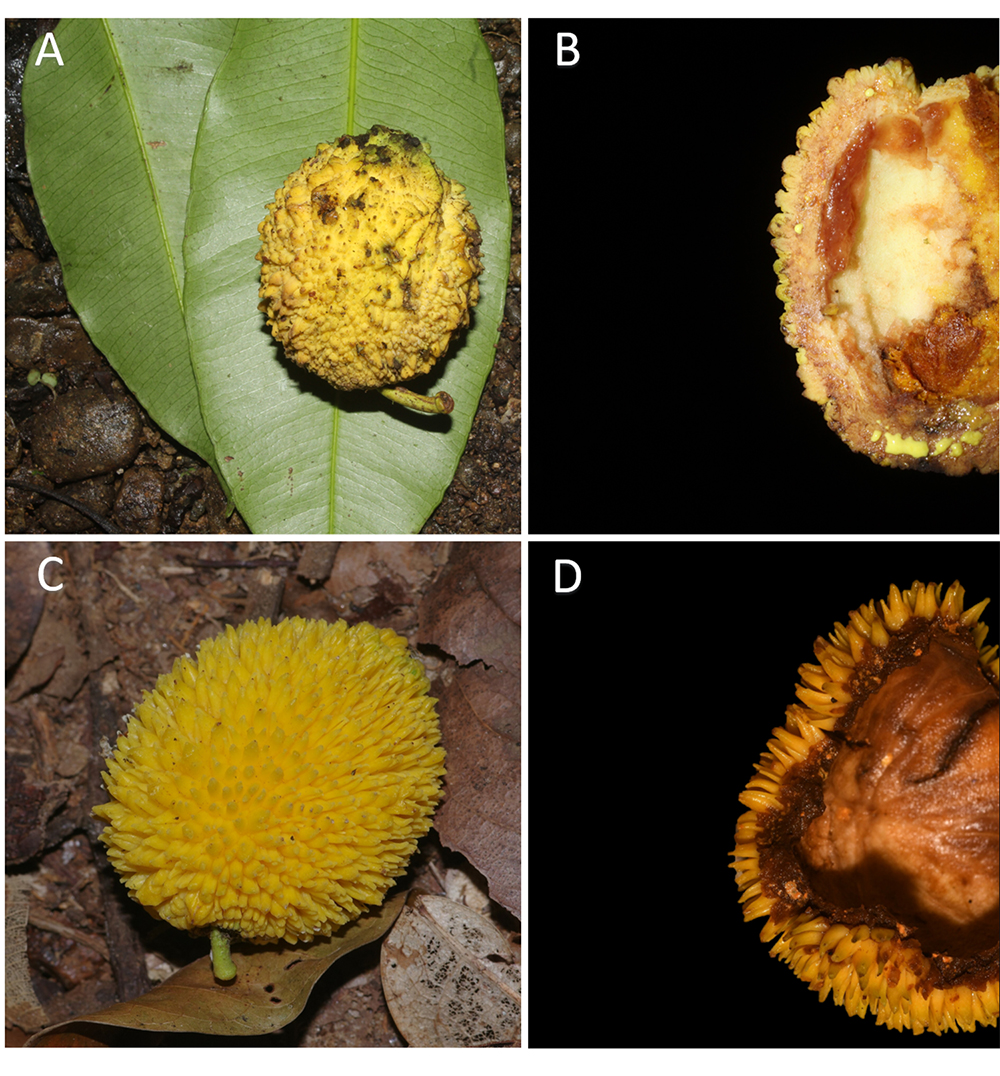
The epicarp in members of this complex is ornamented by projections with acute to rounded tips (Figure 1). The classification of muricate is due to the shapes of the rounded tips (Figure 1 A -B), while echinate refers to the acute forms (Figure 1 C -D). Thus, for the elaboration of the taxonomic key, emphasis was placed on fruit morphology.

Ornamental fruits of Garcinia. A-B. Epicarp muricate, Garcinia sp. C-D. Epicarp echinate, Garcinia floribunda. Photos: A-B = Thiago Mouzinho, C-D = Hervé Galliffet.
Taxonomic key
1. Fruits with muricate epicarp ...................................................................................................2
1’ Fruits with echinate epicarp ....................................................................................................3
2. Branches smooth; leaf blades membranous to sub-chartaceous, secondary veins reach the margin ....................................................................................................Garcinia ieda-amaralae
2’. Branches slightly verrucose to papillose; leaf blades chartaceous; secondary veins arched near the margin ..............................................................................................Garcinia kaiabiana
3. Leaf blades sub-chartaceous, base acute, rounded to cordate; staminate flowers with ca. 40 stamens; fruits with concrescent stigmas of defined lobes ..............................Garcinia guttifolia
3’. Leaf blades chartaceous, base attenuated; staminate flowers with ca. 30 stamens; fruits with concrescent stigma of undefined lobes ........................................................................................4
4. Pistillate flowers with flattened stigma; staminodes ca. 30...........................Garcinia madruno
4’. Pistillate flowers with capitate stigma; staminodes ca. 20........................Garcinia floribunda
Garcinia floribunda Miq.Stirp. Surinam. Select. 89. Miquel (1851). (Fig. 2)

Lectotype of Garcinia floribunda (W. R. Hostmann 593a). Available at: Swedish Museum of Natural History (S).
Type: SURINAME. 1846, bot., W.R. Hostmann 593a (Lectotype designated here: S barcode S11-36118 photo!; isolectotype: MO barcode MO-279691 photo!)
≡ Rheedia floribunda (Miq.) Planch. & Triana, Ann. Sci. Nat., Bot. 14: 319. 1860.
= Rheedia virens Planch. & Triana, Ann. Sci. Nat., Bot. 14: 317. 1860. syn. nov.
≡ Rheedia kappleri Eyma, Meded. Bot. Mus. Herb. Rijks Univ. Utrecht 4: 26. 1932. nom. illeg.
Trees up to 12 m tall; branches angular in sicco, papillose verrucose; exudate yellow. Petioles 9-17.5 mm long, slightly striate transversely; dilated of the base of the petioles discrete in sicco. Leaf blades 8.3-14.7 × 3.8-6.1 cm, chartaceous, greenish in sicco, opaque on abaxial surface, elliptic to elliptic-ovate, apex attenuated, margin slightly sinuous, base attenuated; secondary veins branched near margin; intersecondary veins parallel to secondary, 2-3 pairs per intercostal area; intramarginal vein conspicuous; exudate canals abundant on the abaxial face in sicco. Staminate inflorescence axillary, fasciculate, bracteoles 2, diminute, ca. 30 flowers per fascicle; pedicels 14.5-19.8 mm long. Staminate flowers with sepals 2, 1-1.3 × 1.8-2 mm, rounded; petals 4, the outer ones 3.1-3.3 × 2.2-2.6 mm, rounded, the inner ones 4.2-4.5 × 3-3.2 mm, obovate, central nectariferous disc ca. 2 mm diam., globose, with apiculate center in sicco; stamens ca. 30 per flower, arranged around the disc in 3 series, filaments 2.2-3.6 mm long, terete, anthers globose, thecae 0.25-0.32 × 0.22-0.27 mm. Pistillate inflorescence axillary, fasciculate, bracteoles 2, diminute; pedicels 8.6-9.7 mm long. Pistillate flowers with sepals 2, ca. 2 × 2 mm, deltoid; petals 4, the outer 4.5-4.8 × 1.8-2.1 mm, oblong, the inner 4.5-5.8 × 3.1-3.7 mm, oblong-rounded, annular nectariferous disc ca. 2 mm diam.; staminodes ca. 20 per flower, arranged around the disc in 2 series, filaments 2-3 mm long, terete, rudimentary anthers globose, thecae 0.20-0.25 × 0.20-0.25 mm; ovary 2-2.2 × 2.5-2.7 mm, ovoid, 3 carpels, 3 locules, 1 ovule per locule; stigma ca. 2 mm diam., capitate, lobes defined, trilobate. Fruits with echinate epicarp, sepals, staminodes and stigmas persistent; green when immature, ovoid, when mature 30.3-48.0 × 27.8-38.5 mm, yellow, globose, rostrum absent, stigma concrescent with undefined lobes, sunken at the apex. Seeds not seen. Fig. 3.

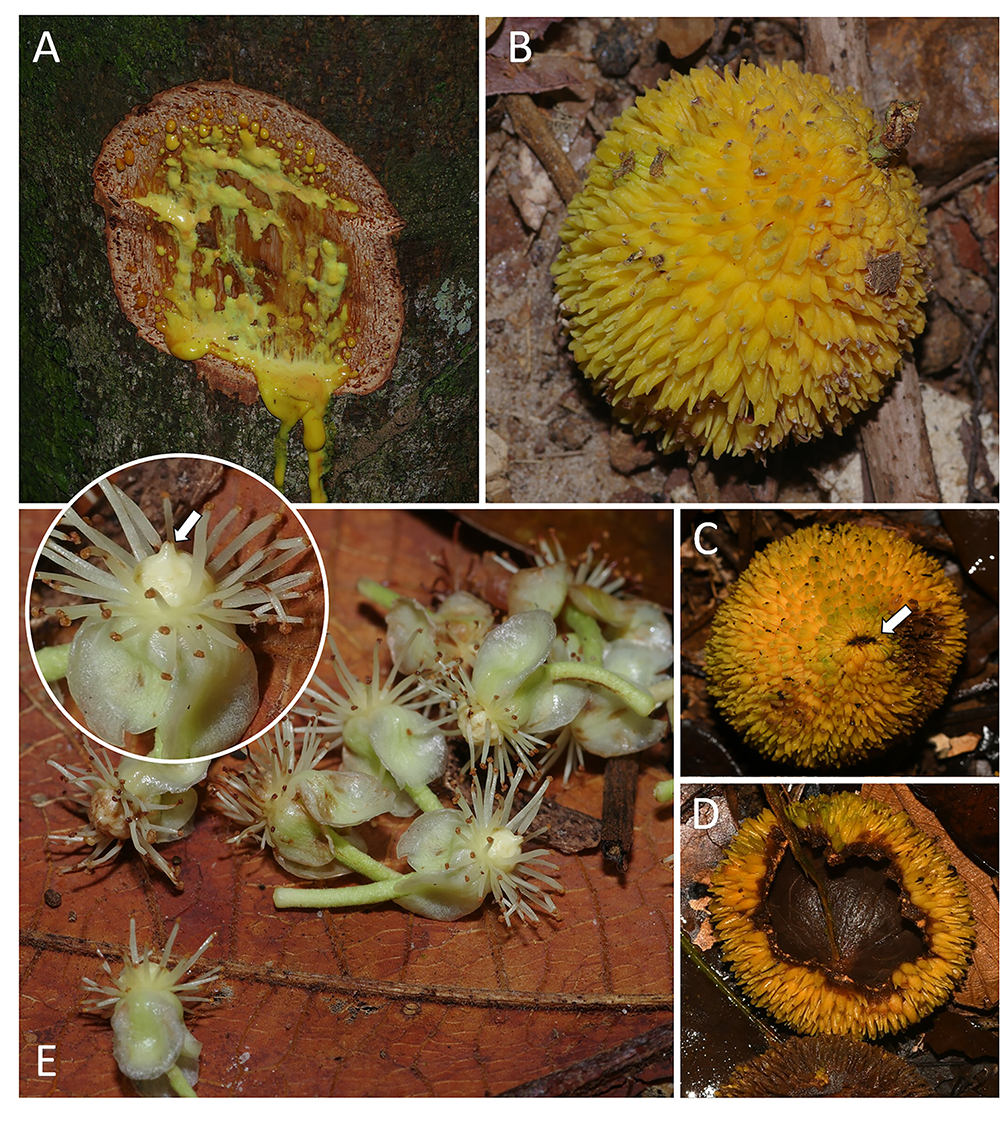
Garcinia floribunda. A. Cut on the trunk showing the exudate. B. Fruit. C. Front view of the fruit in highlighting the stigma (arrow). D. Fruit in cross-section. E. Staminate flowers, in detail, the apiculate nectariferous disc. Photos: Hervé Galliffet.
Vernacular name: SURINAME: hoogland-pakoelie (Brokopondo: C. Bhikhi et al. 936 - U).
Distribution and habitat: Garcinia floribunda occurs in the Guiana Shield region, Guyana (Pomeroon-Supenaam), French Guiana (Kouro) and Suriname (Brokopondo and Zanderij). In Brazil, to date, the species is registered only for the state of Amapá. The species is found in dry land environments corresponding to mountainous areas (Fig. 4). Garcinia floribunda has an extent of occurrence of 215.027 km² (EOO) with an area of occupancy of 28 km² (AOO).

Geographical distribution. G. floribunda (hexagon), Garcinia ieda-amaralae (square), G. guttifolia (circle), G. kaiabiana (triangle) and G. madruno (inverted triangle).
Specimens examined: BRAZIL. Amapá: Rio Jari, 16 June 1969 (fl. ♂), N.T. Nilo 2201 (IAN!). FRENCH GUIANA. Kouro: Passoura, 06 May 1992 (fr.), P. Acevedo-Rdgz et al. 4919 (F photo!); ibidem, Rio Oiapoque, 02°35’N, 52°32’W, 22 September 1960 (fr.), H.S. Irwin et al. 48429 (U photo!). GUYANA. Pomeroon-Supenaam: 07°15’N, 58°32’W, 21 April 1989 (fr.), L.J. Gillespie et al. 1072 (US photo!). SURINAME. 02 February 1916 (fl. ♀), Boschwezen 589 (IAN); 28 September 1948 (st.), J. Lanjouw & J.C. Linderman 517 (IAN!); Brokopondo: van Blommesteijin Lake, 04°52’N, 54°56’W, 22 February 2011 (fr.), C. Bhikhi et al. 483 (U photo!), ibidem, 04°40’N, 54°56’W, 14 April 2011 (fl. ♂), C. Bhikhi et al. 936 (U photo!). Zanderij: May 1944 (st.), Boschwezen 204 (IAN!).
Taxonomic note: We also designate R. virens Planch. & Triana as a new synonym for G. floribunda; this species was known only from the type specimen and has not been mentioned in any other taxonomic studies.
Garcinia floribunda differs from G. madruno by the textures of the papillose-verrucose branches (vs. non-papillose-verrucose in G. madruno), abundant exudate canals on the abaxial face (vs. partially in G. madruno), staminate flowers with obovate inner petals (vs. oblong in G. madruno), apiculate central disc (Fig. 3 E vs. non-apiculate in G. madruno), pistillate flowers with capitate stigma (vs. flattened in G. madruno), staminodes ca. 20 per flower (vs. 30 per flower in G. madruno). Garcinia floribunda can be confused with G. kaiabiana, though it can be distinguished by reproductive characters such as the staminate flowers with obovate inner petals (vs. rounded in G. kaiabiana), apiculate central disc (vs. not apiculate in G. kaiabiana), fruits with echinate epicarp (Fig. 3 B vs. muricate in G. kaiabiana) and absent rostrum (vs. present in G. kaiabiana) (Table 1). Furthermore, it is similar to G. ieda-amaralae (see note on G. ieda-amaralae).
Morphological comparison between species related to the Garcinia madruno complex (in sicco).
Garcinia guttifolia Mouzinho & L.Marinho, sp. nov. (Fig. 5)

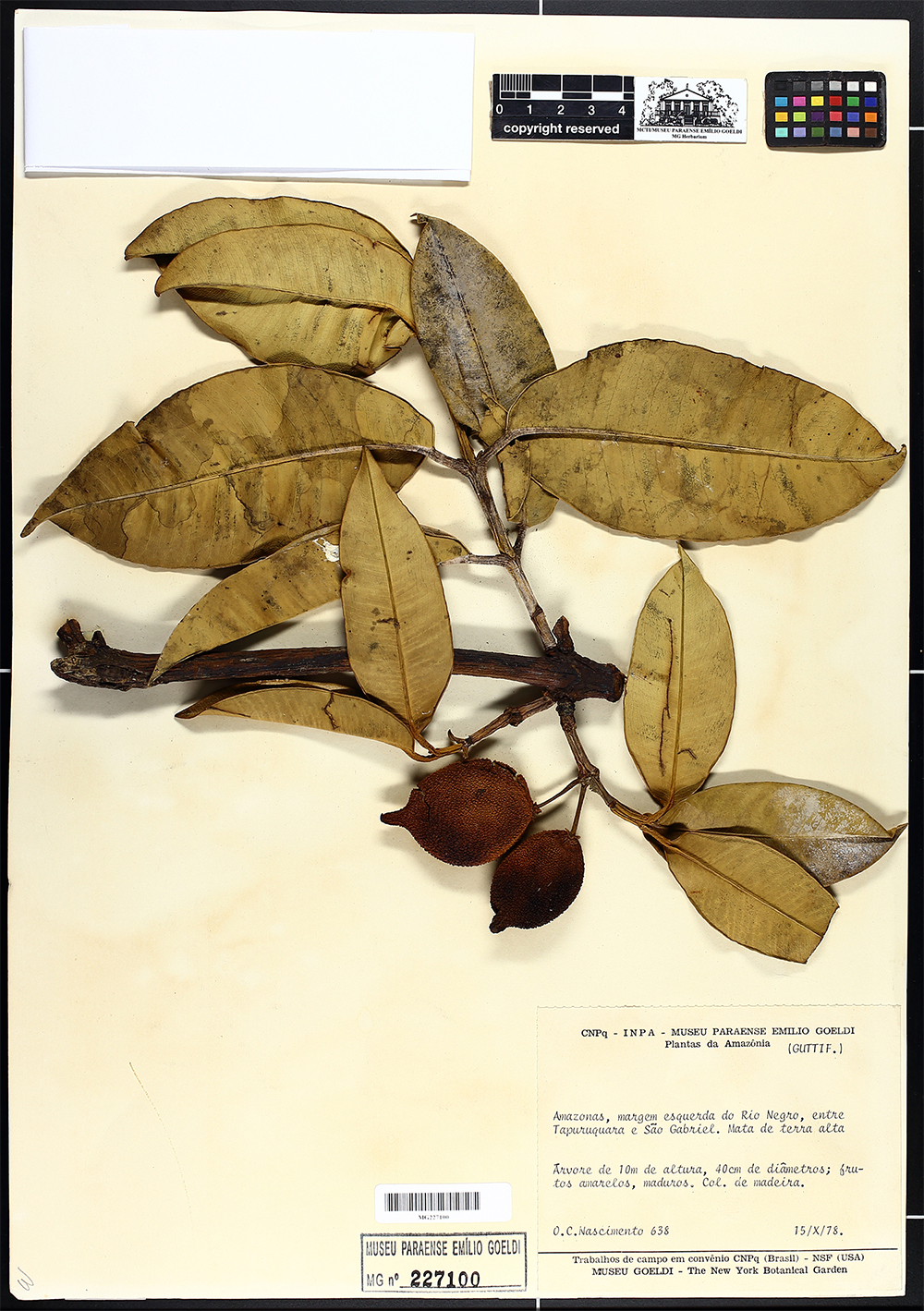
Holotype of Garcinia guttifolia Mouzinho & L. Marinho (O. C. Nascimento 638). Available at: Museu Paraense Emílio Goeldi (MG).
Type: BRAZIL. Amazonas: entre Santa Isabel do Rio Negro e São Gabriel da Cachoeira, Rio Negro, 15 October 1978 (fr.), O.C. Nascimento 638 (holotype: MG barcode MG-227100!; isotype: NY 2-sheets barcodes NY-01304256!, NY-01304227!)
Garcinia guttifolia has yellowish-brown leaf blades in sicco, sub-chartaceous, ovate-elliptic to ovate-oblong, the base acute, rounded to cordate; staminate flowers with outer petals rounded-obovate, the inner ones obovate, and echinate fruits with truncated apex when ripe.
Trees up to 15 m tall. Stem with fissured rhytidoma, lenticels; exudate yellow, dark yellow when oxidized; sapwood reddish and cortex yellowish. Branches strongly angular, verrucose in sicco. Petioles 6.33-15.79 (-18.15) mm long, strongly striated transversely in sicco; dilated of petiole base evident in sicco. Leaf blades 9.6-18.8 × 4.4-8.6 cm, sub-chartaceous, usually yellowish-brown in sicco, opaque on both sides, ovate-elliptic to ovate-oblong, apex acuminate, margin revolute in sicco, base acute, rounded to cordate; secondary veins branched to arcuate, anastomosed, intersecondary veins parallel to secondary veins, 2-3 pairs per intercostal area, reticulated near the margin; conspicuous intramarginal vein conspicuous; exudate canals not abundant on the abaxial face in sicco. Staminate inflorescence axillary, fasciculate, bracteoles 2, conspicuous, ca. 30 flowers per fascicle; pedicels 7.7-22.5 mm long, greenish. Staminate flower buds 3.2-4.6 × 2.5-3.6 mm, globose. Staminate flowers with a mild odor, sepals 2, 2.5-3.3 × 2.8-3.5 mm, greenish, adaxially concave, fleshy, rounded; petals 4, chartaceous, greenish-yellow in the central region, exudate dark yellow canals, hyaline margin, outer ones 6.0-7.1 × 4.0-5.7 mm, rounded-obovate, inner ones 6.3-7.6 × 4.8-5.7 mm, obovate; central nectariferous disc 2-3 mm diam., yellow to yellowish-white, globose, sinuous; stamens ca. 40 per flower, arranged around the disc in 3 series, filaments 3.5-4.2 mm long, hyaline, terete, anthers globose, yellow, ferruginous when senescent, thecae 0.37-0.60 × 0.30-0.43 mm. Pistillate inflorescence axillary, fasciculate, bracteoles 2, conspicuous; pedicels ca. 7.2 mm long, greenish. Pistillate flowers with a mild odor, sepals 2.3-3.3 × 4-4. 6 mm, greenish, concave adaxially, fleshy, rounded; petals 4, chartaceous, concave adaxially, white, exudate canals light yellow, the outer ones 6.7-7.3 × 7-7.5 mm, rounded-obovate, the inner ones 8.1-8.7 × 5-5.2 mm, obovate; annular nectariferous disc ca. 4 mm diam., yellow; staminodes ca. 20 per flower, arranged around the disc in 2 series, filaments ca. 3.5 mm long, hyaline, terete, rudimentary anthers globose, yellow, ferruginous when senescent; ovary ca. 3.2 × 3.5 mm, greenish, ovoid, 3 carpels, 3 locules, 1 ovule per locule; stigma ca. 2.5 mm diam., white, capitate, lobes defined, tri to tetralobate. Fruits with lightly echinate epicarp, sepals, petals, staminodes and stigmas persistent, when immature 18-31.4 × 9.1-24.9 mm, green, ellipsoid, rostrum 4-7.8 mm long; when mature 36.1-45.8 × 27.8-39 mm, yellow, ovoid, rostrum 5.2-8.2 mm long, stigma concrescent 2-3.4 mm diam., lobes defined, tri to tetralobate, slightly capitate; pedicels 9.7-20 mm long. Seeds 2-3, 25.2-31.4 × 7.5-14.8 mm, oblong. Figs 5-6.

Garcinia guttifolia. A. Crown. B. Cut on the trunk showing the exudate. C. Branch. D. Abaxial face of the leaf blade in highlighting the secondary and intersecond veins (in the circle). Photos: A = Thiago Mouzinho. B = Gabriel Marcusso. C-D = Francisco Farroñay.
Etymology: The epithet refers to the usually rounded shape of the leaf base, resembling the outline of the base of a water drop (from Latin, gutti = drop and folia = leaf). Furthermore, all known specimens of G. guttifolia are associated with watercourses, flooded forests and island areas.
Vernacular name: BRAZIL: bacuripari-do-igapó (T.M. Mouzinho 138 - INPA).
Distribution and habitat: Garcinia guttifolia is endemic to the Brazilian Amazon and is found only in the state of Amazonas. The species is found in campinarana and igapó environments, covering the region of the Upper and Middle Rio Negro (Fig. 4). Garcinia guttifolia has an extent of occurrence of 139.933 km² (EOO) with an area of occupancy of 24 km² (AOO).
Paratypes: BRAZIL. Amazonas: Mun. Barcelos, 01°08’29”S, 62°19’23”W, 20 October 2008 (bot.), A.B. Junqueira et al. 726 (INPA!, UEC photo!); ibidem, Parque Nacional do Jaú, Igarapé do Papagaio, 18 July 2001 (fr.), M.J.A. de Mendonça et al. 76 (INPA!); Mun. Iranduba, 23 December 2020 (fl. ♂), T.M. Mouzinho et al. 138 (INPA!, HUAM!); Mun. Manaus, Ilha do Pombo, 08 April 1997 (fl. ♂), R. Mouzinho et al. s.n. (INPA-194357!); ibidem, Rio Cuieiras, 05 April 1974 (fr.), D.G Campbell et al. P21863 (INPA!, NY!); ibidem, 28 January 1986 (fr.), I.J. Guillanmet et al. 5704 (INPA!); Mun. Novo Airão, Parque Nacional de Anavilhanas, 07 October 2022 (fl. ♀), T.M. Mouzinho et al. 275 (INPA!); Mun. Santa Isabel do Rio Negro, Igarapé Jaradí, 00°12’51”S, 65°07’58”W, 18 September 2014 (bot. ♂), A.S.S. Holanda et al. 637 (INPA!, CEPEC photo!); ibidem, Ilha da Silva, 15 October 1971 (fr.), G.T. Prance et al. 15268 (INPA!, MO photo!); ibidem, Rio Cauaburi, 05 September 1979 (fr.), K. Kubitzki et al. 79-147 (INPA!, NY!, US photo!); Mun. São Gabriel da Cachoeira, 00°25’S, 66°25’W, 04 July 1979 (bot./fl. ♂), J.M. Poole 1868 (INPA!, MO photo!, NY!, W photo!).
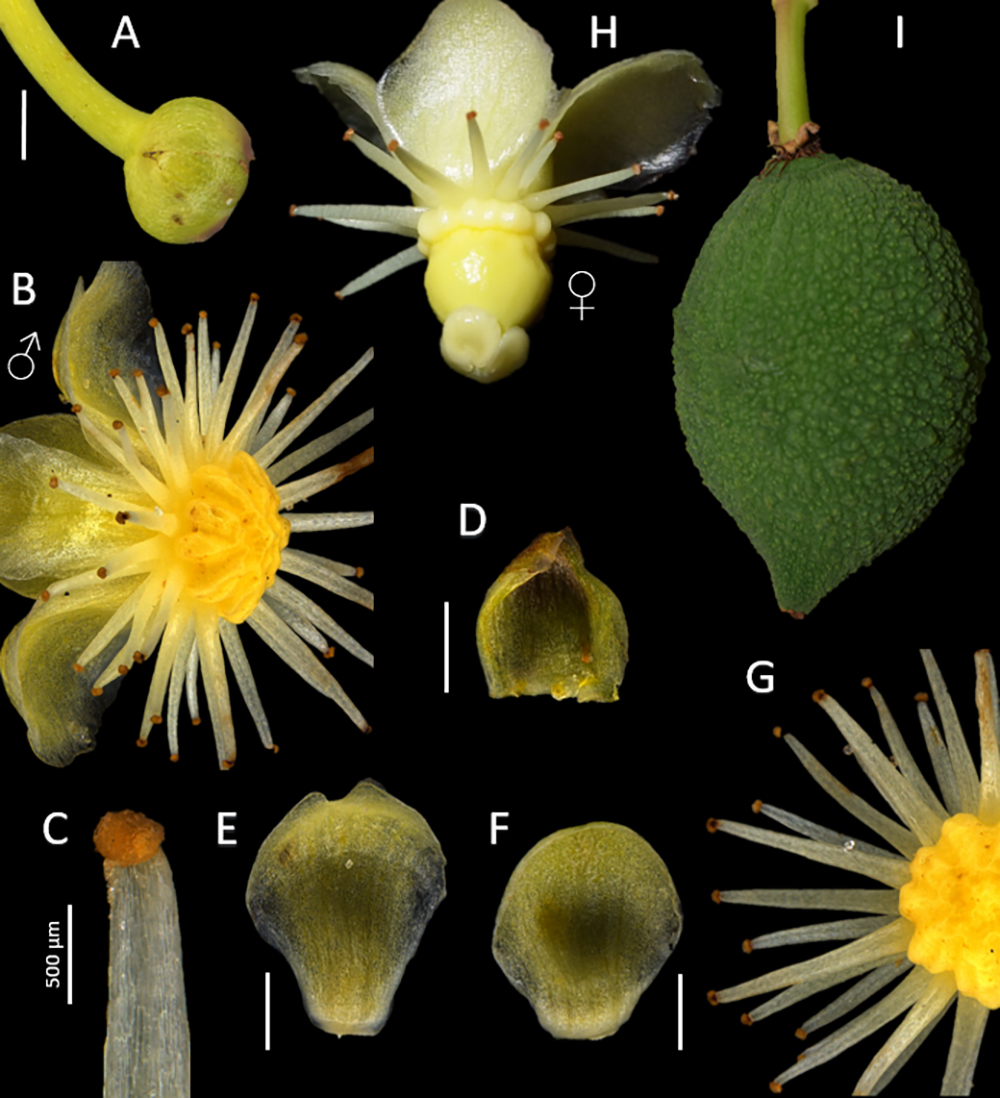
Taxonomic note: Garcinia guttifolia can be distinguished from G. madruno due to it having ovate-elliptic to ovate-oblong leaf blades (Figs 5, 6C vs. elliptic in G. madruno), acute base, rounded to cordate (vs. attenuated in G. madruno), staminate flowers with rounded-obovate outer petals and obovate inner petals (Figs. 7E, 7F vs. rounded and oblong in G. madruno), pistillate flowers ca. 20 staminodes (Fig. 7 H vs. ca. 30 in G.madruno), fruits with presence of rostrum (Fig. 7 I vs. absent in G. madruno), stigma concrescent trilobate, slightly capitate (vs. undefined lobes, sunken at apex in G. madruno). The projections of the equinate epicarp of G. guttifolia are different from those of G. floribunda and G. madruno, as they are smooth projections (lightly equinate) (Figs. 3B, 7I, 13C) (Table 1). In Flora Brasiliensis, Engler (1888) determined the specimen Spruce 2377 as R. floribunda, emphasizing the occurrence of this species in the Brazilian Amazon, but upon analysis of the specimen, we found that it was a specimen of G. guttifolia.

Garcinia guttifolia. A. Floral bud (♂). B. Staminate flower. C. Stamen. D. Sepal (♂). E. Inner petal (♂). F. Outer petal (♂). G. Frontal view of the flower in highlighting the organization of the androecium in the nectariferous disc. H. Pistillate flower. I. Immature fruit (scale = 2 mm). Photos: A-B-C-D-E-F-G = Thiago Mouzinho. H = Gabriel Marcusso. I = Francisco Farroñay.
Garcinia ieda-amaralae Mouzinho & M.L.Soares, sp. nov. (Figs 8-9)
Type: BRAZIL. Acre: Rio Moa, 15 km, 25 October 1966 (fl. ♂), G.T. Prance et al. 2793 (holotype: INPA barcode INPA-0057965!; isotypes: MO barcode MO-3297961!, NY barcode NY-00754604!)

Garcinia ieda-amaralae holotype Mouzinho & M. L. Soares (G. T. Prance et al. 2793). Available at: Instituto Nacional de Pesquisas da Amazônia (INPA).

Garcinia ieda-amaralae Mouzinho & M. L. Soares. A. Branch. B. Intercostal region of the leaf blade. C. Aspect of the branch. D. Staminate flower. E. Inner petal. F. Fruit. G. Detail of the apex of the fruit. Illustration: Thamiris Macedo.
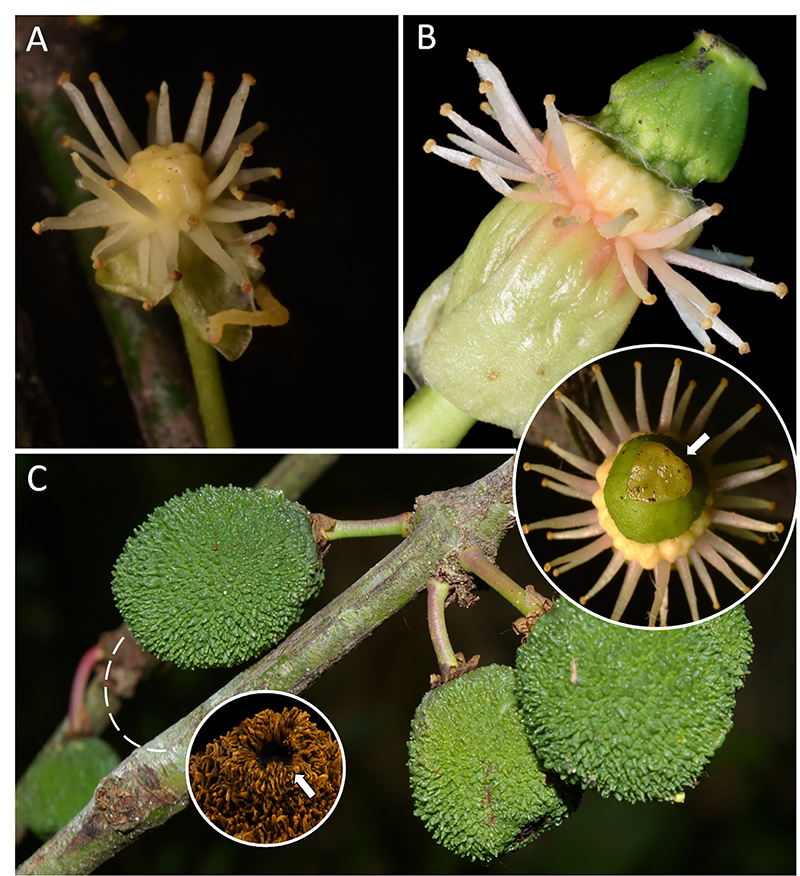
Garcinia ieda-amaralae is morphologically similar to G. floribunda and G. kaiabiana, from which it can be distinguished by its branches with a smooth texture; leaf blades obovate-elliptic to ovate, membranous to sub-chartaceous; staminate flowers with oblong inner petals; fruits with a muricate epicarp and stigma concrescent trilobate, slightly concave.
Trees up to 10 m tall; branches subcylindric in sicco, smooth; exudate yellow. Petioles 5.2-12.4 (-16.7) mm long, slightly striated transversely; dilated of the base of the petioles diminutive in sicco. Leaf blades 6.2-15.3 × 3.0-5.6 cm, membranous to sub-chartaceous, pale greenish in sicco, glossy on adaxial face, rarely on abaxial, obovate-elliptic to ovate, apex acuminate, margin slightly crenate, slightly revolute in sicco, base acuminate to acute; secondary veins predominantly reach margin, rarely arcuate; intersecondary veins parallel to secondary veins, reticulated near margin; intramarginal vein conspicuous; exudate canals abundant on abaxial face in sicco. Staminate inflorescence axillary, fasciculate, bracteoles 2, diminute, ca. 10 flowers per fascicle; pedicels 11.6-16.3 mm long Staminate flower buds 3-3.5 × 2.2-2.5 mm, globose. Staminate flowers with 2 sepals, 1.6-2.3 × 1.2-2 mm, rounded; petals 4, the outer ones ca. 3.7 × 2.1 mm, rounded, the inner ones 4.3-4.6 × 2.9-3.2 mm, oblong; central nectariferous disc ca. 2 mm diam., globose; stamens ca. 30 per flower, arranged around the disc in 3 series, filaments 3.1-4.3 mm long, filiform, anthers ellipsoid to globose, thecae 0.27-0.36 × 0.20-0.22 mm. Pistillate inflorescence and flowers not seen. Fruits with muricate epicarp, sepals, petals, staminodes and persistent stigmas when ripe 26.4-35.4 (-42.4) × 18.7-25.6 mm, yellow, ovoid, rostrum 4-8 mm long, stigma concrescent 2.1-2.4 mm diam., trilobate, slightly concave; senescent staminodes ca. 20, arranged around the disc; pedicels 12.4-17.7 mm long. Seeds 2, 18.2-22.5 × 8.2-13.5 mm, ellipsoid.
Etymology: The specific epithet honors INPA’s botanical researcher Dr. Iêda Leão do Amaral, who has contributed immensely to the knowledge of the flora of the Amazon.
Vernacular name: COLOMBIA: madroñito (J.M. Duque-Jaramillo 2390 - INPA).
Distribution and habitat: Garcinia ieda-amaralae occurs in Brazil (Acre, Amazonas and Rondônia), Colombia (Amazonas) and Peru (Coronel Portillo). Found in terra firme and várzea environments (Fig. 4). Garcinia ieda-amaralae has an extent of occurrence of 502.180 km² (EOO) with an area of occupancy of 32 km² (AOO).
Paratypes: BRAZIL. Acre: Mun. Cruzeiro do Sul, 08°55’S, 72°31’N, 12 March 1992 (fr.), C.A.C. Ferreira et al. 10777 (INPA!, UFACPZ photo!); ibidem, 03 November 1966 (fl. ♂), G.T. Prance et al. 2981 (INPA!, MO photo!, NY!, SPF photo!); ibidem, 21 February 1976 (fr.), O.P. Monteiro et al. 76-568 (INPA!); Mun. Plácido de Castro, 10°15’45”S, 67°36’46’’W, 05 February 2000 (fr.), I.S. Rivero et al. 361 (NY!, UFACPZ photo!). Amazonas: Mun. Jutaí, Rio Solimões, 02°43’S, 66°45’W, 24 October 1986 (fr.), C.A.C. Ferreira et al. 8293 (INPA!, NY!); ibidem, Rio Javari, 18 October 1976 (st.), G.T. Prance et al. 23908 (INPA!, MO photo!, UEC photo!); Mun. São Paulo de Olivença, 04°1’17”S, 69°30’16”W, 17 August 2012 (fr.), C.E. Zartman et al. 9500 (HUEFS!). Rondônia: Mun. Porto Velho, 15 January 2010 (fr.), V.X. Silveira 17 (INPA!). COLOMBIA. Amazonas: Rio Hamacayacu, 20 December 1945 (fr.), J.M. Duque-Jaramillo 2390 (INPA!). PERU. Ucayali: Prov. Coronel Portillo, Leoncio Prado, 08°20’S, 74°35’W Alt: 200 m, 14 May 1984 (fr.), R. Vasquez 4969 (MO photo!, US photo!).
Taxonomic note: Garcinia ieda-amaralae differs from G. madruno by having branches with a smooth texture (Fig. 9 C vs. verrucose in G. madruno), obovate-elliptic to ovate leaf blades (Figs. 8, 9A vs. elliptic in G. madruno), abundant exudate canals on the abaxial face (vs. not abundant in G. madruno), fruits with muricate epicarp (Fig. 9 F vs. echinate in G. madruno) and concrescent stigma with defined lobes (trilobate) (Fig. 9 G vs. sunken at the apex in G. madruno). Garcinia ieda-amaralae can be confused with G. floribunda and G. kaiabiana, mainly when sterile, but differs by its branches with a smooth texture (vs. papillose-verrucose in G. floribunda), leaf blades obovate-elliptic to ovate (vs. elliptic to elliptic-ovate in G. floribunda and G. kaiabiana), intramarginal veins conspicuous (vs. inconspicuous in G. kaiabiana), staminate flowers with oblong inner petals (Fig. 9 E vs. obovate in G. floribunda and rounded in G. kaiabiana), stamens with filiform filaments (Fig. 9 D vs. terete in G. floribunda), fruits ovoid (vs. globose in G. floribunda) and fruits with muricate epicarp (vs. echinate in G. floribunda) (Table 1).
Garcinia kaiabiana Mouzinho, sp. nov. (Figs 10-11)

Holotype of Garcinia kaiabiana Mouzinho (M. G. Silva & C. Rosario 3903). Available at: Instituto Nacional de Pesquisas da Amazônia (INPA).

Garcinia kaiabiana. A. Branch. B. Intercostal region of the leaf blade. C. Fruit. D. Apex of the fruit showing the stigma. E. Staminate flower. F. Inner petal of the staminate flower. G. Pistillate flower. Illustration: Thamiris Macedo.
Type: BRAZIL. Pará: Itaituba-Jacareanga, [Parque Nacional da Amazônia] 23 November 1978 (fr.), M.G. Silva & C. Rosário 3903 (holotype: NY barcode NY-01304243!; isotype: INPA barcode INPA-57986!)
Garcinia kaiabiana is recognized by its staminate flowers with rounded inner petals, ripe fruits with muricate epicarp, rostrum present and stigma with concrescent undefined lobes.
Trees up to 10 m tall, branches sub-cylindrical striated in sicco, slightly verrucose-papillose, exudate yellow. Petioles 6.2-15.8 mm long, slightly striated transversely; dilated of the base of the petioles, diminute, inconspicuous, oblong in sicco. Leaf blades 8.5-17.4 × 3.2-6.1 cm, chartaceous, discolorous, greenish in sicco, generally glossy on the abaxial surface, elliptic to elliptic-ovate, apex acuminate to attenuated, margin slightly revolute in sicco, base acute to attenuated; secondary veins arched and branched near margin; intersecondary veins parallel to the secondary veins, 2-3 pairs between the secondary veins; intramarginal veins inconspicuous; exudate canals conspicuous on both faces in sicco, parallel between the secondary veins on the adaxial face and longitudinal on the abaxial face. Staminate inflorescence axillary, fasciculate; pedicels 11.5-17.5 mm long. Staminate flower buds 3.6-4.5 × 2.8-4.48 mm, globose. Staminate flowers with sepals 2, 2.8-3.4 × 2.1-3.1 mm, rounded; petals 4, outer ones 4-5.4 × 3 mm, rounded, inner ones 4.5-6.3 × 3.2-3.8 mm, rounded; central nectariferous disc ca. 1.5 mm diam., globose; stamens ca. 30 per flower, arranged around the disc in 3 series, filaments 2.5-4.5 mm long, filiform, anthers globose, thecae 0.31-0.38 × 0.24-0.30 mm. Pistillate inflorescence axillary, fasciculate; pedicels 7-15.8 mm long. Pistillate flower buds not seen. Pistillate flowers with sepals 2, ca. 3 × 3 mm, rounded; petals 4, outer ones not analyzed, inner ones 6.0 × 4.0 mm, oblong, annular nectariferous disc 2 mm diam.; staminodes ca. 20 per flower, arranged around the disc in 2 series, filaments 2-3 mm long, filiform, rudimentary anthers globose, thecae 0.22-0.25 × 017-0.22 mm; ovary 3.5-4.2 × 3.0-3.5 mm, ovoid, 3 carpels, 3 locules, 1 ovule per locule; stigma ca. 3 mm diam., capitate, defined lobes, trilobate. Fruits with muricate epicarp, sepals, petals, staminodes and stigmas persistent, when ripe 27.1-45.3 × 12.2-25.6 mm, yellow, ovoid, rostrum 4.8-11.4 mm long, stigma 2-3.5 mm diam., lobes not defined, flattened in sicco; pedicels 7-18.2 mm long. Seeds 2-3, 16.2-19.3 × 7.6-9.4 mm, ellipsoid.
Etymology: The epithet kaiabiana is in honor of the kaiabi people found in the south of the Brazilian Amazon, corresponding to the states of Mato Grosso and Pará, which are locations where the species occurs. Garcinia kaiabiana has an extent of occurrence of 504.286 km² (EOO) with an area of occupancy of 36 km² (AOO).
Vernacular name: BRAZIL: limãozinho (Mato Grosso: G.T. Prance et al. s.n. - INPA-41613).
Distribution and habitat: Garcinia kaiabiana is endemic to Brazil, and is found in the states of Mato Grosso and Pará, occurring in wetlands (Fig. 4).
Paratypes: BRAZIL. Mato Grosso: Mun. Alta Floresta, 09°00’S, 55°00’W Alt. 225m, 12 December 2006 (fr.), D. Sasaki et al. 1155 (INPA!, K photo!); ibidem, Saltos Apiacás, 26 May 1988 (fr.), M. Macêdo 1930 (INPA!); Mun. Aripuanã, Km 24 da BR 174, 20 January 1979 (fl. ♂), M.G. Silva et al. 4336 (INPA!, NY!); ibidem, Cachoeira das Andorinhas, 26 July 1974 (fr.), N.A. Rosa et al. 159 (IAN!); ibidem, Dardanelos, 29 September 1975 (fl. ♀), P. Lisbôa et al. 476 (INPA!); ibidem, Rio Aripuanã, 59°21’N, 10°12’S, 9 October 1973 (fr.), G.T. Prance et al. 18311 (INPA!, MO photo!, NY!, U photo!, UEC photo!, UFMT photo!). Pará: Rio Tapajós, 30 January 1952 (fl. ♂), J.M. Pires 4047 (IAN!); Mun. Itaituba, Rio Tapajós, 17 September 2013 (fr.), I.L. Amaral et al. 3815 (INPA!); ibidem 27 December 1951 (fl. ♀), J.M. Pires 3690 (IAN!); ibidem, Parque Nacional da Amazônia, 04°30’37’’S, 56°15’34’’W Alt. 35m, 13 July 2016 (fr.), M.T. Benjamin et al. 1757 (IAN!); Mun. São Geraldo do Araguaia, Vila Nova, Alto Tapajós, 24 January 1952 (fr.), J.M. Pires 4025 (IAN!, NY!).
Taxonomic note: Garcinia kaiabiana differs from G. madruno by the following reproductive characters; staminate flowers with rounded inner petals (Fig. 11 F vs. oblong in G. madruno), pistillate flowers with capitate stigma (Fig. 11 G vs. flattened in Garcinia madruno), ca. 20 staminodes (vs. ca. 30 in G.madruno), ovoid fruits (Fig. 11 C vs. globose in G. madruno), muricate epicarp (vs. echinate in G. madruno), rostrum present (Fig. 11 D vs. absent in G. madruno), stigma concrescent flattened (vs. sunken at apex in G. madruno). Garcinia kaiabiana is morphologically related to other species (see note on G. floribunda and G. ieda-amaralea) (Table 1).
Garcinia madruno (Kunth) Hammel. Ann. Missouri Bot. Gard. 76 (3): 928. 1989.
(Fig. 12)
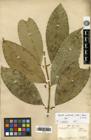
Garcinia madruno lectotype (A. J. Bonpland et al. 1723). Available at: Muséum National D'histoire Naturelle (P).
Type: COLOMBIA. Antioquia: Magdalena and Cauca valleys, [June 1805] (fr.), A.J. Bonpland et al. 1723 (Lectotype, designated by Hammel (1989): P barcode P-01901275 photo!; isolectotype: P 2-sheets barcodes P-00679866 photo!, P-00679867 photo!)
= Verticillaria acuminata Ruiz & Pav, Syst. Veg. Fl. Peruv. Chil. 140-141. 1798.
≡ Calophyllum madruno Kunth, Nov. Gen. Sp. 5: 202. 1822.
= Rheedia acuminata (Ruiz & Pav.) Planch. & Triana, Ann. Sci. Nat., Bot. 14: 314-315. 1860.
≡ Rheedia madruno (Kunth) Planch. & Triana, Ann. Sci. Nat., Bot. 14: 315-316. 1860.
Trees up to 25 m tall; branches subcylindric, slightly verrucose in sicco; exudate yellow. Petioles 8-20 mm long, slightly striated transversely; dilated of the base of the petioles, inconspicuous in sicco. Leaf blades 7-25 × 3-10 cm, chartaceous, pale, greenish in sicco, opaque on the abaxial side, elliptic to elliptic-lanceolate, apex acuminate, margin slightly revolute in sicco, base attenuated; secondary veins reach the margin, rarely arcuate, intersecondary veins hardly differentiated from secondary ones; intramarginal vein conspicuous; exudate canals non-abundant on the abaxial face in sicco. Staminate inflorescence axillary, fasciculate, bracteoles 2, diminute; pedicels 12-20 mm long. Staminate flower buds not seen. Staminate flowers sepals 2, 2-3 × 2-3 mm, rounded; petals 4, the outer ones 5.5-6 × 3.5-4.5 mm, rounded, the inner ones ca. 7 × 3-3.5 mm, oblong; central nectariferous disc ca. 2 mm diam., globose; stamens ca. 30 per flower, arranged around the disc in 3 series, filaments 2-3 mm long, terete, globose anthers, thecae 0.30-0.40 × 0.25-0.30 mm. Pistillate inflorescence axillary, fasciculate. Pistillate flower buds not seen. Pistillate flowers sepals 2, petals 4, oblong, staminodes ca. 30 per flower, arranged around the annular nectariferous disc in 2 series, filaments terete, rudimentary anthers globose; ovary ca. 2 mm long, stigma ca. 2 mm diam., flattened, undefined lobes. Fruits with echinate epicarp, sepals, petals, staminodes and persistent stigmas, when open 29.5-55.8 × 15.5-19.6 mm, yellow, globose, rostrum absent, stigma concrescent > 2 mm diam., lobes undefined, sunken at the apex; pedicels 10.8-11.3 mm long. Seeds 2-3, 17.1-21 × 8.27-12.48 mm, ellipsoid-globose. Fig. 13.

Garcinia madruno. A. Staminate flower. B. Pistillate flower in highlighting the stigma (circled). C. Immature fruits, in detail, the stigma. Photos: A-B = Herber Sarrazola Yepes. C = Rodolfo Vásquez.
Vernacular name: BRAZIL: bacuri-de-espinho (Acre: D.C. Daly et al. 7814 - INPA). BOLIVIA. orocó (Sara: J. Camible s.n. - F-573329). COLOMBIA: madroño (Antioquia: Medellín-Zabala 2015). PERU: charichuela (Huanuco: R.M. Lao et al. s.n. - F1836623).
Distribution and habitat: Garcinia madruno is found in Bolivia (Beni, La Paz and Santa Cruz), Costa Rica (Limón, Puntarenas and San José), Brazil (Acre), Colombia (Amazonas, Antioquia, Chocó, Cordoba, Cundinamarca and Meta), Ecuador (Napo), Panama (Darién and San Blas), Peru (Huánuco, Madre de Dios and San Martín) and Venezuela (Caracas) (Hammel 2010, Medellín-Zabala 2015), occurring in mountainous areas and terra firme forests (Fig. 4). Garcinia madruno has an extent of occurrence of 4.310.230 km² (EOO) with an area of occupancy of 76 km² (AOO).
Specimens examined: BOLIVIA. Beni: 30 July 1976 (bot.), E. Menezes 106 (INPA!). La Paz: S. Yungas, 27-31 July 1939 (fr.), B.A. Krukoff’s 10673 (F photo!). Santa Cruz: Sara, 16 September 1924 (st.), J. Camible s.n. (F573329 photo!). COSTA RICA. Puntarenas: 30 May 1950 (fr.), P.H. Allen 5553 (F photo!). BRAZIL. Acre: Mun. Sena Madureira, 10°07’S, 69°13’W, 21 October 1993 (fr.), D.C. Daly et al. 7814 (INPA!). COLOMBIA. Nuquí: Estación Biológica El Amargal, 05°34’N, 77°31’W, April 1999 (fr.), J. Jácome 382 (F photo!). ECUADOR. Napo: Tena, Jatun Sacha Biological Station, 01°04’S, 77°36’W, 24 December 1990 (fl. ♀), D. Neill et al. 9749 (F photo!). PANAMA. San Blas: El Llano-Carti, 09°19N, 78°55’W, 17 July 1985 (fr.), G. Nevers 5973 (US photo!). PERU. Huánuco: Rio Huallaga, 17 October 1936 (fr.), Y. Mexia 8306 (F photo!); ibidem, Leoncio Prado, 29 September 1967, (fl. ♂), R.M. Lao et al. s.n. (F1836625 photo!); ibidem, Leoncio Prado, 28 October 1967 (fr.), Lao, R.M. et al. s.n. (F1836623 photo!); Madre de Dios: Tambopata, 12°29’S, 69°03’W, 11 November 1991 (fr.), M. Timaná et al. 3119 (F photo!), San Martín: Juanjuí, October 1934 (fr.), G. Krug 3856 (F photo!); ibidem, Mariscal Caceres, 01 October 1969 (st.), J.V. Schunke 3439 (F photo!). VENEZUELA. Cerro Naiguatá: 15-19 November 1963 (fr.), J.A. Steyermark s.n. (F1653395 photo!).
Taxonomic note: The most relevant characters for determining G. madruno are the pistillate flowers with flattened stigma and undefined lobes (Fig. 13 B ), followed by the echinate epicarp fruits with concrescent sunken stigma at the apex (Fig. 13 C ). The fruits of G. madruno are classified as echinate, unlike G. ieda-amaralae and G. kaiabiana, which have muricate-walled fruits. Garcinia madruno can be confused primarily with G. floribunda (see note on Garcinia floribunda). Table 1 presents the morphological aspects of G. madruno in comparison with those of the other related species. Mesoamerican and Andean specimens require deeper investigation, as this study prioritized specimens of the G. madruno complex present only in the Brazilian Amazon Forest.
Acknowledgments
The authors thank the Fundação de Amparo à Pesquisa do Estado do Amazonas (FAPEAM, Brazil) for the master’s scholarship awarded to the first author and the Instituto Nacional de Pesquisas da Amazônia (INPA/PPGBOT, Brazil) for providing the infrastructure. Conselho Nacional de Desenvolvimento Científico e Tecnológico (CNPq, Brazil) for the scientific initiation scholarship (PIBIC/INPA) offered to Tulio Silva and Luana Souza. Financiadora de Estudos e Projetos (FINEP) for the call “modernization of the INPA herbarium collection and its capacities for taxonomy studies” (N° 01.18.0117.00) and for the contribution of the equipment used in this study. To the curators Michael Hopkins (INPA), André Gil (MG) and Helena Raiol Souza (IAN) for the access to their respective collections and to the curators of the NY herbarium Emily Sessa and Matthew Pace for conceding the loans. We also thank Gustavo Shimizu for the considerations related to the epithets of the new species and the research group “Taxonomia da Flora Amazônica” for the support and availability of access to the Laboratório de Taxonomia Vegetal at INPA.
References
- Alencar AC, Marinho, LC. 2017. Flora das cangas da serra dos Carajás, Pará, Brasil: Clusiaceae. Rodriguésia 68: 935-944.
- Bachman S, Moat J, Hill AW, de la Torre J, Scott B. 2011. Supporting Red List threat assessments with GeoCAT: Geospatial conservation assessment tool. In: Smith V, Penev, L (eds.). e-Infrastructures for data publishing in biodiversity science. ZooKeys 150: 117-126.
- Engler HGA. 1888. Guttiferae: Rheedia Flora Brasiliensis 12: 457-466.
- Gonçalves EG, Lorenzi H. 2011. Morfologia Vegetal: organografia e dicionário ilustrado de morfologia de plantas vasculares. 2nd edn. Instituto Plantarum de Estudos da Flora, São Paulo.
- Hammel B. 1989. New combinations and taxonomies in Clusiaceae. Annals of the Missouri Botanical Garden 76: 927-929.
- Hammel B. 2010. Clusiaceae. In: Hammel, B, Grayum, MH, Herrera, C, Zamora, N (eds.). Manual de plantas de Costa Rica. St. Louis, Missouri Botanical Garden. p. 1-54.
- Hickey LJ. 1973. Classification of the architecture of dicotyledonous leaves. American Journal of Botany 60: 17-33.
- Medellín-Zabala DM. 2015. Sistemática del género Garcinia (Clusiaceae): revisión taxonómica para Colombia y filogenia de las especies Neotropicales. MSc Thesis, Universidad Nacional de Colombia.
- Miquel FAW. 1851. Stirpes surinamenses selectae. Apud Arnz. & Soc.
-
Muniz FH. 2023. Garcinia In: Flora do Brasil 2020. Jardim Botânico do Rio de Janeiro. https://floradobrasil.jbrj.gov.br/reflora 01 Dec. 2023.
» https://floradobrasil.jbrj.gov.br/reflora - Mouzinho TM, Soares ML, Cabral FN, Marinho LC. 2022. Nomenclatural and taxonomic novelties in Garcinia (Clusiaceae) from Amazonian forest. Phytotaxa 548: 91-98.
- Mouzinho TM, Cabral FN, Soares ML, Marinho LC. 2023. Garcinia apostoloi: A new species of Clusiaceae from the Brazilian Amazon forest. Brittonia 75: 62-68.
- Pittier H. 1912. New and noteworthy plants from Colombia and Central America. United States National Herbarium, 13: 453-456.
- Planchon JE., Triana J. 1860. Mémoire sur la famille de Guttifères. Annales des Sciences Naturelles, Botanique IV 13: 303-376.
- Rabelo A. 2012. Frutos nativos da Amazônia: comercializados nas feiras de Manaus-AM. Manaus, Editora INPA.
- Ruiz H, Pavon J. 1794. Florae peruvianae et chilensis Prodromus, sive novorum generum plantarum peruvianarum et chilensium descriptiones et icones. Lisbon, Sancha.
-
Stevens PF. 2001. Angiosperm Phylogeny Website. Version 14. https://www.mobot.org/MOBOT/research/APweb/ 01 Dec. 2023.
» https://www.mobot.org/MOBOT/research/APweb/ -
Shorthouse DP. 2010. SimpleMappr, an online tool to produce publication-quality point maps. https://www.simplemappr.net 14 Nov. 2023.
» https://www.simplemappr.net -
Thiers B. 2023. Index Herbariorum: A global directory of public herbaria and associated staff. New York Botanical Garden‘s Virtual Herbarium. https://sweetgum.nybg.org/ih/ 14 Nov. 2023.
» https://sweetgum.nybg.org/ih/ - Van Den Berg ME. 1979. Revisão das espécies brasileiras do gênero Rheedia L. (Guttiferae). Acta Amazonica 9: 43-74.