
 Gender-related phytochemical variation on Baccharis dracunculifolia DC. from two populations
Abstract
Baccharis dracunculifolia DC. is a dioecious shrub native to South America and the main botanical source of green propolis, an important commercial and medicinal product produced by Apis mellifera L. This study evaluated the phytochemical composition and antioxidant activity of hydroethanolic extracts and essential oils from male and female plants collected from different populations. This is the first comparative analysis of genders from different populations, focusing on artepillin C, the main compound of industrial interest. Leaf extracts were analyzed by HPLC-DAD and LC-MS, while hydrodistilled essential oils were assessed using GC-FID and GC-MS. Antioxidant activity was measured using DPPH and ABTS assays. A total of 31 compounds were detected in the extracts, with 17 identified. Major constituents included 3,5-di-Ocaffeoylquinic acid , 4,5-di-O-caffeoylquinic acid, and artepillin C. Essential oils were rich in oxygenated sesquiterpenes, monoterpene and sesquiterpene hydrocarbons, with (E)- nerolidol, β-pinene, and limonene as the main volatiles. Male plants exhibited higher levels of non-volatile compounds, greater essential oil content, and stronger antioxidant activity in both extracts and oils. The highest artepillin C concentration was found in male leaves from both studied populations. These findings highlight the influence of gender and environment on the phytochemical profile, reinforcing its potential for highquality natural products.
Key words
Artepillin C; antioxidant activity; Apis mellifera; essential oil; HPLC-DAD; phenolic compounds
INTRODUCTION
Baccharis dracunculifolia DC. (Asteraceae) is a fast-growing, aromatic, dioecious shrub native to South America, commonly occurring in Brazil, Argentina, Paraguay, and Bolivia (Barroso & Bueno 2002). It typically grows in open habitats such as grasslands, forest edges, and degraded areas, where it plays a key role in ecological succession and the regeneration of native flora (Campos & Martins 2016). Beyond its ecological relevance, B. dracunculifolia is known for its medicinal potential and stands out as the main botanical source of Brazilian green propolis, a bioactive product produced by Apis mellifera L. from the plant’s vegetative buds, enriched with salivary secretions, beeswax, and pollen (Park et al. 2004, Teixeira et al. 2005).
The essential oils obtained from the leaves and inflorescences of the species are characterized by the presence of a wide range of medicinal components (Banskota et al. 1998, Park et al. 2004, Mishima et al. 2005, Teixeira et al. 2005, de Sousa et al. 2009, Parreira et al. 2010, Salazar et al. 2018). Among the main non-volatile compounds found in the plant and in the propolis are the prenylated phenylpropanoids like artepillin C (Banskota et al. 1998, Park et al. 2004, Teixeira et al. 2005) and chlorogenic acids (Mishima et al. 2005). The Japanese market has shown growing interest in Brazilian propolis (Toreti et al. 2013), for its use in foods and beverages with the aim of maintaining or improving human health (Aga et al. 1994). In addition, several studies on artepillin C have provided evidence, among other properties, of its anti-carcinogenic action resulting in the high demand for the propolis product on the market (Ahn et al. 2007, Messerli et al. 2009).
Previous studies have identified numerous biological activities from extracts of B. dracunculifolia such as trypanocidal (Filho et al. 2004), antiulcer (Lemos et al. 2007), antimicrobial (Filho et al. 2008), antimutagenic (Munari et al. 2008), anti-inflammatory (Paulino et al. 2008) and radical scavenging (Nakanishi et al. 2003). These biological activities, including antimicrobial and antioxidant activities, are primarily due to the high levels of prenylated cinnamic acid derivatives, such as artepillin C (Feresin et al. 2003). B. dracunculifolia essential oils also present several biological activities such as antimicrobial (Ferronatto et al. 2007), antibacterial (Barbosa et al. 2015), anti-inflammatory (Florão et al. 2012), insecticide (Chaaban et al. 2017) and cytototoxic activities against HEp-2 cells (Búfalo et al. 2010). In addition, the oil is used as an ingredient to produce fine fragrances (Lapczynski et al. 2008).
Many studies on dioecious plant species have shown morphological and physiological differences between male and female individuals (Espirito-Santo et al. 2003, Besten et al. 2013, Li et al. 2016). Plants with dimorphism can present different allocations of products during vegetative and reproductive phases and studies indicate that energy investments on reproductive processes are greater in female plants (Antos & Allen 1999, Cepeda-Cornejo & Dirzo 2010). However, in B. dracunculifolia sex did not influence the reproduction by stem cuttings (Tomazzoli et al. 2022). In dioecious species, part of the resources used for the development of new tissues such as leaves, roots and stems, can be distinctly reallocated to the production of flowers, fruits and seeds (Dudley 2006).
The physiological differences between female and male individuals may also affect plant secondary metabolism, since primary and secondary metabolic pathways share common precursors and intermediates (Herms & Mattson 1992). Many dioecious species produce greater quantities of phenolics in female plants when compared with males. Consequently, the females are significantly better equipped against herbivory, showing significantly less damage (Cornelissen & Stiling 2005, Cepeda-Cornejo & Dirzo 2010).
Plant secondary metabolism can be influenced by several factors including the environment and plant’s genotype. Geographic conditions may influence the chemical profile of the plant, related to its ecological adaptation to the growth site. Environmental factors such as radiation, temperature, precipitation, photoperiod are also known to affect the chemical constituents of plants (Figueiredo et al. 2008, Bano et al. 2016).
Phytochemical differences between female and male individuals of B. dracunculifolia from different growth sites have not yet been investigated. This information can greatly contribute to understanding the interaction between bee and plant in the fabrication of green propolis, to assist in the production of high-quality seedlings, both for the production of bee pasture and for the production of essential oil. The objective of this study is therefore to evaluate the phytochemical composition and antioxidant activity of hydroethanolic extracts and essential oils from male and female leaves of B. dracunculifolia from different populations in southern Brazil.
MATERIALS AND METHODS
Material Collection and Procedures
Branches of male and female individuals of B. dracunculifolia were collected in April 2018 from two populations in southern Brazil during the flowering period. Population 1 (P1): 25°19’80’’S - 49°48’35’’W, altitude 1027 meters, and Population 2 (P2): 25°30’63’’S - 49°02’58’’W, altitude 891 meters. The branches were collected from 25 female and 25 male individuals in the field and the sex of the plants was confirmed through botanical identification. Voucher specimens were deposited in the Municipal Botanical Museum of Curitiba - MBM Herbarium, with the deposit numbers: MBM-384.962 (Male – P1), MBM-370.693 (Female – P1); MBM-371.866 (Male – P2); MBM-379.293 (Female – P2). The registration number of the species in the ‘Sistema Nacional de Gestão do Patrimônio Genético e do Conhecimento Tradicional Associado - SisGen’ is AC74344.
Within each population, leaves from male and female plants were removed from branches. After, leaves from each treatment were pooled and then divided into two subsets: for HPLC analysis and for essential oil isolation. Leaf material for HPLC analysis was immediately frozen in liquid nitrogen (-196°C) and stored in ultra-low freezer (-80°C) until analyzed. Samples for the isolation of the essential oil were fresh at the time of oil extraction.
Preparation of Extracts for HPLC Analysis
Samples for HPLC analysis were separately lyophilized (Liotop L101®) for 48 hours at a temperature of 35°C and vacuum pressure of 200 mBAR. The material was then ground and the extracts were prepared with 10 mg of ground lyophilized leaves in 1mL of water: ethanol (1:1 v/v) solution in a water bath (Ratek TH5®) for 1h at 60°C. After this period, the solution was filtered through a 2 micron filter. This procedure was performed in 3 replicates. For the chromatography analysis, 1000µl of the extracts were transferred into 2 mL vials.
HPLC-DAD Analysis
Aliquots (10 µl) of the hydroalcoholic extracts of B. dracunculifolia leaves were injected in an Agilent Technologies 1290 Infinity II Liquid Chromatography (HPLC), equipped with C18 reversed phase column (Synergi Fusion-RP 80A, 50mm x 4.6mm Ø, 2.5µm), C18 pre-column and diode array detector – DAD (Agilent Technologies 1260 Infinity II). The samples were eluted using the flow rate of 0.5mL/min and a linear gradient of methanol: water: formic acid (15: 84.9: 0.1, v/v/v, solvent A), and methanol: formic acid (99.9: 0.1, v/v, solvent B). The gradient profile started with 0-10 min (0% B), 10-60 min (72.2% B), 60-65 min (72.2% B), 65-67 min (0% B), 67-75 min (0% B). The chromatogram profiles were recorded at 200, 220, 260, 280, 290, 300 and 316 nm.
For the semi-quantification of the metabolites, external standard curves were calculated with 5 concentrations for the following compounds: chlorogenic acid (0 µg.mL-1 - 1000 µg.mL-1; r2= 0.9998; y= 0.0329x), caffeic acid (0 µg.mL-1 - 1000 µg.mL-1; r2= 0.999; y= 0.0169x), quercetin (0 µg.mL-1 – 100 µg.mL-1; r2= 0.9998; y= 0.0523x) and artepillin C (0 µg.mL-1 - 610 µg.mL-1; r2= 0.9999; y= 0.0309x). Compound concentration were expressed in mg.g-1 of leaves dry mass.
LC-MS/MS Analysis
LC-MS/MS analysis was carried out for annotation of the compounds using the SCIEX X500R QTOF system with Turbo V™ source and Electrospray Ionization (ESI). The negative mode was used with the IS voltage set to 4500 V and the following parameters were adopted: mass range 100–1000m/z, fragmentor energy at 100V, collision energies at 10 and 35 V and the estimated cycle was 1757. The temperature of the source was set at 350°C for ionization mode. High purity nitrogen was used as the desolvation gas with flow at 6 L.min-1 and pressure at 2 bar. The samples (2μL) were eluted from the C18 reversed phase column (Synergi Fusion-RP 80A, 50mm x 4.6mm Ø, 2.5µm) using the flow rate of 0.3 mL.min-1 and a linear gradient of methanol: water: formic acid (15: 84.9: 0.1, v/v/v, solvent A), and methanol and formic acid (99.9: 0.1, v/v, solvent B). The gradient profile started with 0-10 min (0% B), 10-60 min (72.2% B), 60-65 min (72.2% B), 65-67 min (0% B), 67-75 min (0% B).
Extraction and Quantification of the Essential Oil Content
Fresh leaves of male and female plants of each population were separated for essential oil isolation. The extraction used 100g of fresh leaves added to 1L of distilled water. The process was done by hydrodistillation in Clevenger-type apparatus for 2 hours and 30 minutes, in three replications. The essential oil content was measured based on the dry mass of leaves and the yield was expressed as a percentage (%) of dry mass. The essential oil samples were stored in a freezer (-5°C) until further analysis.
Hydrogen and Helium were used as carrier gas flow for GC/FID (1.5 mL.min-1) and GC/MS (1 mL.min-1), respectively. The temperature program was 60°C, rising to 240°C at the rate of 3°C per minute. For GC–MS, the injection volume was 1µL of the sample, 1% (w/v) in hexane, the interface temperature was at 300°C and mass range of m/z 40–400. The mass detector was operated in the ionization mode (electron impact 70 eV) at 3.15 scan.s−1 and the ion source was maintained at 230 °C. The annotation of the compounds was done through the calculation of the linear retention index using a homologous series of alkane: C7-C30 (Van Den Dool & Kratz 1963) and in addition, the mass spectrum was compared with data from the literature (Adams 2007). The constituents were quantified by dividing the peak area of each compound by the total area of the identified compounds (%).
DPPH and ABTS Radical Scavenging Assays
The antioxidant capacity of the ethanolic extracts and essential oil obtained from B. dracunculifolia leaves was assessed through the DPPH (2,2-diphenyl-1-picrylhydrazyl) free radical scavenging assay, following the protocol originally proposed by Brand-Williams et al. (1995). Absorbance was recorded at 515 nm using a UV-Vis spectrophotometer (Shimadzu®-1800) after incubation. The DPPH scavenging capacity was expressed as percentage inhibition: AA(%)= ((Abs.control -Abs.sample)/Abs.control)100 where ‘Abs.control’ is the absorbance of DPPH radical in methanol and ‘Abs. sample’ is the absorbance of DPPH radical solution + plant extract or essential oil. The assay was performed using six graded concentrations of each sample, and the radical scavenging activity was expressed as percentage inhibition. IC₅₀ values, defined as the concentration required to inhibit 50% of the radical activity, were calculated from dose–response curves. Ascorbic acid was included as a positive control standard.
The ABTS (2,2-azinobis-(3-ethyl-benzothiazolin-6-sulfonic acid)) method was also used to determine the antioxidant activity of the hydroethanolic extracts of B. dracunculifolia leaves. The antioxidant capacity of the ethanolic extracts (50% v/v) was evaluated using the ABTS radical scavenging method described by Re et al. (1999), with modifications. Essential oils were not analyzed due to solubility issues. The ABTS radical was generated by combining ABTS with potassium persulfate and allowing the reaction to proceed in darkness at ambient temperature for approximately 16 hours. The resulting mixture was diluted using a sodium acetate buffer solution (20 mM, pH 4) until it reached an absorbance of 0.700 at 734 nm. A 30 µL aliquot of the extract was added to 3 mL of the prepared ABTS solution, and after a 2-hour incubation, absorbance was recorded with a UV-Vis spectrophotometer. The antioxidant activity was quantified in terms of Trolox equivalents (μM·g⁻¹), using a previously established calibration curve.
Statistical Analysis
The experimental design was completely randomized in a 2x2 factorial scheme (two populations and two genders: male and female), with 3 replications. The data were tested with a Bartlett test to verify the homogeneity of the variances. After this, analysis of variance (ANOVA) was applied and, when significantly different, the means were separated by Tukey (P <0.05). The analyses were performed with the software Assistat (Silva & Azevedo 2016).
RESULTS
Chemical Characterization of the Extracts
The chemical constituents from the hydroethanolic extracts (50% v/v) of B. dracunculifolia are described in Table I. Chromatographic analysis such as LC-MS/MS and HPLC-DAD revealed the presence of three compounds identified by comparison to external standards, fourteen compounds identified by mass spectrometry and fourteen unidentified compounds. Chlorogenic acidswith its derivatives and isomers are the main compounds identified in B. dracunculifolia leaves, followed by prenylated cinnamic acid derivatives: artepillin C, baccharin and drupanin.
Differences in gender of the plant and in growth sites (populations) were not identified in the qualitative composition of B. dracunculifolia leaves in this work, but a large difference was found in the quantification of compounds between them by HPLC-DAD (Table II, III e IV).
Means and standard deviation of composition content mg.g-1 of male an female leaves of B. dracunculifolia plants from population P1 and poupaltion P2 characterized by HPLC-DAD.
In quantitative terms, the major compounds identified in the leaves regardless of gender and population were 3,5-di-O-caffeoylquinic acid (21.93 to 10.87 mg.g-1), 4,5-di-O-caffeoylquinic acid (15.25 to 3.72 mg.g-1) and artepillin C (18.95 to 3.29 mg.g-1), however, the interaction between non-volatile constituents of female and male B. dracunculifolia leaves and their place of production was also investigated.
Factor analysis applied to compounds above 0.6 mg.g-1 identified interaction between gender and population for the compounds: Caffeoylquinic acid isomer, caffeic acid, 3,5-di-O-caffeoylquinic acid, 4,5-di-O-caffeoylquinic acid and kaempferide (Table II). The detected interaction refers to the amount of these compounds produced that was linked to plant gender in that specific population. Interestingly, all presented higher content in male plants from P1. However, the interaction between populations and gender was not significant for the compounds: 3,4-di-O-caffeoylquinic acid, tricaffeoylquinic acid, drupanin, artepillin C and p-coumaric acid (Table III e IV). This means that these factors act independently. For these compounds, isolated differences were found, with again higher levels in male plants and in the population P1. The exception was p-coumaric acid, which showed no statistical difference between the treatments.
Means and standard deviation of composition content mg.g-1 of leaves of B. dracunculifolia plants from population P1 and population P2 characterized by HPLC-DAD.
Means and standard deviation of composition content mg.g-1 of leaves of B. dracunculifolia plants from two genders characterized by HPLC-DAD.
As previously reported in this work, we identified differences in the compounds produced between the two populations studied, including phenolics compounds (prenylated cinnamic acid derivatives) and flavonols (kaempferide and their derivatives). This may be related to weather conditions from the two plant growth sites.
Antioxidant Activities of the Extracts
The antioxidant activity of the B. dracunculifolia extracts was expressed as IC50 (µg.ml-1) against DPPH (Table V) and concentration of Trolox (uM.g-1) by ABTS (Fig. 1). The radical scavenging activity can be expressed by the IC50, which is the concentration of antioxidant to reduce the DPPH radical by 50%, where lower IC50 values indicates higher sample activity. For this assay, antioxidant activity varied from 1124.72 ± 50.03 µg.ml-1 to 2563.63 ± 140.15 µg.ml-1 of aqueous ethanolic extract. We observed an interaction between population and sex of the plant (as the same happened with the analyzed compounds) with lower IC50 in male plants from P1 (1124.72 ± 50.03 µg.ml-1) and consequently highest capacity to neutralize free radicals. The antioxidant activity by ABTS did not show factor interaction, but isolated differences between genders and populations were detected, with again higher capacity antioxidant in male plants (1231.22 µM.g-1) and in P1 (1361.22 µM.g-1).
Means and standard deviation from IC50 of antioxidant activity (µg.ml-1) by DPPH of male and female leaves of B. dracunculifolia from P1 and P2.

Means and standard deviation of antioxidant activity by ABTS (µM.g-1) of male and female leaves of B. dracunculifolia from P1 and P2. Means with different lowercase letters differ significantly according to Tukey’s test (P < 0.05).
Essential Oil Content (%)
Interaction between population and gender was not significant (P>0.05) for essential oil content, this means that these factors act independently in this study. However, isolated differences were verified for population and gender. The essential oil contents of populations ranged from 0.513 - 0.781% and plants from P2 produced higher amounts (0.781%) when compared to P1. The production of essential oil between female and male plants ranged from 0.566 - 0.728% and male plants produced higher amounts (0.728%) when compared to female plants (Fig. 2).
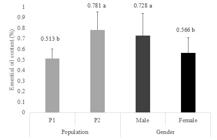
Essential oil content (%) of female and male plants of B. dracunculifolia from P1 and P2. Means with different lowercase letters differ significantly according to Tukey’s test (P < 0.05).
Chemical Composition of Essential Oils
A total of 31 chemical constituents were identified in the essential oils of male and female plants of B. dracunculifolia from the two studied populations. The essential oils were predominantly composed of oxygenated sesquiterpenes (36.24 - 52.44%), monoterpene hydrocarbons (15.75 - 43.24%) and sesquiterpenes hydrocarbons (9.34 - 18.38%). The major compounds were: (E)-nerolidol (13.03 - 19.68%), β-pinene (9.81 - 20.97%), limonene (6.17 - 18.21%) and spathulenol (6.79 - 12.02%) for all botanical materials (Table VI).
Composition of essential oil (%) by GC/MS (mean ± standard deviation) of fresh leaves of female and male plants of B. dracunculifolia from Populations P1 and P2.
Interaction between population and gender was not significant (P>0.05) for the chemical composition of essential oils, this means that these factors act independently in this study. However, isolated differences were verified for population and gender for some compounds. These analyses considered only the chemical constituents with averages higher than 3.0% in at least one of the botanical materials. Plants from P2 produced higher levels of β-pinene, limonene and α-pinene when compared to P1. Plants from P1 produced higher levels of (E)-nerolidol, bicyclogermacrene, germacrene D, thujopsan-2-α-ol, globulol and α-cadinol when compared with P2. Similarly, the isolated gender effects were significant for some compounds studied, where female plants produced higher contents of spathulenol and thujopsan-2-α-ol and male plants produced higher levels of globulol.
Antioxidant Activity of Essential Oils
For antioxidant activity of B. dracunculifolia essential oils, expressed as IC50 (µg ml-1), the interaction between population and gender was also not significant (P>0.05). However, isolated differences between male and female plants were identified (Fig. 3). Essential oils from male plants showed lower IC50 (261.8 µg ml-1) and consequently higher capacity to neutralize free radicals when compared to essential oils from female plants.

Means and standard deviation from IC50 of antioxidant activity (μg.ml-1) by DPPH of male and female leaves of B. dracunculifolia from populations P1 and P2. Means with different lowercase letters differ significantly according to Tukey’s test (P < 0.05). ns = not significant difference.
In addition, local plant growth also influenced the production of essential oil, where plants from P2 produced higher essential oil content (0.781%) (Fig. 2). The highest essential oil content from P2 may be related to low precipitation especially during January and February of 2018, the period that preceded the leaf harvest in March, 2018. Unlike the results of essential oils, the extract analysis by HPLC-DAD (Table II) identified higher production of secondary metabolites in P1 plants.
DISCUSSION
Many studies suggest that B. dracunculifolia is the main botanical source of Brazilian green propolis, where similar profiles were identified between plant resin and propolis samples, in particular to the composition of prenylated cinnamic acid derivative, flavonoids and chlorogenic acid (Quintino et al. 2020, Tomazzoli et al. 2020).
Related to the annotation of the compounds, similar result was found by Park et al. (2004) where the same compounds were identified for male and female B. dracunculifolia leaf bud. However, Teixeira et al. (2005) identified some differences between apices of female and male plants, when evaluated together volatile and nonvolatile compounds, where male plants were chemically more complex than female plants, with 42 identified substances in male and 33 in female apices. This difference can be related to abiotic factors and to the herbivory preference between male and female plants, that affect the plant defense and consequently the secondary metabolism (Hall et al. 2017).
In continuation of this evidence, the chemical composition of the essential oils from B. dracunculifolia observed in this study, particularly the presence of (E)-nerolidol, spathulenol, and β-caryophyllene, aligns with compounds identified in the essential oil of Brazilian green propolis, as reported by Quintino et al. (2020). These compounds were also among the major constituents of this type of propolis, reinforcing its botanical origin from B. dracunculifolia. This correlation supports the hypothesis that the essential oil profile of B. dracunculifolia significantly contributes to the chemical and biological properties of green propolis, including its antioxidant potential.
The concentrations of many secondary metabolites are strongly correlated with plant growth conditions, for example, environmental stresses such as radiation, pathogen attack, nutrient availability, and temperature usually increase phenylpropanoid levels. Whereas phenolic levels are extensively affected by nutritional stress (Dixon & Paiva 1995, Ramakrishna & Ravishankar 2011).
The chemical profile of phenolic compounds is also affected by altitude variation, where the higher the altitude resulted in the higher the phenolic content (Pandey et al. 2018). Plants collected in P1 (altitude = 1027 meters) presented higher levels of these compounds when compared with P2 (altitude = 891 meters). This may have occurred because plants growing at higher altitudes are subjected to higher UV-B radiation and this affects their development, morphology and physiology. As a protective mechanism, plants subject to increased radiation levels, produce higher contents of phenolic and flavonoids (Jaakola & Hohtola 2010).
Phenolic compounds protect plant tissues against UV radiation, consequently, the production of these compounds depends on three factors acting simultaneously: light environment, plant physiology and plant biochemistry (Bantis et al. 2016). These compounds are produced via the shikimic acid biosynthetic pathway. A key enzyme in this pathway is phenylalanine ammonia lyase (PAL), which is strongly stimulated by environmental stresses, and most cases, leads to increased phenolic levels in plants (Wang & Frei 2011).
Although this work has identified differences in the contents of some compounds according to plant growth site, it is important to highlight that generally the male plants presented higher levels of all compounds studied. The sex-differences in secondary metabolites were meaningful and this may have been caused by different reproductive efforts between males and females (Antos & Allen 1999, Cepeda-Cornejo & Dirzo 2010). Male plants frequently make lower total reproductive investment than females, although their investment during the flowering is high (Cepeda-Cornejo & Dirzo 2010). Female plants considerably increase investment in reproduction that is mainly due to ripening of fruit and seeds (Turcotte & Houle 2001). This higher investment of female metabolism for reproduction may indicate a lower shift of products to secondary metabolism, which is directly related to plant defense.
During plant development, including the phenological stages, there is a strong dependency on protein synthesis for the manufacture of photosynthetic, biosynthetic, regulatory enzymes and structural protein. The same occurs for phenolic synthesis and because of this, growth and defense compete for common substrates (Herms & Mattson 1992).
In dioecious species different resource allocations between gender may also determine unequal patterns of defense and herbivory in the field (Hall et al. 2017). The infestation of different galls on B. dracunculifolia is common and the insect Baccharopelma dracunculifoliae (Hemiptera: Psyllidae) is the most frequently found gall in this plant species (Arduin et al. 2005). In work developed by Bastos et al. (2011) no significant difference between genders of B. dracunculifolia were identified about herbivory by different insects: Baccharopelma dracunculifoliae galls infestation and Apis mellifera visit for resin collection. However, the same work identified the plant growth site may influence B. dracunculifoliae gall infestation and resin collecting visits of A. mellifera, confirming the relationship between presence of gall insect and production of defense compounds by host plants as a defense strategy. In contrast, Rodrigues et al. (2020) identified significant differences between male and female plants of B. dracunculifolia, where males had greater infestation by galling insects and females were most visited by bees for resin collection to produce green propolis.
Many studies about the relationship between galls insects and secondary metabolites from host plant have been quantified and widely discussed in the work developed by Hall et al. (2017). It was found that concentrations of phenolic and tannin compounds increased significantly in response to galls, whereas the impact on concentrations of volatile compounds was not significant. Gall strategy is to increase phenolic and tannins levels and therefore, reduce the risk of predation due to herbivory while reducing the risk of predation by the decrease of volatile emissions (Hall et al. 2017). Rodrigues et al. (2020) found higher gall infestation in male plants, this may be the reason our work found increased secondary metabolites male plants of this species.
Some works reported strong antioxidant activity for the chlorogenic acids derivatives emphasizing that its content as the major antioxidant metabolites isolated from Asteraceae plant species (Fraisse et al. 2011, Mijangos-Ramos et al. 2018). The antioxidant capacity of chlorogenic acids can be related to their chemical structure, where catechol moiety combined with unsaturated ester moiety gives their free radical-scavenging activity (Parejo et al. 2004). In addition, studies have been correlating antioxidant capacity levels with the anti-inflammatory activity of these purified compounds, showing that they may be related to their capacity as radical scavengers (Mijangos-Ramos et al. 2018).
Another compound well known for its antioxidant activity is the prenylated cinnamic acid derivative, artepillin C. A previous study by Shimizu et al. (2004) proved its bioavailable antioxidant. Artepillin C has the capacity to pass though the intestinal absorption system in the free form and inhibits oxidative damage of intracellular DNA in hepatocytes. Unlike artepillin C, most dietary phenolics have low bioavailability due to their low intestinal absorption rate.
The chemical structure of artepillin C consists of a simple phenol (single ring) and with two prenyl groups. Previous work described that prenyls increase affinity for cell membranes and this similarly happens with artepillin C, which facilitates its antioxidant effect on membranous lipid peroxidation (Kasai et al. 2002). In this context, due to its affinity for cell membranes and because it is not easily conjugated, artepillin C is used in treatments of degenerative diseases, for example, to prevented renal and pulmonary cancers (Kimoto et al. 2000, 2001).
Therefore, plants of B. dracunculifolia with higher contents of artepillin C and dicaffeyolquinic acids have the potential to produce a higher green propolis quality that is more beneficial to human health due to increased antioxidant activity. This would increase its market value.
B. dracunculifoilia reproduction time is different between the sexes, the male starts flowering earlier, and this can be explained by the competition between males for pollination opportunities. In general, male flowering times are induced by pollen donation (selection pressure) where males that produce earlier flowers increase reproductive success (Espirito-Santo et al. 2003). As the higher terpene content may be involved with pollinator activity (Maffei 2010), this can help us understand the higher essential oil content in male plants.
However, male and female plants may have different physiological requirements and variations between them can be expected (Mwang’Ingo et al. 2010). Gender differences were noticed in the work developed by Radoukova et al. (2018) for the plant Juniperus communis L., where the interaction between plant sex and habitat was highly significant, the essential oil content ranged from 0.28% to 1.21%, with higher levels in female plants. In contrast, the study developed with Juniperus scopulorum Sarg., the essential oil content in male trees was greater than in female trees (Zheljazkov et al. 2013). If the pathways of primary and secondary metabolism share common precursors and intermediates, this higher investment of female metabolism for reproduction may indicate a lower shift of products to secondary metabolism (Herms & Mattson 1992). Consequently, this leads to lower terpene production, and may explain the high levels of essential oil in males when compared to females plants.
These differences between the two populations may be related to the biotic and abiotic factors which include, environmental conditions, edaphic factors, mechanical or chemical injuries, climate, diseases, pests and genetic factors (Figueiredo et al. 2008).
Unlike the results of essential oils, the extract analysis by HPLC-DAD (Table I) identified higher production of secondary metabolites in P1 plants. This may have happened due to the induction of different metabolic pathways for the synthesis of terpenes - MEP or mevalonate pathway- and phenolic acids - shikimic acid pathway (Taiz & Zeiger et al. 2013). Thus, these different metabolic pathways may have affected the levels of terpenes and phenolics in inverse correlation, depending on plant stimulus.
Similar chemical composition has been reported from studies with B. dracunculifolia plants from different growth sites of Brazil, where the compounds (E)-nerolidol and spathulenol were indicated as the majority and β-pinene and limonene presenting low levels (Queiroga et al. 2008, Besten et al. 2012, Barbosa et al. 2015). Besides that, the production of certain terpenes can be increased when plants are exposed to certain abiotic stresses such as light (Liu et al. 2017). Since plants from P1 were subjected to higher radiation, this may also help us understand the higher sesquiterpene yields of these essential oils. For example, the high content of (E)-nerolidol is due to its known scavenging activity (Vinholes et al. 2014) and may act as an antioxidant compound on leaves under stressful conditions.
Differences in antioxidant activity between male and female plants have been reported by other authors (Emami et al. 2007, Zuccolotto et al. 2019). A previous study on essential oils of leaves of Juniperus communis subsp. hemisphaerica verified the DPPH scavenging activity of the male plants with higher potential than oil of female plants for use as preserving food materials (Emami et al. 2007). On the other hand, in work on different species of the genus Baccharis no significant differences in the antioxidant activity of essential oils between male and female plants were observed (Zuccolotto et al. 2019).
The antioxidant activity of essential oil may be a result of the synergistic effect between two or more compounds, as previously reported (Xavier et al. 2016). This synergism may have influenced the high antioxidant capacity of the essential oils of male plants especially due to the high levels of compounds with known antioxidant activity such as (E)-nerolidol (Nogueira Neto et al. 2013, Vinholes et al. 2014) and limonene (Roberto et al. 2009). In addition, significant differences in spathulenol contents in female plants was found and this may be related to possible low antioxidant activity of the compound, since a previous study verified decrease in the contents of spathulenol under NaCl stress, a process that produces oxidative damages in plant cells (Taarit et al. 2009).
The present work identified notable distinctions between male and female specimens of B. dracunculifolia, an aromatic species recognized for its diverse applications, including the extraction of essential oils and its central role in the formation of Brazilian green propolis. Through comparative analysis of chemical profiles and biological properties, the data demonstrated that male plants tend to accumulate greater levels of valuable metabolites, particularly artepillin C and chlorogenic acids. Additionally, they showed enhanced essential oil yield and stronger antioxidant performance in both oil and extract forms. These results highlight the relevance of male individuals as promising candidates for use in natural product industries such as phytotherapy and cosmetics, as well as in the generation of high-quality green propolis. Nonetheless, further research is required to assess whether Apis mellifera exhibits a preference for male plants, which may reinforce their importance in the sustainable sourcing of this economically relevant bee product.
Acknowledgements
The authors acknowledge the Coordenação de Aperfeiçoamento de Pessoal de Nível Superior (CAPES) for financial support.
References
- ADAMS RP. 2007. Identification of essential oil components by gas chromatography/mass spectrometry. Carol Stream, Illinois: Allured Publishing Corporation.
-
AGA H, SHIBUYA T, SUGIMOTO T, KURIMOTO M & NAKAJIMA S. 1994. Isolation and identification of antimicrobial compounds in Brazilian propolis. Biosci Biotechnol Biochem 58(5): 945-946. https://doi.org/10.1271/bbb.58.945.
» https://doi.org/10.1271/bbb.58.945 -
AHN M, KUNIMASA K, OHTA T, KUMAZAWA S, KAMIHIRA M, KAJI K, UTO Y, HORI H, NAGASAWA H & NAKAYAMA T. 2007. Suppression of tumor-induced angiogenesis by Brazilian propolis: Major component artepillin C inhibits in vitro tube formation and endothelial cell proliferation. Cancer Lett 252: 235-243. https://doi.org/10.1016/j.canlet.2006.12.039.
» https://doi.org/10.1016/j.canlet.2006.12.039 -
ANTOS JA & ALLEN GA. 1999. Patterns of reproductive effort in male and female shrubs of Oemleria cerasiformis: a 6 year study. J Ecol 87: 77-84. https://doi.org/10.1046/j.1365-2745.1999.00331.x.
» https://doi.org/10.1046/j.1365-2745.1999.00331.x -
ARDUIN MI, FERNANDES GW & KRAUS JE. 2005. Morphogenesis of galls induced by Baccharopelma dracunculifoliae (Hemiptera: Psyllidae) on Baccharis dracunculifolia (Asteraceae) leaves. Braz J Biol 65: 559. https://doi.org/10.1590/S1519-69842005000400002.
» https://doi.org/10.1590/S1519-69842005000400002 - BANO U, KHAN AF, MUJEEB F, MAURYAL N, TABASUM H, SIDDIQUI MH, HANEEF M, OSAMA K & FAROOQUI A. 2016. Effect of plant growth regulators on essential oil yield in aromatic plants. J Chem Pharm Res 8: 733-739.
-
BANSKOTA AH, TEZUKA Y, PRASAIN JK, MATSUSHIGE K, SAIKI I & KADOTA S. 1998. Chemical constituents of Brazilian propolis and their cytotoxic activities. J Nat Prod 61: 896-900. https://doi.org/10.1021/np980028c.
» https://doi.org/10.1021/np980028c -
BANTIS F, OUZOUNIS T & RADOGLOU K. 2016. Artificial LED lighting enhances growth characteristics and total phenolic content of Ocimum basilicum, but variably affects transplant success. Sci Hortic 198: 277-283. https://doi.org/10.1016/j.scienta.2015.11.014.
» https://doi.org/10.1016/j.scienta.2015.11.014 -
BARBOSA LN, PROBST IS, ANDRADE BFMT, ALVES FCB, ALBANO M, CUNHA MLRS, DOYAMA JT, RALL VLM & FERNANDES JÚNIOR A. 2015. In vitro antibacterial and chemical properties of essential oils including native plants from Brazil against pathogenic and resistant bacteria. J Oleo Sci 64: 289-298. https://doi.org/10.5650/jos.ess14209.
» https://doi.org/10.5650/jos.ess14209 - BARROSO GM & BUENO OL. 2002. Flora ilustrada catarinense plantas compostas-subtribo: Baccharidinae. Itajaí: Herbário Barbosa Rodrigues (HBS).
-
BASTOS EMAF, SANTANA RA, CALACA-COSTA AGF & THIAGO PS. 2011. Interaction between Apis mellifera L. and Baccharis dracunculifolia DC, that favours green propolis production in Minas Gerais. Braz J Biol 71(3): 727-734. https://doi.org/10.1590/S1519-69842011000400018.
» https://doi.org/10.1590/S1519-69842011000400018 -
BESTEN MA, JASINSKI VCG, COSTA AGLC, NUNES DS, SENS SL, WISNIEWSKI JR A, SIMINATTO EL, RIVA D, DALMARCOV JB & GRANATO D. 2012. Chemical composition similarity between the essential oils isolated from male and female specimens of each five Baccharis species. J Braz Chem Soc 23(6): 1041-1047. https://doi.org/10.1590/S0103-50532012000600007.
» https://doi.org/10.1590/S0103-50532012000600007 -
BESTEN MA, NUNES DS, WISNIEWSKI JR A, SENS SL, GRANATO D, SIMINATTO EL, SCHARF DR, DALMARCO JB & MATZENBACHER NI. 2013. Chemical composition of volatiles from male and female specimens of Baccharis trimera collected in two distant regions of southern Brazil: a comparative study using chemometrics. Quim Nova 36: 1096-1100. https://doi.org/10.1590/S0100-40422013000800003.
» https://doi.org/10.1590/S0100-40422013000800003 -
BRAND-WILLIAMS W, CUVELIER ME & BERSET C. 1995. Use of a free radical method to evaluate antioxidant activity. LWT - Food Sci Technol 28: 25-30. https://doi.org/10.1016/S0023-6438(95)80008-5.
» https://doi.org/10.1016/S0023-6438(95)80008-5 -
BÚFALO MC, CANDEIAS JMG, SOUSA JPB, BASTOS JK & SFORCIN JM. 2010. In vitro cytotoxic activity of Baccharis dracunculifolia and propolis against HEp-2 cells. Nat Prod Res 24: 1710-1718. https://doi.org/10.1080/14786410902909300.
» https://doi.org/10.1080/14786410902909300 -
CAMPOS WH & MARTINS SV. 2016. Natural regeneration stratum as an indicator of restoration in area of environmental compensation for mining limestone, municipality of Barroso, MG, Brazil. Rev Árvore 40(2): 189-196. https://doi.org/10.1590/0100-67622016000200001.
» https://doi.org/10.1590/0100-67622016000200001 -
CARVALHO AA ET AL. 2011. In vivo antitumoural activity and composition of an oil extract of Brazilian propolis. Food Chem 126: 1239-1245. https://doi.org/10.1016/j.foodchem.2010.12.035.
» https://doi.org/10.1016/j.foodchem.2010.12.035 -
CEPEDA-CORNEJO V & DIRZO R. 2010. Sex-Related differences in reproductive allocation, growth, defense and herbivory in three dioecious neotropical palms. PLoS ONE 5(3): e9824. https://doi.org/10.1371/journal.pone.0009824.
» https://doi.org/10.1371/journal.pone.0009824 -
CHAABAN A, MARTINS CEN, BRETANHA LC, MICKE GA, CARRER AR, ROSA NF, FERREIRA L & MOLENTO MB. 2017. Insecticide activity of Baccharis dracunculifolia essential oil against Cochliomyia macellaria (Diptera: Calliphoridae). Nat Prod Res 32: 2954-2958. https://doi.org/10.1080/14786419.2017.1392947.
» https://doi.org/10.1080/14786419.2017.1392947 -
CORNELISSEN T & STILING P. 2005. Sex-biased herbivory: a meta-analysis of the effects of/ gender on plant-herbivore interactions. OIKOS 111: 488-500. https://doi.org/10.1111/j.1600-0706.2005.14075.x.
» https://doi.org/10.1111/j.1600-0706.2005.14075.x -
DE SOUSA JPB, JORGE RF, LEITE MF, FURTADO NAJC, BASTOS JK, SILVA FILHO AA, QUEIROGA CL, MAGALHÃES PM & SOARES AEE. 2009. Seasonal variation of the (E)-Nerolidol and other volatile compounds within ten different cultivated populations of Baccharis dracunculifolia D.C. (Asteraceae). J Essent Oil Res 21: 308-314. https://doi.org/10.1080/10412905.2009.9700179.
» https://doi.org/10.1080/10412905.2009.9700179 - DIXON R & PAIVA N. 1995. Stress-induced phenylpropanoid metabolism. Plant Cell 7: 1085-1097. https://doi.org/10.1105%2Ftpc.7.7.1085.
-
DUDLEY LS. 2006. Ecological correlates of secondary sexual dimorphism in Salix glauca (Salicaceae). Am J Bot 93: 1775-1783. https://doi.org/10.3732/ajb.93.12.1775.
» https://doi.org/10.3732/ajb.93.12.1775 -
EMAMI SA, JAVADI B & HASSANZADEH MK. 2007. Antioxidant ctivity of the essential oils of different parts of Juniperus communis subsp. hemisphaerica and Juniperus oblonga. Pharm Biol 45: 769-776. https://doi.org/10.1080/13880200701585931.
» https://doi.org/10.1080/13880200701585931 -
ESPIRITO-SANTO MM, MADEIRA BG, NEVES FS, FARIA ML, FAGUNDES M & FERNANDES GW. 2003. Sexual differences in reproductive phenology and their consequences for the demography of Baccharis dracunculifolia (Asteraceae), a dioecious tropical shrub. Ann Bot 91: 13-19. https://doi.org/10.1093/aob/mcg001.
» https://doi.org/10.1093/aob/mcg001 -
FALCÃO SI, VALE N, GOMAS P, DOMINGUES MRM, FREIRE C, CARDOSO SM & VILAS-BOAS M. 2013. Phenolic profiling of Portuguese propolis by LC–MS spectrometry: uncommon propolis rich in flavonoid glycosides. Phytochem Anal 24: 309-318. https://doi.org/10.1002/pca.2412.
» https://doi.org/10.1002/pca.2412 -
FERESIN GE, TAPIA A, GIMENEZ A, RAVELO AG, ZACCHINO S, SORTINO M & SCHMEDA-HIRSCHMANN G. 2003. Constituents of the Argentinian medicinal plant Baccharis grisebachii and their antimicrobial activity. J Ethnopharmacol 89: 73-80. https://doi.org/10.1016/S0378-8741(03)00259-9.
» https://doi.org/10.1016/S0378-8741(03)00259-9 -
FERNANDES-SILVA CC, SALATINO A, SALATINO MLF, BREYER EDH & NEGRI G. 2013. Chemical profiling of six samples of Brazilian propolis. Quim Nova 36: 237-240. https://doi.org/10.1590/S0100-40422013000200006.
» https://doi.org/10.1590/S0100-40422013000200006 -
FERRONATTO R, MARCHESAN ED, PEZENTI E, BEDNARSKI F & ONOFRE SB. 2007. Antimicrobial activity of essential oils produced by Baccharis dracunculifolia D.C. and Baccharis uncinella D.C. (Asteraceae). Rev Bras Farmacogn 17: 224-230. https://doi.org/10.1590/S0102-695X2007000200016.
» https://doi.org/10.1590/S0102-695X2007000200016 -
FIGUEIREDO AC, BARROSO JG, PEDRO LG & SCHEFFER JJC. 2008. Factors affecting secondary metabolite production in plants: volatile components and essential oils. Flavour Fragr J 23: 213-226. https://doi.org/10.1002/ffj.1875.
» https://doi.org/10.1002/ffj.1875 - FILHO AAS, BUENO PCP, GREGÓRIO LE, SILVA MLA, ALBUQUERQUE S & BASTOS JK. 2004. In vitro trypanocidal activity evaluation of crude extract and isolated compounds from Baccharis dracunculifolia DC (Asteraceae), J Pharm Pharmacol 56: 1195-1199. https://doi.org/10.1211/0022357044067.
-
FILHO AAS, SOUSA JPB, SOARES S, FURTADO NAJC, SILVA MLA, CUNHA WR, GREGÓRIO LE, NANAYAKKARA NPD & BASTOS JK. 2008. Antimicrobial activity of the extract and isolated compounds from Baccharis dracunculifolia D.C. (Asteraceae). Z Naturforsch 63: 40-46. https://doi.org/10.1515/znc-2008-1-208.
» https://doi.org/10.1515/znc-2008-1-208 -
FLORÃO A, BUDEL JM, DUARTE MR, MARCONDES A, RODRIGUES RAF, RODRIGUES MVN, SANTOS CAM & WEFFORT-SANTOS AM. 2012. Essential oils from Baccharis species (Asteraceae) have anti-inflammatory effects for human cells. J Essent Oil Res 24: 561-570. https://doi.org/10.1080/10412905.2012.728081.
» https://doi.org/10.1080/10412905.2012.728081 -
FRAISSE D, FELGINES C, TEXIER O & LAMAISON J. 2011. Caffeoyl derivatives: major antioxidant compounds of some wild herbs of the Asteraceae family. Food Nut Sci 2: 181-192. http://dx.doi.org/10.4236/fns.2011.230025.
» https://doi.org/10.4236/fns.2011.230025 -
HALL CR, CARROLL AR & KITCHING RL. 2017. A meta-analysis of the effects of galling insects on host plant secondary metabolites. Arthropod Plant Interact 11: 463-473. http://dx.doi.org/10.1007/s11829-016-9486-0.
» https://doi.org/10.1007/s11829-016-9486-0 -
HERMS DA & MATTSON WJ. 1992. The dilemma of plants: to grow or defend. Q Rev Biol 67: 283-335. https://doi.org/10.1086/417659.
» https://doi.org/10.1086/417659 -
JAAKOLA L & HOHTOLA A. 2010. Effect of latitude on flavonoid biosynthesis in plants. Plant Cell Environ 33: 1239-1247. https://doi.org/10.1111/j.1365-3040.2010.02154.x.
» https://doi.org/10.1111/j.1365-3040.2010.02154.x -
KASAI S, NAGASAWA H, SHIMAMURA M, UTO Y & HORI H. 2002. Design and synthesis of antiangiogenic/heparin-Binding arginine dendrimer mimicking the surface of endostatin. Bioorg Med Chem Lett 12: 951-954. https://doi.org/10.1016/s0960-894x(02)00066-5.
» https://doi.org/10.1016/s0960-894x(02)00066-5 -
KIMOTO T, KOYA-MIYATA S, HINO K, MICALLEF MJ, HANAYA T, ARAI S, IKEDA M & KURIMOTO M. 2001. Pulmonary carcinogenesis induced by ferric nitrilotriacetate in mice and protection from it by Brazilian propolis and artepillin C. Virchows Arch 438: 259-270. https://doi.org/10.1007/s004280000350.
» https://doi.org/10.1007/s004280000350 -
KIMOTO T, KOYA S, HINO K, YAMAMOTO Y, NOMURA Y, MICALLEF MJ, HANAYA T, ARAI S, IKEDA M & KURIMOTO M. 2000. Renal carcinogenesis induced by ferric nitrilotriacetate in mice, and protection from it by Brazilian propolis and artepillin C. Pathol Int 50: 679-689. https://doi.org/10.1046/j.1440-1827.2000.01097.x.
» https://doi.org/10.1046/j.1440-1827.2000.01097.x -
LAPCZYNSKI A, BHATIA SP, LETIZIA CS & API AM. 2008. Fragrance material review on nerolidol (isomer unspecified). Food Chem Toxicol 46: S247-S250. https://doi.org/10.1016/j.fct.2008.06.063.
» https://doi.org/10.1016/j.fct.2008.06.063 -
LEMOS M, BARROS MP, SOUSA JPB, SILVA FILHO AA, BASTOS JK & ANDRADE SF. 2007. Baccharis dracunculifolia the main botanical source of Brazilian green propolis, Displays Antiulcer Activity. J Pharm Pharmacol 59: 603-608. https://doi.org/10.1211/jpp.59.4.0017.
» https://doi.org/10.1211/jpp.59.4.0017 - LI X, JIANG S & MAN C. 2016. Metabolomic analysis of female and male plants of Pistacia chinensis Bunge. Pak J Bot 48: 1971-1977.
-
LIU H ET AL. 2017. UV-B irradiation differentially regulates terpene synthases and terpene content of peach. Plant Cell Environ 40: 2261-2275. https://doi.org/10.1111/pce.13029.
» https://doi.org/10.1111/pce.13029 -
MAFFEI ME. 2010. Sites of synthesis, biochemistry and functional role of plant volatiles. S Afr J Bot 76: 612-631. https://doi.org/10.1016/j.sajb.2010.03.003.
» https://doi.org/10.1016/j.sajb.2010.03.003 -
MESSERLI S ET AL. 2009. Artepillin C (ARC) in Brazilian green propolis selectively blocks oncogenic PAK1 signaling and suppresses the growth of NF tumors in mice. Phytother Res 23: 423-427. https://doi.org/10.1002/ptr.2658.
» https://doi.org/10.1002/ptr.2658 -
MIJANGOS-RAMOS IF, ZAPATA-ESTRELLA HE, RUIZ-VARGAS JÁ, ESCALANTE-EROSA F, GÓMES-OJEDA N, GARCÍA-SOSA K, CECHINEL-FILHO V, MEIRA-QUINTÃO N & PENHA-RODRÍGUES LM. 2018. Bioactive dicaffeoylquinic acid derivatives from the root extract of Calea urticifolia. Rev Bras Farmacogn 28: 339-343. https://doi.org/10.1016/j.bjp.2018.01.010.
» https://doi.org/10.1016/j.bjp.2018.01.010 -
MISHIMA S, INOH Y, NARITA Y, OHTA S, SAKAMOTO T, ARAKI Y, SUZUKI K, AKAO Y & NOZAWA Y. 2005. Identification of caffeoylquinic acid derivatives from Brazilian propolis as constituents involved in induction of granulocytic differentiation of HL-60 cells. Bioorg Med Chem 13: 5814-5818. https://doi.org/10.1016/j.bmc.2005.05.044.
» https://doi.org/10.1016/j.bmc.2005.05.044 -
MOURA SAL, NEGRI G, SALATINO A, LIMA LDC, DOURADO LPA, MENDES JB, ANDRADE SP, FERREIRA MAND & CARA DC. 2011. Aqueous extract of brazilian green propolis: primary components, evaluation of inflammation and wound healing by using subcutaneous implanted sponges. Evid Based Complement Alternat Med 2011: 1-8. https://doi.org/10.1093/ecam/nep112.
» https://doi.org/10.1093/ecam/nep112 -
MUNARI CC, ALVES JM, SOUSA JPB, BASTOS JK & TAVARES DC. 2008. Mutagenicity and antimutagenicity of Baccharis dracunculifolia extract in chromosomal aberration assays in chinese hamster ovary cells. Planta Med 74: 1363-1367. https://doi.org/10.1055/s-2008-1081306.
» https://doi.org/10.1055/s-2008-1081306 -
MWANG’INGO PL, KIBODYA G & MNG’ONG’O AR. 2010. Oil yield and quality variation between sexes in Osyris lanceolata (African sandalwood) and its value as a fodder plant in Tanzania. South For 72: 69-74. https://doi.org/10.2989/20702620.2010.507018.
» https://doi.org/10.2989/20702620.2010.507018 -
NAKANISHI H ET AL. 2003. Efficient radical scavenging ability of artepillin C, a major component of Brazilian propolis, and the mechanism. Org Biomol Chem 1: 1452-1454. https://doi.org/10.1039/b302098c.
» https://doi.org/10.1039/b302098c -
NOGUEIRA NETO JD, ALMEIDA AAC, OLIVEIRA JS, SANTOS PS, SOUSA DP & FREITAS RM. 2013. Antioxidant effects of nerolidol in mice hippocampus after open field test. Neurochem Res 38: 1861-1870. https://doi.org/10.1007/s11064-013-1092-2.
» https://doi.org/10.1007/s11064-013-1092-2 -
PANDEY G, KHATOON S, PANDEY MM & RAWAT AKS. 2018. Altitudinal variation of berberine, total phenolics and flavonoid content in Thalictrum foliolosum and their correlation with antimicrobial and antioxidant activities. J Ayurveda Integr Med 9: 169-176. https://doi.org/10.1016/j.jaim.2017.02.010.
» https://doi.org/10.1016/j.jaim.2017.02.010 -
PAREJO I, VILADOMAT F, BASTIDA J, SCHMEDA-HISCHMANN G, BURILLO J & CODINA C. 2004. Bioguided isolation and identification of the nonvolatile antioxidant compounds from fennel (Foeniculum vulgare Mill.) waste. J Agric Food Chem 52: 1890-1897. https://doi.org/10.1021/jf030717g.
» https://doi.org/10.1021/jf030717g -
PARK YK, PAREDES-GUZMAN JF, AGUIAR CL, ALENCAR SM & FUJIWARA FY. 2004. Chemical constituents in Baccharis dracunculifolia as the main botanical origin of southeastern Brazilian propolis. J Agric Food Chem 52: 1100-1103. https://doi.org/10.1021/jf021060m.
» https://doi.org/10.1021/jf021060m -
PARREIRA NA ET AL. 2010. Antiprotozoal, schistosomicidal, and antimicrobial activities of the essential oil from the leaves of Baccharis dracunculifolia Chem Biodiversity 7: 993-1001. https://doi.org/10.1002/cbdv.200900292.
» https://doi.org/10.1002/cbdv.200900292 -
PAULINO N, ABREU SRL, UTO Y, KOYAMA D, NAGASAWA H, HORI H, DIRSCH VM, VOLLMAR AM, SCREMIN A & BRETZ WA. 2008. Anti-inflammatory effects of a bioavailable compound, Artepillin C, in Brazilian propolis. Eur J Pharmacol 587: 296-301. https://doi.org/10.1016/j.ejphar.2008.02.067.
» https://doi.org/10.1016/j.ejphar.2008.02.067 -
QUEIROGA CL, BASTOS JK, SOUSA JPB & MAGALHÃES PM. 2008. Comparison of the chemical composition of the essential oil and the water soluble oil of Baccharis dracunculifolia DC. (Asteraceae). J Essent Oil Res 20: 111-114. https://doi.org/10.1080/10412905.2008.9699967.
» https://doi.org/10.1080/10412905.2008.9699967 -
QUINTINO RL, REIS AC, FERNANDES CC, MARTINS CHG, COLLI AC, CROTTI AEM, SQUARISI IS, RIBEIRO AB, TAVARES DC & MIRANDA MLD. 2020. Brazilian green propolis: chemical composition of essential oil and their in vitro antioxidant, antibacterial and antiproliferative activities. Braz Arch Biol Technol 63: e20190408. https://doi.org/10.1590/1678-4324-2020190408.
» https://doi.org/10.1590/1678-4324-2020190408 -
RADOUKOVA T, ZHELJAZKOV VD, SEMERDJIEVA I, DINCHEVA I, STOYANOVA A, KACÁIOVÁ M, MARKOVIC T, RADANOVIC D, ASTATKIE T & SALAMON I. 2018. Differences in essential oil yield, composition, and bioactivity of three juniper species from Eastern Europe. Ind Crops Prod 124: 643-652. http://dx.doi.org/10.1016/j.indcrop.2018.08.012.
» https://doi.org/10.1016/j.indcrop.2018.08.012 - RAMAKRISHNA A & RAVISHANKAR G. 2011. Influence of abiotic stress signals on secondary metabolites in plants. Plant Signal Behav 6: 1720-1731. https://doi.org/10.4161%2Fpsb.6.11.17613.
-
RE R, PALLEGRINI N, PROTEGGENTE A, PANNALA A, YANG M & RICE-EVANS C. 1999. Antioxidant activity applying an improved ABTS radical cation decolorization assay. Free Radic Biol Med 26: 1231-1237. https://doi.org/10.1016/s0891-5849(98)00315-3.
» https://doi.org/10.1016/s0891-5849(98)00315-3 -
ROBERTO D, MICUCCI P, SEBASTIAN T, GRACIELA F & ANESINI C. 2009. Antioxidant activity of limonene on normal murine lymphocytes: relation to H2O2 modulation and cell proliferation. Basic Clin Pharmacol Toxicol 106: 38-44. https://doi.org/10.1111/j.1742-7843.2009.00467.x.
» https://doi.org/10.1111/j.1742-7843.2009.00467.x -
RODRIGUES DM, SOUZA MC, ARRUDA C, PEREIRA RAS & BASTOS JK. 2020. The Role of Baccharis dracunculifolia and its Chemical Profile on Green Propolis Production by Apis mellifera. J Chem Ecol 46: 150-162. https://doi.org/10.1007/s10886-019-01141-w.
» https://doi.org/10.1007/s10886-019-01141-w -
SALAZAR GJT, SOUSA JP, LIMA CNF, LEMOS ICS, SILVA ARP, FREITAS TS, COUTINHO HDM, SILVA LE, AMARAL W & DESCHAMPS C. 2018. Phytochemical characterization of the Baccharis dracunculifolia DC (Asteraceae) essential oil and antibacterial activity evaluation. Ind Crops Prod 122: 591-595. https://doi.org/10.1016/j.indcrop.2018.06.052.
» https://doi.org/10.1016/j.indcrop.2018.06.052 -
SHIMIZU K, ASHIDA H, MATSUURA Y & KANAZAWA K. 2004. Antioxidative bioavailability of artepillin C in Brazilian propolis. Arch Biochem Biophys 424: 181-188. https://doi.org/10.1016/j.abb.2004.02.021.
» https://doi.org/10.1016/j.abb.2004.02.021 - SILVA FAS & AZEVEDO CAV. 2016. The assistat software version 7.7 and its use in the analysis of experimental data. Afr J Agric Res 11: 3733-3740. https://doi.org/0.5897/AJAR2016.11522.
-
SZLISZKA E, KUCHARSKA Z, SOKÓT-LETOWSKA A, MERTAS A, CZUBA ZP & KRÓL W. 2013. Chemical composition and anti-Inflammatory effect of ethanolic extract of Brazilian green propolis on activated J774A.1 Macrophages. Evid Based Complement Alternat Med 2013: 1-13. https://doi.org/10.1155/2013/976415.
» https://doi.org/10.1155/2013/976415 -
TAARIT MB, MSAADA K, HOSNI K, HAMMAMI M, KCHOUK ME & MARZOUK B. 2009. Plant growth, essential oil yield and composition of sage (Salvia officinalis L.) fruits cultivated under salt stress conditions. Ind Crops Prod 30: 333-337. https://doi.org/10.1016/j.indcrop.2009.06.001.
» https://doi.org/10.1016/j.indcrop.2009.06.001 - TAIZ L & ZEIGER E. 2013. Plant Physiology, Sunderland: Sinauer Associates Inc.
- TEIXEIRA ÉW, NEGRI G, MEIRA RMSA, MESSAGE D & SALATINO A. 2005. Plant origin of green propolis: bee behavior. Plant Anatomy and Chemistry. J Evid-Based Complement Altern Med 2: 85-92. https://doi.org/10.1093%2Fecam%2Fneh055.
-
TOMAZZOLI MM, AMARAL W, TOMASI JC, BELNIAKI AC, PANOBIANCO M, ZEVIANI WM & DESCHAMPS C. 2022. Sexual and asexual propagation of Baccharis dracunculifolia DC., a dioecious medicinal Brazilian shrub. Acta Sci Agron 45: e56750. https://doi.org/10.4025/actasciagron.v45i1.56750.
» https://doi.org/10.4025/actasciagron.v45i1.56750 -
TOMAZZOLI MM, ZEGGIO ARS, DAL PAI NETO R, SPECHT L, COSTA C, ROCHA M, YUNES RA & MARASCHIN M. 2020. Botanical source investigation and evaluation of the effect of seasonality on Brazilian propolis from Apis mellifera L. Sci Agric 77: e20180258. https://doi.org/10.1590/1678-992X-2018-0258.
» https://doi.org/10.1590/1678-992X-2018-0258 -
TORETI VC, SATO HH, PASTORE GM & PARK YK. 2013. Recent progress of propolis for its biological and chemical compositions and its botanical prigin. Evid Based Complement Alternat Med 2013: 1-13. https://doi.org/10.1155/2013/697390.
» https://doi.org/10.1155/2013/697390 -
TURCOTTE J & HOULE G. 2001. Reproductive costs in Salix planifolia ssp. Planifolia in subarctic Québec, Canada. Écoscience 8: 506-512. https://doi.org/10.1080/11956860.2001.11682682.
» https://doi.org/10.1080/11956860.2001.11682682 - VAN DEN DOOL H & KRATZ PD. 1963. A generalisation of the retention index system including linear temperature programmed gas-liquid chromatography. J Chromatogr 11: 463-471.
-
VINHOLES J, GONÇALVES P, MARTEL F, COIMBRA MA & ROCHA SM. 2014. Assessment of the antioxidant and antiproliferative effects of sesquiterpenic compounds in vitro Caco-2 cell models. Food Chem 156: 204-211. https://doi.org/10.1016/j.foodchem.2014.01.106.
» https://doi.org/10.1016/j.foodchem.2014.01.106 -
WANG Y & FREI M. 2011. Stressed food – The impact of abiotic environmental stresses on crop quality. Agr Ecosyst Environ 141: 271-286. https://doi.org/10.1016/j.agee.2011.03.017.
» https://doi.org/10.1016/j.agee.2011.03.017 -
XAVIER MN, ALVES JM, CARNEIRO NS, SOUCHIE EL, SILVA EAJ, MARTINS CHG, AMBROSIO MALV, EGEA MB, ALVES CCF & MIRANDA MLD. 2016. Composição Química do Óleo Essencial de Cardiopetalum calophyllum Schltdl. (Annonaceae) e suas Atividades Antioxidante, Antibacteriana e Antifúngica. Rev Virtual Quím 8: 1433-1448. https://doi.org/10.21577/1984-6835.20160101.
» https://doi.org/10.21577/1984-6835.20160101 -
ZHELJAZKOV VD, ASTATKIE T & JELIAZKOVA E. 2013. Year-round variations in essential oil content and composition of male and female Juniper. Hortsci 48: 883-886. https://doi.org/10.21273/HORTSCI.48.7.883.
» https://doi.org/10.21273/HORTSCI.48.7.883 -
ZUCCOLOTTO T ET AL. 2019. Chemical, antioxidant, and antimicrobial evaluation of essential oils and an anatomical study of the aerial parts from Baccharis species (Asteraceae). Chem Biodivers 16: e1800547. https://doi.org/10.21273/HORTSCI.48.7.883.
» https://doi.org/10.21273/HORTSCI.48.7.883


