 In silico development microsatellite marker panel and characterization for the endangered neotropical species Brycon orbignyanus (Characiformes, Bryconidae): a short communication
Abstract
This short communication presents novel molecular tools designed for the endangered species Brycon orbignyanus. In conservation studies, the development of population-specific markers tailored to particular geographic regions is essential. In this study, the prevalence of imperfect microsatellites highlights a evolution of this type of microsatellite in a population of Pelotas, Rio Grande do Sul. Therefore, the methodology used can serve as a guideline for genetic variability analysis even before conducting in vitro or in situ tests. These findings contribute significantly to technological prospecting and hold promise for applications in conservation programs. Additionally, they provide a basis for in vitro assays, such as PCR, to support species monitoring efforts.
Key words
Molecular markers; Neotropical fish; Next generation sequencing; Non-model species
INTRODUCTION
Brycon orbignyanus (Ethnospecies: Piracanjuba) has historically been the focus of intense sport and industrial fishing activities. As a rheophilic species, it undertakes extensive migrations for reproduction. Furthermore, it exhibits seasonal spawning, external fertilization, and lacks parental care behavior. These biological characteristics render it particularly vulnerable to environmental changes, particularly those induced by human activities such as overfishing, habitat fragmentation, and the degradation of riparian forests (Macedo et al. 2024, Marques et al. 2021, Santos et al. 2022).
In recent decades, natural populations of B. orbignyanus have undergone a significant reduction in their distribution range. Presently, the species is listed in the “Red Book of Brazilian Fauna Threatened with Extinction,” categorized as “Endangered” due to a population decline of greater than or equal to 50% (MMA 2018).
The development of genomic tools for B. orbignyanus is paramount for implementing advanced techniques in both in situ and ex situ genetic management of the species. Despite the availability of molecular markers previously developed for the species (Arias et al. 2016, Yazbeck et al. 2018) and focused on populations from Minas Gerais, Brazil, the present study reports the first microsatellite markers developed for specimens from populations occurring in the state of Rio Grande do Sul, Brazil. These tools are crucial not only for maintaining natural stocks in the region but also for facilitating their sustainable commercial exploitation (Carvalho et al. 2019, Fazzi-Gomes et al. 2021). Thus, the objective of this study was to develop and characterize SSR-type markers for B. orbignyanus, employing Next Generation Sequencing technology.
MATERIALS AND METHODS
Molecular DNA processing data
The DNA was extracted from caudal fin samples of Brycon orbignyanus collected in the Uruguay River basin and maintained in captivity at the Panama Piscicultura Aquaculture Station, Santa Catarina, Brazil, using the commercial Wizard® Genomic DNA Purification Kit (Promega), followed by next-generation sequencing using the Illumina platform, specifically employing the Illumina Universal Adapter, Illumina Small RNA 3’ Adapter, Illumina Small RNA 5’ Adapter, and Nextera adapters on the MiSeqTM system. Quality control of the sequencing data was performed using Trimmomatic (Bolger et al. 2014) and FastQC (Andrews 2010). The de novo assembly was made using the SPAdes program (Bankevich et al. 2012) based on a k-mer length of 23.
SSRs identification and primer design
To identify microsatellites, both the MISA program (Beier et al. 2017) and the EasySSR program (Alves et al. 2023) were utilized, each employing default parameters to assess their effectiveness in characterizing microsatellite markers within the genome of B. orbignyanus. Subsequently, the BatchPrimer3 program (You et al. 2008) was employed for the in silico prediction and design of microsatellite marker primers specific to B. orbignyanus. Customized parameters included a primer length range of 15-30 bp, a GC content of 40-50%, a primer melting temperature (Tm) of 55 °C, and a maximum Tm difference of 3 °C.
RESULTS
Illumina sequencing and de novo assembly
A total of 794,299 reads were obtained, with lengths ranging from 36 to 151 bp. These reads met the filtering criteria, exhibiting Q scores ≥ 20, an average quality per read of 38, and a GC content of 42%.
The SPAdes program produced 594 contigs longer than 1,000 bp, including 27 contigs exceeding 5,000 bp in length. Additionally, SPAdes achieved an N50 value of 714. In total, the assembly generated 227,565 contigs with a cumulative length of 73,215,541 bp.
SSRs loci in silico mapping
The MISA program identified a total of 123,228 sequences containing microsatellites within the B. orbignyanus genome, yielding a collective count of 211,025 SSRs (Table I). These SSRs were categorized majority into the perfect class. Pentanucleotide repeats emerged as the most prevalent, accounting for 51.58% of the total SSRs. In contrast, the EasySSR program identified a total of 133,989 microsatellite markers, corresponding to an SSR density of 18% per bp across the genome. The majority of these markers were imperfect comprising 92.66% of the total.
Further examination of perfect microsatellite markers revealed tetranucleotide repeats 44.63% as the most prevalent. Conversely, imperfect microsatellite markers were predominantly composed of dinucleotide 32.58%.
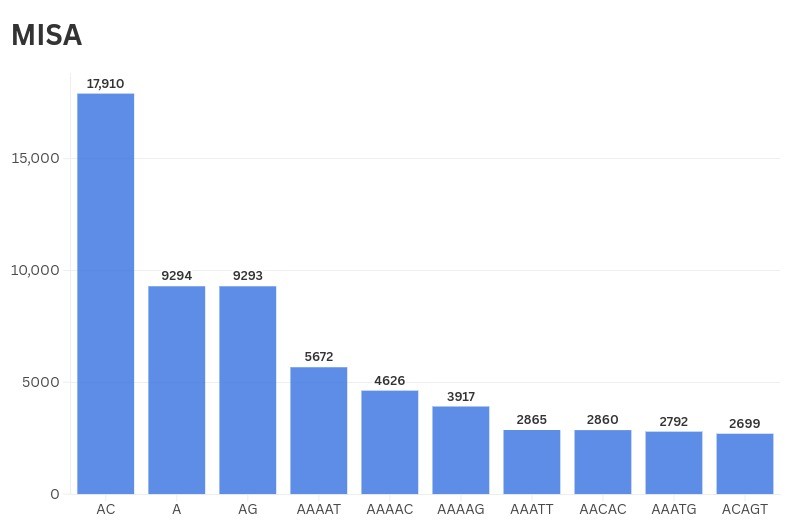
Interestingly, the distribution of SSR motifs varied between the two marker search programs. While the MISA program (Figure 1) primarily identified pentanucleotide repeats, the EasySSR program (Figure 2) predominantly highlighted dinucleotide motifs. Specifically, the AC motif was the most frequently observed motif according to MISA, occurring 17,910 times. Conversely, the TG motif was the most common according to the EasySSR program, with 7,656 occurrences.

Distribution of the 10 most abundant microsatellite motifs identified using the MISA program.

Distribution of the 10 most abundant microsatellite motifs identified using the EasySSR program.
SSR primers
Out of the 501 input sequences, successful primer pairs were obtained for 254 sequences, resulting in a total of 511 primer pairs selected. These primer pairs were distributed across various classes of repeat motifs, including di-, tri-, tetra-, penta-, and hexanucleotides, with 178, 125, 189, 40, and 30 primers developed for each respective class. Notably, primer development was most successful for tetranucleotide markers, resulting in a greater number of markers from this class being generated. The complete set of generated primers is available for reference in the supplementary material (DOI: 10.17632/2sz349gtvm.1).
DISCUSSION
Our findings present a novel panel of microsatellite markers for Brycon orbignyanus, characterized through a rapid and cost-effective methodology, encompassing perfect, imperfect, and compound microsatellites, a molecular tool wich can serve in studies investigating genetic variability and evaluating population structures (Herkenhoff et al. 2023). While Yazbeck et al. (2018) previously developed a panel of microsatellite markers for this species, their focus was solely on perfect microsatellites. This approach is essential for achieving higher resolution in species traceability at the population level, as accounting for population-specific characteristics is critical for informing conservation and fisheries management strategies (Herkenhoff et al. 2023).
The distribution of microsatellite markers identified by the MISA output, particularly the prevalence of pentanucleotide motifs, deviates from the typical pattern observed in fish species. In species such as Danio rerio, Takifugu rubripes, Ictalurus punctatus, Esox lucius, Oncorhynchus mykiss, and Astyanax mexicanus of the Characiformes Order, the distribution pattern commonly follows di- > mono- > tetra- > tri- > penta- > hexanucleotides (Lei et al. 2021). This discrepancy is further highlighted by the higher frequency of pentanucleotide markers observed in the B. orbignyanus genome, contrasting with the findings of Yazbeck et al. (2018). In their study, microsatellites of the dinucleotide class accounted for 74.22% of the total, nearly three times more abundant than all other motif classes combined. However, it is important to note that Yazbeck et al. (2018) solely screened for perfect microsatellite motifs, using the SSRIT program (Temnykh et al. 2001), thus overlooking the imperfect class of microsatellites. As a result, the proportion of SSR motif classes reported by the authors failed to account for imperfect microsatellites.
The MISA program was designed for the identification of perfect simple microsatellites and compound non-redundant motifs within DNA sequences, albeit at the cost of sensitivity to degenerate (imperfect) microsatellites (Beier et al. 2017). In contrast, the EasySSR program utilizes IMEX command lines (Mudunuri & Nagarajaram 2007), offering greater sensitivity towards imperfect microsatellites. Additionally, it allows for flexible parameterization of imperfection thresholds, enabling its use for the identification of perfect microsatellites as well. Hence, the prevalence of imperfect markers observed in the B. orbignyanus genome, as indicated by the EasySSR program, is plausible, as its results align more closely with the expected microsatellite distribution for this species.
The characteristics of imperfect microsatellite markers are linked to significant implications for species conservation (Bhargava & Fuentes 2010). In evolutionary contexts or within populations under impact, imperfect motifs exhibit a lower mutation rate and, consequently, are associated with a reduction in genetic variability (Zhu et al. 2000). Moreover, imperfect sequences have a tendency to persist and accumulate within a population, leading to fewer instances of polymerase slippage during replication and even the occurrence of perfect repeats. This phenomenon is referred to as “microsatellite death” (Kelkar et al. 2011). In this context, the characterization of microsatellite markers in the Brycon orbignyanus genome underscores a evolution of this type of microsatellite. This aligns with the significant decline in stocks of the species in the southern region of Brazil. The 189 tetranucleotide markers generated can serve as efficient tools for high-resolution analyses of the structure of wild populations or allele tracking of the species. Tetranucleotide markers are preferred in polymorphism analyses due to their high mutation rate and ability to minimize genotyping errors (Kelkar et al. 2008).
CONCLUSIONS
In conclusion, this study presents viable alternatives to facilitate the development of molecular markers for Brycon orbignyanus. By rapidly obtaining and characterizing microsatellite markers specific to this species, as well as developing a comprehensive panel of primers, our findings offer valuable insights. In this study, the prevalence of imperfect microsatellites highlights a evolution of this type of microsatellite in a population. Therefore, the methodology used can serve as a guideline for genetic variability analysis even before conducting in vitro or in situ tests. This work holds promise for enhancing the exploration of genetic resources and their applications in conservation programs targeting the endangered species Brycon orbignyanus and potentially other species within the Bryconidae family as well.
Acknowledgements
This work was supported by the Fundação Amazônia de Amparo a Estudos e Pesquisas (FAPESPA) approved in call n° 008/2022 – Program to Support the Retention of Young PhDs in Brazil – Fapespa/CNPq. This work was also produced within the scope of the National Institute of Science and Technology IAmazônia project. We thank Conselho Nacional de Desenvolvimento Científico e Tecnológico (CNPq) for approving the proposal under n° 409001/2024-4.
References
- ALVES SIA, FERREIRA VBC, DANTAS CWD, SILVA ALC & RAMOS RTJ. 2023. EasySSR: a user-friendly web application with full command-line features for large-scale batch microsatellite mining and samples comparison. Front Genet 14: 1228552.
-
ANDREWS S. 2010. FastQC: a quality control tool for high throughput sequence data. Available at: http://www.bioinformatics.babraham.ac.uk/projects/fastqc/ Accessed on June 15, 2025.
» http://www.bioinformatics.babraham.ac.uk/projects/fastqc/ - ARIAS MC ET AL. 2016. Microsatellite records for volume 8, issue 1. Conservation Genetics Resources 8: 43-81.
- BANKEVICH A ET AL. 2012. SPAdes: A new genome assembly algorithm and its applications to single-cell sequencing. J Comput Biol 19: 455-477.
- BEIER S, THIEL T, MÜNCH T, SCHOLZ U & MASCHER M. 2017. MISA-web: A web server for microsatellite prediction. Bioinformatics 33: 2583-2585.
- BHARGAVA A & FUENTES FF. 2010. Mutational Dynamics of Microsatellites. Mol Biotechnol 44: 250-266.
- BOLGER AM, LOHSE M & USADEL B. 2014. Trimmomatic: A flexible trimmer for Illumina sequence data. Bioinformatics 30: 2114-2120.
- CARVALHO LC, RIBEIRO JM & YAZBECK GM. 2019. Microsatellite multiplex systems for Brycon orbignyanus (Characiformes: Bryconidae). Braz J Biol 79: 751-754.
- FAZZI-GOMES PF, AGUIAR JP, MARQUES D, CABRAL GF, MOREIRA FC, RODRIGUES MDN, SILVA CS, HAMOY I & SANTOS S. 2021. Novel microsatellite markers used for determining genetic diversity and tracing of wild and farmed populations of the Amazonian giant Fish Arapaima gigas Genes 12: 1324.
- HERKENHOFF ME, BAJAY MM & COSTAMILAN CADVL-R. 2023. Genetic Structure and Biodiversity in Wild Centropomus parallelus and in Wild and Recently Domesticated Centropomus undecimallis Populations. Life 13: 1595.
- KELKAR YD, ECKERT KA, CHIAROMONTE F & MAKOVA KD. 2011. A matter of life or death: how microsatellites emerge in and vanish from the human genome. Genome Res 21: 2038-2048.
- KELKAR YD, TYEKUCHEVA S, CHIAROMONTE F & MAKOVA KD. 2008. The genome-wide determinants of human and chimpanzee microsatellite evolution. Genome Res 18: 30-38.
- LEI Y, ZHOU Y, PRICE M & SONG Z. 2021. Genome-wide characterization of microsatellite DNA in fishes: survey and analysis of their abundance and frequency in genome-specific regions. BMC Genom 22: 421.
-
MACEDO DB, VIANA JS, COELHO HJP, COSTA CVC, COSTA DGB, SANTOS AD, CORREA RMS, RAMOS TR & RODRIGUES MDN. 2024. Arapaima gigas stocks have declined drastically in the lower Tocantins River in the Amazon Microregion. An Acad Bras Cienc 96: e20231343. https://doi.org/10.1590/0001-3765202420231343
» https://doi.org/10.1590/0001-3765202420231343 - MARQUES LS, FREITAS TR, RODRIGUES RB, TEIXEIRA NS, PÉREZ-ATEHORTÚA M, ROSA-SILVA HT, MOREIRA JCF & STREIT DP. 2021. Vitrification protocol for immature Brycon orbignyanus ovarian tissue as an extinction escape strategy. Cryobiology 103: 116-122.
- MMA. 2018. Livro vermelho da fauna Brasileira ameaçada de extinção. Brasília, Brazil, p. 227.
- MUDUNURI SB & NAGARAJARAM HA. 2007. IMEx: imperfect microsatellite extractor. Bioinformatics 23: 1181-1187.
- SANTOS JS, GUERREIRO S, MEDEIROS NBC, ALVES K, HAMOY I & NUNES-RODRIGUES M. 2022. Loss of genetic diversity among pirarucu broodstocks in fish farms: a pilot study. Rev Sci Agrár Parana 21: 106-109.
- TEMNYKH S, DECLERCK G, LUKASHOVA A, LIPOVICH L, CARTINHOUR S & MCCOUCH S. 2001. Computational and experimental analysis of microsatellites in rice (Oryza satival.): frequency, length variation, transposon associations, and genetic marker potential. Genome Res 11: 1441-1452.
- YAZBECK GM, OLIVEIRA RS, RIBEIRO JM, GRACIANO RD, SANTOS RP, CARMO FMS & LAVENIER D. 2018. A broad genomic panel of microsatellite loci from Brycon orbignyanus (Characiformes: Bryconidae) an endangered migratory neotropical fish. Sci Rep 8: 8511.
- YOU FM, HUO N, GU YQ, LUO M, MA Y, HANE D, LAZO GR, DVORAK J & ANDERSON OD. 2008. BatchPrimer3: A high throughput web application for PCR and sequencing primer design. BMC Bioinform 9: 253.
- ZHU Y, STRASSMANN JE & QUELLER DC. 2000. Insertions, substitutions, and the origin of microsatellites. Genet Res 76: 227-236.
Edited by
-
Handling editor
Alexander Kellner
All data used in this study are available within the manuscript, either in tables or in the main text, and may be requested from the corresponding author via email.