
 How climate change may affect the seasonal and spatial patterns of acoustic activity in a neotropical tree frog?
Abstract
We investigated the climatic niche associated with the acoustic activity of the Neotropical tree frog Scinax fuscomarginatus (Lutz, 1925) to evaluate the long-term effects of climate change on this behavior, considering both its seasonal and spatial distribution. To do so, we employed passive acoustic monitoring and Ecological Niche Modeling (ENM), integrating frog occurrence records with climatic variables in a GIS framework. The current distribution of the species was modeled and projected under future climate scenarios using four presence-only modeling techniques. Acoustic activity was further modeled using a generalized additive mixed model (GAMM), relating calling behavior to ambient temperature based on field-collected data. Long-term projections of climate change effects on the calling activity of S. fuscomarginatus were made by comparing temperature conditions from the early (2000–2010) and late (2090–2100) 21st century. ENM results suggest that the species’ potential geographic distribution will contract due to climatic shifts, reducing areas with favorable conditions for acoustic activity. As a result, the seasonal and daily calling patterns of S. fuscomarginatus males are expected to be significantly altered, with likely consequences for the species’ reproductive success, demographic stability, and long-term population persistence.
Key words
Acoustic behavior; acoustic modeling; passive acoustic monitoring; potential distribution; Scinax fuscomarginatus
INTRODUCTION
In recent decades, the progressive increase in mean temperatures across the world, provoked by the anthropogenic emission of greenhouse gases, has raised concerns throughout the international scientific community (Palmer & Stevens 2019). Predictions for the future are even less encouraging, given that the mean temperature of the planet is expected to increase by up to 4°C by the end of the century (Collins et al. 2013). This represents an enormous challenge for both the scientific community and the decision-makers responsible for the management of environments, given the potentially negative effects of climate change on both biodiversity (Bellard et al. 2012) and humanity, by impacting public health and human wellbeing (Beaudry et al. 2020).
The potential consequences of climate change for biodiversity can be observed at various scales. For example, climate change has been implicated in the disappearance of many forests around the world (Dale et al. 2001), as well as shifts in the geographic distribution (Vasconcelos & Prado 2019) or ecological characteristics (e.g., abundance, spatial distribution, phenology, behavior, demography or morphology) of many species (Pacifici et al. 2017). In this context, climate change emerges as one of the most pressing challenges to contemporary conservation efforts, underscoring the critical need for the development of a comprehensive database that can inform evidence-based environmental management and support the formulation of robust conservation strategies (IPCC 2023).
As ectothermic animals have their metabolism closely regulated by prevailing climatic conditions, they are suitable models for evaluating the effects of climate change (Kearney & Porter 2009). Amphibians, in particular, are ectothermic animals with specific behavioral, ecological, and physiological traits that make them especially vulnerable to phenomena such as pollution, infectious diseases, and habitat degradation, in addition to climate change (Wells 2007). This vulnerability has led to the decline of the populations of many amphibian species around the world (Stuart et al. 2004, Luedtke et al. 2023), with many species now classified as endangered by the IUCN (2025). Despite this, the specific effects of climate change on the amphibian of many regions are still poorly understood, given the ample existence of taxonomic, geographic, and methodological biases (Winter et al. 2016).
Overall, data on the influence of climate change on the behavioral traits of amphibians are still incipient (Winter et al. 2016). In this context, the acoustic monitoring of the species, based on sophisticated passive monitoring procedures (Sugai et al. 2019), may provide an excellent diagnostic tool for the understanding of climate change (Kloepper & Simmons 2014). This tool would be especially valuable for monitoring anuran amphibians, as their vocal behavior plays a crucial reproductive role and is therefore highly dependent on climatic variables, such as ambient temperatures and precipitation levels (Wells 2007, Bittar et al. 2024). This suggests that climate variations may lead to changes in the acoustic activity of amphibians, potentially affecting their reproduction and ultimately threatening population survival. Despite the ecological importance of amphibian vocalizations, few studies have used passive acoustic monitoring to collect data in the field and provide insights into the potential effects of climatic variation on the calling activity of anuran species (see Llusia et al. 2013, Bonnefond et al. 2020).
In recent years, the prediction of the response of species to climate change has become an increasingly active field of ecological research (Nabout et al. 2012), in which Ecological Niche Modeling (ENM) has become one of the most widely used approaches for the prediction of shifts in potential distribution of the target species (Vaz et al. 2015). The traditional niche modeling approach correlates the climatic preferences of a species with its known geographic occurrence to generate estimates of its potential area of distribution in the future (Lima-Ribeiro & Diniz-Filho 2013). This approach can provide important input for the development of more effective conservation and management strategies, especially considering that many predictive studies have indicated that the geographic ranges of many amphibian species will be reduced because of climate change (Araújo et al. 2006, Bicudo & Bicudo 2008, Vasconcelos & Prado 2019). In addition, ENMs based on a mechanistic approach allow for the integration of organismal ecophysiological traits with ecological models to establish causal and consequential relationships between species and their physical environment (see Bovo et al. 2018, for a review). This is an important topic, as it has the potential to provide valuable insights into the effects of climate change on the calling activity of amphibian species (Krause & Farina 2016). This approach can be used to correlate acoustic behavior with predicted climatic conditions. This approach thus enables the prediction of the long-term effects of shifts in climate on the acoustic activity of amphibian species, as well as their long-term consequences for the populations of these species (Krause & Farina 2016).
Scinax fuscormaginatus (Lutz 1925) is a small-bodied amphibian of the family Hylidae (SVL = 15.65–26.69 mm, Pupin et al. 2020), which belongs to the Scinax ruber clade and has an ample distribution in South America, including Argentina, Brazil, Bolivia, and Paraguay (Brusquetti et al. 2014, Frost 2024). This species is common in open areas, where the individuals occupy shrubby and herbaceous vegetation, as well as clumps of grass, as calling sites (Toledo & Haddad 2005). Previous studies (Toledo & Haddad 2005, Souza et al. 2020) have shown that S. fuscomarginatus has a prolonged breeding season, which lasts consecutive months (sensu Wells 1977).
The vocal repertoire of the S. fuscomarginatus male includes different types of calls, which have specific social functions (Toledo & Haddad 2005). However, the advertisement call is the acoustic signal emitted most frequently by the males of this species (Toledo & Haddad 2005). This call has a mean duration of 540.1±61.92 ms (range: 333.8–628.2 ms) and a dominant frequency of 3.82±0.22 kHz (3.07–4.2 kHz). Souza et al. (2020) described the daily and seasonal calling patterns of male S. fuscomarginatus, and the influence of climatic variables (e.g., ambient temperature and precipitation) on this behavior. Scinax fuscomarginatus males vocalize at night (18:00 to 06:00), with a peak in acoustic activity at around 20:00 (Souza et al. 2020).
In the present study, we examined the climatic niche associated with the acoustic activity of male of Scinax fuscomarginatus to evaluate the long-term effects of climate change on the seasonal and spatial patterns of acoustic activity in this species. Specifically, we tested the hypothesis that future climate change will reduce the areas with climates suitable for the occurrence of S. fuscomarginatus, thereby affecting the species’ acoustic activity patterns over space and time. To address this, the present study integrated passive acoustic monitoring with ecological niche modeling to compare current acoustic patterns with predicted future scenarios resulting from climate change.
MATERIALS AND METHODS
Study species and study area
In the present study, we monitored the acoustic activity of males of S. fuscomarginatus on nine different bodies of water (Figure 1) in the southwest of the state of Goiás, in central Brazil. The native vegetation of this region is typical Brazilian Cerrado savanna, although much of the area has been impacted by the spread of farmland and cattle ranching operations (Martins et al. 2016, Siqueira & Faria 2019). The climate of the study region is tropical (AW in the Köppen classification system; Cardoso et al. 2014) with well-defined rainy (October through March) and dry seasons (April–September), annual precipitation of 1600–1900 mm and mean annual temperatures of 22–24°C (Alvares et al. 2014).

Distribution range of Scinax fuscomarginatus and sampled localities in Goiás state, Central Brazil.
Collection of data in the field and acoustic analyses
The acoustic activity of males of S. fuscomarginatus was monitored using the methodology described by Souza et al. (2020). At each body of water, we installed a Sony ICD-PX312 audio recorder to monitor the acoustic activity of study species in MP3 format at 48 kbps. For this, the recorders were set to record the acoustic activity of S. fuscomarginatus continuously over a period of 72 hours, covering three consecutive days and nights in each sampled month. After this period, we removed the recorder, downloaded the audio files, and reinstalled the device the following month. An ICEL HT-4000 datalogger was also installed at each site to record the ambient temperature (°C) and relative humidity (%) at 15-minute intervals. Both devices were installed in trees or shrubs adjacent to each body of water, at a height of approximately 50 cm above the ground, and protected from the rain by a plastic casing.
Both the recorders and dataloggers remained in place at the same time throughout the period from October 2016 to March 2017. As Souza et al. (2020) recorded calling behavior in males S. fuscomarginatus during the rainy season, sampling effort was maximized by restricting data collection to this part of the year. Using Audacity (Audacity Team 2019), we extracted the nocturnal portion (18:00 and 06:00) of the recordings (sensu Madalozzo et al. 2017, Souza et al. 2020). The acoustic activity of the study species and the climatic variables (temperature and relative humidity) were recorded simultaneously for three nights per month throughout the study period, with a total of 18 sampling days (432 hours) of data recording per sampling point.
The audio recordings were analyzed using Audacity software, version 2.1.3 (Audacity Team 2019). For each sampling day, we determined the emission rate (calls per minute) of advertisement calls within the general chorus using a manual counter during the first six minutes (10%) of each hour, from 18:00 to 06:00. For this parameter, then, the total sampling effort was 432 minutes per body of water. The environmental variables (temperature and relative humidity) were recorded for each call-counting interval.
Ecological niche modeling, geographic distribution, and acoustic modeling
In this study, ecological niche models were not designed to estimate population size reductions of the target species. Rather, they generated large-scale projections of occurrence suitability (presence/absence) under a climate change scenario. These projections were then used to infer potential impacts of future climatic shifts on the species’ acoustic activity. In this sense, the ecological niche models (ENMs) were compiled using the data on the occurrence of the study species and climatic variables in GIS format. The occurrence data were obtained from Vasconcelos & Nascimento (2016), together with our empirical field data. To avoid sampling bias and spatial autocorrelation, the occurrence records were mapped in a grid of cells of 0.5ox0.5o (longitude x latitude) and only one record by pixel was considered.
We obtained 19 bioclimatic variables from the ecoClimate database (https://ecoclimate.lncc.br/) for the present (1950–1999) and future (2080–2100) scenarios at a spatial resolution 0.5ox0.5o (longitude x latitude), both of which were simulated by the CCSM4 global circulation model (Lima-Ribeiro et al. 2015). The future climatic simulations were obtained for two distinct scenarios of greenhouse gas emission – RCP4.5 (optimistic) and RCP8.5 (pessimistic). To overcome the multicollinearity problem among all bioclimatic variables in the ENMs predictions, we performed a factorial analysis using varimax rotation and selected the variable with the highest loading on each of the five first factors (the number of factors was established from screen plot). The resulting variables included the annual mean temperature, annual temperature range, precipitation during wettest and driest months, and precipitation during the warmest quarter.
The distribution of the study species was modeled for the present climate conditions and projected to the future climatic scenarios using four methods based on presence-only data (Bioclim, Busby 1991; Domain, Carpenter et al. 1993; Maxent, Phillips et al. 2006; and ENFA, Hirzel et al. 2002). These initial models were combined following the ensemble approach (Diniz-Filho et al. 2009) to obtain a final map of climatic suitability for the study species under each climate scenario (Araújo & New 2007, Diniz-Filho et al. 2009). The predictive performance of each model was originally evaluated using true skill statistics (TSS, Allouche et al. 2006), and the models with poor performance were eliminated from the ensemble process; the remaining models were then averaged using the TSS values as weight. Binary maps of the distribution of the species were then obtained using the 5% quantiles of the suitability values associated with the occurrence records of the species as the threshold. These models were generated in R (R Core Team 2024) using the dismo (Hijmans et al. 2024), factoextra (Kassambara & Mundt 2020), and terra packages (Hijmans 2024).
Finally, we modeled the call emission rates (calls per minute) of S. fuscomarginatus as a function of the temperature recorded in the field by using a Generalized Additive Mixed Model (GAMM) with the thin plate (tp) regression spline function, considering the bodies of water (sampling points) as a random factor, and controlling for the autocorrelation among the months. To evaluate the long-term effects of climate change on the calling activity of S. fuscomarginatus, the acoustic GAMM model was projected onto the conditions (temperature) at the beginning (2000–2010) and end (2090–2100) of the 21st Century, covering the area of distribution of the species predicted by the niche models for each period. For these spatial predictions, we obtained the data of mean surface temperature (mst) for the beginning and end of the 21st Century, at 3-hour intervals, using the CCSM4 general circulation model available in the CMIP5 database (https://pcmdi.llnl.gov/mips/cmip5/). The temperature maps were interpolated for a spatial resolution of 0.5ox0.5o latitude/longitude using the same kriging procedure for the ecoClimate database (see Lima-Ribeiro et al. 2015) and the climatic layers delimited for the Neotropical region. In the last step, we calculated the mean surface temperature over the night (18:00, 21:00, 00:00, 03:00, 06:00) and monthly (October through March) periods of acoustic activity of S. fuscomarginatus. The acoustic GAMM models were generated in R using the mgcv package (Wood 2011), while the spatial predictions were obtained using the raster package (Hijmans 2016), and the interpolations were based on the scripts available in the ecoClimate database (see Lima-Ribeiro et al. 2015).
RESULTS
Seasonal and daily patterns of calling activity
The field records showed that the acoustic activity of the male of S. fuscomarginatus occurred between October and March, with a peak of activity between October and November, when the highest advertisement call rates were recorded (Figure 2a). Over these months, ambient temperatures ranged from 15.2°C to 40.5°C. Over the course of the night, calling activity was most intense between 18:00 and 22:00 (Figure 2b), when the highest call emission rates were recorded. The calling activity of the male frogs decreases considerably from 22:00 onward and cease by approximately 06:00.

Seasonal (a) and daily (b) call rates (mean, percentiles and outliers) of S. fuscomargintus males.
Species distribution and the modeling of calling activity
Based on the occurrence records of S. fuscomarginatus, the ENMs predicted a large geographic distribution, in which the species is widely distributed across South America (Figure 3a). In the future, both the optimistic (RCP45) and pessimistic (RCP85) scenarios indicated a reduction of 46% and 65% in the potential geographic distribution of the species, respectively, which would become restricted, primarily to the Brazilian Atlantic Forest and small areas of the Cerrado savanna and the foothills of the Andes (Figure 3b and 3c).
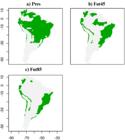
Potential geographic distribution of S. fuscomarginatus predicted by the ecological niche models for the present (a), and in two distinct future scenarios of climate change, i.e., RCP4.5 (b) and RCP8.5 (c).
Based on the GAM model, it was possible to predict the most favorable thermal conditions for the calling activity in S. fuscomarginatus between 20-35°C. The GAM model fitted a highly non-linear and significant relationship between calling frequency and temperature (edf = 9.966, p-value < 0.001). By projecting the GAM predictions on temperature maps, the models predicted that the most favorable thermal conditions at the present for the calling activity in S. fuscomarginatus will be more dispersed spatially between the months of October and December (Figure 4). Over the long term in the future, however, such thermal conditions will be more spatially dispersed between January and March (Figure 5).

Present-day spatial pattern of calling activity in the male S. fuscomarginatus in different months (October through March). The color variation in maps represents the intensity of calling activity.

Future spatial pattern of calling activity predicted in the male S. fuscomarginatus in different months (October through March). The color variation in maps represents the intensity of calling activity.
For the different periods of the night, the niche models predict that the thermal conditions favorable to the occurrence of calling activity in S. fuscomarginatus will not be distributed uniformly across the whole potential distribution of the species. In both the present and future climate change scenarios, the thermal conditions most favorable to the daily calling activity of the study species between 18:00 and 21:00 are concentrated mainly in central part of the potential distribution of the species (Figure 6). A more homogeneous distribution of climatic conditions within the potential distribution of S. fuscomarginatus was predicted, in both scenarios for the period between 00:00 and 06:00 (Figure 7).

Future spatial pattern of calling activity predicted in the male S. fuscomarginatus over the course of the night (from 18:00 to 06:00). The color variation in maps represents the intensity of calling activity.

Present-day spatial pattern of calling activity in the male S. fuscomarginatus over the course of the night (from 18:00 to 06:00). The color variation in maps represents the intensity of calling activity.
DISCUSSION
The field data obtained during the present study using the automatized sound recorders and dataloggers, combined with the ecological niche modeling, allowed us to infer the long-term impacts of climate change on both the geographic distribution and calling activity of the male S. fuscomarginatus. The projections produced by the ENMs indicate that the potential geographic distribution of the study species will decrease in size in response to climate change, which will affect climatic conditions favorable to the calling activity of the species. In both the present and future scenarios, the projections indicate that climatic conditions favorable to calling will not be distributed uniformly, in either spatial or temporal terms, within the geographic distribution of the study species. The extrapolation of our models indicates that the daily and seasonal patterns of the calling activity of the male S. fuscomarginatus will be altered by climate change. These shifts may impact important reproductive and demographic parameters, as well as the potential for the long-term persistence of the populations of this species.
Despite being one of the most amply distributed amphibian species, which is common in open areas, this scenario shows that climate change will probably have a negative impact on S. fuscomarginatus over the long term. The results of the present study indicate that the potential distribution of the study species will undergo a considerable reduction by 2100, when it will become restricted primarily to the Atlantic Forest and small areas of the Cerrado and Andes regions. These results are consistent with the findings of Vasconcelos & Nascimento (2016) who investigated the long-term effects of climate change on the geographic distribution of generalist species from the Cerrado and Atlantic Forest domains. These authors predicted that S. fuscomarginatus would lose 40% of its current area of occurrence by 2050, becoming restricted to the southeastern extreme of South American. In light of the recent taxonomic revision of S. fuscomarginatus (Brusquetti et al. 2014), it is important to emphasize that the impacts of climate change may be even more severe when considering the cryptic diversity within the species. Distinct evolutionary lineages may be at risk of extinction due to the reduction of suitable habitats for their persistence.
Understanding species’ natural history, such as calling behavior, may be extremely important from an ecological perspective (Travis 2020). Unlike Vasconcelos & Nascimento (2016), this study also assesses how climate change may affect a behavioral trait (acoustic activity) which is key to reproductive success and long-term population persistence. By integrating bioacoustics data with ecological niche models, we projected future changes (up to 2100) in climatic conditions favorable to the calling activity of S. fuscomarginatus. Results indicate a reduction and temporal restriction in suitable conditions compared to the present. This is significant, as many studies (e.g., Köhler et al. 2017) have shown that amphibian calling behavior is climate-sensitive. Specifically for S. fuscomarginatus, prior research (Toledo & Haddad 2005, Souza et al. 2020) demonstrates that call parameters are influenced by temperature and precipitation. Our findings suggest that, in the future, calling periods will be shorter and delayed due to less favorable climatic conditions.
The integration of the behavioral data with ecological niche modeling allowed us to determine not only the potential distribution of the study species in the future, but also which areas are more likely to present conditions favorable to the calling behavior of the S. fuscomarginatus males. Understanding where and when climatic conditions favorable to the calling behavior of the study species will occur will be important for the conservation of the species, considering that the abiotic and/or biotic effects of long-term climate change may impede or interrupt the communication between these animals (Penar et al. 2020). This is especially relevant in anurans, given that acoustic communication plays an important role in sexual selection, affecting the reproductive success of the individuals and, consequently, the persistence of populations (Wells 2007). The insights provided by the present study represent an important step toward the resolution of the existing knowledge gaps (Winter et al. 2016), as well as having the potential to contribute to the development of effective management and conservation measures for amphibian species, in the Neotropical region.
Passive acoustic monitoring has been increasingly adopted by anuran ecologists worldwide. Therefore, considering the approach of the present study as well as the framework proposed by Desjonquères et al. (2022), it is essential that future research integrates field data with ecological niche modeling to generate robust predictions regarding the impact of climate change on the acoustic activity of amphibians. Such efforts would significantly contribute to our understanding of the long-term consequences of climate change for this important vertebrate group, which is likely the most threatened with extinction overall (e.g., Luedtke et al. 2023).
Acknowledgements
We would like to thank the Levi Carina Terribile and Priscila Lemes for critical reading of the manuscript. This research was funded by Fundação de Amparo à Pesquisa do Estado de Goiás (CNPq/FAPEG - Process number 2012/10267001108; PPP/FAPEG - Process number 2016/10267001018) and Fundação Grupo Boticário de Proteção à Natureza (Process number 1081_20162). ARM, FAGG and MRSL are grateful to the Conselho Nacional de Desenvolvimento Científico e Tecnológico (CNPq), SRO is grateful to the Coordenação de Aperfeiçoamento de Pessoal de Nível Superior (CAPES) for their fellowships.
References
- ALLOUCHE O, TSOAR A & KADMON R. 2006. Assessing the accuracy of species distribution models: prevalence, kappa and the true skill statistic (TSS). J Appl Ecol 43: 1223-1232.
- ALVARES CA, STAPE JL, SENTELHAS PC, GONÇALVES JLM & SPAROVEK G. 2014. Koppen’s climate classification map for Brazil. Meteorol Z 22: 711-728.
- ARAÚJO MB & NEW M. 2007. Ensemble forecasting of species distributions. Trends Ecol Evol 22: 42-44.
- ARAÚJO MB, THUILLER W & PEARSON RG. 2006. Climate warming and the decline of amphibians and reptiles in Europe. J Biogeogr 33: 1712-1728.
-
AUDACITY TEAM. 2019. Free audio editor and recorder. Version 2.1.3. Audacity audio editing software. Available at: https://audacityteam.org/
» https://audacityteam.org/ - BEAUDRY E, MCKAY FH & HAINES BC. 2020. How are Victorian Local Governments’ responding to climate change and food insecurity? Health Promot J Austr 32: 137-144.
- BELLARD C, BERTELSMEIER C, LEADLEY P, THUILLER W & COURCHAMP F. 2012. Impacts of climate change on the future of biodiversity. Ecol Lett 15: 365-377.
- BICUDO CEM & BICUDO DC. 2008. Mudanças climáticas globais: efeitos sobre as águas continentais superficiais. In: Biologia e Mudanças Climáticas no Brasil, 1a ed., São Carlos: Rima Editora, SP, Brasil.
- BITTAR BB, LIMA-RIBEIRO MS, VAZ-SILVA W, SANTOS CE, OLIVEIRA RF, ANDREANI TL, OLIVEIRA SR & MORAIS AR. 2024. The acoustic activity of Physalaemus cuvieri (Anura Leptodactylidae) is strongly influenced by climatic conditions, but not by latitude or landscape metrics. Ethol Ecol Evol 36: 232-244.
- BONNEFOND A, COURTOIS EA, SUEUR J, SUGAI LSM & LLUSIA D. 2020. Climatic breadth of calling behaviour in two widespread Neotropical frogs: Insights from humidity extremes. Glob Change Biol 26: 5431-5446.
- BOVO RP, NAVAS CA, TEJEDO M, VALENÇA SES & GOUVEIA SF. 2018. Ecophysiology of amphibians: information for best mechanistic models. Diversity 10: 118.
- BRUSQUETTI F, JANSEN M, BARRIO-AMORÓS C, SEGALLA M & HADDAD CFB. 2014. Taxonomic review of Scinax fuscomarginatus (Lutz, 1925) and related species (Anura; Hylidae). Zool J Linn Soc 171: 783-821.
- BUSBY JR. 1991. BIOCLIM - a bioclimate analysis and prediction system. In: Margules CR & Austin MP (Eds), Nature Conservation: Cost Effective Biological Surveys and Data Analysis. Canberra: CSIRO, p. 64-68.
- CARDOSO MRD, MARCUZZO FFN & BARROS JR. 2014. Classificação climática de Köppen-Geiger para o Estado de Goiás e Distrito Federal. Acta Geogr 8: 40-55.
- CARPENTER G, GILLISON AN & WINTER J. 1993. DOMAIN: A flexible modeling procedure for mapping potential distributions of plants and animals. Biodivers Conserv 2: 667-680.
-
COLLINS M ET AL. 2013. Long-term climate change: Projections, commitments and irreversibility. In: Climate Change 2013: The Physical Science Basis. Contribution of Working Group I to the Fifth Assessment Report of the Intergovernmental Panel on Climate Change, Stocker TF, Qin D, Plattner G-K, Tignor M, Allen SK, Doschung J, Nauels A, Xia Y, Bex V & Midgley PM (Eds), Cambridge University Press, p. 1029-1136. doi:10.1017/CBO9781107415324.024.
» https://doi.org/10.1017/CBO9781107415324.024 - DALE VH ET AL. 2001. Climate Change and Forest Disturbances: Climate change can affect forests by altering the frequency, intensity, duration, and timing of fire, drought, introduced species, insect and pathogen outbreaks, hurricanes, windstorms, ice storms, or landslides. BioScience 51(9): 723-734.
- DESJONQUÈRES C, VILLÉN-PÉREZ S, DE MARCO P, MÁRQUEZ R, BELTRÁN JF & LLUSIA D. 2022. Acoustic species distribution models (aSDMs): A framework to forecast shifts in calling behaviour under climate change. Methods Ecol Evol 13: 2275-2288.
- DINIZ-FILHO JAF, BINI LM, RANGEL TF, LOYOLA RD, HOF C, NOGUÉS-BRAVO D & ARAÚJO MB. 2009. Partitioning and mapping uncertainties in ensembles of forecasts of species turnover under climate change. Ecography 32: 897-906.
-
FROST DR. 2024. Amphibian Species of the World: an online reference. Electronic Database accessible at: https://amphibiansoftheworld.amnh.org/index.php Am Mus of Nat Hist, New York, USA.
» https://amphibiansoftheworld.amnh.org/index.php -
HIJMANS R. 2016. Raster Geographic Data Analysis and Modeling. https://cran.r-project.org/web/packages/raster/index.html
» https://cran.r-project.org/web/packages/raster/index.html -
HIJMANS R. 2024. terra: Spatial Data Analysis. R package version 1.7-78. https://CRAN.R-project.org/package=terra
» https://CRAN.R-project.org/package=terra -
HIJMANS R, PHILLIPS S, LEATHWICK J & ELITH J. 2024. dismo: Species Distribution Modeling. R package version 1.3-16. https://CRAN.R-project.org/package=dismo
» https://CRAN.R-project.org/package=dismo - HIRZEL AH, HAUSSER J, CHESSEL D & PERRIN N. 2002. Ecological-niche factors analysis: how to compute habitat-suitability maps without absence data? Ecology 83: 2027-2036.
-
IPCC. 2023. Sections. In: Climate Change 2023: Synthesis Report. Contribution of Working Groups I, II and III to the Sixth Assessment Report of the Intergovernmental Panel on Climate Change. Core Writing Team, Lee H & Romero J (Eds), IPCC, Geneva, Switzerland, p. 35-115. doi: 10.59327/IPCC/AR6-9789291691647.
» https://doi.org/10.59327/IPCC/AR6-9789291691647 -
IUCN. 2025. The IUCN Red List of Threatened Species. Version 2025-1. https://www.iucnredlist.org Accessed on April 10, 2025.
» https://www.iucnredlist.org -
KASSAMBARA A & MUNDT F. 2020. _factoextra: Extract and Visualize the Results of Multivariate Data Analyses_. R package version 1.0.7, <https://CRAN.R-project.org/package=factoextra>.
» https://CRAN.R-project.org/package=factoextra> - KEARNEY M & PORTER W. 2009. Mechanistic niche modelling: combining physiological and spatial data to predict species ranges. Ecol Lett 12: 334-350.
- KLOEPPER LN & SIMMONS AM. 2014. Bioacoustic monitoring contributes to an understanding of climate change. Acoust Today 10: 8-15.
- KÖHLER J, JANSEN M, RRODRÍGUEZ A, KOK PJR, TOLEDO LF, EMMRICH M, GLAW F, HADDAD CFB, RÖDEL MO & VENCES M. 2017. The use of bioacoustics in anuran taxonomy: theory, terminology, methods and recommendations for best practice. Zootaxa 4251: 1-124.
- KRAUSE B & FARINA A. 2016. Using ecoacoustic methods to survey the impacts of climate change on biodiversity. Biol Conserv 195: 245-254.
- LIMA-RIBEIRO MS & DINIZ-FILHO JAF. 2013. Modelos ecológicos e a extinção da megafauna: clima e homem na América do Sul, São Carlos: CUBO, Brazil.
- LIMA-RIBEIRO MS, VARELA S, GONZALEZ-HERNANDEZ J, OLIVEIRA G, DINIZ-FILHO JAF & TERRIBILE LC. 2015. EcoClimate: a database of climate data from multiple models for past, present, and future for macroecologists and biogeographers. Biodivers Inform 10: 1-21.
- LLUSIA D, MÁRQUEZ R, BELTRÁN JF, BENÍTEZ M & AMARAL JP. 2013. Calling behaviour under climate change: geographical and seasonal variation of calling temperatures in ectotherms. Glob Change Biol 19: 2655-2674.
- LUEDTKE JA ET AL. 2023. Ongoing declines for the world’s amphibians in the face of emerging threats. Nature 622(7982): 308-314.
- LUTZ A. 1925. Batraciens du Brésil. Comptes Rendus et Mémoires Hebdomadaires des Séances de la Société de Biologie et des ses Filiales. Paris 93: 137-139.
-
MADALOZZO B, SANTOS TG, SANTOS MB, BOTH C & CECHIN S. 2017. Biodiversity assessment: selecting sampling techniques to access anuran diversity in grassland ecosystems. Wildl Res 44: 78-91. https://doi.org/10.1071/WR16086.
» https://doi.org/10.1071/WR16086 - MARTINS AP, SCOPEL I, SOUZA MS & PEIXINHO DM. 2016. Uso da terra e cobertura vegetal de 1985 a 2015 no Sudoeste de Goiás e relações com o meio físico. In: Peixinho DM & Sousa MS (Eds), Reconfiguração do Cerrado - Uso, conflitos e impactos ambientais, 1a ed., Goiânia: Gráfica UFG, p. 11-34.
- NABOUT JC, CARVALHO P, PRADO MU, BORGES PP, MACHADO KB, HADDAD KB, MICHELAN TS, CUNHA HF & SOARES TN. 2012. Trends and biases in global climate change literature. Nat Conserv 10: 45-51.
- PACIFICI M, VISCONTI P, BUTCHART S, WATSON J, CASSOLA F & RONDININI C. 2017. Species’ traits influenced their response to recent climate change. Nat Clim Change 7: 205-208.
- PALMER T & STEVENS B. 2019. The scientific challenge of understanding and estimating climate change. Proc Nattl Acad Sci USA 116: 24390-24395.
- PENAR W, MAGIERA A & KLOCEK C. 2020. Applications of bioacoustics in animal ecology. Ecol Complex 43: 100847.
- PHILLIPS SJ, ANDERSON RP & SCHAPIRE RE. 2006. Maximum entropy modeling of species geographic distributions. Ecol Modell 190: 231-259.
- PUPIN NC, BRUSQUETTI F & HADDAD CFB. 2020. Seasonality drives body size variation in a widely distributed Neotropical treefrog. J Zool 311: 85-93.
- R CORE TEAM. 2024. R: A language and environment for statistical computing. Viena (Austria): R Foundation for Statistical Computing.
- SIQUEIRA MN & FARIA KMS. 2019. Análise da dinâmica da paisagem no município de Rio Verde, Goiás, Brasil: uma ferramenta para a escolha de áreas prioritárias para a conservação. Soc Nat 31: 1-20.
- SOUZA AO, OLIVEIRA SR, DIAS GP, BASTOS RP & MORAIS AR. 2020. Annual and daily patterns of calling activity in male Scinax fuscomarginatus (Anura: Hylidae) from Central Brazil. Zoologia 37: e54148.
- STUART SN, CHANSON JS, COX NA, YOUNG BE, RODRIGUES AS, FISCHMAN DL & WALLER RW. 2004. Status and trends of amphibian declines and extinctions worldwide. Science 306(5702): 1783-1786.
- SUGAI LSM, SILVA TSF, RIBEIRO-JR JW & LLUSIA D. 2019. Terrestrial passive acoustic monitoring: review and perspectives. BioScience 69: 15-25.
- TOLEDO LF & HADDAD CFB. 2005. Acoustic repertoire and calling behavior of Scinax fuscomarginatus (Anura, Hylidae). J Herpetol 39: 455-464.
- TRAVIS J. 2020. Where is natural history in ecological, evolutionary, and behavioral science? Am Nat 196: 1-8.
- VASCONCELOS TS & NASCIMENTO BTM. 2016. Potential climate-driven impacts on the distribution of generalist treefrogs in South America. Herpetol 72: 23-31.
- VASCONCELOS TS & PRADO VHM. 2019. Climate change and opposing spatial conservation priorities for anuran protection in the Brazilian hotspots. J Nat Conserv 49: 118-124.
- VAZ UL, CUNHA HF & NABOUT JC. 2015. Trends and biases in global scientific literature about ecological niche models. Braz J Biol 75: 17-24.
- WELLS KD. 1977. The social behaviour of anuran amphibians. Anim Behav 25: 666-693.
- WELLS KD. 2007. The ecology and behaviour of amphibian. Chicago: The University of Chicago Press, USA.
- WINTER M, FIEDLER W, HOCHACHKA WM, KOEHNCKE A, MEIRI S & DE-LA-RIVA I. 2016. Patterns and biases in climate change research on amphibians and reptiles: a systematic review. R Soc Open Sci 3: e160158.
- WOOD SN. 2011. Fast stable restricted maximum likelihood and marginal likelihood estimation of semiparametric generalized linear models. J R Stat Soc Series B 73: 3-36.
Edited by
-
Handling editor
Mirco Solé
The data that support the findings of this study are available on request from the corresponding author. The Editor-in-Chief has waived the required archiving due to privacy or ethical restrictions.


