 Influence of pollination mechanisms on the physical-chemical quality of strawberry (Fragaria x ananassa) cv. San Andreas
Abstract
The objective of this study was to evaluate the physical-chemical quality parameters of strawberry fruits, cultivar San Andreas, depending on different pollination mechanisms. The study was conducted in the municipality of Barra do Choça - BA, organized into five treatments, with four replications: T1- Natural pollination (NP), T2- Natural pollination with a density of bees (NPDB), T3- Manual cross-pollination (MCP), T4- Pollination by anemophily (PA) and T5- Self-pollination (SP). For the pollination treatment with a density of bees, four hives of Iraí (<italic>Nannotrigona testaceicornis</italic>) and four hives of Jataí (<italic>Tetragonisca angustula</italic>) were placed near the strawberry plantation. After pollination of all treatments, the flowers were bagged until the development and maturation of the floral receptacle. The fruits were harvested, quantified, and subjected to evaluations to determine physical and chemical parameters. Pollination with a density of bees and natural pollination provided fruits with higher average weight, diameter, and length. Natural pollination, natural pollination with density of bees, manual cross-pollination, and anemophily pollination showed greater chromaticity in the fruits. Natural pollination and density of bees provided the best parameters (Weight, °Brix, ratio, and vit. C). Self-pollination presented the lowest averages in most of the variables analyzed.
Key words
Bee pollination; fruit quality; Nannotrigona testaceicornis; Tetragonisca angustula
INTRODUCTION
Strawberries (Fragaria x ananassa Duch) can be consumed fresh or in the form of a wide variety of processed products, such as juices, jellies, sweets, and others. However, studies show that consumers prefer to ingest it in its natural form, due to its sensorial characteristics of appearance, aroma, and flavor (Paparozzi et al. 2018). Approximately 80% of global strawberry production is destined for fresh trade (Šamec et al. 2016) and, in Brazil, it is no different, where 90% of sales are also made from fresh fruit (Fagherazzi et al. 2021).
Strawberry cultivation is important from a socioeconomic point of view and can provide a profitability of between 50% and 100% of the amount invested. Strawberry productivity varies according to environmental, genetic, and management factors, specifically the cultivar, cultivation system, planting time, and pollination efficiency (Passos et al. 2015). One of the main factors responsible for the success of strawberry cultivation is pollination management (Malagodi-Braga 2018).
Although strawberry flowers can be self-pollinated, pollen rarely spontaneously reaches the entire stigma. In this sense, the wind can favor cross-pollination (Ganser et al. 2018), due to pollen dispersion (Roselino et al. 2009). Even with the presence of hermaphrodite and self-fertile commercial cultivars, the transfer of pollen from anthers to stigmas depends on pollinator visitors (Abrol et al. 2017). From this perspective, studies have shown that strawberry production improves with cross-pollination (Witter et al. 2014). Klatt et al. (2014) found in nine strawberry cultivars that the flowers, after cross-pollination, resulted in fruits with high commercial value.
Cross-pollination occurs mainly through the action of pollinators, such as bees. The behavior of different species of bees in visiting flowers results in a uniform distribution of pollen in the pistils, the female structure of the flower that contains the ovule, fertilizing them and thus producing well-formed and even heavier fruits (Malagodi-Braga & Kleinert 2007, Scheid et al. 2020), in addition to positively affecting the color, firmness and acidity of the fruits (Klatt et al. 2014), thus improving the quality of the fruit.
The quality of fruits and vegetables is a combination of properties that determine their food value, which are visual appearance, sensory characteristics, and chemical and nutritional composition (Boonyakiat et al. 2016). The chemical composition and color of the fruits are the main parameters that influence consumer acceptance. This is because flavor is mainly determined by the content of soluble solids and color by the accumulation of phenolic compounds and anthocyanins (Hossain et al. 2016).
In this sense, the objective of this work was to evaluate the influence of different pollination methods on the physicochemical properties of strawberries of the San Andreas cultivar.
MATERIALS AND METHODS
The study was carried out in the municipality of Barra do Choça - Bahia, in the Planalto da Conquista region, which has latitude 14°52’ South and longitude 40°34’ West, average altitude of 900 m (City hall of Barra do Choça 2020). The climate, according to the Köppen classification, is type Aw, characterized by rainy summers and dry winters (Kottek et al. 2006), with average annual precipitation around 700 mm and predominantly humic dystrophic Yellow Oxisol soil (Santos 2013).
The experiment was carried out during January and February 2022, on a commercial planting property with semi-organic management (use of fertigation when necessary) in an open field under the protection of low tunnels, with the San Andreas cultivar, in an area planted with 900 square meters (30m x 30m).
The treatments were carried out on construction sites, with two lines and eleven tunnels in total. The experiment was organized into five treatments and evaluated using a completely randomized design (DIC), with four replications each: T1- Natural pollination (NP), T2- Natural pollination with density of bees (NPDB), T3 - Manual cross-pollination (MCP), T4 - Pollination by anemophily (PA) and T5 - Self-pollination (SP).
The primary buds were randomly selected, one day before anthesis, and bagged with voile fabric, before and after pollination to control treatments.
For the pollination treatment with densification of bees, fifteen days before the evaluations, four hives of populous colonies of Iraí (Nannotrigona testaceicornis) and four hives of Jataí (Tetragonisca angustula) were installed, placed close to the strawberry plantation, at a distance of 5 meters. The bee colonies were provided by the Beekeeping and Meliponiculture Sector of the State University of Southwest Bahia (Universidade Estadual do Sudoeste da Bahia/UESB). These species occur naturally in the region and are easily managed in rational hives.
For the natural pollination treatment, observations were made before the introduction of Iraí and Jataí bees, considering all types of bees and other insects present in the area. The flowers were marked with adhesive tape, and the insects visited spontaneously.
For the manual cross-pollination treatment, the pollen grains used were collected from other primary flowers of plants of the same cultivar, which had not been pre-selected, being collected the day before pollination and kept in Petri dishes at room temperature.
For manual cross-pollination treatment, the pollen grains used were collected from other primary flowers of plants of the same cultivar, which had not been pre-selected, and were collected the day before pollination and kept in petri dishes at room temperature. The pollen was transferred to the stigma of the flower with the aid of a synthetic brush, by means of movements around the floral receptacle, in order to allow uniform distribution of the pollen. The flowers were then bagged, remaining in this way until the development and maturation of the floral receptacle.
To treat anemophilia, the flowers were bagged with tulle fabric, which allows the passage of wind and prevents the entry of insects or other biotic pollination vectors, thus being kept until harvest.
For self-pollination, the floral buds were bagged with voile bags the day before their anthesis and this protection remained until the fruit matured.
The fruits resulting from the effect of the treatments were harvested and quantified when they showed 75% of their external surface red and fully ripe. On the same day, the fruits were taken to the laboratory, to determine the following physical parameters: fresh mass (g), obtained on an analytical balance; longitudinal length (mm); equatorial diameter (mm), obtained using a caliper; and the coloring of the fruit carried out using a colorimeter, brand Konica Minolta, model CR-400, with direct reflectance reading of the coordinates L* (brightness), a* (red or green tone) and b* (yellow and blue tone) of the Hunterlab Universal Software system, using the CIELAB scale and using the illuminant 10°/D65.
Using the values of a* and b*, the following values were obtained: Hue angle (°H), obtained by the formula: Hue = tg-1 b/a; and chromaticity (C*). The Hue Angle was defined as starting on the +a axis and is expressed in degrees, with 0° corresponding to a+a (red), 90° corresponding to a+b (yellow), 180° corresponding to a–a (green) and 270° corresponds to a–b (blue). Chromaticity defines the intensity of the color, assuming lower values for more neutral, colors (gray) and higher values for vivid colors. This variable was obtained using the formula: C= (a2 +b2).
Chroma is the attribute that represents the chromaticity of the fruit, which defines the intensity of the color, with the most opaque having values close to zero, and those close to 60 being the most vivid (McGuirre 1992).
∆E varies from 0 to 100 and expresses the total color difference of the selected pattern, that is, the distance between the colors, with values < 1 the difference is not perceptible to the human eye, 1-2 is perceptible through close observation, 2 -10 barely noticeable, 11-49 the colors are more similar than opposite and 100 the colors are exactly opposite (Pinheiro et al. 2020).
From samples of the pulp, previously crushed manually with the aid of a pestle until the formation of juice, the fruits were evaluated for pH, determined using a peagameter, and measured directly on the sample. Total Soluble Solids (TSS) were determined by a refractometer, carried out with a table refractometer, with automatic temperature correction to 20°C, expressing the result in °Brix, total titratable acidity (TTA) determined by neutralization titrimetry, with 0.5 to 1g of juice, and titration with 0.1N NaOH solution, Ratio (TSS/TTA) determined by the quotient between the two constituents and vitamin C (ascorbic acid), obtained by the colorimetric method, with 2, 4 dinitrophenylhydrazine, according to the methodology of Strohecker & Henning (1967), with the results expressed in mg 100mL of juice-1.
The data obtained were subjected to normality and homogeneity tests, proceeding to an analysis of variance, and, subsequently, the treatment means were compared using the Scott Knott test, at 5% probability, using the SISVAR statistical program.
RESULTS
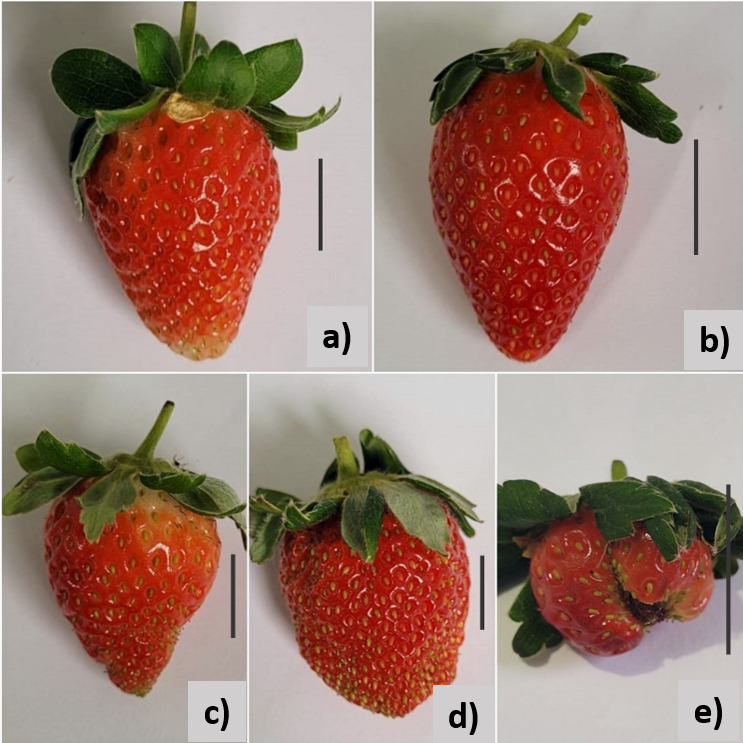
The quantity of fruits formed in the different treatments evaluated did not differ (χ2= 4.71ns), however, there were differences in the visual quality of the fruit in its complete formation (Figure 1). Fruits with natural pollination and density were considered without any deformation (0%). While the fruits obtained from manual cross-pollination and anemophily treatments presented 8.33% of fruits, showing slight deformation, and the fruits that were self-pollinated had 100% of malformed fruits.
Fruits of the strawberry cultivar ‘San andreas’, obtained through different pollination mechanisms: a) Natural Pollination (NP), b) Natural Pollination with Bee Density (NPDB), c) Manual Cross Pollination (MCP), d) Pollination by anemophily (PA) and e) Self-pollination (SP). Barra do Choça - BA. Scale bars = 12.2 mm.
Natural pollination and pollination with bee density provided fruits with higher average weights (18.49 g and 21.71 g, respectively), while self-pollination had a lower average than the others (1.91 g) (Table I). For the length and diameter variables, treatments with different pollination mechanisms did not differ from each other (averages of 36.60 mm and 29.49 mm, respectively), except for self-pollination, which obtained lower values.
Physical analysis (weight, length, diameter, and color: chroma (C*), color difference (ΔE), and Hue° angle (°H) of strawberry fruits cv. ‘San andreas’, resulting from Natural Pollination (NP), Natural Pollination with Bee Density (NPDB), Manual Cross Pollination (MCP), Pollination by anemophily (PA) and Self-pollination (SP) the municipality of Barra do Choça - BA.
The color of the fruits indicated that the chroma (C*), which represents the purity of the color, was 40.27 to 48.06 in the cross-pollinated treatments (NP, NPDB, MCP and, PA), as these are darker (reddish) when compared to the self-pollination treatment, which was the least chromatic, with 11.06. There was an increase in the color difference (ΔE) and the color tone at the Hue° angle (°H) in self-pollination, while the other treatments did not differ from each other.
About the chemical characteristics of the fruit pulp, the pH did not differ between treatments (Table II), while the °Brix (Total Soluble Solids - TSS) presented the highest value of Soluble Solids pollination with densification, followed by the natural pollination treatment. On the other hand, self-pollination had the lowest °Brix content and presented a high total titratable acidity (TTA). The other treatments did not differ in terms of acidity, but the lowest values were obtained in fruits subjected to natural pollination and with density of bees.
Chemical analysis (pH, ATT, °Brix, Ratio, Vit. C) of strawberry fruits cv. ‘San andreas’, resulting from Natural Pollination (NP), Natural Pollination with Bee Density (NPDB), Manual Cross Pollination (MCP), Pollination by anemophily (PA) and Self pollination (SP). Barra do Choça – BA.
The TSS/TTA (ratio) was higher in the treatment with natural pollination with density of bees, on the other hand, the lowest relationship occurred for the treatment with self-pollination.
The highest averages of vitamin C were found in fruits from bee pollination, presenting significant values, while the lowest values occurred in self-pollination.
DISCUSSION
The highest average weight and better quality were observed in fruits that obtained pollination with the density of bees and natural pollination. The same result was found in other studies, such as that by Witter et al. (2012), who obtained fruits with a mass greater than the self-pollination treatment, from pollination carried out by the bee Plebeia nigriceps and natural pollination in the Aromas and Diamante cultivar. Studies show that strawberries pollinated by bees are heavier (Malagodi-Braga & Kleinert 2004, Antunes et al. 2007), probably because a greater proportion of flower ovules pollinated by bees are fertilized, resulting in larger, well-formed fruits. Roselino et al. (2009) also found the effect of flower visitation by bees on the fresh matter mass of fruits. Flowers visited, fresh mass increased and, therefore, it is suggested that the development of the receptacle was also greater.
For fruit diameter and length, it was found that flowers that had access to external pollination agents, whether floral visitors or the wind, had fruits with a larger size (diameter and length), in relation to fruits originating from spontaneous self-pollination. Strawberry is classified as a crop that presents moderate degrees of dependence on cross-pollination (Giannini et al. 2015). This degree of dependence was defined as the average degree of the different cultivars, as some are more dependent and those that are less dependent on cross-pollination.
The diameter of strawberry fruits is an important aspect in commercial classification, according to the Brazilian Program for the Modernization of Horticulture (PBMH) & Integrated Strawberry Production (PIMO) (PBMH & PIMO 2009). The two main classes are 15 and 35, with class 15 being the one that contains fruits measuring 15 to 35 mm; and class 35, which has high-quality fruits with a diameter above 35 mm. Therefore, the results obtained in this research show that only the fruits resulting from self-pollination would not be grouped in class 15, that is, unsuitable for commercialization in nature. The fruits harvested as a result of the other treatments were within the parameters established by the Classification Standard for commercialization.
In the present study, treatments with the exception of self-pollination showed brighter colors, noting that cross-pollination provides greater chromaticity to the fruits. Possibly because these treatments had a greater quantity of fertilized eggs, which may have guaranteed uniform and complete ripening of the fruits.
Self-pollination presented a value of ∆E 70.84, differentiating itself from the other treatments, which obtained lower values. Given this, it is possible to maintain that fruits arising from spontaneous self-pollination vary in color and may affect their market value.
The Hue Angle (H°) is represented by an angle from 0° to 360° degrees and through this the red color of the strawberry is characterized, being an important indication of the shade of the red color. Results with a lower value indicate that the color is closer to red, while results with a higher value indicate that the color is closer to green (Ferreira & Spricigo 2017). The fruits evaluated in all treatments presented coloration within the angles of 0° to 90°, a range that characterizes the typical red hue of ripe and attractive fruits. This pattern was especially evident in treatments that used cross-pollination mechanisms, whose fruits were evaluated at 30°, resulting in a more intense red intensity. This more vivid coloration is an important characteristic, as it is associated with a higher nutritional value of the fruit. Furthermore, according to Klatt et al. (2014), strawberries pollinated by bees present a more intense red, greater firmness and greater durability.
In chemical analyses, the determination of pH is an important parameter for the final destination of the fruits, which can vary between 2.44 (Cecatto et al. 2013) and 3.73 (Souza et al. 2014), results that were obtained in the present study. However, strawberries with a more acidic pH (< 3.0) are recommended for industry, as they are not well accepted sensorially for fresh consumption (Oliveira et al. 2015). This characteristic was only observed in self-pollination, indicating that the fruit may be considered inappropriate for fresh consumption.
The total soluble solids content (°Brix) can be an indicator of the degree of maturity of the strawberry, which can influence the flavor of the fruit (Yan et al. 2020). According to the Brazilian Program for the Modernization of Horticulture – PBMH, an immature fruit is classified as a serious defect, being defined by the minimum content of soluble solids, in degrees °Brix, that each fruit must have. According to Kader (1992), fresh strawberries have a total soluble solids content between 4.1 and 11.9 °Brix, depending on the cultivar and pre-harvest factors. These levels tend to increase as the fruits mature and vary depending on the cultivar and the climate. High levels of soluble solids are desirable, both for fresh consumption and for processing. Our results indicate that management with bee density can improve °Brix levels in crops with poor pollination due to a lack of pollinators, presenting tastier fruits with higher sugar content, due to the fertilization of a significant amount of the ovules presente in the flowers.
Total titratable acidity (TTA) indicates the amount of organic acids present in fruits which, in balance with sugar content, represent an important quality attribute. Many of these acids are volatile, thus contributing to the characteristic aroma of fruits (Kluge et al. 2002). For Camargo et al. (2011), commercially, the minimum soluble solids content is 7.0% and the maximum titratable acidity is 0.8%, constituents of sweetness and acidity.
The TSS/TTA ratio provides a good assessment of fruit flavor, being more representative than the isolated measurement of sugars and acidity. Fruits managed with natural pollination and high bee density are ideal for fresh consumption. According to Lima et al. (2002), fruits intended for this purpose must present TSS/TTA ratio values above 8%, since the fresh fruit market values those with a higher concentration of total soluble solids (TSS) and lower titratable acidity (TTA) (Figueiredo et al. 2015).
One of the most relevant nutritional aspects of the fruit is its high vitamin C content and the results verified for this content in the present research present values lower than those observed in the literature (5 to 24 mg 100g-¹). In the literature, relative data for ascorbic acid ranges from 39 to 89 mg 100g-¹ of pulp, with the average value, for strawberries, being 60 mg 100g-¹ of fruit (Cordeiro et al. 2019).
Several authors state that strawberries have a high content of ascorbic acid (Antunes et al. 2014, Maksimović et al. 2015, Hossain et al. 2016, Hernández et al. 2017), but depending on the cultivar, time of year, location and form of cultivation, this content may differ (Souza et al. 2020). Divergences in vitamin C content (26.46 mg 100 g-1 to 37.77 mg 100 g-1) were described by Hossain et al. (2016) between different strawberry genotypes. While Souza et al. (2014), when cultivating strawberries in a subtropical region of Minas Gerais, observed a significant content of ascorbic acid (90.13 mg 100 g⁻¹). This result may be associated with the low average temperature recorded in the study, 21°C. According to Antunes et al. ( 2014), climatic conditions influence the stability of vitamin C, which is highly sensitive to high temperatures. However, in the present study, the duration during the summer, with average temperatures of 28°C, is likely to have occurred greater oxidation of the vitamin.
Strawberries are frequently reported as one of the crops with unauthorized pesticide residues or above the maximum residue limit. Considering the importance of bees for this crop, it is essential to promote agricultural practices that minimize the use of chemical pesticides, seeking more sustainable alternatives that are less harmful to the health of pollinators. Proper management can not only protect bees, but also improve fruit quality, contributing to food security and environmental preservation.
CONCLUSIONS
Although the number of fruits produced in each treatment suggests that there is no pollination deficit in the scientific area, other parameters, such as fresh weight, Brix, TSS/TTA ratio and vitamin C content, indicate that the evaluation of pollen flow goes beyond the simple quantity of fruits. These data suggest that problems related to pollination can affect fruit quality, even when the production is guaranteed. Therefore, it is essential to consider multiple performance indicators to identify possible pollination deficits and adopt strategies to improve them.
References
- ABROL DP, GORKA AK, ANSARI MJ, AL-GHAMDI A & ALKAHTANI S. 2017. Impact of insect pollinators on yield and fruit quality of strawberry. Saudi J Biol Sci 24: 1-7.
- ANTUNES MC, CUQUEL FL, ZAWADNEAK MAC, MOGOR ÁF & RESENDE JTV. 2014. Postharvest quality of strawberry produced during two consecutive seasons. Hortic Bras 32(2): 168-173.
- ANTUNES OT, CALVETE EO, ROCHA HC, NIENOW AA, CECCHETTI D, RIVA E & MARAN RE. 2007. Production of strawberry cultivars pollinated by the jataí bee in a protected environment. Hortic Bras 25(1): 94-99.
- BOONYAKIAT D, CHUAMUANGPHAN C, MANIWARA P & SEEHANAM P. 2016. Comparison of physico-chemical quality of different strawberry cultivars at three maturity stages. Int Food Res J 23(6): 2405-2412.
- CAMARGO LKP, RESENDE JTV, TOMINAGA TT, KURCHAIDT SM, CAMARGO CK & FIGUEIREDO AST. 2011. Postharvest quality of strawberry fruits produced in organic and conventional systems. Hortic Bras 29: 577-583.
- CECATTO AP, CALVETE EO, NIENOW AA, COSTA RC, MENDONÇA HFC & PAZZINATO AC. 2013. Culture systems in the production and quality of strawberry cultivars. Acta Sci Agron 35(4): 471-478.
-
CITY HALL OF BARRA DO CHOÇA. 2020. Available at: http://barradochoca.com.br/home/pagina/post Accessed on October 11, 2023.
» http://barradochoca.com.br/home/pagina/post - CORDEIRO ECN, RESENDE JTV, CÓRDOVA KRV, NASCIMENTO DA, SAGGIN JÚNIOR OJ, ZEIST AR & FAVARO R. 2019. Arbuscular mycorrhizal fungi action on the quality of strawberry fruits. Hortic Bras 37(4): 437-444.
- FAGHERAZZI AF, ZANIN DS, SANTOS MFS, LIMA JM, WELTER PD, RICHTER AF, NERBASS FR, KRETZSCHMAR AA, RUFATO L & BARUZZI G. 2021. Initial crown diameter influences on the fruit yield and quality of strawberry pircinque. Agronomy 11(1): 184.
- FERREIRA MD & SPRICIGO PC. 2017. Colorimetry: Principles and applications in agriculture. In: Instrumentation in fruits and vegetables, 1st ed., São Carlos: Embrapa Instrumentation, p. 209-220.
- FIGUEIREDO FRA, HAFLE OM, RODRIGUES MHBS, PEREIRA JÚNIOR EB & DELFINO FI. 2015. Productivity and quality of yellow passion fruit fruits under different plant management methods. J Sci Agric in the Semi-Arid 11(4): 23-32.
- GANSER D, MAYR B, ALBRECHT M & KNOP E. 2018. Wildflower strips enhance pollination in adjacent strawberry crops at the small scale. Ecol Evol 8(23): 11775-11784.
- GIANNINI TC, CORDEIRO GD, FREITAS BM, SARAIVA AM & IMPERATRIZ-FONSECA VL. 2015. The dependence of crops for pollinators and the economic value of pollination in Brazil. J Econ Entomol Adv 108: 839-848.
- HERNÁNDEZ JMV, CARDOSO GM, EAPINOZA JAM, HINOJOSA CV, SÁNCHEZ FDL, CABRERA FR, TEJACAL IA & FLORES LJP. 2017. Antioxidant Capacity In vitro and In vivo of Various Ecotypes of Mexican Plum (Spondias purpurea L.). J Food Sci 82(11): 2576-2582.
- HOSSAIN A, BEGUM P, ZANNAT MS, RAHMAN MH, AHSAN M & ISLAM SN. 2016. Nutrient composition of strawberry genotypes cultivated in a horticulture farm. Food Chem 199(1): 648-652.
- KADER AA. 1992. Postharvest technology of horticultural crops. 2nd ed., Oakland Ca: University of Califórnia.
- KLATT BK, HOLZSCHUH A, WESTPHAL C, CLOUGH Y, SMIT I, PAWELZIK E & TSCHARNTKE T. 2014. Bee pollination improves crop quality, shelf life and comercial value. Proc R Soc B 281: 1775.
- KLUGE RA ET AL. 2002. Physiology and post-harvest management of temperate fruits. Rural Bookstore and Publisher. 2nd ed., Campinas, 214 p.
- KOTTEK M, GRIESER J, BECK C, RUDOLF B & RUBEL F. 2006. World map of the Köppen-Geiger climate classification updated. Meteorol Z 15(3): 259-263.
- LIMA EDPA, LIMA CAA, ALDRIGUE ML & GONDIM PS. 2002. Physical and chemical characterization of the fruits of the umbu-cajazeira (Spondias sp.) at five stages of maturation, pulp and nectar. Braz Fruit Grow Maga 24(2): 338-343.
- MAKSIMOVIĆ JD, POLEDICA M, MUTAVDŽIĆ D, MOJOVIĆ M, RADIVOJEVIĆ D & MILIVOJEVIĆ J. 2015. Variation in Nutritional Quality and Chemical Composition of Fresh Strawberry Fruit: Combined Effect of Cultivar and Storage. Plant Foods for Hum Nutri 70(1): 77-84.
- MALAGODI-BRAGA KS. 2018. Pollination as a production factor in strawberry cultivation. Technical Communication 56, Jaguariúna, AP: Embrapa Meio Ambiente.
- MALAGODI-BRAGA KS & KLEINERT AMP. 2004. Could Tetragonisca angustula Latreille (Apinae, Meliponini) be effective as strawberry pollinator in greenhouses? Aust J Agric Res 55: 771-773.
- MALAGODI-BRAGA KS & KLEINERT AMP. 2007. How does the behavior of bees in the strawberry flower (Fragaria x ananassa Duchesne) influence fruit formation? Biosci J 23(1): 76-81.
- MCGUIRRE RG. 1992. Reporting of objective color measurements. Hort Sci 17(12): 1254-1255.
- OLIVEIRA A, GOMES MH, ALEXANDRE EMC, POÇAS F, ALMEIDA DPF & PINTADO M. 2015. Phytochemicals preservation in strawberry as affected by pH modulation. Food Chem 170(1): 74-83.
- PAPAROZZI ET, MEYER GE, SCHLEGEL V, BLANKENSHIP EE, ADAMS AS, CONLEY ME, LOSEKE B & READ PE. 2018. Strawberry cultivars vary in productivity, sugars and phytonutrient content when grown in a greenhouse during the winter. Hortic Sci 227(1): 1-9.
- PASSOS FA, TRANI PE & CARVALHO CRL. 2015. Agronomic performance of strawberry genotypes. Hortic Bras 33(2): 261-271.
- PBMH & PIMO. 2009. Brazilian Program for the Modernization of Horticulture & Integrated Strawberry Production. Strawberry Grading Standards. São Paulo: CEAGEAP (Documents 33).
- PINHEIRO PO, ALMAHAIRI A, BENMALEK R, GOLEMO F & COURVILLE AC. 2020. Unsupervised learning of dense visual representations. Adv in Neu Inf Proc Sys 33: 4489-4500.
- ROSELINO AC, SANTOS SB, HRNCIR M & BEGO LR. 2009. Differences between the quality of strawberries (Fragaria x ananassa) pollinated by the stingless bees Scaptotrigona aff. depilis and Nannotrigona testaceicornis. GMR 8(2): 539-545.
- ŠAMEC D, MARETIĆ M, LUGARIĆ I, MEŠIĆ A, SALOPEK-SONDI B & DURALIJA B. 2016. Assessment of the differences in the physical, chemical and phytochemical properties of four strawberry cultivars using principal component analysis. Food Chem 194(1): 828-834.
- SANTOS HG. 2013. Brazilian system of soil classification. Revised and Expanded, 3rd ed., Embrapa, Brasília, Brazil, 353 p.
- SCHEID L, MARTARELLO NS, HOLDEFER DR & GRUCHOWSKI-WOITOWICZ FC. 2020. Efficacy of bees as pollinators of strawberry plants (Fragaria x ananassa Duch., cultivar San Andreas) in southern Brazil. Light 22(2): 6-17.
- SOUZA ICC, CARVALHO ACB, SILVA-NETO JMD, FERNANDES JPC, ROCHA-JUNIOR JD, ARAÚJO FMMC & MELO RLF. 2020. Physicochemical characterization of tropical fruits from Northeastern Brazil. Res Soc Dev 9(6): 125963562.
- SOUZA VR, PEREIRA PAP, SILVA TLT, LIMA LCO, PIO R & QUEIROZ F. 2014. Determination of the bioactive compounds, antioxidant activity and chemical composition of Brazilian blackberry, red raspberry, strawberry, blueberry and sweet cherry fruits. Food Chem 156(1): 362-368.
- STROHECKER RL & HENNING HM. 1967. Vitamin analysis: proven methods. Madrid: Paz Montalvo, 428 p.
- WITTER S, NUNES-SILVA P & BLOCHTEIN B. 2014. Bees in Canola Pollination: environmental and economic benefits, Porto Alegre, 71 p.
- WITTER S, RADIN B, LISBOA BB, TEIXEIRA JSG, BLOCHTEIN B & IMPERATRIZ-FONSECA VL. 2012. Performance of strawberry cultivars subjected to different types of pollination in protected cultivation. Braz Agric Res 47(1): 58-75.
- YAN Y, DUAN S, ZHANG H, LIU Y, LI C, HU B, LIU A, WU D, HE J & WU W. 2020. Preparation and characterization of Konjac glucomannan and pullulan composite films for strawberry preservation. Carbohydr Polym 243: 116446.