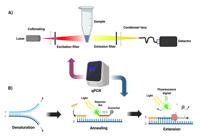
| Volumetric, Microfluidic Plasmonic RT-PCR |
|
|
X |
|
X |
|
X |
|
|
10e3 copies/mL |
SARS-CoV-2 |
Present a volumetric microfluidic plasmonic RT‑PCR system that exploits plasmon-induced heating to dramatically speed up thermal cycling and enhance nucleic acid detection sensitivity |
Chellani et al. (2025) |
| Stick-and-test tape-based devices |
X |
|
|
X |
|
|
X |
|
|
10 copies/μL |
SARS-CoV-2 |
Report a tape-based diagnostic platform that integrates simple sample processing with isothermal amplification to enable rapid, low-cost SARS‑CoV‑2 detection at the point of care |
Estrela et al. (2025) |
| Single-layer radially compartmentalized paper chip for rapid isothermal multiplex detection |
|
X |
|
|
X |
|
|
X |
|
10 copies/µL |
SARS-CoV-2 |
Propose a single‑layer, radially compartmentalized paper chip (RCP‑Chip) that enables rapid, isothermal multiplex detection of SARS‑CoV‑2 gene targets in a low‑cost, user‑friendly format |
Sukumar et al. (2025) |
| Deep learning-enhanced hand-driven spatial encoding microfluidics |
X |
|
|
|
X |
|
|
X |
|
5 × 10e11 M for HPV 6/16/18 and 1 × 10e10 M for HPV 11 |
HPV |
Combine deep learning with a hand‑driven spatial encoding microfluidic platform to enable at-home, multiplexed molecular testing with enhanced diagnostic accuracy |
Zhang et al. (2025) |
| Microfluidic LAMP and real-time fluorescence assay |
|
|
X |
|
X |
|
X |
|
|
10e3 to 10e4 copies/mL |
Influenza A(H1N1), Mycoplasma pneumoniae, respiratory syncytial virus type A, and SARS-CoV-2 |
Demonstrate a portable microfluidic device that couples loop‑mediated isothermal amplification with real‑time fluorescence to simultaneously detect four respiratory pathogens in a compact format |
Liu et al. (2024a) |
| Microchip-based device using sandblasting technique |
|
|
X |
|
X |
|
X |
|
|
500 copies/mL |
SARS-CoV-2 |
Introduce a cost-effective microchip fabricated via sandblasting that achieves real‑time multiplex PCR detection with high sensitivity and rapid turnaround |
Liu et al. (2024c) |
| Droplet digital molecular beacon-LAMP assay via pico-injection for ultrasensitive detection of pathogens |
|
X |
|
|
|
X |
X |
|
|
9 copies/μL in a model plasmid containing the malB gene and 3 CFU/μL in a spiked milk sample. |
Escherichia coli
|
Introduce a droplet digital molecular beacon‑LAMP assay via pico‑injection that achieves ultrasensitive, quantitative detection of pathogens within a microfluidic format |
Ma et al. (2024) |
| Rapid, multiplex and automated detection of bacteria and fungi in endophthalmitis via a microfluidic real-time PCRsystem |
|
|
X |
|
X |
|
X |
|
|
500 copies/mL |
17 common pathogens of endophthalmitis |
Design a microfluidic realtime PCR system that automates sample processing and amplification for the rapid, multiplexed detection of bacteria and fungi in cases of endophthalmitis |
Wang et al. (2024) |
| Fully integrated and automated centrifugal microfluidic chip for point-of-care multiplexed molecular diagnostics |
|
X |
|
|
X |
|
X |
|
|
40 Salmonella or 25 Escherichia coli |
Escherichia coli and Salmonella
|
Report a fully integrated, automated centrifugal microfluidic chip that simplifies point‑of‑care multiplexed molecular diagnostics by streamlining sample handling, amplification, and detection |
Xiao et al. (2024) |
| Molecular diagnostic platform that integrates a fabless plasmonic nano-surface into an autonomous microfluidic cartridge |
X |
|
|
|
X |
|
|
X |
|
5 RNA copies/μL in saliva |
SARS-CoV-2 |
Develop the QolorEX platform, which integrates nanoplasmonic amplification into a microfluidic cartridge to accelerate colorimetric quantification of nucleic acid biomarkers from pathogens within minutes |
AbdElFatah et al. (2023) |
| Integrated dual-layer microfluidic platform |
|
X |
|
|
X |
|
X |
|
|
10 copies |
SARS-CoV-2, influenza viruses A (FluA) H1N1, H3N2, and influenza virus B (FluB) |
Develop an integrated duallayer microfluidic platform that combines sequential amplification and CRISPR/Cas12a-based detection for multiplexed screening of respiratory viruses in a single device |
Wang et al. (2023) |
| Ultrafast PCR detection of COVID-19 by using a microfluidic chip-based system |
|
|
X |
|
X |
|
X |
|
|
500 copies/mL |
SARS-CoV-2 |
Present an ultrafast microfluidic chipbased PCR system that markedly reduces assay times and reagent consumption for rapid COVID19 detection |
Chen et al. (2022) |
| Manually-operated, slider cassette for multiplexed molecular detection at the point of care |
|
X |
|
|
X |
|
X |
X |
|
30 to 300,000 IU HBV |
Hepatitis B virus (HBV) |
Develop a manually operated slider cassette that integrates sample lysis, nucleic acid extraction, and isothermal amplification to deliver rapid, multiplexed point-of-care molecular detection |
Seok et al. (2022) |
| Rapid molecular diagnosis of live Mycobacterium tuberculosis on an integrated microfluidic system |
|
|
X |
|
X |
|
X |
|
|
100 cfu |
live M. tuberculosis |
Design an integrated microfluidic system for the rapid molecular diagnosis of live Mycobacterium tuberculosis that consolidates sample processing with sensitive amplification in a compact platform |
Wang et al. (2022) |
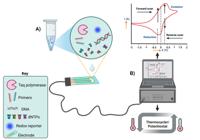
| Integrated pumpless microfluidic chip for pathogens detection by PCR and electrochemical analysis |
|
|
|
X |
X |
|
|
|
X |
10e2 CFU |
E. coli O157:H7, S. enteritidis, and B. cereus
|
Describes a pumpless microfluidic chip that integrates PCR modules, manual fluid handling, and electrochemical analysis, offering a portable, low-cost, and highly sensitive solution for the rapid detection of foodborne pathogens, representing a substantial improvement in analytical testing for food safety |
Park et al. (2021) |
| Stretch-driven microfluidic chip for nucleic acid detection |
|
X |
|
X |
X |
|
|
X |
|
NM |
SARS-CoV-2 |
Describe a stretch-driven microfluidic chip that uses mechanical actuation to precisely control fluid dynamics, thereby enabling rapid and sensitive nucleic acid detection |
Li et al. (2021) |

 Molecular assays and point-of-care tools: a review of amplification methods and nucleic acid detection systems
 Thumbnail
 Thumbnail
 Thumbnail
 Thumbnail
 Thumbnail
 Thumbnail
 Thumbnail


