
 Assessing metal tolerance genes in enterococci isolated from animals in South Brazil
Abstract
Heavy metal pollution is a global environmental problem. Enterococci have been recognized as sentinels of environmental pollution.This study investigates metal tolerance genes (arsA, merA, and tcrB) among enterococci isolated from fecal samples of domestic and wild animals from Atlantic Forest, Pampa biomes, and coastal regions of southern Brazil. Among the 238 enterococci analyzed, 38% harbored arsA_I/arsA_II and 10% contained tcrB, while none tested positive for merA genes. These results suggest that the selective pressure exerted by anthropogenic activities in the animals’ habitats may contribute to the occurrence of heavy metal tolerance genes in host-associated enterococci.
Key words
bacteria; metal tolerance genes; environmental contamination; anthropogenic impacts; animals
INTRODUCTION
The Brazilian ecosystems have faced significant challenges in recent decades. Among these challenges, heavy metal (HM) pollution has emerged as a significant problem in the Amazon, Atlantic Forest, and Pampa biomes, as well as in coastal regions and large cities. In southern Brazil, multiple anthropogenic activities, such as pesticide use, mining, industrial activities, and urbanization, are the major sources of HM pollution. As a result, some human and animal populations have shown high levels of HM (Ellwanger & Chies 2023).
Monitoring environmental pollution is an important issue addressed by One Health. Recently, Rebelo et al. (2021) proposed that enterococci, Gram-positive bacteria found in the animal gut microbiota, could serve as bioindicators of HM pollution influenced by anthropogenic activities. In this perspective, we sought to investigate the distribution of metal tolerance genes (arsA for arsenic, merA for mercury, and tcrB for copper) among Enterococcus strains isolated from domestic and wild animals from the Atlantic Forest and Pampa biomes, as well as coastal regions in southern Brazil. Additionally, we aimed to explore the potential connections between these metal tolerance genes and anthropogenic activities in animal habitats.
To assess the distribution of arsA, merA and tcrB genes among enterococci, we selected 238 Enterococcus spp. isolates, including 133 E. faecalis, 44 E. hirae, 22 E. faecium, 14 E. casseliflavus, five E. durans, two E. mundtii, one E. raffinosus, one E. gallinarum, one E. avium, and 15 Enterococcus spp. These strains were isolated from fecal samples of domestic (broilers, n = 59) and wild animals (Capuchin monkeys, n =72; fur seals, n = 34; sea turtles, n = 24; Brazilian free-tailed bats, n = 17; Geoffroy’s cats, n = 8; Pampas foxes, n = 12; and Magellanic penguins, n = 12) between 2011 and 2020 from different geographic areas of the southern Brazil (Figure 1). These strains were isolated, tested for antimicrobial susceptibility profiles and for the presence of antibiotic resistance genes (tetM, tetL, ermB and msrC) in our previous works (Cassenego et al. 2011, Santestevan et al. 2015, Prichula et al. 2016, Grassotti et al. 2018, Costa et al. 2019, Oliveira et al. 2020). All previous studies were conducted in accordance with the regulations of the Ethics Committees at the Federal University of Rio Grande do Sul.
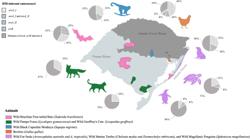
Distribution of heavy metal tolerance genes, arsA (arsenic), merA (mercury), and tcrB (copper), in Enterococcus isolated from fecal samples of domestic animals (broilers) and wild animals (Capuchin monkeys, fur seals, sea turtles, Brazilian free tailed bats, Geoffroy’s cats, Pampas foxes, and Magellanic penguins) collected across three regions in southern Brazil: the Atlantic Forest biome (Iron), the Pampa biome (Gray), and coastal areas (Purple).
The presence of the arsA_I, arsA_II, tcrB, merA_III, merA_V, and merA_VI genes was determined by PCR, as described by Rebelo et al. (2021). Fisher’s exact and chi-square tests were performed to evaluate the associations between the occurrence of heavy metal tolerance genes and antimicrobial resistance. Differences were considered significant at p < 0.05.
According to our results, of the 238 enterococci strains tested for the presence of heavy metal tolerance genes, 79 strains (33%) were positive for arsA_I gene, 1 (0.4%) for the arsA_II gene, 11 (5%) for the arsA_I + arsA_II genes, and 23 (10%) for the tcrB gene. None of the strains were positive for merA_III, merA_V, or merA_VI genes. This finding is consistent with Rebelo et al. (2021), who showed the presence of these genes in enterococci collected from diverse epidemiological backgrounds, such as humans, food animal production setting and foodstuffs of animal/vegetable origin, and aquatic environment in Portugal and linked the occurrence of arsA and tcrB genes in the strains with the selective pressure due to arsenic and copper exposure, respectively. Moreover, we recently detected ars and tcrB genes in Enterococcus spp. isolated from seabird cloacal samples, where individuals showed heavy metal accumulation in blood and feathers, further supporting the potential of these bacteria as bioindicators of environmental pollution (Mocellin et al. 2024).
Among strains isolated from wild animals, the arsA_I/arsA_II genes were detected in high frequency in Brazilian free-tailed bats (58%; n=10/17), followed by Pampas foxes (33%; n=4/12), Capuchin monkeys (33%; n=24/72), fur seals (32%; n=11/34), Geoffroy’s cats (25%; n=2/8), sea turtles (21%; n=5/24), and Magellanic penguins (8%; n=1/12). The tcrB gene was found in fur seals (18%, n=6/34), Capuchin monkeys (14%; 10/72), Magellanic penguins (8%; n=1/12), and sea turtles (4%; n=1/24) (Figure 1). Consistent with the literature, the presence of heavy metal tolerance genes in strains collected from Capuchin monkeys in the Atlantic Forest biome, as well as Brazilian free-tailed bats, Pampas foxes, and Geoffroy’s cats in the Pampa biome, indicates potential anthropogenic pollution in their habitats. These animals inhabit highly productive livestock and agricultural regions of Rio Grande do Sul, where extensive use of pesticide and antibiotic might contribute to environmental contamination (Portella et al. 2023, Ziliotto et al. 2023). About marine animals, strains carrying the arsA and tcrB genes may be associated with contamination in Brazilian coastal waters (Ellwanger & Chies 2023, Mocellin et al. 2024). Furthermore, our previous studies indicate that anthropogenic activities, such as livestock farming, agricultural practices, urban effluent discharge, and direct or indirect contact with humans, contribute to the occurrence of antibiotic-resistant enterococci in the gut microbial communities of these animals (Cassenego et al. 2011, Santestevan et al. 2015, Prichula et al. 2016, Grassotti et al. 2018, Costa et al. 2019, Oliveira et al. 2020).
Regarding the enterococci isolated from domestic animals, 38 strains (64%) from cloacal samples of broilers were positive for heavy metal tolerance genes: 27 (46%) for arsA_I, 1 (2%) for arsA_II, 6 (10%) for arsA_I + arsA_II and 5 (8%) for tcrB (Figure 1). The occurrence of heavy metal tolerance genes in strains collected from broilers may be associated with their diets. The high frequency of arsenic-tolerance genes in these strains may be related to the selective pressure caused by the use of arsenic-derived compounds, commonly used as feed additives, in the poultry industry. Although the use of organoarsenic compounds, such as roxarsone, is banned in some countries due to their roles in promoting animal growth, controlling coccidiosis, improving meat pigmentation and serving as antiparasitics, these compounds are still used in Brazil (Baloš et al. 2019).
The absence of merA_III, merA_V, or merA_VI genes in the strains is consistent with Rebelo et al. (2021), who also reported a low frequency of MerA III, V and VI proteins in phylogenetic study of heavy metal tolerance proteins in Enterococcus spp. genomes isolated from animals. Furthermore, mercury contamination is relatively lower in southern Brazil than in other regions, such as the Amazon (Ellwanger & Chies 2023).
A significant association was found between the antibiotic resistance genes (tetM; p=0.008 and msrC; p=0.028) and the arsenic tolerance gene (arsA_I). Such associations suggest that these determinants may be co-located on plasmids or other mobile genetic elements, as previously reported (Hammerum et al. 2010, Rebelo et al. 2021). This facilitates co-selection and the simultaneous dissemination of resistance to both antibiotics and toxic metals, ultimately promoting bacterial persistence in contaminated environments.
In conclusion, our study identified heavy metal tolerance genes in Enterococcus spp. isolated from fecal samples of both wild and domestic animals in southern Brazil. The occurrence of these genes suggests that enterococci are facing selective pressures due to anthropogenic activities present in the environments inhabited by these animals.
Acknowledgements
We thank the Conselho Nacional de Desenvolvimento Científico e Tecnológico do Brasil (CNPq) and Coordenação de Aperfeiçoamento de Pessoal de Nível Superior (CAPES) of the Brazilian Government and the Federal University of Rio Grande do Sul, Porto Alegre, Brazil.
References
- BALOŠ MŽ, JAKŠIĆ S & PELIĆ DL. 2019. The role, importance and toxicity of arsenic in poultry nutrition. Worlds Poult Sci J 75: 375-386.
- CASSENEGO APV, D’AZEVEDO PA, RIBEIRO AML, FRAZZON J, VAN DER SAND ST & FRAZZON APG. 2011. Species distribution and antimicrobial susceptibility of enterococci isolated from broilers infected experimentally with Eimeria spp. and fed diets containing different supplements. Braz J Microbiol 42: 480-488.
- COSTA LDFX, GRASSOTTI TT, CANANI CR, LIRA AD, MOURA TMD, CAMPOS AAS, FRAZZON J & FRAZZON APG. 2019. Diversidade, perfis de resistência e virulência de Enterococcus spp. em fezes de morcegos urbanos Tadarida brasiliensis (Brazilian free-tailed bats). R Bras Bioci 17: 43-52.
- ELLWANGER JH & CHIES JAB. 2023. Brazil’s heavy metal pollution harms humans and ecosystems. Sci One Health 2: 100019.
- GRASSOTTI TT, ZVOBODA D, COSTA LFX, ARAÚJO AJG, PEREIRA RI, SOARES RO, WAGNER PGC, FRAZZON J & FRAZZON APG. 2018. Antimicrobial resistance profiles in Enterococcus spp. isolates from fecal samples of wild and captive Black Capuchin monkeys (Sapajus nigritus) in South Brazil. Front Microbiol 9: 2366.
- HAMMERUM AM, LESTER CH & HEUER OE. 2010. Antimicrobial-resistant enterococci in animals and meat: a human health hazard? Foodborne Pathog Dis 7: 1137-1146.
- MOCELLIN RR, TOIGO AL, DOS SANTOS CC, FRAZZON J, NUNES GT, BUGONI L, PRICHULA J & FRAZZON APG. 2024. Metal tolerance in enterococci isolated from seabirds in Abrolhos Archipelago, Brazil: Evaluating their role as bioindicators of marine pollution. Mar Pollut Bull 207: 116866.
- OLIVEIRA AG, HUFF R, FAVARINI MO, MANN MB, PETERS FB, FRAZZON J & FRAZZON APG. 2020. Multidrug resistance in enterococci isolated from wild pampas foxes (Lycalopex gymnocercus) and Geoffroy’s cats (Leopardus geoffroyi) in the Brazilian Pampa Biome. Front Vet Sci 7: 606377.
- PORTELLA DN, FARIA EC, HENNEQUIN IS, SANTOS JT, ALVES JC & GALEB LAG. 2023. Impactos causados no meio ambiente por resíduos antimicrobianos de uso veterinário. Braz J Anim Environ Res 6: 3708-3722.
- PRICHULA J ET AL. 2016. Resistance to antimicrobial agents among enterococci isolated from fecal samples of wild marine species in the southern coast of Brazil. Mar Pollut Bull 105: 51-57.
- REBELO A ET AL. 2021. The diversity of metal and antibiotic resistance genes in Enterococcus spp. from the last century reflects multiple sources of pollution and genetic exchange among phyla from overlapping ecosystems. Sci Total Environ 787: 147548.
- SANTESTEVAN NA ET AL. 2015. Antimicrobial resistance and virulence factor gene profiles of Enterococcus spp. isolates from wild Arctocephalus australis (South American fur seal) and Arctocephalus tropicalis (Subantarctic fur seal). World J Microbiol Biotechnol 31: 1935-1946.
- ZILIOTTO M, KULMANN-LEAL B, ROITMAN A, CHIES JAB & ELLWANGER JH. 2023. Pesticide pollution in the Brazilian Pampa: Detrimental impacts on ecosystems and human health in a neglected biome. Pollutants 3: 280-292.
Edited by
-
Handling editor
Mirco Solé
Data will be made available upon reasonable request.

