
 Macrofungi with Potential for Bioremediation of the Herbicide Atrazine
Abstract
Atrazine is used widely corn cultivation, providing as an effective and low-cost control of broadleaf and grassy weeds. However, this herbicide exhibits high persistence in the soil and can potentially interfere with the photosynthesis of non-target plants. Scientific literature has demonstrated that macrofungi offer several advantages for use in the bioremediation of environmental contaminants, mainly due to their ability to withstand stressful conditions and produce extracellular enzymes with low specificity that may be involved in the biodegradation process. This study evaluated the ability of macrofungal species to tolerate the herbicide atrazine and produce laccase, an enzyme capable of degrading xenobiotics. To achieve this, tolerance assays of fungi to atrazine were performed to assess growth rate and mycelial growth inhibition, as well as analysis of laccase enzymatic activity through the oxidation of 2,2’-azino-bis (3-ethylbenzothiazoline-6-sulfonic acid) (ABTS) at 420 nm using a spectrophotometer. The results demonstrated that all four analyzed macrofungi were tolerant to the herbicide atrazine. However, Lentinus crinitus SA37 stood out, due to its low mycelial growth inhibition rate and laccase production. This research enabled the selection of L. crinitus SA37 for future studies on the biodegradation and mineralization of atrazine.
Key words
Basidiomycetes; decontamination; Laccase; tolerance; triazine
INTRODUCTION
In Brazil, agriculture is the country’s most significant economic activity. However, growth of this sectoral has been closely linked to the increased use of agricultural chemicals and, globally Brazil currently leads both in consumption and importation of such products (Mattei & Michellon 2021). Among pesticides, the use of herbicides has substantially contributed to crop-raising success, ensuring that cultivated plants have uninterrupted access to the resources necessary for their development (Salomão et al. 2020, Toller et al. 2021, Ribeiro et al. 2022).
Atrazine (6-chloro-N2-ethyl-N4-isopropyl-1,3,5-triazine-2,4-diamine) is the second most used herbicide, both in Brazil and worldwide, being both cheap and effective, so making it a highly practical choice. The Brazilian National Health Surveillance Agency (ANVISA) classified this herbicide as class III in terms of toxicity and a class II environmental hazard. Consequently, its intensive use has, justifiably, raised concerns regarding its adverse environmental impacts, as levels above the maximum allowed for extended periods can result in complications in organisms such as mammals, birds, fish, and invertebrates (Usepa 2001, 2018, Embrapa 2011, de Albuquerque et al. 2020).
Due to its solubility in water, atrazine has a high potential for soil contamination, as well as for groundwater. As a result, this herbicide has been banned in a variety countries due to its extended, multi-year, persistence in aqueous surfaces. It is characterized as a compound with high environmental persistence, with reports of half-life intervals ranging from 10 days to 15 years (Martinazzo 2010, Peruzzo et al. 2020). In the eastern region of Mato Grosso state, Brazil, an area known for high agricultural productivity, there are reports of atrazine residues and its metabolite desethylatrazine in water contamination studies (Dores et al. 2006), highlighting the need for studies on environmental contamination by herbicides in this region.
In such circumstances, bioremediation emerges as a promising solution to reduce the impacts caused by the use of atrazine. This process can occur naturally through the action of bacteria-, fungi-, and plant-produced enzymes, which, through metabolic processes, utilize these contaminants as a source of carbon and energy (Mallmann et al. 2019). Furthermore, unlike physical or chemical approaches, bioremediation is considered more economical and environmentally friendly, as it takes advantage of natural degradation processes (Fernandes & Silva 2021).
Fungi are ideal candidates for the remediation of a wide range of pollutants as they show rapid growth, posesses a vast network of hyphae that gives a high surface area to volume ratio, show resistance to xenobiotics and heavy metals, as well as adaptability to fluctuating pH and temperature, and the ability to produce extracellular and intracellular ligninolytic enzymes, which facilitate the degradation of recalcitrant substances by promoting the cleavage of aromatic rings and destabilizing the chemical bonds present in xenobiotics (Bhattacharya & Das 2011, da Silva Patrício et al. 2021). Among these organisms, macrofungi stand out, as they play a crucial role in the preservation of ecosystems and are fundamental in the production of biomass (Figueiredo et al. 2020, Mendoza et al. 2023). Macrofungi Phyla comprise two phyla, Ascomycota and Basidiomycota characterized by the form of their spore-production structures, known as ascoma or basidioma, respectively.
Several studies have highlighted the capacity of ligninolytic fungi to degrade key xenobiotics, including certain herbicides, due to the action of extracellular oxidative enzymes, such as laccase, lignin peroxidase (LiP), and manganese peroxidase (MnP). Additionally, cytochrome P450 is known to be both an important intracellular enzyme and involved in the biodegradation of xenobiotics (Lemos et al. 2008). Together, these enzymes can contribute to the detoxification of contaminated environments, and the reduction of environmental impacts associated with many environmental contaminants (Rodríguez et al. 2022).
Initial biological assays to evaluate the potential for macrofungal bioremediation can be assessed through a variety of in vitro tests, including: (i) analysis of the Bavendamm reaction by the oxidation of gallic acid or guaiacol (Cavalcante et al. 2023, Pesenti et al. 2023), (ii) tests for the decolorization of anthraquinone dyes such as Remazol Brilliant Blue R (RBBR) (Silva et al. 2017, Vasconcelos 2010), and (iii) tests for tolerance to the environmental contaminant of interest (Colla et al. 2008, Argumedo-Delira et al. 2012, Lee et al. 2020, Toller et al. 2021). It is important to emphasize that an ability to tolerate the presence of herbicides does not mean that the fungus is directly degrading the compound, but rather that it can maintain its vital functions and grow even under adverse conditions. However, this tolerance is a primary indicator of the fungus’s potential to excrete extracellular enzymes involved in the degradation of recalcitrant molecules (Schneider et al. 2021, da Silva & Moreira 2024). Studies on the production of ligninolytic enzymes in the presence of the contaminant of interest can also provide an indication of the fungi’s capacity to degrade xenobiotics (Bail 2020, Pacheco & Santos 2022).
Thus, identifying herbicide-tolerant fungi and conducting an analysis of extracellular enzyme activity form vital and important steps for selecting candidate species for bioremediation, as such organisms are more likely to contribute effectively to the degradation and neutralization of these contaminants. In this context, the current study aims to evaluate the ability of macrofungi species to tolerate the herbicide atrazine, as well as to produce laccase, with the goal of selecting strains that demonstrate potential for use in new studies on the bioremediation of soils historically contaminated with herbicides.
MATERIALS AND METHODS
Macrofungal Strains
The macrofungi species used in this study were: Phanerochaete australis SA18, Polyporus sp. SA23, Lentinus crinitus SA37, and Hypoxylon fendleri SA41 (Figure 1a, b, c, d, respectively), with their mycelia isolated and purified from material collection in at the Serra das Araras Ecological Station - EESA (15°39’ S 57°1’ W), a fully protected conservation unit located in the southwestern region of Mato Grosso State, Brazil. These species were pre-selected for their ability to produce phenoloxidases, as indicated by tests for gallic acid oxidation capacity or the ability to decolorize the dye Remazol Brilliant Blue R (RBBR) (following de Souza et al. 2022) (Table I). The mycelia of the macrofungi used in this study are stored in the Mycological Collection of the Microbial Biotechnology Laboratory (LBM) at the Center for Agro-Environmental Research, Studies, and Development (CPEDA) of the Universidade do Estado de Mato Grosso (UNEMAT), Tangará da Serra, Campus “Eugênio Carlos Stieler”.

Polyporus sp. SA23 (a), Lentinus crinitus SA37 (b), Phanerochaete australis SA18 (c), and Hypoxylon fendleri SA41 (d), grown in MEA 2%.
Results of tests with gallic acid and decolorization of RBBR by macrofungi isolated from EESA, Mato Grosso, Brazil.
Atrazine herbicide tolerance assay
The experimental design used was completely randomized with a 4x4 factorial scheme in triplicate, with the factors being: fungal species (P. australis SA18, Polyporus sp. SA23, L. crinitus SA37, and H. fendleri SA41) and different atrazine concentrations (0 µg/mL, 1000 µg/mL, 3000 µg/mL, and 5000 µg/mL). Initially, the macrofungi species were reactivated in 2% Malt Extract Agar (MEA) (20 g/L Malt Extract; 15 g/L Agar) and incubated in an incubator for 10 days at 28°C. An atrazine solution (Sigma Aldrich, 334343, 98%) was prepared with a concentration of 10 mg/mL and solubilized in ethyl acetate.
Before starting the assay, Petri dishes containing 0.2% MEA medium (2 g/L Malt Extract; 15 g/L Agar) were superficially contaminated with atrazine aliquots at concentrations of 1000 µg/mL, 3000 µg/mL, and 5000 µg/mL, using a Drigalski spatula, in triplicate. The concentrations used have values 10 times smaller than that normally used in this type of study (2.5 kg of active ingredient for 150 L/ha) since the various factors that contribute to herbicide loss were considered, from the moment of application until its arrival in the soil and contact with microorganisms. These include: degradation (physical, chemical or biological), leaching, drift and volatilization.
After the incubation period of the fungi, culture discs (8 mm) were taken from the edges of the colonies and transferred to the center of the plates containing the different atrazine concentrations and the control group, which was not contaminated with the herbicide. The assay was conducted with incubation at 28°C for 4 days. Radial mycelial growth was measured daily using a millimeter ruler.
The fungal growth rate (FG) and fungal growth inhibition (IFG) were estimated as follows: FG (%) = (DA / DC) x 100, where the diameter of the mycelial colony exposed to atrazine (DA) was divided by the diameter of the mycelial colony of the control group (DC); and IFG (%) = 100 – FG, calculated from the fungal growth rate (FG) results above (Argumedo-Delira et al. 2012). The data obtained were subjected to 4x4 factorial analysis followed by analysis of variance (ANOVA) and Tukey’s test (p<0.05) using Assistat Software® Version 7.7.
Laccase enzymatic activity analysis
For the evaluation of laccase enzymatic activity, three 8 mm discs from each macrofungus culture were inoculated in Erlenmeyer flasks containing 50 mL of 2% Malt Extract broth (20 g/L Malt Extract), in triplicate. The flasks were then placed in an incubator with shaking at 28°C and 150 rpm for 48 hours. Immediately following this, the flasks were contaminated with atrazine at concentrations of 1000 µg/mL and 5000 µg/mL, separately and for each fungus, in triplicate. The uncontaminated flasks comprised the control group, and all were maintained under the same incubation conditions mentioned above for an additional three days. After this, vacuum filtration of the flask contents was performed, followed by centrifugation of the enzymatic extract at a speed of 7830 rpm at 4°C for 30 minutes (NT 816 Novatecnica). The supernatant obtained in this step was then used as the enzyme source.
Laccase activity was assayed by the oxidation of 2,2’-azino-bis(3-ethylbenzothiazoline-6-sulfonic acid) (ABTS), using the method described by Buswell et al. (1995). The reaction was performed using: 300 µL of a 0.1 M sodium acetate buffer solution (pH 5.0), 100 µL of the ABTS solution, and 600 µL of the enzyme solution, analyzed in a spectrophotometer (Bel UV-M51 UV-Visible) at 420 nm. After calibrating the equipment, the first absorbance reading was taken at the beginning of the reaction. Then, the cuvette solution was transferred to a water bath at a temperature of 37°C for 10 minutes, followed by a new reading in the spectrophotometer. The initial and final absorbance data were used to measure the ABTS oxidation process by laccase, according to the formula given below, based on Lambert-Beer’s Law
Where: U.L⁻¹ = enzyme unit, that is, the amount of enzyme necessary to oxidize 1 µmol of substrate per minute/liter; ∆A = Difference between final and initial absorbance; V = Volume of the reaction (0.001 L); 10⁶ = Conversion factor (ɛ moles to μmoles); ɛ = Extinction coefficient (M⁻¹ cm⁻¹); R = Amount of enzyme extract (L); T = Reaction time (min). The data obtained were subjected to analysis of variance (ANOVA) (p<0.05) using Assistat Software® Version 7.7.
RESULTS AND DISCUSSION
The four macrofungal species evaluated in this study were tolerant to the herbicide atrazine. In the presence of 1000 µg/mL and 3000 µg/mL of atrazine mycelial radial growth rates did not differ significantly for any of the four tested macrofungal species. However, in assays with 5000 µg/mL of atrazine, growth was greater, and statistically different, for Hypoxylon fendleri SA41 compared to the other fungi (p<0.05). Polyporus sp. SA23 was the least tolerant at higher atrazine concentrations. Generally, radial mycelial growth decreased gradually with increasing herbicide concentration; however, for Lentinus crinitus SA37, there was no statistically significant difference in mycelial growth across all evaluated treatments (Table II), indicating similar growth regardless of concentration. For Fungal Growth Rate (FG), Phanerochaete australis SA18 showed the highest percentage increase in the presence of 1000 µg/mL of atrazine (90%), followed by H. fendleri SA41 (85%) and L. crinitus SA37 (82%). However, at concentrations of 3000 µg/mL and 5000 µg/mL of atrazine, L. crinitus SA37 maintained its FG (78% and 84%), followed by H. fendleri SA41 (70% and 55%), respectively. At atrazine concentrations of 5000 µg/mL P. australis SA18 showed a sharp drop in FG (25%) (Figure 1a). Consequently, the Fungal Growth Inhibition Rate (IFG) confirms that the higher the dosage, the greater the contaminant’s interference. In the presence of 5000 µg/mL, there were high IFG levels in P. australis SA18 (70%), Polyporus sp. SA23 (50%), and H. fendleri SA41 (40%), with L. crinitus SA37 having the lowest IFG (10%) (Figure 2).
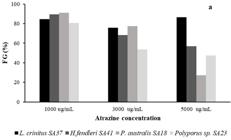
Fungal growth rate (FG) (a) and Fungal growth inhibition rate (IFG) (b) on the 5th day of incubation.
Radial mycelial growth (mm) of macrofungi on the 4th day of the Atrazine herbicide tolerance assay.
All the macrofungi studied here were tolerant to different concentrations of the herbicide atrazine. This ability to grow in the presence of toxic compounds forms a key part of studies on a species’ potential for bioremediation, and is often related to detoxification capability (Bononi 1999, Rodríguez et al. 2022). Unlike H. fendleri SA41, the basidiomycete L. crinitus SA37 showed similar growth across all treatments, both in the absence and presence of the herbicide, revealing notable resistance to atrazine toxicity without substantial modifications in growth rate.
The genus Hypoxylon is cosmopolitan and is generally found colonizing decaying wood debris. In the literature, there are reports of the capacity of Hypoxylon spp. to tolerate phenanthrene and pyrene, exhibiting low mycelial growth inhibition indices and greater mycelial growth compared to other evaluated fungi (Souza et al. 2017). H. fendleri SA41 has already been shown to be tolerant to the herbicide glyphosate, with high mycelial growth rates (above 57%) in environments with different concentrations (30 µg/mL and 50 µg/mL) of this herbicide (de Souza et al. 2022). Accordingly, the current study corroborates previous reports in the scientific literature, confirming the capacity of fungi from the genus Hypoxylon for herbicide tolerance. However, the discovery here that H. fendleri SA41 has high radial growth in the presence of atrazine (5000 µg/mL) is the first report in the literature.
The basidiomycete L. crinitus is also known to tolerate such xenobiotics as glyphosate and phenanthrene (Schneider et al. 2021, de Souza et al. 2022). The tolerance of L. crinitus to the presence of the herbicide 2,4-D has also been reported, with similar mycelial growth observed both in the presence and absence of this herbicide (Serbent et al. 2020). It is worth noting that tolerance demonstrates the organisms’ ability to withstand the toxicity of the xenobiotic, but we can’t say that such a recalcitrant compound is being degraded by the fungus.
However, when a given macrofungal species tolerates high concentrations of a particular xenobiotic, and produces ligninolytic enzymes, such as laccase, lignin peroxidase, and manganese peroxidase, it is likely that such an organism has the ability to promote the biodegradation of the contaminant under study as a survival alert response due to the presence of a possible limiting factor for its development.
It is important to mention that other enzymes may be involved in the process of xenobiotic degradation, such as monooxygenases, which enable the hydroxylation of carbon and the oxidation of heteroatoms, and arylamine N-acetyltransferase homologous enzymes, which support aromatic amines found in environmental contaminants, in addition to the intracellular enzyme cytochrome P450. This explains the capacity of species of fungi from the Phylum Ascomycota to withstand the toxicity of atrazine. Therefore, it is likely that H. fendleri SA41 expresses some of the enzymes mentioned or others that assist the species in surviving the atrazine’s high toxicity (Cocaign et al. 2013, Xin et al. 2014, Karagianni et al. 2015, Tan et al. 2015).
In this scenario, macrofungi belonging to the phylum Basidiomycota stand out when it comes to the biodegradation of environmental contaminants, as they produce extracellular enzymes with low specificity, which gives them the ability to decompose persistent organic pollutants (POPs), chlorinated pesticides (DDT), dioxins, polychlorinated biphenyls, polycyclic aromatic hydrocarbons, pentachlorophenol, hexachlorobenzene, among other pesticides (Harms et al. 2011, Kamida et al. 2007). The scientific literature has shown efficacy in biodegradation and bioremediation with some species, such as Hygrocybe sp., Lentinus crinitus, Peniophora cinerea, Phellinus gilvus, Pleurotus sajor-caju, Psilocybe castanella, Pycnoporus sanguineus, Trametes villosa, and Phanerochaete chrysosporium, the latter of which can mineralize some xenobiotics (Gugliotta 2001, Matheus 2003, Machado et al. 2005, Kamida et al. 2007).
For the laccase enzyme activity, only L. crinitus SA37 proved to be effective, both in the control group (0,83 U.L⁻¹) and in the other treatments. Furthermore, its enzyme production capacity was higher at greater herbicide concentrations, specifically at a concentration of 5000 µg/mL (4,21 U.L⁻¹) (Table III).
Laccase activity of macrofungi in the absence and presence of different concentrations of the herbicide atrazine.
Several studies in the literature have demonstrated the capacity of L. crinitus to produce ligninolytic enzymes under different cultivation conditions. The relationship of this marked capacities to degrade hexachlorobenzene, decolorize the textile dye reactive blue 220 (RB220), and RBBR dye among other environmental pollutants, abilities that are strongly associated with biodegradation. Research has also indicated the possibility of using these organisms in the purification of dye-containing wastewater (Machado et al. 2005, Neto 2006, Niebisch et al. 2010, Valle et al. 2014, Cambri et al. 2016, Santana et al. 2018, Marim et al. 2018, Almeida et al. 2018).
The induction of laccase production by the presence of recalcitrant compounds and its relationship with degradation has been known to researchers for several decades. Previous studies have already indicated that oxidation of organochlorine, dimethylphenol, atrazine and diuron compounds are directly related to increased laccase activity (Jeon et al. 2008, Piscitelli et al. 2011, Silva et al. 2013, Cupul et al. 2014, da Silva Coelho-Moreira et al. 2018). Reports in the literature indicate that herbicide atrazine can stimulate the production of the enzyme laccase under adverse conditions (Mougin et al. 2002, Monteiro 2013) and corroborates with the result found in the current study regarding the induction of enzymes that degrade these molecules. Similar responses have been induced by pesticides atrazine and tricyclazole including the textile dyes Neutral Red, Indigo Carmine, Naphthol Base Bordeaux, and Ruby Sulfate, whose presence resulted in a two to fourfold increase in enzymatic activity (Singh et al. 2018). In his experiments, Henn (2009) found that some fungi only exhibited laccase enzyme production when culture extracts contained pesticide, concluding that the enzyme was activated in the presence of the contaminant. Rezende et al. (2005) discovered a significant increase in laccase production by Pleurotus ostreatus in cultures with the herbicide imazaquin at concentrations above 1.5%. Additionally, toxic substances such as atrazine, xylidine, nonylphenol, and aniline also stimulated laccase production in Trametes versicolor (Mougin et al. 2002). Other fungal species, such as T. hirsuta, and Lentinus edodes, also demonstrated activation of the lignin and laccase enzymatic system in the presence of atrazine (Gorbatova et al. 2006).
The presence of laccase in L. crinitus SA37 reinforces the importance of expanding studies of the potential for biodegradation and mineralization of the herbicide atrazine, a process still little explored using fungi, with the catabolic action of soil bacteria being better known and the associated biochemical degradation pathways being more fully understood. Furthermore, laccase is an enzyme known for its low specificity and capacity to catalyze xenobiotic, needing only a substrate and oxygen. It can also withstand high temperatures without losing activity (Datta et al. 2017), an important attribute on an industrial scale. Laccase can also be used freely or in an immobilized form, making it an interesting option for applications in bioremediation programs (Majeau et al. 2010).
It is important to conduct further investigations with L. crinitus SA37 about produce other types of enzymes that work together to facilitate remediation of soils contaminated by herbicides, as well as in vitro assays on biodegradation, metabolite production, and mineralization (Marinho et al. 2017, Mallerman et al. 2019, Kurami et al. 2023). Research conducted in Landfarm may also be the next step toward elucidating the efficiency of the selected species in bioremediation programs (Pereira et al. 2012, Francisco & Queiroz 2018). Furthermore, there are reports in the literature on pesticide biodegradation in soils and biomixes using microbial consortia of fungi and bacteria (Ellegaard-Jensen et al. 2014, Pinto et al. 2016, Crecca et al. 2023, Kang et al. 2024). Studies like this are scientifically important as they contribute to the development of environmental technologies aimed at preserving ecosystem integrity and promoting environmental detoxification.
ACKNOWLEDGMENTS
We thank the Fundação de Amparo à Pesquisa do Mato Grosso (FAPEMAT) for granting the scientific initiation scholarship to the first author and Adrian Barnett, for English language revision.
REFERENCES
- ALMEIDA PH, OLIVEIRA ACCDE, SOUZA GPNDE, FRIEDRICH JC, LINDE GA, COLAUTO NB & VALLE JSDO. 2018. Decolorization of remazol brilliant blue R with laccase from Lentinus crinitus grown in agro-industrial by-products. An Acad Bras Cienc 90: 3463-3473. DOI 10.1590/0001-3765201820170458.
- ARGUMEDO-DELIRA R, ALARCON A, FERRERA-CERRATO R, ALMARAZ JJ & PEÑA-CABRIALES JJ. 2012. Tolerance and growth of 11 Trichoderma strains to crude oil, naphthalene, phenanthrene and benzo[a]pyrene. J Environ Gerenciar 95(suppl): S291-S299.
- BAIL J. 2020. Lacase e suas aplicações biotecnológicas: Uma revisão. Núcl Conhecimento, ano 05, 10th ed., vol. 14, p. 21-30. ISSN: 2448-0959.
- BHATTACHARYA S & DAS A. 2011. Mycoremediation of congo red dye by filamentous fungi. Braz J Microbiol 42: 1526-1536.
- BONONI VLR. 1999. Zigomicetos, Basidiomicetos e Deuteromicetos: noções básicas de taxonomia e aplicações biotecnológicas. São Paulo, SP: Instituto de Botanica, Secretaria do Estado do Meio Ambiente.
- BUSWELL JA, CAI Y & CHANG S. 1995. Effect of nutrient nitrogen and manganese on manganese peroxidase and laccase production by Lentinula (Lentinus) edodes. FEMS Microbiol Lett V 128: 81-88.
- CAMBRI G, DE SOUSA MML, FONSECA DDM, MARCHINI FK, DA SILVEIRA JLM & PABA J. 2016. Analysis of the biotechnological potential of a Lentinus crinitus isolate in the light of its secretome. J Proteome Res 15(12): 4557-4568.
- CAVALCANTE FSA, MENDOZA AYG, CAMPOS MCC & DE LIMA JPS. 2023. Bioeconomia de fungos: uma revisão da literatura. Rev Valore 8: 1-12.
- COCAIGN A ET AL. 2013. Biotransformation of Trichoderma spp. and their tolerance to aromatic amines, a major class of pollutants. Appl Environ Microbiol 79(15): 4719-4726.
- COLLA LM, PRIMAZ AL, LIMA MD, BERTOLIN TE & COSTA JAV. 2008. Isolamento e seleção de fungos para biorremediação a partir de solo contaminado com herbicida triazínicos. Ciênc Agrotec 32(3): 809-813.
- CRECCA VDMT, DA SILVA JM & DE SOUZA PAR. 2023. Technological prospecting: Patent mapping of bioremediation of soil contaminated with agrochemicals using fungi. World Pat Inf 73: 102196.
- CUPUL WC, ABARCA GH, VÁZQUEZ RR, SALMONES D, HERNÁNDEZ RG & GUTIÉRREZ EA. 2014. Response of ligninolytic macrofungi to the herbicide atrazine: dose-response bioassays. Rev Argent Microbiol 46(4): 348-357.
- DA SILVA COELHO-MOREIRA J, BRUGNARI T, SÁ-NAKANISHI AB, CASTOLDI R, DE SOUZA CG, BRACHT A & PERALTA RM. 2018. Evaluation of diuron tolerance and biotransformation by the white-rot fungus Ganoderma lucidum. Fungal Biol 122(6): 471-478.
- DA SILVA JV & MOREIRA JDSC. 2024. Análise enzimática de isolados de basidiomicetos e potencial de biorremediação do herbicida 2, 4-D (ácido 2, 4-Diclorofenoxiacético). Rev Bras Meio Ambiente 12(2): 1-14.
- DA SILVA PATRÍCIO AS, MENDOZA AYG, CAVALCANTE FSA, DOS SANTOS VS & LIMA RA. 2021. Levantamento de Macrofungos na Reserva Natural De Palmari, Atalaia do Norte, Amazonas, Brasil. Rev Biodiversidade 20: 91-99.
- DATTA R, KELKAR A, BARANIYA D, MOLAEI A, MOULICK A, MEENA RS & FORMANEK P. 2017. Enzymatic degradation of lignin in soil: a review. Sustainability 9(7): 1163.
- DE ALBUQUERQUE FP, DE OLIVEIRA JL, MOSCHINI-CARLOS V & FRACETO LF. 2020. An overview of the potential impacts of atrazine in aquatic environments: perspectives for tailored solutions based on nanotechnology. Sci Total Environ 700: 134868.
- DE SOUZA FS, DE LIMA SOUZA HM, DOS SANTOS OLIVEIRA JA, PAMPHILE JA, POLONIO JC & INOUE MH. 2022. Isolamento e seleção de fungos tolerantes ao herbicida Glyphosate. Res Soc Dev 11(1): e31411124782.
- DORES EF, NAVICKIENE S, CUNHA ML, CARBO L, RIBEIRO ML & DE-LAMONICA-FREIRE EM. 2006. Multiresidue determination of herbicides in environmental waters from Primavera do Leste Region (Middle West of Brazil) by SPE-GC-NPD. J Braz Chem Soc 17: 866-873.
- ELLEGAARD-JENSEN L, KNUDSEN BE, JOHANSEN A, ALBERS CN, AAMAND J & ROSENDAHL S. 2014. Fungal-bacterial consortia increase diuron degradation in water-unsaturated systems. Sci Total Environ 466: 699-705.
- EMBRAPA. 2011. Determinação de atrazina em solos e água em áreas de cultivo de milho irrigado do Distrito Federal. Brasília: Embrapa.
- FERNANDES JAF & SILVA LNA. 2021. Técnicas de biorremediação microbiana de solos contaminados com metais pesados. In: XII CONGEA, Salvador, BA.
- FIGUEIREDO BV, DOS SANTOS MB & FORTUNA JL. 2020. Identificação de macrofungos encontrados em um fragmento de Mata Atlântica no extremo Sul da Bahia. Braz J Anim Environ Res 3(4): 3170-3193.
- FRANCISCO WC & QUEIROZ TMD. 2018. Biorremediação. Nucleus 15(1): 249.
- GORBATOVA ON, KOROLEVA OV, LANDESMAN EO, STEPANOVA EV & ZHERDEV AV. 2006. Increase of the detoxification potential of basidiomycetes by induction of laccase biosynthesis. APBMAC 42: 414-419.
- GUGLIOTTA AM. 2001. Utilização de basidiomicetos nativos na remoção de corantes em efluentes na indústria têxtil. Tese de Doutorado, Universidade de São Paulo, São Paulo.
- HARMS H, SCHLOSSER D & WICK LY. 2011. Untapped potential: exploiting fungi in bioremediation of hazardous chemicals. Nat Rev Microbiol 9(3): 177-192.
- HENN C. 2009. Seleção de linhagens de basidiomicetos resistentes aos herbicidas Atrazina e Diurom - Produção de enzimas ligninolíticas e degradação dos compostos. São José do Rio Preto, p. 1-115.
- JEON JR, MURUGESAN K, KIM YM, KIM EJ & CHANG YS. 2008. Synergistic effect of laccase mediators on pentachlorophenol removal by Ganoderma lucidum laccase. Appl Microbiol Biotechnol 81: 783-790.
- KAMIDA HM, SOARES HCP, DA SILVA SANTOS I & UETANABARO APT. 2007. Biodegradação de efluentes têxteis por fungos basidiomicetos produtores de enzimas ligninolíticas: uma breve revisão. SITIENTIBUS Sér Ciênc Biol 7(2): 143-149.
- KANG Z, HAN X, WANG C & YU H. 2024. Artificial microbial consortium for simultaneous removal of dibutyl phthalate and atrazine combined pollutants at low temperatures. Chem Eng J 482: 149075.
- KARAGIANNI EP, KONTOMINA E, DAVIS B, KOTSELI B, TSIRKA T, GAREFALAKI V & BOUKOUVALA S. 2015. Homologues of xenobiotic metabolizing N-acetyltransferases in plant-associated fungi: Novel functions for an old enzyme family. Sci Rep 5(1): 12900.
- KURAMI U, BANERJEE T, NARAYANAN N & SINGH N. 2023. Degradation of co-applied Atrazine and Fipronil in Phanerochaete Chrysosporium Augmented Biobeds. Bull Environ Contam Toxicol 111(4): 50.
- LEE AH, LEE H, HEO YM, LIM YW, KIM CM, KIM GH & KIM JJ. 2020. A proposed stepwise screening framework for the selection of polycyclic aromatic hydrocarbon (PAH)-degrading white rot fungi. BBE 43: 767-783.
- LEMOS JLS, BARROS CA, OLIVEIRA SDD & REICHE AP. 2008. Fungos filamentosos: Agentes de degradação de petróleo e de hidrocarbonetos aromáticos policíclicos (HAPs). Rio de Janeiro: CETEM/MCT. 48.STA, p. 11-54.
- MACHADO KM, MATHEUS DR & BONONI VL. 2005. Produção de enzimas ligninolíticas e descoloração do azul brilhante de Remazol R por fungos basidiomicetos tropicais brasileiros. Braz J Microbiol 36: 246-252.
- MAJEAU JA, BRAR SK & TYAGI RD. 2010. Laccases for removal of recalcitrant and emerging pollutants. Bioresour Technol 101: 2331-2350.
- MALLERMAN J, ITRIA R, BABAY P, SAPARRAT M & LEVIN L. 2019. Biodegradation of nonylphenol polyethoxylates by litter-basidiomycetous fungi. J Environ Chem 7(5): 103316.
- MALLMANN V, ARAGÃO LWR, FERNANDES SSL, FERNANDES TCL, ARAGÃO RFR & DA SILVA RCDL. 2019. As Vantagens da Biorremediação na Qualidade Ambiental. C Biol Agr Saúde 23(1): 12-15.
- MARIM RA, AVELINO KV, LINDE GA, COLAUTO NB & VALLE JS. 2018. Lentinus crinitus strains respond differently to cultivation pH and temperature. Genet Mol Res 17(1): gmr16039885.
- MARINHO G, BARBOSA BCA, RODRIGUES K, AQUINO M & PEREIRA L. 2017. Potential of the filamentous fungus Aspergillus niger AN 400 to degrade Atrazine in wastewaters. Biocatal Agric Biotechnol 9: 162-167.
- MARTINAZZO R. 2010. Dinâmica da atrazina e da mesotriona em solos: degradação acelerada, sorção e implicações ambientais. Porto Alegre (RS), Tese de doutorado, 135 p.
- MATHEUS D. 2003. Otimização da biodegradação de hexaclorobenzeno por fungos basidiomicetos em solos contaminados com resíduos industriais. Rio Claro, Universidade Estadual Paulista, Tese de doutorado, 125 p.
- MATTEI TF & MICHELLON E. 2021. Panorama da agricultura orgânica e dos agrotóxicos no Brasil: uma análise a partir dos censos 2006 e 2017. RESR 59(4): e222254.
- MENDOZA AYG, CAVALCANTE FSA, LIMA RA & DE LIMA JPS. 2023. Macrofungos na Amazônia Brasileira e importância para o meio ambiente: uma revisão integrativa. Rev Valore 8: e-8019.
- MONTEIRO KBS. 2013. Remoção do herbicida atrazina por fungos de decomposição branca. Dissertação (Mestrado em Engenharia do Meio Ambiente), Universidade Federal de Goiás, Goiânia, 140 p. (Unpublished).
- MOUGIN C, KOLLMANN A & JOLIVALT C. 2002. Enhanced production of laccase in the fungus Trametes versicolor by the addition of xenobiotics. Biotechnol Lett 24(2): 139-142.
- NETO SLM. 2006. Enzimas ligninolíticas produzidas por Psilocybe castanella CCB444 em solo contaminado com hexaclorobenzeno. Biodiversidade vegetal e meio ambiente. Dissertação (Mestrado). Instituto de Botânica da Secretaria do Meio Ambiente. São Paulo. (Unpublished).
- NIEBISCH CH, MALINOWSKI AK, SCHADECK R, MITCHELL DA, KAVA-CORDEIRO V & PABA J. 2010. Decolorization and biodegradation of reactive blue 220 textile dye by Lentinus crinitus extracellular extract. J Hazard Mater 180(1-3): 316-322.
- PACHECO CSG & SANTOS RP. 2022. Sociedade, Tecnologia e Meio Ambiente: avanços, retrocessos e novas perspectivas, 2nd ed., p. 20-578.
- PEREIRA DS, GOMES RC & SEMÊDO LTA. 2012. Potencial das actinobactérias na biodegradação de hidrocarbonetos. Rev Eletrônica Teccen 5(2): 71-96.
- PERUZZO FT, DA SILVA DRO, DA SILVA ÀAA, NOVELLO BDP & CUCHI ML. 2020. Efeito do residual de atrazina e atrazina + simazina em soja residual effect of atrazine and atrazine + simazine in soybean. RCA, p. 64-72.
- PESENTI MEA, MARQUES TA, CAMPOS VA, URATA SL & PRATES KVMC. 2023. Avaliação do potencial biorremediador dos fungos Candida spp. e Trichophyton spp. no tratamento de lixiviado proveniente de aterro sanitário. Holos Ano 39: 1-14.
- PINTO AP, RODRIGUES SC, CALDEIRA AT & TEIXEIRA DM. 2016. Exploring the potential of novel biomixtures and Lentinula edodes fungus for the degradation of selected pesticides. Evaluation for use in biobed systems. Sci Total Environ 541: 1372-1381.
- PISCITELLI A, GIARDINA P, LETTERA V, PEZZELLA C, SANNIA G & FARACO V. 2011. Induction and transcriptional regulation of laccases in fungi. Curr Genomics 12(2): 104-112.
- REZENDE MI, BARBOSA AM, VASCOLCELOS AFD, HADDAD R & DEKKER RF. 2005. Growth and production of laccases by the ligninolytic fungi, Pleurotus ostreatus and Botryosphaeria rhodina, cultured on basal liquid media containing the herbicide, Scepter®(imazaquin). J Basic Microbiol 45(6): 460-469.
- RIBEIRO SDDM, SIQUEIRA MTD, GURGEL IGD & DINIZ GTN. 2022. A comercialização de agrotóxicos e o modelo químico-dependente da agricultura do Brasil. Saúde Debate: 46: 210-223.
- RODRÍGUEZ ME, PERGASSERE GB, KUBACH C, ORTIZ A, GRASSO F, MONTOYA P, CAMPITELLI P & ROBLEDO G. 2022. Potencial de hongos de pudrición blanca en el tratamiento de pesticidas para el desarrollo de biocamas: Sistemas de biorremediación: biocamas. Lilloa(Suplemento) 59: 63-76.
- SALOMÃO PEA, FERRO AMS & RUAS WF. 2020. Herbicidas no Brasil: uma breve revisão. Res Soc Dev 9(2): e32921990.
- SANTANA TT, LINDE GA, COLAUTO NB & DO VALLE JS. 2018. Metallic-aromatic compounds synergistically induce Lentinus crinitus laccase production. Biocatal Agric Biotechnol 16: 625-630.
- SCHNEIDER G, DE SOUZA FS, DOS SANTOS OLIVEIRA JA & DE LIMA SOUZA HM. 2021. Tolerância ao fenantreno por fungos isolados de uma reserva ecológica de Mato Grosso, Brasil. Res Soc Dev 10(17): e161101724419.
- SERBENT MP, GUIMARÃES DKS, DRECHSLER-SANTOS ER, HELM CV, GIONGO A & TAVARES LBB. 2020. Growth, enzymatic production and morphology of the white-rot fungi Lentinus crinitus (L.) Fr. upon 2, 4-D herbicide exposition. IJEST 17: 2995-3012.
- SILVA LASD, OLIVEIRA JMD, DUARTE EAA, BARRETO NSE & CAZETTA ML. 2017. Descoloração do corante Azul Brilhante de Remazol R por leveduras isoladas de moluscos do Rio Subaé, no estado da Bahia, Brasil. Eng Sanit Ambient 22(06): 1065-1074.
- SILVA MCF, ANTUNES AA, LINS CIM, PARENTE AH, PEREIRA SV & CAMPOS-TAKAKI GM. 2013. Remoção do fenantreno por biomassa viva e inativada de Cunninghamella elegans UCP0542. E-xacta 6(1): 1-8.
- SINGH S, KUMAR V, CHAUHAN A, DATTA S, WANI AB, SINGH N & SINGH J. 2018. Toxicity, degradation and analysis of the herbicide atrazine. Environ Chem Lett 16: 211-237.
- SOUZA HMDL, BARRETO LR, MOTA AJD, OLIVEIRA LAD, BARROSO HDS & ZANOTTO SP. 2017. Tolerance to polycyclic aromatic hydrocarbons (PAHs) by filamentous fungi isolated from contaminated sediment in the Amazon region. Acta Scientiarum. Biol Sci 39(4): 481-488.
- TAN LR, LU YC, ZHANG JJ, LUO F & YANG H. 2015. A collection of cytochromes P450 monooxygenase genes involved in modification and detoxification of herbicide atrazine in rice (Oryza sativa) plants. Ecotoxicol Environ Saf 119: 25-34.
- TOLLER N, GUIMARÃES E & BRAVO C. 2021. Biodegradation of the atrazine herbicide by Saccharomyces cerevisiae. Eng Sanit Ambient 26: 651-658.
- USEPA - UNITED STATES ENVIRONMENTAL PROTECTION AGENCY. 2001. The incorporation of water treatment effects on pesticide removal and transformations in food quality protection act (FQPA) drinking water assessments, p. 6-50.
- USEPA - UNITED STATES ENVIRONMENTAL PROTECTION AGENCY. 2018. Edition of the drinking water standards and health advisories tables, p. 1-12.
- VALLE JS, VANDENBERGHE LPS, SANTANA TT, ALMEIDA PH, PEREIRA AM, LINDE GA, COLAUTO NB & SOCCOL CR. 2014. Optimum conditions for inducing laccase production in Lentinus crinitus. Genet Mol Res 13(4): 8544-8551.
- VASCONCELOS FR. 2010. Bactérias com potencial biotecnológico na descoloração de corantes têxteis. Fortaleza (CE), p. 2-64.
- XING H, ZHANG Z, YAO H, LIU T, WANG L, XU S & LI S. 2014. Effects of atrazine and chlorpyrifos on cytochrome P450 in common carp liver. Chemosphere 104: 244-250.


