 The hidden impact of global warming on the structure and dynamics of zooplankton communities in freshwater habitats
Abstract
This study investigates the impact of global warming on zooplankton community structure in freshwater ecosystems, focusing on the relationship between zooplankton species and environmental factors. Due to rising temperatures and environmental changes, zooplankton are reducing in body size, leading to the appearance of smaller opportunistic species such as rotifers, known for their tolerance to extreme conditions Canonical Correspondence Analysis (CCA) identified some abiotic factors that impact species, such as temperature (T), dissolved oxygen (DO), electrical conductivity (EC), salinity, turbidity (Turb) and pH as significantly influencing zooplankton distribution and diversity. A high diversity of Rotifera species, primarily benthic and cosmopolitan, was observed, commonly found in Turkey’s freshwater littoral zones. Cluster analysis emphasizes similarities and differences in species composition sampling site, and complex interactions of abiotic factors that shape zooplankton communities. Global warming supports smaller zooplankton species with changing community structure and reducing their body size. As zooplankton are integral to the aquatic food chain, changes in their populations could impact the dynamics of trophic relationships and the balance of ecosystems. In the study emphasizes the need for comprehensive future research on both abiotic and biotic factors to improve our knowledge of how aquatic ecosystems respond to climate change.
Key words
Abiotic factors; CCA; Global warming; Turkey; Zooplankton
INTRODUCTION
Global warming adversely affects the flora and fauna of the water bodies. Many experimental studies show that global warming can reduce the aquatic biological diversity of freshwaters (Carosi 2022, Faquim et al. 2021). Climate change directly affects most of the biotic components of fish, benthic macroinvertebrates, and zooplankton in all the world’s freshwater ecosystems (Dinh et al. 2022). Through interacting with pollutants, they can induce an additive or substitutive effect depending on taxon, life stage, exposure level, and exposure time (Fernández et al. 2022). The increase in natural and anthropogenic effects of greenhouse gas emissions is destroying the ecosystem integrity in shallow waters, resulting in declines in subaquatic vegetation communities (Zhang 2018). In addition to that, climate change can cause the distribution of plants and animals and changes in the distribution of plants and animals and changes in habitat conditions. Moreover, it can effect the productivity and diversity of aquatic ecosystems (Khan & Patel 2021). Zooplanktonic organisms play a vital role in energy transfer in aquatic ecosystems, from phytoplanktonic organisms that are primary producers in the food chain to predator fish and mammals at the highest trophic levels (Cabral et al. 2020). These are found in all kinds of aquatic habitats such as seas, lakes, ponds, dam lakes, rivers, lagoons, sinkholes, swamps, caves, etc. mainly as microscopic animals (Ustaoğlu et al. 2012, Durmaz et al. 2022, Gürbüzer et al. 2023). Zooplankton species are sensitive to various environmental and biological effects, including eutrophication, pollution, global warming, and environmental issues (Özdemir et al. 2021). Furthermore, they are known as indicator species for determining water quality in their habitats (Kumari & Kumar 2018). They quickly respond to environmental changes in water (Başak et al. 2014). Zooplankton communtiy consists of three main groups: Rotifera, Cladocera, and Copepoda. Various abiotic (light, water temperature, dissolved oxygen levels, pH, electrical conductivity, salinity, nutrient levels, turbidity) and biotic factors (predation, competition within and among species) and also climate, topography, hydrology, and the presence of macrophytes influence the distribution of zooplankton organisms (Brysiewicz et al. 2017, Özdemir et al. 2021).
In this study, zooplankton samples were collected from 91 different locations across various water habitats (lake, reservoir, river, stream, water puddle, trough) in the Çanakkale province, and the effects of global warming on species diversity and the relationships with measured physicochemical parameters at each location were investigated.
MATERIALS AND METHODS
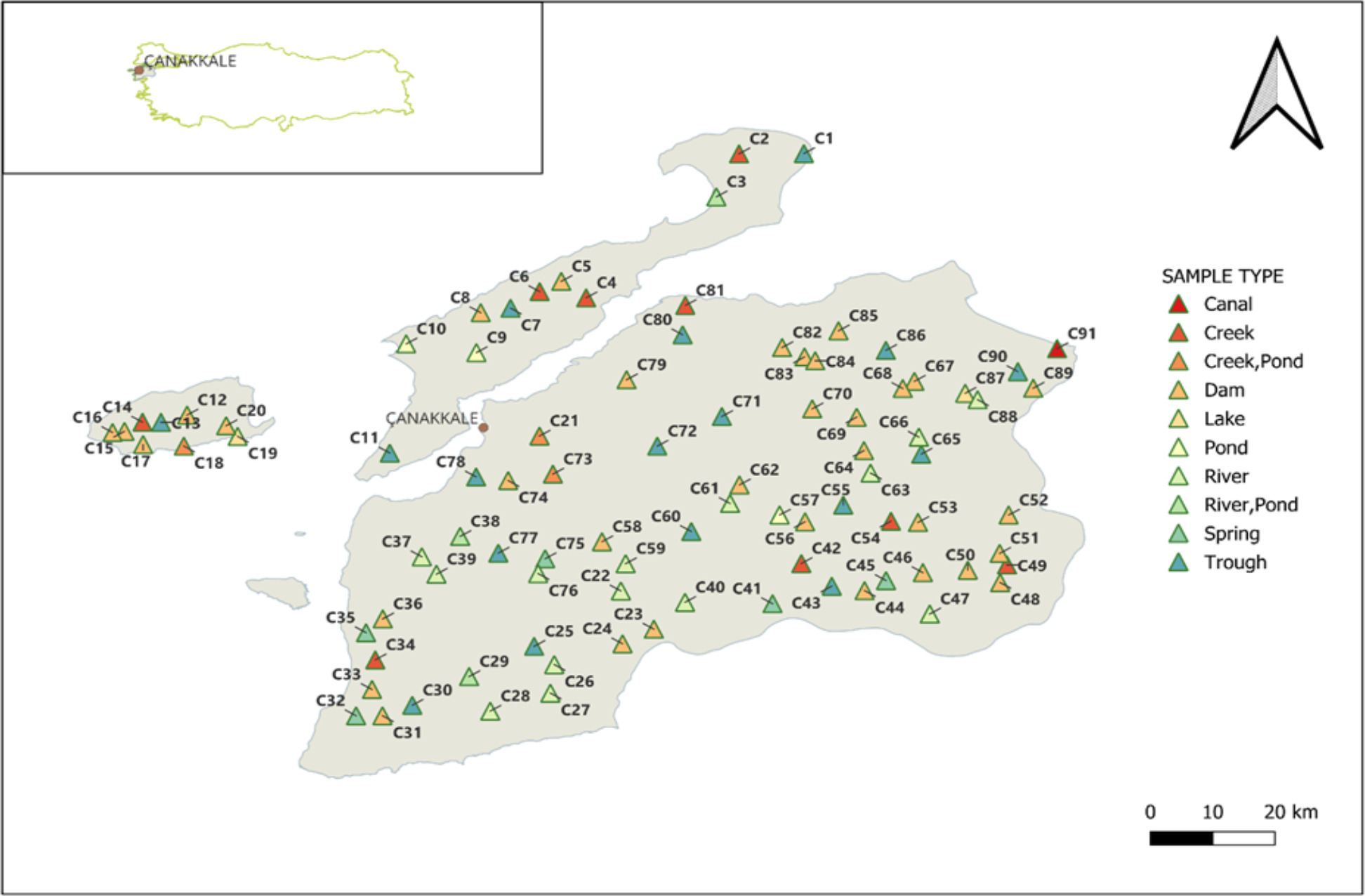
In Çanakkale Province, samples were collected from various aquatic ecosystems, selected randomly, by separately water, sediment, and planktonic organisms (Figure 1). At each sampling site, photographs and videos of the area were taken, documenting both the land and relevant aquatic environment information. Zooplankton samples were collected using a 55 µm open-type plankton net through horizontal tow sampling. The obtained samples were fixed with 70% ethanol. Samples were stored in 100 ml sterile double-capped plastic collection containers and kept in a cooler. Geographic data (coordinates, altitude, pressure, etc.) at each site’s coordinates were recorded using a Global Positioning System (GPS) device. For water analyses, 100 ml sterile double-capped plastic containers were used. Each sample was preserved in a cooler and sent to the laboratory at Eskişehir Technical University for analysis. Statistical analyses included canonical correspondence analysis (CCA) based on linear regression (ter Braak 1986), which measured the effects of abiotic variables on species distributions (McCune 1997). Another statistical analysis applied was Cluster Analysis, which utilized the Euclidean distance measurement formula and the Ward’s hierarchical clustering method (Murtagh & Legendre 2014, Legendre & Legendre 2012). All statistical analyses were created using the RStudio Version 2024.12.1+563.

RESULTS
In this study, carried out between October 28 and November 2, 2022, an examination of zooplankton samples collected from 91 locations in Çanakkale revealed the presence of zooplankton at 54 sites (3 ponds, 1 lake, 1 spring, 9 rivers, 3 creek, 26 dams, and 11 troughs) (Table I). The analysis of zooplankton samples from 91 stations in Çanakkale identified a total of 56 species, comprising 45 species (81.35%) from Rotifera, 7 species (11.87%) from Cladocera, and 4 species (6.78%) from Copepoda. The dominant species among the zooplankton included bdelloid rotifers, Keratella tecta, Polyarthra vulgaris, Lecane lunaris, Lecane luna from Rotifera, Bosmina longirostris and Chydorus sphaericus from Cladocera, and Cyclops strenuus from Copepoda. The zooplankton species identified in this study are presented in Table II.

Zooplankton species identified in Çanakkale province and their respective sampling stations.
DISCUSSION
Zooplanktonic organisms play a significant role in aquatic ecosystems, connecting primary producers, such as phytoplankton, with higher trophic-level organisms. Additionally, nearly all fish species depend on zooplankton during their larval stages, with some fish species continuing to feed on zooplankton throughout their lives (Fontaine & Revera 1986, Kumari & Kumar 2018). The presence and dominance of zooplankton species play an important role in the functioning of fresh water ecosystems. Therefore, zooplanktonic organisms are considered indicators of water quality (Geiger 1983). Due to their short lifespans, zooplankton respond rapidly to environmental changes in water, such as temperature, pH, oxygen, color, smell and taste. Furthermore, zooplankton species are sensitive to numerous environmental and biological effects, including eutrophication, pollution, and global warming (Özdemir et al. 2021).
Zooplankton are divided into three main groups: Rotifera, Cladocera, and Copepoda: Rotifera, Cladocera, and Copepoda. In this study, the dominant species identified belonged to the Rotifera group. The most frequently observed genus within Rotifera were Lecane (7 species) and Trichocerca (5 species), followed by Polyarthra (3 species) and Colurella (3 species).
Rotifers are important indicator organisms in water quality assessments, as their community structures are sensitive to ecological environmental changes (Qu et al. 2021). Rotifers constitute a significant component of freshwater zooplankton communities. The composition of rotifer communities is influenced by the amount of nutrients and planktivorous fish, invertebrate predators, and competition between species. Rotifers are typically abundant in nutrient-rich aquatic ecosystems (Fontaneto & de Smet 2015). Most rotifers, cladocerans also compete for similar food sources, while some cyclopoid copepods are effective predators on rotifers. Increased rotifer abundance with increased trophic levels has been widely reported in research (Pace 1986, Yoshida et al. 2003). Moreover, abiotic factors such as temperature, pH, oxygen, and turbidity impact rotifer abundance and species distribution (Duggan et al. 2002).
As a result of this study, the most identified species between stations included Philodina megalotrocha and Rotaria rotatoria, both bdelloid rotifers, which were found at 20 locations, along with other bdelloid species. Polyarthra vulgaris was observed in 13 locations, Keratella tecta in 10, and two species Lecane lunaris and Lecane luna in 8 locations. Among Cladocera, Bosmina longirostris was found in 7 locations and Chydorus sphaericus in 5 locations, while among Copepoda, Cyclops strenuus was found in 12 locations.
All of the identified species, appear to be cosmopolitan species commonly found in the littoral zones of various lakes worldwide and in Turkey, predominantly inhabiting nutrient-rich eutrophic waters. Bdelloid rotifers constitute a class within the phylum Rotifera and are known for their resilience to extreme conditions through anhydrobiosis (Ricci 1987). Bdelloids are widespread inhabitants of freshwater and soil, often adhering to surfaces. While primarily benthic, some bdelloid species can occasionally be found in plankton and also inhabit periphyton in both lotic and lentic waters. Another frequently found rotifer species, Keratella cochlearis tecta, is present across water bodies and is reported to develop during the mixing phases of lakes, particularly in spring and winter when water and nutrient inflows are at their peak (Gophen 2021).
It is commonly found in the littoral zones of nutrient-rich lakes and ponds, attaching its eggs directly to littoral vegetation (Edmondson 1959). Keratella cochlearis tecta is considered cosmopolitan and adaptable to various aquatic environments, including lakes, ponds, reservoirs, pools, rivers, peat bogs, and saline waters, where it resides in both still and flowing waters, as well as benthic, periphytic, and semi-planktonic habitats enriched with mineral and detrital sediments (Rotifer World Catalog). It is an euplanktonic rotifer species widely present in lakes and reservoirs and has been associated with pollution (Braioni & Gelmini 1983, Koste & Shiel 1991). Another frequently recorded rotifer species, Polyarthra vulgaris, is primarily euplanktonic but also found among macrophytes in potamoplankton in freshwater lakes and ponds (Jersabek & Bolortsetseg 2010). This eurythermal species is adapted to cold waters, as noted by several researchers (Ruttner-Kolisko 1972, Bērzıņš & Pejler 1989). P. vulgaris is euryalkaline, with a pH tolerance ranging from 4.9 to 8.7 (Bielańska-Grajner & Cudak 2014, Osmanov et al. 2018), and commonly found in mesotrophic lakes, even though it can also survive in oligotrophic and eutrophic waters. Sládeček (1983) classified it as a B-mesosaprobic (2:0) species.
The current study found that the most common genus among the identified species was Lecane, Brachionus, and Trichocerca. Additionally, It was found that benthic and periphytic species that live in clean water, such as Lecane, Lepadella, and Scaridium (Guermazi et al. 2023). Additionally the genus Trichocerca, which was found as dominant, has Laurasian origins. The analysis indicated that over one-third of the observed species exhibit strict cosmopolitanism, with widely distributed taxa accounting for the majority (65.7%). A notable latitudinal variation was observed in 26.9% of Trichocerca species, most of which prefer warm water habitats. The genus Trichocerca is unique among Rotifera due to its ecological diversity, encompassing freshwater, marine, pelagic, coastal, and psammobiotic species. T. tenuior, for example, frequently inhabits psammon (sandy habitats) (Segers 2003). Sládeček (1983) classified all Trichocerca species as oligosaprobic and/or beta-mesosaprobic.
Many species are eurycious, yet some display preferences for specific environments such as eutrophic, oligotrophic, or polyhumic waters (Sládeček 1983). The most frequently observed Lecane species, Lecane luna and Lecane lunaris, are cosmopolitan and eurytopic, representing the most widespread species within the genus. Lecane is characteristic of littoral habitats rich in nymphaeids, submerged macrophytes, and helophytes (Pejler 1995, Pholpunthin & Chittapun 1998). Lecane lunaris is a cosmopolitan species, commonly found in the littoral zone, plankton, and nutrient-rich waters (de Manuel Barrabin 2000). Although typically inhabiting coastal habitats, it can also be found in exotic water environments like psammon and phytotelmata (Pejler & Berzins 1993, Segers 1995).
Among Cladocera, one of the most frequently identified species, Bosmina longirostris, is an epi–and euplanktonic species commonly found in lakes and reservoirs, predominantly in littoral regions. It is often recorded in systems with low mineralization and eutrophic conditions (Margaritora 1985, Alonso 1985). Bosmina longirostris is a cosmopolitan species, and reported in various water bodies around Turkey as well (Ustaoğlu et al. 2012). Another dominant Cladocera species, Chydorus sphaericus, is a cosmopolitan and generally found in the littoral zones of shallow waters, predominantly planktonic and often related to algae and macrophytes (Korovchinsky 2000). Studies have highlighted its tolerance to environmental conditions, despite it’s limited tolerance to high chloride concentrations (Margalef et al. 1976). It is habitat littoral and pelagic zones of oligotrophic and eutrophic lakes and has frequently been used as an indicator of eutrophication, particularly when found in high densities (Duigan & Murray 1987). C. sphaericus is considered cosmopolitan in Turkey, with a wide distribution across various water bodies, from small ponds to large lakes. Its adaptability is attributed to its tolerance to physicochemical changes, a rounded carapace that provides protection from predation, and the ability to use algae as a substrate when transitioning to a planktonic lifestyle.
Among the Copepoda, Cyclops strenuus was the most identified species. Wide distribution shows in Europe, it is commonly reported in small water bodies, ponds, and temporary waters, though it is less frequent along lake shores. C. strenuus can survive in low-oxygen environments. During diapause, specimens are found buried up to 5 cm in bottom sediments from April to late autumn (Błędzki & Rybak 2016). This study did not identify any calanoid copepod species. Calanoid copepods are predominantly planktonic, cyclopoid and harpacticoid copepods prefer to live littoral or benthic substrates (Galassi et al. 2009). Cyclopoid and calanoid copepods is that calanoids tend to dominate in oligotrophic conditions, whereas cyclopoids are better adapted to eutrophic conditions (Aygen et al. 2009). Blancher (1984) noted that cyclopoid copepods are more commonly found than calanoids in eutrophic lakes (İpek-Alış & Saler 2016). This study identified only cyclopoid and harpacticoid copepod species, which were primarily observed in the littoral and benthic substrates of the lake. Rotifers and copepods, forming part of the zooplankton group, have been shown to colonize new water habitats more quickly than cladocerans (Badosa et al. 2010).
Effects of Global Warming on Zooplankton Community Structure
Global warming deeply affects aquatic ecosystems worldwide, accelerating the decline of critical plant communities and animal biodiversity and also changing the structure of aquatic habitats. The changes in temperature and environmental conditions disrupt the distribution, behavior, and health of aquatic animals, with potential consequences for marine and freshwater biodiversity. The interdependence of ecosystems worldwide compounded by anthropogenic factors, increases the complexity of these impacts (Sikotariya et al. 2024).
Global warming is rapidly increasing due to multiple stress factors on ecosystems (Miranda et al. 2014, Solomon et al. 2015). Climatic change has already impacted ecosystems, contributing to a global trend of increased extreme weather cast, meaning greater frequency, duration, and intensity of rainfall (IPCC 2022). Change in rainfall patterns and increase in temperatures can maintain the accumulation of terrestrial dissolved organic carbon (tDOC) in lakes and significantly impacting lake ecosystem dynamics (Gudasz et al. 2010). These climate changes, connected with antropogenic effect, deeply influence nutrient cycles in lakes (Tong et al. 2020). Rising temperatures affect the thermal structure of lakes, tDOC inputs increase nutrient availability and cause light limitation, both of which shift the dynamics within food webs (Degerman et al. 2018). Estimates suggest that heated oceans will decrease the size of marine animals due to oxygen limitations (Murthy 2022).
Primary consumers, such as zooplankton, are more homeostatic and generally more tolerant to environmental changes, such as light limitation, than lower trophic levels (Feijoó et al. 2014). However, changes in zooplankton food sources, driven by nutrient dynamics and availability, can have bottom-up solid effects (Liu et al. 2023).
Ecological stoichiometry offers a framework for exploring how the dynamics of pelagic consumers respond to nutrient-driven environmental changes and how consumer biomass is influenced by food resource quality and quantities (Sterner & Elser 2002, Calderó-Pascual et al. 2022). In particular, seston property, including the phosphorus (P) and carbon (C) to phosphorus ratio, plays a significant role in assigned zooplankton biomass and community composition (Urabe et al. 2002). Studies on biodiversity and ecosystem functioning have focused on taxonomic composition (Cardinale et al. 2012). However, recent research has focused on the importance of functional property for ecosystem processes (Pinheiro-Silva et al. 2020). According to that zooplankton body size has emerged as a key functional property linking community structure to ecosystem processes, mainly in energy transfer from lower trophic levels (Litchman et al. 2013, Cadotte 2017).
Empirical evidence suggests that global warming can change zooplankton community structure, supporting smaller-bodied organisms such as rotifers over larger cladocerans (Hart & Bychek 2011, Havens et al. 2015, Zohary et al. 2021). This trend emerges from lower metabolic demands and reduced size-associated costs, offering a competitive advantage in warmer conditions (Hart & Bychek 2011, Havens et al. 2015). Additionally, warming promotes the growth and dominance of cyanobacteria, which tend to be of lower nutritional value and less appealing to zooplankton (Jöhnk et al. 2008) potentially leading to dominance by smaller, selective zooplankton grazers such as Chydorus, rotifers, and copepods (Ersoy et al. 2019, Josué et al. 2019, Pinheiro-Silva et al. 2020).
Climate change increases the predation on larger zooplankton by planktivorous fish (Jeppesen et al. 2012). Since the body size of zooplankton is a strong indicator of top-down control on both zooplankton and phytoplankton (Jeppesen et al. 2003, Ye et al. 2013, Gianuca et al. 2016), understanding shifts in size structure can provide valuable insights into changing predator-prey relationships.
This study observed a clear reduction in zooplankton body size as a distinct impact of global warming on zooplankton community structure. This shift was marked by the dominance of small-sized, stress-tolerant species, including rotifers, small-bodied cladocerans like Alona, Bosmina, and Chydorus, and cyclopoid and harpacticoid copepods. The abundance of larger-bodied bdelloid rotifers within the Rotifera group is based on their cryptobiotic characteristics, which tolerate high temperatures. Climatic change generally supports smaller zooplankton species such as rotifers, contributing to reduced zooplankton body size (Zohary et al. 2021).
Previous studies have found that global warming and tDOC can have variable effects on zooplankton (e.g., Nicolle et al. 2012, Hébert et al. 2023, Koizumi et al. 2023). Additionally, the result of this study showed that zooplankton community structure tends to be relatively smaller organisms (Zohary et al. 2021). We suggested that global warming and tDOC negatively impact zooplankton biomass, resource use efficiency, and average body size, likely due to a bottom-up effect initiated by increased microbial activity. These results emphasized multiple synergistic impacts of multiple stressors on lake ecosystems (Yıldız et al. 2022).
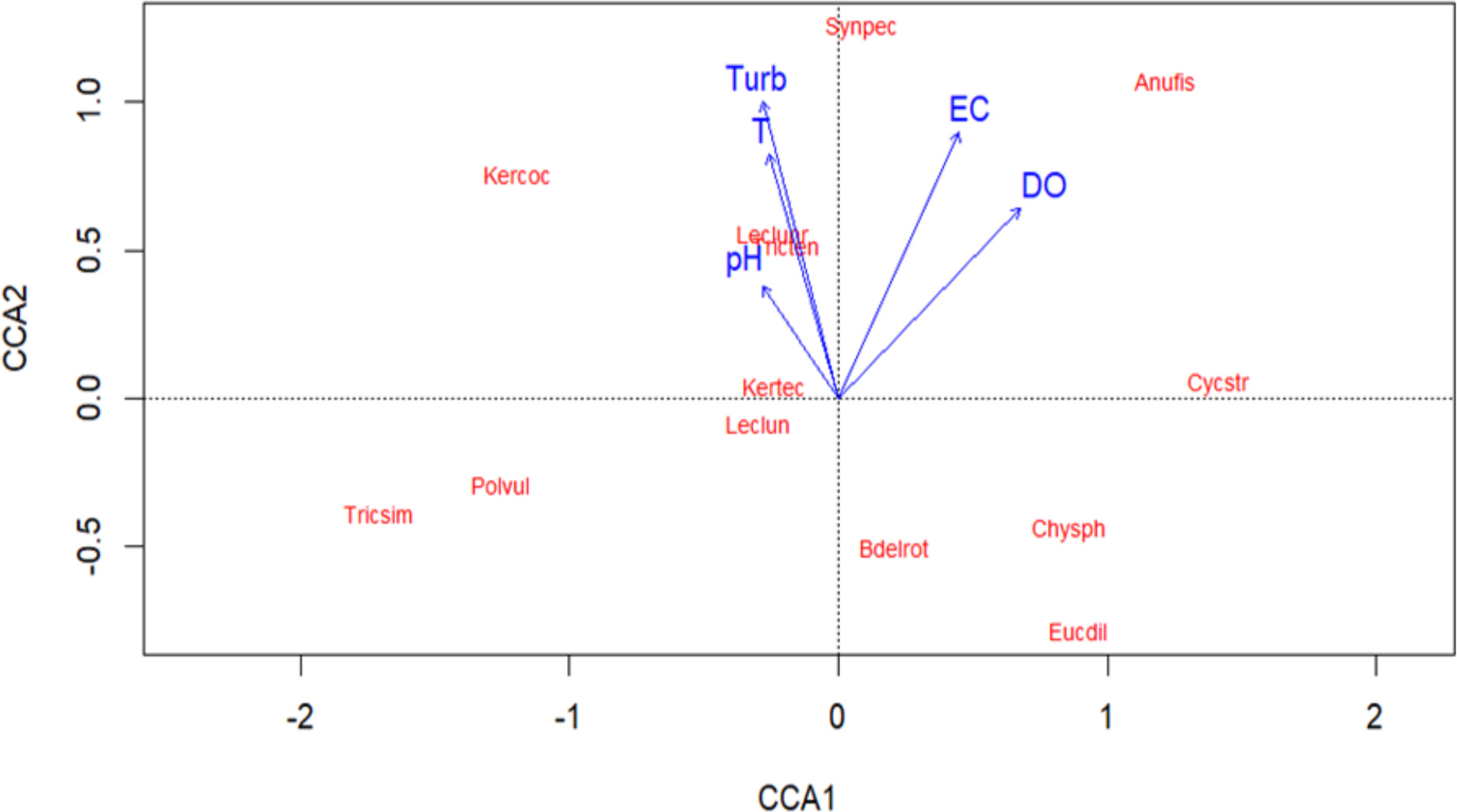
Canonical Correspondence Analysis (CCA) was carried out using Multivariate Statistics (Figure 3) to explaine the relationships between environmental factors and zooplankton species. Before the analysis, a correlation analysis was performed using Past 4.0, which showed a high correlation between salinity and EC (electrical conductivity). To avoid issues of multicollinearity, analyses were conducted based on EC. VIF (Variance Inflation Factor) values were calculated to assess the multicollinearity among independent variables. VIF values below 5 indicate that multicollinearity is within acceptable limits. In the CCA analyses, the VIF values of environmental variables were all below 5.

Demonstrating the relationship between species and environmental variables on a CCA3 graphic.
The Canonical Correspondence Analysis (CCA) resulted in eigenvalues for three axes of 0.4582, 0.2832, and 0.2608, respectively, with a cumulative variance explanation rate of 88%, meaning that these three components represent most of the data variation. According to the CCA results, on the CCA 2 axis, EC, temperature, and turbidity showed the most statistically significant positive relationships with Anureopsis fissa and Synhaeta pectinata. A positive effect of these three environmental variables was also observed on Keratella cochlearis. Conversely, Euchlanis dilatata, bdelloid rotifers, and Chydorus sphaericus negatively correlated with EC, temperature, and turbidity on the CCA 2 axis.
On the CCA 1 axis, dissolved oxygen (DO) showed a positive relationship with Cyclops strenuus, while its effect on Keratella cochlearis, Polyarthra vulgaris, and Trichocerca similis was negative.
While pH and DO positively affected the species Euchlanis dilatata and Cyclops strenuus on CCA 3 (Figure 3), they negatively impacted Lecane luna and Chydorus sphaericus.
The canonical correlation analysis has explained the effects of environmental variables on species. These variables, such as pH, electrical conductivity (EC), temperature (T), dissolved oxygen (DO), and turbidity (Turb) showed positive and negative impacts on species. For example, EC, T, and Turb had notably strong effects on Anureopsis fissa and Synchaeta pectinata. In contrast, Euchlanis dilatata and Cyclops strenuus displayed distribution patterns dependent on pH and DO levels. Increases in these two variables exerted a suppressive effect on species such as Keratella cochlearis, Polyarthra vulgaris, and Trichocerca similis.
The Cluster analysis (Figure 4) performed to observe the similarities in species diversity between locations within the study area, indicated a strong resemblance between C80 and C85.

The cluster analysis dendrogram consists of 40 localities from Çanakkale province and species diversity between locations within the study area.
However, the species in C80 were significantly different from those in C20 and C46. Additionally, the species in C68 and C67 showed a closer similarity, though not as pronounced as the similarity between those in C20 and C46. Thewidth of the gray zone indicates species diversity, indicating that differences observed among species within this gray zone are greater compared to other groups.
CONCLUSIONS
Zooplankton can respond very rapidly to environmental changes (Başak et al. 2014). In this study, it has been clearly observed that global warming has altered the zooplankton community structure, leading to a reduction in body size. Consequently, global warming may support zooplankton species such as rotifers, which are known as opportunistic species in extreme conditions. This trend could lead to further reduce the overall body size of the zooplankton communites. The study clearly noted high diversity of Rotifera species and the presence of rotifers, which is influenced by the complex interaction of various physicochemical, geographical, biological, and ecological parameters. The rotifer fauna in freshwater ecosystems is essential for maintaining aquatic ecological balance and can serve as a valuable bioindicator of ecological health and trophic levels. As a result, examining physicochemical parameters can help in understanding the trophic dynamics of the freshwater bodies (Vanjare & Pai 2013).
Most of the zooplankton species identified in this study are benthic and cosmopolitan, commonly inhabiting the littoral zones of water bodies, and are species found in Turkey’s freshwater bodies. According to CCA, the study identified temperature, dissolved oxygen, EC, salinity, pH, and turbidity as influential factors in zooplankton presence. Blancher (1984) reported that cyclopoid copepods are more abundant than calanoid copepods in eutrophic lakes (İpek-Alış & Saler 2016). According to Sousa et al. (2008), high electrical conductivity values are generally associated with higher trophic levels and significantly explain the relationship between zooplankton species composition and environmental variables.
Zooplankton species can tolerate low oxygen concentrations and use different oxygen levels as a defense against predation (Horpila et al. 2000). Low oxygen concentration has minimal effect on zooplankton (Yang et al. 2012). This study shows that increased water temperatures from global warming favor smaller zooplankton, such as rotifers, leading to a decrease in the community’s size structure.
Acknowledgements
This study was supported by the 121Y430 TUBITAK 1001 Project. All statistical analyses in this study were performed with the contribution of the course TUBITAK 2237-A Analytical Nature-Clustering and Ordination Techniques. We want to thank TUBITAK, Prof. Dr. Kürşad Özkan and Prof. Dr. Serkan Gülsoy, and all the researchers who participated in the project. We would also like to congratulate Begüm Özer for providing the map.
References
- ALONSO M. 1985. Daphnia (Ctenodaphnia) Mediterranea: A new species of hyperhaline waters, long confused with D.(C.) Dolichocephala Sars, 1895. Hydrobiologia 128(3): 217-228.
- AYGEN C, ÖZDEMİR MİS D, USTAOĞLU MR & BALIK S. 2009. Zooplankton composition and abundance in Lake Eğrigöl, a high mountain lake (Gündoğmuş, Antalya). Turk J Zool 33: 83-88.
- BADOSA A, FRISCH D, ARECHEDERRA A, SERRANO L & GREEN AJ. 2010. Recovery of zooplankton diversity in a restored Mediterranean temporary marsh in Donana National Park (SW Spain). Hydrobiologia 654: 67-82.
- BAŞAK E, AYGEN C & KÜLKÖYLÜOĞLU O. 2014. Taxonomy, distribution, and ecology of crustacean zooplankton in trough waters of Ankara (Turkey). Turk J Zool 38: 1-10.
- BĒRZIŅŠ B & PEJLER B. 1989. Rotifer occurrence in relation to oxygen content. Hydrobiologia 183(2): 165-172.
- BİELAŃSKA-GRAJNER I & CUDAK A. 2014. Effects of salinity on species diversity of rotifers in anthropogenic water bodies. Pol J Environ Stud 23(1): 27-34.
- BLANCHER EC. 1984. Zooplankton-trophic state relationships in some north and central Florida lakes. Hydrobiologia 109(3): 251-263.
-
BŁĘDZKI LA & RYBAK J. 2016. Freshwater crustacean zooplankton of Europe: Cladocera & Copepoda (Calanoida, Cyclopoida) key to species identification, with notes on ecology, distribution, methods and introduction to data analysis. DOI: https://doi.org/10.1007/978-3-319-29871-9
» https://doi.org/10.1007/978-3-319-29871-9 - BRAIONI MG & GELMINI D. 1983. Rotiferi Monogononti. Guida per il Riconoscimento Delle Specie Animali Delle Acque Interne Italiane. CNR, Italy, p. 180.
- BRYSIEWICZ A, SŁUGOCKI Ł, WESOŁOWSKI P & CZERNIAWSKI R. 2017. Zooplankton community structure in small ponds in relation to fish community and environmental factors. Appl Ecol Environ Res 15(4): 929-941.
- CABRAL CR, DINIZ LP, DA SILVA AJ, FONSECA G, CARNEIRO LS, DE MELO JÚNIOR M & CALIMAN A. 2020. Zooplankton species distribution, richness and composition across tropical shallow lakes: A large scale assessment by biome, lake origin, and lake habitat. In Ann Limnol 56: 25. EDP Sciences.
- CADOTTE MW. 2017. Functional traits explain ecosystem function through opposing mechanisms. Ecol Lett 20: 989-996.
-
CALDERÓ-PASCUAL M ET AL. 2022. The importance of allochthonous organic matter quality when investigating pulse disturbance events in freshwater lakes: a mesocosm experiment. Hydrobiologia 846: 3905-3929. DOI: https://doi.org/10.1007/s10750-021-04757-w.
» https://doi.org/10.1007/s10750-021-04757-w - CARDINALE BJ ET AL. 2012. Biodiversity loss and its impact on humanity. Nature 486(7401): 59-67.
- CAROSI A. 2022. Effects of Climate Change on Freshwater Biodiversity. Water 23: 3953.
- DEGERMAN R, LEFÉBURE R, BYSTRÖM P, BÅMSTEDT U, LARSSON S & ANDERSSON A. 2018. Food web interactions determine energy transfer efficiency and top consumer responses to inputs of dissolved organic carbon. Hydrobiologia 805: 131-146.
- DE MANUEL BARRABIN J. 2000. The Rotifers of Spanish Reservoirs: Ecological, Systematical and Zoogeographical Remarks. Limnetica 19: 91-167.
- DINH KV ET AL. 2022. Interactive effects of warming and pollutants on marine and freshwater invertebrates. Curr Pollut Rep 8(4): 341-359.
- DUGGAN IC, GREEN JD & SHIEL RJ. 2002. Distribution of rotifer assemblages in North Island, New Zealand, lakes: relationships to environmental and historical factors. Freshw Biol 47(2): 195-206.
- DUIGAN CA & MURRAY DA. 1987. A contribution to taxonomy of C. sphaericus sens. lat. (Cladocera, Chydoridae). Hydrobiologia 145: 113-124.
- DURMAZ O, ALTINDAG A, GURGEN G & BERDI D. 2022. Zooplankton fauna and seasonal changes of two karstic sinkhole lakes: Meyil and Kızören (Konya/Turkey). J Limnol Freshw Fish Res 8(3): 251-257.
- EDMONDSON WT. 1959. Freshwater biology. 2nd ed. John Wiley & Sons Inc., London - Chapman and Hall Limited, New York, USA, 1284 p.
- ERSOY Z, BRUCET S, BARTRONS M & MEHNER T. 2019. Experimental tests of fish predation on zooplankton, and recovery rate of zooplankton community structure after stop of predation. PLoS ONE 14(2): e0212351.
- FAQUIM RCP ET AL. 2021. Shortcuts for biomonitoring programs of stream ecosystems: Evaluating the taxonomic, numeric, and cross-taxa congruence in phytoplankton, periphyton, zooplankton, and fish assemblages. PLoS ONE 16(10): e0258342.
- FEIJOÓ C ET AL. 2014. Stoichiometric homeostasis in the food web of a chronically nutrient-rich stream. Freshw Sci 33(3): 820-831.
- FERNÁNDEZ R, ALCOCER J & OSEGUERA LA. 2022. Microcrustacean (Cladocera and Copepoda) assemblages of a tropical karst lake district. Diversity 14(7): 564.
- FONTAINE CT & REVERA DB. 1986. The mass culture of rotifers, Branchionus plicatilis, for use as foodstuff in aquaculture. Proc World Maricult Soc 11: 211-218.
- FONTANETO D, IAKOVENKO N & DE SMET WH. 2015. Diversity gradients of rotifer species richness in Antarctica. Hydrobiologia 761: 235-248.
- GALASSI DMP, HUYS R & REID JW. 2009. Diversity, ecology and evolution of groundwater copepods. Freshw Biol 54: 691-708.
- GEIGER JG. 1983. A review of ponds zooplankton productions fertilization for the culture of larval and fingerlings. Aquaculture 36: 353-360.
- GIANUCA AT, PANTEL JH & DE MEESTER L. 2016. Disentangling the effect of body size and phylogenetic distances on zooplankton top-down control of algae. Proc R Soc B 283(1824): 20160487.
- GOPHEN M. 2021. Effects of climate conditions on TP outsourcing in Lake Kinneret (Israel). Climate 9(9): 142.
- GUDASZ C, BASTVIKEN D, STEGER K, PREMKE K, SOBEK S & TRANVIK LJ. 2010. Temperature-controlled organic carbon mineralization in lake sediments. Nature 466(7305): 478-481.
- GUERMAZI W, EL-KHATEEB M, ABU-DALO M, SALLEMI I, AL-RAHAHLEH B, REKIK A & ANNABI-TRABELSI N. 2023. Assessment of the zooplankton community and water quality in an artificial freshwater lake from a semi-arid area (Irbid, Jordan). Water 15(15): 2796.
- GÜRBÜZER P, ALTINDAG A, TEKATLI G & TEKATLI Ç. 2023. Zooplankton fauna of high mountain lake: Sarıncof (Çamlıhemşin, Rize, Turkey). Kahramanmaraş Sütçü İmam Univ Tarım Doğa Derg 26(3): 673-679.
- HART RC & BYCHEK EA. 2011. Body size in freshwater planktonic crustaceans: an overview of extrinsic determinants and modifying influences of biotic interactions. Hydrobiologia 668: 61-108.
- HAVENS KE, BEAVER JR, MANIS EE & EAST TL. 2015. Inter-lake comparisons indicate that fish predation rather than high temperature is the major driver of summer decline of Daphnia and other changes among the cladoceran zooplankton in subtropical Florida lakes. Hydrobiologia 750: 57-67.
- HÉBERT MP, SOUED C, FUSSMANN GF & BEISNER BE. 2023. Dissolved organic matter mediates the effects of warming and inorganic nutrients on a lake planktonic food web. Limnol Oceanogr 68: S23-S38.
- HORPILA J, MALINEN T, NURMINEN L, TALLBERG P & VINNI M. 2000. A metalimnetic oxygen minimum indirectly contributing to the low biomass of cladocerans in Lake Hiidenvesi: a diurnal study on the refuge effect. Hydrobiologia 436: 81-90.
- IPCC - INTERGOVERNMENTAL PANEL ON CLIMATE CHANGE. 2022. Contribution of working group II to the sixth assessment report of the intergovernmental panel on climate change. In: Pörtner HO et al. (Eds), Climate change 2022: Impacts, adaptation, and vulnerability, p. 3056. Cambridge University Press, Cambridge and New York.
- İPEK ALIŞ N & SALER S. 2016. Zooplankton Fauna of Özlüce Dam Lake (Bingöl-Turkey). BEÜ Fen Bilim Derg 5(1): 86-90.
- JEPPESEN E ET AL. 2012. Biomanipulation as a restoration tool to combat eutrophication: recent advances and future challenges. Adv Ecol Res 47: 411-488.
- JEPPESEN E, JENSEN JP, SØNDERGAARD M, LAURIDSEN T & LANDKILDEHUS F. 2003. Trophic structure, species richness and biodiversity in Danish lakes: changes along a phosphorus gradient. Freshw Biol 48(9): 1619-1632.
- JERSABEK CD & BOLORTSETSEG E. 2010. Mongolian rotifers (Rotifera, Monogononta) a checklist with annotations on global distribution and autecology. Proc Acad Nat Sci Phila 159(1): 119-168.
- JÖHNK KD ET AL. 2008. Summer heatwaves promote blooms of harmful cyanobacteria. Glob Change Biol 14: 495-512.
- JOSUÉ IIP, CARDOSO SJ & MIRANDA M. 2019. Cyanobacteria dominance drives zooplankton functional dispersion. Hydrobiologia 831: 149-161.
- KHAN R & PATEL V. 2021. The influence of global climate change on freshwater ecosystem. In: Water Conserv Era Glob Clim Change, p. 347-366.
- KOIZUMI S, HAMDAN M, PUTS IC, BERGSTRÖM AK, KARLSSON J & BYSTRÖM P. 2023. Experimental warming and browning influence autumnal pelagic and benthic invertebrate biomass and community structure. Freshw Biol 68(7): 1224-1237.
- KOROVCHINSKY NM. 2000. Species richness of pelagic Cladocera of large lakes in the eastern hemisphere. Hydrobiologia 434: 41-54.
- KOSTE W & SHIEL RJ. 1991. Rotifera from Australian inland waters. VII: Notommatidae (Rotifera: Monogononta). Trans R Soc S Aust 115: 111-159.
- KUMARI S & KUMAR J. 2018. Studies on seasonal zooplankton community structure of Gandak River. Res J Sci Tech 10(2): 137-139.
- LEGENDRE P & LEGENDRE L. 2012. Numerical ecology, 3rd ed., Vol. 24. Elsevier Science BV, Amsterdam.
- LITCHMAN E, OHMAN MD & KIØRBOE T. 2013. Trait-based approaches to zooplankton communities. J Plankton Res 35: 473-484.
- LIU Z ET AL. 2023. Turnover of phytoplankton and zooplankton communities driven by human-induced disturbances and climate changes in a small urban coastal wetland. Ecol Indic 157: 111271.
- MARGALEF R, PLANAS D, ARMENGOL J, VIDAL A, PRAT N, GUISET A, TOJA J & ESTRADA M. 1976. Limnología de los embalses españoles. Dirección General de Obras Hidráulicas, Ministerio de Obras Públicas, Madrid, 422 p.
- MARGARITORA FG. 1985. Fauna d’Italia. Cladocera. Edizioni Calderini, Bologna, 399 p.
- MCCUNE B. 1997. Influence of noisy environmental data on canonical correspondence analysis. Ecology 78: 2617-2623.
- MIRANDA LE, ANDREWS CS & KRÖGER R. 2014. Connectedness of land use, nutrients, primary production, and fish assemblages in oxbow lakes. Aquat Sci 76: 41-50.
- MURTAGH F & LEGENDRE P. 2014. Ward’s hierarchical agglomerative clustering method: which algorithms implement Ward’s criterion? J Classif 31: 274-295.
- MURTHY HS. 2022. Impact of climate change and global warming on aquaculture and fisheries: an insight. In: Impact of climate change on hydrological cycle, ecosystem, fisheries and food security. CRC Press, p. 163-170.
- NICOLLE A ET AL. 2012. Predicted warming and browning affect timing and magnitude of plankton phenological events in lakes: a mesocosm study. Freshw Biol 57(4): 684-695.
- OSMANOV MM, RABAZANOV NI, BARKHALOV RM, AMAEVA FSH, ALIGADZHIEV MM & ABDURAKHMANOVA AA. 2018. Dynamics of zooplankton distribution in the waters of Tyulenii Island of the Caspian Sea. Yug Rossii Ekol Razv 13(4): 57-67.
- ÖZDEMIR CD, SAYGI G, DEMIRKALP FD & KARACAOĞLU Ç. 2021. Assessment of the zooplankton community in coastal Uzungöl Lagoon (Kızılırmak Delta, Turkey) based on community indices and physicochemical parameters. Turk J Zool 45: 33-45.
- PACE ML. 1986. An empirical analysis of zooplankton community size structure across lake trophic gradients. Limnol Oceanogr 31(1): 45-55.
- PEJLER B. 1995. Relation to habitat in rotifers. Hydrobiologia 313: 267-278.
- PEJLER B & BERZINS B. 1993. On the ecology of Trichocercidae (Rotifera). Hydrobiologia 263: 55-59.
- PHOLPUNTHIN P & CHITTAPUN S. 1998. Freshwater Rotifera of the genus Lecane from Songkhla Province, southern Thailand. Hydrobiologia 387/388: 23-26.
- PINHEIRO-SILVA L, GIANUCA AT, SILVEIRA MH & PETRUCIO MM. 2020. Grazing efficiency asymmetry drives zooplankton top-down control on phytoplankton in a subtropical lake dominated by non-toxic cyanobacteria. Hydrobiologia 847: 2307-2320.
- QU J, XU R, YANG H, LI Y, SHAO X, LIU Q & ZHANG Q. 2021. Community structure of two rotifer populations and ecological assessment of water quality in Miyun Reservoir. IOP Conf Ser Earth Environ Sci 829(1): 012018.
- RICCI CN. 1987. Ecology of bdelloids: how to be successful. In: Rotifer Symposium IV: Proceedings of the Fourth Rotifer Symposium, held in Edinburgh, Scotland, p. 117-127. Springer Netherlands.
- RUTTNER-KOLISKO A. 1972. The metabolism of Brachionus plicatilis (Rotatoria) as related to temperature and chemical environment. Dt Zool Ges 65: 89-95.
- SEGERS H. 1995. Rotifera. Volume 2: The Lecanidae (Monogononta). Guides Identif Microinvertebr Cont Waters World. Coordinating editor: HJF Dumont. ISSN 0928-2440.
- SEGERS H. 2003. A biogeographical analysis of rotifers of the genus Trichocerca Lamarck, 1801 (Trichocercidae, Monogononta, Rotifera), with notes on taxonomy. Hydrobiol 500: 103-114.
- SIKOTARIYA H, DAVE TH, BHADARKA M, MAKWANA K, BISWAS S, BAMANIYA M & KHARADI N. 2024. A review of global warming effect on aquatic flora and fauna. Vigyan Varta 5(5): 135-139.
- SLÁDEČEK V. 1983. Rotifers as indicators of water quality. Hydrobiol 100(1): 169-201.
- SOLOMON CT ET AL. 2015. Ecosystem consequences of changing inputs of terrestrial dissolved organic matter to lakes: current knowledge and future challenges. Ecosystems 18: 376-389.
- SOUSA W, ATTAYDE JL, ROCHA EDS & ESKINAZI-SANT’ANNA EM. 2008. The response of zooplankton assemblages to variations in the water quality of four man-made lakes in semi-arid northeastern Brazil. J Plankton Res 30(6): 699-708.
- STERNER RW & ELSER JJ. 2002. Ecological stoichiometry: the biology of elements from molecules to the biosphere. Princeton Univ Press, Princeton.
- TER BRAAK CJF. 1986. Canonical correspondence analysis: a new eigenvector technique for multivariate direct gradient analysis. Ecology 67: 1167-1179.
- TONG Y ET AL. 2020. Improvement in municipal wastewater treatment alters lake nitrogen to phosphorus ratios in populated regions. Proc Natl Acad Sci USA 117(21): 11566-11572.
- URABE J, ELSER JJ, KYLE M, YOSHIDA T, SEKINO T & KAWABATA Z. 2002. Herbivorous animals can mitigate unfavourable ratios of energy and material supplies by enhancing nutrient recycling. Ecol Lett 5(2): 177-185.
- USTAOĞLU MR, ALTINDAĞ A, KAYA M, AKBULUT N, BOZKURT A, MİS DÖ & OKGERMAN HC. 2012. A checklist of Turkish rotifers. Turk J Zool 36(5): 607-622.
- VANJARE AI & PAI K. 2013. Ecology of freshwater rotifera in a seasonal pond of the University of Pune (Maharashtra, India). Appl Ecol Environ Res 11(4): 525-539.
- YANG G, QIN B, TANG X, GONG Z, ZHONG C, ZOU H & WONG X. 2012. Contrasting zooplankton communities of two bays of the large, shallow, eutrophic Lake Taihu, China: their relationship to environmental factors. J Great Lakes Res 38: 299-308.
- YE L, CHANG CY, GARCÍA-COMAS C, GONG GC & HSIEH CH. 2013. Increasing zooplankton size diversity enhances the strength of top-down control on phytoplankton through diet niche partitioning. J Anim Ecol 82(5): 1052-1061.
- YILDIZ D ET AL. 2022. Effects of a microplastic mixture differ across trophic levels and taxa in a freshwater food web: in situ mesocosm experiment. Sci Total Environ 836: 155407.
- YOSHIDA T, URABE J & ELSER JJ. 2003. Assessment of ‘top-down’ and ‘bottom-up’ forces as determinants of rotifer distribution among lakes in Ontario, Canada. Ecol Res 18(6): 639-650.
- ZHANG K, CHENG X, SHU X, LIU Y & ZHANG Q. 2018. Linking soil bacterial and fungal communities to vegetation succession following agricultural abandonment. Plant Soil 431: 19-36.
- ZOHARY T, FLAIM G & SOMMER U. 2021. Temperature and the size of freshwater phytoplankton. Hydrobiol 848: 143-155.