 Reinterpretation of Bakiribu waridza from the Romualdo Formation (Lower Cretaceous) of Brazil: a fish not a pterosaur
Abstract
Fragmentary fossil remains from the Romualdo Formation (Lower Cretaceous) of Brazil, preserved in association with two fish were interpreted as two individuals of a new genus and species of ctenochasmatine pterosaur, Bakiribu waridza Pêgas et al. 2025. Comparison with fossils from the same geological unit show that the remains represent the gill arch apparatus of a large actinopterygian fish. A series of partially articulated bony elements correspond closely in morphology to the ceratohyals, hypohyals, basibranchial and hypobranchials of amiid fish while the purported ‘teeth’, which lack enamel, dentine tubules and in most cases evidence of a structure corresponding to a pulp cavity, are reinterpreted as gill filaments. Bakiribu waridza is a fish, not a pterosaur and the name, founded on indeterminate remains of an actinopterygian fish, possibly an amiid, should be treated as a nomen dubium. Rather than a regurgitalite this association of several fish remains appears to be a typical Romualdo Formation concretion. This reinterpretation of Bakiribu has negligible impact on our current understanding of the evolutionary history of pterosaurs as ctenochasmatines represented, for example, by Pterodaustro, were already known to be present in South America until the end of the Early Cretaceous.
Key words
Pterosaur; fish; actinopterygian; gill arches; Romualdo Formation; regurgitalite
INTRODUCTION
Pêgas et al. (2025) recently described a new genus and species of ctenochasmatine pterosaur, Bakiribu waridza, from the Lower Cretaceous Romualdo (= Santana) Formation of Brazil, a well-known fossil Lagerstätte that has yielded a diverse assemblage of pterodactyloid pterosaurs (e.g., Pinheiro et al. 2025 and refs therein). The multiple fragments of this “pterosaur”, purportedly representing two individuals and preserved together with two fish in a single nodule (MCC 1271.1-V and MPSC 7312), were interpreted by Pêgas et al. as a regurgitalite “a mass of indigestible material expelled orally by a predator”, possibly a spinosaurid dinosaur.
Comparison with a range of vertebrates including ctenochasmatine pterosaurs, the extinct fish Belonochasma, and extant fish, principally the Bowfin (Amia), led to the reidentification of the holotype (MCC 1271-Va and MPSC 7312a) and paratype (MCC 1271-Ve and MPSC 7312e) of Bakiribu waridza as the remains of a large actinopterygian fish. Here we summarise evidence in support of that conclusion and discuss its implications.
Institutional abbreviations
CYGB, Chaoyang Geological Park, Liaoning Province, China; IG-CAGS, Institute of Geology, Chinese Academy of Geological Sciences, Beijing, China; IVPP, Institute of Vertebrate Palaeontology and Palaeoanthropology, Beijing, China; JME SoS, Jura-Museum, Eichstätt, Bavaria, Germany; JPM, Jinzhou Palaeontological Museum, Jinzhou, Liaoning Province, China; MCC, Museu Câmara Cascudo, Natal, Rio Grande do Norte, Brazil; MPSC, Museu de Paleontologia Plácido Cidade Nuvens, Santana do Cariri, Ceará, Brazil; NKMB, Naturkunde-Museum, Bamberg, Bavaria, Germany; PMOL, Palaeontological Museum of Liaoning, Shenyang, Liaoning Province, China; SMNS, State Museum for Natural History, Stuttgart, Baden-Württemberg, Germany; SNSB-BSPG, Bavarian State Collection for Palaeontology and Geology, Munich, Bavaria, Germany.
Anatomical abbreviations
bb, basibranchial; cb1, cb2, ceratobranchial 1 and 2; ch, ceratohyal; chp, posterior ceratohyal; egf, elongate gill filaments; f1, fish 1; f2, fish 2; gf, gill filaments; gr, gill rakers; hb1, hb2, hb3, hb4, hypobranchial 1, 2, 3 and 4; hh, hypohyal; rf, reflexed hypobranchial; sgf, relatively short gill filaments.
MATERIALS AND METHODS
Materials
Data for this study was drawn from our observations of fossil material of ctenochasmatids including Ctenochasma elegans (SNSB-BSPG 1935.I.24, SNSB-BSPG 1920.I.57, JME SoS 2179, JME SoS 2476, SMNS 8180), Balaenognathus maeuseri (NKMB P2011-633), Gegepterus changi (IVPP 11981), Gladocephaloideus jingangshanensis (IG-CAGS-08-07, JPM 2014-004), Liaodactylus primus (PMOL-AP00031), Ningchengopterus liuae (CYGB-0035), and fish from the Upper Jurassic including Belonochasma aenigmaticum (SNSB-BSPG 1938 I 87; SNSB-BSPG 1975 IX 1) and Lower Cretaceous, principally Cratoamia gondwanica and Tharrhias. Additional data on Bakiribu waridza (MCC 1271-V and MPSC 7312) was collected from the original paper and supplementary digital materials published by Pêgas et al. (2025). Details of the dental morphology of Pterodaustro were compiled from studies by Chiappe & Chinsamy (1996) and Cerda & Codorniú (2023). Additional data on the gill arch morphology and gill filaments of amiid fish was assembled from studies by Bevelander (1934), Olson (1981), Grande & Bemis (1998) and Brito et al. (2008, 2018).
Methods
Approaches adopted included visual inspection of comparative pterosaur and fish specimens, utilising a variety of lighting modes including orthogonal and low angle (raking) light, binocular microscopy and high-definition ultra-violet fluorescence photography. Photography was conducted using a Nikon D850 and macro lens (Nikon; AF-S Micro Nikkor 105 mm; 1:2.8G ED); UV (Hoya UV(0)) and polarizing filters (Hoya Pro 1 MC PL-C ); ISO setting of 80; an aperture of 1/11 and shutter speeds ranging from 1/500 to 10 seconds. Light sources included natural light, tungsten lamps and hand-held UV LED lamps (Weltool M2-BF; wavelength 365 nm; LED radiation flux 2100 microwatts). Editing of digital images (saturation; colour balance) was conducted in Apple Macintosh Preview v 10.1 and Adobe Photoshop (version 22.4.3).
RESULTS 1: REINTERPRETATION OF MCC 1271-VA and MPSC 7312 AS A FISH
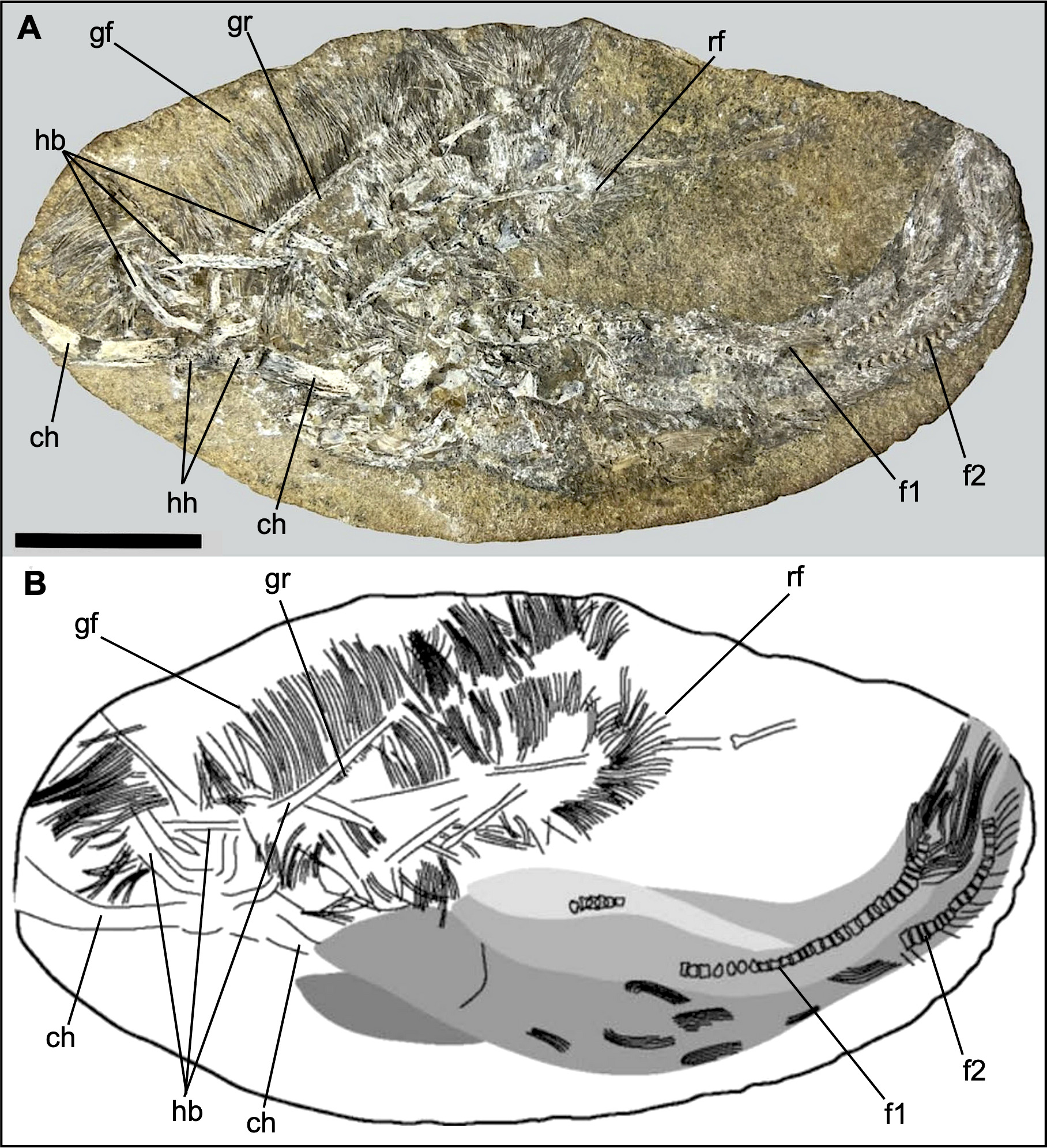
The elongate bony elements interpreted by Pêgas et al. (2025) as fragments of the rostrum and mandibular symphysis of two pterosaurs are reinterpreted here as components of the gill arch apparatus of a large actinopterygian fish (Figures 1–5). Identifiable elements include a pair of robust anterior ceratohyals, closely comparable in form to those of Cratoamia (Brito et al. 2008) each articulated with a hypohyal (Figure 2a). Posteriorly the hypohyals are in contact with a basibranchial, a midline element to either side of which are the first two pairs of hypobranchials (Figure 3a). This configuration, consistent with a collapsed gill arch, almost exactly matches that described for Cratoamia (Brito et al. 2008, fig. 6; Figure 2b). The remaining hypobranchials are displaced and, in most cases, incomplete (Figures 1, 2a, 3a).

Reinterpretation of MPSC 7312 based on Pêgas et al. 2025. (a) Fossil remains. (b) Sketch of associated fish remains including gill arch apparatus of a large amiid and two examples of Tharrhias araripis (?). Scale bar = 50 mm.

Comparison of MPSC 7312 with the gill arch of a fish and the rostrum of a ctenochasmatine pterosaur. (a). Line drawing of MPSC 7312 rotated vertically to facilitate comparison. (b). Cratoamia gondwanica (UERJ-PMB89), Crato Formation (Lower Cretaceous), Araripe, Brazil. Gular plate, hyoid arch and gill arches. (c). Ctenochasma elegans (JME SoS 2476), Altmühltal Formation (Upper Jurassic: Tithonian), Solnhofen, Germany. Rostrum with complete dentition in dorsal view. Scale bar = 25 mm. (a) Compiled from Pêgas et al. 2025; (b) reproduced from Brito et al. 2008, fig. 6); (c) Photo courtesy of R. Belben.

Anatomical details of the gill arches of MCC 1271-Va, e and MPSC 7312a, e. (a) Partially articulated remains of the gill arch assembly with a basibranchial, ceratohyals, hypohyals and hypobranchials #1 and #2 in natural association. (b) Gill rakers. (c) A reflexed hyobranchial element with elongate gill filaments proximally and relatively short gill filaments distally. Scale bar = 25 mm. (Compiled from Pêgas et al. 2025).
As in Cratoamia the hypobranchials are elongate elements that taper distally. Along one margin each hypobranchial bears numerous tightly packed highly elongate gill filaments oriented perpendicular to the long axis of the hypobranchial. In well preserved examples, small, short gill rakers fringe the opposite margin of the hypobranchial (Pêgas et al. 2025, fig. 4a; Figure 3b).
The majority of the preserved portions of the hypobranchials and associated gill filaments appear to represent basal portions of the hypobranchial. One example (Figure 3c) appears to be more complete preserving the distal portion of the hypobranchial, though only fragments of this remain. This part of the hypobranchial is sharply reflected toward the base of the structure, exhibiting a hook-shaped morphology, with the gill elements fanning out around the external margin of the hook. Proceeding toward the tip of the hypobranchial these filaments exhibit a marked decline in length. This hypobranchial gill filament assembly is strikingly similar to that observed in Amia (Olson 1981) and an actinopterygian from the Upper Jurassic Solnhofen Limestones of Southern Germany, described under the name Belonochasma (Broili 1939, Mayr 1973, figs 1, 2; Figure 4b).

Comparison between Bakiribu waridza and Belonochasma aenigmatum. (a) sketch of the gill apparatus of Bakiribu waridza preserved on the counterpart (MPSC 7312). (b) UV fluorescence photograph of the holotype of Belonochasma aenigmaticum Broili, 1939 (SNSB-BSPG 1938 I 87), the gill apparatus of a fish from the Upper Jurassic Solnhofen Plattenkalk (Upper Jurassic: Tithonian) of Solnhofen, Bavaria, Germany. (C) Anatomical details of SNSB-BSPG 1938 I 87 (box in B) illustrating the relationship of gill filaments to a branchial. Scale bar: (a, b) 10 mm, (c) 2 mm. (a) modified from Pêgas et al. 2025.
RESULTS 2: COMPARISON OF MCC 1271-VA, E and MPSC 7312A, E WITH CTENOCHASMATINE PTEROSAURS
The slender, elongate needle-like elements interpreted by Pêgas et al. (2025) as teeth, reinterpreted here as gill filaments, bear a superficial similarity to the dentition of ctenochasmatine pterosaurs (Witton 2013). They differ from the latter, however, in several important respects.
(1) In ctenochasmatines the dentition is symmetrically arranged on either side of the rostrum and the mandibular symphysis (Wellnhofer 1970, Bennett 2007, 2025, Zhou & Fan 2025; Figure 2c). By contrast in MCC 1271-Va and e and MPSC 7312a and e the needle-like elements are almost entirely restricted to just one side of the supporting spar (Figures 1, 2a, 3).
(2) The teeth of ctenochasmatines are longest anteriorly and show a uniform reduction in length posteriorly such that the posterior-most teeth are less than 30% the length of the anterior-most elements (Bennett 2007; Figure 2c). By contrast, in MCC 1271-Va, e and MPSC 7312a, filaments in the posterior-most positions are as long, or longer, than filaments in anterior positions (Pêgas et al. 2025; Figures 1, 2a) opposite to the condition in ctenochasmatines. Moreover, in Bakiribu while most filaments are of comparable length, a few filaments are illustrated as exceptionally elongate (Pêgas et al. 2025, fig. 3a), a pattern never encountered in ctenochasmatid dentitions (e.g., Bennett 2007 fig. 2; Martill et al. 2023, fig. 24).
(3) The dentition of ctenochasmatines almost invariably shows distinct patterns of tooth replacement with shorter replacement teeth regularly intercalated between longer, mature, fully erupted teeth (Martill et al. 2023, Zhou & Fan 2025; Figures 2c, 4d). There is no evidence of such patterns in the filaments of MCC 1271-Va, e and MPSC 7312a, e (Figures 1, 2a). Note, however, that tooth replacement appears to be absent in Pterodaustro (Cerda & Codorniú 2023), recovered by Pêgas et al. (2025) as the sister taxon to Bakiribu. Consequently, the seeming absence of tooth replacement in Bakiribu does not, alone, certainly demonstrate the non-pterosaurian nature of Bakiribu.
(4) The ‘tooth crowns’ of Bakiribu are described as ‘subquadrangular’ in cross-section, a morphology consistent with gill filaments but not the teeth of ctenochasmatids which are invariably circular or sub-circular in cross-section (Cerda & Codorniú 2023, Fernandes et al. 2023). In addition, the base of each ‘tooth’ seems to be distinctly expanded (Figures 5a, b) as also observed in gill filaments of Belonochasma (Figure 4c) and an Upper Jurassic fish (Figure 5c), quite unlike the teeth of ctenochasmatids such as Ctenochasma (Figure 5d), Balaenognathus (Martill et al. 2023, fig 7) and Pterodaustro (Cerda & Codorniú 2023, figs 1-2). Remarkably, the ‘teeth’ of Bakiribu appear to lack roots (Pêgas et al. 2025, fig. 4; Figures 5a, b). By contrast, all pterosaur teeth appear to have had a well-developed root (e.g., Wellnhofer 1991) and, as demonstrated in a recent study by Cerda & Codorniú (2023, figs 4g-i), they are particularly elongate in derived ctenochasmatids.

Anatomical comparisons between Bakiribu waridza, a fish and the pterosaur Ctenochasma elegans. (a) photograph and (b) sketch illustrating the relationship between gill filaments and a hypobranchial of Bakiribu waridza (MCC 1271.1-V). Filaments lie adjacent to, but do not insert into the hypobranchial. (c) Isolated gill arch (likely a ceratobranchial) with associated gill filaments and gill rakers of a large indeterminate actinopterygian from the Upper Jurassic Altmühltal Formation of Eichstätt (Tithonian). Note the distinct gap between the gill filaments and the branchial. Uncatalogued specimen photographed using UV fluorescence, Jura-Museum Eichstätt. (d) Section of the rostrum and dentition, Ctenochasma elegans (JME SoS 2476), Altmühltal Formation (Upper Jurassic: Tithonian), Solnhofen, Germany. Teeth insert directly into the premaxilla/maxilla. Arrows indicate immature teeth. Scale bar: (a, b) 10 mm, (c) 25 mm, (d) 5 mm. (a) and (b) compiled from Pêgas et al. 2025, (d) Photo courtesy of R. Belben.
(5) Histological details of the ‘teeth’ of Bakiribu are inconsistent with those reported for the teeth of ctenochasmatines (e.g., Chiappe & Chinsamy 1996, Cerda & Codorniú 2003) or other pterosaurs (e.g., Aureliano et al. 2025). Contra Pegas et al. (2025) who reported dentine and pulp cavities, in cross-section the ‘teeth’ exhibit a uniform amorphous texture (Pêgas et al. 2025, fig. 5b) and lack an enamel layer or dentine tubules. In one example (Pêgas et al. 2025, figs 5b, e) a dark subcircular patch in the centre of the section is interpreted as a pulp cavity but this structure appears to be a depression rather than a canal and is absent from other ‘teeth’.
(6) Tooth implantation. In Bakiribu there is a distinct gap between filaments and the supporting spar (Figures 3b, 4a, b). The same arrangement is seen in Cratoamia (Figure 2b) and fossilised remains of an Upper Jurassic fish represented by an isolated gill arch with associated gill filaments (Figure 5c). This is fundamentally different from the arrangement in pterosaurs where teeth insert directly into dental alveoli borne by the premaxilla, maxilla and dentary (Figure 5d). The only exceptions are the darwinopteran Allkaruen (Codorniú et al. 2016) and the ctenochasmatid Pterodaustro (Cerda & Codorniú 2023) where part of the dentition is implanted in a groove. In the latter the teeth are tightly packed and bounded by labial and lingual bone walls (Cerda & Codorniú 2023: fig. 4). This arrangement is completely different from that illustrated for Bakiribu where the ‘teeth’ are separated by distinct gaps and not located in sockets (Pêgas et al. 2025, figs 5a-e), unlike most toothed pterosaurs, or bounded by labial and lingual walls of bone as in Pterodaustro (Cerda & Codorniú 2023, fig 4) the supposed sister taxon of Bakiribu.
Aside from the comparisons described above, the skeletal anatomy of Bakiribu also differs from that of other pterosaurs in several other ways. Apart from neonatal individuals, the external surface of pterosaur bone is often remarkably smooth with a dense satiny texture (Bennett 1993; Griffin et al. 2020), distinctly different from the uneven, irregular texture evident on the bones of Bakiribu. Moreover, not one of the skeletal elements preserved on either surface of the split concretion shows a good match with skeletal elements of pterosaurs. Pêgas et al. (2025) note that: “An indeterminate metatarsal and an indeterminate pedal phalanx are also present…”. These are not indicated on the figures, however, and we were unable to locate or identify these bones.
DISCUSSION
Identification of MCC 1271-Va, e and MPSC 7312a, e
Not one of the skeletal elements preserved on the main slab (MCC 1271-V) or counterpart (MPSC 7312), exhibits a morphological feature that is uniquely pterosaurian. The filament-like structures, interpreted as teeth by Pêgas et al. (2025) show a superficial resemblance to the dentition of ctenochasmatines but lack key pterosaurian characteristics such as symmetry in the distribution of teeth along the jaw margins and distinctive patterns in size variation related to waves of tooth replacement, universally present in dentate pterosaurs and particularly well developed in ctenochasmatines (Zhou & Fan 2025).
As demonstrated in Figures 2 and 5, the morphology of the skeletal elements and filaments and the disposition of those bones that remain in articulation compare extremely closely to elements of the gill arch of a large actinopterygian. The remains are too fragmentary to permit a more precise taxonomic assignment, but we note similarities between MCC 1271-Va, e and MPSC 7312a, e and amiids from the Lower Cretaceous of South America including Calamopleurus (Brito et al. 2018) and Cratoamia (Brito et al. 2008).
Preservation and taphonomy
The interpretation of MCC 1271-V and MPSC 7312 as a regurgitalite necessarily requires a complex sequence of events. This would have begun with the capture and killing, or possibly scavenging, by a predator (as yet unknown) of a ctenochasmatid pterosaur. This would have been followed by the mechanical processing of the carcase such that only fragments of the jaws and a few other bones remained. Here, we note that the violence required to render the ‘jaws’ into multiple fragments is highly inconsistent with the preservation of the ‘teeth’ which show little or no displacement or damage. While somehow retaining the remains of the first pterosaur, a second ctenochasmatid of exactly the same size was also caught and killed, or scavenged, in exactly the same way as the first, leaving the same set of skeletal remains, again with no damage to the fine, filament-like teeth. Somehow, both sets of remains were then retained by the predator, in such a way that no further modification of the remains took place since, according to Pêgas et al. (2025), there was “no clear macroscopic evidence of digestive corrosion on the bones or scales”. Subsequently, the predator captured, or scavenged four fish (only two are evident in the published illustrations), likely Tharrhias. The fish were not mechanically processed, however, and, at this point, the remains of all the fish and both pterosaurs were formed into a pellet that was then expelled. This explanation, which relies on a precise sequence of events, several of which are, themselves, unlikely, seems highly improbable and is without precedent in the fossil record.
Our reinterpretation of MCC 1271-V and MPSC 7312 as the remains of a large actinopterygian fish, likely an amiid, preserved in association with the remains of two small fish, permits much simpler explanations of this fossil that are also consistent with taphonomic pathways already documented for the Romualdo Formation (Martill 1988, Martill et al. 2008). There are two possibilities.
(1) The small fish became lodged in the buccal cavity of the larger fish as several examples of the Romualdo Formation amiid Calamopleurus with smaller fish lodged in their gape are known (Mulder 2014). Ultimately, this led to the death of the larger fish and fossilisation of the associated remains.
(2) The association may simply be fortuitous, the concretion forming around the smaller fish and part (the gill arches) of the larger fish while most of latter lay beyond the concretion boundary. Tharrhias is a common species in the Romualdo Formation, with several examples known where multiple individuals are preserved together in the same nodule (Maisey 1991, Martill 1993).
Palaeontological déjà vu?
This is not the first occasion on which the remains of the gill arches of a fish have been mistaken for a ctenochasmatid pterosaur. In 1939 Broili described a new vertebrate, Belonochasma aenigmaticum, in which gill arches and gill filaments were interpreted as the jaws and dentition of a ctenochasmatid. This specimen (SNSB-BSPG 1938.I.87; Figure 4b) was later reidentified as the gill arches of a fish by Mayr (1973) who provided a detailed account based on a series of specimens in which more complete remains of the fish are preserved. Several examples figured by Mayr (1973, figs 1–3) show clear similarity to MCC 1271-Va, e and MPSC 7312a, e.
Implications of the reidentification of MCC 1271-Va, e and MPSC 7312a, e for pterosaur evolutionary history
Prior to the publication of Bakiribu waridza, concluded here to be a fish, ctenochasmatine pterosaurs were unreported from the Lower Cretaceous of Brazil. Cearadactylus atrox Leonardi & Borgomanero (1985), interpreted by Unwin (2002) as a ctenochasmatid (Naish & Martill 2003), but lost during the fire that destroyed the Museu Nacional Brazil in 2018 (Pinheiro et al. 2025), was reinterpreted as an ornithocheirid following the demonstration that the fragmentary remains of the skull and jaws had been inaccurately reconstructed (Vila Nova et al. 2014). Unwindia trigonus Martill (2011), while seemingly not a ctenochasmatine, appears to be a lonchodectid and thus a member of Ctenochasmatoidea (Pinheiro et al. 2025; Witton 2013) (= Archaeopterodactyloidea of some workers: e.g., Kellner 2003, Andres 2021, Hone et al. 2024).
The reinterpretation of Bakiribu waridza as a fish does not significantly change our understanding of pterosaur evolutionary history. Prior to this study, ctenochasmatines, represented, for example, by Pterodaustro, were already known to be present in South America, persisting there until at least the end of the Early Cretaceous (Codorniú & Gasparini 2007). The continued absence of ctenochasmatines sensu stricto from either the Crato or Romualdo Formations contrasts with their complete dominance of the ‘Loma del Pterodaustro’ deposits in Argentina (Chiappe et al. 1998). While taphonomic processes have undoubtedly been the principal factor that shaped the temporal and geographic patterns of distribution seen in the pterosaur fossil record (Dean et al. 2016) the sharp disparity in the occurrence/absence of ctenochasmatids in these two deposits suggests that ecology may also have played an important role.
CONCLUSIONS
MCC 1271.1-V and MPSC 7312 is a typical fish bearing Romualdo concretion and not a regurgitalite. Bakiribu waridza is a fish, not a pterosaur. In that MCC 1271-Va, e and MPSC 7312a, e appears to consist of the gill apparatus of an actinopterygian fish, possibly an amiid, the name Bakiribu waridza should be treated as a nomen dubium.
Acknowledgements
We are grateful to Oliver Rauhut, Max Kellermann and Markus Moser (Bavarian State Collection for Paleontology and Geology, Munich, Germany); Valentina Rosina and the late Martin Röper (Bürgermeister-Müller-Museum, Solnhofen, Germany); Christina Ifrim and Andreas Hecker (Jura-Museum, Eichstätt, Germany); Georg Bergér (Museum Bergér, Harthof, Eichstätt, Germany); Erin Maxwell and Rainer Schoch (State Museum of Natural History, Stuttgart, Germany) and Mike Day (Natural History Museum, South Kensington, UK) for facilitating access to specimens in their collections. Rachel Belben kindly provided a photograph of Ctenochasma. We thank Alexander Kellner and Daniel Lopes Lima Sant’Anna for their editorial support and Rab Smyth and two anonymous referees for their feedback which contributed significantly to the final version of the paper.
References
- ANDRES B. 2021 Phylogenetic systematics of Quetzalcoatlus Lawson 1975 (Pterodactyloidea: Azhdarchoidea). J Vert Paleontol 41(sup1): 203-217. DOI 10.1080/02724634.2020.1801703.
- AURELIANO T, ROCHA MPS, LIMA-FILHO FP & GHILARDI AM. 2025. Histology and fossil diagenesis of a pterosaur tooth from the Crato Formation (Lower Cretaceous of Brazil). The Anatomical Record: 1-13. DOI 10.1002/ar.70093.
- BENNETT SC. 1993. The ontogeny of Pteranodon and other pterosaurs. Paleobiology 19: 92-106.
-
BENNETT SC. 2007. A review of the pterosaur Ctenochasma: taxonomy and ontogeny. Neues Jahrbuch für Geologie und Paläontologie – Abhandlungen, 245(1): 23-31. DOI 10.1127/0077-7749/2007/0245-0023.
» https://doi.org/10.1127/0077-7749/2007/0245-0023 -
BENNETT SC. 2025. A review of the pterosaur Gnathosaurus subulatus from the Tithonian Solnhofen Lithographic Limestones of Germany: taxonomy and ontogeny. Neues Jahrbuch für Geologie und Paläontologie – Abhandlungen, 314(1): 93-114. DOI 10.1127/njgpa/2025/1245.
» https://doi.org/10.1127/njgpa/2025/1245 - BEVELANDER G. 1934. The gills of Amia calva specialized for respiration in an oxygen deficient habitat. Copeia 1934(3): 123-127.
-
BRITO PM, NAVA WR & MARTINELLI AG. 2018. A new fossil Amiidae (Holostei: Halecomorphi) from the Upper Cretaceous Adamantina Formation, Southeastern Brazil, with comments on western Gondwana amiids. Cretac Res 77: 39-43. DOI 10.1016/j.cretres.2017.04.018.
» https://doi.org/10.1016/j.cretres.2017.04.018 -
BRITO PM, YABUMOTO Y & GRANDE L. 2008. New amiid fish (Halecomorphi: Amiiformes) from the Lower Cretaceous Crato Formation, Araripe Basin, Northeast Brazil. J Vert Paleontol 28(4): 1007-1014. DOI 10.1671/0272-4634-28.4.1007.
» https://doi.org/10.1671/0272-4634-28.4.1007 - BROILI F. 1939. Über ein neues Wirbeltier aus den oberen Jura von Franken. Sitzungsberichte der Bayerischen Akademie der Wissenschaften, mathematisch-naturwissentschaftliche Abteilung 1939: 133-138.
- CERDA IA & CODORNIÚ L. 2023. Palaeohistology reveals an unusual periodontium and tooth implantation in a filter-feeding pterodactyloid pterosaur, Pterodaustro guinazui, from the Lower Cretaceous of Argentina. J Anatomy: DOI 10.1111/joa.13878.
- CHIAPPE LM & CHINSAMY A. 1996. Pterodaustro’s true teeth. Nature 379: 211-212.
- CHIAPPE LM ET AL. 1998. Biotic association and palaeoenvironmental reconstruction of the ”Loma del Pterodaustro” fossil site (Lagarcito Formation, Early Cretaceous, San Luis, Argentina). Geobios 31: 349-369.
- CODORNIÚ L & GASPARINI Z. 2007. Pterosauria. In: Gasparini Z, Coria RA & Salgado L (Eds), Patagonian Mesozoic Reptiles. Indiana University Press, p. 143-166.
-
CODORNIÚ L, PAULINA CARABAJAL A, POL D, UNWIN D & RAUHUT OWM. 2016. A Jurassic pterosaur from Patagonia and the origin of the pterodactyloid neurocranium. PeerJ 4: e2311. DOI 10.7717/peerj.2311.
» https://doi.org/10.7717/peerj.2311 - DEAN CD, MANNION, PD & BUTLER RJ. 2016 Preservational bias controls the fossil record of pterosaurs. Palaeontology 59: 225-247.
-
FERNANDES AE, BECCARI V, KELLNER AWA & MATEUS O. 2023. A new gnathosaurine (Pterosauria, Archaeopterodactyloidea) from the Late Jurassic of Portugal. PeerJ 11: e16048. DOI 10.7717/peerj.16048.
» https://doi.org/10.7717/peerj.16048 -
GRANDE L & BEMIS WE. 1998. A comprehensive phylogenetic study of amiid fishes (Amiidae) based on comparative skeletal anatomy. an empirical search for interconnected patterns of natural history. J Vert Paleontol 18(sup1): 1-696. DOI 10.1080/02724634.1998.10011114.
» https://doi.org/10.1080/02724634.1998.10011114 -
GRIFFIN CT, STOCKER MR, COLLEARY C, STEFANIC CM, LESSNER EJ, RIEGLER M, FORMOSO K, KOELLER K & NESBITT SJ. 2021. Assessing ontogenetic maturity in extinct saurian reptiles. Biol Rev 96: 470-525. DOI 10.1111/brv.12666.
» https://doi.org/10.1111/brv.12666 - HONE DWE, FITCH AJ, SELZER S, LAUER R & LAUER B. 2024 A new and large darwinopteran reveals the evolutionary transition to the pterodactyloid pterosaurs. Curr Biol 34: 5607-5614.
- KELLNER AWA. 2003. Pterosaur phylogeny and comments on the evolutionary history of the group. Geol Soc Lond Spec Publ 217: 105-137.
- LEONARDI G & BORGOMANERO G. 1985. Cearadactylus atrox nov. gen., nov. sp.: novo Pterosauria (Pterodactyloidea) da Chapada do Araripe, Ceara, Brasil. Coletânea de Trabalhos Paleontológicos, Série Geologia, Brasilia 27: 75-80.
- MAISEY JG. 1991. Santana Fossils An Illustrated Atlas. Tropical Fish Hobbyist, New Jersey, 459 p.
- MARTILL DM. 1988. The preservation of fossil fishes in concretions from the Cretaceous of Brazil. Palaeontology 30: 1-18.
- MARTILL DM. 1993. Fossils of the Santana and Crato Formations, Brazil. The Palaeontological Association Field Guides to Fossils 5.
- MARTILL DM. 2011. A new pterodactyloid pterosaur from the Santana Formation (Cretaceous) of Brazil. Cretac Res 32: 236-243.
- MARTILL DM, BRITO PM & WASHINGTON-EVANS J. 2008. Mass mortality of fishes in the Santana Formation (Lower Cretaceous, ?Albian) of northeast Brazil. Cretac Res 29: 649-658.
-
MARTILL DM, FREY E, TISCHLINGER H, MÄUSER M, RIVERA-SYLVA HE & VIDOVIC SU. 2023. A new pterodactyloid pterosaur with a unique filter-feeding apparatus from the Late Jurassic of Germany. Paläontologische Zeitschrift 97: 383-424. DOI 10.1007/s12542-022-00644-4.
» https://doi.org/10.1007/s12542-022-00644-4 - MAYR FX. 1973. Uber Belonochasma aus dem oberen Jura von Franken: Neues Jahrbuch für Geologie und Paläontologie Monatschefte 1873(9): 565-572.
- MULDER E. 2014. On the piscivorous behaviour of the Early Cretaceous amiiform neopterygian fish Calamopleurus cylindricus from the Santana Formation, northeast Brazil. Netherl J Geosci: 119-122. DOI 10.1017/S0016774600000044.
- NAISH D & MARTILL DM. 2003. Pterosaurs - a successful invasion of prehistoric skies. Biologist 50(5): 213-216.
- OLSON KR. 1981. Morphology and vascular anatomy of the gills of a primitive air-breathing fish, the bowfin (Amia calva). Cell Tissue Research 218: 499-517.
-
PÊGAS RV, AURELIANO T, HOLGADO B, ALMEIDA WBS, SANTOS CLA & GHILARDI AM. 2025. A regurgitalite reveals a new filter-feeding pterosaur from the Santana Group. Sci Rep 15(1): 37336. DOI 10.1038/s41598-025-22983-3.
» https://doi.org/10.1038/s41598-025-22983-3 -
PINHEIRO FL ET AL. 2025. Cretaceous pterosaurs of the Araripe Basin: a comprehensive taxonomic update and paleobiological insights. An Acad Bras Cienc 97: e20250622. DOI 10.1590/0001-3765202520250622.
» https://doi.org/10.1590/0001-3765202520250622 - UNWIN DM. 2002. On the systematic relationships of Cearadactylus atrox Leonardi and Borgomanero, 1985, an enigmatic Lower Cretaceous pterodactyloid pterosaur from the Santana Formation of Brazil. Mitteilungen Museum für Naturkunde Berlin, Geowissenschaftlichen Reihe 5(1): 239-263.
-
VILA NOVA BC, SAYÃO JM, NEUMANN VHML & KELLNER AWA. 2014. Redescription of Cearadactylus atrox (Pterosauria, Pterodactyloidea) from the Early Cretaceous Romualdo Formation (Santana Group) of the Araripe Basin, Brazil. J Vert Paleontol 34(1): 126-134. DOI 10.1080/02724634.2013.793694.
» https://doi.org/10.1080/02724634.2013.793694 - WELLNHOFER P. 1970. Die Pterodactyloidea (Pterosauria) der Oberjura Plattenkalke Süddeutschlands. Bayerische Akademie der Wissenschaften, mathematisch-naturwissentschaftliche Klasse, Abhandlungen 141: 1-133.
- WELLNHOFER P. 1991. The Illustrated Encyclopedia of Pterosaurs. London: Salamander Books, 192 p.
- WITTON MP. 2013. Pterosaurs: Natural History, Evolution, Anatomy. Princeton University Press, 291 p.
-
ZHOU C-F & FAN F. 2025. Tooth replacement of the filter-feeding pterosaur Forfexopterus and its implications for ecological adaptation. An Acad Bras Cienc 97: e20240673. DOI 10.1590/0001-3765202520240673.
» https://doi.org/10.1590/0001-3765202520240673
Edited by
-
Handling editor
Alexander Kellner
Data will be made available upon reasonable request.