
 Day-time variations in essential oil contents of sweet basil (Ocimum basilicum L.) ecotypes in semi-arid climatic conditions
Abstract
Sweet basil is a tropical herbaceous plant valued for essential oil containing over 200 compounds. This study aimed to determine the optimal harvest time to harvest maximum essential oil and linalool yields in hot Southeast Anatolian conditions of Turkey, using two ecotypes, Dicle and Silbe, planted in Medicinal Plants Collection Garden, of Dicle University. The plants were harvested at five intervals of three hours duration from 06:00 to 18:00. Their dried leaves were hydrodistilled for extraction of essential oil, which was subjected to GC-MS analysis to determine the variance in chemical compounds composition. The results showed significant variations in essential oil contents, which fluctuated due to diurnal changes in temperature and humidity. The Dicle ecotype exhibited the highest essential oil contents after the 2nd cutting, The Silbe ecotype had the minimum essential oil after first cutting. The interaction between harvest times and ecotypes significantly affected oil yields. A biplot analysis revealed a two-dimensional PCA score (51.15% and 25.29%) for the Dicle ecotype, indicating a total variation rate of 76.44%. The study underscores the responsible factors in maximizing basil essential oil. It also indicated presence of 50-65% linalool and methyl chavicol in essential oil analyzed from the two O. basilicum ecotypes.
Key words
Ecotypes; Essential oil; Harvest; Linalool; Ocimum basilicum
INTRODUCTION
Sweet basil “feslegen” or “reyhan” in Turkish (Ocimum basilicum L.), a member of the Labiatae family, is a tender summer and annual condimental herbaceous plant (Akgul 1993, Chang et al. 2009). It is cultivated in some parts of Turkey, and is widely used in soups, desserts, pickles, pizza, spaghetti sauce, eggs, cheese dishes, tomato juice, dressings, confectionery, salads, meat products etc. as a flavouring agent (Ozcan & Chalchat 2002). Its essential oil is of strongly aromatic odour due to presence of monoterpenes, sesquiterpenes and phenylpropanoids. The main components of oil are linalool, methyl chavicol, eugenol, 1,8-cineole, geranial, neral, methyl cinnamate (Nurzynska-Wierdak et al. 2013). These compounds exhibit a wide range of antioxidant and antimicrobial activities (Javanmardi et al. 2003, Telci et al. 2009). The plant is native to areas in Asia, Africa and some pacific islands; where it grows as wild perennial. It was brought from India to Europe through the Middle East in the sixteenth century, and subsequently naturalized in America in the seventeenth century (Bakhtiar et al. 2024).
More than 200 chemical compounds including methyl chavicol, linalool, and 1,8-cineole have been reported in the plant essential oil so far (Bakhtiar et al. 2024). Studies have also been carried out and reported to understand the effects of some essential oils for the treatment of infectious diseases (Hussain et al. 2008).
The biosynthesis and accumulation of secondary metabolites are also influenced by genetic and environmental factors such as light, temperature, humidity, planting date, fertilization, harvest, collection time, and post-harvest practices (Homer et al. 2000, Figueiredo et al. 2008).
Several factors influence the optimal harvest time for medicinal and aromatic plants, including phenological stages, seasonal fluctuations, organs, and plant age. Recognizing stage-specific phenology and its effects on active substances crucial for exploiting these plants optimally, for identifying availability of maximum concentrations of specific compounds. The time of harvest holds particular significance for medicinal and aromatic plant species as their active compounds could show variations depending on the time of harvest (Hazrati et al. 2024).
Examining monthly and daily changes in factors such as temperature, light and humidity and determining the ideal harvest time for the grown product are important to understand their effects on the amount and quality of secondary metabolites (Padalia et al. 2017, Hazrati et al. 2022). The diurnal temperature is variable from morning to night and it has more effect on essential oil in medicinal plants (Ramezani et al. 2009).
There is a linear and positive relationship between the amount of secondary metabolites, especially essential oils, contained in medicinal plants and harvest time. This study aimed to determine appropriate harvest times to reap maximum essential oil and linalool under hot environmental conditions of Southeast Anatolia, Turkey.
MATERIALS AND METHODS
Plant Materials
Seeds of O. basilicum ecotypes were provided from two different locations and named the same according to the place of province (Dicle-purple and Silbe-purple). They were planted in the Medicinal Plant Collection Garden of the Department of Field Crops, Faculty of Agriculture, Dicle University, Diyarbakir, Turkey (latitude 37°53’N, longitude 40°16’E, altitude 680 m). The experimental site has semi - arid climatic conditions.
The seeds of the Ocimum ecotypes were sown in the nursery on 24 March and when seedlings reached 10-15 cm they were transplanted to the field (18 May 2015) at a spacing of 70 × 20 cm and raised following normal agricultural practices. The area of one plot was 6.3 m2 (2.1 × 3 m2). The three times replicated field experiment was established as split-split plot design.
Voucher specimens of O. basilicum were deposited in the Herbarium of Medicinal and Aromatic Plants, Faculty of Agriculture, Dicle University (DUZF 0048-49).
The first harvest (cutting) was performed on 15 July 2015 at beginning of flowering and the second harvest was performed on 18 August 2015 (36 days after first harvest). Each harvest was by given an equal interval during harvest, as 6:00, 9:00, 12:00, 15:00 and 18:00 in both ecotypes at the beginning of flowering to determine the variation in the secondary metabolites. The plants were cut 10-15 cm above the ground. The samples of each ecotype were dried in a shaded and well-ventilated area at room temperature. These dry leaf samples (30 g) were taken from each experimental plot (30 g × 3 samples for each ecotype) for essential oil analyses.
Essential oil extraction
The dried leaves of different ecotypes (30 g) from different times of the day were separately hydro distilled for 2,5 h using a Clevenger-type apparatus. The essential oils were stored in glass vials and kept at 4oC ± 1 until analysis.
Gas chromatography–mass spectrometry (GC-MS) analysis
GC-MS analyses were conducted in the Plant Physiology Laboratory of the Department of Biology of Kahramanmaras Sutcu Imam University, Kahramanmaras, Turkey. GC/MS analyses were performed with Agilent GC-6890 II series coupled with Agilent 5975C Mass Spectrometer. Column: HP-88, 100 m × 250 µm × 0.20 µm film thickness. Temperature programmed: from 70oC (1 min) to 230oC (20 min) at 10oC/min. The injection temperature: 250oC. Injection volume: 1.0 µL. Carrier gas: He. Injection mode: split (20:1). MS interface temp.: 250°C; MS mode: EI; detector voltage: 70 eV; mass range: 35-400 m/z; scan speed (amu/s). The components of the oil were identified by mass spectra with those of pure authentic samples and NIST08, Willey7n.1 and HPCH1607 libraries reference compounds. The ratios of compounds were evaluated according to MS results. Retention indices were computed from gas chromatograms by logarithmic interpolation between n-alkanes. The homologous series of n-alkanes C7–C40, Supelco, USA were used as standard. Retention indices calculated as HP-88 capillary column (Kizil et al. 2015). All samples were repeated three times for GC/MS analysis.
Statistical analysis
All statistical analyses were carried out using “Jump Pro 17” computer software package. Collected data were subjected to statistical analysis of variance (ANOVA) using split - split plot design. The means of treatments were compared using the Least Significant Difference (LSD) test at 0.05 probabilities. Principal component analysis was computed according to the scatterplot model in the Genstat (GENSTAT 2009) 12th (Copyright 2011, VSN International Ltd) statistical package program.
RESULTS AND DISCUSSION
Essential oil content
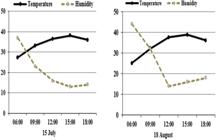
Data regarding temperature and humidity values on the day of harvest in the field trial are given in Figure 1. The average temperature values in July and August, when the harvests were made, were recorded as 30.9 and 30.1 degrees, respectively. Figure 1 shows the amount of humidity in the morning hours, which was higher in the August harvest compared to the July harvest. The highest humidity was noted in the morning hours, which decreased gradually during afternoon at 15:00 and thereafter.

Chromatograms of Dicle and Silbe O. basilicum ecotypes essential oils at two harvest periods.
The values in terms of temperature are close to each other in the first harvest period, while the values in terms of moisture values increased in the second harvest (Figure 1). Temperature varies considerably, especially during harvest hours. Medicinal and aromatic plants produce high yields as well as secondary metabolites at optimum temperatures. These products are significantly affected by temperature changes.
In Table I, it is shown that the essential oil content was significantly influenced by the ecotypes, the time of harvest, the harvest period and their interactions. Ecotype × harvest period × harvest time interaction was found statistically significant (p < 0.01). The essential oil content in Dicle ecotype ranged 0.61±0.02 l to 0.85±0.00%, and 1.03±0.06 to 0.77±0.01 in the first and 2nd harvest in the same sequence. The essential oil content in Silbe ecotype ranged 0.60±0.00 to 0.85±0.00 and 0.65±0.00 to 0.70±0.00 in the first and 2nd harvest, respectively.
Essential oil content of different sweet basil ecotypes harvested different time of the day.
The highest essential oil content was found from Dicle ecotype at 2nd harvest as 1.03% at 09:00, while the lowest essential oil content was obtained from the Silbe ecotype as 0.60% in the 1st harvest at 09:00 (Table I).
The essential oil content of Dicle ecotype was the highest at 12:00 (0.85%), while the minimum was obtained at 18:00 (0.61) in the first harvest period. In the Silbe ecotype maximum oil content (0.85%) was obtained from morning at 06:00 in the first harvest period, and minimum content (0.65%) at 06:00 and 18:00 hours in the second harvest period (Table I; Figure 2).
While the highest mean essential oil content for Dicle ecotype was obtained at 12:00 and 09:00, for Silbe ecotype was obtained at 06:00 and 12:00 during first and 2nd harvest period, respectively. Similar results were confirmed in our previous study Kizil et al. (2019) and Carvalho Filho et al. (2006) who have reported that harvesting should be done at 08:00 and 12:00 for high linalool and essential oil yield of O. basilicum.
Salehi & Hazrati (2017) obtained the highest essential oil percentage (1.11%) in German chamomile flowers harvested between 22:00-12:00, while the lowest essential oil percentage (0.65%) was obtained in flowers collected between 18:00-20:00. This diurnal change was induced due to the related to the temperature and moisture change during the day ending up with physiological modifications in the characteristics of the plant.
Interaction between different harvest periods and ecotypes was significantly important. When the two ecotypes were compared in terms of essential oil content averages, in the Dicle ecotype, the highest value (0.84%) was obtained at 09:00 and the minimum (0.74%) at 18:00, in the Silbe ecotype, the highest (0.75%) essential oil content was obtained at 06:00, the lowest (0.65%) at 09:000 and 15:00 (Table I, Figure 3).

Dicle ecotype (0.79%) has higher essential oil content than the Silbe ecotype (0.69%) (Figure 4). There is no significant difference in terms of average temperature between different harvest periods. Fluctuations were detected in the percentage of essential oil obtained in both harvest periods and ecotypes. Although, it is difficult to say a specific trend. It could be assumed that this could be due to fluctuations in day time temperature and humidity that constantly varied during day in agreement with Manukyan & Schnitzler (2006), who noted such variations in sage and lemon catmint plants. However, Bernhardt et al. (2015), Soltanbeigi et al. (2021), Abuhashem (2023) and Mulugeta et al. (2023) reported these components varied depending on many factors such as geographic location, environmental conditions, cultivation techniques, freshness or dryness of the plant material, genetic diversity, and cutting time also have their role.

Plants containing essential oils are more adapted to hot regions. In general, essential oil content increases from morning to noon, decreases in the afternoon due to the effect of temperature, and starts to increase again towards the evening hours. As daytime temperatures increase towards noon hours which cause water loss in plants as well as a decrease in the essential oil contents, in agreement with previous studies (Padalia et al. 2017, Gurbuz et al. 2006, Toncer et al. 2016). Khalid et al. (2009) reported in their study on Melissa officinalis that the essential oil content varied greatly during the first and second cutting, ranging from 0.12% to 0.25% (0.048 to 0.1000 g per plant), and the essential oil yield was particularly high at 17:00 during the first cutting (0.25% or 0.1000 g per plant). Karik et al. (2019) reported that essential oil concentration of Lippia citriodora leaves was found the highest (1.64%) in upper part of leaves at 16:00 and the lowest (0.78 %) in the lower part of leaves at 10:00.
Essential oil components
Chemical composition of two O. basilicum ecotypes essential oil harvested at different times during the day with GC–MS is shown in Figure 5, Tables II and III.

The main classes of components of sweet basil ecotypes essential oil were oxygenated monoterpenes (55.96% - 87.94% and 47.38% - 73.28%), oxygenated sesquiterpenes (4.63% - 22.29% and 3.69% - 14.60%) and sesquiterpene hydrocarbons (3.71% - 20.22% and 15.82% - 29.09%). Phenylpropanoids (0.00% - 1.29% and 0.79% - 3.74%) and monoterpene hydrocarbons (0.00% - 0.10% and 0.01% - 0.58%) were present in low amounts in all analyzed samples (Tables II and III). Oxygenated monoterpenes were higher compared to other groups, and these components showed highest value (77.03%) in the first harvest period at 12:00 in Dicle ecotype, while they gave the highest value (70.64%) in the second harvest period at 6:00 am in Silbe ecotype.
Malekshahi et al. (2021) also noted that more than 98% of essential oil components were hydrocarbon, oxygenated monoterpenes, oxygenated sesquiterpenes, and phenylpropanoids.
A total of twenty-seven constituents, representing 91.18 – 99.69% and 91.17 – 99.05% of the total oil composition were identified. In the distribution of the components constituting the oil, it was found that oxygenated monoterpenes were higher at 2nd harvest in the Dicle ecotype, while oxygenated sesquiterpenes were higher in 1st harvest. These changes in the group constituents were less pronounced in the Silbe ecotype (Table II and III).
Essential oil components of Dicle ecotype of O. basilicum at two cutting periods and different harvest hours
Essential oil components of Silbe ecotype of O. basilicum at two cutting periods and different harvest hours.
In ecotypes, linalool and methyl chavicol constitute 50-65% of the total oil. Previous studies have reported that there are different chemotypes in basil. The essential oil in both basil ecotypes; linalool, methyl chavicol, methyl cinnamate, β- elemene, cadinene, cadinol, 1,8 cineol were found as major compounds. Linalool ratio increased from morning hours to 12:00 noon, and then a decrease was again towards the end of the day. Linalool content was higher in the 2nd harvest compared to the 1st harvest (Tables II and III; Figure 6).

Variation of major essential oil components of O. basilicum ecotypes obtained by harvesting at different times of the day.
The amount of methyl chavicol in the first and second harvests increased from morning to noon hours. The rate at the beginning of the day decreased towards noon but increased again towards evening hours. While the methyl chavicol ratio varied between 11.58% and 35.48% in the Dicle ecotype, it varied between 1.31 and 4.51% in the Silbe ecotype (Tables II and III). Similar to our results, Skrubis & Markakis (1976) reported the percentage of linalool, the common component in basil oil, was fairly constant over the range of 9:00 to 12:00 h and 18:00 to 24:00 h, but decreased rapidly when the photoperiod was increased from 12:00 to 18:00 h.
The amount of epi alpha cadinol was greater in the first cutting than in the second cutting (Figure 6). Methyl cinnamate ratio showed significant differences among ecotypes. The methyl cinnamate rate of the Silbe ecotype was found to be significantly higher than the Dicle ecotype and to be significantly higher in the harvests made in the evening hours (Tables II and III). Moreover, while 1,8 Cineole was found at very low amount (0.00 - 2.95%) in Dicle ecotype, it was detected more high and at significant levels (0.64 - 11.54%) in the Silbe ecotype (Figure 6).
Essential oil components in both ecotypes gave similar results. No wide variation was observed. Some researchers reported variations in essential oil can be attributed to many factors, viz., genetic dissimilarity within accessions, climate variability, and origin of plants in addition to drying, storage, and extraction processes (Skrubis & Markakis 1976).
Khalid et al. (2009) found that the highest percentage of monoterpene compounds was resulted at 5 pm during the first and second cutting. The highest percentage of sesquiterpene compounds was resulted at 13:00 pm treatment during the first cutting while it resulted at 15:00 treatment during the second cutting.
It has also been reported that there are differences in terms of essential oil content and components between green and purple basil ecotypes. However, it is stated that the main component of essential oil in purple leaf varieties is linalool, while in green leaf ecotypes it is methyl chavicol (Rathore et al. 2022).
The chemical composition of ecotypes shows variation during daytime. Studies on the differences in essential oil yields obtained from daytime harvesting have been carried out on many medicinal and aromatic plants. According to the results of the studies, in general, it has been reported that the essential oils generally reach their highest content in the morning hours; however, this situation has varied depending on the medicinal and aromatic plants studied in different geographical regions (Kaya et al. 2012, Jose et al. 2015, Kizil et al. 2019, Yesil & Ozcan 2021).
It is difficult to independently distinguish the factor responsible for changes in secondary metabolite production. Because of the diurnal variation (combined effect of light quality, intensity and duration, relative humidity, temperature fluctuations during the day), temperature, relative humidity, intensity and duration of sunlight are interdependent and influence each other, which has a different impact on the production and quality of essential oil in different aromatic plants. Moreover, temperature is one of the main factors that varies from morning to evening and thus has significant effects on plant physiology, especially photosynthesis and various biochemical pathways (Padalia et al. 2017). De Vasconcelos Silva et al. (1999) reported that a considerable variation was observed in the eugenol yield, 98% at 12.00 am. to 11% at 05.00 p.m. These results show the influence of the solar light on eugenol production and can be useful to indicate the optimal time for collection of the plant. A study by Gurbuz et al. (2006) demonstrated that linalool (41.23%), α-cadinol (9.69%) and eugenol (5.37%) were found as major constituents of O. basilicum. In addition, essential oil ratios were recorded such as 0.67% at 6:00 h, 0.62% at 12:00 h and 0.74% at 21:00 h. Aygun et al. (2022) in their study with different basil genotypes, the main components of essential oils were determined as linalool, eucalyptol, trans α-bergamotene, methyl cinnamate, α-muurolol and eugenol. Moreover, Kholiya et al. (2022) reported that essential oil compositions were affected by phenological stages. They detected linalool (66.9-84.2%), geranial (1.1-9.0%), neral (0.8-7.0%) and 1,8-cineole (0.5-3.4%) as the main constituents. They reported that the linalool content tends to increase mainly in the middle of the day. A similar situation can be said for our study regarding linalool. Padalia et al. (2017) evaluated four different Ocimum species in terms of essential oil content and composition. Essential oil content and composition were compared according to different harvest times i.e. morning 6:00, noon 12:00 and evening 18:00. While O. basilicum, O. americanum and O. kilimandscharicum (camphor type) gave higher essential oil yield when harvested at noon, higher oil yield was obtained in O. gratissimum variety in the evening, followed by noon and morning harvest. In the O. kilimandscharicum (eugenol/methyl chavicol) chemotype, similar to our study, oil yield was found as morning > noon > evening. Turkmen & Ertekin (2023) reported in a study conducted with different basil genotypes that the main component of essential oil of all genotypes was linalool, that the highest essential oil content could be obtained from the dried flowers of Arapgir genotype harvested at 00:00 h, and also that the Midnight genotype had higher essential oil content than the others. In another study, Patel et al. (2018) analysed leaf samples collected at different times of the day to evaluate the daily changes in the chemical composition of O. sanctum leaves and did not find any significant difference in the chemical composition. They concluded that O. sanctum, unlike O. gratissimum, which is taxonomically very close to O. sanctum, does not show diurnal changes in its chemical composition.
Biplot analysis
The biplot analysis method, which has become widespread in recent years, is a method that can be used to determine the performance of parameters such as genotype, yield components, essential oil components and the relationships of these parameters with each other. The graphs formed in this method are obtained by using the average of the data (Hosseini et al. 2021, Kumar et al. 2024). In the graphs, the percentage of total variation created by the main component groups (harvest time and components) and their relationships with the investigated features are displayed with the component matrix (Rahimi et al. 2023).
For the Dicle ecotype, in the biplot graph obtained from the first harvest time averages, the two-dimensional PCA score was 51.15% for PC1 and 25.29% for PC2, respectively, and the total variation rate was determined as 76.44%. Five sectors and four mega environments were formed. In the visual, there is a positive relationship between the components and harvest times in the same sector and mega environment. Additionally, components positioned anti clockwise on the coordinate plane showed a negative correlation with components positioned clockwise (Yan & Tinker 2006, Pimentel et al. 2023). In the 1st sector, 5 (Linalool), 13 (β – cubebene) and 14 (Germacrene) had the highest means at 09:00 a.m. In the 2nd sector, components 2 (1.8 cineole), 4 (cis-α-bergamotene), 8 (α-bulnesene), 9 (α-bisabolene) and 26 (eugenol) are located and these components had the best means at 12.00 p.m. The most of components examined are located in the 3rd sector, and the components reached the best average in the harvest at 18:00 p.m. In the 4th sector, components 18 (Trans geraniol), 19 (citral), 21 (epi cubenol), 23 (epi alpha cadinol) and 25 (methyl cinnamete) came to the fore in the harvests made at 06:00 a.m and 15:00 p.m. There were no components in the 5th sector.
At second harvest time, the two-dimensional PCA score was determined as 41.61% for PC1 and 38.91% for PC2, respectively, and the total variation rate was determined as 80.52%. As a result of the analysis, three sectors and mega environments were formed. The most of components located in the 1st sector at 12:00. In the 2nd sector, components 1 (limonene), 2 (1.8 cineol), 6 (β - elemene), 7 (β-caryophyllene), 8 (α-bulnesene), 14 (germacrene) and 24 (isospathulenol) located and these components had the best means at 15.00 p.m. In the 3rd sector, components 15 (methyl chavicol) and 26 (eugenol) had the highest value at harvests of 06:00, 09:00 and 18:00. Hazrati et al. (2022) found in the results obtained by biplot analysis of the Salvia officinalis plant that the essential oil component ratios varied in harvests at different times of the day (Figure 7).

Biplot analysis based on the first and second principal components (PC) at different times of the day for first and second cuttings of Dicle ecotype. Components codes: 1 - limonene; 2 - 1.8 cineol; 3 - α-copaene; 4 - Cis-α-bergamotene; 5 - Linalool; 6 - Β- elemene; 7 - β-caryophyllene; 8 - α-bulnesene; 9 - α-bisabolene; 10 - Bornyl acetate; 11 - Alpha humulene; 12 - γ-cadinene; 13 - β–cubebene; 14 - Germacrene D; 15 - Methyl chavicol; 16 - α-terpineol; 17 - Cis geraniol; 18 - Trans geraniol; 19 - Citral; 20 - Nerolidol; 21 - Epi cubenol; 22 - methyl eugenol; 23 - Epi alpha cadinol; 24 - Isospathulenol; 25 - methyl cinnamete; 26 - Eugenol.
For the Silbe ecotype, in the biplot analysis conducted for the first harvest time, the two-dimensional PCA score was 39.60% for PC1 and 31.97% for PC2, respectively, and the total variation rate was determined as 71.57%. As a result of the analysis, three sectors and mega environments were formed. In the 1st sector, 3 (α-copaene), 5 (linalool), 16 (α-terpineol), 20 (nerolidol), 22 (methyl eugenol) and 25 (methyl cinnamete) numbered components had the best averages in the harvests at 09:00 and 12:00. The most of components located in the 2nd sector and had the best averages at harvests 06.00 and 18:00. In the 3rd sector, components 7 (β-caryophyllene), 8 (α-bulnesene), 10 (bornyl acetate), 12 (γ-cadinene), 19 (citral) and 23 (epi alpha cadinol) represented the highest average at 15.00 p.m.
At the second harvest time, the two-dimensional PCA score was 48.54% for PC1 and 26.11% for PC2, respectively, and the total variation rate was determined as 74.65%. As a result of the analysis, four sectors and mega environments were formed. Components numbered 8 (α-Bulnesene) and 15 (methyl chavicol) located in the 1st sector and these components had the best averages at 18:00 p.m. The most of the components examined are located in the 2nd sector and that the components reached the best average in the harvest at 15:00 p.m. Components numbered 3 (α-copaene), 5 (linalool), 10 (bornyl acetate), 22 (methyl eugenol), 25 (methyl cinnamete) and 26 (eugenol) located in the 3rd sector and represented the highest averages at 06:00. In the 4th sector, components 1 (limonene), 2 (1.8 Cineol) and 24 (isospathulenol) performed the highest averages at 09:00 and 12:00 (Figure 8).

Biplot analysis based on the first and second principal components (PC) at different times of the day for first and second cuttings of Silbe ecotype. Components codes: 1 – limonene; 2 - 1.8 cineol; 3 - α-copaene; 4 - Cis-α-bergamotene; 5 – Linalool; 6 - Β-elemene; 7 - β-caryophyllene; 8 - α-bulnesene; 9 - α-bisabolene; 10 - Bornyl acetate; 11 - Alpha humulene; 12 - γ-cadinene; 13 - β –cubebene; 14 - Germacrene D; 15 - Methyl chavicol; 16 - α-terpineol; 17 - Cis geraniol; 18 - Trans geraniol; 19 – Citral; 20 – Nerolidol; 21 - Epi cubenol; 22 - methyl eugenol; 23 - Epi alpha cadinol; 24 – Isospathulenol; 25 - methyl cinnamete; 26 – Eugenol.
CONCLUSIONS
The highest essential oil content for the Dicle ecotype was determined at 12:00 in the first harvest period and at 9:00 in the second harvest period. The highest essential oil content for the Silbe ecotype was obtained at 06:00 in the first harvest period and at 12:00 in the second harvest period. It was determined that both ecotypes contained linalool as the major component, and the linalool content varied between 27.41-59.38% in the Dicle ecotype and 19.97-49.49% in the Silbe ecotype. Linalool content showed a gradual increase towards noon in both ecotypes, and a decrease from afternoon to evening. Future studies should focus on herb yield, harvest time and chemotype of sweet basil for inclusion in variety breeding programs.
Acknowledgements
This work did not receive funding from any funding agency.
References
- ABUHASHEM YS, KHALIL HB & EL-TAHAWEY MAFA. 2023. Exploring the morphological and genetic diversity of Egyptian basil landraces (Ocimum sp.) for future breeding strategies. Beni-Suef Univ J Basic Appl Sci 12(1): 70. doi: 10.1186/s43088-023-00408-2.
- AKGUL A. 1993. Spice science and technology. Turkish Association Food Technologists. Ankara, Turkey: ASÜD 15: 110 p.
- AYGUN YZ, EREN Y & ERTEKIN EN. 2022. Diurnal variation of essential oil ratio and composition of some basil genotypes. Bangladesh J Bot 51(4): 787-795. doi: 10.3329/bjb.v51i4.63498.
-
BAKHTIAR Z, HASSANDOKHT M, NAGHAVI MR & MIRJALILI MH. 2024. Phenotypical, genetic structure, and essential oil characteristics of twenty Ocimum basilicum L. agro-ecotypic populations from Iran. Sci Hortic 326: 112748. https://doi.org/10.1016/j.scienta.2023.112748.
» https://doi.org/10.1016/j.scienta.2023.112748 -
BERNHARDT B, SZABÓ K & BERNÁTH J. 2015. Sources of variability in essential oil composition of Ocimum americanum and Ocimum tenuiflorum Acta Alimentaria 44: 111-118. doi.org/10.1556/aalim.44.2015.1.11.
» https://doi.org/10.1556/aalim.44.2015.1.11 -
CARVALHO FILHO JLS, BLANK AF, ALVES PB, EHLERT PA, MELO AS, CAVALCANTI SCH, ARRIGONI-BLANK MF & SILVA-MANN R. 2006. Influence of the harvesting time, temperature and drying period on basil (Ocimum basilicum L.) essential oil. Rev Bras Farmacogn 16: 24-30. doi.org/10.1590/S0102-695X2006000100007.
» https://doi.org/10.1590/S0102-695X2006000100007 - CHANG X, ALDERSON PG & WRIGHT CJ. 2009. Variation in the essential oils in different leaves of basil (Ocimum basilicum L.) at day time. Hortic J 2: 13-16.
- DE VASCONCELOS SILVA MG, CRAVEIRO AA, MATOS FA, MACHADO MIL & ALENCAR JW. 1999. Chemical variation during daytime of constituents of the essential oil of Ocimum gratissimum leaves. Fitoterapia 70(1): 32-34. doi: 10.1016/S0367-326X(98)00020-3.
- FIGUEIREDO AC, BARROSO JG, PEDRO LG & SCHEFFER JJ. 2008. Factors affecting secondary metabolite production in plants: volatile components and essential oils. Flavour Fragr J 23(4): 213-226. doi: 10.1002/ffj.1875.
- GENSTAT. 2009. GenStat for Windows (12th edition). Introduction. VSN International, Hemel Hempstead. GenStat.co.uk.
- GURBUZ B, IPEK A, BASALMA D, SARIHAN EO, SANCAK C & OZCAN S. 2006. Effects of diurnal variability on essential oil composition of sweet basil (Ocimum basilicum L.). Asian J Chem 18(1): 285-288.
- HAZRATI S, BEIDAGHI P, BEYRAGHDAR KASHKOOLI A, HOSSEINI SJ & NICOLA S. 2022. Effect of harvesting time variations on essential oil yield and composition of Sage (Salvia officinalis). Horticulturae 8(2): 149. doi: 10.3390/horticulturae8020149.
- HAZRATI S, MOUSAVI Z & NICOLA S. 2024. Harvest time optimization for medicinal and aromatic plant secondary metabolites. Plant Physiol Biochem 212: 108735. doi: 10.1016/j.plaphy.2024.108735.
- HOMER LE, LEACH DN, LEA D, LEE LS, HENRY RJ & BAVERSTOCK PR. 2000. Natural variation in the essential oil content of Melaleuca alternifolia Cheel (Myrtaceae). Biochem Syst Ecol 28(4): 367-382. doi: 10.1016/S0305-1978(99)00071-X.
- HOSSEINI SJ, TAHMASEBI-SARVESTANI Z, PIRDASHTI H, MODARRES-SANAVY SAM, MOKHTASSI-BIDGOLI A, HAZRATI S & NICOLA DS. 2021. Investigation of yield, phytochemical composition, and photosynthetic pigments in different mint ecotypes under salinity stress. Food Sci Nutr 9: 2620-2643. doi: 10.1002/fsn3.2219.
- HUSSAIN AI, ANWAR F, HUSSAIN SHERAZI ST & PRZYBYLSKI R. 2008. Chemical composition, antioxidant and antimicrobial activities of basil (Ocimum basilicum) essential oils depends on seasonal variations. Food Chem 108(3): 986-995. doi: 10.1016/j.foodchem.2007.12.010.
- JAVANMARDI J, STUSHNOFF C, LOCKE E & VIVANCO JM. 2003. Antioxidant activity and total phenolic content of Iranian Ocimum accessions. Food Chem 83(4): 547-550. doi: 10.1016/S0308-8146(03)00151-1.
- JOSE JV, MARQUES PAA, DA SILVA LP, FRANCISCO JP & DA ROCHA HS. 2015. Analysis of harvest time and plant parts for the extractıon of basil essential oil. Rev Em Agronegocio Meio Ambiente 8: 55-70. doi: 10.17765/2176-9168.2015v8nEd.esp.p55-70.
- KARIK U, CINAR O, TUNCTURK M & SEKEROGLU N. 2019. Morphological and diurnal variability of essential oil in lemon verbena (Lippia citriodora HBK). ANADOLU 29(2): 114-120. doi: 10.18615/anadolu.660270.
- KAYA DA, INAN M, GIRAY ES & KIRICI S. 2012. Diurnal, ontogenetic and morphogenetic variability of Lavandula stoechas L. ssp. stoechas in east Mediterranean region. Revista De Chimie 63: 749-753.
-
KHALID KA, HU W, CAI W & HUSSIEN MS. 2009. Influence of cutting and harvest day time on the essential oils of lemon balm (Melissa officinalis L.). Essent Oil-Bear Plants 12(3): 348-357. doi.org/10.1080/0972060X.2009.10643730.
» https://doi.org/10.1080/0972060X.2009.10643730 - KHOLIYA S, PUNETHA A, KUMAR D, UPADHYAY RK & PADALIA RC. 2022. Essential oil yield and composition of Ocimum basilicum L. at different phenological stages, plant density and post-harvest drying methods. S Afr J Bot 151: 919-925. doi: 10.1016/j.sajb.2022.11.019.
- KIZIL S, TONCER O, DIRAZ E & KARAMAN S. 2015. Variation of agronomical characteristics and essential oil components of thyme (Thymbra spicata L. var. spicata) populations in semi-arid climatic conditions. Turk J Field Crops 20(2): 242-251. doi: 10.17557/tjfc.46517.
- KIZIL S, TONCER O, SOGUT T, DIRAZ E & KARAMAN S. 2019. Determination of some agronomical characteristics and essential oil variation in different local Ocimum basilicum L. ecotypes under semi-arid climatic conditions. Acta Sci Pol Hortorum Cultus 18(3): 3-15. doi: 10.24326/asphc.2019.3.1.
- KUMAR A, SHARMA N, KUMAR A, KUMAR D, JNANESHA AC, GUPTA AK & LAL RK. 2024. Differential responses of genotype× environment interaction on agronomic interventions affect the yield and quality of essential oil of interspecific basil hybrid of Ocimum basilicum L.× Ocimum kilimandscharicum Ecol Genet Genom 30: 100217. doi: 10.1016/j.egg.2024.100217.
- MALEKSHAHI F, MEHRABI AA, TAVAKOL E, MEHDIKHANLO K & SHARIATI V. 2021. The comparison of the essential oil percentage content and composition of african basil (Ocimum gratissimum L.) in spring and fall harvests. Hortic Sci 35(2): 209-221. doi: 10.22067/jhs.2021.61739.0.
- MANUKYAN AE & SCHNITZLER WH. 2006. Influence of air temperature on productivity and quality of some medicinal plants under controlled environment conditions. Eur J Hortic Sci 71(1): 36.
- MULUGETA SM, SÁROSI S & RADÁCSI P. 2023. Physio-morphological trait and bioactive constituents of Ocimum species under drought stress. Ind Crops Prod 205: 117545. doi: 10.1016/j.indcrop.2023.117545.
- NURZYNSKA-WIERDAK R, BOROWSKI B, DZIBA K, ZAWISLAK G & KOWALSKI R. 2013. Essential oil composition of sweet basil cultivars as affected by nitrogen and potassium fertilization. Turk J Agric For 37: 427-436. doi: 10.3906/tar-1203-43.
- OZCAN M & CHALCHAT JC. 2002. Essential oil composition of Ocimum basilicum L. Czech J Food Sci 20(6): 223-228.
- PADALIA RC, VERMA RS & CHAUHAN A. 2017. Diurnal variations in aroma profile of Ocimum basilicum L., O. gratissimum L., O. americanum L, and O. kilimandscharicum Guerke. Essent Oil Res 29(3): 248-261. doi:10.1080/10412905.2016.1216898.
- PATEL N, KANAKI N & MOVALIYA V. 2018. Assessment of diurnal variation in Ocimum sanctum Linn. by gas chromatographic fingerprint analysis coupled with chemometric methods. Plant Sci Today 5(3): 131-134. doi: 10.14719/pst.2018.5.3.413.
- PIMENTEL FAG, SILVA MA, MEDEIROS SDS, LUZ JMQ & SALA FC. 2023. Agronomic, sensory and essential oil characterization of basil (Ocimum basilicum L.) accessions. Horticulturae 9(7): 831. doi: doi.org/10.3390/horticulturae9070831.
- RAHIMI M, MORTAZAVI M, MIANABADI A & DEBNATH S. 2023. Evaluation of basil (Ocimum basilicum) accessions under different drought conditions based on yield and physio-biochemical traits. BMC Plant Biology 23(1): 523. doi: 10.1186/s12870-023-04554-8.
- RAMEZANI S, REZAEI MR & SOTOUDEHNIA P. 2009. Improved growth, yield and essential oil content of basil grown under different levels of phosphorus sprays in the field. Appl Biosci 3(2): 96-101.
- RATHORE S, MUKHIA S, KAPOOR S, BHATT V, KUMAR R & KUMAR R. 2022. Seasonal variability in essential oil composition and biological activity of Rosmarinus officinalis L. accessions in the western Himalaya. Sci Rep 12(1): 3305. doi: 10.1038/s41598-022-07298-x.
-
SALEHİ A & HAZRATİ S. 2017. How essential oil content and composition fluctuate in German chamomile flowers during the day? Essent Oil-Bear Plants 20(3): 622-631. doi.org/10.1080/0972060X.2017.1351895.
» https://doi.org/10.1080/0972060X.2017.1351895 - SKRUBIS B & MARKAKIS P. 1976. The effect of photoperiodism on the growth and the essential oil of Ocimum basilicum (sweet basil). Econ Bot 30: 389-393.
- SOLTANBEIGI A, OZGUVEN M & HASSANPOURAGHDAM MB. 2021. Planting-date and cutting-time affect the growth and essential oil composition of Mentha piperita and Mentha arvensis Ind Crops Prod 170: 113790. doi: 10.1016/j.indcrop.2021.113790.
-
TELCI I, ELMASTAS M & SAHIN A. 2009. Chemical composition and antioxidant activity of Ocimum minimum essential oils. Chem Nat Compd 45: 568-571. https://doi.org/10.1007/s10600-009-9369-z.
» https://doi.org/10.1007/s10600-009-9369-z - TONCER O, KARAMAN S, DIRAZ E, SOGUT T & KIZIL S. 2016. Diurnal variation effects in essential oils of wild thyme (Thymbra spicata var. spicata L.) under cultivation conditions. Essent Oil-Bear Plants 19(8): 2037-2048. doi: 10.1080/0972060X.2016.1252694.
- TURKMEN M & ERTEKIN EN. 2023. Essential oil content and components in different purple basil genotypes according to the diurnal changes. Bangladesh J Bot 52(2): 357-367. doi: 10.3329/bjb.v52i2.67037.
- YAN W & TINKER NA. 2006. Biplot Analysis of Multi-Environment Trial Data: Principles and Applications. Can J Plant Sci 86: 623-645. doi: 10.4141/P05-169.
- YESIL M & OZCAN MM. 2021: Effects of harvest stage and diurnal variability on yield and essential oil content in Mentha× piperita L. Plant Soil Environ 67(7): 417-423. doi: 10.17221/114/2021-PSE.


