 First record of Polypedilum mehinaku (Chironomidae) galls induced in the aquatic angiosperm Mourera fluviatilis (Podostemaceae) for Bahia, Brazil
Abstract
Galls induced by insects on aquatic angiosperms are rare and poorly understood. To expand our knowledge of these galls on aquatic host plants and update the distribution of their gall-inducing insect, we present the first record of Polypedilum mehinaku galls on Mourera fluviatilis in Bahia, thus expanding the area in which the gall-inducing insect is found, whose distribution was restricted to Pará. The galls are globoid, green, unilocular, glabrous, and induced individually along the leaf veins. The results confirm previous records of galls on M. fluviatilis and extend the geographical distribution of the gall-inducing insect in Brazil.
Key words
Atlantic forest; Diptera; Gall-inducing insects-host plant interaction; Macrophyte; Northeast Brazil
INTRODUCTION
Insect galls are morphological and anatomical changes that occur in plant tissues as a result of the parasitic and species-specific interactions between host plants and gall-inducing insects (Stone & Schönrogge 2003). These structures have stimulated growing scientific interest in various regions of the world and are being studied for their ecological complexity and evolutionary relevance (Oliveira et al. 2006), particularly in terrestrial ecosystems and, less frequently, in aquatic environments (Maia & Silva 2021).
Galls induced on aquatic angiosperms are rare and poorly understood (e.g., Fernandes & Lara 1997, Peláez-Rodríguez et al. 2003, Jäger-Zürn et al. 2013). Several factors may limit gall induction in aquatic environments, including water dynamics that impede insect colonization, flexible and less lignified plant tissues that may be less attractive, and high insect mortality due to pathogens. Despite their rarity, galls induced on aquatic plants offer unique ecological niches that provide shelter and resources for associated invertebrate fauna, thereby influencing community structure and abundance (Peláez-Rodríguez et al. 2003). Moreover, these galls constitute a valuable model for investigating the evolutionary processes and adaptive significance underlying insect gall induction.
To expand our knowledge of induced galls on aquatic plants and update the distribution of their gall-inducing insects, we present the first record of a Polypedilum mehinaku Bidawid & Flittkau, 1996 (Diptera, Chironomidae) gall on Mourera fluviatilis Aubl. (Podostemaceae) in the Brazilian state of Bahia.
MATERIALS AND METHODS
Study area
This study was carried out in the rocky rapids section of the Piau River (13°20’46.64”S, 39°8’50.09”O), located in Valença municipality, southern Bahia state (Figure 1). The Piau River, a tributary of the Una River, plays a significant role in the local hydrography and contributes to the municipal seat’s water supply. The region’s vegetation is dense ombrophilous forest, which covers an area of 28,884.98 hectares in the municipality of Valença (SOS Mata Atlântica 2020).
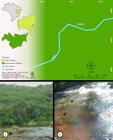
Geographic location of the Piau River, municipality of Valença, Bahia, Brazil. a: Piau riverbed. b: Sampled population of Mourera fluviatilis Aubl. (Podostemaceae). Photos: Fabiano Santos.
Study Species
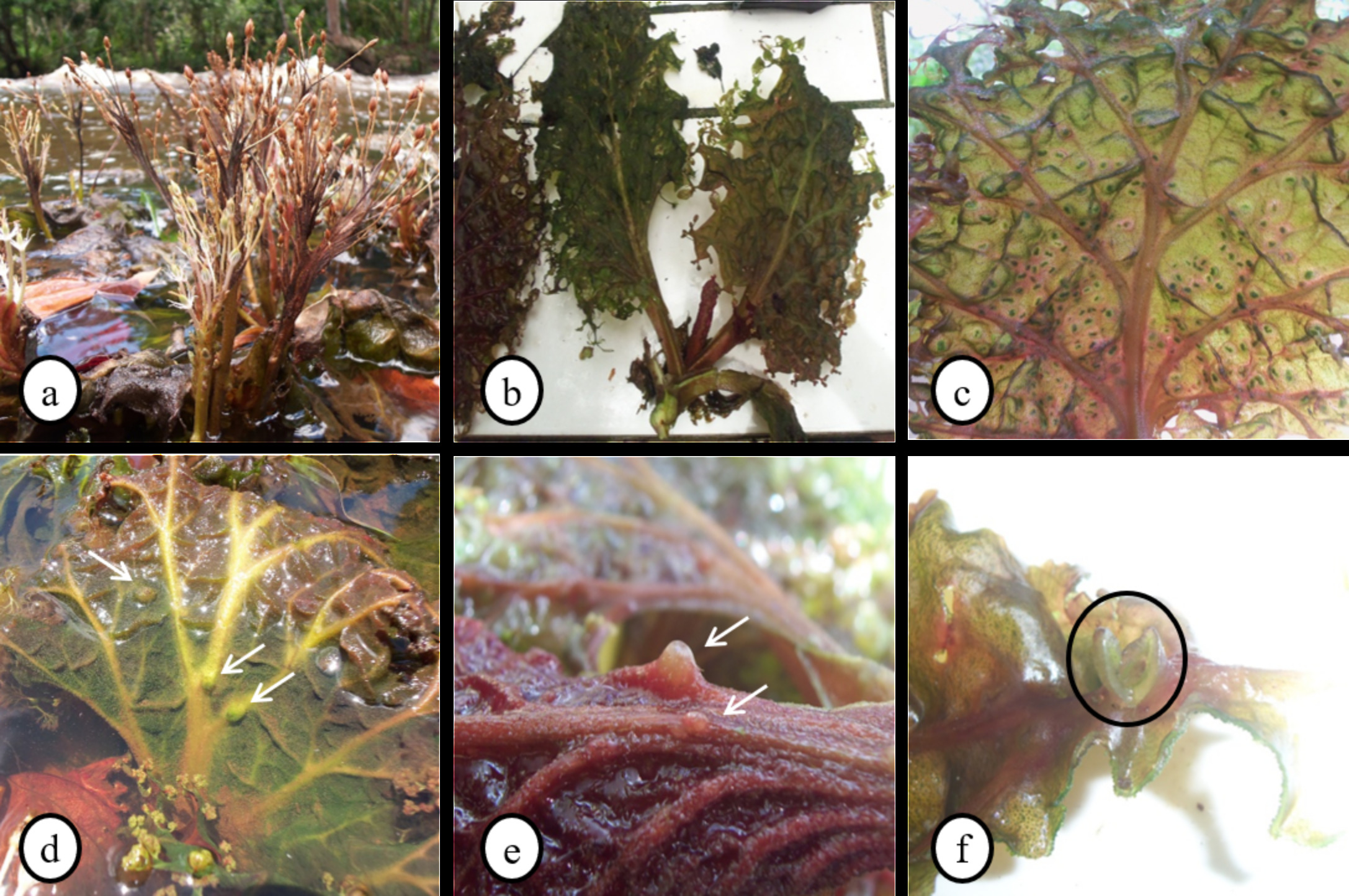
Mourera fluviatilis is an aquatic plant in the Podostemaceae family. It has a prostrate, bifacial stem which is fully anchored to the solid substrate. It has membranaceous, pinnatifid leaves and spiciform inflorescences bearing lilac or pink flowers (Figures 2a-c). It occurs in northeastern South America, including Venezuela, the Guianas, and Brazil, where it has a disjunct distribution between northern and northeastern states (Philbrick et al. 2010, Pellegrini et al. 2025). It is found attached to rocks in rapids and waterfalls, forming dense mats that often dominate these habitats. These mats offer shelter and food for various freshwater animals (Jäger-Zürn et al. 2013).
Sampling of galls and host plant
Collections were made in January and February 2021 (in the southern hemisphere summer), when the river level was at its lowest. The galls were collected (N=40) and photographed, and their morphological characteristics were noted. Some of the galls were stored in plastic containers to allow the emergence of the inducing insects (or any associated fauna). Other samples were dissected under a stereomicroscope to extract larvae and to determine the number of chambers. Both the larvae and the emerging winged insects (N=10) were preserved in 70% ethanol. The identification of the insect species was undertaken by comparisons with the morphotype of known gall-inducing insect previously identified for Mourera fluviatilis and confirmed by a specialist. The identification of the host plant was made by comparisons with specimens previously identified and confirmed by specialists.
RESULTS
Mourera fluviatilis hosts globoid galls that are green in color, glabrous, and 0.5–1 cm in diameter, with a central cavity which is inhabited by the larva (Figures 2d-f). These galls are induced by Polypedilum mehinaku along the veins of its leaves (Figures 2d-e). The infested part of the leaf appears swollen and much thicker than the uninfested part.
Leaf galls induced by Polypedilum mehinaku Bidawid & Flittkau, 1996 (Chironomidae) induced in the aquatic angiosperm Mourera fluviatilis Aubl. (Podostemaceae). a: Detail of inflorescence; b: Stem; c: Datail leaf lamina showing venation; d: Submerged leaf showing galls; e: Lateral view of galls; f: Larval chamber. Photos: Fabiano Santos.
DISCUSSION
Polypedilum mehinaku was described by Bidawid & Fittkau (1996) based on a specimen collected in the state of Pará in the upper reaches of the Paru de Oeste River. This area is located close to the Missioneira and has been traditionally occupied by the Tiriyó people. The epithet ‘mehinaku’ is a tribute to the Mehinako, an indigenous group inhabiting the Upper Xingu region.
The first records of P. mehinaku galls on M. fluviatilis leaves (Fittkau 1971, Bidawid & Fittkau 1996) were documented in the type locality, and is being documented for the first time in Bahia state. The galls reported here were an chance discovery in connection with fieldwork designed for other purposes in the municipality of Valença, located in southern Bahia state. The plants were sampled relatively easily during the dry season, when the waters of the Piau River were at their lowest.
It is expected that P. mehinaku will occur in other Brazilian states where M. fluviatilis has been confirmed. Galling insects are a specialized group of herbivorous insects that manipulate the tissues of host plants, altering cell growth and inducing gall formation (Oliveira et al. 2016). This interaction is specific in that gall-inducing insects can only induce galls on one or a few genetically related host plants (Mendonça 2007). Consequently, the distribution of gall-inducing insects is strongly influenced by the distribution of their host plants.
Our findings provide the first record of galls on aquatic macrophytes in northeastern Brazil and expand the known distribution of P. mehinaku to Bahia. Further research is needed to discover the many other interesting results associated with this system.
Acknowledgements
We thank the Fundação de Amparo à Pesquisa do Estado da Bahia – FAPESB for the study grant awarded to GAB Melo and to FJ Santos; Dr. Patrícia Reis (INPA) and Dr. Edson Moura (UNIVASF) for their help in identifying the gall-inducing insect and host plant, respectively.
References
- BIDAWID N & FITTKAU EJ. 1996. Zur Kenntnis der neotropischen Arten der Gattung Polypedilum Kieffer, 1912. Teil 1 (Diptera, Chironomidae). Entomofauna 16(27): 465-534.
- FERNANDES GW & LARA ACF. 1997. Leaf galls on an aquatic macrophyta, Nymphoides indica (Nymphaeaceae), in Rio Doce Valley, Brazil. Bios 5(5): 65-67.
- FITTKAU EJ. 1971. Distribution and ecology of Amazonian chironomids. Can Entomol 103: 407-413.
- JÄGER-ZÜRN I, SPIES M, PHILBRICK CT, BOVE CP & MORA-OLIVO A. 2013. Plant galls (cecidia) in the neotropical water plant family Podostemaceae induced by larvae of Chironomidae. Spixiana 36(1): 97-112.
- MAIA VC & SILVA BG. 2021. Galhas de insetos do Cerrado Brasileiro: fauna associada. Biota Neotrop 21: e20211202.
- MENDONÇA MS JR. 2007. Plant diversity and galling arthropod diversity searching for taxonomic patterns in an animal-plant interaction in the neotropics. Bol Soc Argent Bot 42(3): 347-357.
- OLIVEIRA DC, CHRISTIANO JCS, SOARES GLG & ISAIAS RMS. 2006. Reações de defesas químicas e estruturais de Lonchocarpus muehlbergianus Hassl. (Fabaceae) a ação do galhador Euphalerus ostreoides Crawf. (Hemiptera: Psyllidae). Braz J Bot 29(4): 657-667.
- OLIVEIRA DC, ISAIAS RMS, FERNANDES GW, FERREIRA BG, CARNEIRO RGS & FUZARO L. 2016. Manipulation of host plant cells and tissues by gall-inducing insects and adaptive strategies used by different feeding guilds. J Insect Physiol 84: 103-113.
- PELÁEZ-RODRÍGUEZ M, TRIVINHO-STRIXINO S & URSO-GUIMARÃES MV. 2003. Galls in rhizome of an aquatic macrophyte, Eichhornia azurea (Swartz) kunth (Pontederiaceae), in Jataí Ecological Station, Luiz Antônio, SP, Brazil. Braz J Biol 63(4): 723-726.
-
PELLEGRINI MOO, BOVE CP & PHILBRICK CT. 2025. Mourera in Flora e Funga do Brasil. Jardim Botânico do Rio de Janeiro. Available at: https://floradobrasil.jbrj.gov.br/consulta/ficha.html?idDadosListaBrasil=87123 Access: May 19, 2025.
» https://floradobrasil.jbrj.gov.br/consulta/ficha.html?idDadosListaBrasil=87123 - PHILBRICK CT, BOVE CP & STEVENS HI. 2010. Endemism in Neotropical Podostemaceae. Ann Missouri Bot Gard 97(3): 425-456.
-
SOS MATA ATLÂNTICA. 2020. Mata Atlântica: Restam apenas 12,4% da floresta que existia originalmente. Available at: https://www.sosma.org.br
» https://www.sosma.org.br - STONE GN & SCHÖNROGGE K. 2003. The adaptive significance of insect gall morphology. Tree 18: 512-522.
Edited by
-
Handling editor
Leandro Juen
All data generated or analyzed during this study are included in this published article.