 Wood as Cultural and Biodiversity Heritage: a case study at Fazenda Dois Rios, Rio de Janeiro, Brazil
Abstract
Wood has always been fundamental to human development, serving as a raw material for buildings, tools, and other artefacts. Its diverse applications over time are recognised as part of our cultural heritage, as wood not only holds aesthetic value but also embodies the skills and knowledge of past generations. Additionally, the taxonomic identification of the species from which these historic woods were sourced provides insights into the flora of different regions worldwide. These aspects gain greater importance when evaluated together at the only UNESCO Mixed Heritage Site of Culture and Biodiversity in Brazil, Paraty and Ilha Grande. Thus, we examined the wood used in the construction of a 18th century warehouse on Ilha Grande. The identification of the samples began with the InsideWood database to generate preliminary taxa. Detailed anatomical comparisons were conducted using databases, literature, and reference collection. Species were selected for comparison based on anatomical similarity, commercial relevance, geographic distribution, and local floristic records. Seven different taxa were identified, six of which are compatible with the local formation of Atlantic Forest. These wood identifications expand the knowledge of the region’s cultural and environmental heritage and ratify the use of wood as an analytical tool for understanding environmental history.
Key words
biodiversity and conservation; historical anatomy; historical wood; UNESCO heritage
INTRODUCTION
Wood is considered an indispensable raw material for the development of humanity (Lourenço & Branco 2012, Santini Junior et al. 2020), as evidenced by its multiple uses (Mainieri & Chimelo 1989, Paula & Alves 1997). One of the oldest uses of wood is in the construction of temporary or permanent shelters, which have been modified to the present day (Lourenço & Branco 2012). Barham et al. (2023) described the structural use of wood in a building at least 476,000-years-old in Kalambo Falls, Zambia. This is the oldest record of the use of wood in foundations and possibly served to install a raised platform, walkway or house. In Brazil, wooden piles at platforms of buildings dating back over 2,250 years were found in mangroves of the state of Santa Catarina (Melo Júnior et al. 2016), while wooden stilts at least 1,230 and 1,050-years-old were found in the state of Maranhão (Gonçalves et al. 2021). These latter woods, used by the “water people,” elevated buildings over rivers, preventing them from being swept away by the current, and facilitated subsistence fishing.
Analysis of the constituent materials of historic buildings reveals information that is often not available in existing documents. Thus, buildings that have survived over the years are testimonials of material and immaterial culture, and show the extraction and use of wood in a given period of time (Andreacci & Melo Júnior 2011, Neto Boschetti et al. 2014, Dong et al. 2017, Di Giulio et al. 2020, Omurova et al. 2020, Nascimento Silva et al. 2022). In this context, studies focusing on the anatomical identification of wood have added important information about the analysed material heritage. Furthermore, such studies enable the assessment of the composition of the local flora, thereby explaining the evolution of the current landscape (e.g. Andreacci & Melo Júnior 2011, Melo Júnior 2012, Neto Boschetti et al. 2014, Dong et al. 2017, Omurova et al. 2020, Nascimento Silva et al. 2022).
The present study was conducted at one of the 40 Mixed Heritage Sites of Culture and Biodiversity recognized by UNESCO worldwide (UNESCO 2024). This unique site in Brazil encompasses Ilha Grande (UNESCO 2019), a significant Atlantic Forest remnant with evidence of human occupation dating back over 3,000 years BP (Callado et al. 2009, Santiago et al. 2009). The forest legacy of this island environment is the result of interactions between past populations and the environment, as well as the landscape configuration, creating a system managed for centuries by successive generations (Oliveira & Coelho Netto 2006). This management included the establishment of farms, a quarantine station for maritime travellers (lazaretto), and prisons (Santiago et al. 2009).
The present study highlights Fazenda Dois Rios, built in the 18th century. The farm was initially dedicated to the production of sugarcane and then to coffee. According to a 1794 record, Fazenda Dois Rios already demonstrated effective activity in the production of sugarcane (Schnoor 2012), while the good quality of its construction was still highlighted in 1851 (Mello 1987). With its acquisition by the Brazilian Empire in 1894, the buildings belonging to the old farm were used to operate the first prison institution on Ilha Grande, the Colônia Correcional de Dois Rios (Santiago et al. 2009). Significant among the reused buildings were the farm headquarters (as administration and director’s residence), the slave quarters (enlarged and transformed into cells) and the large warehouse.
Only the warehouse remains standing, and has been partially restored. During the prison period (1894-1994), this building changed from a warehouse to a prison for women and minors, and later functioned as a place to store materials; perform janitorial, carpentry and barbershop activities; and house offices for the prison institutions that followed (Xavier unpublished data, Santiago unpublished data, Santos Miranda & Almeida Rosso 2015). The building currently houses the Museu do Meio Ambiente, one of the four centres that compose the Ecomuseu Ilha Grande of Universidade do Rio de Janeiro (Santos Miranda & Almeida Rosso 2015). The walls of this construction from the Brazilian colonial period feature the use of geometric stones (masonry stones), irregular stones (handmade stones) and clay tiles, and there are traces of shells in the binding material (sambaqui lime), common characteristics of buildings of the 1700s (Mori 1987, Alvim 1997, Marcolin 2011). Wood also played an important role in the construction of the warehouse, being used to frame walls, make doors and windows, and structure roofs.
In this sense, the present study aimed to identify, through wood anatomy, the taxa whose wood was used in the warehouse of Fazenda Dois Rios - one of the oldest buildings still standing on Ilha Grande - and to analyse the possible occurrence of these taxa in the local forest, ultimately associating aspects of culture and biodiversity in this only UNESCO Mixed Heritage Site in Brazil.
MATERIALS AND METHODS
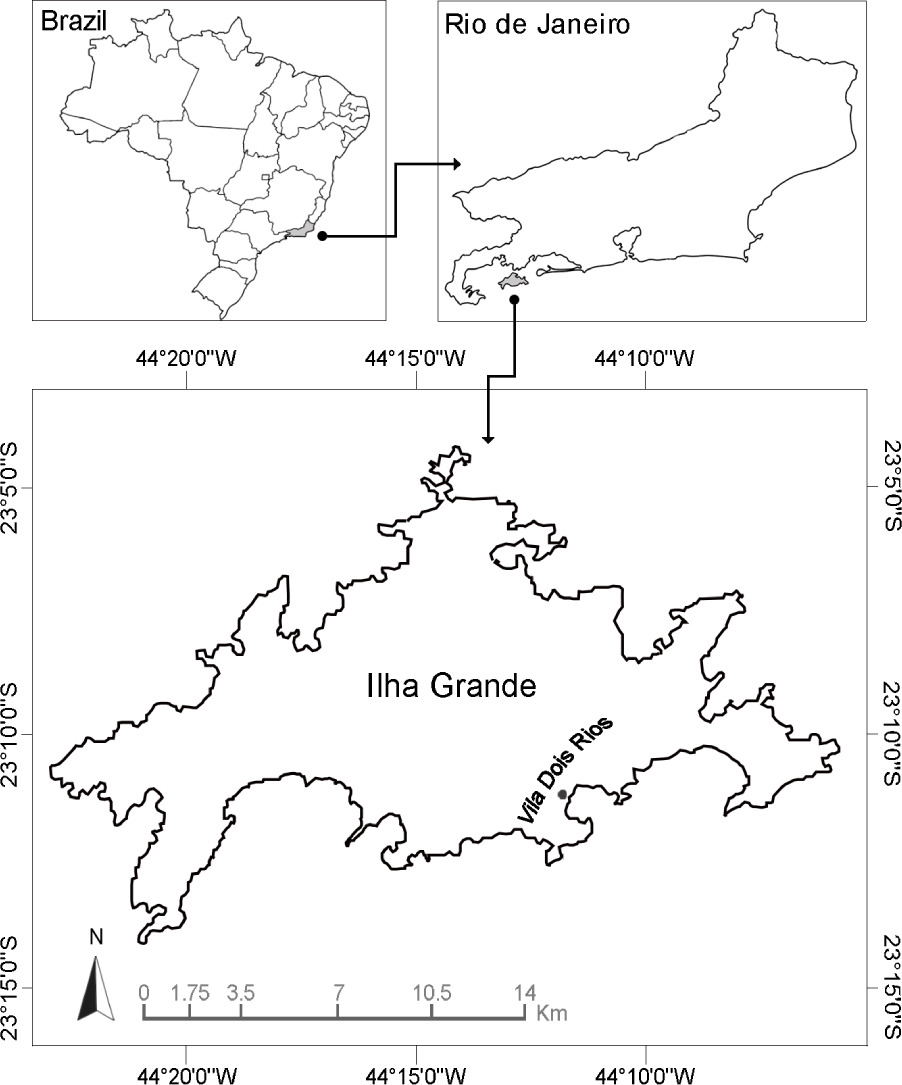
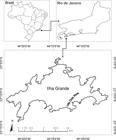
The investigated historical property, the warehouse of Fazenda Dois Rios, is located in Vila Dois Rios on the southeastern slope of Ilha Grande, municipality of Angra dos Reis, state of Rio de Janeiro, Brazil, at the geographic coordinates 23°10’51.5”S, 44°11’27.2”W (Fig. 1, 2a).
Samples were collected during restoration work on the property, employing a saw, chisel and hammer, seeking to minimize damage to the investigated structures. Wood samples from 10 different structural parts of the historic building were investigated (Fig. 2b-h). Standardized blocks of wood were made for each of the investigated structures. These blocks were used to calculate basic wood density, defined as the ratio of oven-dry mass to green volume (Coradin & Muniz 1992), while the another part, intended for histology, was oriented in transverse, tangential longitudinal and radial longitudinal planes and softened by boiling in water and glycerine (Burger & Richter 1991), or by soaking in 10% ethylenediamine (Carlquist 1982) for denser samples.

Warehouse of Fazenda Dois Rios. a: Image of warehouse in 1942. Collection of the Ecomuseu Ilha Grande. b-h: Sampled wooden structures. b-c: Roof. b: purlin 1 (grey arrow), purlin 2 (black arrow) and rafter (white arrow). c: structural pillar (arrow). d: Window 1, jamb (arrow). e: Window 2, jamb (black arrow) and structural support, covered by the building’s masonry (white arrow). f: External door, jamb (arrow). g: Internal door, structural support covered by the building’s masonry (arrow). h: Wall, structural support covered by the building’s masonry (arrow).
The histology samples were then infiltrated with polyethylene glycol in an oven at 60 °C (Barbosa et al. 2010) and sectioned with a Leica SM 2010R sliding microtome at a thickness of 14 to 20 µm. The histological sections were double stained with Astra Blue and Safranin (Burger & Richter 1991) and mounted on permanent slides with Entellan® (Merk) and Erv-Mount® (EasyPath-Diagnostics) synthetic resins. Histological images were obtained using an Olympus BX 41 optical microscope coupled to a Tucsen ISH500 camera and a computer equipped with TCapture software version 4.3.0.605. The measurement and counting of cellular elements, as well as the description of the wood anatomical features, followed international standards (IAWA Committee 1989, 2004).
The sample identification process was conducted in accordance with the methodology described by Nascimento Silva et al. (2022). Initially, the anatomical descriptions of the samples were submitted to the identification key of the InsideWood database (InsideWood 2004-onwards), which provided a preliminary list of potential taxa. These results served as a starting point for detailed anatomical comparisons. The anatomical characteristics of the samples were then compared with information obtained from: (1) wood identification databases (Table I); (2) publications about wood anatomy (Table I); and (3) histological slides from the reference collection (Table I). Species selection for comparison was guided by the following criteria: (1) taxonomic or anatomical proximity to the species suggested by the InsideWood database (InsideWood 2004-onwards); (2) commercial relevance (Table I); (3) geographic distributions in Brazil (Flora e Funga do Brasil 2025, Table I); (4) current floristic records of the region (Jabot 2025, speciesLink 2025, Table I). The final criterion was based on previous studies showing that historical constructions utilized locally available forest resources (Azevedo unpublished data, Dong et al. 2017, Nascimento-Silva et al. 2022). Additionally, historical records referencing wood use on Ilha Grande were consulted to support species identification (Mello 1987, Santiago et al. 2009).
Data regarding the mechanical properties and natural durability of the identified wood samples were obtained from the scientific literature (Table II). Information on the popular names of taxa was obtained from Camargos et al. (2001), Lorenzi (1992, 1998, 2009), Lorenzi et al. (2003) and Flora e Funga do Brasil (2025).
RESULTS
Seven different taxa were identified from the 10 samples obtained during the restoration of the Fazenda Dois Rios warehouse. The identified hardwood species were Albizia niopoides (Spruce ex Benth.) Burkart, Handroanthus heptaphyllus (Vell.) Mattos, Manilkara subsericea (Mart.) Dubard, Mouriri sp., Qualea gestasiana A.St.-Hil., and Terminalia januariensis DC, while the genus Pinus L. was the only softwood species. Table II provides the taxa identified for the investigated structural parts while the Supplementary Material - Tables SI and SII present the quantitative anatomical features of the samples. Figures 3-9 present the diagnostic anatomical features used in identification. The main anatomical features of the identified taxa follow.
Albizia niopoides (Fabaceae, angico-branco)
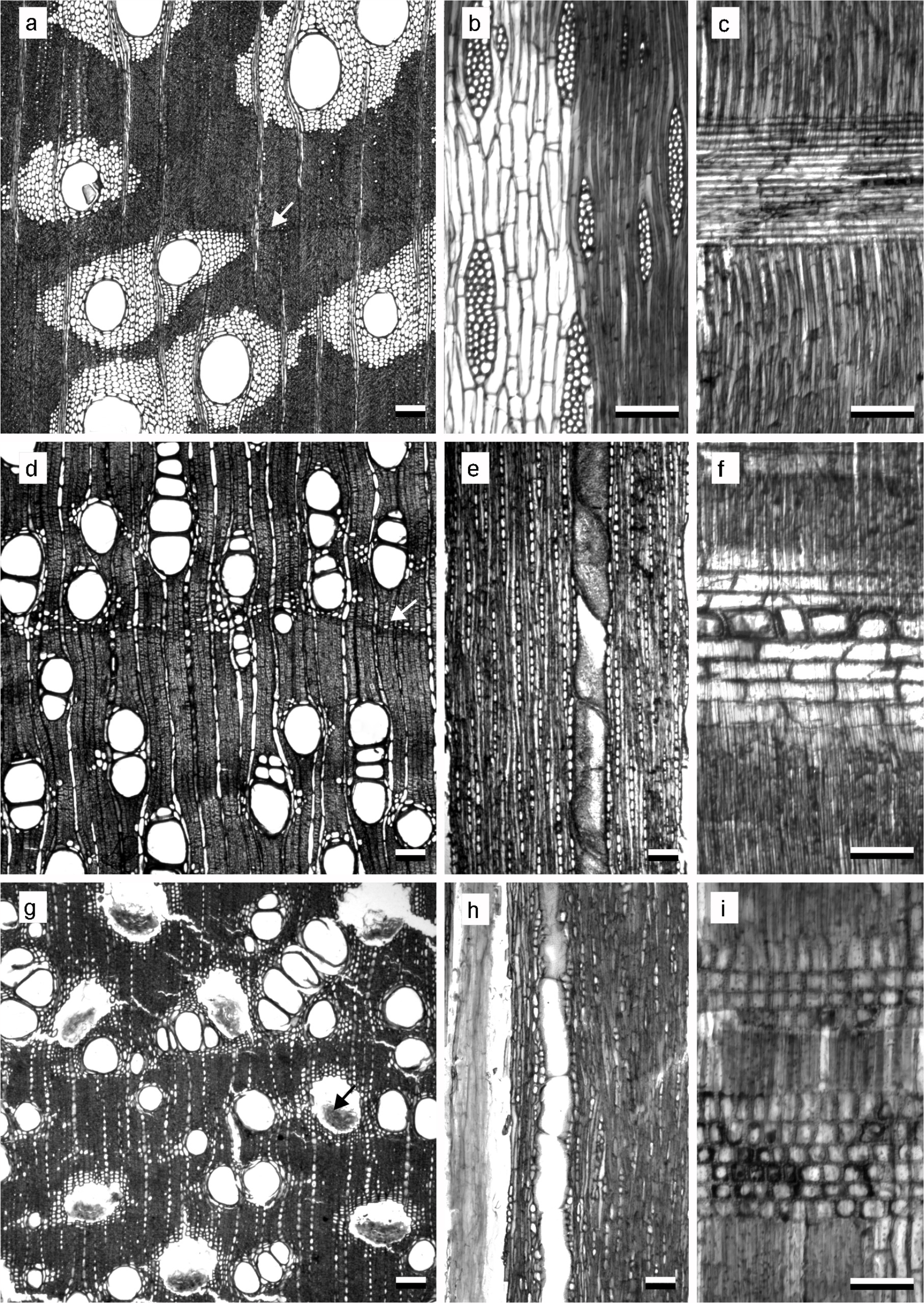
The roof samples (Fig. 2b), identified as Albizia niopoides (Table II), showed indistinct to distinct growth ring boundaries marked by radially flattened fibres (Fig. 3a); diffuse porosity; exclusively solitary vessels, sometimes in radial multiples of 2 to 3, circular to oval outline, mean tangential diameter 163 µm, mean frequency 2 vessels/mm², simple perforation plates and gum/resins in lumen of vessel elements; alternate, circular, vestured and small to medium-sized intervessel pits; vessel-ray pits similar to intervessel pits in size and shape; septate and non-septate libriform fibres with thin- to thick-walled; paratracheal axial parenchyma types lozenge-aliform and confluent (Fig. 3a), with 2–4 cells per parenchyma strand; multiseriate rays 2–4 cells wide (Fig. 3b), mean height 209 µm, composed only of procumbent cells (Fig. 3c); prismatic crystals in chambered axial parenchyma cells; and basic density 0.7 g/cm³.
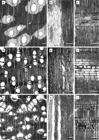
a-c: Albizia niopoides. a: growth ring boundaries marked by radially flattened fibres (arrow). b: multiseriate rays. c: rays composed only of procumbent cells. d-f: Terminalia januariensis. d: growth ring boundaries marked by marginal parenchyma (arrow). e: rays exclusively uniseriate. f: rays composed only of procumbent cells with mineral inclusions (prismatic crystals). g-i: Mouriri sp. g: diffuse phloem (arrow). h: rays exclusively uniseriate. i: rays composed only of square and/or upright. a, d and g transverse section; b, c, e, f, h and i longitudinal section. Scale bar: 100 µm.
Terminalia januariensis (Combretaceae, merindiba)
The roof sample (Fig. 2b) identified as Terminalia januariensis (Table II), showed distinct growth ring boundaries marked by marginal parenchyma and radially flattened fibres (Fig. 3d); diffuse porosity; solitary vessels and in radial multiples of 2 to 5, circular to oval outline, mean tangential diameter 142 µm, mean frequency 10 vessels/mm²; simple perforation plates; alternate, circular, vestured, and medium to large-sized intervessel pits; vessel-ray pits similar to intervessel pits in size and shape; non-septate libriform fibres with thin- to thick-walled; paratracheal axial parenchyma types aliform, confluent and marginal at ring boundary (Fig. 3d), with 2–7 cells per parenchyma strand; rays exclusively uniseriate (Fig. 3e), mean height 388 µm, composed only of procumbent cells (Fig. 3f), with the presence of dark-staining contents; elongate crystals in axial parenchyma cells and in ray cells; and basic density 0.6 g/cm³.
Mouriri sp. (Melastomataceae, cambucá-bravo)
The roof sample (Fig. 2c) identified as Mouriri sp. (Table II), showed indistinct growth ring boundaries (Fig. 3g); diffuse porosity; solitary vessels and in multiples of 2 to 6, circular to oval outline, mean tangential diameter 122 µm, mean frequency 11 vessels/mm²; simple perforation plates; alternate, circular, vestured and small-sized intervessel pits; vessel-ray pits similar to intervessel pits in size and shape; non-septate libriform fibres with thin- to thick-walled; axial parenchyma types apotracheal diffuse-in-aggregates, paratracheal scanty, vasicentric, aliform and confluent, with 1–6 cells per parenchyma strand; rays exclusively uniseriate (Fig. 3h), mean height 243 µm, composed of upright and/or square cells (Fig. 3i), with disjunctive cell walls and the presence of dark-staining contents; prismatic crystals absent; cambial variants of the diffuse included phloem type present (Fig. 3g); and basic density 0.7 g/cm³.
Handroanthus heptaphyllus (Bignoniaceae, ipê-roxo)
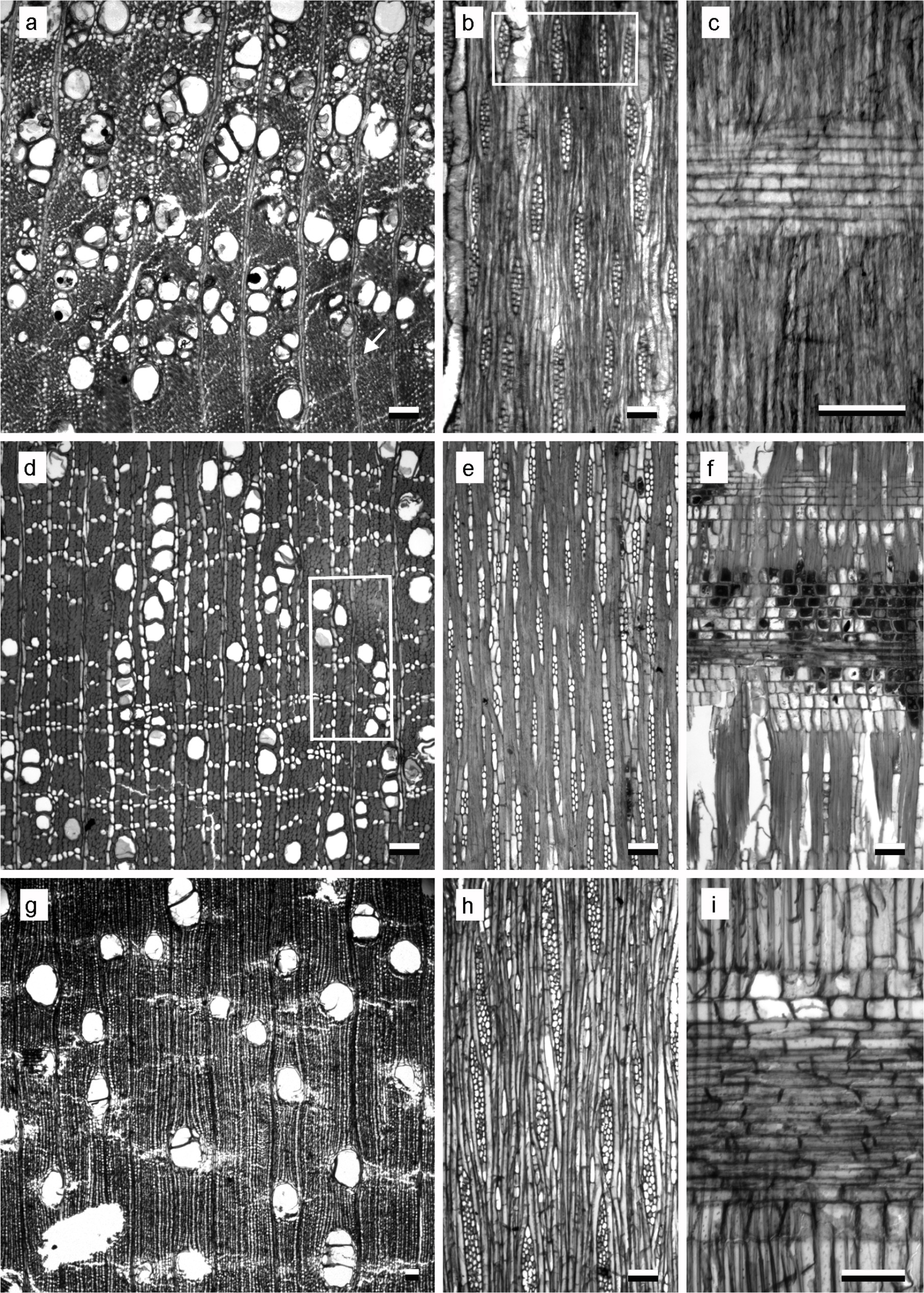
The window 2 structural support sample covered by the building’s masonry (Fig. 2e), identified as Handroanthus heptaphyllus (Table II), showed distinct growth ring boundaries marked by marginal parenchyma in lines (Fig. 4a); diffuse porosity; solitary vessels and in radial multiples of 2–4, circular to oval outline, mean tangential diameter 103 µm, mean frequency 24 vessels/mm²; simple perforation plates and tyloses common in the lumen of vessel elements (Fig. 4a); alternate, circular and medium to large-sized intervessel pits; vessel-ray pits similar to intervessel pits in shape; non-septate libriform fibres; paratracheal axial parenchyma types vasicentric, aliform, confluent and marginal at ring boundary (Fig. 4a), with 2 to 3 (rare) cells per parenchyma strand; multiseriate rays 2–3 cells wide (Fig. 4b), mean height 192 µm, composed only of procumbent cells (Fig. 4c); prismatic crystals absent; presence of storied vessel elements, axial parenchyma and rays (Fig. 4b); signs of biodeterioration; and basic density 0.4 g/cm³.
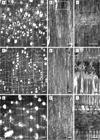
a-c: Handroanthus heptaphyllus. a: growth ring boundaries marked by marginal parenchyma (arrow). b: rays storied (rectangle). c: rays composed only of procumbent cells. d-f: Manilkara subsericea. d: vessels in diagonal and/or radial pattern (rectangle). e: uni- and biseriate rays. f: body ray cells procumbent with rows of square and/or upright marginal cells and with presence of dark-staining contents. g-i: Qualea gestasiana. g: vessels arrangement without defined pattern and axial parenchyma winged-aliform. h: multiseriate rays. i: body ray cells procumbent with rows of square and/or upright marginal cells. a, d and g transverse section; b, c, e, f, h and i longitudinal section. Scale bar = 100 µm.
Manilkara subsericea (Sapotaceae, maçaranduba)
The external door sample (Fig. 2f), identified as Manilkara subsericea (Table II), showed indistinct growth ring boundaries (Fig. 4d); diffuse porosity, diagonal and/or radial arrangement (Fig. 4d); solitary vessels and in radial multiples of 2 to 6, oval outline, mean tangential diameter 73 µm, mean frequency 18 vessels/mm²; simple perforation plates and tyloses common in the lumen of vessel elements; alternate, circular, and small to medium-sized intervessel pits; vessel-ray pits with much reduced borders to apparently simple, pit rounded to horizontal in outline; non-septate libriform fibres with very thick-walled; apotracheal axial parenchyma types diffuse, diffuse-in-aggregates tending to form narrow bands or lines of up to three cells wide, with 3–8 cells per parenchyma strand and the presence of dark-staining contents; rays uniseriate and biseriate (Fig. 4e), mean height 319 µm, composed of body cells procumbent with 2–4 or more rows of square and/or upright marginal cells and with the presence of dark-staining contents (Fig. 4f); prismatic crystals in chambered axial parenchyma cells; and basic density 0.8 g/cm³.
Qualea gestasiana (Vochysiaceae, pau-terra-da-mata)
The wall sample covered by the building’s masonry (Fig. 2h), identified as Qualea gestasiana (Table II), showed indistinct growth ring boundaries (Fig. 4g); diffuse porosity; solitary vessels and in multiples of 2 to 3 (rare), circular to oval outline, mean tangential diameter 181 µm, mean frequency 3 vessels/mm²; simple perforation plates; alternate, circular, vestured, and small to medium-sized intervessel pits; vessel-ray pits similar to intervessel pits in shape; non-septate libriform fibres with thin- to thick-walled; paratracheal axial parenchyma types winged-aliform and confluent (Fig. 4g), with a common frequency of 3–4 cells per parenchyma strand; uniseriate and multiseriate rays 2–3 cells wide (Fig. 4h), mean height 490 µm and composed only of procumbent cells (rare) or of procumbent body cells with 1–2 rows of square and/or upright marginal cells (Fig. 4i); prismatic crystals absent; signs of biodeterioration; and basic density 0.3 g/cm³.
Pinus sp. (Pinaceae, pinus)
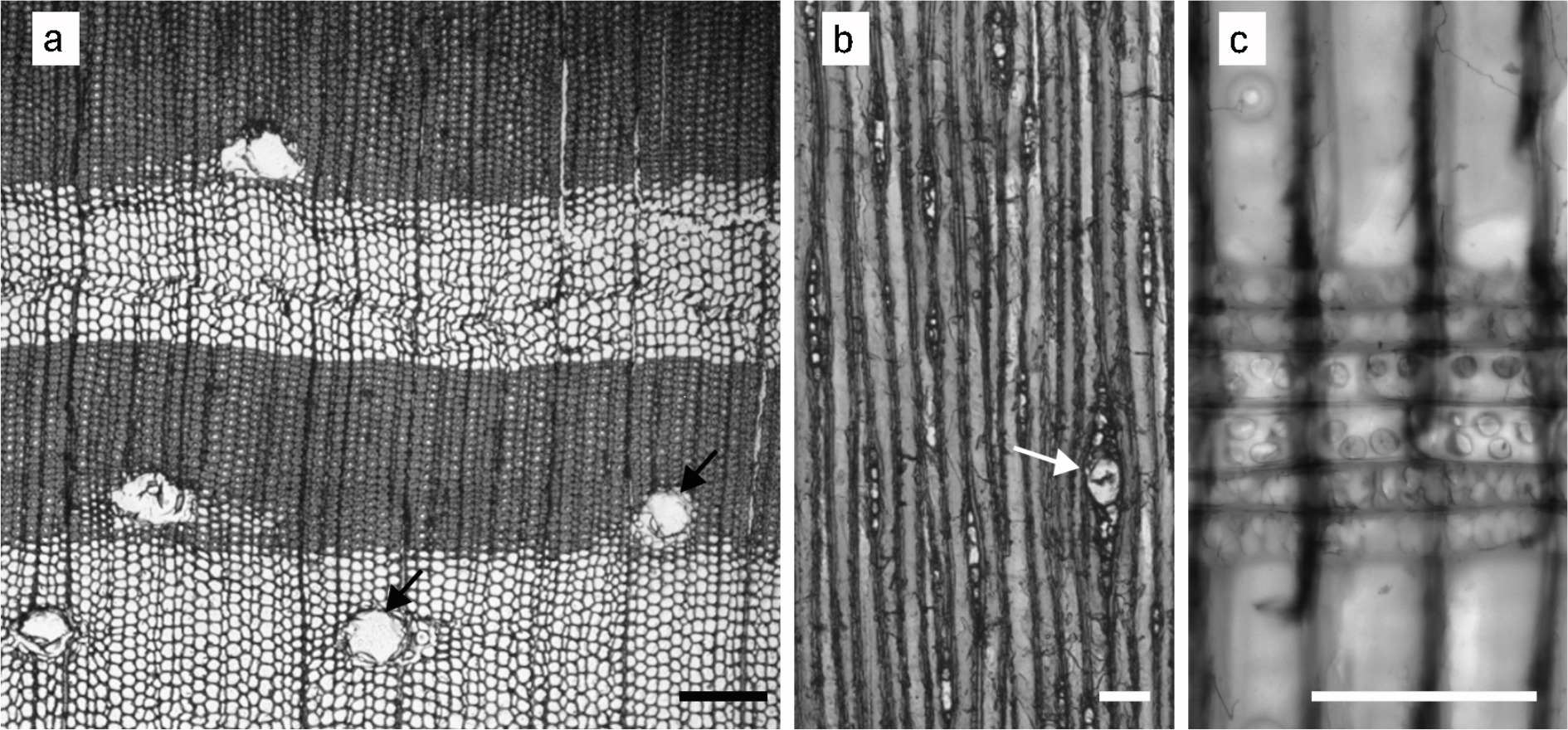
The samples from the windows (Fig. 2d,e) and internal door covered by the building’s masonry (Fig. 2g), identified as belonging to the genus Pinus (Table II), showed distinct growth ring boundaries marked by abrupt transition in tracheid wall thickness and radial diameter from earlywood to latewood within the same growth ring and between subsequent growth rings (Fig. 5a); presence of axial and radial intercellular canals (Fig. 5a,b) with presence of brown-staining content; average tracheid length 4075 µm, with thick walls in latewood and the presence of predominantly uniseriate pits, bearing disc-shaped torus and crassulae; axial parenchyma absent; rays exclusively uniseriate (Fig. 5b), average height 136 µm; rays heterogeneous, with radial parenchyma with distinctly pitted end wall cells and ray tracheids with reticulate to dentate cell walls (Fig. 5c), pinoid pits (2–6 pits per cross-field - Fig. 5c); average fusiform ray height 397 µm; mineral inclusions absent; and basic density 0.7 g/cm³.

Pinus sp. a: growth ring boundaries marked by abrupt transition between earlywood and latewood in same growth ring and between subsequent growth rings and axial intercellular canal (arrows). b: uniseriate rays and radial intercellular canal (arrow). c: ray composition. a transverse section; b and c longitudinal section. White scale bar = 300 μm. Black scale bar = 100 μm.
DISCUSSION
Identification by comparative analysis
Albizia niopoides
The anatomical features of the wood samples from the roof purlins are consistent with those of the family Fabaceae (Metcalfe & Chalk 1950, Evans et al. 2006), and of South American species of the genus Albizia (Quirk 1983, Evans et al. 2006, Zanne et al. 2009). The only species of Albizia cited for Ilha Grande to date is Albizia pedicellaris (Jabot 2025, speciesLink 2025, Table I), currently synonymized under Hydrochorea pedicellaris (Flora e Funga do Brasil 2025). However, the wood of this species differs from the sampled wood and from the features of Albizia (Quirk 1983, Evans et al. 2006, Zanne et al. 2009). The sampled wood does not have minute intervessel pits and exclusively uniseriate rays, and has septate fibres, characteristics not described for H. pedicellaris (Barros et al. 2001, Evans et al. 2006). These differences rule out the possibility of the wood used on the purlins of the roof as belong to this species. However, it is important to highlight that the wood anatomy results corroborate the phylogenomic analysis that classified H. pedicellaris as distinct from the genus Albizia (Soares et al. 2022). Other species of the genus Albizia have been recorded in forest remnants close to Ilha Grande. Albizia polycephala, which occurs approximately 31 km distant (Jabot 2025) from the studied forest remnant, has a wood density of 0.6 g/cm³ and is recommended for internal works and civil construction in general, such as beams, slats, boards and flooring (Carvalho 2006). However, the wood of A. polycephala differs from the analysed samples due its rays not being 4 cells wide (Evans et al. 2006, RBw 5940). Albizia niopoides presents similarities, such as small intervessel pits, vessel tangential diameter ≥ 200 µm, presence of deposits in vessels, septate fibres, ray width of 1–4 cells and wood density around 0.7g /cm³ (Evans et al. 2006, Carvalho 2008, León 2008, Zanne et al. 2009). The species which occurs approximately 59 km distant (Jabot 2025). According to Carvalho (2008), wood of this species is recommended for boards, boxes and light objects. Other species of Albizia (Table I) exhibit anatomical differences from the wood under investigation. The wood of Albizia inundata differs by the absence of aliform parenchyma and gum deposits in vessels, as well as by the presence of vessels with smaller tangential diameters, parenchyma bands more than three cells wide, and perforated ray cells (Baldin & Marchiori 2014). Albizia procera differs by the presence of larger intervessel pits, a greater tangential diameter of vessel lumina, and the absence of septate fibres (Chauhan & Dayal 1985, Evans et al. 2006). Albizia lebbeck is also distinct, characterized by the presence of larger intervessel pits (Evans et al. 2006). Taken together, the density values, proximity between forest remnants and anatomical structure indicate the use of A. niopoides for the wood of the roof purlins. Considering that the analysed samples are preserved, with no apparent traces of the actions of xylophagous organisms, it is estimated that the structural application was successful without contact with the soil and under roof tiles.
Terminalia januariensis
The anatomical features of the wood sample from the roof rafter are consistent with those of the family Combretaceae (Metcalfe & Chalk 1950) and of South American species of the genus Terminalia (van Vliet 1979, León 2007b, Zanne et al. 2009). According to Mainieri & Chimelo (1989), Terminalia wood is recommended for roof structures as it has good mechanical resistance. Eight species of Terminalia occur in the state of Rio de Janeiro (Flora e Funga do Brasil 2025), however, the only record at the study site is of the invasive alien species Terminalia catappa (Callado et al. 2023, Jabot 2025, Table I), which differs from the studied wood by presenting small to medium-sized intervessel pits, multiseriate rays, druses in idioblasts and the absence of marginal parenchyma (León 2007b). It is worth highlighting that Terminalia januariensis and Terminalia glabrescens Mart. occur close to the studied area, approximately 23 km distant and approximately 31 km distant, respectively (Jabot 2025). The wood density of both species is around 0.8 g/cm³ (Zanne et al. 2009). Nonetheless, the wood of T. glabrescens presents different anatomical features than those observed in the analysed sample, such as the presence of prismatic crystals in axial parenchyma cells and the absence of elongate crystals in ray cells (Scheel-Ybert & Gonçalves 2017). On the other hand, T. januariensis shows anatomical features compatible with those of the analysed sample, is indicated for similar use and occurs geographically very close to Ilha Grande (Mainieri & Chimelo 1989, Jabot 2025).
Mouriri sp.
The anatomical features of the wood sample from the roof structural pillar are consistent with those of the family Melastomataceae (Metcalfe & Chalk 1950, ter Welle & Koek-Noorman 1981, van Vliet 1981) and of the genus Mouriri (ter Welle & Koek-Noorman 1981, Zanne et al. 2009, León 2014, Scheel-Ybert & Gonçalves 2017). The woods of species of Mouriri are dense, but not very resistant due to the presence of lacunae promoted by the loss of cells of included phloem, and thus, in civil construction, they are recommended for boards in general and more temporary constructions (Mainieri & Chimelo 1989, Lorenzi 2009). Five species of Mouriri occur in the state of Rio de Janeiro (Flora e Funga do Brasil 2025). Among these, the wood of Mouriri chamissoana differs from the sampled wood by having lower values for mean tangential diameter, mean frequency of rays/mm and strand length of axial parenchyma, as well as higher values for frequency of vessels/mm², presence of tyloses common and absence of aliform and confluent parenchyma (Scheel-Ybert & Gonçalves 2017). Mouriri glazioviana also differs from the sampled wood, exhibiting lower values for mean frequency of vessels/mm² and the length of axial parenchyma strand cells (RBw 6805). Mouriri arborea and Mouriri doriana (Rosa unpublished data, Jabot 2025, speciesLink 2025) occur on Ilha Grande but with very small populations (≤ 15 trees/hectare), the latter being classified as in danger of extinction (MMA Ordinance nº 148, June 7, 2022). The anatomical features of the sample, combined with the presence of the two species of the genus in the studied region, suggest that the wood used in the structural pillar of the roof may belongs to one of these species. However, it is not currently possible to determine the species with certainty due to the lack of comparative material (Table I).
Handroanthus heptaphyllus
The anatomical features of the wood sample from the structural support of window 2 are consistent with those of the family Bignoniaceae (Metcalfe & Chalk 1950, Pace et al. 2015). Among representatives of this family, the anatomical features of the sampled wood is similar to the wood of the genus Handroanthus (Zanne et al. 2009, Pace et al. 2015). Although the density of the sample was lower than that described for the genus, the sample was deteriorated, with degraded fibres and tissue lacunae, and the determinant anatomical features of the genus Handroanthus remained. Wood of species of the genus are very similar to each other and identification to the species level is not always possible, as observed by Nascimento Silva et al. (2022). The occurrence of the genus in the forest remnants of Ilha Grande is limited to the species Handroanthus heptaphyllus, with very small populations (4 trees/hectare) (Rosa unpublished data, Jabot 2025, speciesLink 2025), the anatomy of which is compatible with that of the wood of the analysed window structure regarding vessel frequency and tangential diameter, intervessel pit shape and size, and fibre length (Pereira 1933, Dos Santos & Miller 1992, Gerolamo & Angyalossy 2017). H. heptaphyllus has very dense wood, around 0.9 g/cm³ (Carvalho 2003, Zanne et al. 2009), but as the sample was deteriorated, density could not be compared.
Manilkara subsericea
The anatomical features of the wood sample from the external door are consistent with those of the family Sapotaceae (Metcalfe & Chalk 1950) and of the genus Manilkara (Kukachka 1981, Costa unpublished data, Zanne et al. 2009). In general, Manilkara wood is very heavy and resistant to attack by xylophagous organisms, being recommended for various external and civil constructions (Mainieri & Chimelo 1989, Lorenzi 1998). Five species of the genus occur in the state of Rio de Janeiro (Flora e Funga do Brasil 2025). Among these, three are distributed far from the site of the construction studied. Manilkara bella is recorded only in the mountain regions of Rio de Janeiro (Jabot 2025, speciesLink 2025). Manilkara elata differs from the analysed sample by presenting vessels with larger tangential diameters and lower frequency of tyloses within the vessel lumina (Kukachka 1981, RBw 2957, RBw 5473). Manilkara zapota can be distinguished by its rays, with less than 4 rows of upright and/or square marginal cells (Richter & Dallwitz 2000). Although Manilkara salzmannii occurs closer to the Ilha Grande region, it differs from the sample in having both vessels with larger tangential diameters and longer fibers (Kukachka 1981). Species of “maçaranduba” have been cited for Ilha Grande since the colonial period (Santiago et al. 2009). The only representative of the genus currently recorded in inventories of the island is Manilkara subsericea, with populations of up to 23 trees/hectare (Rosa unpublished data, Jabot 2025, speciesLink 2025, Table I). According to Carvalho (2010), M. subsericea is recommended for beams and parts of external structures of houses. This anatomical and functional compatibility, combined with the documented presence on the island, reinforces the probability of the wood used in the external door belonging to this locally occurring species.
Qualea gestasiana
The anatomical features of the wood sample from the wall are consistent with those of the family Vochysiaceae (Metcalfe & Chalk 1950). Among representatives of this family, the anatomical structure of the sampled wood is similar to wood of the genera Qualea and Ruizterania, as these two genera do not present anatomical differences in the wood that allow a reliable distinction (León 2003). However, the distribution of Ruizterania is limited to the North, Northeast and Center-West regions of Brazil, while the genus Qualea is widely distributed in the country (Flora e Funga do Brasil 2025). Wood of species of the genus Qualea has a density between 0.5 and 1 g/cm³ (Zanne et al. 2009), may be very or slightly susceptible to attack by xylophagous organisms and is indicated in wood in civil construction for plywood, door cores, frames, trims, skirting boards, slats and dividers (Lorenzi 2009). Six species of the genus occur in the state of Rio de Janeiro (Flora e Funga do Brasil 2025, Table I). Among these, Qualea dichotoma, Qualea grandiflora and Qualea multiflora differ from the analysed sample by having a higher vessel frequency, a smaller tangential diameter of vessel lumina, banded axial parenchyma, and the presence of mineral and organic inclusions (Sonsin et al. 2013, RBw 3629, RBw 6734). The occurrence of the genus in the forest remnants of Ilha Grande is limited to two species: Qualea cryptantha and Qualea glaziovii (Jabot 2025, speciesLink 2025, Table I). However, both differ from the wood under investigation by presenting a higher frequency of vessels in radial multiples and the presence of mineral inclusions (InsideWood 2004-onwards, RBw 3259). Furthermore, Q. cryptantha is characterised by the presence of thin-walled fibres (InsideWood 2004-onwards), while Q. glaziovii, exhibits polygonal intervessel pit outlines, a higher frequency of vessels, and a smaller tangential diameter of the vessel lumen (RBw 3259). Another species of the genus, Qualea gestasiana, has been recorded in a forest remnant approximately 31 km from Ilha Grande (Jabot 2025, speciesLink 2025). This species shows anatomical similarities with the sample analysed, such as a tangential vessel diameter greater than 100 µm, rays with more than one row of marginal cells and the absence of crystals (Barros et al. 2008, RBw 7591, RBw 7610, RBw 7601, RBw 3254), which may suggest that the investigated wood belongs to this species.
Pinus sp.
The anatomical features of the wood samples from the internal door and jambs of windows 1 and 2 are consistent with those of the family Pinaceae (Phillips 1941). Within this family, the anatomical features of the sampled wood is similar to wood of the genus Pinus L. (Bailey 1909, Phillips 1941, Kukachka 1960, Zanne et al. 2009). According to Lorenzi et al. (2003), pine wood is, in general, moderately heavy and resistant, being recommended for various constructions of carpentry and joinery. Pinus sylvestris, known as “pinho-de-riga” (Lorenzi et al. 2003), was one of the most exported coniferous woods from Europe, through the port of Riga, to America (Quites et al. 2015). However, the wood differs from the studied samples by presenting fenestriform pits, with one to two pits per cross-field (Phillips 1941, Kukachka 1960, Schoch et al. 2004). According to Schoch et al. (2004), Pinus mugo and Pinus nigra have wood anatomy similar to that of Pinus sylvestris, thus the analysed samples also do not belong to these species. Another species that differs from the analysed wood is Pinus elliottii as it presents latewood tracheids that contrast little with those of earlywood (Siegloch & Marchiori 2018). According to the taxonomic separation table proposed by Phillips (1941), species of the genus Pinus exhibit a high degree of anatomical similarity, with some species being distinguishable only by their geographic origin. This anatomical uniformity poses a challenge for species-level identification, particularly in regions such as Brazil, where Pinus is considered an exotic taxon (Flora e Funga do Brasil 2025). The difficulty is further compounded by historical factors: during the Brazilian colonial period, ships from various foreign nations, including England, Netherlands, France and Spain, frequently docked in Ilha Grande Bay (Mello 1987, Santiago et al. 2009). As a result, the provenance of the analysed wood samples remains uncertain, which complicates their identification at the species-level. It is worth noting that the wood of the jambs of windows 1 and 2 and of the structural support of internal door, exhibits anatomical similarity in both composition and measured characteristics, suggesting that it may have been taken from the same tree or from trees of the same region.
Wood from historical buildings and historical-geographical aspects
Wood from Ilha Grande aroused the interest of Portuguese colonizers since at least the 17th century, as revealed in a letter from Bento Corrêa de Sousa Coutinho to the King of Portugal, after an expedition to the Ilha Grande (Santiago et al. 2009). The letter constantly emphasizes the existence of “royal woods” that could be used to manufacture frigates and other constructions for the Portuguese court. Currently, many species with good quality wood are no longer found (Callado et al. 2009), or have significantly reduced populations in the remaining forest of Ilha Grande (Delamonica unpublished data, Manão unpublished data, Rosa unpublished data).
Investigations involving wood used in constructive structures on Brazilian farms from the colonial period, the same historical period as the present study, demonstrate the use of a diversity of woody taxa, which is compatible with the results found for the warehouse at Fazenda Dois Rios (Azevedo unpublished data, Neto Boschetti et al. 2014). Neto Boschetti et al. (2014) identified the use of Manilkara sp. at Fazenda Fortaleza, state of Espírito Santo, among 12 other taxa. Azevedo (unpublished data) noticed the use of Manilkara sp. and Terminalia sp. in the slave quarters at Fazenda Ponte Alta, state of Rio de Janeiro, among 32 other taxa, with wood of medium to high density (0.5 to 0.9 g/cm3) in different structures. As in the present study, most of the identified samples have a density between 0.6 and 0.8 g/cm3, being medium to high density wood (Coradin & Muniz 1992). The exceptions are samples that showed biodeterioration, namely the wood used as structural support for the window and wall with 0.4 and 0.3 g/cm3, respectively. In general, wood of medium to high density was the most used in several studied historical constructions (Andreacci & Melo Júnior 2011, Melo Júnior 2012, Azevedo unpublished data, Di Giulio et al. 2020, Nascimento Silva et al. 2022). Regarding the mechanical properties of the wood used in the historical warehouse under study, most of the structural elements were made from timber of medium mechanical strength (40%) and low natural durability (60%). Although these woods are more susceptible to degradation and attack by wood-boring insects, they were primarily employed in roof structures and other internal components, which are less exposed to environmental elements.
No records could be found on the importation of wood to Fazenda Dois Rios, so how the Pinus sp. identified in this study reached the construction under investigation remains undetermined. Until the beginning of the 19th century, most transport was by sea or river and with vessels made entirely of wood (Gonzaga 2006). In a study carried out in Siberia, Omurova et al. (2020) noted that more than half of eleven buildings and stilt houses dating from the 15th and 16th centuries had wood as the main construction material, probably reused from ships or boats. According to Andrade et al. (2022), pine wood was often obtained from the ballast of foreign ships that anchored in the Brazilian port, and was reused for various purposes, such as flooring, lining, sculpture and furniture. This reinforces the hypothesis that the exotic wood used in the property investigated here may have come from the ballasts from foreign ships or was leftover from repairs made on ships that eventually anchored or were shipwrecked in the region (Mello 1987). The first record of anchorage for docking and repairing vessels on Ilha Grande dates to the 16th century (Bastos et al. 2009). In addition, the existence of a point for disembarking supplies and slaves about 5 km away from Vila Dois Rios (Mello 1987, Santiago et al. 2009), reinforces this hypothesis for the origin of pine wood in buildings on Ilha Grande.
By studying 93 wooden sculptures from different periods and origins, Macchioni et al. ( 2015) were able to identify the environments in which the identified species occurred, as well as the characteristics of the artists who produced them. These results allowed the authors to draw relationships between the availability and accessibility of timber resources in association with local traditions (Macchioni et al. 2015). Azevedo (unpublished data), studying a 19th century slave quarters in the state of Rio de Janeiro, and Dong et al. (2017), studying buildings from the 7th to 20th centuries in Shanxi province in China, also emphasize that the main criterion adopted for selecting wood in older buildings was the forest resources surrounding the buildings. This is particularly relevant for older constructions on Ilha Grande, as the strategy facilitates the transport of inputs, reduces costs and overcomes the difficulties imposed by the geographical conditions of the region. Thus, the location of Fazenda Dois Rios on the oceanic side of Ilha Grande, the availability of high-quality wood in the local forest remnant and the identification of wood from the investigated construction as native species of the island itself or of areas adjacent, show the exploitation of local natural resources over time and represents a historical record of the current landscape. This may also explain why many populations of native species are no longer found or are poorly represented in the remaining forest of the island. Nascimento Silva et al. (2022) also found this true for the Ilha Grande, identifying the use of Zollernia ilicifolia (Brongn.) Vogel, whose wood, among several other applications, was used in bridge construction, yet only one living individual has been found to date in the current forest remnant (Jabot 2025).
CONCLUSIONS
Analysis of the wood used in the construction of the warehouse of Fazenda Dois Rios on Ilha Grande reveals a correlation between the application and the selection of wood, considering woody taxa with anatomical structure and density that offer, in general, resistance and durability. Except for pine, the present investigation indicates that the diversity of wood used in this construction is related to the availability of raw material in the Ilha Grande vegetation. The survey of these historic woods expands the knowledge of the flora of this island environment and reinforces the importance of conserving and understanding aspects of the current flora as a reflection of the past exploitation of natural resources.
The data obtained here indicate the occurrence of taxa not yet recorded in the studied area, represent a testimony of the forest composition of the past, complementing current floristic inventories of Ilha Grande. Furthermore, the taxonomic identification of the species whose wood was used in the Fazenda Vila Dois Rios warehouse provides vital insights for the creation of a floristic list to support ecosystem restoration on Ilha Grande. Thus, we emphasize the importance of historic wood not only as cultural heritage, but also as biodiversity heritage.
Acknowledgements
The authors are grateful to Marcelo Fraga Castilhori and João Victor de Souza Castelar for help in sampling material; to Centro de Estudos Ambientais e Desenvolvimento Sustentável (CEADS) and Parque Botânico do Ecomuseu Ilha Grande (PaB/ECOMIG) for infrastructure for fieldwork; to Instituto Estadual do Ambiente (INEA) for scientific research authorization (INEA 063/2018), and to Instituto de Pesquisas Jardim Botânico do Rio de Janeiro and curator Claudia Franca Barros for the loan of xylarium material (RBw). This study was funded by the Coordenação de Aperfeiçoamento de Pessoal de Nível Superior– Brasil (CAPES, Finance Code 001); Conselho Nacional de Desenvolvimento Científico e Tecnológico (CNPq, Proc. 309959/2025-0); and Fundação Carlos Chagas Filho de Amparo à Pesquisa do Rio de Janeiro (FAPERJ, Procs. E-26/210.288/2021, E-26/200.961/2021 and E-26/204.346/2024). This paper was derived from the thesis of the first author.
References
- ALVIM SPF. 1997. Arquitetura religiosa colonial no Rio de Janeiro: plantas, fachadas e volumes, Rio de Janeiro: Editora UFRJ : IPHAN : Prefeitura da Cidade do Rio de Janeiro.
- ANDRADE MVO, FREITAS JM & LASMAR MC. 2022. Bens culturais, drogas, documentos e outras aplicações dos isótopos forenses. In: Nardoto GB et al. (Eds), Isótopos Forenses, Campinas, SP: Millennium Editora, p. 181-204.
- ANDREACCI F & MELO JÚNIOR JCF. 2011. Madeiras históricas do barroco mineiro: interfaces entre o patrimônio cultural material e a anatomia da madeira. Rodriguésia 62: 241-251.
- BAAS P, SCHMID R & VAN HEUVEN BJ. 1986. Wood anatomy of Pinus longaeva (bristlecone pine) and the sustained length-on-age increase of its tracheids. IAWA J 7: 221-228.
- BAILEY IW. 1909. The Structure of the Wood in the Pineae. Bot Gaz 48: 47-55.
- BALDIN T & MARCHIORI JNC. 2014. Anatomia da madeira de Albizia inundata (Mart.) Barneby & J.W. Grimes (Fabaceae). Balduinia 46: 25-31.
- BARBOSA ACF, PACE MR, WITOVISK L & ANGYALOSSY V. 2010. A new method to obtain good anatomical slides of heterogeneous plant parts. IAWA J 31: 373-383.
- BARHAM L ET AL. 2023. Evidence for the earliest structural use of wood at least 476,000 years ago. Nature 622: 107-111.
- BARROS CF & CALLADO CH. 1997. Madeiras da Mata Atlântica: Anatomia do lenho de espécies ocorrentes nos remanescentes florestais do Estado do Rio de Janeiro - Brasil, Rio de Janeiro: Instituto de Pesquisas Jardim Botânico do Rio de Janeiro.
- BARROS CF, CALLADO CH, COSTA CG, MARQUETE O, LIMA HRP, DA CUNHA M & MARCON ML. 2001. Madeiras da Mata Atlântica: anatomia do lenho de espécies ocorrentes nos remanescentes florestais do Estado do Rio de Janeiro - Brasil, Vol. II, Rio de Janeiro: Instituto de Pesquisas Jardim Botânico do Rio de Janeiro.
- BARROS CF, CALLADO CH, DA CUNHA M, MARCON-FERREIRA ML, TAMAIO N, MARQUETE O & COSTA CG. 2008. Madeiras da Mata Atlântica: anatomia do lenho de espécies ocorrentes nos remanescentes florestais do Estado do Rio de Janeiro - Brasil, Vol. III, Rio de Janeiro: Instituto de Pesquisas Jardim Botânico do Rio de Janeiro.
- BASTOS M ET AL. 2009. Estruturas econômicas e organização sociocultural e política. In: Bastos M & Callado CH (Eds), O Ambiente da Ilha Grande, Rio de Janeiro: EDUERJ, p. 371-470.
- BRUNNER M, KUCERA LJ & ZÜRCHER E. 1994. Major timber trees of Guyana - a lens key. Backhuys Publishers, The Tropenbos Foundation. (Tropenbos series: 10).
- BURGER LM & RICHTER HG. 1991. Anatomia da madeira, São Paulo: Nobel.
- CALLADO CH, BARROS AAM, RIBAS LA, ALBARELLO N, GAGLIARDI RF & JASCONE CES. 2009. Flora e cobertura vegetal. In: Bastos M & Callado CH (Eds), O Ambiente da Ilha Grande, Rio de Janeiro: EDUERJ, p. 91-162.
- CALLADO CH, MANÃO CYG, CASTILHORI MF, MOREIRA NS, REIS RCC & RODRIGUES MJG. 2023. Risco de invasão por espécies exóticas e indicação de espécies nativas para plantios na Ilha Grande, Rio de Janeiro, Brasil. Rev Ineana 11: 9-24.
- CAMARGOS JAA, CORADIN VTR, CZARNESKI CM, OLIVEIRA D & MEGUERDITCHIAN I. 2001. Catálogo de árvores do Brasil, 2a ed., Brasília: Ed. IBAMA, 896 p.
- CARLQUIST S. 1982. The Use of Ethylenediamine in Softening Hard Plant Structures for Paraffin Sectioning. Stain Technol 57: 311-317.
- CARVALHO PER. 2003. Espécies Arbóreas Brasileiras, Vol. 1, Brasília: Embrapa Informação Tecnológica, 1039 p.
- CARVALHO PER. 2006. Espécies Arbóreas Brasileiras, Vol. 2, Brasília: Embrapa Informação Tecnológica, 627 p.
- CARVALHO PER. 2008. Espécies Arbóreas Brasileiras, Vol. 3, Brasília: Embrapa Informação Tecnológica, 593 p.
- CARVALHO PER. 2010. Espécies arbóreas brasileiras, Vol. 4, Brasília, DF: Embrapa Informação Tecnológica, 644 p.
- CHAUHAN L & DAYAL R. 1985. Wood anatomy of indian Albizias. IAWA Journal 6: 213-218.
- CORADIN VTR & MUNIZ GIB. 1992. Normas e procedimentos em estudos de anatomia da madeira: I - Angiospermae II - Gimnospermae, Brasília: LPF.
- DI GIULIO G, SIGNORINI G, NAVARRO F & FIORAVANTI M. 2020. The wood species of the historic gala berlines of the Palazzo Pitti in Florence. J Cult Herit 41: 249-255.
- DONG M, ZHOU H, JIANG X, LU Y, WANG W & YIN Y. 2017. Wood used in ancient timber architecture in Shanxi Province, China. IAWA J 38: 182-200.
- DOS SANTOS G & MILLER RB. 1992. Wood anatomy of Tecomeae. In: Bignoniaceae, Part II (tribe Tecomeae), New York: New York Botanical Garden Press, p. 336-358.
- EVANS JA, GASSON PE & LEWIS GP. 2006. Wood anatomy of the Mimosoideae (Leguminosae). IAWA J: 1-117.
-
FLORA E FUNGA DO BRASIL. 2025. Jardim Botânico do Rio de Janeiro. Published on the Internet. http://floradobrasil.jbrj.gov.br/ (Accessed 09 June 2025).
» http://floradobrasil.jbrj.gov.br/ - GEROLAMO CS & ANGYALOSSY V. 2017. Wood anatomy and conductivity in lianas, shrubs and trees of Bignoniaceae. IAWA J 38: 412-432.
-
GONÇALVES TA, NISGOSKI S, OLIVEIRA JS, MARCATI CR, BALLARIN AW & MUNIZ GI. 2016. A contribution to the identification of charcoal origin in Brazil II-Macroscopic characterization of Cerrado species. An Acad Bras Cienc 88: 1045-1054. https://doi.org/10.1590/0001-3765201620150322.
» https://doi.org/10.1590/0001-3765201620150322 - GONÇALVES TAP, NAVARRO AG, NISGOSKI S & SONSIN-OLIVEIRA J. 2021. The trees of the Water People: archeological waterlogged wood identification and near-infrared analysis in Eastern Amazonia. Wood Sci Technol 55: 991-1011.
- GONZAGA AL. 2006. Madeira: uso e conservação, Brasilia: IPHAN/MONUMENTA, 246 p.
- IAWA COMMITTEE. 1989. IAWA list of microscopic features for hardwood identification. IAWA Bull 10: 219-332.
- IAWA COMMITTEE. 2004. IAWA list of microscopic features for softwood identification. IAWA J 25: 1-70.
- ICKERT-BOND SM. 2001. Reexamination of wood anatomical features in Pinus krempfii (Pinaceae). IAWA J. 22: 355-365.
- INSIDEWOOD. 2004-onwards. InsideWood Database. Published on the Internet. http://insidewood.lib.ncsu.edu/search (Accessed 16 January 2024)
-
JABOT. 2025. Banco de Dados da Flora Brasileira. Published on the Internet. http://jabot.jbrj.gov.br/ (Accessed 20 June 2025).
» http://jabot.jbrj.gov.br/ - KUKACHKA BF. 1960. Identification of coniferous woods. TAPPI 43: 887-896.
- KUKACHKA BF. 1981. Wood Anatomy of the Neotropical Sapotaceae: XX. Manilkara, Madison: Forest Products Laboratory, Forest Service, US Department of Agriculture.
- LEME CLD. 2016. Wood anatomy of seven species known as “Pau-Para-Tudo” in Brazil. Cerne 22: 261-270.
- LEÓN W. 2003. Anatomía xilemática comparativa de los géneros Qualea y Ruizterania (Vochysiaceae). Pittieria 32: 69-81.
- LEÓN W. 2007a. Anatomía del xilema secundario de diez especies de la familia Bignoniaceae de Venezuela. Acta Botánica Venezuélica 30: 361-384
- LEÓN W. 2007b. Anatomía de la madera de siete especies del género Terminalia l. en Venezuela. Ernstia 17: 35-53.
- LEÓN W. 2008. Anatomía de madera en 31 especies de la subfamília Mimosoideae (Leguminosae) en Venezuela. Colomb For 11: 113-135.
- LEÓN W. 2012. Anatomia de la madera de 69 especies de la Reserva Forestal Caparo (Barinas, Venezuela). Rev Forestal Venezolana 56.2: 167-196.
- LEÓN W. 2014. Anatomía de maderas de 108 especies de Venezuela. Pittieria (Publicación Especial No 1).
- LEÓN W. 2020. Anatomía de maderas de 130 especies de Venezuela. Pittieria (Publicación Especial No 2)
- LORENZI H. 1992. Árvores brasileiras: manual de identificação e cultivo de plantas arbóreas nativas do Brasil, Vol. 1, Nova Odessa, SP, Brazil: Instituto Plantarum de Estudos da Flora.
- LORENZI H. 1998. Árvores Brasileiras: manual de identificação e cultivo de plantas arbóreas nativas do Brasil, Vol. 2, Nova Odessa, SP, Brazil: Instituto Plantarum de Estudos da Flora.
- LORENZI H. 2009. Árvores brasileiras: manual de identificação e cultivo de plantas arbóreas nativas do Brasil, Vol. 3, Nova Odessa, SP, Brazil: Instituto Plantarum de Estudos da Flora.
- LORENZI H, SOUZA HM, TORRES MAV & BACHER LB. 2003. Árvores exóticas no Brasil: madeireiras, ornamentais e aromáticas, Nova Odessa, SP, Brasil: Institituto Plantarum de Estudos da Flora, 368 p.
- LOUREIRO AA & SILVA MF. 1977. Contribuição para o estudo dendrológico e anatômico da madeira de três espécies de Qualea (Vochysiaceae) da Amazônia. Acta Amaz. 7: 407-416.
- LOURENÇO PB & BRANCO JM. 2012. Dos abrigos da pré-história aos edifícios de madeira do século XXI, Portugal: Centro de Investigação Transdisciplinar: Cultura, Espaço e Memória, 201-213 p.
- MACCHIONI N, FACHECHI GM, LAZZERI S & SOZZI L. 2015. Timber species and provenances of wooden sculptures. Information from the collections of the National Museum of “Palazzo di Venezia” in Rome. J Cult Herit 16: 57-64.
-
MADEIRAS IPT. 2025. Informações técnicas sobre madeiras brasileiras e plantadas: Pinus-eliote. Published on the Internet. https://madeiras.ipt.br/pinus-eliote/ (Accessed 02 June 2025).
» https://madeiras.ipt.br/pinus-eliote/ - MAINIERI C & CHIMELO JP. 1989. Fichas de características das madeiras brasileiras, São Paulo: IPT.
-
MARCOLIN N. 2011. Um saber quase morto: estudo recupera técnica milenar de construção de pedra. Rev Pesqui FAPESP. Published on the Internet. Available at: https://revistapesquisa.fapesp.br/um-saber-quase-morto/ (Accessed 06 May 2024).
» https://revistapesquisa.fapesp.br/um-saber-quase-morto/ - MELLO CEHV. 1987. Apontamentos para a história Fluminense (Ilha Grande), Angra dos Reis, Angra dos Reis: Edição do Conselho Municipal de Cultura.
- MELO JÚNIOR JCF. 2012. Anatomia de madeiras históricas: um olhar biolágico sobre patrimônio cultural, Joinville: Editora Univille.
- MELO JÚNIOR JCF, SILVEIRA ER & BANDEIRA DR. 2016. Arqueobotânica de um sambaqui sul-brasileiro: integrando indícios sobre o paleoambiente e o uso de recursos florestais. Bol Mus Para Emílio Goeldi Ciênc Humanas 11: 727-744.
- METCALFE CR & CHALK L. 1950. Anatomy of the dicotyledons, Oxford: Claredon Press.
- MILLER RB & DÉTIENNE P. 2001. Major timber trees of Guyana. Wood anatomy. Tropenbos International, Wageningen.
-
MORI VH. 1987. A cal de sambaqui. Técnicas construtivas e programas da arquitetura tradicional paulista, Curso de Especialização: patrimônio cultural- FAU/USP. Published on the Internet. https://patrimoniovaledoribeira.wordpress.com/wp-content/uploads/2014/10/a-cal-de-sambaqui-1987.pdf (Accessed 06 May 2024).
» https://patrimoniovaledoribeira.wordpress.com/wp-content/uploads/2014/10/a-cal-de-sambaqui-1987.pdf - NASCIMENTO SILVA S, SANTOS KCM, COSTA WS, CASTILHORI MF & CALLADO CH. 2022. Anatomical investigation of wood from two old bridges as part of the historical record of the flora of the Atlantic Forest. IAWA J 44: 85-107.
- NETO BOSCHETTI WT, BARBOSA AA, OLIVEIRA JTS & SANTOS AR. 2014. Identificação de Madeiras do Patrimônio Histórico Usadas em Estruturas: Estudo de Caso da Fazenda Fortaleza. Rev Ciênc Madeira 5: 118-126.
- OLIVEIRA RR & COELHO NETTO AL. 2006. O rastro do homem na floresta. In: Prado R (Ed), Ilha Grande: do sambaqui ao turismo, Rio de Janeiro: Garamond/ EDUERJ, p. 39-58.
- OMUROVA GT, SEIM A, BARINOV VV, KARDASH OV & MYGLAN VS. 2020. Construction history and timber use of the medieval settlement Nadymskiy Gorodok in the northwestern Siberian forest-tundra. J Archaeol Sci 116: 105101.
- PACE MR, LOHMANN LG, OLMSTEAD RG & ANGYALOSSY V. 2015. Wood anatomy of major Bignoniaceae clades. Plant Syst Evol 301: 967-995.
- PATEL RN. 1971. Anatomy of stem and root wood of Pinus radiata D. Don N Z J For Sci 1: 37-49.
- PAULA JE & ALVES JLH. 1997. Madeiras nativas: anatomia, dendrologia, dendrometria, produção e uso, Brasília: Fundação Mokiti Okada, 544 p.
- PEREIRA JA. 1933. Contribuição para identificação micrographica das nossas madeiras, São Paulo: Escola Politécnica de São Paulo.
- PHILLIPS EWJ. 1941. The Identification of Coniferous Woods by their Microscopic Structure. J Linn Soc Lond Bot 52: 259-320.
- QUIRK JT. 1983. Data for a Computer-Assisted Wood Identification System I. Commercial Legumes of Tropical Asia and Australia. IAWA J 4: 118-130.
- QUITES MRE, MEDRANO S, PIGOZZO RJB & BETTIO SM. 2015. Uso do “Pinho-de-Riga” em esculturas policromadas: identificação de madeiras e trânsito entre os continentes. Imagem Bras 8: 198-207.
- REIS ARS, ABREU JLL, PINHO DM, LISBOA PLB & URBINATI CV. 2014. Caracterização anatômica da madeira de mandioqueira (Qualea Aubl.) comercializada no mercado madeireiro do estado do Pará. Enciclopédia Biosfera 10: 448-462.
-
RICHTER HG & DALLWITZ MJ. 2000. Commercial timbers: descriptions, illustrations, identification, and information retrieval. Published on the Internet. https://www.delta-intkey.com/wood/en/index.html (Accessed 05 January 2024).
» https://www.delta-intkey.com/wood/en/index.html - SANTIAGO AMA, GUIMARÃES C, NOGUEIRA I, SANTOS MS & SANT’ANNA T. 2009. História da Ilha Grande e patrimônio cultural material e imaterial. In: Bastos M & Callado CH (Eds), O Ambiente da Ilha Grande, Rio de Janeiro: EDUERJ, p.299-370.
- SANTINI JUNIOR L, FLORSHEIM SMB & TOMMASIELLO FILHO M. 2020. Anatomia e identificação da madeira de 90 espécies tropicais comercializadas em São Paulo, Ponta Grossa, PR: Atena Editora, 217 p.
- SANTOS MIRANDA VB & ALMEIDA ROSSO TC. 2015. Ecomuseu Ilha Grande: uma unidade que congrega ambiente e cultura. Rev Educ Ciênc E Matemática 5: 41-48.
- SCHEEL-YBERT R & GONÇALVES TAP. 2017. Primeiro atlas antracológico de espécies brasileiras, Rio de Janeiro: Museu Nacional.
- SCHNOOR EC. 2012. Escravos e cidadãos na Ilha Grande: a alvorada republicana demorou a chegar. História Ciênc Saúde-Manguinhos 19: 233-258.
- SCHOCH W, HELLER I, SCHWEINGRUBER FH & KIENAST F. 2004. Wood anatomy of central European Species. Published on the Internet. www.woodanatomy.ch (Accessed 10 January 2024).
- SIEGLOCH AM & MARCHIORI JNC. 2015. Anatomia da madeira de treze espécies de coníferas. Ciência da Madeira 6: 149-165.
- SIEGLOCH AM & MARCHIORI JNC. 2018. Lenhos de gimnospermas: atlas microscópico e chave de identificação, Santa Maria: Editora UFSM.
- SILVA MCF, SOUZA FIB & GOMES JI. 2021. Caracterização anatômica da madeira de quatro espécies de Vochysiaceae conhecidas, na Amazônia brasileira, como “mandioqueira”. Ciênc Florest 31: 1193-1215.
- SOARES MVB, KOENEN EJM, IGANCI JRV & MORIM MP. 2022. A new generic circumscription of Hydrochorea (Leguminosae, Caesalpinioideae, mimosoid clade) with an amphi-Atlantic distribution. PhytoKeys 205: 401-437.
- SONSIN JO, GASSON P, MACHADO SR, CAUM C & MARCATI CR. 2013. Atlas da diversidade de madeiras do cerrado paulista, Botucatu: FEPAF.
-
SOUZA-PINTO NR & SCHEEL-YBERT R. 2021. Charcoal anatomy of Brazilian species. II. 15 native species occurring in Atlantic or Amazon rainforest. An Acad Bras Cienc 93: e20190983. https://doi.org/10.1590/0001-3765202120190983.
» https://doi.org/10.1590/0001-3765202120190983 -
SPECIESLINK. 2025. speciesLink. Published on the Internet. Available at: https://specieslink.net/search/ (Accessed 20 June 2025).
» https://specieslink.net/search/ - TAMPORI EG, BIH FK, ANTWI K, & CHAKURAH I. 2024. Physical and mechanical properties of wood of plantation grown Albizia lebbeck in the savannah ecological zone, Ghana. Les/Wood 73: 55-68.
- TER WELLE BJH & KOEK-NOORMAN J. 1981. Wood anatomy of the neotropical Melastomataceae. Blumea Biodivers Evol Biogeogr Plants 27: 335-394.
-
UNESCO. 2019. Paraty and Ilha Grande - Culture and Biodiversity. Published on the Internet. Available at: https://whc.unesco.org/en/list/1308 (Accessed 19 August 2023).
» https://whc.unesco.org/en/list/1308 -
UNESCO. 2024. World Heritage List. Published on the Internet. Available at: https://whc.unesco.org/en/list/?&type=mixed (Accessed 06 May 2024).
» https://whc.unesco.org/en/list/?&type=mixed - VAN VLIET GJCM. 1979. Wood anatomy of the Combretaceae. Blumea Biodivers Evol Biogeogr Plants 25: 141-223.
- VAN VLIET GJCM. 1981. Wood anatomy of the palaeotropical Melastomataceae. Wood Anat Palaeotropical Melastomataceae 27: 395-462.
- YAJURE P & YORGANA C. 2014. Identification of the Bignoniaceae of the city of Merida using wood anatomy. Pittieria 38: 121-134.
- YAMAN B. 2007. Comparative wood anatomy of Pinus sylvestris and its var. compacta in the West Black Sea region of Turkey. IAWA J 28: 75-82.
- ZANNE AE, LOPEZ-GONZALEZ G, COOMES DA, ILIC J, JANSEN S, LEWIS SL, MILLER RB, SWENSON NG, WIEMANN MC & CHAVE J. 2009. Data from: Towards a worldwide wood economics spectrum. Dataset.
- ZENID GJ. 2009. Madeira: uso sustentável na construção civil. 2nd ed., São Paulo: IPT.
Edited by
-
Handling editor
María-José Endara
All data supporting the results of this study are available within the article and its Supplementary Material