 When passion is not enough: A letter from a young Brazilian researcher
In Letters to a Young Scientist, biologist, writer, and science communicator Edward O. Wilson encourages aspiring researchers to prioritize their deepest interests. As he puts it, “Put passion ahead of training” (Wilson 2013, p. 16). For Wilson, becoming a scientist is not merely about academic preparation, it is, first and foremost, about a passion for solving problems. That idea struck a powerful chord with me early in my undergraduate studies. Since childhood, I have been drawn to complex, thought-provoking questions, regardless of discipline. In high school, I was captivated by physics and cosmology—the interplay between the subatomic and the cosmic sparked a profound sense of wonder.
Coming from a rural background and acutely aware of the limited job prospects for physics teachers in Brazil, I chose a more pragmatic path: I enrolled in an Agronomy program. While not my first love, I eventually discovered a source of inspiration in soil microbiology. Over four years as a scientific initiation scholarship holder, I explored the role of microorganisms in various ecosystems. This experience confirmed my passion for research and led me to pursue a master’s degree in Soil Science.
Nevertheless, the reality I encountered during my graduate studies was disheartening. Despite the program’s recognized excellence—ranked with a CAPES Concept 7, the highest possible rating in Brazil’s graduate evaluation system—I faced a host of structural and institutional challenges. Chronic resource shortages undermined both research and morale. Some laboratory equipment was outdated or missing. Basic working conditions were often inadequate. Even more demoralizing was the general lack of enthusiasm for science among many of my peers.
The scholarship barely covered my living expenses, and the looming threat of funding cuts, faculty strikes, and supply shortages created a pervasive sense of instability. On some occasions, we even had to bring toilet paper from home due to the lack of basic departmental provisions. Faced with this stark reality, I made the difficult decision to leave academia and pursue a career in private-sector research—hoping, perhaps naively, that conditions in public science institutions might someday improve.
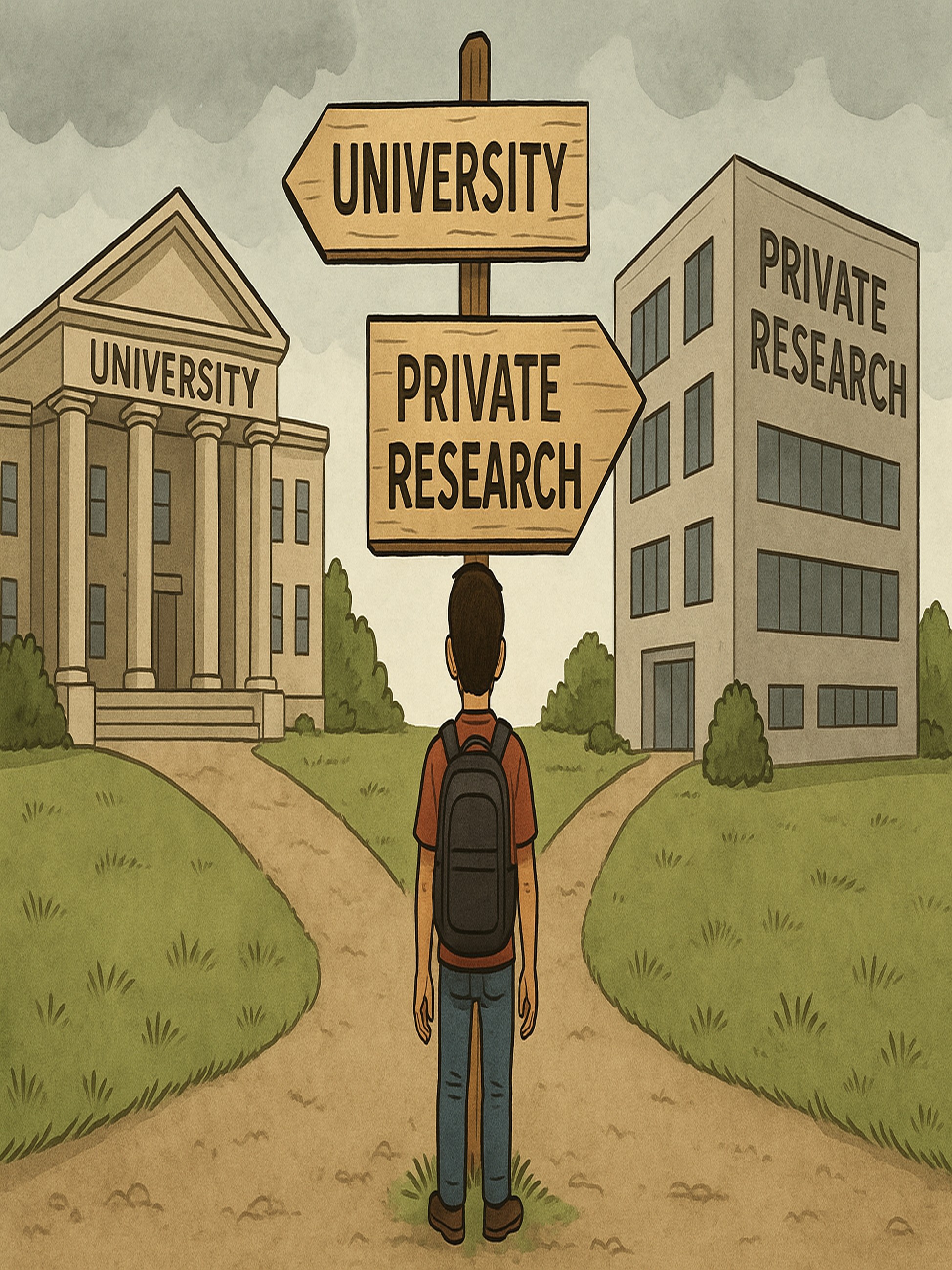
Five years have passed, and from what I hear, the situation has only deteriorated further — as recently reported by Martelli Júnior et al. (2025) in their analysis of Brazil’s scientific decline. I often find myself reflecting on how many bright, passionate young scientists are lost to the chronic underfunding and institutional erosion of Brazil’s public universities. Among my colleagues, many are now considering doctoral studies abroad in institutions where scientific inquiry is valued and structurally supported. But that decision, too, comes with a cost. On the one hand, lies the increasingly precarious national academic landscape; on the other, the private sector’s unrelenting demand for immediate, commercially viable results (Figure 1).

Scientific crossroads: a young Brazilian researcher facing the choice between staying in public academia or moving to private research, reflecting the dilemmas between academic vocation and structural pressures. Image generated by ChatGPT (AI-assisted illustration).
In this complex and often disheartening context, perhaps the most honest and realistic conclusion is this: in present-day Brazil, choosing to remain a scientist is no longer simply a career path — it is an act of defiance and resilience. However, we can change this scenario by fostering a new scientific culture within academia. We must build structures that nurture talent and purpose — mentorship programs linking students with academic and industry leaders, initiatives that bridge basic and applied research, and interdisciplinary environments that foster creativity and collaboration. As recently highlighted by González et al. (2025), strengthening such support systems is essential to ensure graduate students’ participation and long-term engagement with the scientific community. Only by building such bridges can we turn resilience into opportunity and secure a more sustainable future for Brazilian Science.
References
-
GONZÁLEZ PH, GUIMARÃES VA & DIELE-VIEGAS LM. 2025. Bridging the funding gap: a barrier to graduate students’ participation in academic events. An Acad Bras Cienc 97: e20241051. https://doi.org/10.1590/0001-3765202520241051.
» https://doi.org/10.1590/0001-3765202520241051 -
MARTELLI JÚNIOR H, DE SOUSA AAD, OLIVEIRA MCLA, MARTELLI DRB & OLIVEIRA EA. 2025. Brazil’s scientific resilience: recovering from decline. An Acad Bras Cienc 97: e20241505. https://doi.org/10.1590/0001-3765202520241505.
» https://doi.org/10.1590/0001-3765202520241505 - WILSON EO. 2013. Letters to a Young Scientist. New York: Liveright Publishing Corporation, 256 p.