
 Natural biopesticide: Thymol’s efficacy on beetle Tenebrio molitor
 Abstract
Tenebrio molitor is a key pest of stored products, and the search for sustainable control methods has led to increasing interest in plant-based insecticides. In this study, we evaluated the contact toxicity of thymol, a monoterpene extracted from Lamiaceae plants, against T. molitor larvae. A total of 1,200 fourth- and fifth-instar larvae were exposed to thymol-treated surfaces at concentrations ranging from 0 to 50 gL⁻¹. Larval mortality varied significantly among concentrations, with a clear dose-dependent response. Even at 0.1 gL⁻¹, thymol induced considerably higher mortality than the control group. Mortality rates exceeded 80% at concentrations ≥1 gL⁻¹, and most deaths occurred within the first 24 hours. The LC₅₀ and LC₉₀ values estimated for this period were 0.17 and 2.75 gL⁻¹, respectively, indicating high acute toxicity. These findings confirm thymol’s potential as a fast-acting botanical insecticide for the management of stored-product pests. Future studies should investigate its efficacy under real storage conditions, long-term stability, and potential non-target effects.
Key words
Agricultural entomology; Integrated pest management; Natural insecticides; Stored product pests; Botanical compounds
INTRODUCTION
Brazil produces approximately 288.1 million tons of grains annually (CONAB 2025). Post-harvest losses caused by insect pests, fungi, and mycotoxins represent a significant challenge for grain storage and food security (Khan 2024). Among these factors, insect pests are considered one of the primary contributors to economic losses during storage (Banga et al. 2020, Pozebon et al. 2020, Pimentel et al. 2024). In Brazil, major grain crops, including corn, soybeans, beans, rice, wheat, barley, and sorghum, suffer considerable losses, with insect-related damage alone estimated to exceed US$4.7 billion per year, according to the most recent national data (Oliveira et al. 2014).
Tenebrio molitor Linnaeus, 1758 (Coleoptera: Tenebrionidae), is a cosmopolitan pest of stored products that frequently infests food storage facilities worldwide. Both larvae and adults cause significant quantitative and qualitative damage to cereals, grains, and flour-based products, compromising food safety and leading to substantial economic losses (Costa Lima 1995, Fazolin et al. 2007). These infestations highlight the urgent need for effective, sustainable, and environmentally friendly pest management strategies (Swathy et al. 2024, Vivekanandhan et al. 2024a, b, Toledo & Ferreira 2025).
Conventional chemical pesticides remain the most widely used approach for insect control. However, they are often toxic, broad-spectrum, and environmentally damaging, contributing to biodiversity loss and ecosystem imbalances (Kaur et al. 2024, Kamlesh et al. 2024). In Brazil alone, the management of insect pests in major grain crops requires approximately 137,000 tons of insecticides annually, resulting in expenditures exceeding US$ 2.1 billion (Oliveira et al. 2014). This heavy reliance on chemical inputs underscores the urgent need for safer and more sustainable alternatives.
In this context, various environmentally friendly control strategies have emerged as promising alternatives to synthetic insecticides for managing T. molitor. These include the use of entomopathogenic nematodes such as Steinernema feltiae (Filipjev, 1934) and Heterorhabditis bacteriophora Poinar, 1975 (Susurluk, 2006), parasitoid insects such as Trichogramma spp., and Dinarmus basalis (Rondani, 1877) (Gonçalves et al. 2003, Pimentel et al. 2024), entomopathogenic fungi such as Beauveria bassiana (Bals.-Criv.) Vuill. 1912, Metarhizium anisopliae (Metschn.) Sorokin 1883, and Metarhizium rileyi (Farl.) Kepler, Rehner & Humber (2014) (Shah et al. 2023, Swathy et al. 2024, Vivekanandhan et al. 2024a), as well as botanical insecticides derived from plant essential oils, such as those extracted from Vachellia nilotica (L.) PJH Hurter & Mabb., and menthol P.A., which demonstrate significant insecticidal activity with low environmental impact (Perumal et al. 2023, Toledo & Ferreira 2025).
Botanical compounds, derived from secondary metabolism, penetrate the insect body through the cuticle and digestive tract (Afroz et al. 2021), where they interfere with vital physiological systems, particularly the respiratory and nervous systems (Viegas-Junior 2003, Chaubey 2019, Souto et al. 2021). Their action can lead to sudden death, as well as morphological, physiological, and behavioral changes in target insects (Grzesiuk et al. 2013, Pauliquevis et al. 2013, Tavares et al. 2013, Dias et al. 2019a, b, Toledo & Ferreira 2025). Compared to conventional pesticides, these plant-based insecticides pose significantly lower risks to human health and the environment, making them promising, viable, and cost-effective alternatives for pest management (Viegas-Junior 2003, Knaak & Fiuza 2010, Coitinho et al. 2011, Mishra et al. 2012).
Among these botanical options, thymol (C₁₀H₁₄O), a monoterpenoid commonly found in essential oils from Lamiaceae species, has attracted considerable attention. Its concentration in these plants can range from 10.4% to 81.1% (Escobar et al. 2020, Leite et al. 2022). Thymol has demonstrated insecticidal activity against several species, including Ripicephalus microplus (Canestrini, 1987), T. molitor adults, Tribolium castaneum (Herbst, 1797), Mahanarva spectabilis (Distant, 1909), and Solenopsis saevissima (Smith, 1855) (Novelino et al. 2007, Lima et al. 2011, Malika et al. 2016, Dias et al. 2019a, b, Santos-Prezoto, 2019).
Given its proven insecticidal properties and low environmental toxicity, thymol emerges as a strong candidate for the development of botanical bioinsecticides. Therefore, the objective of this study was to evaluate the contact insecticidal efficacy of thymol against T. molitor larvae, providing data on its potential use in controlling stored grain pests.
MATERIALS AND METHODS
Obtention, Maintenance, and Selection of Tenebrio molitor
Specimens of T. molitor were obtained from local commercial suppliers in Juiz de Fora, Minas Gerais, Brazil, and transported to the Laboratório de Zoologia de Invertebrados do Centro Universitário Uniacademia – Campus Arnaldo Janssen, Juiz de Fora, Minas Gerais. A matrix was subsequently established using newly emerged adult beetles, housed in plastic containers (38 × 53 × 8.5 cm) containing approximately 2 cm of wheat bran and maize meal as the primary food source (Zamperlini et al. 1992, Ribeiro et al. 2018, Eberle et al. 2022). To maintain adequate moisture levels, slices of chayote (Sechium edule (Jacq.) Swartz, 1800) and/or cucumber ( Cucumis sativus L.) were provided (Fraenkel et al. 1950). The culture was maintained under controlled environmental conditions (25 ± 1°C and 80 ± 5% relative humidity) following the protocols described by Ribeiro et al. (2018) and Eberle et al. (2022). This setup enabled the continuous production of larvae, from which 4th- and 5th-instar individuals were selected for the experiments, based on their appropriate size for handling, physiological stability, and sensitivity in bioassays, as recommended by previous studies (Morales-Ramos et al. 2015, Eberle et al. 2022).
Experimental design and data collection
Thymol P.A. (Synth®) was weighed using an analytical balance and dissolved in distilled water pre-heated to 60°C to enhance solubility. Subsequently, 1% dimethyl sulfoxide (DMSO) (Isofar®) was added as an emulsifying agent to facilitate thymol dispersion, following the methodology described by Abreu et al. (2025). This procedure was used to prepare the following treatment concentrations: 0 gL⁻¹ (control group), 0.1 gL⁻¹, 0.2 gL⁻¹, 0.3 gL⁻¹, 0.4 gL⁻¹, 0.5 gL⁻¹, 0.6 gL⁻¹, 0.7 gL⁻¹, 0.8 gL⁻¹, 0.9 gL⁻¹, 1 gL⁻¹, 2 gL⁻¹, 3 gL⁻¹, 4 gL⁻¹, 5 gL⁻¹, 6 gL⁻¹, 7 gL⁻¹, 8 gL⁻¹, 9 gL⁻¹, 10 gL⁻¹, 20 gL⁻¹, 30 gL⁻¹, 40 gL⁻¹, and 50 gL⁻¹.
For each concentration, 5 mL of the solution was uniformly applied to 9.5 cm diameter Petri dishes containing two layers of previously sterilized filter paper at 120°C for 2 hours. This procedure ensured that the larvae remained in contact with the treated surface without risk of drowning. Immediately after application, ten fourth- and/or fifth-instar T. molitor larvae were carefully transferred to each dish, ensuring direct contact with the treated surface (Toledo & Ferreira 2025). Larval mortality was evaluated at two time intervals: 24 and 48 hours post-exposure. Larvae were considered dead if they exhibited cuticle darkening and no movement in response to gentle tactile stimulation. Each treatment was replicated five times (n = 50 larvae per concentration).
Statistical analysis
A generalized linear mixed model (GLMM) was used to evaluate the effects of thymol concentration (a 24-level categorical variable) and exposure time (a two-level categorical variable) on larval mortality (a numeric variable), with replication included as a random effect. The model was fitted using a binomial distribution and a logit link function, allowing simultaneous assessment of fixed and random effects while accounting for variability among replicates.
Thymol concentration differences were analyzed using Tukey’s post-hoc test for pairwise comparisons. Model adequacy was evaluated using simulated residuals generated with the DHARMa package (Hartig 2022). Graphical inspection revealed no discernible patterns in the standardized residuals, indicating a good model fit. Additionally, the uniformity test (p = 0.95) and the dispersion test (p = 0.19) confirmed the absence of overdispersion. The outlier test (p = 0.90) identified no influential observations, further supporting the model’s robustness.
To estimate the median lethal concentration (LC50) and the high lethal concentration (LC90) at 24 hours post-exposure, due to the high observed mortality within this period, a subset of the data corresponding to the 24-hour interval was selected. Mortality data were normalized and expressed as percentages. Subsequently, a four-parameter log-logistic model (LL.4) was fitted using the “drc” package (Ritz et al. 2015) in R software. Lethal concentration estimates and their respective confidence intervals were calculated using the delta method. Finally, a predicted mortality curve across the tested concentration range was generated to visually assess the goodness of fit of the dose-response model.
Analyses were performed using R software version 4.5.0 (R Core Team 2025), and the packages “lme4” (Bates et al. 2015), “multcomp” (Hothorn et al. 2008), and “stats” (R Core Team 2025). Graphs were generated using the “dplyr” (Wickham et al. 2023), “ggplot2” (Wickham 2016), “ggpubr” (Kassambara 2023), and “multcompView” (Graves et al. 2024) packages.
RESULTS
The mortality of T. molitor larvae varied significantly among thymol concentrations (χ²₂₃ = 246.36, F = 8.23, p < 0.0001; Fig. 1). All thymol groups differed significantly from the control (0 gL⁻¹). Notably, even the lowest concentration tested (0.1 gL⁻¹) induced a significant increase in larval mortality compared to the control, indicating a high sensitivity of T. molitor larvae to thymol exposure (Fig. 1). From 0.1 to 0.9 gL⁻¹, a clear dose-dependent increase in mortality was observed, with mortality rates exceeding 70% at concentrations ≥ 0.7 gL⁻¹. Above 1 gL⁻¹, larval mortality remained consistently high, with most concentrations causing mortality levels above 80%, suggesting a plateau effect (Fig. 1).
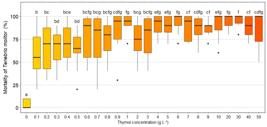
Mortality percentage of Tenebrio molitor at different concentrations of thymol (gradient colors from lowest to highest concentration). Box-and-whisker plots show the median (horizontal line), interquartile range (box), and the range from the upper and lower quartiles (whiskers). Lower-case letters indicate significant differences among concentrations, based on pairwise Tukey comparison.
In addition to the dose-dependent effect, larval mortality was significantly higher within the first 24 hours compared to 48 hours (β = -1.51 ± 0.13, χ²₁ = 139.72, z = -11.32, p < 0.0001; Fig. 2a). In total, 826 larvae (68.8%) died within the first 24 hours, demonstrating the rapid action of thymol on larval mortality (Fig. 2A). Finally, the LC50 (0.17 gL⁻¹) and LC90 (2.75 gL⁻¹) values, calculated exclusively for the first 24 hours of exposure, highlight the acute toxicity of thymol to T. molitor larvae (Fig. 2b).

Mortality percentage of Tenebrio molitor. Bars represent mortality at 24 hours (blue), 48 hours (yellow), and survivors (green) (a). Dose-response curve for Tenebrio molitor mortality after the first 24 hours. The black line shows the dose-response curve; vertical dashed lines indicate the LC₅₀ (red, 50% mortality) and LC₉₀ (blue, 90% mortality) concentrations (b).
DISCUSSION
Our study demonstrated a clear and rapid toxic effect of thymol on T. molitor larvae, with significant increases in mortality observed even at the lowest tested concentration. The mortality response was both dose- and time-dependent, with most deaths occurring within the first 24 hours of exposure. The low LC50 and LC90 values calculated for this period further emphasize the high sensitivity of T. molitor larvae to thymol.
The high larval mortality of T. molitor observed at concentrations ranging from 1 to 50 gL⁻¹ (exceeding 80%) underscores thymol’s potential as a promising candidate for bioinsecticide development. According to the National Health Surveillance Agency (ANVISA) guidelines, substances must achieve over 90% insect mortality via contact to qualify as insecticides (Brazil 2009). In our study, mortality ranged from 40% to 92% within the first 24 hours, with a further 18.7% increase after 48 hours, demonstrating that high efficacy can be reached even at relatively low thymol concentrations.
These results align with previous studies reporting strong insecticidal activity of thymol across multiple pest species and developmental stages. For M. spectabilis, mortality exceeded 70% and 80% in nymphs after 24 and 48 hours, respectively, and reached up to 97% in adults at concentrations above 5% (Dias et al. 2019a, b). Similarly, 100% mortality was reported in S. saevissima workers within 24 hours at 0.5 mgmL⁻¹ (Santos-Prezoto 2019), and R. microplus larvae showed 55% mortality at 0.5% thymol (Novelino et al. 2007). For T. castaneum, thymol caused up to 50% mortality, with rapid onset of toxic effects (Malika et al. 2016). Notably, Malika et al. (2016) also reported temperature-dependent efficacy, with higher mortality observed at 20°C and 25°C, conditions consistent with those in our study, reinforcing the robustness of our findings.
Beyond its lethal effects, thymol induced immediate agitation in T. molitor larvae, characterized by erratic, escape-oriented movements. Similar behavioral responses have been documented in M. spectabilis (Dias et al. 2019a, b), R. microplus (Novelino et al. 2007), and in T. molitor larvae exposed to menthol (Toledo & Ferreira 2025). This supports the hypothesis that thymol also acts as a repellent, offering dual action as both a toxicant and behavioral deterrent, a valuable characteristic for Integrated Pest Management (IPM) strategies.
Toxicological comparisons further highlight thymol’s efficacy via contact exposure. The LC50 (0.17 gL⁻¹) and LC90 (2.75 gL⁻¹) determined in our study are substantially lower than those reported for T. molitor adults exposed to thymol via fumigation (LC50 = 14.71 µLL⁻¹ air; LC90 = 17.21 µLL⁻¹ air (Lima et al. 2011)). Given that both assessments were conducted 24 hours after exposure, this contrast highlights the influence of exposure route and developmental stage on thymol toxicity. The higher sensitivity observed in larvae via contact suggests that thymol could effectively reduce larval survival, disrupt the insect life cycle, and mitigate future infestations and economic losses (Coitinho et al. 2006, 2011, Toledo & Ferreira 2025).
In addition to these toxicological and behavioral effects, surviving larvae (approximately 12.5%) may also experience sublethal physiological impacts. Previous research on plant-derived volatile organic compounds reported significant alterations in reproductive physiology, including reduced oocyte volume, suppressed vitellogenin gene expression, and diminished energy reserves in T. molitor ovaries (Walkowiak-Nowicka et al. 2023). Although our study did not evaluate reproductive parameters, such findings suggest that thymol may exert broader physiological and ecological impacts beyond direct mortality. We recommend that future studies investigate thymol’s sublethal, endocrine-disrupting, and ovicidal effects on T. molitor, including on embryonic development.
Furthermore, given thymol’s demonstrated ovicidal activity against M. spectabilis eggs (Dias et al. 2019a, b) and its fumigant toxicity on adult T. molitor (Lima et al. 2011), a multi-target approach combining contact, fumigation, and repellency effects could enhance control efficacy across life stages. Such integration is essential, as insecticidal performance often varies with species, developmental stage, and environmental conditions (Lima et al. 2011).
Finally, thymol’s additional antifungal properties against storage pathogens like Aspergillus and Penicillium species (Paster et al. 1995, Boudine et al. 2016, Schlösser & Prange 2019), coupled with its non-phytotoxicity to maize germination (Montes-Belmont & Carvajal 1998), further reinforce its potential as a safe, eco-friendly, and multifunctional agent for sustainable pest management in agribusiness systems.
CONCLUSIONS
Thymol demonstrated high insecticidal efficacy against T. molitor larvae, with significant dose- and time-dependent mortality. Even at low concentrations (0.1 gL⁻¹), thymol significantly increased larval mortality compared to the control, reaching over 80% at concentrations above 1 gL⁻¹. The rapid toxic action, with nearly 69% mortality occurring within the first 24 hours, highlights thymol’s potential for quick pest control. The low LC50 and LC90 values further emphasize its acute toxicity. These findings suggest that thymol is a promising, plant-based alternative for IPM in stored grain systems, offering both efficiency and environmental safety.
References
-
ABREU P, TOLEDO AMO, SILVA JÚNIOR VO, DAEMON E & D’AGOSTO MT. 2025. Efficacy of thymol as a promising candidate substance against the exotic pest Achatina fulica Bowdich, 1822 (Mollusca, Gastropoda). An Acad Bras Cienc 97: e20250228. https://doi.org/10.1590/0001-3765202520250228.
» https://doi.org/10.1590/0001-3765202520250228 - AFROZ M, RAHMAN M & AMIN R. 2021. Insect plant interaction with reference to secondary metabolites: a review. Agric Rev 42(4): 427-433.
-
BANGA KS, KUMAR S, KOTWALIWALE N & MOHAPATRA D. 2020. Major insects of stored food grains. Int J Chem Stud 8(1): 2380-2384. https://doi.org/10.22271/CHEMI.2020.V8.I1AJ.8624.
» https://doi.org/10.22271/CHEMI.2020.V8.I1AJ.8624 -
BATES D, MÄCHLER M, BOLKER B & WALKER S. 2015. Fitting linear mixed-effects models using lme4. J Stat Softw 67(1): 1-48. https://doi.org/10.18637/jss.v067.i01.
» https://doi.org/10.18637/jss.v067.i01 - BOUDINE L, LOUASTE B, ELOUTASSI N, CHAMI N, CHAMI F & REMMAL A. 2016. Antifungal activity of oregano essential oil and thymol against some fungi isolated from corn grains. Int J Innov Appl Stud 17(4): 1120-1124.
- BRASIL. 2009. Manual de Testes de Eficácia em Produtos Desinfestantes. Agência Nacional de Vigilância Sanitária, Brasília: ANVISA, 50 p.
- CHAUBEY MK. 2019. Essential oils as green pesticides of stored grain insects. Eur J Biol Res 9(4): 202-244.
- COITINHO RLBC, OLIVEIRA JV, GONDIM-JUNIOR MGC & CÂMARA CAGD. 2006. Atividade inseticida de óleos vegetais sobre Sitophilus zeamais Mots. (Coleoptera: Curculionidae) em milho armazenado. Rev Caatinga 19(2): 176-182.
- COITINHO RLBC, OLIVEIRA JV, GONDIM-JUNIOR MGC & CÂMARA CAGD. 2011. Toxicidade por fumigação, contato e ingestão de óleos essenciais para Sitophilus zeamais Motschulsky, 1885 (Coleoptera: Curculionidae). Ciênc Agrotec 35(1): 172-178.
-
CONAB - COMPANHIA NACIONAL DE ABASTECIMENTO. 2025. Acompanhamento da Safra Brasileira de Grãos: Safra 2024/25 - Nono Levantamento. Brasília, DF: CONAB. Available at: https://www.gov.br/conab/pt-br/atuacao/informacoes-agropecuarias/safras/safra-de-graos/boletim-da-safra-de-graos/9o-levantamento-safra-2024-25/9o-levantamento-safra-2024-25 Accessed 14 June 2025.
» https://www.gov.br/conab/pt-br/atuacao/informacoes-agropecuarias/safras/safra-de-graos/boletim-da-safra-de-graos/9o-levantamento-safra-2024-25/9o-levantamento-safra-2024-25 - COSTA LIMA A. 1955. Insetos do Brasil: Coleópteros. Rio de Janeiro: Escola Nacional de Agronomia, 263 p.
-
DIAS ML, AUAD AM, MAGNO MC, RESENDE TT, FONSECA MG & SILVA SE. 2019a. Insecticidal activity of compounds of plant origin on Mahanarva spectabilis (Hemiptera: Cercopidae). Insects 10(10): 360. https://doi.org/10.3390/insects10100360.
» https://doi.org/10.3390/insects10100360 -
DIAS ML, AUAD AM & RESENDE TT. 2019b. Insecticidal effects of thymol on Mahanarva spectabilis (Hemiptera: Cercopidae) in two evaluation methodologies. J Agric Crop Res 7(10):181-185. https://doi.org/10.33495/jacr_v7i10.19.154.
» https://doi.org/10.33495/jacr_v7i10.19.154 -
EBERLE S, SCHADEN LM, TINTNER J, STAUFFER C & SCHEBECK M. 2022. Effect of temperature and photoperiod on development, survival, and growth rate of mealworms, Tenebrio molitor Insects 13(4): 321. https://doi.org/10.3390/insects13040321.
» https://doi.org/10.3390/insects13040321 - ESCOBAR A, PEREZ M, ROMANELLI G & BLUSTEIN G. 2020. Thymol bioactivity: A review focusing on practical applications. Arab J Chem 13(12): 9243-9269.
- FAZOLIN M, ESTRELA JLV, CATANI V, ALÉCIO MR & LIMA MS. 2007. Propriedade inseticida dos óleos essenciais de Piper hispidinervum C. DC., Piper aduncum L. e Tanaecium nocturnum (Barb. Rodr.) Bur. & K. Shum sobre Tenebrio molitor L., 1758. Ciênc Agrotec 31(1): 113-120.
- FRAENKEL G, BLEWETT M & COLES M. 1950. The nutrition of the mealworm, Tenebrio molitor L, (Tenebrionidae, Coleoptera). Physiol Zool 23: 92-108.
- GONÇALVES JR, OLIVEIRA CRF & MATOS CHC. 2003. Potencial de Trichogramma spp. no controle de pragas de grãos armazenados. Eng Agríc 11: 65-71.
-
GRAVES S, PIEPHO H & DORAI-RAJ LSWHFS. 2024. multcompView: Visualizations of Paired Comparisons. doi:10.32614/CRAN.package.multcompView. https://doi.org/10.32614/CRAN.package.multcompView, R package version 0.1-10, https://CRAN.R-project.org/package=multcompView
» https://CRAN.R-project.org/package=multcompView - GRZESIUK VL, STEFANELLO TB & GEBARA KS. 2013. Avaliação do potencial inseticida da espécie vegetal Croton floribundus (Euphorbiaceae) frente a Periplaneta americana (Blatidae). Interbio 7: 41-46.
-
HARTIG F. 2022. DHARMa: Residual Diagnostics for Hierarchical (Multi-Level / Mixed) Regression Models. R package version 0.4.6. Disponível em: https://CRAN.R-project.org/package=DHARMa
» https://CRAN.R-project.org/package=DHARMa -
HOTHORN T, BRETZ F & WESTFALL P. 2008. Simultaneous inference in general parametric models. Biom. J. Math. Methods Biosci 50(3): 346-363. https://doi.org/10.1002/bimj.200810425.
» https://doi.org/10.1002/bimj.200810425 - KAMLESH R, SANTOSH S, SUDHAKAR P & SUNITA A. 2024. Role of pesticides in biodiversity loss. Int J Innov Appl 6(1): 01-03.
-
KASSAMBARA A. 2023. ggpubr: ‘ggplot2’ Based Publication Ready Plots. R package version 0.6.0. Disponível em: https://CRAN.R-project.org/package=ggpubr
» https://CRAN.R-project.org/package=ggpubr - KAUR R, CHOUDHARY D, BALI S, BANDRAL SS, SINGH V, AHMAD MA, RANI N, SINGH TG & CHANDRASEKARAN B. 2024. Pesticides: An alarming detrimental to health and environment. Sci Total Environ 170113. doi: 10.1016/j.scitotenv.2024.170113.
-
KHAN AA. 2024. Insect as major carrier of aflatoxins and mycotoxin in foods: A review. J Entomol Zool Stud 12(3): 46-53. https://doi.org/10.22271/j.ento.2024.v12.i3a.9318.
» https://doi.org/10.22271/j.ento.2024.v12.i3a.9318 -
KNAAK N & FIUZA LM. 2010. Potencial dos óleos essenciais de plantas no controle de insetos e microrganismos. Neotrop Biol Conserv 5(2): 120-132. https://doi.org/10.4013/4757.
» https://doi.org/10.4013/4757 -
LEITE JCVA, SILVA MRE, SANTOS JAA & FARIA RX. 2022. Natural products as a control measure of the Achatina fulica (Gastropoda: Achatinidae). Braz J Biol 84: e260065. https://doi.org/10.1590/1519-6984.260065.
» https://doi.org/10.1590/1519-6984.260065 - LIMA RK, CARDOSO MDG, MORAES JC, CARVALHO SM, RODRIGUES VG & GUIMARÃES LGL. 2011. Chemical composition and fumigant effect of essential oil of Lippia sidoides Cham. and monoterpenes against Tenebrio molitor (L,) (Coleoptera: Tenebrionidae). Ciênc Agrotec 35(4): 664-671.
-
MISHRA BB, TRIPATHI SP & TRIPATHI CPM. 2012. Response of Tribolium castaneum (Coleoptera: Tenebrionidae) and Sitophilus oryzae (Coleoptera: Curculionidae) to potential insecticide derived from essential oil of Mentha arvensis leaves. Biol Agric Hortic 28(1): 34-40. https://doi.org/10.1080/01448765.2012.662792.
» https://doi.org/10.1080/01448765.2012.662792 -
MONTES-BELMONT R & CARVAJAL M. 1998. Control of Aspergillus flavus in maize with plant essential oils and their components. J Food Prot 61(5): 616-619. https://doi.org/10.4315/0362-028X-61.5.616.
» https://doi.org/10.4315/0362-028X-61.5.616 - MORALES-RAMOS JA, KAY S, ROJAS MG, SHAPIRO-ILAN DI & TEDDERS WL. 2015. Morphometric analysis of instar variation in Tenebrio molitor (Coleoptera: Tenebrionidae), Ann Entomol Soc Am 108(2): 146-159. https://doi.org/10.1093/aesa/sau049.
-
NOVELINO AMS, DAEMON E & SOARES GLG. 2007. Avaliação da atividade repelente do timol, mentol, salicilato de metila e ácido salicilico sobre larvas de Boophilus microplus (Canestrini, 1887) (Acari: Ixodidae). Arq Bras Med Vet Zootec 59(3): 700-704. https://doi.org/10.1590/S0102-09352007000300023.
» https://doi.org/10.1590/S0102-09352007000300023 -
OLIVEIRA CM, AUAD AM, MENDES SM & FRIZZAS MR. 2014. Crop losses and the economic impact of insect pests on brazilian agriculture. Crop Prot 56: 50-54. https://doi.org/10.1016/j.cropro.2013.10.022.
» https://doi.org/10.1016/j.cropro.2013.10.022 -
PASTER N, MENASHEROV M, RAVID UZI & JUVEN B. 1995. Antifungal activity of oregano and thyme essential oils applied as fumigants against fungi attacking stored grain. J Food Prot 58(1): 81-90. https://doi.org/10.4315/0362-028X-58.1.81.
» https://doi.org/10.4315/0362-028X-58.1.81 - PAULIQUEVIS CF, CONTE CO & FAVERO S. 2013. Atividade insetistática do óleo essencial de Pothomorphe umbellata (L.) Miq., sobre Rhyzopertha dominica (Fabricius, 1792) (Coleoptera: Bostrichidae). Rev Bras Agroecol 8(3): 39-45.
-
PERUMAL V, KANNAN S, PITTARATE S, CHINNASAMY R & KRUTMUANG P. 2023. Essential oils from Acacia nilotica (Fabales: Fabaceae) seeds: May have insecticidal effects? Heliyon 9(4): e14808. https://doi.org/10.1016/j.heliyon.2023.e14808.
» https://doi.org/10.1016/j.heliyon.2023.e14808 -
PIMENTEL AJB, RIBEIRO AEL, CALADO DC, COSTA VA & FREITAS RS. 2024. First record of Dinarmus basalis parasititing Callosobruchus maculatus on cowpea grains, in the state of Bahia. Rev Agric Neotrop 11(3): e8883. https://doi.org/10.32404/rean.v11i3.8883.
» https://doi.org/10.32404/rean.v11i3.8883 -
POZEBON H, MARQUES RP, PADILHA G, O’NEAL M, VALMORBIDA I, BEVILAQUA JG, TAY WT & ARNEMANN JA. 2020. Arthropod invasions versus soybean production in Brazil: A review. J Econ Entomol 113(4): 1591-1608. https://doi.org/10.1093/JEE/TOAA108.
» https://doi.org/10.1093/JEE/TOAA108 -
R CORE TEAM 2025. R: A Language and environment for statistical computing. R Foundation for Statistical Computing, Vienna, Austria. <https://www.R-project.org/>.
» https://www.R-project.org/> -
RIBEIRO N, ABELHO M & COSTA R. 2018. A review of the scientific literature for optimal conditions for mass rearing Tenebrio molitor (Coleoptera: Tenebrionidae). J Entomol Sci 53(4): 434-454. https://www.doi.org/10.18474/JES17-67.1.
» https://doi.org/10.18474/JES17-67.1 -
RITZ C, BATY F, STREIBIG JC & GERHARD D. 2015. Dose-response analysis using R. PLOS ONE 10(12): e0146021. https://doi.org/10.1371/journal.pone.0146021.
» https://doi.org/10.1371/journal.pone.0146021 - SANTOS-PREZOTO HH. 2019. Formigas lava-pés Solenopsis saevissima (smith, 1855): do voo nupcial ao controle populacional. Tese de Doutorado em Ciências Biológicas (Zoologia): Comportamento e Biologia Animal. Universidade Federal de Juiz de Fora, 88 p. https://repositorio.ufjf.br/jspui/handle/ufjf/14082.
-
SCHLÖSSER I & PRANGE A. 2019. Antifungal activity of selected natural preservatives against Aspergillus westerdijkiae and Penicillium verrucosum and the interactions of these preservatives with food components. J Food Prot 82(10): 1751-1760. https://doi.org/10.4315/0362-028X.JFP-19-082.
» https://doi.org/10.4315/0362-028X.JFP-19-082 -
SHAH S, ASH GJ & WILSON BA. 2023. Resporulation of Metarhizium anisopliae granules on soil and mortality of Tenebrio molitor: Implications for wireworm management in sweetpotato. Ann Appl Biol 182(1): 65-76. https://doi.org/10.1111/aab.12797.
» https://doi.org/10.1111/aab.12797 -
SOUTO AL, SYLVESTRE M, TÖLKE ED, TAVARES JF, BARBOSA-FILHO JM & CEBRIÁN-TORREJÓN G. 2021. Plant-derived pesticides as an alternative to pest management and sustainable agricultural production: Prospects, applications and challenges. Molecules 26(16): 4835. https://doi.org/10.3390/molecules26164835.
» https://doi.org/10.3390/molecules26164835 - SUSURLUK A. 2006. Effectiveness of the entomopathogenic nematodes Heterorhabditis bacteriophora and Steinernema feltiae against Tenebrio molitor (yellow mealworm) larvae in different soil types at different temperatures, Turk. J Biol 30(4): 199-205. https://journals.tubitak.gov.tr/biology/vol30/iss4/3.
-
SWATHY K, PARMAR MK & VIVEKANANDHAN P. 2024. Biocontrol efficacy of entomopathogenic fungi Beauveria bassiana conidia against agricultural insect pests. Environ Qual Manag 34(1): e22174. https://doi.org/10.1002/tqem.22174.
» https://doi.org/10.1002/tqem.22174 - TAVARES WS, FREITAS SS, GRAEL CFF, DE MENEZES CWG, PEREIRA AIA, ASSIS JÚNIOR SL, GRAZZIOTTI GH & ZANUNCIO JC. 2013. Tenebrio molitor (Coleoptera: Tenebrionidae) as a guinea pig for the analysis of the toxicity of natural products. Vie Milieu 63(3/4): 193-204.
-
TOLEDO AMO & FERREIRA PA. 2025. Menthol in pest control: Toxicidal activity on Tenebrio molitor (L., 1758) (Coleoptera: Tenebrionidae). BioAssay 20: ba20001. https://doi.org/10.37486/1809-8460.ba20001.
» https://doi.org/10.37486/1809-8460.ba20001 -
VIEGAS-JUNIOR C. 2003. Terpenos com atividade inseticida: uma alternativa para o controle químico de insetos. Quím Nova 26(3): 390-400. https://doi.org/10.1590/S0100-40422003000300017.
» https://doi.org/10.1590/S0100-40422003000300017 -
VIVEKANANDHAN P, ALAHMADI TA & ANSARI MJ. 2024a. Pathogenicity of Metarhizium rileyi (Hypocreales: Clavicipitaceae) against Tenebrio molitor (Coleoptera: Tenebrionidae). J. Basic Microbiol 64(5): 2300744. https://doi.org/10.1002/jobm.202300744.
» https://doi.org/10.1002/jobm.202300744 -
VIVEKANANDHAN P, ALAHMADI TA, ANSARI MJ & SUBALA SP. 2024b. Biocontrol efficacy of cajeput oil against Anopheles stephensi L. mosquito and its effect on non-target species. Front Physiol 15: 1357411. https://doi.org/10.3389/fphys.2024.1357411.
» https://doi.org/10.3389/fphys.2024.1357411 -
WALKOWIAK-NOWICKA K, MIREK J, CHOWAŃSKI S, SOBKOWIAK R & SŁOCIŃSKA M. 2023. Plant secondary metabolites as potential bioinsecticides? Study of the effects of plant-derived volatile organic compounds on the reproduction and behaviour of the pest beetle Tenebrio molitor Ecotoxicol Environ Saf 257(114951): 10-1016. https://doi.org/10.1016/j.ecoenv.2023.114951.
» https://doi.org/10.1016/j.ecoenv.2023.114951 -
WICKHAM H, FRANÇOIS R, HENRY L, MÜLLER K & VAUGHAN D. 2023. dplyr: A grammar of data manipulation. 10.32614/CRAN.package.dplyr <https://doi.org/10.32614/CRAN.package.dplyr>, R package version 1.1.4, <https://CRAN.R-project.org/package=dplyr>.
» https://CRAN.R-project.org/package=dplyr> - WICKHAM H. 2016. ggplot2: Elegant graphics for data analysis. Springer-Verlag New York.
- ZAMPERLINI B, ZANUNCIO JC, LEITE JEM & BRAGANÇA MAL. 1992. Influência da alimentação de Tenebrio molitor L. 1758 (Coleoptera: Tenebrionidae) no desenvolvimento ninfal de Podisus connexivus Bergroth, 1891 (Hemiptera: Pentatomidae). Rev Árvore 16(2): 224-230.


