 Expanding the distribution of the lichenized genus Sarcographa Fée in continental Ecuador
ABSTRACT
The study of lichens in Neotropical regions has uncovered a remarkable diversity, much of which remains largely unexplored. Within this context, several species of Sarcographa, including the common and widespread S. labyrinthica (Ach.) Müll. Arg., S. fissurinoides, and S. feei had not been documented in Ecuador until now. This study expands the known geographical range of the species and provides new insights into the ecology and morphology of the genus Sarcographa.
Keywords:
crustose thallus; Graphidaceae; lowland tropical forests; neglected records; Neotropical biodiversity; Yasuní National Park
RESUMEN
El estudio de los líquenes en regiones Neotropicales ha revelado una notable diversidad, gran parte de la cual sigue siendo en gran medida inexplorada. En este contexto, varias especies de Sarcographa, incluyendo las común y de amplia dispersión S. labyrinthica (Ach.) Müll. Arg., S. fissurinoides y S. feei no habían sido previamente documentadas en Ecuador. Este estudio amplía el rango geográfico conocido de las especies y proporciona nuevos conocimientos sobre su ecología y morfología.
Palabras clave:
biodiversidad neotropical; bosques tropicales de tierra bajas; Graphidaceae; líquenes; Parque Nacional Yasuní; talo crustáceo
Lichens are a highly diverse group of organisms, with an estimated number of nearly 20,000 known species worldwide, and potentially up to 30,000 still awaiting discovery, particularly in underexplored tropical regions (Ahmadjian 1987; Feuerer and Hawksworth 2007; Lücking et al. 2017). Particularly in Neotropical regions, the study of lichens has revealed a remarkable diversity, much of which remains insufficiently documented and understood (Lucheta et al. 2019). This is the case of Ecuador, a Neotropical country which despite the relatively small geographical surface, is expected to harbor approximately 2,700 species of lichens (Lücking et al. 2009), with 2,225 species currently recorded in its continental area (Yánez-Ayabaca et al. 2023). Tropical lowland rainforests harbor a significant proportion of global lichen diversity, with families like Graphidaceae, Trypetheliaceae and Pyrenulaceae being among the most species-rich (Aptroot and Sipman 1997; Aptroot et al. 2016; Lücking et al. 2017; Déleg et al. 2021), and Neotropical ones are no exception (Komposch and Hafellner 2000; Cáceres et al. 2007; Rivas-Plata and Lücking 2013), but were so far little studied for lichen diversity in Ecuador. Countries such as Venezuela, Colombia, Peru, and Brazil have made significant progress in cataloging their lichen biota (Ahti and Sipman 2013; Flakus 2013), and also the knowledge of Ecuador’s lichen diversity has recently increased abruptly (Yánez-Ayabaca et al. 2023). However, in some areas, especially in the Amazonian provinces of Morona Santiago, Orellana, Pastaza, and Sucumbíos, lichen diversity remains poorly understood in comparation with other provinces of Ecuador (Yánez-Ayabaca et al. 2023). Recent efforts have led to the discovery of new species, such as Heterodermia arvidssoniiMoberg (Moberg 2011), Pyrenula flavoinspersa Aptroot and Sipman (Aptroot et al. 2013) and Dictyonema huaorani Dal-Forno et al. (Schmull et al. 2014), yet much remains to be uncovered.
The genus Sarcographa, characterized by its crustose thalli, lirellae, and distinctive white pruina (Lücking and Rivas-Plata 2008) is currently represented by four species in Ecuador, two being recorded from the Galápagos Islands only (S. medusulina and S. ramificans) and two from continental Ecuador (S. fenicis and S. tricosa; Yánez-Ayabaca et al. 2023). Here, we provide the results from recent field studies in Yasuní (Vega et al. 2021; Déleg et al. 2021) and herbarium revisions in the Herbarium Berolinense, focusing on the S. labyrinthica complex.
The specimen of Sarcographa labyrinthica reported here was collected using standard epiphytic lichen sampling techniques on the Yasuní National Park, one of the most biodiverse areas on the planet, in the Ecuadorian Amazon (Bass et al. 2010). We also revised several instances of S. labyrinthica reported from Ecuador in GBIF and LICHCOL, with additional confirmed records of this species and of S. fenicis, a previously unlisted and confirmed record of S. fissurinoides, and the first reports of S. feei for Ecuador from the B herbarium.
Sarcographa feei (C.F.W. Meissn.) Müll. Arg
This species has not been recognized as different from Sarcographa labyrinthica until recently (Lücking et al. 2023; Mardones et al. 2024), although it was mentioned as an uncommented entry in the lichen checklist for the Guianas (Hekking and Sipman 1988). It differs from S. labyrinthica in the morphology of the pseudostromata: whereas in the latter, the lirellae are much divided into finally angular discs directly bordering each other, in S. feei the originally lirelline character of the individual ascomata is largely maintained and the secondary transverse division of the lirellae leads to the formation of rounded discs separated by distinct areas of sterile whitish tissue (Figure 1a). Sarcographa feei is known from Costa Rica, Colombia and the Guianas and is here for the first time reported from Ecuador, from the northwestern province of Esmeraldas, based on material previously identified as S. labyrinthica.

Neglected records of Sarcographa in Ecuador. A - Specimen from Esmeraldas (78°50′11.65″ W, 1°16′2.18″ N) Sarcographa feei; B - Specimen from Los Ríos (79°27′09.88″ W, 0°59′06.10″ S) Sarcographa fenicis; C - Specimen from Esmeraldas (78°50′11.65″ W, 1°16′2.18″ N) Sarcographa fissurinoides; D - Sarcographa labyrinthica. Structures of Sarcographa labyrinthica specimen from Yasuní (Voucher: Vega et al. 002 at HUTPL, 76°24′21.00″ W, 0°40′33.00″ S): E - Thallus with immersed lirellae; F - Transverse section showing carbonized exciple; G - Non-amyloid hymenium with evenly dispersed components; H - Spores with four distinct septa.
Examined material: Ecuador, Esmeraldas, San Lorenzo, 30 m. Secondary rainforest; 12 VI 1982, Aptroot & Hensen 11071 (B; B 60 0178472).
Sarcographa fenicis (Vain.) Zahlbr.
Sarcographa fenicis agrees with S. labyrinthica in the distinctly pseudostromatic ascomata (Figure 1b), with the lirellae becoming much divided and forming angular, directly adjacent discs without sterile whitish tissue separating them, the typically 3-septate ascospores, and the stictic acid chemistry. It differs from the latter in the immersed pseudostromata remaining more or less flush with the thallus and lacking a thickened whitish margin. Also, the discs are often thinly pruinose and darker than in S. labyrintica. Previously, Sarcographa fenicis was reported from Ecuador only from Loja in the southern part of the country (Benítez et al. 2015; Yánez-Ayabaca et al. 2023). However, several previously unpublished collections identified as S. labyrinthica or Glyphis cicatricosa Ach. from western and central-western Eduador (Manabí and Los Ríos provinces) also represent this species.
Examined material: Ecuador, Los Ríos, Quevedo, km 54 north, 200 m. Primary rainforest; 15 VII 1982, Aptroot & Hensen 11194 (B; B 60 0178470), 11205 (B; B 60 0178473); Ecuador, Manabí, Puerto Lopez, 50 m. Coastal area with Cereus savanna; 1 VIII 1982, Aptroot & Hensen 10465 (B; B 60 0177264), 10582 (B; B 60 0177261).
Sarcographa fissurinoides M. Cáceres & Lücking
This species was only described recently (Cáceres 2007). It is most similar to Sarcographa feei in having pseudostromata with sterile whitish tissue separating the lirellae (Figure 1c). However, the lirellae remain mostly entire, with few transverse subdivisions, and the margins of the pseudostromata remain flush with the thallus, the young lirellae along the pseudostromat margins appearing fissurine. So far, the species was only known from the Atlantic rainforest in northeastern Brazil (Cáceres 2007; Menezes et al. 2013; Junior et al. 2021). The present specimen from Ecuador is an typical representative of this taxon and is the first report for Ecuador and outside Brazil. Previously, the only known records were from the type locality in Brazil, where the species occurs at 50 m elevation in the closed forest of the Mata Atlântica (Cáceres 2007).
Examined material: Ecuador, Esmeraldas, San Lorenzo, 30 m. Secondary rainforest; 12 VII 1982, Aptroot & Hensen 11053 (B; B 60 0178393).
Sarcographa labyrinthica (Ach.) Müll. Arg.
Typical specimens of Sarcographa labyrinthica feature distinct pseudostromata elevated above the thallus (Figure 1d), with a distinct whitish margin and with the lirellae divided into angular discs bordering each other. The ascospores are almost exclusively 3-septate. The taxon had not been reported before from Ecuador (Yánez-Ayabaca et al. 2023), but several specimens collected by A. Aptroot and R. Hensen in the early 1980s housed in B represent that species. In part of the Ecuadorian material, the younger pseudostromata feature sterile whitish tissue separating the discs, but the discs soon become angular and in well-developed pseudostromata the separating whitish tissue dissappears, in contrast to S. feei (see above).
Examined material: Ecuador, Esmeraldas, San Lorenzo, 30 m. Secondary rainforest; 12 V 1982, Aptroot & Hensen 11041 (B; B 60 0178471); Ecuador, La Tola, 5 m. Coastal area; 13 VII 1982, Aptroot & Hensen 11173 (B; B 60 0178469); Ecuador, Los Ríos, Quevedo, km 54 north, 200 m., primary rainforest; 15 VII 1982, Aptroot & Hensen 11194 (B; adest in S. fenicis under B 60 0178470); Ecuador, Orellana, Yasuní National Park, Estación Científica Yasuní PUCE, 265 m, 22 II 2019, M. Vega 002 (HUTPL).
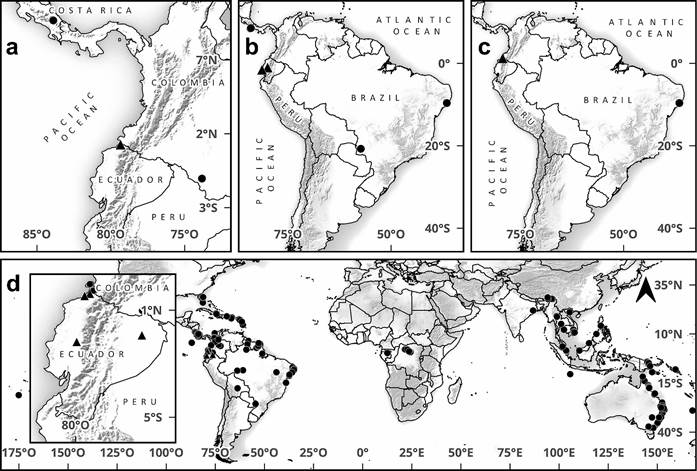
The Yasuní specimen of S. labyrinthica was collected at an elevation of 265 m, growing epiphytically on the bark of canopy trees. It is characterized by a crustose thallus with a yellowish to olive-green hue, often bearing branched lirellae that are 0.1-0.2 mm wide (Figure 1e). The exciple is fully carbonized at the base, with thick margins (Figure 1f), and the hymenium is non-amyloid (Figure 1g). The ascospores are typically 14-17.6 × 6-6.2 µm, exhibiting 3 slightly differentiated transverse septa with angular lumina (Figure 1h). The lirellae are deeply immersed to slightly erumpent and exhibit transverse fissures, a characteristic feature of the genus Sarcographa (Lücking and Rivas-Plata 2008). Secondary metabolites detected in S. labyrinthica include stictic, constictic, cryptostictic, and hypostictic acids. Sarcographa labyrinthica has been recorded in lowland tropical forests from several regions (Figure 2). In South America, it has been found in Colombia (García-Martínez and Mercado-Gómez 2020), Venezuela (Komposch and Hafellner 2000), Guyana (Hekking and Sipman 1988), French Guiana and Brazil (Cáceres et al. 2014). In Central America and the Caribbean, it has been reported from Costa Rica (Lücking et al. 2008; Mardones et al. 2024), Cuba (Rosabal and Burgaz 2010), Puerto Rico (Mercado-Díaz and Sur 2009), Panama (Breuss 2008), Mexico, and Florida, U.S. (Archer 2009). In Africa (Figure 3) and Asia, it has been recorded from the Democratic Republic of the Congo and Gabon, from India, Thailand, Myanmar, Vietnam (Aptroot and Sparrius 2006), the Philippines, Singapore (Sipman 2010), Malaysia, and Indonesia (Ohmura et al. 2020). In Australasia (Figure 2), it has been found in Papua New Guinea, Australia, and New Zealand (Archer 2004; Singh and Sinha 2010; Ohmura et al. 2020). Whether all these reports represent the same taxon remains to be seen.

Global range of Sarcographa. Bibliographic records (circles) and new reports (triangles) presented in this study for A - Sarcographa feei, B - S. fenicis, C - S. fissurinoides (top right), D - S. labyrinthica (bottom). The inset highlights the records of S. labyrinthica in Ecuador.

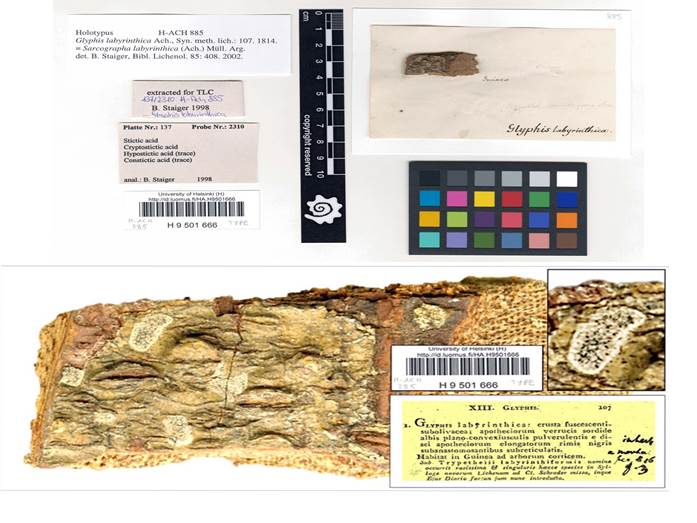
Holotype of Sarcographa labyrinthica (Ach.) Müll. Arg. = Glyphis labyrinthica Ach. By Erik Acharius 1814 campo H-ACH:0885 Finnish Museum of Natural History H9501666. Available in Finnish Biodiversity Information Facility under Creative Commons license CC BY 4.0 DEED Attribution 4.0 International. Type locality Africa Guinea coord 10N -10W.
Key to the species of Sarcographa known from Ecuador
1a Thallus (medulla) and ascomata or stromata lacking secondary substances, in surface view P- and in microscopic section K-; ascomata in more or less stellate clusters, composed of narrow, more or less radiating, immersed lirellae without secondary divisions .............2
1b Thallus (medulla) and ascomata or stromata with stictic acid as major secondary substance, in surface view P+ orange(-red) and in microscopic section with a K+ persistently yellow efflux (stictic acid); ascomata either distinctly pseudostromatic with the lirellae secondarily divided or lirellae very long and radiating, prominent lirellae ............................................................................3
2a Ascospores consistently 3-septate .......Sarcographa tricosa
2b Ascospores predominantly 5-septate, although often with 3-septate ascospores intermingled ..................................................................................................Sarcographa medusulina
3a Ascomata not pseudostromatic; lirellae radiating, becoming prominent, with narrow disc; ascospores 7-11-septate, 30-55 μm long ............................Sarcographa ramificans
3b Ascomata distinctly pseudostromatic; lirellae usually with secondary transverse divisions; pseudostromata immersed to erumpent; ascospores 3(-5)-septate, 15-25 μm long .........................................................................................4
4a Pseudostromata immersed, without differentiated margin; discs often thinly pruinose and dark .....Sarcographa fenicis
4b Pseudostromata erumpent to prominent or becoming sessile, with thin to distinct margin .................................5
5a Individual lirellae initially fissurine, the disc becoming exposed towards the center or in mature pseudostromata; lirellae in mature pseudostromata radiating and with scattered transverse fissures; pseudostromata laterally with flush margins ..........................Sarcographa fissurinoides
5b Individually lirellae initially not distinctly fissurine, soon becoming divided into numerous, small discs; pseudostromata laterally erumpent, with distinct whitish margin ............................................................................6
6a Individual lirellae radiating, becoming divided into rounded segments, separated by distinct whitish areas .............................................................Sarcographa feei
6b Individual lirellae with frequent transverse fissures, eventually forming dense clusters of minute, angular discs not separated by whitish areas ...Sarcographa labyrinthica
Four new records of the genus Sarcographa have been added here, located in Esmeraldas, Los Ríos and Orellana provinces, in addition to those previously recorded. Thus, our results emphasize the need for further research into the lichen biota from Ecuador’s lowland forests. Future studies should aim to assess the full extent of lichen diversity in the Amazon basin, particularly in canopy environments where many species remain under-sampled. Additionally, molecular analyses could provide further insights into the genetic diversity and potential cryptic speciation within Sarcographa and related genera in these highly biodiverse regions.
ACKNOWLEDGMENTS
We thank the Private Technical University of Loja (UTPL) for funding the fieldwork for this research.
REFERENCES
- Ahmadjian, V. 1987. Coevolution in lichens. Annals of New York Academy of Sciences 503: 307-315.
- Ahti, T.; Sipman, H. J. 2013. Ten new species of Cladonia (Cladoniaceae, lichenized fungi) from the Guianas and Venezuela. South America. Phytotaxa 93: 25-39.
- Aptroot, A.; Cáceres, M.E.S.; Johnston, M.K.; Lücking, R. 2016 How diverse is the lichenized fungal family Trypetheliaceae (Ascomycota: Dothideomycetes)? A quantitative prediction of global species richness. Lichenologist 48: 983-1011.
- Aptroot, A.; Sipman, H.J.M. 1997. Diversity of lichenized fungi in the tropics. In: Hyde, K.D. (Ed). Biodiversity of Tropical Microfungi, Hong Kong University Press, Hong Kong. p.93-106.
- Aptroot, A.; Sipman, H.J.M.; Cáceres, M.E. 2013. Twenty-one new species of Pyrenula from South America, with a note on over-mature ascospores. Lichenologist 45: 169-198.
- Aptroot, A.; Sparrius, L.B. 2006. Additions to the lichen flora of Vietnam, with an annotated checklist and bibliography. The Bryologist 109: 358-371.
- Archer, A.W. 2004. The lichen genera Cyclographina, Diplogramma, Glyphis, Gymnographa, Medusulina, Sarcographa and Sarcographina (Graphidaceae) in Australia. Telopea 10: 589-605.
- Archer, A.W. 2009. Graphidaceae. In: McCarthy, P.M. (Ed). Flora of Australia, (Lichens 5), Canberra & CSIRO Publishing, Melbourne. p. 84-194.
- Bass, M.S.; Finer, M.; Jenkins, C.N; Kreft, H.; Cisneros-Heredia, D.F.; McCracken, S.F.; et al 2010. Global conservation significance of Ecuador’s Yasuní National Park. Plos One 5: e8767.
- Benítez, Á.; Prieto, M.; Aragón, G. 2015. Large trees and dense canopies: key factors for maintaining high epiphytic diversity on trunk bases (bryophytes and lichens) in tropical montane forests. Forestry: An International Journal of Forest Research 88: 521-527.
- Breuss, O. 2008. Flechten aus Panama. Linzer Biologische Beiträge 40: 321-327.
- Cáceres, M.E. 2007. Corticolous crustose and microfoliose lichens of northeastern Brazil. Libri Botanici 22: 1-168.
- Cáceres, M.E.; Lücking, R.; Rambold, G. 2007. Phorophyte specificity and environmental parameters versus stochasticity as determinants for species composition of corticolous crustose lichen communities in the Atlantic rain forest of northeastern Brazil. Mycological Progress 6: 117-136.
- Cáceres, M.E.; de Lima, E.L.; Nascimento, A.A.; Lücking, R. 2014. Liquens brasileiros: novas descobertas evidenciam a riqueza no Norte e Nordeste do país. Boletim do Museu de Biologia Mello Leitão 35: 101-119.
- Déleg, J.; Gradstein, S.R.; Aragón, G.; Giordani, P.; Benítez, Á. 2021. Cryptogamic epiphytes as indicators of successional changes in megadiverse lowland rain forests of western Amazonia. Ecological Indicators 129: 107890.
- Feuerer, T.; Hawksworth, D.L. 2007. Biodiversity of lichens, including a worldwide analysis of checklist data based on Takhtajan’s floristic regions. Biodiversity and Conservation 16: 85-98.
- Flakus, A.; 2013. Foliicolous lichenized fungi of lowland Amazon forests in Pando, Bolivia. Polish Botanical Journal 58: 539-554.
- García-Martínez, S.; Mercado-Gómez, J.D. 2020. Contribución a la microbiota liquénica del bosque seco tropical colombiano (Montes de María, Sucre). Ciencia en Desarrollo 11: 43-52.
- Hekking, W.H.A.; Sipman, H.J.M. 1988. The lichens reported from the Guianas before 1987. Willdenowia 17: 193-228.
- Junior, I.O.; Aptroot, A.; da Silva Cáceres, M.E. 2021. Lichens from Monte Pascoal, Bahia, Brazil, with some new pyrenocarpous species and a key to the Pyrenula species from Brazil. The Bryologist 124: 552-568.
- Komposch, H.; Hafellner, J. 2000. Diversity and vertical distribution of lichens in a Venezuelan tropical lowland rain forest. Selbyana 21: 11-24.
- Lucheta, F.; Koch, N.M.; Käffer, M.I.; Riegel, R.P.; de Azevedo Martins, S.M.; Schmitt, J.L. 2019. Lichens as indicators of environmental quality in southern Brazil: An integrative approach based on community composition and functional parameters. Ecological Indicators 107: 105587.
- Lücking, R.; Álvaro-Alba, W.R.; Moncada, B.; Marín-Canchala, N.L.; Tunjano, S.S.; Cárdenas-López, D. 2023. Lichens from the Colombian Amazon: 666 taxa including 28 new species and 157 new country records document an extraordinary diversity. The Bryologist 126: 242-303.
- Lücking, R.; Chaves, J.L.; Sipman, H.J.; Umaña, L.; Aptroot, A. 2008. A first assessment of the ticolichen biodiversity inventory in Costa Rica: the genus Graphis, with notes on the genus Hemithecium (Ascomycota: Ostropales: Graphidaceae). Fieldiana Botany 2008: 1-126.
- Lücking, R.; Hodkinson, B.P.; Leavitt, S.D. 2017. The 2016 classification of lichenized fungi in the Ascomycota and Basidiomycota-Approaching one thousand genera. The Bryologist 119: 361-416.
- Lücking, R.; Rivas, E.; Chaves, J.L.; Umaña, L.; Sipman, H.J.M. 2009. How many tropical lichens are there really? Bibliotheca Lichenologica 100: 399-418.
- Lücking, R.; Rivas-Plata, E. 2008. Clave y guía ilustrada para géneros de Graphidaceae. Glalia 1: 1-41.
- Mardones, M.; Tenorio, L.U.; Montero, M.D.M.G.; Mata, M.; Hidalgo, A.R.B.; Piepenbring, M.; Minter, D.; Coto-López, C.; Velázquez, J.C. 2024. The first annotated checklist of Costa Rican fungi. Funga Latina 2: V2A7.
- Menezes, A.A.; de Souza Souto, L.; Lücking, R 2013. Composição de espécies e a influência de fatores ambientais na riqueza e composição de microliquens corticícolas em diferentes fitofisionomias Master’s dissertation, Universidade Federal de Sergipe, Brazil, 77p.
- Mercado-Díaz, J.A.; Sur, J.B. 2009. Preliminary checklist of lichens and lichenicolous fungi of Puerto Rico (Version 1, July 2009) San Juan, Puerto Rico. p. 1-54
- Moberg, R. 2011. The lichen genus Heterodermia (Physciaceae) in South America-a contribution including five new species. Nordic Journal of Botany 29: 129-147.
- Ohmura, Y.; Sugimoto, M.; Aung, M.M.; Tanaka, N. 2020. Contribution to the knowledge of the Lichen Mycota of Myanmar (I) twenty species newly recorded from Southern Myanmar. Taiwania 65: 548-558.
- Rivas-Plata, E.R.; Lücking, R. 2013. High diversity of Graphidaceae (lichenized Ascomycota: Ostropales) in Amazonian Perú. Fungal Diversity 58: 13-32.
- Rosabal, D.; Burgaz, A.R. 2010. Líquenes corticícolas en dos formaciones vegetales de la Reserva Ecológica Loma del Gato-Monte Líbano (Cuba). Botanica Complutensis 34: 27-30.
- Schmull, M.; Dal-Forno, M.; Lücking, R.; Cao, S.; Clardy, J.; Lawrey, J.D. 2014. Dictyonema huaorani (Agaricales: Hygrophoraceae), a new lichenized basidiomycete from Amazonian Ecuador with presumed hallucinogenic properties. The Bryologist 117: 386-394.
- Singh, K.P.; Sinha, G.P. 2010. Indian Lichens: an Annotated Checklist. Botanical Survey of India. Ministry of Environment and Forests, Salt Lake City, Kolkata. 571 pp.
- Sipman, H.J. 2010. A conspectus of the lichens (lichenized fungi) of Singapore. Gardeners’ Bulletin Singapore 61: 437-481.
- Vega, M.; Déleg, J.; Benítez, Á. 2021. Primer registro del liquen Pyrenula hirsuta para Sudamérica. Neotropical Biodiversity 7: 75-77.
- Yánez-Ayabaca, A.; Benítez, Á.; Batallas Molina, R.; Naranjo, D.; Etayo, J.; Prieto, M.; et al 2023. Towards a dynamic checklist of lichen-forming, lichenicolous and allied fungi of Ecuador-using the Consortium of Lichen Herbaria to manage fungal biodiversity in a megadiverse country. The Lichenologist 55: 203-222.
Data availability
The data that support the findings of this study were published in this article.
Edited by
-
ASSOCIATE EDITOR:
Maria-Beatriz Caruzo https://orcid.org/0000-0002-8393-214X