 Analysis of the Guazuma crinita site index as a predictor of forest plantation quality in the Aguaytía River basin, Ucayali, Peru
ABSTRACT
The site index (SI) was evaluated in Guazuma crinita plantations for the Aguaytía River region, Ucayali, Peru, with seedlings from 200 open-pollinated families from 14 sites using a randomized block design in three sectors of the basin. At 48 months, the height (H), diameter at breast height (DBH), and the number of branches with leaves (C/Leaf) and without leaves (S/Leaf) of the trees in 11 plantations were measured. The population means were 9.8 cm (DAP), 1139.6 cm (H), 12.4 branches (C/Leaf) and 2.4 branches (S/Leaf), distributed in four phenotypic groups (G1, G2, G3, G4). Groups G1 and G3 presented greater growth in DAP and H. The correlations between SI and edaphic variables show a significantly positive association with calcium (Ca+2: 0.62), cation exchange capacity (CEC: 0.67), magnesium (Mg+2: 0.61), and pH (059), and non-significant negative association with texture (-0.38), sand (-0.38), potassium (K+: -0.15) and aluminum (Al+3: -0.39). Physiographic and climatic correlations indicate a significantly strong association between SI and elevation (0.85) and precipitation (0.97), while correlations between SI and DBH, H, basal area (BA) and volume (V) They have a high significance of 0.8, 0.7, 0.7 and 0.8, respectively. The middle and upper sectors of the basin present more favorable conditions for the development of commercial plantations that improve with the selection of the best phenotypic groups from the Río Aguaytía, San Alejandro, Río Curimana and Von Humboldt collection sites.
Keywords:
Amazon Forest; forest plantation; white bolaina; site index; provenance
RESUMEN
Se evaluó el índice de sitio (SI) en plantaciones de Guazuma crinita para la región del río Aguaytía, Ucayali, Perú, con plántulas de 200 familias de polinización abierta de 14 sitios mediante un diseño de bloques al azar en tres sectores de la cuenca. A los 48 meses, se midió la altura (H), el diámetro a la altura del pecho (DAP), el número de ramas con hojas (C/Hoja) y sin hojas (S/Hoja) de los árboles en 11 plantaciones. Las medias poblacionales fueron 9.8 cm (DAP), 1139.6 cm (H), 12.4 ramas (C/Hoja) y 2.4 ramas (S/Hoja), distribuidos en cuatro grupos fenotípicos (G1, G2, G3, G4). Los grupos G1 y G3 presentaron mayores crecimientos en DAP y H. Las correlaciones entre SI y variables edáficas muestran una asociación significativamente positiva con calcio (Ca+2: 0,62), capacidad de intercambio catiónico (CEC: 0,67), magnesio (Mg+2: 0,61), y pH (059), y asociación negativa no significativa con textura (-0,38), arena (-0,38), potasio (K+: -0,15) y aluminio (Al+3: -0,39). Las correlaciones fisiográficas y climáticas indican una asociación significativamente fuerte entre SI y la elevación (0,85) y la precipitación (0,97), mientras que las correlaciones entre SI y DAP, H, área basal (BA) y volumen (V) tienen una alta significancia de 0,8; 0,7; 0,7 y 0,8 respectivamente. Los sectores medio y alto de la cuenca presentan condiciones más favorables para el desarrollo de plantaciones comerciales que mejoran con la selección de los mejores grupos fenotípicos de los sitios de recolección Río Aguaytía, San Alejandro, Río Curimana y Von Humboldt.
Palabras clave:
Selva Amazónica; plantación forestal; bolaina blanca; procedencia; índice de sitio
INTRODUCTION
The popularity of bolaina blanca, or Guzuma crinita, timber has led to producers cutting down younger and younger trees (Rochon et al., 2007). This wood is then processed at sawmills located in the Curimaná and Nueva Requena areas, within the Coronel Portillo and Padre Abad provinces of Ucayali, Peru. Most of this wood comes from naturally regrowing forests along the Aguaytía River and its connected streams. Yet, this supply struggles to keep pace with the timber industry’s increasing needs (Revilla-Chávez et al. 2022b). As a result, the region of Huánuco has seen the creation of commercial tree farms to meet the strong demand, presenting a key financial chance for those replanting forests in Amazonian areas (Ramos-Huapaya and Domínguez 2016). This could become a good replacement for only cutting down certain trees in natural forests if the right support plans are put into place (Martínez-Zurimendi et al. 2015).
The places where trees grow best depend on environmental conditions. Therefore, it’s key to know how well tree species chosen for tropical forest planting can adjust, grow, and live. In these regions, temperature, rainfall amounts, and elevation create the basic environmental conditions, and also affect other environmental aspects, either straight away or in less obvious ways (Revilla-Chávez et al. 2022b). Therefore, a plantation site is established as a uniform area that can promote growth, where ecological characteristics (such as forest, fauna, climate, topography, soil) are also important to consider. Site evaluations can contribute to identifying the productive potential of present and future forest stocks (Murillo-Brito 2017; Hernández-Ramos et al. 2023; García-Cuevas et al. 2021; Carvajal-Arroyo 2022).
For this reason, the World Center for Agroforestry (ICRAF) has conducted domestication trials of G. crinita to evaluate the response of F1 progeny collected between 1999 and 2005 and installed in 15 plantations as seed orchards. In production plots in the Aguaytía River basin, preliminary results indicate that there are significant differences in the growth of G. crinita due to genetic, climatic, and edaphic factors (Revilla-Chávez et al. 2022a, 2022b). Thus, it is important to measure the productivity indicators in the plantations in which the research was conducted and their interaction with the site index (SI; Vaca et al. 2020). In a previous study on stability, adaptability, and productivity at 36 months of age in the same river basin, both site and progeny showed significant differences; however, no significant differences were found for the genotype-environment interaction (Revilla-Chávez et al. 2022b). Therefore, this study contributes new information on site indices for diameter, height, and leaf traits of G. crinita at 48 months of age, based on observations of the upper quintile of trees. The evaluation of the site index in forest plantations of the Aguaytía River basin is particularly relevant as it links growth performance with soil, climate, and provenance through phenotypic grouping, providing a robust indicator of the species’ potential for commercial plantations in the Peruvian Amazon.
MATERIAL AND METHODS
Study Species
Guazuma crinita (bolaina blanca) is a durable, fast-growing heliophyte tree species that can reach usable dimensions between 6 and 9 years (Revilla et al. 2021). The species is widely distributed throughout the Neotropics, from Central America to the Amazon, southern Brazil and Bolivia, and mostly occurs at up to 1,500 m above sea level (Reynel et al., 2003). The species is abundant in the Peruvian Amazon, occurring in areas with both constant high rainfall and a marked dry season, where it develops mainly in early secondary vegetation, along roads, and in disturbed sites, growing on silty to sandy soils of low fertility or stony substrates. Although it does not tolerate waterlogging during the seedling stage, it thrives in nutrient-rich soils along riverbanks and streams, forming nearly homogeneous “bolainales” or isolated individuals. It is often associated with pioneer species such as Schizolobium amazonicum, Croton matourensis, Cecropia spp., Calycophyllum spruceanum, Cordia alliodora and Inga spp., among others (Flores 2018).
Study sites
The research was conducted in the Aguaytía River basin, a tributary of the Ucayali River, Coronel Portillo province, Ucayali, Peru (9°24’12.3” S and 8°08’25.9” S and 75°54’38.9” W and 74°04’25.2”W), covering an area of 1,762,086 ha. The Aguaytía River basin extends southwest of the city of Pucallpa and presents a mountainous landscape on the western side and a predominantly flat and flood prone relief to the east (Revilla-Chávez et al. 2021).
Experimental design
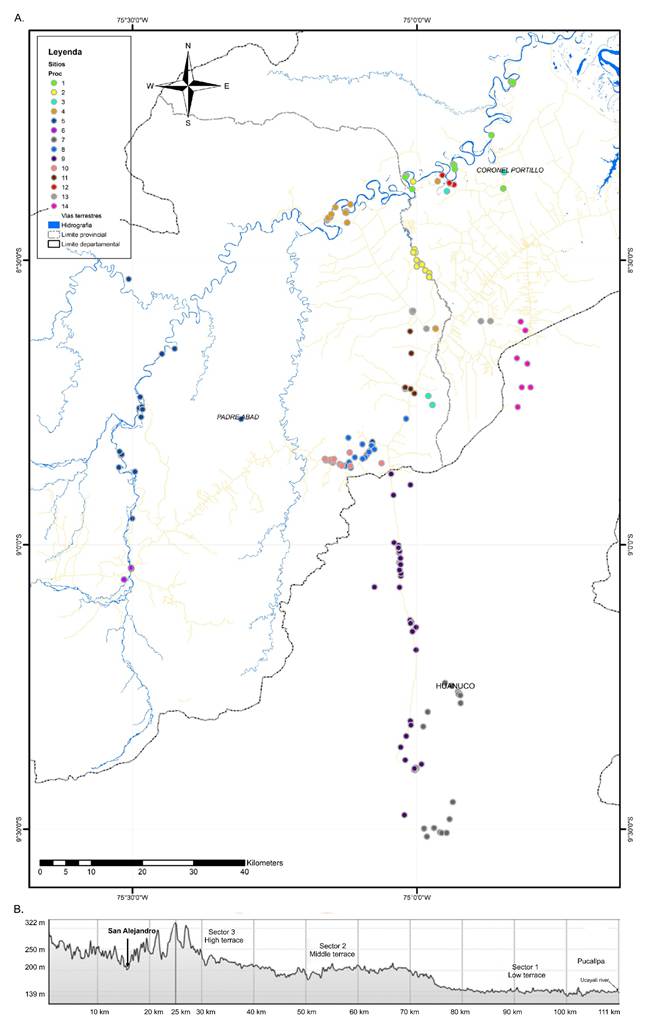
In 1998, the Agroforestry Tree Domestication Program of the World Center for Agroforestry (ICRAF) carried out a collection of G. crinita open-pollinated seeds from 200 trees from 14 sites (provenances) in the Aguaytia River basin (Figure 1a). Selection was based on commercial quality criteria, i.e., stem form and crown. With the germplasm of the 14 provenances, 15 plantations or plots of 2,500 m2 each were installed in 2001 in the non-flooding zone of the Aguaytia River basin. Seedlings were planted at a spacing of 2.5 x 2.5 m, using a randomized block design, 15 plots with 200 subplots each, each subplot corresponds to one progeny (200 progenies) two plants per progeny in each subplot, for a total of 400 plants per plot, plus two non-evaluable border lines with a five-meter-wide “fire break” around the plot. The plots were distributed in three geographic sectors (block), corresponding to the lower, middle, and upper parts of the basin.
Location of progeny collection and groups of Guazuma crinita plots in the Aguaytia river basin. A. Seed collection locations from 209 trees for Guazuma crinita progeny testing: 1= New Requena - River (17 trees); 2= Neshuya Stream (13 trees); 3= Tahuayo Stream (11 trees); 4= Curimana - River (20 trees); 5= Aguaytia River (19 trees); 6= Yurac Stream (3 trees); 7= Inca Port (18 trees); 8= Von Humboldt (17 trees); 9= Macuya (49 trees); 10= Santo Alexandre (17 trees); 11= CFB up to Km 72 (7 trees); 12= Road to Nueva Requena (4 trees); 13= Road to Curimaná (7 trees); 14= Road to Tournavista (7 trees) (Source: Revilla-Chávez et al., 2021). The collection coordinates can be found in the Table A1. B. altitude of the sectors in the Aguaytia River basin.
All plantations were established by the ICRAF program, based on the principles of participatory research with farmers and on farms (Cornelius and Ugarte 2010). The areas in which the plantations were installed correspond to areas with previous land use for annual crops, pastures, and areas in recovery. At 36 months of age, phenotypic thinning, consisting of the elimination of the shortest individual, with a forked and/or inclined stem for each progeny, according to the Revilla-Chávez et al. (2024b) classification. For the present study, 11 of the 15 plantations or plot, distributed across three elevation sectors or block were included in the analysis, where: block 1 corresponds to Campo Verde - Nueva Requena lower basin; block 2 to Neshuya - Curimaná highway, middle basin; and block 3 includes plants, from 14 collection sites and 193 identified progenies.
Study variables
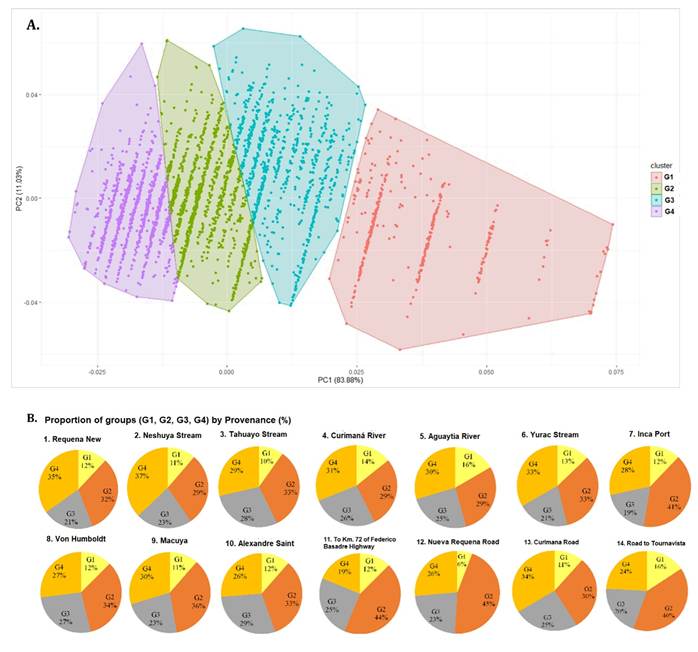
At 48 months after planting, height (H, m), diameter at breast height (DBH, cm), basal area (m2 ha-1) and volume (m3 ha-1), and the number of top branches with leaves (BTWL) and without leaves (BTWOL) were used to determine the site index (SI) and the productivity of commercial forest plantations. Considering the different number of progenies per provenance (Figure 2), the observations were classified into four phenotypic groups (G1, G2, G3, and G4) based on the values of the measured variables, in order to evaluate their influence on the site index and productivity.
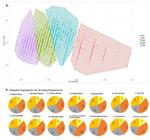
Phenotypic grouping by provenance of G. crinita. A. Clustering by phenotypic mean by origin at 48 months of age using the K-means algorithm, where: G1=H (15.33 m), DBH (13.56 cm), BTWL (28.52), BTWOL (1.763); G2=H (10.21 m), DBH (9.06 cm), BTWL (10,554), BTWOL (2.313); G3=H (14.93 m), DBH (13.36 cm), BTWL (16.289), BTWOL (2.846); G4=H (6.91m), DBH (6.29 cm), BTWL (5.109), and BTWOL (1.935). B. Map of phenotypic group proportions by provenance identified in plantations at 48 months of age (%).
Edaphoclimatic characterization
For site characterization, plantations were mapped in relation to the digital coverage of the Ecological Economic Zoning of the Aguaytia River basin (GRU 2017) using ArcGIS 10.5 with the ArcMap 10.5 tool and ArcCatalog 10.5 (Table A1). The temperature (°C), precipitation (mm ha-1 year-1), and elevation (m a.s.l.) were obtained from Fick and Hijmans (2017), and the classification of climatic zones was from on the Climate Classification map of Peru (SENAMHI 2018) (Table A2). Soil characteristics were assessed based on samples taken using the Bazan (2017) methodology and analyzed in the National Institute of Agrarian Innovation (INIA) soil laboratory (Table A3).
Data analysis
Descriptive statistics for the set of plots were developed for tree height (H, m), diameter at breast height (DBH, cm), and the number of upper stem branches with and without leaves (Table 1). In addition, the basal area (AB, m²) was derived as AB = π DBH².400-1, and the tree volume (V, m³) was estimated using the species-specific allometric equation Ln(V)= 0.79 + 6.07Ln (DBH2) + 10.85Ln (DBH*H) - 10.49 Ln (DBH2*H) (Revilla et al., 2021).
Descriptive statistics of diameter at breast height (DBH, cm), total height (H, m), number of top branches with leaves (BTWL), and number of top branches without leaves (BTWOL) of Guazuma crinita at 48 months of age across all evaluated trees and plots in the Aguaytía River basin, Ucayali, Peru.
Provenance, defined as the seed collection area comprising more than one progeny, and progeny, defined as plants derived from open-pollinated seeds of a selected tree, were explicitly considered as grouping factors to assess differences between genetic sources, while edaphic, physiographic and climatic variables of the study sites (soil texture, clay, sand, Ca+², Mg+², K+, CEC, pH, organic carbon, P; altitude, precipitation and temperature) were used in the site index and productivity analyses.
To classify tree performance across provenances, phenotypic groups were established (Table 2a, b, c). These groups were defined using k-means clustering (k = 4) in the RStudio Integrated Development Environment (IDE) (version 1.1.463) and the Graphpad Prism 6 program (Romero et al., 2020), applied to standardized tree-level characteristics (height, diameter at breast height, number of branches). The objective of this step was to identify distinct yield classes that integrate multiple traits and guide subsequent analyses of site index and productivity. The clustering procedure was performed after an exploratory inspection (elbow method) and validated using nonparametric comparisons (Dunn’s test) to ensure significant separation between groups.
Phenotypic groups by provenance in 48-month-old G. crinita plantations based on k-means algorithm analysis. A. Means of traits established based on the number of groups generated (k =4) (diameter at breast height (DBH, cm), total height (H, m), number of branches from the top with leaves (BTWL, branches), and number of upper branches without leaves (BTWOL, branches) by provenance).
Phenotypic groups by provenance in 48-month-old G. crinita plantations based on k-means algorithm analysis. B. Dunn’s multiple comparisons test between phenotypic groups for diameter at breast height (DBH, cm), total height (H, m), number of branches from the top with leaves (BTWL, branches), and number of upper branches without leaves (BTWOL, branches) by provenance.
The site index (SI) was subsequently calculated at the plot level (Table 3). For each plot, dominant height was defined as the mean height of trees at or above the 80th percentile (upper quintile) of the height distribution within that plot, calculated using the Excel function PERCENTILE.INC. This dominant height at the reference age of 48 months was used as the SI. By definition, the SI was obtained per plot, not per tree, to capture productivity at the site level. The normality of the variables was checked using the Kolmogorov-Smirnov test, and since several distributions were abnormal, Spearman’s rank correlations were used to evaluate the associations between IS and edaphic, physiographic, and climatic variables. Differences in IS between groups and phenotypic sectors (lower, middle, and upper catchment) were checked using Kruskal-Wallis tests with Dunn’s post-hoc comparisons. All analyses were performed in R (v4.2.2) / RStudio (v1.1.463).
Site index (SI) for Guazuma crinita plantations at 48 months of age, based on the upper quantile of commercially important traits height (H), diameter at breast height (DBH), basal area (BA) and commercial volume (V) by plot and sector in the Aguaytía River basin, Ucayali, Peru.
Correlation of the site index with edaphic, physiographic, climatic, and phenotypic variables
The normality of the variables was checked using the Kolmogorov-Smirnov test in R (v4.2.2, Rcmdr package). Since most variables and the site index (SI) did not meet the normality assumptions, correlations were assessed using Spearman’s rank coefficient in RStudio (v1.1.463). The analysis considered three groups of variables:
Soil properties (Table 4a): texture (sand, silt, clay), pH, organic carbon, available phosphorus, cation exchange capacity (CEC), and exchangeable cations (Ca+2, Mg+2, K+, Al+3), measured at two depths (0-15 cm and 15-30 cm).
Physiographic and climatic variables (Table 4b): altitude (m a.s.l.), mean annual precipitation (mm), and mean annual temperature (°C).
Spearman’s correlations between site index (SI) and phenotypic and edaphoclimatic variables for Guazuma crinita plantations at 48 months of age in the Aguaytía River basin, Ucayali, Peru. B. Correlations between site index (SI), elevation, precipitation, and temperature by plot.
Phenotypic variables (Table 4c): total height (A, m), diameter at breast height (DBH, cm), basal area (BA, m²), and volume (V, m³), all measured at 48 months. Provenance and progeny were also included as categorical factors.
Spearman’s correlations between site index (SI) and phenotypic and edaphoclimatic variables for Guazuma crinita plantations at 48 months of age in the Aguaytía River basin, Ucayali, Peru. C. Correlation between site index (SI) and provenance (Pv), progeny (Prog) and phenotypic variables in plots and sites.
In all cases, the site index was calculated per experimental plot as the dominant mean height of trees in the upper quintile of the height distribution at 48 months of age.
RESULTS
Descriptive statistics for the Guazuma crinita data at 48 months of age
Across all plots, trees showed an average DBH of 9.8 ± 0.4 cm and a mean total height of 11.4 ± 0.6 m at 48 months. On average, trees had 12.4 branches with leaves and 2.4 branches without leaves (Table 1). Basal area per tree was 0.012 ± 0.002 m², corresponding to a stand basal area of 9.3 m² ha-¹, while the mean tree volume was 0.046 ± 0.008 m³ (Table 1). These descriptive statistics provide the baseline for subsequent analyses of site index, phenotypic grouping, and correlations with soil and environmental variables.
Phenotypic groups by provenance
Four phenotypic groups were identified (G1-G4), and they differed significantly in DBH, height, and branching traits (p < 0.05), except between G1 and G3 (Table 2a). Groups G1 and G3 represented the highest-quality phenotypes, while G2 and G4 were composed of lower-performing trees. Provenances such as Aguaytía River, San Alejandro, Curimaná River, and Von Humboldt contributed the largest proportions of superior trees (mainly in G1 and G3), indicating that phenotypic grouping is strongly associated with geographic origin (Table 2b, 2c). These results highlight that provenances with greater representation in G1 and G3 have higher potential for site selection and genetic improvement.
Site index
The site index (SI) varied between plots and provenances, reflecting differences in environmental and genetic factors. The SI showed a strong, positive correlation with precipitation (r = 0.89, p < 0.01) and plot (r = 0.89, p < 0.01), which in turn was related to altitude (r = 0.85, p < 0.01), indicating that wet climate and higher altitude conditions favor tree growth in the watershed. A moderate but significant association was also observed between the SI and soil chemical properties, particularly calcium, cation exchange capacity, magnesium, and pH (r = 0.59-0.61, p < 0.05), while texture, sand, potassium, and aluminum showed weak, nonsignificant negative correlations (Table 4a).
Genetic effects were less pronounced. Although provenances differed in their distribution among phenotypic groups (Table 2), their direct effect on SI was limited compared to environmental factors (Table 4b). Provenances from the Aguaytía, San Alejandro, Curimaná, and Von Humboldt rivers contributed a greater proportion of trees to the higher phenotypic groups (G1 and G3), but SI patterns between plots were more consistently explained by precipitation, altitude, and soil fertility than by provenance alone (Table 4c).
Site index was strongly associated with tree growth metrics (height, DBH, basal area, and volume), but showed no significant relationship with provenance or progeny (Table 4c).
DISCUSSION
Phenotypic groups by origin and site index
According to the results of this study, the site index (SI) of Guazuma crinita plantations in the Peruvian Amazon was weakly influenced by provenance; however, it contributed positively to the representation of phenotypic groups. Similarly, the moderate correlation (r = 0.51) between provenance (Pv) and progeny is consistent with that reported in other studies (Rochon et al. 2007; Vallejos et al. 2009; Ugarte et al., 2009). These results are consistent with previous provenance trials on G. crinita, which showed variation in the progeny. Studies of genetic diversity of G. crinita have also revealed high variation within provenances and relatively low differentiation between them (Tuisima et al., 2016). This pattern helps explain why provenance itself did not have a direct effect on the site index (SI), but did influence the distribution of trees among phenotypic groups.
From a genetic perspective, phenotypic clustering based primarily on DBH and altitude provides a practical tool for identifying promising provenances. Similar approaches combining PCA and clustering have been shown to be effective in distinguishing provenances with superior performance, as in the case of Alnus cremastogyne clones (Zheng et al. 2023).
Therefore, considering the lack of correlation between the provenance, progeny and SI of the studied plantations, the SI themselves could be used to support the selection of the best sites for the establishment of commercial forest plantations, since these are directly related to the best plant traits (H, DAP, BA, V), which in turn have high positive correlations with the sector and the plot (Revilla-Chávez et al. 2022b, 2024a).
Edaphic correlation with site index
The positive correlations between SI and Ca+2, CEC, Mg+2, and pH indicate that Guazuma crinita attains greater total and commercial height growth in slightly acidic to neutral soils with higher base cation availability and good cation exchange capacity, conditions that improve nutrient exchange and reduce acidity-related constraints (Nano et al. 2016; Flores 2019). Although studies on other tropical species report associations between soil N, P and K and tree height, those nutrients drive different physiological processes and are only available in soils with a higher cation exchange capacity (Ara 1999; Idiege et al. 2014), which occurs in media with slightly acidic pH. Therefore, our results suggest that in the study area, edaphic limitations are more closely related to base-cation availability than to macronutrient supply.
On the other hand, we found a slightly negative correlation between SI and soil variables such as texture, sand, K+, and Al+3. This pattern suggests that the species performs better in loamy soils with moderate levels of sand and potassium, and shows only moderate tolerance to aluminum. Similar results were reported by Ara (1999), who emphasized the need for more information to quantify the response of G. crinita to increased exchangeable cations and reduced Al+3 in the soil.
From what was observed, soil fertility variables, particularly Ca+2, CEC, Mg+2 and pH, showed significantly important associations with the SI, which reinforces the importance of soil quality in plantation performance. Our results are consistent with previous studies that found that the growth in height and volume of species such as Gmelina arborea, Prosopis alba, and Calycophyllum spruceanum were conditioned by the chemical properties of the soil (Ugarte et al. 2009; Senilliani et al. 2020; Telles et al. 2021)
Physiographic and climatic correlation with site index
The observed results show that environmental factors exerted a strong influence on the behavior of the G. crinita site index, as evidenced by the positive correlations with precipitation and altitude. These relationships indicate that physiographic and climatic gradients largely determine growth potential, consistent with recent findings for other tropical species that highlight local plasticity and site productivity as key determinants of forest performance (Di Fabio et al. 2024; Kurjak et al. 2024).
The positive association between the site index and altitude indicates that the higher elevations of the watershed offer more favorable conditions for the growth of G. crinita (Revilla-Chávez et al., 2024a, 2024b). This may be linked to the lower temperatures and increased precipitation at higher elevations reducing water stress and improving nutrient cycling, which can improve tree height growth and overall productivity. This behavior is consistent with other reports showing that topographic factors influence the distribution and performance of forest species by determining their access to water and nutrients (Sánchez-Soto et al., 2016; Herraiz et al., 2023). Therefore, comparable results were observed in Gmelina arborea plantations, where dominant height and SI were strongly related to elevation and precipitation, explaining up to 70% of the observed variation (Barrios-Trilleras et al., 2021). These patterns suggest that species adapted to humid tropical conditions tend to perform better at higher elevations where precipitation is more stable, while species from drier environments may show the opposite trend. However, estimating the performance of G. crinita plantations in similar topographical areas in other ecological zones requires genetic tests of the stability and adaptability of the progeny in the areas where the projects are planned to be developed (Revilla-Chávez et al. 2022b).
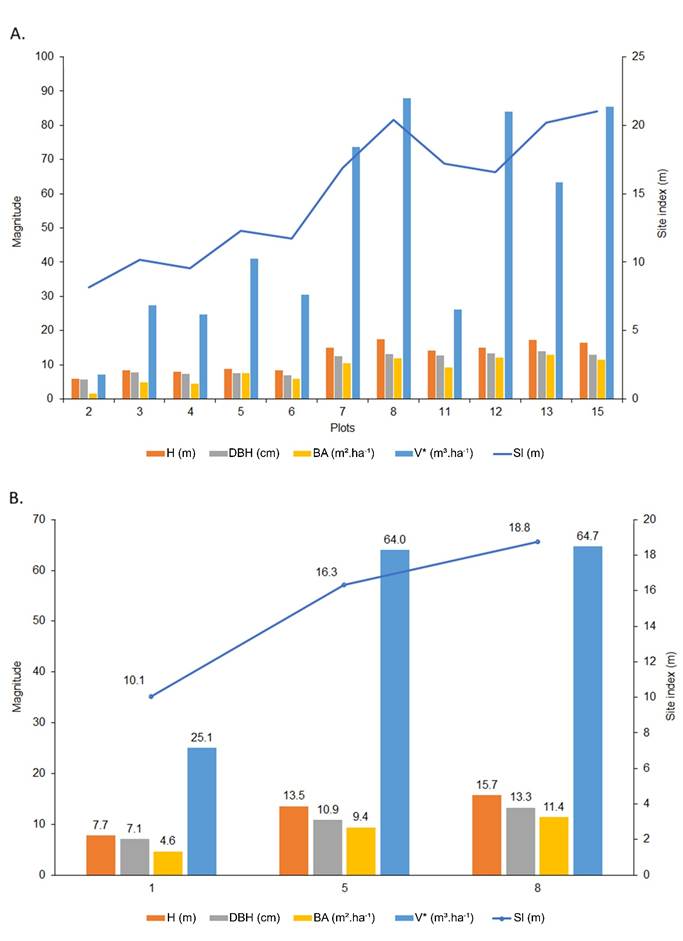
The observed correlations suggest that the plots located at higher altitudes (Figure 3) offer the most favorable conditions for the establishment of commercial forest plantations, despite the fact that these variables did not show a correlation with the provenance (Pv) or with the progeny (Table 4c of this study; Revilla-Chávez et al., 2024b). Taken together, these results indicate that environmental factors, especially rainfall and altitude, play a dominant role in determining IS, while genetic variation between provenances contributes only secondarily by influencing the representation of higher phenotypes within sites and suggest a dual management strategy combining site selection and phenotypic selection. Therefore, priority should be given to areas with higher rainfall, moderate to high altitudes, and fertile soils with adequate base saturation, while favoring provenances that contribute a higher proportion of superior phenotypes. This integrated approach aligns with the recommendations of provenance analysis methodologies (Vallejos et al., 2009; Zheng et al., 2023) and supports the inclusion of phenotypic grouping as a practical tool in selection strategies for commercial plantations of G. crinita in the Peruvian Amazon.
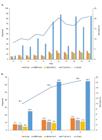
Silvicultural variables of 48-month-old G. crinita plantations in the Aguaytia River basin; A. Silvicultural variables by plot. The blue line located at the top represents the increase of the site index as the plot and sector are located at a higher altitude.
CONCLUSIONS
This study shows that the growth performance of Guazuma crinita plantations in the Peruvian Amazon is shaped by the interaction of genetic diversity and environmental conditions. These findings emphasize the importance of integrating both site selection and genetic choice in the design of tropical plantations, providing a framework for improving the productivity and sustainability of G. crinita and other fast-growing species in Amazonian reforestation programs.
ACKNOWLEDGEMENTS
We thank the World Agroforestry Center (ICRAF) for allowing us to use field data for the preparation of this article. We also thank Dr. Evelyn Roberta Nimmo for the English editing.
REFERENCES
- Ara, M. 1999. Vigor de establecimiento de Bolaina (Guazuma crinita) en relación a la fertilidad del suelo en Pucallpa. Revista de Investigaciones Veterinarias del Perú 10: 63-70.
- Barrios-Trilleras, A.; López-Aguirre, A.; Báez-Aparicio, C. 2021. Modelamiento de la productividad de Gmelina arborea Roxb. con base en variables biofísicas y de rodal. Colombia forestal 24: 71-87.
-
Bazan, R. 2017. Manual de procedimientos de los análisis de suelos y agua con fines de riego. Instituto Nacional de Innovación Agraria, Lima, Perú. 89p. https://hdl.handle.net/20.500.12955/504
» https://hdl.handle.net/20.500.12955/504 - Carvajal-Arroyo, D. 2022. Índice de sitio para Cedrela odorata L. en sistemas agroforestales con café en Pérez Zeledón, Costa Rica. Kurú 19: 9-17.
- Cornelius, J.; Ugarte-Guerra, J. 2010. Introducción a la genética y Domesticación Forestal para la Agroforestería y Silvicultura. Manual Técnico. Centro Mundial para la Agroforestería (ICRAF), Lima, Perú. 124p.
- Di Fabio, A.; Buttò, V.; Chakraborty, D.; O’Neill, G. A.; Schueler, S.; Kreyling, J. 2024. Climatic conditions at provenance origin influence growth stability to changes in climate in two major tree species. Forests and Global Change 7: 1422165.
- Fick, S.E. and Hijmans, R.J. 2017, WorldClim 2: new 1-km spatial resolution climate surfaces for global land areas. International Journal of Climatology 37: 4302-4315.
-
Flores, Y. 2019. Fichas técnicas para plantaciones con especies nativas en zonas de selva baja. Instituto Nacional de Innovación Agraria-INIA, Lima, Perú. 54p. http://repositorio.inia.gob.pe/handle/20.500.12955/943
» http://repositorio.inia.gob.pe/handle/20.500.12955/943 - Flores, Y. 2018. Árboles nativos de la Región Ucayali. Estación Experimental Agraria Pucallpa, Pucallpa, Perú. 375p.
- García-Cuevas, X.; Toledo-Chiu, C.; Hernández-Ramos, J.; Mendoza-Muñoz, J.A.; Hernández-Ramos, A. 2021. Índice de sitio para plantaciones forestales comerciales de Cedrela odorata L. en Quintana Roo, México. Revista Mexicana de Ciencias Forestales 12: 92-114.
-
GRU (Gobierno Regional de Ucayali), 2017. Zonificación ecológica económica base para el Ordenamiento Territorial de la Región Ucayali. Dirección de Gestión del Territorio de la Autoridad Regional Ambiental de Ucayali, Pucallpa, Perú. 227p. ( (https://sinia.minam.gob.pe/sites/default/files/sinia/archivos/public/docs/estudio_de_la_propuesta_de_zee_10.pdf ). Accessed on 17 July 2024.
» https://sinia.minam.gob.pe/sites/default/files/sinia/archivos/public/docs/estudio_de_la_propuesta_de_zee_10.pdf - Herraiz, A.; Salazar-Zarzosa, P.; Mesas, F.; Arenas-Castro, S.; Ruiz-Benito, P.; Villar, R. 2023. Modelling aboveground biomass and productivity and the impact of climate change in Mediterranean forests of South Spain. Agricultural and Forest Meteorology 337: 109498.
- Hernández-Ramos, J.; Ordaz-Ruiz, A.; García-Espinoza, G.; García-Magaña, G.; García-Cuevas, X. 2023. Índice de sitio para plantaciones forestales de Pinus patula en el Estado de México. Madera Bosques 28: e2822308.
- Idiege, D.; Ijomah, J.; Amadi, D.; Agba, O., Lifu, M. 2014. Nutrient distribution of Gmelina arborea L. plantation on the slopes of UKPON river forest reserve of cross river state, Nigeria. IOSR Journal of Environmental Science, Toxicology and Food Technology 8: 1-8.
- Kurjak, D.; Petrík, P.; Konôpková, A. S.; Link, R. M.; Gömöry, D.; Hájek, P.; Liesebach, M.; Leuschner, C.; Schuldt, B. 2024. Inter-provenance variability and phenotypic plasticity of wood and leaf traits related to hydraulic safety and efficiency in seven European beech provenances differing in yield. Annals of Forest Science 81: 11.
- Martínez-Zurimendi, P.; Domínguez-Domínguez, M.; Juárez-García, A.; López-López, L.; de la Cruz-Arias, V.; Álvarez-Martínez, J. 2015. Índice de sitio y producción maderable en plantaciones forestales de Gmelina arborea en Tabasco, México. Revista Fitotecnia Mexicana 38: 415-425.
- Murillo-Brito, Y.; Domínguez-Domínguez, M.; Martínez-Zurimendi, P.; Lagunes-Espinoza, L.; Aldrete, A. 2017. Índice de sitio en plantaciones de Cedrela odorata en el trópico húmedo de México. Revista de la Facultad de Ciencias Agrarias Universidad Nacional de Cuyo 49: 15-31.
- Nano, G.; Raulo, R.; Rengifo, J.; Rengifo, A. 2016. Propiedades Físico-Químicas del suelo en plantaciones de Bolaina blanca (Guazuna crinita C. Mart.) en el distrito de Yuyapichis, Huánuco. Investigación y Amazonía 6: 50-59.
- Ramos-Huapaya, A.; Domínguez, G. 2016. Selección de árboles de bolaina blanca (Guazuma crinita Mart.) como candidatos a árboles “plus” para ensayos de rejuvenecimiento y brotación. Ecología Aplicada 15: 115-123.
- Revilla, J.; Abanto-Rodríguez, C.; Guerra, W.; García, D.; Guerra, H.; Domínguez, G.; Carmo, I. 2021. Modelos alometricos para estimar el volumen de madera de Guazuma crinita en plantaciones forestales. Scientia Agropecuaria 12: 25-31.
- Revilla-Chávez, J.M.; López-Galán, E.E.; Guerra-Arevalo, W.F.; García-Soria, D.G.; Rojas-Mego, K.C.; Domínguez-Torrejón, G.; Abanto-Rodríguez, C. 2021. Modelos alometricos de biomasa de árboles de Guazuma crinita Mart en plantaciones forestales de Ucayali, Perú. Scientia Agropecuaria 12: 579-587.
- Revilla-Chávez, J.M.; López-Galan, E.E.; Gonzales-Alvarado, A.C.; Manturano Perez, R.D.; Sáenz-Ramírez, L.H.; Guerra-Arevalo, H.; Mori-Vásquez, J.A. 2022a. Valoración económica de plantaciones de bolaina blanca (Guazuma crinita Mart.) en Ucayali, Perú. Folia Amazónica 31: 243-257.
- Revilla-Chávez, J.M.; de Moraes, M.A.; Pinchi-Ramirez, M.H.; Sebbenn, A.M. 2022b. Productivity, adaptability, and stability in Guazuma crinita progeny tests across three environments in the Aguaytia River Basin, Ucayali, Perú. Silvae Genetica 71: 72-80.
- Revilla-Chávez, J.M.; Sebbenn, A. 2024a. Genetic control of quantitative and qualitative traits of Calycophyllum spruceanum in the Peruvian Amazon. Crop Breeding and Applied Biotechnology 24: e47262419.
- Revilla-Chávez, J.M.; López-Galán, E.E.; Gonzales-Alvarado, A.C.; Sáenz-Ramírez, L H.; Mori-Vásquez, J.A.; Rojas-Mego, K.C.; et al 2024b. Methodology for the phenotypic evaluation in Guazuma crinita trees in Ucayali, Peru. Ciência Florestal 33: e71675.
- Reynel, C.; Pennington, R. T.; Pennington, T. D.; Flores, C.; Daza, A. 2003. Árboles útiles de la Amazonía peruana y sus usos: un manual con apuntes de identificación, ecología y propagación de las especies. Tarea Gráfica Educativa, Lima, Perú. 509p.
- Rochon, C.; Margolis, H.; Weber, J. 2007. Genetic variation in growth of Guazuma crinita (Mart.) trees at an early age in the Peruvian Amazon. Forest Ecology and Management 243: 291-298.
-
Romero, L.; Ramirez, M.; Rojas, J.; Darghan, E. 2020. Análisis de Cluster. https://rpubs.com/lhromeroj/analisisdeclusterR
» https://rpubs.com/lhromeroj/analisisdeclusterR - Telles, R.; Rodríguez, E.; Jiménez-Pérez, J.; Aguirre-Calderón, O.A.; Treviño-Garza, E.J.; de los Santos-Posadas, H.M. 2021. Características edáficas y topográficas asociadas con el crecimiento en volumen de Gmelina arborea Roxb, en Tlatlaya Estado de México. Madera y Bosques 27: e2711987.
- Tuisima, L.L.T.; Čepková, P.H.; Lojka, B.; Weber, J.C.; Alves-Milho S.F. 2016. Genetic diversity in Guazuma crinite from eleven provenances in the Peruvian Amazon revealed by ISSR markers. Bosque 37: 63-70.
- Sánchez-Soto, B.H.; García-Moya, E.; Reyes-Olivas, Á.; Romero-Manzanares, A.; Luna-Cavazos, M. 2016. Factores topográficos y edáficos que influyen en la estructura de especies perennes de islas de la costa de Sinaloa, México. Botanical Sciences 94: 63-73.
- SENAMHI (Servicio Nacional de Meteorología e Hidrología). 2018. Mapa de clasificación climática del Perú. SENAMHI, Lima, Perú. 9 p.
- Senilliani, M.G.; Bruno, C.; Brassiolo, M. 2020. Factores edáficos y su impacto en la altura dominante en plantaciones de Prosopis alba Madera y Bosques 26: e2632054.
- Ugarte, J.; Weber, J.; Sotelo, C.; Cornelius, J. 2009. Domesticación participativa de especies forestales. Una estrategia para el desarrollo de mercado forestal. Tecnología y Sociedad, Soluciones Prácticas 16: 31-41.
- Vaca, R.A.; Golicher, D.J.; Macario-Mendoza, P.A.; Estrada-Lugo, E.I.J.; Bello-Baltazar, E.; Sánchez-Pérez, L.C.; et al. 2020. Calidad de sitio para caoba (Swietenia macrophylla King) en bosques naturales de Quintana Roo. Revista de Silvicultura Sostenible 41: 33-50.
- Vallejos, J.; Badilla, Y.; Picado, F.; Murillo, O. 2009. Metodología para la selección e incorporación de árboles plus en programas de mejoramiento genético forestal. Agronomía Costarricense 34: 105-119.
- Zheng, Y.; Feng, M.; Li, X.; Huang, X.; Chen, G.; Bai, W.; et al 2023. Phenotypic variation analysis and excellent clone selection of Alnus cremastogyne from different provenances. Plants 12: 3259.
-
CITE AS:
López-Galán, E.E.; Revilla-Chávez, J.M.; Domínguez-Torrejon, G.; Vidaurre-Arévalo, H.E.; Ugarte-Guerra, L.J.; Bendezú, J.; et al. 2026. Analysis of the Guazuma crinita site index as a predictor of forest plantation quality in the Aguaytía River basin, Ucayali, Peru. Acta Amazonica 56: e55gs24262.
Data availability
The data that support the findings of this study are available from the Graduate Program in Forest and Forest Resources Management, Universidad Nacional Agraria La Molina (Av. La Molina, District of La Molina, Lima 25012, Peru). Data are curated by Edinson E. López-Galán. The datasets include measurements of dominant height, diameter at breast height (DBH), and other dendrometric variables from Guazuma crinita plantations in the Aguaytía River basin, Ucayali region, Peru. Data are available from the corresponding author upon reasonable request (edulopezg@gmail.com).
APPENDIX
López-Galán et al. Analysis of the Guazuma crinita site index as a predictor of forest plantation quality in the Aguaytía River basin, Ucayali, Peru.
Edited by
-
ASSOCIATE EDITOR:
Francesco Ripullone https://orcid.org/0000-0003-4851-3422