Predation of Helicops angulatus (Serpentes: Colubridae) by Didelphis marsupialis (Didelphimorphia: Didelphidae) in the Brazilian Amazon
ABSTRACT
Several mammal species are known predators of snakes, both venomous and non-venomous, and such interactions are well documented in the literature. This study reports the first record of predation on Helicops angulatus (Linnaeus, 1758), a mildly venomous semiaquatic snake, by Didelphis marsupialis Linnaeus, 1758, an omnivorous marsupial known for its resistance to snake venom. The event, filmed in an anthropized area in southern Amazonas, Brazil, involved a female carrying a juvenile while consuming the snake. The predation of a venomous, semiaquatic prey by a nocturnal, terrestrial mammal expands the known trophic repertoire of the species.
KEYWORDS:
Feeding behavior; Neotropical marsupial; ophiophagy; snake consumption; trophic interection
Direct behavioral observations of trophic interactions are particularly valuable in megadiverse regions such as the Amazon, where ecological relationships are complex and often inferred indirectly (Polis and Strong 1996, Wootton and Emmerson 2005). Documenting predator-prey events in the field provides key insights into feeding behavior and ecological flexibility within tropical ecosystems (Curtsdotter et al. 2019).
Among Neotropical mammals, the genus Didelphis (Didelphidae) is well known for its opportunistic and omnivorous feeding habits, including occasional predation on small vertebrates such as mammals, birds, amphibians, and reptiles (Emmons and Feer 1997, Astúa 2015). The common opossum, Didelphis marsupialis Linnaeus, 1758, is widely distributed across South America and frequently exploits human-modified environments, displaying remarkable adaptability (Voss and Jansa 2012, Wang et al. 2021).
Species of Didelphis have been reported preying on snakes, including venomous taxa, but most records are based on stomach content analyses or anecdotal reports rather than direct observations (Almeida-Santos et al. 2000). The semiaquatic snake Helicops angulatus (Linnaeus, 1758) is common in riparian habitats throughout the Amazon Basin (Martins and Oliveira 1998, Murphy and Voris 2014) and possesses Duvernoy’s glands that produce mild venom effective against small vertebrates (Villca-Corani et al. 2021, Luna et al. 2022).
The predation event described here, in which an adult D. marsupialis fed on H. angulatus in a human-modified landscape in southern Amazonas, represents a rare, directly documented case of this interaction in the wild. Such observations contribute valuable natural history data and expand knowledge on the feeding ecology of D. marsupialis.
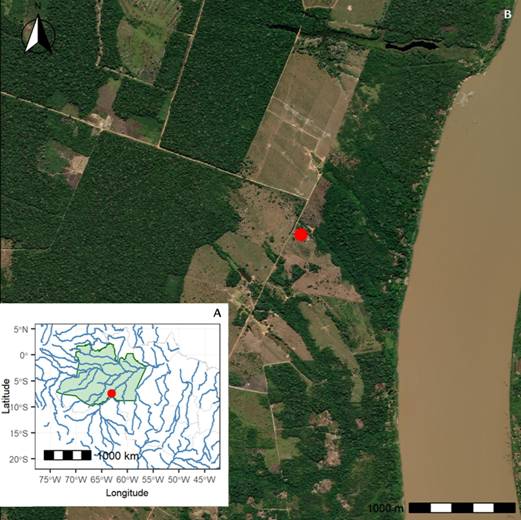
On April 1st, 2025 at 7:56 p.m. (GMT-4), an adult female D. marsupialis carrying a juvenile was recorded feeding on an H. angulatus specimen. The event occurred along a secondary road in a human-modified landscape near Sítio Bueno (7°27’02”S, 63°02’03”W; Fig. 1), municipality of Humaitá, southern Amazonas, Brazil. The snake was identified based on external morphological characters visible in the video record, including a moderately robust body, strongly keeled dorsal scales, and a distinctive dorsal color pattern composed of dark, angular blotches along the body. The head was slightly distinct from the neck, with dorsally positioned eyes-a typical feature of semiaquatic species of Helicops. The ventral surface appeared pale with darker lateral margins. This combination of characters allows distinction from other congeneric and sympatric species occurring in southern Amazonas, such as Helicops leopardinus (Schlegel, 1837) and H. hagmanni Roux, 1910, which differ mainly in dorsal pattern configuration and overall body proportions (Cunha and Nascimento 1993, Martins and Oliveira 1998).
(A) Geographic location of the predation record in northern Brazil, highlighting the state of Amazonas and the Rio Madeira basin. (B) High-resolution satellite image of the observation site in Humaitá, Amazonas, Brazil, showing an anthropogenically modified landscape with adjacent water bodies. Satellite imagery: Esri World Imagery (Maxar).
The opossum showed no signs of disturbance from vehicle headlights and manipulated the snake using her forelimbs while tearing and ingesting tissue primarily from the head region. The juvenile remained on her back without interacting. The entire event lasted approximately 1 minute and 40 seconds and was recorded on video (Video S1). Upon departure of the observer, the adult retreated into nearby vegetation, still consuming the prey. The event occurred in an area characterized by disturbed habitats such as pastures, small farms, and poultry holdings-conditions that often attract generalist species like D. marsupialis.
Seasonal flooding of roadside ditches likely increases encounters between terrestrial omnivores and semiaquatic reptiles such as H. angulatus (Martins and Oliveira 1998, Laurance et al. 2009; Da Cunha and Nascimento 2020). The opossum consumed the snake despite its mild venom, a behavior occasionally reported in other Didelphis species (Oliveira and Santori 1999, Silva 2004). Predation of snakes by mammals has also been documented in the Neotropics, including Eira barbara (Linnaeus, 1758) preying on Bothrops and Crotalus species (Beisiegel 2001).
Our observation adds H. angulatus to the list of snakes preyed upon by didelphids and represents one of the few direct records of this interaction in the wild. Given that H. angulatus possesses Duvernoy’s glands and is considered mildly venomous (Villca-Corani et al. 2021, Luna et al. 2022), such events highlight the trophic versatility of D. marsupialis in human-modified environments. Continued field documentation of similar interactions will contribute to a broader understanding of predator-prey dynamics involving Neotropical marsupials and reptiles.
ACKNOWLEDGMENTS
We thank Vergílio P. Bueno and Nadi O. Bueno for granting access to the study site and authorizing this report. We are grateful to Daiana P.M. da Silva for assistance with field observations and to the local community of Humaitá for support during fieldwork.
-
Almeida-Santos SM, Antoniazzi MM, Sant’Anna OA, Jared C (2000) Predation by the opossum Didelphis marsupialis on the rattlesnake Crotalus durissus Current Herpetology 19(1): 1-9. https://doi.org/10.5358/hsj.19.1
» https://doi.org/10.5358/hsj.19.1 -
Astúa D (2015) Diet of Didelphis marsupialis in altered habitats: implications for trophic ecology. Mammalia 79(2): 195-205. https://doi.org/10.1515/mammalia-2014-0131
» https://doi.org/10.1515/mammalia-2014-0131 -
Beisiegel BM (2001) Feeding ecology of Eira barbara in Brazilian Atlantic Forest. Journal of Tropical Ecology 17(5): 567-575. https://doi.org/10.1017/S0266467401001452
» https://doi.org/10.1017/S0266467401001452 -
Curtsdotter A, Ehnström J, Jonsson M,Ebenman B (2019) Trophic roles and the structure of ecological networks. Ecology Letters 22(5): 791-803. https://doi.org/10.1111/ele.13234
» https://doi.org/10.1111/ele.13234 -
Da Cunha TM, Nascimento LB (2020) Habitat disturbance and flood regimes influence predator-prey encounter rates in Amazonian riparian zones. Biotropica 52(4): 678-686. https://doi.org/10.1111/btp.12782
» https://doi.org/10.1111/btp.12782 - Cunha OR, Nascimento FP (1993) Ofídios da Amazônia: as cobras da regiãoleste do Pará. Museu Paraense Emílio Goeldi, Belém, 191 pp.
- Emmons LH, Feer F (1997) Neotropical rainforest mammals: a field guide. University of Chicago Press,Chicago, 307 pp.
-
Laurance WF, Peletier-Jacob M, Curran T, Alves OE, Campbell M-J, et al. (2009) Impacts of roads and hydroelectric projects on Amazonian floodplain forests: linking hydrology and geomorphology. Biological Conservation 142(12): 2532-2542. https://doi.org/10.1016/j.biocon.2009.06.029
» https://doi.org/10.1016/j.biocon.2009.06.029 -
Luna MC, Rodríguez-Acosta A, Chávez-Ochoa C, Villca-Corani J (2022) Bioactive compounds in the venom of Helicops angulatus: implications for its toxicological profile. Toxins 14(3): 167. https://doi.org/10.3390/toxins14030167
» https://doi.org/10.3390/toxins14030167 - Martins M, Oliveira ME (1998) Natural history of Helicops angulatus in Amazonian riparian environments. Herpetological Review 29(3): 155-160.
-
Murphy JC, Voris HK (2014) Habitat associations of aquatic and semi-aquatic snakes in the Amazon Basin. Journal of Herpetology 48(2): 230-240. https://doi.org/10.1670/12-042
» https://doi.org/10.1670/12-042 -
Oliveira DPF, Santori CR (1999) Serum inhibitors of snake venom metalloproteases in didelphid marsupials. Brazilian Journal of Medical and Biological Research 32(9): 1127-1135. https://doi.org/10.1590/S0100-879X1999000900003
» https://doi.org/10.1590/S0100-879X1999000900003 -
Polis GA, Strong DR (1996) Food web complexity and community dynamics. The American Naturalist 147(5): 813-846. https://doi.org/10.1086/285839
» https://doi.org/10.1086/285839 -
Silva ER (2004) Resistance to snake venom in Brazilian marsupials: biochemical approaches. Toxicon 43(6): 663-670. https://doi.org/10.1016/j.toxicon.2003.12.008
» https://doi.org/10.1016/j.toxicon.2003.12.008 -
Villca-Corani J, LunaMC, Paz R, Torres A (2021) Clinical report of Helicops angulatus envenomation in the Bolivian Amazon. Tropical Medicine & International Health 26(10): 1224-1229. https://doi.org/10.1111/tmi.13642
» https://doi.org/10.1111/tmi.13642 - Voss RS, Jansa SA (2012) Didelphis Linnaeus, 1758 (Didelphimorphia: Didelphidae) and the evolution of American marsupials. American Museum of Natural History, New York, 34 pp.
-
Wang Y, Carvalho FMV, Costa LM, Gomes CA (2021) Adaptation of Didelphis marsupialis to urban environments in South America. Urban Ecosystems 24(3): 655-665. https://doi.org/10.1007/s11252-020-01023-8
» https://doi.org/10.1007/s11252-020-01023-8 -
Wootton JT, Emmerson M (2005) Measurement of interaction strength in nature. Annual Review of Ecology, Evolution, and Systematics 36: 419-444. https://doi.org/10.1146/annurev.ecolsys.36.102003.152558
» https://doi.org/10.1146/annurev.ecolsys.36.102003.152558
ADDITIONAL NOTES
- ZooBank register
-
Data Availability Statement
All data generated and/or analyzed are included in this article.
-
Funding
This study was supported by the Conselho Nacional de Desenvolvimento Científico e Tecnológico (CNPq, grant 314038/2021-3 to FCP).
-
Ethical Statement
This study did not involve live vertebrate animals and therefore did not require approval by an ethics committee.
-
AI Statement
Artificial intelligence tools were used solely to assist with language editing and grammar.
-
How to cite this article
Silva ALF, Passos FC, Gordo M (2026) Predation of Helicops angulatus (Serpentes: Colubridae) by Didelphis marsupialis (Didelphimorphia: Didelphidae) in the Brazilian Amazon. Zoologia 43: e25038. https://doi.org/10.1590/S1984-4689.v43.e25038
-
Published by
Sociedade Brasileira de Zoologia at Scientific Electronic Library Online - https://www.scielo.br/zool
Supplementary material 1
Video S1
Author: André Luiz Ferreira da Silva.
Data type: Species interaction data.
Copyright notice: This dataset is made available under the Open Database License - ODBbL (https://opendatacommons.org/licenses/odbl/1.0/). The ODbL is a license agreement intended to allow users to freely share, modify, and use this Dataset while maintaining this same freedom for others, provided that the original source and author(s) are credited.
All data generated and/or analyzed are included in this article.