A new species of Pareas (Squamata: Pareidae) from southwestern Yunnan, China
ABSTRACT
A new species of Pareas is described from Gengma County, Lincang City, Yunnan Province, China, based on morphological comparisons and phylogenetic analysis. The new species is phylogenetically closely related and morphologically similar to P. nigriceps and P. tigerinus. It can be distinguished from P. nigriceps and P. tigerinus and other congeners by a combination of the following characters: snout-vent length 352-472 mm in adults, tail length/snout-vent length 0.25-0.29, preoculars 1-2, subocular single, postocular single, one row of vertebral scales enlarged, 1-7 rows of dorsal scales keeled at mid-body, ventral scales 172-176, subcaudals 68-77, maxillary teeth 4-5, dorsal head solid black, 62-69 black bars on trunk, 27-33 black bars on tail, iris solid black.
KEYWORDS:
Molecular; morphology; slug-eating snake; taxonomy.
INTRODUCTION
Pareas is a highly successful group of snakes. Although they are small, slow, and non-venomous, they have few predators because of their specialized feeding habits. Large populations of these snakes have occupied a vast area from Sundaland to northeastern India and southern China (You et al. 2015, Wang et al. 2020, Liu and Rao 2021, Vogel et al. 2021, Poyarkov et al. 2022). At present, Pareas contains a total of 31 species, of which 23 are distributed in China (Liu et al. 2024, Uetz et al. 2024). Within China, Yunnan Province has the highest species diversity of Pareas, including more than half of the described species in China (Liu et al. 2023b, 2024). However, due to the conservative morphology and insufficient investigation, the species diversity of this genus in Yunnan is still underestimated (Ding et al. 2020, Wang et al. 2020, Liu and Rao 2021, Guo 2023, Liu et al. 2023a, 2023b).
During our recent field work in southwestern Yunnan, China, snakes that superficially resembled P. nigriceps Guo & Deng, 2009 and P. tigerinus Liu, Zhang, Poyarkov, Hou, Wu, Rao, Nguyen & Vogel, 2023 were collected from Gengma County, Lincang City. Detailed morphological comparison and molecular analyses conducted on them showed that the specimens from Gengma County are distinct from P. nigriceps and P. tigerinus and other named species within the genus. Here we describe them as a new species of Pareas.
MATERIAL AND METHODS
Snakes were collected in the field at night. Specimens were preserved in 75% ethanol and deposited at Kunming Natural History Museum of Zoology, Kunming Institute of Zoology, Chinese Academy of Sciences (KIZ). Specimen collection was performed in accordance with the Wild Animals Protection Law of the People’s Republic of China and the study was approved by the Ethics Committee of Kunming Institute of Zoology, Chinese Academy of Sciences (protocol code IACUC-OE-2024-10-001).
Measurements were taken using a measuring tape to the nearest 1 mm. Paired meristic characters are given as left/right. The methodology of measurements and meristic counts followed Liu et al. (2023b): SVL, snout-vent length, from tip of snout to posterior margin of cloacal plate; TL, tail length, from posterior margin of cloacal plate to tip of tail; PrFBO, prefrontal bordering orbit; PreO, preoculars; PosO, postoculars; SubO, suboculars; SPOF, subocular-postocular fused; LoBO, loreal bordering orbit; ATem, anterior temporals; PTem, posterior temporals; SupL, supralabials; InfL, infralabials; Vs, ventrals; Prec, precloacal plate divided or undivided; Sc, subcaudals; DS, dorsal scale rows, counted at one head length behind head, at mid-body, and at one head length before vent, respectively; NED, number of enlarged dorsal scale rows at mid-body; NKD, number of keeled dorsal scale rows at mid-body; Max, maxillary teeth; VBTr, vertical dark bars on trunk; VBTa, vertical dark bars on tail.
Molecular data were generated for the newly collected specimens from Gengma County, Yunnan Province, China. All new sequences have been deposited in GenBank and other sequences used in the phylogenetic analysis were obtained from GenBank (Table 1).
Total genomic DNA was extracted from liver tissues. Fragments of the mitochondrial gene cytochrome b (cytb) were amplified and sequenced by Tsingke Biotechnology Co., Ltd. using primers L14910: 5’-GACCTGTGATMTGAAAAACCAYCGTTGT-3’ and H16064: 5’-CTTTGGTTTACAAGAACAATGCTTTA-3’ (Burbrink et al. 2000). Sequences were managed using SeqMan in Lasergene.v7.1 (Burland 2000).
Sequences were aligned using ClustalW (Thompson et al. 1994) with default parameters. The best-fit substitution model GTR+F+I+G4 was chosen using the Akaike information criterion in ModelFinder (Kalyaanamoorthy et al. 2017). Bayesian inference was performed in MrBayes 3.2.6 (Ronquist et al. 2012) and the Markov chains were run for 5,000,000 generations and sampled every 100 generations. Maximum likelihood analysis was performed in RaxmlGUI 2.0 (Edler et al. 2021) and nodal support was estimated by 1,000 ultrafast bootstrap replicates. The genetic divergence (uncorrected p-distance) between species was calculated in MEGA 11 with the parameters Transitions + Transversions, Uniform rates and Pairwise deletion (Tamura et al. 2021).
Species delimitation was conducted using the method of Assemble Species by Automatic Partitioning (ASAP) and the substitution model of simple distance (p-distances). The lowest ASAP-score is considered the best partition according to Puillandre et al. (2021).
RESULTS
Bayesian inference and maximum likelihood analyses showed similar results: the newly collected specimens from Gengma County formed a distinct lineage, sister to P. tigerinus, with strong support (Fig. 1). The genetic divergence (uncorrected p-distance) between the lineage from Gengma County and P. tigerinus was 3.4%, the genetic divergence (uncorrected p-distance) between the lineage from Gengma County and P. nigriceps was 4.8% (Supplementary material Table S1).

Bayesian phylogenetic inference phylogram of Pareas inferred from cytb gene sequences. Numbers before slashes indicate Bayesian posterior probabilities (values below 0.90 are not shown) and numbers after slashes indicate bootstrap support for maximum likelihood analyses (values below 90 are not shown).
The best partition (score = 1.5) revealed by the ASAP analysis assigned the sequences of the genus Pareas into 32 putative species, one of which comprises the sequences of the newly collected specimens from Gengma County and others correspond to the recognized species of the genus, respectively (Fig. 2).

ASAP species delimitation in the genus Pareas based on cytb sequences. The best partition with the lowest score is highlighted with red frame.
TAXONOMY
Pareas melanops sp. nov.
https://zoobank.org/A8C5F112-61CF-4A48-A44A-BD64B1EEEC84
Diagnosis. Body size moderate (SVL 352-472 mm in adults), tail moderately long (TL/SVL 0.25-0.29), prefrontal bordering orbit, preoculars 1-2, subocular single, postocular single, subocular and postocular not fused, supralabials 7-8, infralabials seven, infralabial not fused with chin-shield, anterior temporal 1-3, posterior temporals 2-3, one row of vertebral scales slightly enlarged, 1-7 rows of dorsal scales keeled at mid-body, ventral scales 172-176, subcaudals 68-77, maxillary teeth 4-5, dorsal head solid black, dark nuchal band present, two large black spots on each side of head, 62-69 vertical black bars on each side of trunk, 27-33 vertical black bars on each side of tail, iris solid black.
Type Material. HOLOTYPE: KIZ 2024092, adult male, collected on 28 August 2024 by Shuo Liu from Mangdi Village, Hepai Township, Gengma County, Lincang City, Yunnan Province, China, 23°29’58”N, 99°18’45”E, 1,940 m elevation. PARATYPES: KIZ 2024093 and KIZ 2024095, two adult females, collected on 29 August 2024; KIZ 2024094, adult male, collected on 28 August 2024; and KIZ 2024096, juvenile, collected on 27 August 2024, all from the same locality as the holotype.
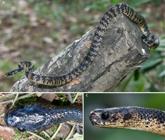
The holotype (KIZ 2024092) of Pareas melanops sp. nov. in life: (A) general view; (B) dorsal view of the head; (C) lateral view of the head.
Description. Holotype: adult male, SVL = 472 mm, TL 135 = mm, TL/SVL = 0.29, TL/total length 0.22; body elongated; head distinct from neck; snout blunt, projecting beyond lower jaw; body laterally compressed, vertebral ridge feebly developed; rostral approximately as wide as high, nearly invisible from above; nasals undivided; internasals elongated, much wider than long; prefrontals triangular, bordering orbits; frontal shield-shaped, slightly longer than wide; parietals large, longer than wide, median suture slightly longer than frontal; supraoculars longer than wide; loreal 1/1, not bordering orbit; preocular 1/1; subocular 1/1, elongated crescent-shaped; postocular 1/1; anterior temporal 1/1, posterior temporals 2/2; supralabials 7/7, not bordering orbit; infralabials 7/7, anterior-most in contact with its opposite, first four in contact with anterior chin-shield, infralabial not fused with chin-shield; chin-shields three pairs, left one smaller than right one in first pair, left and right ones almost equal size in second and third pairs; ventral scales 172; cloaca plate undivided; subcaudals 71, paired; dorsal scales in 15 rows throughout, one row of vertebral scales slightly enlarged, seven rows of mid-dorsal scales slightly keeled at middle of body; maxillary teeth 4/4.
Coloration of holotype in life. Dorsal surface of head solid black, a large black band on neck, dorsal surface of body and tail brown; lateral surface of head yellow with many dark brown spots, two large black spots on each side of head, one on lower rear region of eye, another above angle of mouth; lateral surface of body and tail brownish yellow, approximately 64 vertical, billowing, black bars on each side of trunk and approximately 33 vertical, billowing, black bars on each side of tail, bars on different sides connected to each other on vertebrals; ventral surface of head light yellow, a few black spots on outer margin of ventral head; ventral surface of body light yellow with a few small black spots; ventral surface of tail yellowish white with many black spots; iris solid black.
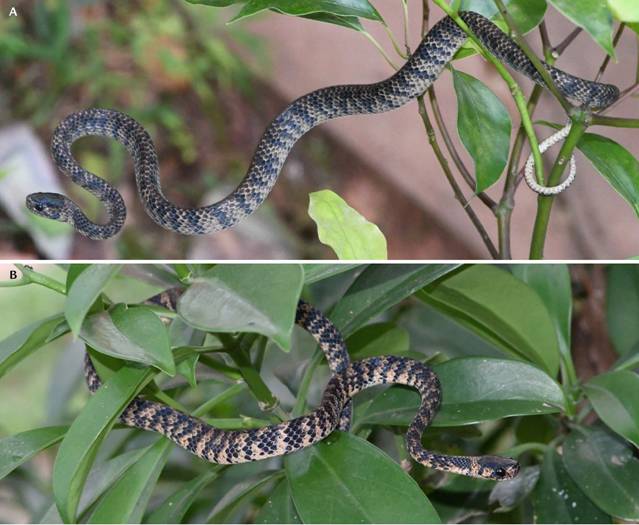
Variations. Morphometric and meristic data of the paratypes is similar to that of the holotype except that all paratypes are smaller than the holotype. The two female paratypes (KIZ 2024093 and KIZ 2024095) have two preoculars on each side, and the juvenile paratype (KIZ 2024096) has two preoculars on right side; the loreal borders the orbit in three paratypes (KIZ 2024093, KIZ 2024094, and KIZ 2024096); the male paratype (KIZ 2024094) has 3/2 anterior temporals and 3/3 posterior temporals; and the female paratype (KIZ 2024095) has five maxillary teeth on left side (Table 2). Concerning the coloration, the female paratype (KIZ 2024093) has a darker body while the other paratypes (KIZ 2024094-KIZ 2024096) have paler body than the holotype (Fig. 4).

The paratypes of Pareas melanops sp. nov. in life: (A) the female KIZ 2024093; (B) the male KIZ 2024094.
Measurements (in mm) and scalation data of Pareas melanops sp. nov. For abbreviations, see Materials and Methods section. Paired meristic characters are given as left/right.
Distribution. This species is currently known only from Gengma County, Lincang City, Yunnan Province, China (Fig. 5).
Habitat. All specimens of the new species were found on bushes beside a stream at night, surrounded by secondary forests. Four other reptile species were found at the type locality of the new species, namely Lycodon chapaensis (Angel & Bourret, 1933), Ovophis makazayazaya (Takahashi, 1922), Pseudoxenodon macrops (Blyth, 1855), and Trimeresurus sp.

Map showing the type locality of Pareas melanops sp. nov. (red star) in Gengma County, Lincang City, the type locality of P. tigerinus (black dot) in Menghai County, Xishuangbanna Prefecture, and the type locality of P. nigriceps (black triangle) in Longling County, Baoshan City, Yunnan Province, China.
Etymology. The specific epithet “melanops” is an adjec tive in the nominative case derived from the Ancient Greek “melanos” for “black” and “ops” for “eye”, and is given in reference to the conspicuous uniform black iris coloration of the new species. We recommend “Black-eyed slug-eating snake” for the common English name and Pinyin: heī yǎn dùn tóu shé for the common Chinese name of the new species.
Comparisons. Pareas melanops sp. nov. can be easily distinguished from all other species of the genus except P. andersonii Boulenger, 1888, P. macularius Theobald, 1868, P. margaritophorus (Jan, 1866), P. modestus Theobald, 1868, P. nigriceps, and P. tigerinus by having solid black iris (vs. iris being yellow, orange, red, or brown). Pareas melanops sp. nov. can be further distinguished from all other species of the genus except P. andersonii, P. dulongjiangensis Liu, Yang, Rao, Guo & Rao, 2023, P. kaduri Bhosale, Phansalkar, Sawant, Gowande, Patel & Mirza, 2020, P. macularius, P. margaritophorus, P. modestus, P. niger (Pope, 1928), P. nigriceps, P. stanleyi (Boulenger, 1914), P. tigerinus, and P. yunnanensis (Vogt, 1922) by the solid black dorsal surface of the head (vs. dorsal surface of head being yellow, orange, red, or brown with no or some dark spots) (Boulenger 1900, 1905, Vogt 1922, Pope 1935, Zhao et al. 1998, Grossmann and Tillack 2003, Guo and Deng 2009, Guo et al. 2011, Loredo et al. 2013, Vogel 2015, You et al. 2015, Hauser 2017, Yang et al. 2019, 2021, Bhosale et al. 2020, Ding et al. 2020, Vogel et al. 2020, 2021, Wang et al. 2020, Le et al. 2021, Liu and Rao 2021, David and Deuti 2022, Poyarkov et al. 2022, Gong et al. 2023, Liu et al. 2023a, 2023b, 2024).
Pareas melanops sp. nov. can also be easily distinguished from P. andersonii, P. modestus, P. macularius, and P. margaritophorus by having yellow or brownish yellow body background color (vs. body background color being grey, brownish grey, or black) (Hauser 2017, Vogel et al. 2020, David and Deuti 2022, Poyarkov et al. 2022).
Pareas melanops sp. nov. can be further distinguished from P. dulongjiangensis and P. stanleyi by preocular being present (vs. preocular being absent); from P. kaduri by 1-5 rows of dorsal scales being keeled at mid-body in females (vs. all dorsal scales being smooth in females) and having fewer maxillary teeth (4-5 vs. 6-7); from P. niger by having one subocular and one postocular (vs. subocular and postocular being fused) and fewer maxillary teeth (4-5 vs. 6-8); and from P. yunnanensis by having dark nuchal band (vs. not having dark nuchal band), distinct dark spots on each side of head (vs. having no or indistinct spots on each side of head), and more subcaudals (68-77 vs. 59-65) (Vogt 1922, Pope 1935, Bhosale et al. 2020, Liu et al. 2023a, 2023b).
Pareas melanops sp. nov. is phylogenetically closely related to and resembles P. nigriceps and P. tigerinus. However, it can be distinguished from the latter two species by having one subocular and one postocular (vs. subocular and postocular being fused into one crescent-shaped scale). In addition, Pareas melanops sp. nov. can be distinguished from P. nigriceps by having fewer maxillary teeth (4-5 vs. 6-7) and more vertical black bars on tail (27-33 vs. 18); Pareas melanops sp. nov. can be distinguished from P. tigerinus by having more ventral scales (172-176 vs. 160-171), more subcaudals (68-77 vs. 62-64), more vertical black bars on trunk (63-69 vs. 53-61), and more vertical black bars on tail (27-33 vs. 22-24) (Liu et al. 2023b, Guo and Deng 2009, Yang et al. 2019) (Table 3).
Comparisons of morphometric and meristic data for Pareas melanops sp. nov., P. tigerinus, and P. nigriceps. Measurements in mm, data for P. tigerinus from Liu et al. (2023b), data for P. nigriceps from Guo and Deng (2009) and Yang et al. (2019).
DISCUSSION
The type-locality of Pareas melanops sp. nov., is located close to Yunnan Nangunhe National Nature Reserve. The type locality area is greatly affected by human activities, where many crops and fruit trees are planted. This will undoubtedly have some adverse effects on the population of this species at the site. However, this species is also distributed within Yunnan Nangunhe National Nature Reserve, as documented by a juvenile found in the nature reserve by the forest rangers (Fig. 6). The nature reserve contains large areas of original forests and is legally protected, and therefore, we suspect that this species may not be endangered.

The two larger individuals in the type series of the new species have a darker body, while the smaller individuals have a paler body. The juvenile found by locals in the nature reserve has a much paler body. We speculate that the color of the body of this species may gradually darken with age. Due to the limited sample size our description is based on, further field surveys are needed to verify this hypothesis.
At the type locality of Pareas tigerinus in Menghai County, Xishuangbanna Prefecture, P. xuelinensis and P. tigerinus coexist at an altitude of approximately 1,920 m. We have also found P. xuelinensis in the area near the type locality of Pareas melanops sp. nov. in Gengma County, Lincang City. However, P. xuelinensis does not coexist with Pareas melanops sp. nov. Specimens of Pareas melanops sp. nov. were found at altitudes above 1,900 m, while specimens of P. xuelinensis were all found at altitudes below 1,800 m in Gengma County. Since the altitudes of the type localities of Pareas melanops sp. nov. and P. tigerinus are similar, the reason why P. xuelinensis and P. tigerinus coexist in Menghai County, whereas P. xuelinensis and Pareas melanops sp. nov. do not coexist in Gengma County, is unknown. More observation and research on the physiology and ecology of these species are needed to unravel these unsolved mysteries.
ACKNOWLEDGMENTS
We thank the forest rangers of Yunnan Nangunhe National Nature Reserve for providing valuable information about and photo of the new species described in this study. We also thank the editors and reviewers for their efforts on this manuscript. This work was supported by the national important research and development project: Biodiversity conservation and restoration technology in high mountain and valley regions of southwestern China (Grant: 2017YFC0505202), Biological Resources Programme, Chinese Academy of Sciences, the Position of Bioclassonomist of Chinese Academy of Sciences (Grant: CAS-TAX-24), and Foundation of Yunnan Key Laboratory of Biodiversity Information, Kunming Institute of Zoology, Chinese Acade my of Sciences.
LITERATURE CITED
-
Bhosale H, Phansalkar P, Sawant M, Gowande G, Patel H, Mirza ZA (2020) A new spe cies of snail-eating snakes of the genus Pareas Wagler, 1830 (Reptilia: Serpentes) from eastern Himalayas, India. European Journal of Taxonomy 729(1): 54-73. https://doi.org/10.5852/ejt.2020.729.1191
» https://doi.org/10.5852/ejt.2020.729.1191 -
Boulenger GA (1900) Descriptions of new reptiles and batrachians from Borneo. Proceedings of the Zoological Society of London 69(2): 182-187. https://doi.org/10.1111/j.1096-3642.1890.tb01716.x
» https://doi.org/10.1111/j.1096-3642.1890.tb01716.x -
Boulenger GA (1905) Descriptions of two new snakes from Upper Burma. Bombay Natural History Society 16: 235-236. https://doi.org/10.1080/03745480509443665
» https://doi.org/10.1080/03745480509443665 -
Burbrink FT, Lawson R, Slowinski JB (2000) Mitochondrial DNA phylogeography of the polytypic North American rat snake (Elaphe obsoleta): a critique of the subspecies concept. Evolution 54(6): 2107-2118. https://doi.org/10.1111/j.0014-3820.2000.tb01253.x
» https://doi.org/10.1111/j.0014-3820.2000.tb01253.x -
Burland TG (2000) DNASTAR’s Lasergene sequence analysis soft ware. Methods in Molecular Biology 132: 71-91. https://doi.org/10.1385/1-59259-192-2:71
» https://doi.org/10.1385/1-59259-192-2:71 -
David P, Deuti K (2022) On the Type Specimens of Pareas macularius Theobald, 1868 and Pareas berdmorei Theobald, 1868 with the Designation of a Lectotype for Pareas macularius (Squamata: Serpentes: Pareidae). Zootaxa 5105: 490-500. http://doi.org/10.11646/zootaxa.5105.4.2
» http://doi.org/10.11646/zootaxa.5105.4.2 -
Ding L, Chen ZN, Suwannapoom C, Nguyen TV, Poyarkov NA, Vogel G (2020) A new species of the Pareas hamptoni complex (Squamata: Serpentes: Pareidae) from the Golden Triangle. Taprobanica 9(2): 174-193. https://doi.org/10.47605/tapro.v9i2.230
» https://doi.org/10.47605/tapro.v9i2.230 -
Edler D, Klein J, Antonelli A, Silvestro D (2021) RaxmlGUI 2.0: A graphical interface and toolkit for phylogenetic analyses using RAxML. Methods in Ecology and Evolution 12(2): 373-377. https://doi.org/10.1111/2041-210X.13512
» https://doi.org/10.1111/2041-210X.13512 -
Gong YA, Wu JX, Huang S, Xu YH, Yang DC, Liu YJ, et al. (2023) A new species of Pareas (Squamata, Pareidae) from Guangxi Province, China. Animals 13: 2233. https://doi.org/10.3390/ani13132233
» https://doi.org/10.3390/ani13132233 -
Grossmann W, Tillack F (2003) On the taxonomic status of Asthenodipsas tropidonotus (Van Lidth de Jeude, 1923) and Pareas vertebralis (Boulenger, 1900) (Serpentes: Colubridae: Pareatinae). Russian Journal of Herpetology 10(3): 175-190. http://rjh.folium.ru/index.php/rjh/article/view/636
» http://rjh.folium.ru/index.php/rjh/article/view/636 -
Guo KJ, Deng XJ (2009) A new species of Pareas (Serpentes: Colubridae: Pareatinae) from the Gaoligong Mountains, southwestern China. Zootaxa 2008: 53-60. https://doi.org/10.11646/zootaxa.2008.1.5
» https://doi.org/10.11646/zootaxa.2008.1.5 -
Guo YH (2023) Research progress on the systematics of the genus Pareas (Serpentes: Pareidae). Chinese Journal of Zoology 58(2): 307-317. https://doi.org/10.13859/j.cjz.202302015
» https://doi.org/10.13859/j.cjz.202302015 -
Guo YH, Wu YK, He SP, Shi HT, Zhao EM (2011) Systematics and molecular phylogenetics of Asian snail-eating snakes (Pareatidae). Zootaxa 3001(1): 57-64. https://doi.org/10.11646/zootaxa.3001.1.4
» https://doi.org/10.11646/zootaxa.3001.1.4 - Hauser S (2017) On the validity of Pareas macularius Theobald, 1868 (Squamata: Pareidae) as a species distinct from Pareas margaritophorus (Jan in Bocourt, 1866). Tropical Natural History 17(1): 25-52.
-
Kalyaanamoorthy S, Minh BQ, Wong TKF, von Haeseler A, Jermiin LS (2017) ModelFinder: fast model selection for accurate phylogenetic estimates. Nature Methods 14: 587-589. https://doi.org/10.1038/nmeth.4285
» https://doi.org/10.1038/nmeth.4285 -
Le DTT, Tran TG, Hoang HD, Stuart BL (2021) A new species of Pareas (Squamata, Pareidae) from southern Vietnam. Vertebrate Zoology 71: 439-451. https://doi.org/10.3897/vz.71.e70438
» https://doi.org/10.3897/vz.71.e70438 -
Li JN, Liang D, Wang YY, Guo P, Huang S, Zhang P (2020) A large-scale systematic framework of Chinese snakes based on a unified multilocus marker system. Molecular Phylogenetics and Evolution 148: 106807. https://doi.org/10.1016/j.ympev.2020.106807
» https://doi.org/10.1016/j.ympev.2020.106807 -
Liu S, Rao DQ (2021) A new species of the genus Pareas (Squamata, Pareidae) from Yunnan, China. ZooKeys 1011: 121-138. https://doi.org/10.3897/zookeys.1011.59029
» https://doi.org/10.3897/zookeys.1011.59029 -
Liu S, Yang MJ, Rao JQ, Guo YH, Rao DQ (2023a) A New Species of Pareas Wagler, 1830 (Squamata, Pareidae) from Northwestern Yunnan, China. Taxonomy 2023(3): 169-182. https://doi.org/10.3390/taxonomy3020013
» https://doi.org/10.3390/taxonomy3020013 -
Liu S, Zhang DR, Poyarkov NA, Hou M, Wu L, Rao DQ, et al. (2023b) Resurrection of Pareas yunnanensis (Vogt, 1922) with Description of a New Species of Pareas from Yunnan Province, China (Squamata, Pareidae). European Journal of Taxonomy 860: 1-26. https://doi.org/10.5852/ejt.2023.860.2045
» https://doi.org/10.5852/ejt.2023.860.2045 -
Liu S, Mo MZ, Li M, Li B, Luo X, Rao DQ, Li S (2024) Description of a New Species of the Pareas hamptoni Complex from Yunnan, China, with Confirmation of P. hamptoni Sensu Stricto in China (Squamata, Pareidae). Animals 14: 421. https://doi.org/10.3390/ani14030421
» https://doi.org/10.3390/ani14030421 -
Loredo AI, Wood PL, Quah ES, Anuar S, Greer L, Norhayati A, Grismer LL (2013) Cryptic speciation within Asthenodipsas vertebralis (Boulenger, 1900) (Squamata: Pareatidae), the description of a new species from Peninsular Malaysia and the resurrection of A. tropi donotus (Lidth de Jude, 1923) from Sumatra: an integrative taxonomic analysis. Zootaxa 3664(4): 505-524. https://doi.org/10.11646/zootaxa.3664.4.5
» https://doi.org/10.11646/zootaxa.3664.4.5 - Pope CH (1935) The reptiles of China. Turtles, Crocodilians, Snakes, Lizards. Natural History of Central Asia. The American Museum of Natural History, New York, vol. 10, 604 pp.
-
Poyarkov NA, Nguyen TV, Pawangkhanant P, Yushchenko PV, Brakels P, Nguyen LH, et al. (2022) An integrative taxonomic revision of slugeating snakes (Squamata: Pareidae: Pareineae) reveals unprecedented diversity in Indochina. PeerJ 10: e12713. https://doi.org/10.7717/peerj.12713
» https://doi.org/10.7717/peerj.12713 -
Puillandre N, Brouillet S, Achaz G (2021) ASAP: Assemble species by automatic partitioning. Molecular Ecology Resources 21(2): 609-620. https://doi.org/10.1111/17550998.13281
» https://doi.org/10.1111/17550998.13281 -
Ronquist F, Teslenko M, Van Der Mark P, Ayres DL, Darling A, Höhna S, et al. (2012) MrBayes 3.2: efficient Bayesian phylogenetic inference and model choice across a large model space. Systematic Biology 61(3): 539-542. https://doi.org/10.1093/sysbio/sys029
» https://doi.org/10.1093/sysbio/sys029 -
Tamura K, Stecher G, Kumar S (2021) MEGA11: Molecular Evolutionary Genetics Analysis Version 11. Molecular Biology and Evolution 38(7): 3022-3027. https://doi.org/10.1093/molbev/msab120
» https://doi.org/10.1093/molbev/msab120 -
Thompson JD, Higgins DG, Gibson TJ (1994) CLUSTAL W: improving the sensitivity of progressive multiple sequence alignment through sequence weighting, position-specific gap penalties and weight matrix choice. Nucleic Acids Research 22: 4673-4680. https://doi.org/10.1093/nar/22.22.4673
» https://doi.org/10.1093/nar/22.22.4673 -
Uetz P, Freed P, Hošek J (2024) The Reptile Database. http://www.reptile-database.org [Accessed: 11/10/2024]
» http://www.reptile-database.org -
Vogel G (2015) A new montane species of the genus Pareas Wagler, 1830 (Squamata: Pareati dae) from northern Myanmar. Taprobanica 7(1): 1-7. https://doi.org/10.4038/tapro. v7i1.7501
» https://doi.org/10.4038/tapro. v7i1.7501 -
Vogel G, Nguyen TV, Lalremsanga HT, Biakzuala L, Hrima V, Poyarkov NA (2020) Taxonom ic reassessment of the Pareas margaritophorus-macularius species complex (Squamata, Pa reidae). Vertebrate Zoology 70(4): 547-569. https://doi.org/10.26049/VZ70-4-2020-02
» https://doi.org/10.26049/VZ70-4-2020-02 -
Vogel G, Nguyen TV, Zaw T, Poyarkov NA (2021) A new species of the Pareas monticola complex (Squamata: Serpentes: Pareidae) from Chin Mountains with additions to the Pareas fauna of Myanmar. Journal of Natural History 54: 2577-2612. https://doi.org/10.1080/00222933.2020.1856953
» https://doi.org/10.1080/00222933.2020.1856953 - Vogt T (1922) Zur Reptilien-und Amphibienfauna Südchinas. Archiv für Naturgeschichte 88(10): 135-146.
-
Wang P, Che J, Liu Q, Li K, Jin JQ, Jiang K, et al. (2020) A revised taxonomy of Asian snail-eating snakes Pareas (Squamata, Pareidae): evidence from morphological comparison and molecular phylogeny. ZooKeys 939: 45-64. https://doi.org/10.3897/zookeys.939.49309
» https://doi.org/10.3897/zookeys.939.49309 -
Yang JH, Huang XY, Ye JF, Yang SP, Zhang XC, Chan BPL (2019) A report on the herpetofauna of Tengchong Section of Gaoligongshan National Nature Reserve, China. Journal of Threatened Taxa 11(11): 14434-14451. https://doi.org/10.11609/jott.4437.11.11.14434-14451
» https://doi.org/10.11609/jott.4437.11.11.14434-14451 -
Yang JH, Yeung HY, Huang XY, Yang SP (2021) First record of Pareas vindumi Vogel, 2015 (Reptilia: Pareidae) from China with a revision to morphology. Taprobanica 10(1): 39-46. https://doi.org/10.47605/tapro.v10i1.246
» https://doi.org/10.47605/tapro.v10i1.246 -
You CW, Poyarkov NA, Lin SM (2015) Diversity of the snail-eating snakes Pareas (Serpentes, Pareatidae) from Taiwan. Zoologica Scripta 44(4): 349-361. https://doi.org/10.1111/zsc.12111
» https://doi.org/10.1111/zsc.12111 - Zhao EM, Huang MH, Zong Y, Jiang YM, Huang QY, Zhao H, et al. (1998) Fauna Sinica Reptilia, vol. 3: Squamata: Serpentes. Science Press, Beijing, 522 pp.
ADDITIONAL NOTES
-
Funding
Chinese Academy of Sciences (Grant: 2017YFC0505202) (Grant: CAS-TAX-24). This work was supported by the national important research and development project: Biodiversity conservation and restoration technology in high mountain and valley regions of southwestern China (Grant: 2017YFC0505202), Biological Resources Programme, Chinese Academy of Sciences, the Position of Bioclassonomist of Chinese Academy of Sciences (Grant: CAS-TAX-24), and Foundation of Yunnan Key Laboratory of Biodiversity Information, Kunming Institute of Zoology, Chinese Acade my of Sciences.
-
Data Availability
All data generated and/or analyzed are included in this article.
- ZooBank register
-
How to cite this article
Liu S, Li Z, Yang T, Rao D (2025) A new species of Pareas (Squamata: Pareidae) from southwestern Yunnan, China. Zoologia 42: e24068. https://doi.org/10.1590/S1984-4689.v42.e24068
-
Published by
Sociedade Brasileira de Zoologia at Scientific Electronic Library Online - https://www.scielo.br/zool
Supplementary material 1
Authors: S. Liu, Z. Li, T. Yang, D. Rao.
Data type: database.
Copyright notice: This dataset is made available under the Open Database License (http://opendatacommons.org/licenses/odbl/1.0/). The Open Database License (ODbL) is a license agreement intended to allow users to freely share, modify, and use this Dataset while maintaining this same freedom for others, provided that the original source and author(s) are credited.
All data generated and/or analyzed are included in this article.
Data citations
Uetz P, Freed P, Hošek J (2024) The Reptile Database. http://www.reptile-database.org [Accessed: 11/10/2024]