Distributional expansion of Serrapinnus notomelas to the Iguaçu River basin: natural or human-mediated introduction?
ABSTRACT
Recent sampling efforts documented the occurrence of Serrapinnus notomelas (Eigenmann, 1915) at two different sites in the Iguaçu River basin, one in the upper portion and another in the lower stretch of the river, expanding the geographical range of this small-sized Cheirodontinae species to an important tributary of the left margin of the Paraná River. The new records likely result from a recent, human-mediated accidental introduction associated with stocking programs. This finding is relevant for species inventories and for analyses of freshwater fish diversity patterns.
KEYWORDS:
Aquatic ecoregion; Atlantic Forest; characin; freshwater fish; Neotropical region
Cheirodontinae Eigenmann, 1915 is a monophyletic subfamily of small characins that occur in most Neotropical river basins (Malabarba 1998, 2003), comprising 18 genera and 63 valid species (Fricke et al. 2025). This subfamily, supported by morphological and molecular evidence (Malabarba 1998, Mariguela et al. 2013, Mirande 2019, Melo et al. 2024), is diagnosed by the following synapomorphies: the presence of a large triangular pseudotympanum, lack of humeral spot, pedunculated teeth largely expanded and compressed distally, and premaxilla with a single regular and perfectly aligned tooth row (Malabarba 1998).
SerrapinnusMalabarba, 1998 was proposed to host a monophyletic assemblage of small characins species previously assigned to Cheirodon Girard, 1855. The genus is the most species-rich and geographically widespread Cheirodontinae, diagnosed by a series of synapomorphies related to the sexual dimorphism, such as the number and shape of the ventral procurrent caudal-fin rays and the ventral curvature of the caudal peduncle on males (Malabarba 1998). Recently, Mariguela et al. (2013) proposed Serrapinnus as polyphyletic based on molecular phylogenetics. However, Jerep and Malabarba (2014) and Chuctaya et al. (2018) stated that Mariguela et al. (2013) ignored important characteristics associated with the primary and secondary sexual systems in their phylogenetic analyses, which supports the recognition of the tribes Cheirodontini and Compsurini (sensu Malabarba 1998), as well as several Cheirodontinae genera. Serrapinnus notomelas (Eigenmann, 1915) was described as Cheirodon notomelas by Eigenmann (1915) in his monograph on Cheirodontinae, with the examination of material from the rio Tietê, upper rio Paraná. The black pigmentation on the anterior and proximal border of the dorsal fin usually distinguishes S. notomelas from its congeners (Jerep and Malabarba 2014). The species is widely distributed in the upper Paraná River Basin (Dagosta et al. 2024).
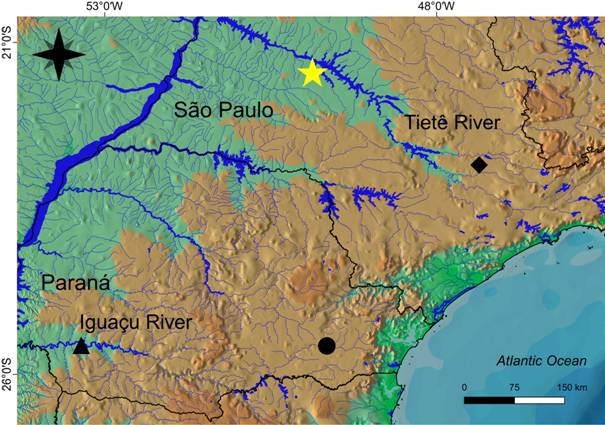
Recent samples in the Iguaçu River basin-an important tributary of the Lower Paraná River-revealed the presence of Serrapinnus notomelas in two sites, one located in the upper portion of the basin and the other in the lower stretch of the Iguaçu River (Fig. 1). Such specimens (N = 24) represent the first records of the family Cheirodontinae for this aquatic ecoregion (sensu Abell et al. 2008). Here, we document and discuss these distribution records.

Geographic distribution of the collection records of Serrapinnus notomelas in the upper portion (black circle) and lower stretch of Iguaçu River basin (black triangle) and Tietê River basin (black diamond) in southeastern Brazil. Yellow star, type locality cited in the literature (Avanhandava municipality, São Paulo State).
Seven specimens of S. notomelas (30.4-33.6 mm of standard length) were sampled in a small tributary of the right margin of Rio Itaqui, upper Iguaçu River basin, 25°34’20.46”S 49°39’17.97”W, municipality of Balsa Nova, state of Paraná, on 9 Feb 2021 (Table 1). The other 17 specimens (31.8-34.9 mm of standard length) were sampled in the Salto Caxias Reservoir, Lower Iguaçu River, 25°34’5.91”S 53°7’27.8”W, municipality of Nova Prata do Iguaçu, state of Paraná, on 10 Feb 2024 (Table 1). Voucher specimens were deposited in the ichthyological collection of the Museu de História Natural Capão da Imbuia (MHNCI) under catalog numbers MHNCI 13047 (N = 7) and 13048 (N = 17), available at http://www.splink.org.br/. Fieldwork was conducted under the permit SISBIO #10320-8.
Morphometric data of Serrapinnus notomelas obtained in Iguaçu River basin, Southern Brazil. Standard deviation (SD).
Measurements to the nearest 0.01 mm were made using a digital caliper following Fink and Weitzman (1974), under a dissecting microscope and are presented as percentages of standard length (SL) or head length (HL). Osteological observations of jaws and teeth, ventral procurrent caudal-fin rays, and anal-fin rays were made on one specimen cleared and stained (c&s) for bone and cartilage following the protocol by Taylor and Van Dyke (1985).
We based our specimen’s identification on the original description in Eigenmann (1915) and the identification key provided by Géry (1977), considering that there is not an appropriate taxonomic characterization of S. notomelas and some diagnostic features provided by Ota et al. (2018) differ from the original description. We also measured 10 individuals of S. notomelas collected in Ribeirão dos Toledos, a tributary of the Piracicaba River, Tietê River basin, municipality of Santa Bárbara D’Oeste, state of São Paulo, upper Paraná River basin (MHNCI 13049) (Table 1).
All specimens from the Iguaçu River basin showed the main taxonomic characteristics consistent with the description of S. notomelas: compressed body, black pigmentation on the anterior and proximal border of the dorsal fin (Fig. 2); premaxilla with four teeth aligned in one single row and maxilla with two teeth, all pedunculated and distally expanded (Fig. 3); twenty-two anal-fin rays (iii, 19), fourth to ninth anal rays of males expanded, with hooks posterolaterally arranged (Fig. 4); males also with hypertrophied and ventrally exposed procurrent caudal-fin rays (Fig. 5). Morphometric measures of individuals from the upper and lower Iguaçu River basin highly overlap with specimens from Tietê River basin, upper Paraná River basin (Table 1).

Serrapinnus notomelas, mature male, MHNCI 13047, 32.2 mm SL from Balsa Nova municipality, upper Iguaçu River basin, Paraná State, Brazil: (2) habitus; (3) clear and stained upper jaw showing right side of premaxilla (PM) and maxilla (M), lateral view; (4) clear and stained anal fin with hypertrophied anal-fin rays and hooks shape and arrangement. Lateral view; (5) clear and stained ventral procurrent caudal-fin rays, lateral view. Scale bar 1 mm.
The discovery of S. notomelas in the lower and upper stretches of the Iguaçu River basin seems to represent a recent human-mediated accidental introduction instead of faunal exchange and range expansion associated with headwater capture events between the neighboring drainages. The upper Paraná and Iguaçu Aquatic Ecoregions have shown some cases of sharing of species previously considered endemic to the Iguaçu River basin: Psalidodon bifasciatus (Frota et al. 2020, Neves et al. 2020), Rhamdiopsis moreirai (Hoffmann et al. 2015), and Cambeva davisi (Nascimento et al. 2017). Furthermore, this species (or any other Cheirodontinae) has not been reported in several ichthyofaunal surveys performed in the Iguaçu River basin (e.g., Haseman 1911a, 1911b, Godoy 1979, 1987, Severi and Cordeiro 1994, Garavello et al. 1997, Ingenito et al. 2004, Baumgartner et al. 2012, Daga et al. 2016, Frota et al. 2016, Delariva et al. 2018, Reis et al. 2020, Mezzaroba et al. 2021, Freitas and Abilhoa 2023).
The introduction of S. notomelas in the Iguaçu River basin might be caused by the release of contaminated batches of species from adjacent ecoregions, aiming at fish stocking programs, aquaculture, or sport fishing. That is the case of Colossoma macropomum (Cuvier, 1816), Prochilodus lineatus (Valenciennes, 1837), Megaleporinus macrocephalus (Garavello & Britski, 1988), Megaleporinus obtusidens (Valenciennes, 1837), and Salminus brasiliensis (Cuvier, 1816). In fact, aquaculture, aquarium trade, and fish stocking are the main vectors of introductions, either intentional or unintentional, of nonnative fish species in the Iguaçu River basin (Daga et al. 2016). Although fish stocking is a common management action used worldwide and encouraged by government initiatives in Brazil (Pelissoli et al 2023), the outcomes of this management technique have been highly controversial, producing the dissemination of pathogens and parasites, impacts on the structure and functioning of communities, and the introduction of nonnative species of aquatic organisms (Agostinho et al. 2010).
Despite the lack of evidence to determine the origin of some fish species from the Iguaçu River basin in the comprehensive compilation of records available from ichthyological collections performed by Reis et al. (2020) and Mezzaroba et al. (2021), the number of nonnative fish is increasing, and the recent discovery of new endemic species (Reis et al. 2021, Alonso et al. 2023, Costa et al. 2024) and records of S. notomelas and other freshwater genera and species (e.g., Pimelodella meeki, Poecilia vivipara, Hollandichthys multifascitaus) in the Iguaçu River basin reveal how insufficiently the freshwater ichthyofauna is known.
ACKNOWLEDGEMENTS
We thank the Meros do Brasil project (sponsored by Petrobras) for the logistic support. We are also grateful to Adriano Hauer for the aid in field collections and Carla Pavanelli from the Núcleo de Pesquisas em Limnologia, Ictiologia e Aquicultura (Nupélia) for the clearing and staining process for osteological analysis.
LITERATURE CITED
-
Abell R, Thieme ML, Revenga C, Bryer M, Kottelat M, et al. (2008) Freshwater Ecoregions of the World: A new map of biogeographic units for freshwater biodiversity conservation. BioScience 58(5): 403-414 https://doi.org/10.1641/B580507
» https://doi.org/10.1641/B580507 -
Alonso F, Terán GE, Calviño P, Alanis WSS, Montes MM, et al. (2023) Expect the unexpected: a new species of killifish from a highly stochastic temporary wetland near Iguazu Falls (Cyprinodontiformes: Rivulidae). Canadian Journal of Zoology 102(3): 298-314. https://doi.org/10.1139/cjz-2023-0132
» https://doi.org/10.1139/cjz-2023-0132 -
Agostinho AA, Pelicice FM, Gomes LC, Júlio Jr HF (2010) Reservoir Fish Stocking: When One Plus One May Be Less Than Two. Natureza and Conservação 8(2): 103-111. https://doi.org/10.4322/natcon.00802001
» https://doi.org/10.4322/natcon.00802001 - Baumgartner G, Pavanelli CS, Baumgartner D, Bifi AG, Debona T, Frana VA (2012) Peixes do Baixo Rio Iguaçu. Eduem, Maringá, 203 pp.
-
Chuctaya J, Bührnheim CM, Malabarba LR (2018) Two new species of Odontostilbe historically hidden under O. microcephala (Characiformes: Cheirodontinae). Neotropical Ichthyology 16(1): e170047. https://doi.org/10.1590/1982-0224-20170047
» https://doi.org/10.1590/1982-0224-20170047 -
Costa WJEM, Feltrin CRM, Mattos JLO, Katz AM (2024) Top mountain areas of subtropical southern Brazil sheltering four new small-ranged catfishes (Siluriformes, Trichomycteridae): relationships and taxonomy. Evolutionary Systematics 8(2): 199-218. https://doi.org/10.3897/evolsyst.8.126393
» https://doi.org/10.3897/evolsyst.8.126393 -
Daga VS, Debona T, Abilhoa V, Gubiani ÉA, Vitule JRS (2016) Non-native fish invasions of a Neotropical ecoregion with high endemism: a review of the Iguaçu River. Aquatic Invasions 11(2): 209-223. https://doi.org/10.3391/ai.2016.11.2.10
» https://doi.org/10.3391/ai.2016.11.2.10 -
Dagosta FCP, Monção MS, Nagamatsu BA, Pavanelli CS, Carvalho FR, et al. (2024) Fishes of the upper rio Paraná basin: diversity, biogeography and conservation. Neotropical Ichthyology 22(1): e230066. https://doi.org/10.1590/1982-0224-2023-0066
» https://doi.org/10.1590/1982-0224-2023-0066 -
Delariva RL, Neves MP, Larentis C, Kliemann BCK, Baldasso MC, Wolff LL (2018) Fish fauna in forested and rural streams from an ecoregion of high endemism, lower Iguaçu River basin, Brazil. Biota Neotropica 18(3): e20170459. https://doi.org/10.1590/1676-0611-bn-2017-0459
» https://doi.org/10.1590/1676-0611-bn-2017-0459 -
Eigenmann CH (1915) The Cheirodontinae, a subfamily of minute characid fishes of South America. Memoirs of the Carnegie Museum 7(1): 1-100. https://doi.org/10.5962/bhl.title.46579
» https://doi.org/10.5962/bhl.title.46579 -
Fink WL, Weitzman SH (1974) The so-called Cheirodontin fishes of Central America with descriptions of two new species (Pisces: Characidae). Smithsonian Contributions to Zoology 172: 1-46. https://doi.org/10.5479/si.00810282.172
» https://doi.org/10.5479/si.00810282.172 - Freitas MO, Abilhoa V (2023) Chordata, Actinopterygii. In: Straube FC (Ed.) Inventário da Fauna de Curitiba. Prefeitura Municipal de Curitiba, Curitiba, 207-209.
-
Fricke R, Eschmeyer WN, Van der Laan R (2025) Eschmeyer’s Catalog of Fishes: Genera, Species, References. http://researcharchive.calacademy.org/research/ichthyology/catalog/fishcatmain.asp
» http://researcharchive.calacademy.org/research/ichthyology/catalog/fishcatmain.asp -
Frota A, Gonçalves EVR, Deprá GC, Graça WJ (2016) Inventory of the ichthyofauna from the Jordão and Areia river basins (Iguaçu drainage, Brazil) reveals greater sharing of species than thought. Check List 12(6): 1-12. https://doi.org/10.15560/12.6.1995
» https://doi.org/10.15560/12.6.1995 -
Frota A, Ota RR, Deprá GC, Ganassin MJM, Da Graça WJ (2020) A new inventory for fishes of headwater streams from the rio das Cinzas and rio Itararé basins, rio Paranapanema system, Paraná, Brazil. Biota Neotropica 20(1): e20190833. https://doi.org/10.1590/1676-0611
» https://doi.org/10.1590/1676-0611 - Garavello JC, Pavanelli CS, Suzuki HI (1997) Caracterização da ictiofauna do rio Iguaçu. In: Agostinho AA, Gomes LC (Eds) Reservatório de Segredo: bases ecológicas para o manejo. Eduem, Maringá , 61-84.
- Géry J (1977) Characoids of the World. TFH Publications, Neptune City, 672 pp.
- Godoy MP (1979) Reconhecimento da ictiofauna, modificações ambientais e usos múltiplos dos reservatórios: Rio Iguaçu, Paraná, Brasil. Eletrosul Centrais Elétricas do sul do Brasil SA, Florianópolis, 33 pp.
- Godoy MP (1987) Peixes do estado de Santa Catarina. Editora da UFSC, Florianópolis, 571 pp.
-
Haseman JD (1911a) An annotated catalog of the cichlid fishes collected by the expedition of the Carnegie Museum to central South America, 1907-10. Annals of the Carnegie Museum 7(3-4): 329-373. https://doi.org/10.5962/p.242803
» https://doi.org/10.5962/p.242803 -
Haseman JD (1911b) Some new species of fishes from the Rio Iguassú. Annals of the Carnegie Museum 7(3-4): 374-387. https://doi.org/10.5962/p.167633
» https://doi.org/10.5962/p.167633 -
Hoffmann AC, Nascimento RHC, Shibatta AO (2015) Fish fauna from tributaries throughout the Tibagi River basin, upper Paraná basin, Brazil. Check List 11(6): 1815. https://doi.org/10.15560/11.6.1815
» https://doi.org/10.15560/11.6.1815 - Ingenito LFS, Duboc LF, Abilhoa V (2004) Contribuição ao conhecimento da ictiofauna da bacia do alto rio Iguaçu, Paraná, Brasil. Arquivos de Ciências Veterinárias e Zoológicas da UNIPAR 7(1): 23-36.
-
Jerep FC, Malabarba LR (2014) A new species of Serrapinnus Malabarba, 1998 (Characidae: Cheirodontinae) from Rio Grande do Norte State, northeastern Brazil. Neotropical Ichthyology 12(2): 301-308. https://doi.org/10.1590/1982-0224-20130218
» https://doi.org/10.1590/1982-0224-20130218 - Malabarba LR (1998) Monophyly of the Cheirodontinae, characters and majors clades (Ostariophysi: Characidae). In: Malabarba LR, Reis RE, Vari RP, Lucena ZMS, Lucena CAS (Eds) Phylogeny and Classification of Neotropical Fishes. Edipucrs, Porto Alegre, 193-233.
- Malabarba LR (2003) Subfamily Cheirodontinae (Characins, tetras). In: Reis RE, Kullander SO, Ferraris Jr C (Eds) Check list of the freshwater fishes of South and Central America. Edipucrs, Porto Alegre , 215-221.
-
Mariguela TC, Ortí G, Avelino GS, Abe KT, Oliveira C (2013) Composition and interrelationships of a large Neotropical freshwater fish group, the subfamily Cheirodontinae (Characiformes: Characidae): a case study based on mitochondrial and nuclear DNA sequences. Molecular Phylogenetics and Evolution 68: 23-34. https://doi.org/10.1016/j.ympev.2013.03.011
» https://doi.org/10.1016/j.ympev.2013.03.011 -
Melo BF, Ota RP, Benine RC, Carvalho FR, Lima FCT, et al. (2024) Phylogenomics of Characidae, a hyper-diverse Neotropical freshwater fish lineage, with a phylogenetic classification including four families (Teleostei: Characiformes). Zoological Journal of the Linnean Society 202(1): zlae101. https://doi.org/10.1093/zoolinnean/zlae101
» https://doi.org/10.1093/zoolinnean/zlae101 -
Mezzaroba L, Debona T, Frota A, Da Graça WJ, Gubiani ÉA (2021) From the headwaters to the Iguassu Falls: Inventory of the ichthyofauna in the Iguassu River basin shows increasing percentages of nonnative species. Biota Neotropica 21(2): e20201083. https://doi.org/10.1590/1676-0611-BN-2020-1083
» https://doi.org/10.1590/1676-0611-BN-2020-1083 -
Mirande JM (2019) Morphology, molecules and the phylogeny of Characidae (Teleostei, Characiformes). Cladistics 35(3): 282-300. https://doi.org/10.1111/cla.12345
» https://doi.org/10.1111/cla.12345 -
Nascimento RHC, Frantine-Silva W, Souza-Shibatta L, Sofia SH, Ferrer J, Shibatta AO (2017) Intrapopulational variation in color pattern of Trichomycterus davisi (Haseman, 1911) (Siluriformes: Trichomycteridae) corroborated by morphometrics and molecular analysis. Zootaxa 4290(3): 503-518. https://doi.org/10.11646/zootaxa.4290.3.5
» https://doi.org/10.11646/zootaxa.4290.3.5 -
Neves MP, Silva PC, Delariva RL, Fialho CB, Netto-Ferreira AL (2020) First record of Astyanax bifasciatus Garavello & Sampaio, 2010 (Teleostei, Ostariophysi, Characidae) in the Piquiri river basin, upper Paraná river basin. Check List 16(1): 93-101. https://doi.org/10.15560/16.1.93
» https://doi.org/10.15560/16.1.93 -
Ota RR, Deprá GD, Da Graça WJ, Pavanelli CS (2018) Peixes da planície de inundação do alto rio Paraná e áreas adjacentes: revised, annotated and updated. Neotropical Ichthyology 16(2): e170094. https://doi.org/10.1590/1982-0224-20170094
» https://doi.org/10.1590/1982-0224-20170094 -
Pelissoli YM, Agostinho AA, Schmitz MH, Pelicice FM (2023) An overview of fish stocking in Brazil. Neotropical Ichthyology 21(3): e220117. https://doi.org/10.1590/1982-0224-2022-0117
» https://doi.org/10.1590/1982-0224-2022-0117 -
Reis RB, Ferrer J, da Graça WJ (2021) A new species of Cambeva (Siluriformes, Trichomycteridae) from the Rio Iguaçu basin, Paraná state, Brazil and redescription of Cambeva stawiarski (Miranda Ribeiro 1968). Journal of Fish Biology 96: 350-363. https://doi.org/10.1111/jfb.14204
» https://doi.org/10.1111/jfb.14204 -
Reis RB, Frota A, Deprá GC, Ota RR, Graça WJ (2020) Freshwater fishes from Paraná State, Brazil: an annotated list, with comments on biogeographic patterns, threats, and future perspectives. Zootaxa 4868(4): 451-494. https://doi.org/10.11646/zootaxa.4868.4.1
» https://doi.org/10.11646/zootaxa.4868.4.1 - Severi W, Cordeiro AAM (1994) Catálogo de peixes da bacia do rio Iguaçu. IAP, GTZ, Curitiba, 118 pp.
-
Taylor WR, Van Dyke GC (1985) Revised procedures for staining and clearing small fishes and other vertebrates for bone and cartilage. Cybium 9: 107-119. https://doi.org/10.26028/cybium/1985-92-001
» https://doi.org/10.26028/cybium/1985-92-001
ADDITIONAL NOTES
- ZooBank register
-
Data Availability
Datasets generated or analyzed in this study are available from the corresponding author on reasonable request.
-
Funding
This research was supported by the Conselho Nacional de Desenvolvimento Científico e Tecnológico (CNPq, 130545/2023-6) to JM.
-
How to cite this article
Abilhoa V, Maccari JM, Hamann MH, Dalcin RH, Freitas MO (2025) Distributional expansion of Serrapinnus notomelas to the Iguaçu River basin: natural or human-mediated introduction? Zoologia 42: e25005. https://doi.org/10.1590/S1984-4689.v42.e25005
-
Published by
Sociedade Brasileira de Zoologia at Scientific Electronic Library Online - https://www.scielo.br/zool
Datasets generated or analyzed in this study are available from the corresponding author on reasonable request.
Data citations
Fricke R, Eschmeyer WN, Van der Laan R (2025) Eschmeyer’s Catalog of Fishes: Genera, Species, References. http://researcharchive.calacademy.org/research/ichthyology/catalog/fishcatmain.asp