Three new species, first country records, and a key to South American Cylloceria (Hymenoptera: Ichneumonidae) from the Northern Andes
ABSTRACT
Three new species of Cylloceria Schiødte, 1838 (Ichneumonidae: Cylloceriinae) from the Northern Andes are described, representing the first records of the genus for Colombia and Ecuador. This study aims to advance the understanding of Neotropical Cylloceriinae diversity and biogeography. Specimens were collected in high Andean forests in both countries using Malaise traps and were examined using stereomicroscopy. The newly described species-C. andesilvana sp. nov. from Ecuador, along with C. jaramilloi sp. nov. and C. murrayblumi sp. nov. from Colombia-are fully described and illustrated, and an identification key to all South American species of Cylloceria is provided. These findings increase the number of known Neotropical species of the genus to 12 and underscore the ecological relevance of Andean montane ecosystems as reservoirs of undocumented ichneumonid diversity.
KEYWORDS:
Andean forests; biodiversity; Neotropical region; parasitoid wasps; species description; taxonomy
INTRODUCTION
Ichneumonidae, or Darwin wasps (Klopfstein et al. 2019), are parasitoid wasps considered one of the largest families in the animal kingdom, acting as natural enemies of a wide range of holometabolous insects and spiders (Broad et al. 2018). Recently, 96 new species have been recorded from Colombia, increasing the country’s total to 276 (Fernandes et al. 2023, Nascimento et al. 2024, Lima et al. 2024). In Ecuador, at least 287 species are currently known (Bordera et al. 2016a, 2016b, Yu et al. 2016, Bordera et al. 2019, Di Giovanni et al. 2021, Mazón and Bordera 2023, Bordera and Mazón 2024, Mazón et al. 2024).
Cylloceriinae Schiødte, 1839 comprises four genera: Allomacrus Förster, 1869 (five species), Cylloceria Schiødte, 1838 (34 species), Hyperacmus Holmgren, 1858 (five species), and Rossemia Humala, 1997 (one species) (Choi and Lee 2016, Yu et al. 2016, Khalaim et al. 2017, Liu and Reshchikov 2019). Cylloceria is a cosmopolitan genus, and only nine species are currently known from the Neotropical region: Cylloceria alva radoi Gauld, 1991 (Mexico [Oaxaca, Veracruz], Honduras, Costa Rica, and Panama); Cylloceria arizonica Dasch, 1992 (USA and Mexico); Cylloceria barbouraki Gauld, 1991 (Costa Rica); Cylloceria mexicana Kasparyan & Ruíz-Cancino, 2003 (Mexico); Cylloceria morelia Humala & Khalaim, 2017 (Mexi co); Cylloceria tincochacae Viereck, 1913 (Peru); Cylloceria trishae Gauld, 1991 (Costa Rica); Cylloceria tropicana Humala, 2012 (Mexico); and Cylloceria ugaldevi Gauld, 1991 (Costa Rica) (Yu et al. 2016, Khalaim et al. 2017).
Cylloceria is characterized by the presence of glymmae on the first metasomal tergite; short sternite distinctly separated from the tergite, usually only reaching the level of spiracles; absence of the basal transverse carina on the propodeum; and the specific location and shape of tyloids on the male flagellomeres, starting from the third segment (Varga and Kostro-Ambroziak 2021).
The biology of Cylloceriinae remains poorly understood, with only a few reliable host records available. Species of Cylloceria have been reared from the larvae of crane flies (Diptera: Tipulidae) collected in decaying wood (Broad et al. 2018). Prior to this study, no species of this subfamily had been recorded from Colombia or Ecuador. Here, we describe three new Neotropical species: two from Colombia and one from Ecuador. In addition, illustrations and an identification key to all South American species of Cylloceria are provided.
MATERIAL AND METHODS
The specimens examined in this study were deposited in three institutional collections: Entomological Collection of the Universidad de Antioquia (CEUA), Medellín, Colombia (curator M. Wolff), under the “ANLA collection permit of specimens of biologi cal diversity”; Collection of the Universidad Nacional de Loja (LOUNAZ), Loja, Ecuador (curator A. Paucar-Cabrera); and the National Museum of Natural History, Smithsonian Institution (USNM), Washington, D.C., United States (curator S. Brady).
Terminology used in the species descriptions follows Broad et al. (2018), ensuring consistency with recent taxonomic treatments of Ichneumonidae.
Digital images, morphometric data, and proportions of the Colombian specimens were obtained using a Leica DMC4500 digital camera attached to a Leica M205A stereomicroscope, with image stacking performed using Leica Application Suite software (version 4.10.0). All images were processed and finalized using Adobe Photoshop.
Photographs and measurements of the Ecuadorian specimens were taken at the Natural History Museum, London (NHMUK), employing a Canon EOS 5DSR digital camera coupled with a Canon MP-E 65 mm macro lens, mounted on a StackShot Macro Rail system. Image acquisition and post-processing were conducted using Helicon Remote and Helicon Focus software (version 3.6.6).
The section “Type material” transcribes the details provided on the specimen labels. The distribution map showing the collection localities was generated using the online platform SimpleMappr (Shorthouse 2010).
TAXONOMY
Cylloceria Schiødte, 1838
CylloceriaSchiødte, 1838: 140. Type species: Phytodietus caligatus Gravenhorst, 1829.
Chalinocerus Ratzeburg, 1852: 130. Type species: Chalinocerus longicornis Ratzeburg, 1852.
Asphragis Förster, 1869: 166. Type species: Lissonota occupator Gravenhorst, 1829.
Cylloceria andesilvana Mazón, sp. nov.
https://zoobank.org/6F3A9769-C82B-4F92-AC24-BEE171F9BB7B
Type material. Holotype female: ECUADOR • ♀; Zamora Chinchipe province, Tapichalaca Reserve, degraded area, Malaise trap, 4°29’20.8”S 79°07’34.1”W, 2574 masl, 31.III-15.IV.2018, Leg. M. Mazón (LOUNAZ). Paratypes ECUADOR • 7 ♀♀; same locality and date as holotype (1 female, LOUNAZ); same locality as holotype, 15-29.IV.2018 (1 female, LOUNAZ); Loja province, Madrigal del Podocarpus Reserve, secondary forest, Malaise trap, 4°30’50.0”S 79°10’30.7”W, 2519 masl, 21.XII.2015-8.I.2016 (1 female, LOUNAZ); same locality, area under ecological restoration, Malaise trap, 02-21.XII.2015 (1 female - LOUNAZ); same locality and same ecosystem, 08-21.I.2016. All leg. M. Mazón, (3 females - LOUNAZ).
Diagnosis. Cylloceria andesilvana sp. nov. can be distinguished from other Neotropical species by the following combination of characters: 1) head about 2.0 × wider than long; 2) frons smooth; 3) fore wing with nervellus antefurcal; 4) wings hyaline; 5) tergite I about 2.0 × longer than wide, rugulose, with indistinct dorso-median carinae in basal half; 6) ovipositor sheath about 1.5 × longer than hind tibia.

Holotype and paratype of Cylloceria andesilvana sp. nov., female: (A) Habitus, holotype; (B) head, frontal view, (paratype); (C) head, mesosoma and tergite I, dorsal view, paratype. Scale bars: 1.0 mm.
Description. Female (Holotype). Body length 10.8 mm, fore wing length 10.2 mm. Head about 2.0 × wider than long. Antenna long and slender, with 28 flagellomeres; first flagellomere about 13.0 × longer than centrally broad. Gena relatively short, slightly and roundly narrowed behind eye, with setiferous punctures on a shiny background. Ocelli of moderate size, distance between lateral ocellus and eye as long as ocellar diameter; ocelli surrounded by a thin carina, separated from the occipital carina by a distance greater than the ocellar diameter. Occipital carina complete. Face about 2.0 × wider than high and about 0.5 × as wide as head, with parallel sides, rugose in the middle, densely punctured at sides, only smooth and polished along a narrow band by facial orbits; central part of the face slightly convex and limited by two shallow vertical grooves that divide face into three areas of approximately the same width. Frons smooth, only sparsely punctate, slightly concave. Clypeus polished, narrowly convex along anterior margin, remainder flattened, separated from face by a distinct groove, about 2.5 × wider than long, with posterior margin truncate. Malar space strongly granulate, about 1.0 × as long as width of the mandibular base, with subocular sulcus present. Mandible robust, upper tooth more than twice as wide as lower one; anterior half of mandible with rough setiferous punctures, posterior half smooth and polished (Fig. 1B). Mesosoma about 1.5 × longer than high in lateral view. Mesoscutum about 1.0 × longer than wide, in profile abruptly rounded; notauli deep, converging and meeting posteriorly on a strongly strigose-rugulose area, the rest of the surface densely punctate on a shiny background (Fig. 1C). Epomia pre sent; propleurum smooth and polished, with some wrinkles parallel to epomia. Scutellum convex, with lateral carinae only at its anterior part. Mesopleuron smooth, somewhat rugose posteriorly, with scattered punctures bearing rather long white setae; epicnemial carina complete, reaching anterior margin of mesopleuron. Metapleuron coarsely rugulose. Propodeum coarsely rugulose, with lateromedian longitudinal carinae subparallel, slightly converging towards posterior part; propodeal spiracle ovoid, pleural carina thin and complete. Legs with hind femur about 5.5 × longer than wide; tarsus I of hind leg about 0.5 × as long as the hind tibia. Fore wing with nervellus antefurcal; 2rs-m about 0.5 × longer than abscissa of M between 2rs-m and 2m-cu. Hind wing nervellus intercepted in the middle by second abscissa of CU. Metasoma with tergite I about 2.0 × longer than wide, rugulose, with indistinct dorso-median carinae in basal half; spiracle at anterior 0.5 of tergite. Glymma present. Sternite I separated from tergite, with sclerotized part reaching about 0.5 × length of tergite (in center) and posterior margin roundly incised. Tergite II about 1.0 × longer than wide, mostly unpolished and granulate, only polished on posterior 0.1 of its length, with some scattered setiferous punctures along the tergite. Remaining tergites subpolished, with denser setiferous punctures. Ovipositor sheath moderately long, about 1.5 × longer than hind tibia, with dorsal subapical notch.
Coloration. Body predominantly black; second and following metasomal tergites with a fine posterior line and thyridium reddish-brown; annellus and mandible teeth, reddish-brown; palpi brown; tegula dark brown; legs, except black coxae and brown trochantera, yellow; wings hyaline, with a light golden tone, veins and pterostigma brown to dark brown (Fig. 1A).
Variation. Some of the paratypes from Loja province are smaller, body length from 7.5 to 10.8 mm, and fore wing length from 6.5 to 9.5 mm. One of the paratypes has 27 flagellomeres. Grooves in face might be more or less conspicuous. Lateral longitudinal carina of propodeum is sometimes more or less developed.
Male. Unknown.
Distribution. Ecuador (Loja and Zamora Chinchipe provinces) (Fig. 6).
Etymology. The specific epithet refers to the ecosystem type where the type material was collected: Andean forests. The name is derived from the Latin silvana, meaning “from the forest”, combined with andes.
Biology. Host unknown. Specimens were collected at elevations between 2,519-2,574 m a.s.l.
Remarks. Cylloceria andesilvana sp. nov. is similar to C. alvaradoi mainly by the metapleuron centrally rugulose; the narrow malar space about 1.0 × as long as width of the mandibular base; mesopleuron smooth, somewhat rugose posteriorly, with scattered punctures bearing rather long whitish setae; and the black coloration of the body except for the yellow legs. In C. andesilvana sp. nov., fore wing with nervellus antefurcal; hind wing nervellus intercepted in the middle by second abscissa of CU; propodeum coarsely rugulose, with lateromedian longitudinal carinae subparallel, slightly converging towards posterior part, pleural carina thin and complete; metasoma with tergite I rugulose; ovipositor sheath moderately long, about 1.5 × longer than hind tibia, with dorsal subapical notch. In contrast, in C. alvaradoi fore wing with nervellus interstitial; hind wing nervellus intercepted below the middle inclivous by second abscissa of CU; propodeum dorsally coriaceous between longitudinal carinae; metasoma with tergite I finely coriaceous; ovipositor sheath moderately long, in all 1.9-2.0 × as long as hind tibia.
Cylloceria jaramilloi Fernandes, Nascimento & Pádua, sp. nov.
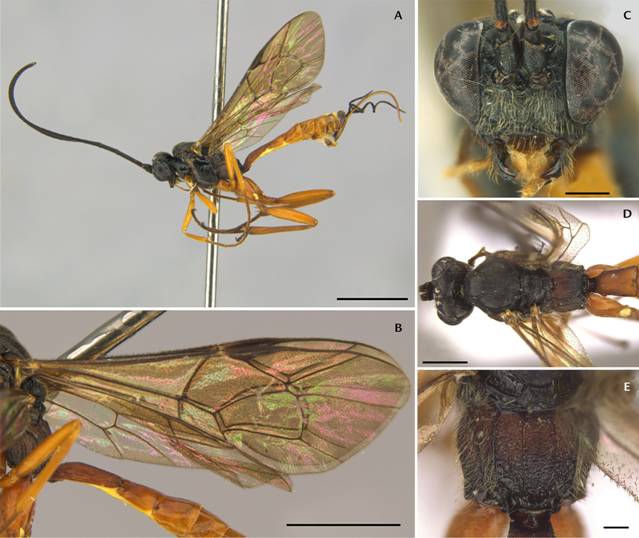
Figs 2 A-E, 4 C-D, 6
https://zoobank.org/B167719A-E2BA-49BF-99A7-492E9CC71AFC
Type material. Holotype female: COLOMBIA • ♀; Mcpio [Municipio] Andes, Antioquia, Mesenia-Paramillo Nature Reserve, Malaise trap 3, 5°29’55.5”N 75°54’14.0”W, 2501 msnm, IX.2020, col. L. Mazariegos (CEUA). Paratypes COLOMBIA • 6 ♀♀; Mcpio [Municipio] Andes, Antióquia, Mesenia-Paramillo Nature Reserve, Malaise trap 3, 5°29’55.5”N 75°54’14.0”W, 2501 msnm, II-III.2021, col. L. Mazariegos (3 females - CEUA); same data but, I.2021, col. L. Mazariegos (1 female - CEUA); same data but, V.2021, col. L. Mazariegos (1 female - CEUA); same data but, IX.2021, col. L. Mazariegos (1 female - CEUA).
Diagnosis. Cylloceria jaramilloi sp. nov. can be distinguished from other Neotropical species by the following combination of characters: 1) Head about 1.5 × wider than long; 2) frons slightly rugose; 3) fore wing with nervellus interstitial; 4) wings brown iridescent; 5) tergite I about 2.5 × longer than wide, polished and granulate on anterior and slightly granulate posteriorly; and 6) ovipositor sheath about 1.5 × longer than hind tibia.

Holotype of Cylloceria jaramilloi sp. nov., female: (A) Habitus; (B) wings; (C) head, frontal view; (D) mesosoma, dorsal view; (E) propodeum, dorsal view. Scale bars: A-B = 2.0 mm, C = 0.5 mm, D = 1.0 mm, E = 0.2 mm.
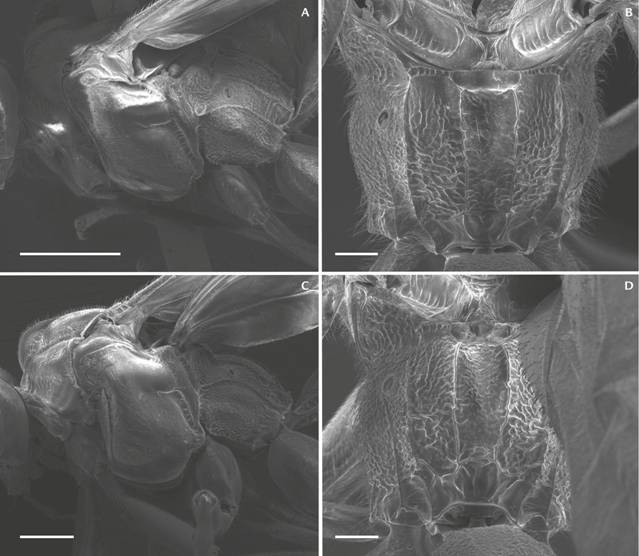
Description. Female (Holotype). Body length 8.2 mm, fore wing length 6.9 mm. Head about 1.5 × wider than long. Antenna long and slender with 44 flagellomeres; first flagellomere about 7.0 × longer than centrally broad. Gena relatively short, slightly and roundly narrowed behind eye, with setiferous punctures on a shiny background. Ocelli of moderate size, distance between lateral ocellus and eye as long as ocellar diameter; ocelli surrounded by a thin carina, separated from the occipital carina by a distance greater than the ocellar diameter. Occipital carina complete. Face about 2.0 × wider than high and about 0.5 × as wide as head, with parallel sides, rugose in the middle, densely punctured, only smooth and polished along a narrow band by facial orbits; central part of the face slightly convex and limited by two shallow vertical grooves that divide face into three areas of approximately the same width. Frons slightly rugose, sparsely punctate, slightly concave. Clypeus polished, narrowly convex along anterior margin, remainder flattened, separated from face by a distinct groove, about 5.0 × wider than long, with posterior margin truncate. Malar space strongly granulate, about 2.0 × longer than the width of the mandibular base, with subocular sulcus present. Mandible robust, upper tooth more than twice as wide as lower one; basal half of mandible with rough setiferous punctures, apical half smooth and polished (Fig. 2C). Mesosoma about 1.5 × longer than high in lateral view. Mesoscutum about 1.0 × longer than wide, in profile abruptly rounded; notauli deep, converging and meeting posteriorly on a strongly strigose-rugulose area, the rest of the surface densely punctate on a polished background (Fig. 2D). Epomia present; propleurum smooth and polished, with some wrinkles parallel to epomia. Scutellum convex, with lateral carinae only at its anterior part (Fig. 2D). Mesopleuron smooth, somewhat rugose posteriorly, with scattered punctures bearing rather long white setae; epicnemial carina complete, reaching anterior margin of mesopleuron. Metapleuron coarsely rugulose (Fig. 4C). Propodeum coarsely rugulose, with lateromedian longitudinal carinae subparallel, slightly converging towards posterior part; propodeal spiracle ovoid, pleural carina thin and complete (Figs 2E; 4D). Legs with hind femur about 5.0 × as long as wide; tarsus I of hind leg about 0.5 × longer than the hind tibia. Fore wing with nervellus interstitial; 2rs-m about 0.5 × longer than abscissa of M between 2rs-m and 2m-cu. Hind wing nervellus intercepted in the middle by second abscissa of CU (Fig. 2B). Metasoma with tergite I about 2.5 × longer than wide, rugulose, with indistinct dorso-median carinae in basal half; spiracle at anterior 0.5 of tergite; tergite I with two latero-median carinae. Glymma present. Sternite I separated from tergite, with sclerotized part reaching about 0.2 × length of tergite (in center) and posterior margin roundly incised. Tergite II about 0.75 × longer than wide, polished, and granulate on anterior and slightly granulate posteriorly, T3+ polished with some setiferous punctures. Ovipositor sheath moderately long, about 1.5 × longer than hind tibia, ovipositor tip with dorsal subapical notch.
Coloration. Head black with labial palp brown and maxillary palp yellow; mesosoma predominantly black with the anterior part of propodeum reddish-brown to black; wings brown iridescent, veins and pterostigma brown to dark brown; legs orangish-red with infuscate tarsus; metasoma orangish-red with TI infuscate (Fig. 2A).
Variation. Body length 6.6-8.4 mm. Fore wing length 6.8-7.0 mm.
Male. Unknown.
Distribution. Antioquia (Colombia) (Fig. 6).
Etymology. The specific epithet jaramilloi pays tribute to Jorge Jaramillo Jaramillo, a native of La Mesenia village and a dedicated park ranger at the Mesenia-Paramillo Nature Reserve. Jorge’s invaluable contributions extend far beyond his role as a ranger; his expertise has significantly advanced our understanding of the biodiversity of Hymenoptera within the reserve.
Biology. Host unknown. Specimens were collected at 2,501 m a.s.l.
Remarks. Cylloceria jaramilloi sp. nov. is similar to C. mexicana mainly in color pattern, having body black and metasoma with TI blackish and TII+ reddish brown; occipi tal carina complete; epomia present; epicnemial carina complete; metapleuron coarsely rugulose; 2rs-m about 0.5 × longer than abscissa of M between 2rs-m and 2m-cu; ovipositor sheath moderately long, about 1.5 × longer than hind tibia, with dorsal subapical notch. In C. jaramilloi sp. nov. legs orangish red with infuscate tarsus; malar space strongly granulate, about 2.0 × longer than the width of the mandibular base, with subocular sulcus present; mesopleuron smooth, somewhat rugose posteriorly, with scattered punctures bearing rather long white setae; propodeum coarsely rugulose, with lateromedian longitudinal carinae subparallel, slightly converging towards posterior part; propodeal spiracle ovoid, pleural carina thin and complete; fore wing with nervellus interstitial; and metasoma with tergite I about 2.5 × longer than wide. In contrast, in C. mexicana all coxae and trochanters black, femora reddish, all tibiae, spurs, front and middle tarsi brownish red, hind femur at extreme apex and hind tibia at basal 0.08 blackish, and hind tarsus blackish or dark brown; malar space 0.9-1.0 × as long as basal width of mandible; mesopleuron usually matt, predominantly rugulose with punctures; propodeum coarsely rugulose with all longitudinal carinae of propodeum distinct to hind margin of propodeum, apical transverse carina present, apical area very short, subpolished, partly crossed by longitudinal carina; fore wing with nervellus antefurcal; and metasoma with tergite I about 1.7 × longer than wide.
Cylloceria murrayblumi Fernandes, Nascimento & Pádua, sp. nov.
Figs 3 A-E, 4 A-B, 6
https://zoobank.org/89E7D0F3-3602-49AB-830E-5C7774631AC1
Type material. Holotype female: COLOMBIA • ♀; Mcpio [Municipio] Andes, Antióquia, Mesenia-Paramillo Nature Reserve, Malaise [trap] 3, 5°29’55.5”N 75°54’14.0”W, 2501 msnm, VII.2020, col. L. Mazariegos (1 female - CEUA). Paratype: COLOMBIA • ♀; Mcpio [Municipio] Andes, Antióquia, Mesenia-Paramillo Nature Reserve, Malaise [trap] 1, 5°29’57.7”N 75°54’00.3”W, 2389 msnm, IX.2021, col. L. Mazariegos (CEUA).
Diagnosis. Cylloceria murrayblumi sp. nov. can be distinguished from other Neotropical species by the following combination of characters: 1) Head about 2.0 × wider than long; 2) frons slightly rugose; 3) fore wing with nervellus interstitial; 4) wings brown iridescent; 5) tergite I about 2.0 × longer than wide, rugulose, with indistinct dorso-median carinae in basal half; and 6) ovipositor sheath about 1.0 × longer than hind tibia.

Holotype of Cylloceria murrayblumi sp. nov., female: (A) Habitus; (B) wings; (C) head, frontal view; (D) mesosoma, dorsal view; (E) propodeum, dorsal view. Scale bars: A-B = 2.0 mm, C = 0.5 mm, D = 1.0 mm, E = 0.2 mm.
Description. Female (Holotype). Body length 9.3 mm, fore wing length 7.5 mm. Head about 2.0 × wider than long. Antenna long and slender, with 27 flagellomeres; first flagellomere about 12.0 × longer than centrally broad. Gena relatively short, slightly and roundly narrowed behind eye, with setiferous punctures on a shiny background. Ocelli of moderate size, distance between lateral ocellus and eye as long as ocellar diameter; ocelli surrounded by a thin carina, separated from the occipital carina by a distance greater than the ocellar diameter. Occipital carina complete. Face about 2.0 × wider than high and about 0.5 × as wide as head, with parallel sides, rugose in the middle, densely punctured at sides, only smooth and polished along a narrow band by facial orbits; central part of the face slightly convex and limited by two shallow vertical grooves that divide face into three areas of approximately the same width. Frons slightly rugose, sparsely punctate, slightly concave. Clypeus polished, narrowly convex along anterior margin, remainder flattened, separated from face by a distinct groove, about 3.0 × wider than long, with posterior margin truncate. Malar space strongly granulate, about 0.1 × as long as width of the mandibular base, with subocular sulcus present. Mandible robust, upper tooth more than twice as wide as lower one; basal half of mandible with rough setiferous punctures, apical half smooth and polished (Fig. 3C). Mesosoma about 1.5 × longer than high in lateral view. Mesoscutum about 1.0 × longer than wide, in profile abruptly rounded; notauli deep, converging and meeting posteriorly on a strongly strigose-rugulose area, the rest of the surface densely punctate on a polished background. Epomia present; propleurum smooth and polished, with some wrinkles parallel to epomia. Scutellum convex, with lateral carinae only at its anterior part (Fig. 3D). Mesopleuron smooth, somewhat rugose posteriorly, with scattered punctures bearing rather long white setae; epicnemial carina complete, reaching anterior margin of mesopleuron. Metapleuron coarsely rugulose (Fig. 4A). Propodeum coarsely rugulose, with lateromedian longitudinal carinae subparallel, slightly converging towards posterior part; propodeal spiracle ovoid, pleural carina thin and complete (Figs 3E, 4B). Legs with hind femur about 4.5 × longer than wide; tarsus I of hind leg about 2.0 × as long as the hind tibia. Fore wing with nervellus interstitial; 2rs-m about 0.5 × longer than abscissa of M between 2rs-m and 2m-cu. Hind wing nervellus intercepted in the middle by second abscissa of CU (Fig. 3B). Metasoma with tergite I about 2.0 × longer than wide, rugulose, with indistinct dorso-median carinae in basal half; spiracle at anterior 0.5 of tergite; tergite I without two latero-median carinae. Glymma present. Sternite I separated from tergite, with sclerotized part reaching about 0.3 × length of tergite (in center) and posterior margin roundly incised. Tergite II about 1.0 × longer than wide, polished, and granulate anteriorly and polished posteriorly, with some scattered setiferous punctures along the tergite. Remaining tergites subpolished, with denser setiferous punctures. Ovipositor sheath moderately long, about 1.0 × longer than hind tibia, ovipositor tip with dorsal subapical notch.
Coloration. Body black with labial palp and maxillary palp brown; mesosoma predominantly black; fore and mid legs with femur yellowish-orange and infuscate mark, tibia yellowish-orange, and tarsus dark brown; hind leg with basal part of tibia infuscate; wings brown iridescent, veins and pterostigma dark brown; metasoma black with apical margin tergites II-V reddish (Fig. 3A).
Variation. Body length 9.0-9.5 mm; flagellomeres 27-29. Fore wing length 7.5-7.9 mm.
Male. Unknown.
Distribution. Antioquia (Colombia) (Fig. 6).
Etymology. Named in honor of Murray Blum (1929-2015), an American pioneering entomologist recognized for his research in chemical ecology and his innovative studies on chemical communication by insects. Blum served as a research professor at the University of Georgia for three decades and was highly decorated for his significant contributions to the field, including authoring over 300 papers.
Biology. Host unknown. Specimens collected at elevations between 2,389-2,501 m a.s.l.
Remarks. Cylloceria murrayblumi sp. nov. is similar to C. arizonica and C. morelia mainly by having black body with tergites II-V with apical margin reddish or brownish; mesosoma about 1.5 × longer than high in lateral view; propodeum coarsely rugulose; glymma present; epomia present; scutellum convex, with lateral carinae only at its anterior part; epicnemial carina complete, reaching anterior margin of mesopleuron; and metapleuron coarsely rugulose. In C. murrayblumi sp. nov. fore and mid legs with femur yellowish orange and infuscate mark, tibia yellowish orange, and tarsus dark brown, and hind leg with basal part of tibia infuscate; clypeus polished, narrowly convex along anterior margin, remainder flattened, separated from face by a distinct groove, about 3.0 × wider than long, with posterior margin truncate; propodeum with lateromedian longitudinal carinae subparallel, slightly converging towards posterior part, pleural carina thin and complete; fore wing with nervellus interstitial; and ovipositor sheath moderately long, about 1.0 × longer than hind tibia, with dorsal subapical notch. In contrast, in C. arizonica rufous on legs except more dusky apically on tarsus; clypeus slightly raised at base, then flattened to apex, apex truncate; propodeum with carinae largely lacking except for faint portions of median and lateral longitudinal carinae, and stronger transverse carina around petiolar area, petiolar area mostly polished; fore wing with nervellus interstitial; and ovipositor short, stout, and curved, about 1.6 × length of hind tibia. In contrast, in C. morelia fore and mid legs dark brown with coxae black and trochanters mostly whitish, and hind leg predominantly black with spurs brown and trochantellus ventrally with white strip; clypeus convex along upper margin, remainder flattened, separated from face by distinct groove, 2.7 × as wide as high, with apical margin truncate; propodeum with dorsal longitudinal carinae subparallel and posterior transverse carina more or less developed centrally; fore wing with nervellus antefurcal; and ovipositor moderately long, 1.8 × as long as hind tibia, with subapical dorsal notch.
Cylloceria tincochacae Viereck, 1913
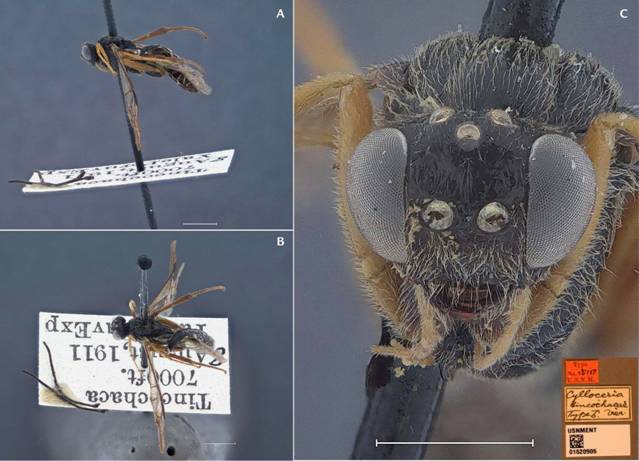
Type material. Holotype male: PERU • ♂; Cusco, Tincochaca, 7000ft.[2134m], 8.VIII.1911, YalePeruvExp [Yale Peruvian Expedition], USNMENT01520905, studied by photographs [EZID: http://n2t.net/ark:/65665/3ae40ffe1-bb94-4d75-9a66-d97f3dc03f5e] (digital image analyzed).
Diagnosis. According to the original description by Vie reck (1913), this species can be distinguished by the following combination of characters: 1) frons slightly rugose; 2) wings hyaline; 3) propodeum with median longitudinal carinae converging posteriorly; 4) tergite I with the presence of two longitudinal carinae between the spiracles and the base of the segment; 5) body black, with all femurs, tibiae, and tarsi brownish orange, except hind tibia and tarsus brownish.
Female. Unknown.

Cylloceria spp. in a scanning electron microscope: (A-B) Holotype of Cylloceria murrayblumi sp. nov., female: (A) mesosoma, lateral view; (B) propodeum, dorsal view. (C-D) Holotype of Cylloceria jaramilloi sp. nov., female: (C) mesosoma, lateral view; (D) propodeum, dorsal view. Scale bars: A = 1.0 mm, B = 0.2 mm, C = 0.2 mm, D = 0.2 mm.

Holotype of Cylloceria tincochacae, male: (A) Habitus, lateral view; (B) habitus, dorsal view; (C) head, frontal view. Photos: Natasha Young. Scale bars: A-B = 2.0 mm, C = 1.0 mm.

Geographical distribution of South American Cylloceria. Yellow star: Cylloceria murrayblumi sp. nov. and Cylloceria jaramilloi sp. nov.; Yellow circle: Cylloceria tincochacae; Yellow square: Cylloceria andesilvana sp. nov.
Distribution. Peru (Cusco) (Fig. 6).
Biology. Host unknown. Specimens collected at 2,133.6 m a.s.l.
Key to South American species of Cylloceria Schiødte, 1838
The female of C. tincochacae and the males of C. andesilvana sp. nov., C. jaramilloi sp. nov., and C. murrayblumi sp. nov. are unknown
1. Frons slightly rugose .................... 2
1’. Frons smooth .................... Cylloceria andesilvana Mazón, sp. nov.
2. Wings brown iridescent; metasoma not entirely black .................... 3
2’. Wings hyaline; metasoma entirely black .................... C. tincochacaeViereck, 1913
3. Head about 1.5 × wider than long; tergite II about 0.75 × longer than wide, polished and granulate on anterior and slightly granulate posteriorly; metasoma orangish-red .................... C. jaramilloi Fernandes, Nascimento & Pádua, sp. nov.
3’. Head about 2.0 × wider than long; tergite I about 2.0 × longer than wide, rugulose; metasoma black with apical margins tergites II-V reddish .................... C. murrayblumi Fernandes, Nascimento & Pádua, sp. nov.
DISCUSSION
Eight species of Cylloceria are currently known from the Neotropical part of Mexico southwards to Costa Rica and Panama, and together with the four species known from South America, i.e., C. tincochacae from Peru and the three new species described herein: Cylloceria jaramilloi sp. nov., and Cylloceria murrayblumi sp. nov. from Colombia; and Cylloceria andesilvana sp. nov. from Ecuador, it brings the total number of described species of this genus to 12 for the Neotropical Region. All South American species were collected at high elevations, approximately between 2,134 and 2,574 m a.s.l. The other neotropical species of Cylloceria were collected above 2,000-2,500 m (Gauld 1991, Dasch 1992, Kasparyan and Ruíz-Cancino 2003, Humala 2012, Khalaim et al. 2017) except C. alvaradoi (1,200-1,800 m in Costa Rica and Honduras) (Gauld 1991, Humala 2012) and C. arizonica with some specimens collected below 1,800 m (Dasch 1992, Humala 2012).
Probably, the distribution of this subfamily is wider in this region, but the lack of samples and specialists of this subfamily is an obstacle to the study of this group of Darwin wasps. In recent years, 30 species of Ichneumonidae have been recorded for the Mesenia-Paramillo Nature Reserve, thirteen being new to science, which demonstrates a notable gap in knowledge of Darwin wasps in this region (as well as in Colombia as a whole). However, this reserve can still contribute considerably to the knowledge of Colombian species in the coming years, as sampling efforts in this area are still quite recent (2017-2022) (see Pádua et al. 2019, 2020, 2023, Araujo et al. 2020, Araujo et al. 2022, Fernandes et al. 2023, Nascimento et al. 2024, Lima et al. 2024).
ACKNOWLEDGMENTS
We thank the staff of the Mesenia-Paramillo, Tapichalaca, and Madrigal del Podocarpus reserves, as well as the Fundación Bioconservancy and the Invertebrate Collection of INPA, for logistical and technical support during field work. We also thank colleagues and curators from CEUA, LOUNAZ, and USNM for access to material and facilities. Furthermore, layer photographs of C. andesilvana sp. nov. were done during a research visit made by M. Mazón to the Natural History Museum of London, supported by a Synthesys grant (GB-TAF-TA3-028).
LITERATURE CITED
-
Araujo RO, Alvarado M, Fernandes DRR, Mazariegos LA (2022) New records for the Neotropical Anomaloninae (Hymenoptera: Ichneumonidae) in South America. Acta Biológica Colombiana 27(2): 308-311. https://doi.org/10.15446/abc.v27n2.89666
» https://doi.org/10.15446/abc.v27n2.89666 -
Araujo RO, Pádua DG, Jaramillo J, Mazariegos LA (2020) Five new species of Dolichomitus Smith from the tropical Andes, with a key for the South American species (Hymenoptera, Ichneumonidae, Pimplinae). ZooKeys 937: 89-113. https://doi.org/10.3897/zookeys.937.51361
» https://doi.org/10.3897/zookeys.937.51361 -
Bordera S, Mazón M (2024) The Neotropical species of Atractodes Gravenhorst (Hymenoptera, Ichneumonidae, Phygadeuontinae), III: the A. podocarpus species-group. Insect Systematics & Evolution 55(2): 105-225. http://doi.org/10.1163/1876312X-bja10054
» http://doi.org/10.1163/1876312X-bja10054 -
Bordera S, Mazón M, Sääksjärvi IE (2016a) The Neotropical species of Atractodes (Hymenoptera, Ichneumonidae, Cryptinae) I: the A. propodeator and A. altoandinus species-groups. Zootaxa 4137(1): 108-120. http://doi.org/10.11646/zootaxa.4137.1.8
» http://doi.org/10.11646/zootaxa.4137.1.8 -
Bordera S, Mazón M, Sääksjärvi IE (2016b) The Neotropical species of Atractodes (Hymenoptera, Ichneumonidae, Cryptinae) II: the A. pleuripunctatus species-group. Zootaxa 4161(3): 437-444. http://doi.org/10.11646/zootaxa.4161.3.11
» http://doi.org/10.11646/zootaxa.4161.3.11 -
Bordera S, Mazón M, Sääksjärvi IE (2019) Revealing the hidden species diversity of tropical cryptines: a review of the Neotropical Lissaspis Townes (Hymenoptera, Ichneumonidae, Cryptinae). Insect Systematics & Evolution 50(5): 601-669. http://doi.org/10.1163/1876312X-00002186
» http://doi.org/10.1163/1876312X-00002186 - Broad GR, Shaw MR, Fitton MG (2018) Ichneumonid Wasps (Hymenoptera: Ichneumonoidea): their Classification and Biology. Handbooks for the Identification of British Insects. Royal Entomological Society, London, vol. 7, 418 pp.
-
Choi J-K, Lee JW (2016) First record of the subfamily Cylloceriinae (Hymenoptera: Ichneumonidae) from South Korea with description of one new species. Entomological Research 46: 298-305. https://doi.org/10.1111/1748-5967.12176
» https://doi.org/10.1111/1748-5967.12176 - Dasch CE (1992) The Ichneumon-Flies of America North of Mexico: Part 12. Subfamilies Microleptinae, Helictinae, Cylloceriinae and Oxytorinae (Hymenoptera: Ichneumonidae). Memoirs of the American Entomological Institute 52: 1-473.
-
Di Giovanni F, Pádua DG, Araujo RO, Santos AD, Sääksjärvi IE (2021) A striking new species of Dolichomitus Smith, 1877 (Hymenoptera: Ichneumonidae; Pimplinae) from South America. Biodiversity Data Journal 9: e67438. https://doi.org/10.3897/BDJ.9.e67438
» https://doi.org/10.3897/BDJ.9.e67438 -
Fernandes DRR, Pádua DG, Mazariegos LA, Araujo RO (2023) Two new Darwin wasp species of Eiphosoma Cresson, 1865 (Ichneumonidae: Cremastinae) from the northwestern Andes of Colombia. Zootaxa 5375(2): 262-272. https://doi.org/10.11646/zootaxa.5375.2.7
» https://doi.org/10.11646/zootaxa.5375.2.7 - Gauld ID (1991) The Ichneumonidae of Costa Rica I. Memoirs of the American Entomological Institute 47: 1-589.
- Humala AE (2012) Contribution to the knowledge of the genus Cylloceria (Hymenoptera: Ichneumonidae: Cylloceriinae) in Central America with description of a new species from Mexico. Zoosystematica Rossica 21(1): 163-168.
-
Kasparyan DR, Ruíz-Cancino E (2003) A new species of Cylloceria Schiødte from Mexico (Hymenoptera: Ichneumonidae). Zoosystematica Rossica 11(2): 347-349. https://doi.org/10.31610/zsr/2002.11.2.347
» https://doi.org/10.31610/zsr/2002.11.2.347 -
Khalaim AI, Humala AE, Ruiz-Cancino E, Figueroa de la Rosa JI (2017) Mexican species of Cylloceria Schiødte (Hymenoptera, Ichneumonidae, Cylloceriinae). Proceedings of the Zoological Institute RAS 321(1): 65-71. https://doi.org/10.31610/trudyzin/2017.321.1.65
» https://doi.org/10.31610/trudyzin/2017.321.1.65 -
Klopfstein S, Santos BF, Shaw MR, Alvarado M, Bennett AM, et al. (2019) Darwin wasps: a new name heralds renewed efforts to unravel the evolutionary history of Ichneumonidae. Entomological Communications 1: ec01006. https://doi.org/10.37486/2675-1305.ec01006
» https://doi.org/10.37486/2675-1305.ec01006 -
Lima AGM, Pádua DG, Araujo RO, Mazariegos LA, Fernandes DRR (2024) Revisiting the Darwin wasp genus Epelaspis Townes, 1970 (Hymenoptera: Ichneumonidae: Phygadeuontinae): five new species, new records and a key to Neotropical species. Zootaxa 5468(1): 52-74. https://doi.org/10.11646/zootaxa.5468.1.2
» https://doi.org/10.11646/zootaxa.5468.1.2 -
Liu J-X, Reshchikov A (2019) A new species of Cylloceria Schiødte, 1838 (Hymenoptera, Ichneumonidae) from the Oriental Region. Zootaxa 4609(1): 139-148. https://doi.org/10.11646/zootaxa.4609.1.6
» https://doi.org/10.11646/zootaxa.4609.1.6 -
Mazón M, Bordera S (2023) Two new species and new records of Metopiinae (Hymenoptera, Ichneumonidae) from Ecuador. Neotropical Entomology 52: 718-724. https://doi.org/10.1007/s13744-023-01053-1
» https://doi.org/10.1007/s13744-023-01053-1 -
Mazón M, Bordera S, Broad GR (2024) New species of Grotea (Hymenoptera, Ichneumonidae, Labeninae) from Ecuador, with new records and a key to the Neotropical species. Neotropical Entomology 53: 868-879. https://doi.org/10.1007/s13744-024-01166-1
» https://doi.org/10.1007/s13744-024-01166-1 -
Nascimento AC, Pádua DG, Araujo RO, Mazariegos LA, Fernandes DRR (2024) Synopsis of Lusius Tosquinet, 1903 (Hymenoptera: Ichneumonidae, Phaeogenini) from South America: a new species, new records, and key to Neotropical species. Zootaxa 5410(2): 289-296. https://doi.org/10.11646/zootaxa.5410.2.9
» https://doi.org/10.11646/zootaxa.5410.2.9 -
Pádua DG, Araujo RO, Mazariegos LA (2019) Pimpla Fabricius (Hymenoptera: Ichneumonidae: Pimplinae) from Colombia. Zootaxa 4683(3): 439-446. https://doi.org/10.11646/zootaxa.4683.3.8
» https://doi.org/10.11646/zootaxa.4683.3.8 -
Pádua DG, Fernandes DRR, Araujo RO, Mazariegos LA (2023) Filling gaps in the knowledge of the Colombian Darwin wasps (Hymenoptera: Ichneumonidae): new records, description of unknown males, and taxonomical notes. Zootaxa 5244(1): 61-70. https://doi.org/10.11646/zootaxa.5244.1.5
» https://doi.org/10.11646/zootaxa.5244.1.5 -
Pádua DG, Sääksjärvi IE, Monteiro RF, Oliveira ML (2020) Review of the New World genus Acrotaphus Townes, 1960 (Hymenoptera: Ichneumonidae: Pimplinae), with descriptions of fifteen new species. Zootaxa 4719(1): 1-62. https://doi.org/10.11646/zootaxa.4719.1.1
» https://doi.org/10.11646/zootaxa.4719.1.1 - Schiødte G (1838) Ichneumonidarum ad faunam Daniae pertinentium, genera et species novae. Revue Zoologique par la Société Cuvierienne 1: 139-141.
-
Shorthouse DP (2010) SimpleMappr, an online tool to produce publication-quality point maps. https://www.simplemappr.net [Accessed: 08/11/2022]
» https://www.simplemappr.net -
Varga O, Kostro-Ambroziak A (2021) New Records of the Subfamilies Cylloceriinae and Microleptinae (Hymenoptera, Ichneumonidae) from Eastern Europe. Zoodiversity 55(6): 485-492. https://doi.org/10.15407/zoo2021.06.485
» https://doi.org/10.15407/zoo2021.06.485 - Viereck HL (1913) Results of the Yale Peruvian expedition of 1911. Hymenoptera - Ichneumonoidea. Proceedings of the United States National Museum 44(1964): 469-470.
- Yu DSK, Achterberg C, Horstmann K (2016) Taxapad 2016, Ichneumonoidea 2015. Ottawa, Taxapad, Database on flash-drive.