Fossil constraints on the origin and evolution of Platyhelminthes are surprisingly concordant with modern molecular phylogenies
ABSTRACT
Trace fossils preserved with fossil worm-shaped remains suggest the presence of free-living flatworms during the Ordovician at the latest and their occurrence in terrestrial environments during the Permian. The presence of hooks associated with acanthodian and placoderm fishes indicates the existence of parasitic monopisthocotyleans, with a simple life cycle, during the Devonian. The presence of eggs in shark coprolites suggests the occurrence of eucestode tapeworms, with complex life cycles, during the Permian, possibly even earlier in the Carboniferous. Fossil evidence for trematode flatworms, also with complex life cycles, is more recent, including diverse findings associated with bivalves, lizards, and coprolites of archosaurs in terrestrial environments between 126 and 76 Ma in the Cretaceous. Convincing evidence for gymnophallid trematodes in marine environments appears in the Eocene, with an earlier occurrence in Cretaceous freshwater environments. This chronological pattern of first appearance (Turbellarians > Monopisthocotylea > Cestoda > Trematoda) is surprisingly concordant with some recent molecular phylogenetic analyses. Further evidence to test these hypotheses could be obtained by conducting systematic screenings for resistant remains of platyhelminths such as hooks and eggs as well as characteristic traces such as trails or shell concretions preserved with their producers. Additional study and scrutiny are particularly needed for trace fossils attributed to free-living flatworms that are not associated with their producers. We make recommendations on how different constraints on flatworm evolution can be interpreted and used in future studies.
KEY WORDS:
Cophylogeny; flatworms; fossil record; macroevolution
INTRODUCTION
Flatworms are a diverse group of invertebrate animals with over 30000 described extant species (Caira and Littlewood 2013). Although most described flatworm species that exist today are members of the obligately parasitic Neodermata, the ancestral flatworm is inferred to have been free-living. All current free-living flatworms are contained within the paraphyletic “Turbellaria” (Collins 2017). The reported species numbers likely underestimate the diversity of both free-living and parasitic flatworms (Poulin and Morand 2000, Dobson et al. 2008, Curini-Galletti et al. 2020). Platyhelminths are of extreme societal and scientific importance as model organisms for the study of regeneration (Collins 2017, Vila-Farré et al. 2023), and because of their relevance for biomedicine and veterinary sciences as well as for conservation and evolutionary biology (Solà et al. 2015, Sluys 2019, van Straalen 2021, Mulvey et al. 2022).
The simple body plan of platyhelminths and their estimated phylogenetic position nested within Spiralia and Lophotrochozoa (Marlétaz et al. 2019) suggest that they are an ancient group of organisms. There has been considerable interest in what the ancestral flatworm might have looked like from both a neontological (Littlewood and Bray 2001, Baguñà and Riutort 2004b, Goodheart et al. 2023) and a paleontological perspective (De Baets et al. 2015, Budd and Jackson 2016, Tang et al. 2021); however, there is little doubt that it must have been free-living with a simple life cycle rather than a parasitic form with a complex life cycle.
Given their soft-bodied nature, comparatively small size and presence in habitats which hamper fossilization, it is not surprising that the flatworm fossil record is patchy and remains understudied (Kowalewski 1997, De Baets et al. 2021b, Littlewood and Donovan 2003). Only planarian tricladids, polyclads and neodermatans are among the flatworms to exhibit larger (> 1-2 mm) body sizes. All the other groups are collectively called “microturbellarians”, reflecting their microscopic size and plesiomorphic adaptations to interstitial habitats (Laumer et al. 2015). Nevertheless, the latest reviews on the fossil record of platyhelminths show a better record than commonly assumed for neodermatan parasites (De Baets et al. 2015), resistant eggs of free-living rhabdocoels (Matsuoka and Ando 2021) or helminths more generally (De Baets et al. 2021a). Other sources reviewing the fossil record are over twenty years old (Poinar 2003). Currently available data suggest that several lineages are traceable to the Paleozoic based on trace fossils as well as resistant eggs and hooks (De Baets et al. 2015, 2021a).
Flatworms now exclude (xen)acoelomorphs (Ruiz-Trillo et al. 1999, Philippe et al. 2007, 2011). They consist of a monophyletic grouping of two clades, Catenulida and Rhabditophora, which are well-supported by molecular data (Egger et al. 2015, Laumer et al. 2015, Littlewood and Waeschenbach 2015). The sister groups Catenulida and Rhabditophora are each morphologically well-defined, but do not seem to share any known morphological apomorphies (Smith et al. 1986, Hooge 2001, Baguñà and Riutort 2004a, Larsson and Jondelius 2008). Although considerable progress has been made in the last decade, the internal phylogenetic relationships of Platyhelminthes are not yet fully resolved (Hahn et al. 2014, Egger et al. 2015, Laumer et al. 2015, Littlewood and Waeschenbach 2015, Kenny et al. 2019, Brabec et al. 2023, Caña-Bozada et al. 2023). Internal relationships are important for understanding constraints on the evolution of life history strategies and habitat shifts. Multiple flatworm lineages, including several turbellarian groups, developed symbiotic relationships (Jennings 1971, 1997, Rohde, 1997, Hoyal Cuthill et al. 2016, Blair et al. 2023), with at least nine inferred independent origins of parasitic relationships (Weinstein and Kuris 2016).
The relationships within the monophyletic Neodermata remain a particularly recalcitrant issue (Littlewood and Bray 2001, Littlewood 2006). Recent molecular phylogenetic analyses suggest a single origin of a parasitic lifestyle, with free-living Bothrioplanida as the closest relatives of the Neodermata (Egger et al. 2015, Laumer et al. 2015, Littlewood and Waeschenbach 2015). A previous popular hypothesis was that the initial appearance of ectoparasites with a simple life cycle was followed by the common origin of complex life cycles of trematodes and cestodes (Lockyer et al. 2003, Park et al. 2007, Hahn et al. 2014). Newer analyses question this hypothesis and find support for a scenario in which neodermatan lineages with a simple life cycle are not monophyletic (Justine 1998) and in which transitions between ectoparasitism with a simple life cycle and endoparasitism with a complex life cycle might have happened more than once (Brabec et al. 2023, Caña-Bozada et al. 2023, Zhang et al. 2024).
Another vexing issue is the scarcity of body fossils that can confidently be attributed to free-living turbellarians relative to members of Neodermata (De Baets et al. 2015). While relationships between some lineages of free-living flatworms are still debated, molecular phylogenetic ana lyses clearly suggest that free-living forms appeared before parasitic forms. Molecular phylogenetic analyses have also contributed to our understanding of habitat transitions between marine, freshwater, and (limno)terrestrial environments or of dispersal across environments (Van Steenkiste et al. 2013, Sluys 2019, van Straalen 2021, Okamura et al. 2022) in both turbellarians (Álvarez-Presas et al. 2008, Riutort et al. 2012, Benítez-Álvarez et al. 2020, Solà et al. 2022) and neodermatans (Badets et al. 2011, Brabec et al. 2015, Achatz et al. 2019, Fraija-Fernandez et al. 2021). While it is yet to be determined if the fossil record can provide suitable constraints on the age of all these transitions, such records would be the only direct evidence for the presence of flatworms in particular habitats at particular times ( De Baets and Littlewood 2015). If no direct evidence is available for particular groups of platyhelminths, the fossil record of their close relatives could at least provide temporal constraints in other parts of the platyhelminth tree which might help to constrain the timing of these transitions. The fossil record of flatworms is often considered inappropriate for this task or deemed to be non-existent, but this is not entirely true - particularly when considering characteristic eggs and trace fossils associated with the remains of bodies of platyhelminths. The fossil record of helminth eggs can be at least as good as independently calibrated molecular divergence time estimates in eucestode tapeworms (De Baets et al. 2021a).
Here we review the fossil record and archeological finds of representatives of Platyhelminthes with a particular reference to constraining the earliest appearance of particular clades or the colonization of particular habitats or regions. We also evaluate how these fossil constraints on their evolution align with current phylogenetic hypotheses (Brabec et al. 2023) and make suggestions on the most fruitful directions to expand the application of fossils constraints when investigating flatworm evolution.
MATERIAL AND METHODS
We re-evaluated previously published findings including those listed in review articles (Poinar 2003, Gonçalves et al. 2003, Sianto et al. 2009 De Baets et al. 2015, 2021a, Ledger and Mitchell 2022). We also searched for new publications using Google Scholar and Web of Science with combinations of the keywords “fossil”, “flatworm” or “Platyhelminthes” and/or “paleoparasitology”. Only peer-reviewed articles, book chapters or review articles and additional references included in these sources were considered. To support our re-evaluations, we also sought references citing the original publications in Google Scholar containing expert opinions confirming or disagreeing with particular assignments.
RESULTS
Turbellarians
Multiple isolated body fossils have been attributed to tricladid or rhabdocoel turbellarians ranging from the Precambrian to the Quaternary. The oldest report of putative free-living flatworm fossils derives from the Precambrian (Allison 1975), although both the age and affinity of this specimen (Cloud et al. 1976, Eberlein and Lanphere 1988, Tweet et al. 2023) is questionable. We therefore advise against using this specimen to confidently constrain the presence of free-living flatworms.
Tang et al. (2021) compared the enigmatic ribbon-like fossil Rugosusivitta to flatworms, but they could not unequi vocally assign it to Platyhelminthes. Peculiarly, although Tang et al. (2021) highlighted its larger size and obviously free-living mode of life, they compared it with derived parasitic tapeworms rather than their free-living relatives.
Poinar (2003, 2004) described an inclusion in Eocene Baltic amber as Micropalaeosoma balticus(Poinar, 2003) and interpreted it to be a rhabdocoel of the now defunct order Typhloplanoida and this finding was accepted by multiple authors (Knaust 2010, Van Steenkiste et al. 2010, De Baets et al. 2015, 2021a, Vila-Farré and Rink 2018, Worsaae et al. 2023). However, this amber inclusion has been plausibly re-interpreted as a pseudo inclusion by Szadziewski et al. (2018) making this taxon invalid. These authors reinterpreted the flatworm body with putative eggs as likely air bubbles on the surface of a 1.5 mm long ellipsoidal dent. This is in line with the lack of a digestive tract and its unnatural transparent preservation. As such, we suggest to not use this specimen as a calibration point.
The second-oldest report of body fossils from the Cenozoic attributed to free-living rhabdocoels and triclads are silicified remains from Miocene calcareous petroliferous nodules from a former lake environment in the Calico Mountains in California (Pierce 1960). These findings also need further scrutiny as the original publication only contains interpretative drawings and no photographs of the original specimens to corroborate these claims.
The oldest direct records that can be confidently attributed to free-living rhabdocoels are therefore eggs reported from Pleistocene to Holocene lake and sea deposits (Frey 1964, Harmsworth 1968, Kadota 1973, Van Geel et al. 1980, Haas 1996, Cocker et al. 2021, Matsuoka and Ando 2021). They are reminiscent of eggs of members of the rhabdocoel families Dalyelliidae, Polycystididae and Typhloplanidae (Matsuoka and Ando 2021). The oldest rhabdocoel eggs described so far derive from the Middle Pleistocene (250000 yrs BP [years Before Present]) of Lake Biwa in Japan (Kadota 1973). These eggs are of the Gyratrix-type and thus indicative of the presence of members of Polycystididae (Matsuoka and Ando 2021). Modern rhabdocoel representatives of the endosymbiotic Umagillidae and ectosymbiotic Temnocephalidae (Matsuoka and Ando 2021) as well as representatives of Tricladida (Kakui and Tsuyuki 2024) also produce characteristic egg capsules which could in principle be recovered from the sediment but are yet to be reported from the fossil record. Symbiotic fecampiids produce flash-shaped to long, tubular and spiral cocoons which typically contain two egg capsules attached to their hosts (mostly crustaceans) or hard marine substrates (e.g., rocks, wood, coral, rhizomes), but only modern specimens have been recovered so far (Handl and Bouchet 2007). As the exceptionally preserved body fossil record cannot be confidently identified before the Quaternary, there is a need to investigate the trace fossil record attributed to turbellarians (Fig. 1), particularly those associated with putative worm-like body fossils.

Examples of characteristic traces or structures attributed to representatives of Platyhelminthes which can be preserved in the fossil record. (A) Modern marine polyclad producing a mucociliary trail (drawing based on Collins et al. 2000); (B) Modern planarian producing a mucociliary trail (drawing based on Pantin 1950); (C) Circlet of hooks attributed to monopisthocotylean neodermatans associated with Devonian gnathostome fish (drawing based on Upeniece 2001); (D-F) Igloo-shaped concretions attributed to gymnophallid trematodes in a fossil bivalve (drawing based on Rogers et al. 2018) and a modern bivalve (drawing based on Ituarte et al. 2005); (G, H) eggs attributed to eucestode neodermatans in a Permian coprolite (drawings based on Dentzien-Dias et al. 2013). Scale bars: A = 5.0 mm, D = 0.5 mm, G = 1.0 mm, H = 50 μm.
Knaust and colleagues recently attributed various trails to flatworm producers from the Ordovician (Knaust and Desrochers 2019) and the Triassic (Knaust 2010, 2021, Knaust and Costamagna 2012) which in some cases are still associated with a putative, but poorly preserved vermiform body outline. The latter are mostly preserved as calcitic casts of moulds but sometimes contain limonite mineralization around it, interpreted to represent a multilayered and complex body wall. In the best-preserved samples, the limonitic putative body wall is broken up by interpreted intercellular spaces and vacuoles filled by calcite. Some specimens are associated with complex calcareous spicules reminiscent of the spicular skeletons originating from the basal membrane known from modern marine rhabdocoel turbellarians such as Florianella and Bertiliella (Rieger and Sterrer 1975, Tyler and Hooge 2004). Superficially reminiscent spicules or small granular or crystalline bodies are known from most other flatworm orders as well as from other phyla including Xenacoelomorpha and Nemertea, but their composition, morphology, size and/or position seem to differ (Rieger and Sterrer 1975).
Various types of traces have been attributed to free-living flatworms (Knaust 2021), but only two types of traces (Fig. 1A, C) have clear modern analogues (Alessandrello et al. 1988, Knaust 2010). Horizontal creeping trails produced by minute vermiform organisms moving mucociliarily on or just beneath the seafloor were investigated by Collins et al. (2000). It might be difficult to unequivocally assign the mucociliary trails to particular lineages, but the size and morphology of associated worm-like body casts have been used to justify their assignment to platyhelminth orders or at least the phylum Platyhelminthes as opposed to other phyla or groups (Nemertea, sipunculid Annelida, Xenacoelomorpha). Such mucociliary trails from the Triassic were attributed to polyclads (Knaust 2010) based on their similarity to traces (Fig. 1A) produced by modern polyclad flatworms (Collins et al. 2000) as well the presence of spicules and vacuoles in the inferred body wall in associated putative body fossils. The size and appearance of the casts were used to assign similar traces from the Ordovician to free-living flatworms (Knaust and Desrochers 2019). Other traces at the Ordovician site have been attributed to members of Nemertea and Acoelomorpha based on their association with putative vermiform body fossils with different morphologies. The putative fossil nemerteans are more robust and elongate than turbellarians and display a pointed to rounded anterior end with structures consistent with the rhynchocoel, a fluid-filled coelomic cavity containing the proboscis, as well as a pointed anus indicative of a complete digestive system. The putative acoelomorph fossils have a flatter and rounder (discoidal) shape, which is consistent with the lack of a body cavity. A putative dark spot can be interpreted as a statocyst. Although they are no longer considered to belong to Platyhelminthes (Ruiz-Trillo et al. 1999, Baguñà and Riutort 2004), acoelomorphs share some characteristics with members of Nemertea and Platyhelminthes, including a ciliated epidermis, the presence of a statocyst, and a meiofaunal mode of life.
Age: The oldest marine trails associated with body fossils attributed to turbellarians derive from the Vauréal Formation of Anticosti Island, Canada (Knaust and Desrochers 2019). The studied units are assigned to the Katian allowing to assign an age at least as old as 445.2 ± 0.9 Ma (Mega-annum, i.e. unit of time equal to one million [106] years) according to GTS 2020 (Goldman et al. 2020).
Terricolichnus permicusAlessandrello, Pinna & Terruzi, 1988 trails from Permian and Terricolichnus sp. from the Triassic (Knaust 2010) have been attributed to planarian tricladids. They consist of a linear sequence of irregularly curved minute trails with impressions 0.5-1.0 mm long, 0.1 mm wide and in intervals of about 0.5-1.0 mm (Alessandrello et al. 1988, Knaust 2010). They are a few millimeters in length, straight to irregularly curved and often characterized by abrupt changes in directions consistent with the locomotion of peristaltic waves produced by myopodia going backward (Fig. 1B) to the direction of movement (Alessandrello et al. 1988) known from modern planarians (Pantin 1950, Froehlich 1955, Jones 1978, Minelli 1981). These traces from the Triassic (Knaust 2010) are sometimes associated with tiny sulphide aggregates interpreted as their producer’s imprint, but the nature of these remains reveal no further anatomical details. The assignment of these traces to Tricladida seems reasonable based on our current state of knowledge, although experimental taphonomy might be needed for a more precise assignment and for better understanding the preservation mode of those traces. If the assignment is correct, it constrains terrestrial planarians as present by the Early Permian. The assignment of these traces to land planarians has been criticized by Ogren et al. (1999) who argued that (i) mucus trails cannot be preserved in the fossil record (although the opposite has been demonstrated; compare Collins et al. 2000) and that (ii) tracks resemble pressed tracks left by other animals with a higher body weight than land planarians. The more general argument that the tracks were produced by other mucus-ciliary movements is harder to dismiss (Collins et al. 2000, Ogren et al. 1999). Similar traces have occasionally also been attributed to or compared with arthropod tracks (Buatois et al. 2017, Ronchi and Santi 2003). The Permian and Triassic trails assigned to T. permicus are remarkably similar to observations (Fig. 1B) of modern planarian triclads of Rhynchodemus (Pantin 1950) and Microplana (Minelli 1981). Given the peculiarities of their movement, a triclad nature of these trails seems most likely.
Age: The oldest trails of T. permicus were found on a grey-green siltstone slab from the Lower Permian of Pre-Alps in Lombardy and interpreted to be produced by land planarians (Alessandrello et al. 1988). The siltstone slab was initially attributed to the Collio Formation which is now bounded by radiometric ages yielding a minimum age of 279.8 ± 1.1 Ma for these traces (Marchetti et al. 2015a, Schaltegger and Brack 2007). However, the holotype of T. permicus derives from the former Orobic Collio Formation in the Scioc valley (Ronchi and Santi 2003) and these units are now assigned to the Pizzo del Diavolo Formation considered to be of Kungurian age (Marchetti et al. 2015b). As the precise position within the Pizzo del Diavolo Formation is unknown, we suggest using the conservative minimum age of the top of the Kungurian, which is 274.4 ± 0.4 Ma according to GTS 2020 (Henderson et al. 2020).
Older trace fossils, such as Curvolithus from the Precambrian and Cambrian (Webby 1970, Buatois et al. 1998, Seilacher et al. 2003, 2005), have been suggested to be produced by larger free-living flatworms. However, they lack association with putative body fossils, have no obvious modern analogue, and are also not consistent with the supposedly small size of early branching lineages of modern free-living flatworms (Laumer and Giribet 2014, Laumer et al. 2015). Such traces could have been produced by a variety of infaunal carnivores including gastropod molluscs and nemerteans in addition to free-living flatworms (Buatois et al. 1998, Baucon et al. 2015). Additional constraints are needed to confidently attribute these Precambrian to Cambrian trails and other ichnofossils, particularly those not found in association with body fossils, to a flatworm producer and they should therefore not be used to constrain the flatworm molecular clock divergence time estimates.
Neodermata
Counterintuitively, the fossil record of derived parasitic neodermatans is more diverse and older (De Baets et al. 2015, 2021a) than those of their turbellarian relatives (compare Table 1, Figs 1, 2), which relates to their record of resistant eggs, hooks and pathologies preserved with their skeletonized hosts.
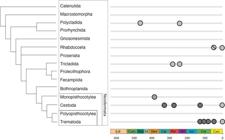
Stratigraphic occurrence of fossil evidence for particular orders of Platyhelminthes. Phylogeny follows Littlewood and Waeschenbach (2015) with the exception of Neodermata which follows Brabec et al. (2023). See Table 1 and text for further details of each find.
Fossil finds attributed to particular groups of Platyhelminthes. More details can be found in text.
Upeniece and colleagues described over 69 circlets of hooks, at least 29 still associated with placoderms and acanthodian fishes (Upeniece 2001, 2011, De Baets et al. 2015, 2021a, Leung 2017, 2021), which were considered the earliest record of ectoparasitic neodermatans with a simple life cycle. No formal phylogenetic analyses were performed, but their circular arrangement of the bilateral symmetric hooks (Fig. 1C), traces of cuticular discs, their position as well as the maximum number of associations of up to 16 hooks speak for their assignment to Monopisthocotylea. So far, no additional reports of hooks attributable to Monopisthocotylea have been published, which could relate to the exceptional preservation, preparation biases and/or a lack of interest. Cuticular hooks attributable to cestodes - their potential sister lineage (Brabec et al. 2023) - have been interpreted as present in a tapeworm egg containing a putative developing larva in a proglottid (Dentzien-Dias et al. 2013, De Baets et al. 2015, 2021a).
Age: The circlets of hooks attributable to Monopisthocotylea derive from the Lode Formation which was traditionally assigned to the early Frasnian (Upeniece 2001). However, the Lode Formation is currently assigned to the Upper Givetian. This corresponds to 378.9 ± 1.2 Ma which is the minimum age assigned to the Givetian-Frasnian boundary according to GTS 2020 (Becker et al. 2020).
Tapeworm eggs have few defining characters and could potentially be confused with those of other helminths (Zangerl and Case 1976). In the Permian, the assignment of eggs associated with tapeworms in a spiral coprolite is supported by a putative developing embryo in one of the eggs (Fig. 1G) as well as assortment of eggs (Fig. 1H) in proglottids (De Baets et al. 2015, Dentzien-Dias et al. 2013). The latter speaks for their assignment to eucestode tapeworms.
Age: The coprolite containing the eggs interpreted to be associated with proglottids derives from the upper member of the Rio do Rasto Formation (Paraná Basin, southern Brazil). The vertebrate fauna suggests a Guadalupian (Late Wordian - Capitanian) age (Dentzien-Dias et al. 2013) which yields a minimum age of 259.5 ± 0.4 Ma defined by the Guadalupian-Lopingian boundary in GTS 2020 (Henderson et al. 2020).
Older eggs in a cololite associated with the shark genus Cobelodus have a surface structure and size consistent with modern tapeworm eggs (Zangerl and Case 1976), but their more precise assignment needs further investigation (De Baets et al. 2015, 2021a).
Age: The older eggs assigned to cestodes derive from excrements still lodged within the intestine of its producer the shark Cobelodus aculeatus (Cope, 1894). The fossil association derives from the Stark Shale member of the Dennis Formation near Forth Calhoun, Nebraska (Zangerl and Case 1976). It is assigned to the Missourian North American regional substage which largely corresponds to the Kasimovian (Falcon-Lang et al. 2011, Rosscoe and Barrick 2013). Conodont microfossils from this unit derive from the Idiognathus confragus zone (Heckel et al. 2011, Heckel 2013, Barrick et al. 2022) which would have a minimum age of 304.8 Ma according to GTS 2020 (Aretz et al. 2020).
An additional fossil egg was attributed to cestodes in a Cretaceous archosaur (?theropod) coprolite of Bernissart (Belgium) where it was associated with a putative trematode egg and amoeboid cyst (Poinar and Boucot 2006).
Age: See age discussed for the trematode egg found within the same coprolite.
Recently, a difficult to place isolated structure in Myanmar amber (Luo et al. 2024) was interpreted as a cestode tentacle (rostellum). It has some characteristics which at first glance seem most consistent with its assignment to trypanorhynch tapeworms (Palm et al. 2009) that parasitize marine elasmobranchs (mainly sharks and rays). However, the tentacle is longer, and the hooks are different and inconsistently shaped from those that can be confidently assigned to any modern lineage of Trypanorhyncha. The structure also has similarities to extinct armored worm-like paleoscolecid ecdysozoans not recovered from the Post-Silurian fossil record (Harvey et al. 2010, Wills et al. 2012), but this was also the time their main preservational windows closed (Wendruff et al. 2020, Whitaker et al. 2020). The taphonomic scenario to explain how to detach such structures which are firmly embedded within a scolex (Beveridge et al. 2014) is highly speculative and unlikely. More complete material, preferably still associated with its host remains, is necessary to confirm its precise assignment, mode of life as well as its host affinities. Irrespective of their assignment and host affinity Luo et al. 2024, they further underline that structures similar to a cestode scolex and its hooks could be more widely preserved in the fossil record than currently known.
Age: See age discussed for the swelling in an agamid lizard attributed to trematodes
Trematodes
Various fossils indicate that trematodes were present in terrestrial environments in the Cretaceous (Okamura et al. 2022). However, the oldest is an egg from a bump-head lace morphotype of a fish coprolite derived from Las Hoyas Lagerstätte (Cuenca, Spain) which was compared with the eggs of members of the modern family Opisthorchiidae and attributed to Digenea (Barrios-de Pedro et al. 2020).
Age: The oldest egg (MUPA-LH-SnG11-Tr) attributed to the digenetic trematodes derives from the Las Hoyas locality, which is interpreted to be deposited in a freshwater wetland environment. Las Hoyas located within La Huérguina Formation is attributed to the latest Barremian based on the combination of charophyte and ostracod content (Schudack and Schudack 2009, Vicente and Martín-Closas 2013, Fregenal-Martínez et al. 2017). A conservative minimum age for the egg is therefore the Barremian-Aptian boundary coinciding with the start of magnetochron M0r which was placed at 121.4 ± 0.6 Ma according to GTS 2020 (Gale et al. 2020). However, the start of magnetochron M0r has now been redated to 120.29 ± 0.09 Ma (Li et al. 2023).
A second egg attributable to trematodes was reported from a slightly younger archosaur coprolite (Poinar and Boucot 2006) but could not be assigned further.
Age: The fossil-bearing Wealden-facies of the Sainte Barbe Clays Formation in the Bernissart pit can now be more precisely dated as Late Barremian to Early Aptian in age (MCT4) based on the combination of palynology and chemostratigraphy (Yans et al. 2006, 2012, Schnyder et al. 2009), corresponding with the upper part of magnetochron M1n, M0r and the basal part of M0n. This yielded an approximate minimum age for these strata of 120.6 Ma, the age assigned to the base of the Leupoldina cabri biozone which is correlated to postdate the upper part of MCT4 corresponding with M0n (Schnyder et al. 2009) in GTS 2020 (Gale et al. 2020). However, a recent redating of magnetochron M0r resulted in an age of 119.40 ± 0.12 Ma assigned to the base of L. cabri Zone (Li et al. 2023).
So far, no additional eggs from the Mesozoic could be confidently assigned to trematodes, but Matsuoka and Ando (2021) suggested that some taxa of organic-walled acritarch microfossils could potentially represent trematode egg capsules.
A swelling in an agamid lizard preserved in Myanmar amber was also compared and interpreted as an encysted trematode metacercaria using computed tomography (Poinar et al. 2017).
Age: Myanmar amber is at least 98.79 ± 0.62 Ma old (Shi et al. 2012).
Gymnophallid lineages of trematodes produce charac teristic pit and igloo-structures (Figs 1D-F, 3) which have been confidently traced back to the Eocene (Todd and Harper 2011, Huntley and De Baets 2015) and Cretaceous (Rogers et al. 2018, Huntley et al. 2021), respectively. The oldest igloo- structures from the Maastrichtian of the USA reminiscent of structures produced by modern gymnophallids complete the Cretaceous record of trematodes (Rogers et al. 2018).

Summary of the stratigraphic occurrence of characteristic igloo-shaped and pit-shaped structures attributed to gymnophallid trematodes. Question mark refers to a superficially similar igloo structure discussed in text which is superficially similar but lacks diagnostic characters to make it clearly assignable to trematodes. See text for further details.
Age: Distinctive igloo-shaped traces attributable to a trematode have been found on the freshwater bivalve belonging to Sphaerium in the fluvial and lacustrine facies of the Coal Ridge Member of the Judith River Formation of Montana. The coal ridge member is well constrained through radiometric ages between 76.32 and 75.22 Ma (Rogers et al. 2016, Ramezani et al. 2022).
The Cretaceous igloo-like structures might therefore indicate the presence of representatives of Gymnophallidae by 75 Ma in freshwater environments at the latest (Rogers et al. 2018) and pre-date the appearance and fossil record of their modern shorebird hosts (Ruiz and Lindberg 1989, Černý and Natale 2022). The latest molecular divergence time estimate places the origin of shorebirds in the Paleocene (Černý and Natale 2022). Interestingly, the London Clay Formation which yielded the oldest known pits confidently assignable to trematodes also yielded fossils of shorebirds (Mayr and Kitchener 2023). Both of these traces have modern analogues (Huntley and De Baets 2015, Huntley et al. 2021) and have been comparatively well-studied in Gymnophallidae (Ituarte et al. 2001 2005, Cremonte and Ituarte 2003, Huntley 2007).
The absence of reports of pits from older deposits might relate to the lack of systematic screening of suitable materials (e.g., well-preserved sediment-free inner valves) but internal moulds or rare silicified shells might provide suitable conditions for discovery of both shell concretions and pearl-like structures as far back as the Paleozoic (Lilje dahl 1985, De Baets et al. 2011).
Age: The oldest precisely dated shells - Venericor clarendonensis (Wood, 1871) - with trematode pits derive from subdivision B2 of the London Clay Formation (Todd and Harper 2011). This part of the London Clay Formation (Berggren and Aubry 1996) was dated to the upper calcareous nannofossil zone NP 11 (Ypresian, Early Eocene), which corresponds to a minimum age of 52.930 Ma assigned to its top in GTS 2020 correlated with the base of magnetochron C24n.1n (Speijer et al. 2020).
Archeological finds
Eggs of neodermatans have been repeatedly reported from the Quaternary (see Table 2, Fig. 4). Dicrocoeliidae can be dated back to at least 550000 yrs BP in a coprolite attributed to a carnivorous mammal (Jouy-Avantin et al. 1999), Anoplocephalidae to 16985 yrs BP in rodent coprolites (Beltrame et al. 2012) and Hymenolepididae and Taeniidae to 12680 yrs BP in ground sloth coprolites (Oyarzún-Ruiz et al. 2021). Findings of these families also represent some of the oldest eggs reported from archeological sites with eggs of Anoplocephalidae and Hymenolepididae reported from human remains dated at 10421 yrs BP (Fugassa et al. 2010) and eggs of Taeniidae associated with dog remains at 10049 yrs BP (Paknezhad et al. 2017). The oldest members of Dicrocoeliidae attributable to a modern genus and species are based on DNA traces associated with sediments from occupational layers dated at 7269 yrs BP (Maicher et al. 2017). Various other families are found in the Holocene record ranging from Diphyllobothridae (Reinhard and Barnum 1991, Reinhard 1992), Fasciolidae (Harter-Lailheugue et al. 2005), Diplostomatidae and Opisthorchiidae (Engovatova and Khrustalev 1996, Slepchenko and Reinhard 2018), Troglotrematidae (Hall 1976, Horne 1985), Notocotylidae (Boast et al. 2018, Wood et al. 2013 also found a DNA trace of a sister family to Notocotylidae of similar age), Paramphistomatidae (Maicher et al. 2017), Schistosomatidae (Anastasiou et al. 2014), Echinostomatidae (Maicher et al. 2019), Dipylidiidae (Ramirez et al. 2021), Davaneidae (Askari et al. 2022), Heterophyidae (Zimmerman and Smith 1975), to Gymnophallidae (Shin et al. 2012). The oldest find of a modern genus and species is Viscachataenia quadrata reported from rodent coprolites from the Cueva Huenel 1 in Argentina dated to 16985 yrs BP (Beltrame et al. 2012). Although the characteristic igloo-like structures attributable to members of Gymnophallidae (Leung 2021) can be traced from the Cretaceous (Rogers et al. 2018) to the Quaternary (Huntley and De Baets 2015, Ituarte et al. 2005), finds of their eggs in the archaeological record attributable to a modern genus and species Gymnophalloides seoi Lee, Chai & Hong, 1993, can only be traced back to 449 yrs BP so far (Shin et al. 2012).
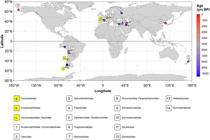
Earliest direct archaeological finds of families of parasitic platyhelminths from Pleistocene (c. 2.58 Ma - 11.7 Ka, yellow labels) and Holocene (< 11.7 Ka, white labels). Sites numbered in chronological order; age in years Before Present (yrs BP); age scale bar pertains to Holocene finds. See Table 2 for further details of each find.
Earliest archaeological finds of parasitic Platyhelminthes families from Pleistocene (c. 2.58 Ma-11.7 Ka) and Holocene (< 11.7 Ka), in chronological order. Taxonomy follows the National Center for Biotechnology Information (NCBI) database. All Holocene finds except for Euphrates Cave (ID:7) are associated with human habitation. If an age range given, earliest age provided; site ID corresponds to Fig. 4; where applicable, review articles given in square brackets; yrs BP, years Before Present; NS, not specified.
DISCUSSION
Given what we currently know about the appearance of metazoan phyla in the fossil record (Slater and Bohlin 2022) and the nested position of Platyhelminthes within Spiralia or Lophotrochozoa (Marlétaz et al. 2019, Drábková et al. 2022, Liao et al. 2023), a late Precambrian to Cambrian appearance seems likely. Deep Precambrian (pre-Ediacaran) estimates of metazoans based on molecular clock analyses (Cunningham et al. 2017, Anderson et al. 2023) are hard to bridge with the diverse fossil evidence (Slater and Bohlin 2022) and could be explained by various biases in such molecular divergence approaches rather than by large-scale taphonomic biases (Budd and Mann 2020, 2023). The oldest trace fossil evidence associated with putative body fossils places free-living flatworms in the marine environment in the late Ordovician at the latest (Knaust and Desrochers 2019, Knaust 2021). As they leave no resistant mouth parts and do not have a resistant cuticle, it is perhaps not so surprising. Also, early branching flatworms are considered to be quite small (Laumer et al. 2015). Recent molecular analyses suggest a single transition from marine to freshwater environments in Tricladida, which might be one of the oldest among soil invertebrates; however, a calibrated time-tree is missing (Sluys 2019, van Straalen 2021). Subsequently, freshwater forms colonized the land although some forms re-invaded freshwater environments. Trace fossil evidence suggests planarians to be present in freshwater environments at the latest in the early Permian (Alessandrello et al. 1988, Knaust 2010). These trace fossils suggest that Tricladida was present in Eurasia when the supercontinent Pangea was assembled and before the break-up of Gondwana.
The oldest fossils assignable to flatworms are trace fossils attributed to turbellarians in the Ordovician and are followed by the first evidence of ectoparasitic neodermatans assignable to Monopisthocotylea associated with acanthodian and placoderm hosts in the Devonian. Fossils attributable to endoparasitic neodermatans with complex life cycles appear later in the Carboniferous and Permian in the form of tapeworm eggs associated with shark body fossils or coprolites. Evidence for endoparasitic trematodes in vertebrates appears considerably later in the Cretaceous fossil record. Trematodes and cestodes have been reported to co-occur in Cretaceous archosaur coprolites but older coprolites only yielded tapeworms, which seems to suggest that the lack of trematodes might be a genuine pattern rather than an artefact. At the moment there is no comprehensive study on the relationship between structure and preservation potential of egg capsules for trematodes and cestodes. Lineages in both groups have eggs that can survive aggressive palynomorph preparations. It has also been suggested that quinone tanning (sclerotization) of eggs in their ancestors may have been a pre-adaptation to colonize the gut and survive acids and digestive enzymes (Llewellyn 1965, Zamparo 2001) which could contribute to their preservation in the fossil record. The transmission strategy in parasites might also play a role in the degree of tanning (and therefore preservation potential) as demonstrated by up to six independent losses in trematodes and one loss of quinone tanning within Cestoda. However, the structure and preservation potential needs further study in an up-to-date and more comprehensive phylogenetic framework. Acetolysis experiments have shown the complete destruction of eggs of the nematode Ascaris lumbricoides Linnaeus, 1758 and the trematode Schistosoma japonicum Katsurada, 1904, many destroyed eggs of the cestode Taenia pisiformis Bloch, 1780, but a relative increase in egg number of the trematode Clonorchis sinensis Cobbold, 1875 (Reinhard et al. 1986).
So, there is no straightforward difference in the range of possible structures and preservations of egg capsules between cestodes and trematodes which could further relate to their reproductive strategies (Smyth and Clegg 1959, Shinn 1993, Wharton 1983). Understanding the difference in preservation potential is also complicated by the packaging of eggs in proglottids in eucestodes which would be the functional equivalent of changing a quinone-tanned eggshell for a keratinized eggshell (Zamparo 2001) and could further improve their preservation potential. The earlier appearance of cestodes in the fossil record needs to be further corroborated by recovery of additional positive identification of (isolated) tapeworm eggs in comprehensive sampling of pre-Cretaceous coprolites which are negative for trematode eggs.
This relative order of appearance is most consistent with the hypotheses resulting from some new molecular phylogenetic analyses placing the divergence of Monopisthocotylea from the rest of Neodermata before the divergence of Cestoda from a clade of Trematoda and Polyopisthocotylea (Fig. 5). Using the fossil record to confirm this hypothesis needs further support by extending the fossil record of resistant hooks of Monopisthocotylea beyond the single Devonian site and by additional sampling of Pre-Cretaceous coprolites for helminth eggs as the discovery of older trematode eggs could potentially turn this pattern around. Eggs of members of Monopisthocotylea or Polyopisthocotylea have so far not been reported in the fossil record even though many of them are also be expected to be tanned/sclerotized and resistant with some rare exceptions (Llewellyn 1965, Fried and Stromberg 1971, Ramalingam 1973b, Guraya and Parshad 1988, Cable et al. 1997, Kearn et al. 1999, Zamparo 2001, Kearn 2005). So far, no fossil findings can be attributed to Polyopisthocotylea. In the case of clamps, this may relate to differences in composition as these are stabilized by dityrosine as opposed to keratin in hook sclerites and hamuli (Lyons 1966, Ramalingam 1973a). However, differences in stabilization need to be further investigated in a phylogenetic context and the presence of polyopisthocotyleans in coelacanths (Latimeria) and lungfishes has been used to argue for their latest origin at the split of Actinopterygia-Sarcopterygia (De Baets et al. 2015, Verneau et al. 2009). However, so far there is no direct evidence for the latter claim and latest analyses suggest both host switching and parasite extinction might have played a larger role in the evolution of Polyopisthocotylea than commonly assumed (Mulvey et al. 2022, Verneau et al. 2023).

Alternative topologies obtained for Neodermata in analyses of Brabec et al. (2023). Circles indicate the oldest fossil record for particular groups (differently coloured circles reflect those for early to later branching groups in Fig. 2). Light gray tree branches reflect lacking fossil record, black bars reflect present fossil record. Circle within circle refers to origin of endoparasitism and smaller circle attached to larger circle refers to origin of ectoparasitism based on fossil record. See Table 1 and discussion in text for further details of the oldest finds. Note the different stratigraphic range and distribution of ghost lineages depending on the topology.
Other new analyses inferring a sister-group relationship between a clade of Monopisthocotylea and Cestoda on the one hand and a clade of Polyopisthocotylea and Trematoda on the other hand would indicate a large gap in the stratigraphic record lacking fossils - also called ghost lineage - of the latter clade (Fig. 5). The latter merits discussing - in addition to the preservation potential of their eggs - an older igloo-like structure in a Silurian bivalve (Liljedahl 1985) and potentially relating it to a trematode producer (Huntley and De Baets 2015). However, the difference in morphology and the large temporal gap with the igloo-type structures confidently assignable to gymnophallid trematodes as well as the absence of their final tetrapod hosts speak for their assignment to a trace-maker with a similar behaviour but different phylogenetic assignment (Huntley and De Baets 2015).
It seems unlikely that fossil species and genera des cribed from the Paleozoic and Mesozoic represent modern species or genera. Also, modern families could not be confidently traced back beyond the Quaternary with the exception of Gymnophallidae (De Baets et al. 2015, 2021a, Leung 2017). This begs the question of how far back we can trace modern species, genera, or other families in the Quaternary (Fig. 4). Many families can be traced back within the Holocene and some as far back as the Pleistocene with the oldest egg capsules of dicrocoeliid trematodes and polycystidid turbellarians dated to at least 550,000 and 250,000 yrs BP, respectively.
Future perspectives
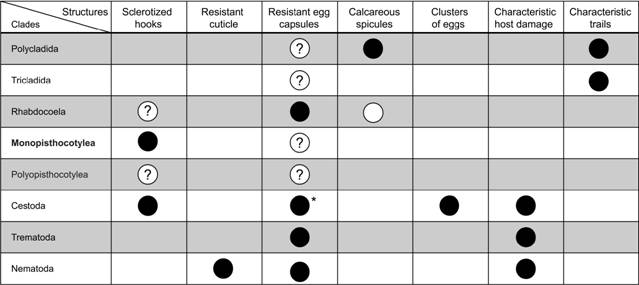
Currently, the oldest most reliable age for parasitic flatworms is provided by circlets of resistant hooks and eggs. More resistant remains need further systematic screening to potentially fill the gaps (compare Fig. 6). In the case of free-living flatworms, the oldest evidence comprises trace fossils indicative of mucociliary motion associated with putative body fossils.

Table highlighting the possible (hollow circles) and realized (filled circles) preservation potential of structures in the fossil record modified and mainly expanded from these references (Rieger and Sterrer 1975, Littlewood and Donovan 2003, Knaust 2010, De Baets et al. 2021a, 2021b). In-depth discussion of these points and associated references can be found in the main text. Question marks relate to a structure likely having increased preservation potential but further documentation is needed. Asterisks refers to packaging of eggs may further increase resistance of egg capsules.
Trace fossils attributed to free-living flatworms and other mucociliary motion might need further scrutiny, particularly those not associated with body fossils. Meiofaunal sites where trace fossils are occasionally associated with resistant body parts or outlines might help in this endeavor (Knaust 2007, 2010, Knaust and Desrochers 2019). Even if the internal structure is mostly destroyed due to early-diagenetic processes, their morphology and size can still be used to recognize higher-order taxa and as fingerprints to link a trace maker to a distinct meiobenthic trace fossil (Knaust 2007). Simple traces could potentially be produced by vermiform organisms belonging to a range of animal phyla. However, new mathematical approaches enable to identify previously unrecognized signatures left by trace makers (e.g., deviation angle series of self-crossing traces) allowing to more confidently assign them to their known modern (or fossil) producers (Wang and Rahman 2023). In addition, the association of trace fossils with characteristic spicules and a more comprehensive understanding of the distribution of such behavior or spicules in an up-to-date phylogenetic context (Rieger and Sterrer 1975, Knaust 2010) would also be helpful to more robustly assign them to modern lineages.
The preservation potential of the smallest flatworm representatives, namely the microturbellarians, is poorly known. Many groups of microturbellarians, including macrostomorphs, gnosonesimids, rhabdocoels, and proseriates, have sclerotized parts in their atrial organs or feeding structures that can be beautifully preserved for SEM (Damborenea et al. 2007) or as permanent whole mounts (Schockaert 1996), while dissolving the weak tissues with harsh chemicals. Indeed, these sclerotized parts in microturbellarians range from hooks/spines/girdles/stylets or cirri armed with tiny spines in the male copulatory organ (Artois and Schockaert 2003, Smith III et al. 2020), to hooks or denticles in the kalyptorhynch proboscis (Uyeno and Kier 2010). Some rhabdocoel groups have sclerotized bursal appendages, thickened basal membranes, bursal spines or sclerotized channels guarding the female system (Artois and Schockaert 2005, Van Steenkiste and Leander 2018). However, whether these structures can be recovered in fossil samples and would be recognized as such needs to be further explored. The preservation potential of catenulids, the earliest diverging major lineage of flatworms (Laumer et al. 2015), is likely limited due to the combination of their small size and a simple anatomy lacking hard parts (Van Steenkiste et al. 2023).
More resistant platyhelminth eggs in coprolites, palynomorph preparations or sediment samples remain a largely untapped resource with great potential. To our knowledge no comprehensive comparative studies on the preservation potential of eggs across different lineages of flatworms have been performed. Various lineages produce sclerotized/tanned egg capsules which increases their preservation potential (Guraya and Parshad 1988, Shinn 1993, Zamparo 2001) including Tricladida (Huggins and Waite 1993), Polycladida (Ishida and Teshirogi 1986), Rhabdocoela (Breckenridge and Nathanael 1988) and Neodermata (Smyth and Clegg 1959, Kearn et al. 1999, Ramalingam 1973b). Eggs capsules of at least some lineages of rhabdocoel microturbellarians including Dalyelliidae, Polycystididae (Gyratrix) and Typhloplanidae (Haas 1996, Warner 1989, Matsuoka and Ando 2021) as well as parasitic cestodes such as Diphyllobothrium and trematodes such as Dicroelium or Clonorchis are well-known to be more resistant to palynological preparations (Reinhard et al. 1986, Shumilovskikh and van Geel 2020) and have been recovered from fossil samples older than 250000 yrs BP.
Eggs of parasitic flatworms are often considered less resistant than those of nematodes (Brinkkemper and van Haaster 2012, Dufour and Le Bailly 2013) which might explain why nematodes have been recovered more often from Mesozoic coprolites (Hugot et al. 2014, Cardia et al. 2019, Nonsrirach et al. 2023) and sedimentary samples in the archeological record (Morrow et al. 2016). However, the oldest and the only helminth eggs recovered from Paleozoic coprolites can be attributed to tapeworms (Zangerl and Case 1976, Dentzien-Dias et al. 2013, Chin 2021). Isolated eggs of cestodes and trematodes co-occur in at least some Cretaceous coprolite samples (Poinar and Boucot 2006), but confidently identified trematode eggs have so far not been recovered from coprolites positive for nematode or cestode helminths before the Cretaceous. Sampling effort as well as preservation factors could play a role in this pattern. If the archeological record is an indicator, eggs of nematodes are more common than those of cestodes and trematodes, but whether this relates to their different preservation potential or other factors remains unresolved. Isolated trematode or cestode eggs in sediment samples could potentially also be confused with turbellarian eggs (Matsuoka and Ando 2021). The better body fossil record of nematodes is not so surprising due to their resistant cuticle (Littlewood and Donovan 2003, Poinar 2011, Maas 2012, De Baets et al. 2021b, 2023, Luo et al. 2023). Also, nematode eggs seem to be more resistant compared to those of trematodes when subjected to hard acids and bases (Brinkkemper and van Haaster 2012, Dufour and Le Bailly 2013, but see Reinhard et al. 1986).
Despite their patchiness, fossil remains of flatworms (particularly when combined with fossil evidence from outgroups) can remain valuable for calibrating molecular divergence estimates. At least the age of some fossil constraints (e.g., eucestode tapeworms) are as good as those of independently calibrated molecular divergence estimates as their ages fall within or even pre-date confidence limits of previous divergence time estimates (De Baets et al. 2021a). Based on poor fossil records in some groups, biogeographic calibrations have been suggested as an alternative to fossil constraints (Zietara and Lumme 2002, Scarpa et al. 2015, Sluys 2019). However, the consistency of such hypotheses with modern distributions should be independently and robustly tested before using them as potential calibrations (Upchurch 2008, Kodandaramaiah 2011). When inherent assumptions and attendant errors are properly considered, calibrations derived from geological events are not necessarily more precise or easier to codify than those of the fossil record and should be seen as complementary rather than competing approaches (De Baets et al. 2016). The same can be said for host calibrations in the case of symbiotic linea ges (Olson et al. 2010, Badets et al. 2011, Hoyal Cuthill et al. 2016), which should likely only be used if there is a strong independent support for a high degree of co-divergence and host specificity, but a low degree of host switching or extinction in this part of the trees (Warnock and Engelstädter 2021, Mulvey et al. 2022). (Co-)evolutionary history is likely more complex as revealed by traditional models with host switching as well as extinction playing a larger role and codivergence a smaller role than traditionally thought (e.g., Araujo et al. 2015, Brooks and Boeger 2019). Various new methods have been developed to help with reconstructing and testing this complex history (Braga et al. 2020, Warnock and Engelstädter 2021, Dismukes et al. 2022, Mulvey et al. 2022).
Whatever the calibrations used, constraints on their assumptions should be explicitly discussed and rigidly tested independently in a non-circular way. For instance, biogeographic or host calibration should not be used to test related biogeographic or host hypotheses, respectively; trace fossils should not be used to reconstruct the evolution of locomotion behavior but rather in sensitivity analyses. A better understanding of the flatworm fossil record as well as the modern phylogenetic placement of preservable structures (hooks, eggs, spicules) therefore remains crucial for constraining the timing of the origin and evolution of Platyhelminthes as well as their co-phylogeny with their hosts.
ACKNOWLEDGEMENTS
KDB would like to thank organizers and participants of the “XV International Symposium on Flatworm Biology” in São Sebastião (XVISFB) as well as the “Fossil Record in Resins and Sediments” Conference in Gdańsk who led to existing discussion considering the topic of this paper. KDB, AS, PD-D and JWH thank Barbara Seuss and Elizabeth Dowding as well as other members of the BITE workshop for discussion and support. KDB’s participation to XVISFB was supported by the São Paulo Research Foundation (FAPESP). MPMV’s participation to XVISFB was supported by travel grant K1A9423N of the Research Foundation-Flanders (FWO-Vlaanderen). KDB, WŁ, AS and KV were supported by the I.3.4 Action of the Excellence Initiative - Research University Programme at the University of Warsaw (Project: PARADIVE) and action II.1.2. Establishing and strengthening cooperation with strategic partners. This work also benefitted from a research visit PD-D to Warsaw that was funded through Action I.1.1/IV.1.1 “Mentoring Programme”. KDB, AS, PD-D and JWH thank the Paleosynthesis Project and the Volkswagen Stiftung for funding the BITE workshop which benefitted this project (Az 96 796). JWH was supported by NSF EAR CAREER 1650745.
LITERATURE CITED
-
Achatz TJ, Pulis EE, Junker K, Binh TT, Snyder SD, Tkach VV (2019) Molecular phylogeny of the Cyathocotylidae (Digenea, Diplostomoidea) necessitates systematic changes and reveals a history of host and environment switches. Zoologica Scripta 48(4): 545-556. https://doi.org/10.1111/zsc.12360
» https://doi.org/10.1111/zsc.12360 - Alessandrello A, Pinna G, Teruzzi G (1988) Land planarian locomotion trail from the Lower Permian of Lombardian Pre-Alps (Tricladida Terricola). Atti Della Società Italiana Di Scienze Naturali e Del Museo Civico Di Storia Naturale Di Milano 129(2-3): 139-145.
- Allison CW (1975) Primitive fossil flatworm from Alaska: New evidence bearing on ancestry of the Metazoa. Geology 3(11): 649-652.
-
Álvarez-Presas M, Baguñà J, Riutort M (2008) Molecular phylogeny of land and freshwater planarians (Tricladida, Platyhelminthes): From freshwater to land and back. Molecular Phylogenetics and Evolution 47(2): 555-568. https://doi.org/10.1016/j.ympev.2008.01.032
» https://doi.org/10.1016/j.ympev.2008.01.032 - Anastasiou E, Lorentz KO, Stein GJ, Mitchell PD (2014) Prehistoric schistosomiasis parasite found in the Middle East. The Lancet Infectious Diseases 14(7): 553-554.
-
Anderson RP, Woltz CR, Tosca NJ, Porter SM, Briggs DE (2023) Fossilisation processes and our reading of animal antiquity. Trends in Ecology & Evolution 38(11): 1060-1071. https://doi.org/10.1016/j.tree.2023.05.014
» https://doi.org/10.1016/j.tree.2023.05.014 -
Araujo SB, Braga MP, Brooks DR, Agosta SJ, Hoberg EP, Von Hartenthal FW, Boeger WA (2015) Understanding host-switching by ecological fitting. Plos One 10(10): e0139225. https://doi.org/10.1371/journal.pone.0139225
» https://doi.org/10.1371/journal.pone.0139225 - Aretz M, Herbig H-G, Wang XD, Gradstein FM, Agterberg FP, Ogg JG (2020) The Carboniferous Period. In: Gradstein FM, Ogg JG, Schmitz MD, Ogg GM (Eds) Geologic time scale 2020. Elsevier, Amsterdam, vol. 2, 811-874.
-
Artois TJ, Schockaert ER (2003) Primary homology assessment in the male atrial system of the Polycystididae (Platyhelminthes: Eukalyptorhynchia). Zoologischer Anzeiger - A Journal of Comparative Zoology 242(2): 179-190. https://doi.org/10.1078/0044-5231-00095
» https://doi.org/10.1078/0044-5231-00095 -
Artois TJ, Schockaert ER (2005) Primary homology assessment of structures in the female atrial system among species of the Polycystididae (Rhabditophora, Eukalyptorhynchia). Invertebrate Biology 124(2): 109-118. https://doi.org/10.1111/j.1744-7410.2005.00013.x
» https://doi.org/10.1111/j.1744-7410.2005.00013.x -
Askari Z, Mas-Coma S, Bouwman AS, Boenke N, Stöllner T, Aali A, Rezaiian M, Mowlavi G (2018) Fasciola hepatica eggs in paleofaeces of the Persian onager Equus hemionus onager, a donkey from Chehrabad archaeological site, dating back to the Sassanid Empire (224-651 AD), in ancient Iran. Infection, Genetics and Evolution 62: 233-243. https://doi.org/10.1016/j.meegid.2018.04.028
» https://doi.org/10.1016/j.meegid.2018.04.028 -
Askari Z, Ruehli F, Bouwman A, Shariati V, Naddaf SR, Otranto D, et al. (2022) Genomic palaeoparasitology traced the occurrence of Taenia asiatica in ancient Iran (Sassanid Empire, 2th cent. CE-6th cent. CE). Scientific Reports 12(1): 12045. https://doi.org/10.1038/s41598-022-10690-2
» https://doi.org/10.1038/s41598-022-10690-2 -
Badets M, Whittington I, Lalubin F, Allienne JF, Maspimby JL, Bentz S, et al. (2011) Correlating early evolution of parasitic platyhelminths to Gondwana breakup. Systematic Biology 60(6): 762-781. https://doi.org/10.1093/sysbio/syr078
» https://doi.org/10.1093/sysbio/syr078 -
Baguñà J, Riutort M (2004a) Molecular phylogeny of the Platyhelminthes. Canadian Journal of Zoology 82(2): 168-193. https://doi.org/10.1139/z03-214
» https://doi.org/10.1139/z03-214 -
Baguñà J, Riutort M (2004b) The dawn of bilaterian animals: The case of acoelomorph flatworms. Bioessays 26(10): 1046-1057. https://doi.org/10.1002/bies.20113
» https://doi.org/10.1002/bies.20113 -
Barrick JE, Alekseev AS, Blanco-Ferrera S, Goreva NV, Hu K, Lambert LL, et al. (2022) Carboniferous conodont biostratigraphy. Geological Society, London, Special Publications 512(1): 695-768. https://doi.org/10.1144/SP512-2020-38
» https://doi.org/10.1144/SP512-2020-38 -
Barrios-de-Pedro S, Osuna A, Buscalioni ÁD (2020) Helminth eggs from early cretaceous faeces. Scientific Reports 10(1): 18747. https://doi.org/10.1038/s41598-020-75757-4
» https://doi.org/10.1038/s41598-020-75757-4 -
Baucon A, Venturini C, Neto de Carvalho C, Felletti F, Muttoni G (2015) Behaviors mapped by new geographies: Ichnonetwork analysis of the Val Dolce Formation (lower Permian; Italy-Austria). Geosphere 11(3): 744-776. https://doi.org/10.1130/GES00994.1
» https://doi.org/10.1130/GES00994.1 - Becker RT, Marshall JEA, Da Silva A-C, Agterberg FP, Gradstein FM, Ogg JG (2020) The Devonian Period. In: Gradstein FM, Ogg JG, Schmitz MD, Ogg GM (Eds) Geologic time scale 2020. Elsevier, Amsterdam, vol. 2, 733-810.
-
Beltrame MO, Sardella NH, Fugassa MH, Barberena R (2012) A palaeoparasitological analysis of rodent coprolites from the Cueva Huenul 1 archaeological site in Patagonia (Argentina). Memórias do Instituto Oswaldo Cruz 107: 604-608. https://doi.org/10.1590/S0074-02762012000500006
» https://doi.org/10.1590/S0074-02762012000500006 -
Benítez-Álvarez L, Leal-Zanchet AM, Oceguera-Figueroa A, Ferreira RL, de Medeiros Bento D, Braccini J, et al. (2020) Phylogeny and biogeography of the Cavernicola (Platyhelminthes: Tricladida): Relicts of an epigean group sheltering in caves? Molecular Phylogenetics and Evolution 145: 106709. https://doi.org/10.1016/j.ympev.2019.106709
» https://doi.org/10.1016/j.ympev.2019.106709 -
Berggren WA, Aubry MP (1996) A late Paleocene-early Eocene NW European and North Sea magnetobiochronological correlation network. Geological Society, London, Special Publications 101(1) : 309-352. https://doi.org/10.1144/GSL.SP.1996.101.01.17
» https://doi.org/10.1144/GSL.SP.1996.101.01.17 -
Beveridge I, Bray RA, Cribb TH, Justine JL (2014) Diversity of trypanorhynch metacestodes in teleost fishes from coral reefs off eastern Australia and New Caledonia. Parasite 21: 60. https://doi.org/10.1051/parasite/2014060
» https://doi.org/10.1051/parasite/2014060 -
Blair D, Cannon LR, Littlewood DTJ, Olson PD, Sewell KB (2023) The Temnocephalidae (Platyhelminthes): Molecular data illuminate the evolution of an ancient group of symbiotic flatworms. Systematics and Biodiversity 21(1): 2174611. https://doi.org/10.1080/14772000.2023.2174611
» https://doi.org/10.1080/14772000.2023.2174611 -
Boast AP, Weyrich LS, Wood JR, Metcalf JL, Knight R, Cooper A (2018) Coprolites reveal ecological interactions lost with the extinction of New Zealand birds. Proceedings of the National Academy of Sciences 115(7): 1546-1551. https://doi.org/10.1073/pnas.171233711
» https://doi.org/10.1073/pnas.171233711 - Borrero LA (1999) The faunas of the Pleistocene/Holocene boundary in the Seno de la Ultima Esperanza, Chile. In: Driver J (Ed.) Zooarchaeology of the Pleistocene/Holocene boundary. BAR International Series, 59-62.
-
Brabec J, Salomaki ED, Kolísko M, Scholz T, Kuchta R (2023) The evolution of endoparasitism and complex life cycles in parasitic platyhelminths. Current Biology 33(19): 4269-4275.e3. https://doi.org/10.1016/j.cub.2023.08.064
» https://doi.org/10.1016/j.cub.2023.08.064 -
Brabec J, Waeschenbach A, Scholz T, Littlewood DTJ, Kuchta R (2015) Molecular phylogeny of the Bothriocephalidea (Cestoda): Molecular data challenge morphological classification. International Journal for Parasitology 45(12): 761-771. https://doi.org/10.1016/j.ijpara.2015.05.006
» https://doi.org/10.1016/j.ijpara.2015.05.006 -
Braga MP, Landis MJ, Nylin S, Janz N, Ronquist F (2020) Bayesian inference of ancestral host-parasite interactions under a phylogenetic model of host repertoire evolution. Systematic Biology 69(6): 1149-1162. https://doi.org/10.1093/sysbio/syaa019
» https://doi.org/10.1093/sysbio/syaa019 -
Breckenridge WR, Nathanael S (1988) Vitelline gland histochemistry in the commensal temnocephalid Paracaridinicola platei (Fernando, 1952) Baer, 1953, together with some notes on the egg. Journal of Helminthology 62(2): 167-174. https://doi.org/10.1017/S0022149X00011457
» https://doi.org/10.1017/S0022149X00011457 -
Brinkkemper O, van Haaster H (2012) Eggs of intestinal parasites whipworm (Trichuris) and mawworm (Ascaris): Non-pollen palynomorphs in archaeological samples. Review of Palaeobotany and Palynology 186: 16-21. https://doi.org/10.1016/j.revpalbo.2012.07.003
» https://doi.org/10.1016/j.revpalbo.2012.07.003 -
Brooks DR, Boeger WA (2019) Climate change and emerging infectious diseases: Evolutionary complexity in action. Current Opinion in Systems Biology 13: 75-81. https://doi.org/10.1016/j.coisb.2018.11.001
» https://doi.org/10.1016/j.coisb.2018.11.001 -
Buatois LA, Mangano MG, Mikuláš R, Maples CG (1998) The ichnogenus Curvolithus revisited. Journal of Paleontology 72(4): 758-769. https://doi.org/10.1017/S0022336000040452
» https://doi.org/10.1017/S0022336000040452 -
Buatois LA, Wisshak M, Wilson MA, Mangano MG (2017) Categories of architectural designs in trace fossils: A measure of ichnodisparity. Earth-Science Reviews 164: 102-181. https://doi.org/10.1016/j.earscirev.2016.08.009
» https://doi.org/10.1016/j.earscirev.2016.08.009 -
Budd GE, Jackson IS (2016) Ecological innovations in the Cambrian and the origins of the crown group phyla. Philosophical Transactions of the Royal Society B: Biological Sciences 371(1685): 20150287. https://doi.org/10.1098/rstb.2015.0287
» https://doi.org/10.1098/rstb.2015.0287 -
Budd GE, Mann RP (2020) Survival and selection biases in early animal evolution and a source of systematic overestimation in molecular clocks. Interface Focus 10(4): 20190110. https://doi.org/10.1098/rsfs.2019.0110
» https://doi.org/10.1098/rsfs.2019.0110 -
Budd GE, Mann RP (2023) Two notorious nodes: A critical examination of relaxed molecular clock age estimates of the bilaterian animals and placental mammals. Systematic Biology: syad057. https://doi.org/10.1093/sysbio/syad057
» https://doi.org/10.1093/sysbio/syad057 -
Cable J, Tocque K, Tinsley RC (1997) Histological analysis of the egg capsule of the ovoviviparous polystomatid monogenean, Pseudodiplorchis americanus International Journal for Parasitology 27(9): 1075-1080. https://doi.org/10.1016/S0020-7519(97)00068-4
» https://doi.org/10.1016/S0020-7519(97)00068-4 -
Caira JN, Littlewood DTJ (2013) Worms, Platyhelminthes. In: Levin SA (Ed.) Encyclopedia of Biodiversity. Academic Press, 2nd ed., 437-469. https://doi.org/10.1016/B978-0-12-384719-5.00166-0
» https://doi.org/10.1016/B978-0-12-384719-5.00166-0 -
Caña-Bozada V, Robinson MW, Hernández-Mena DI, Morales-Serna FN (2023) Exploring evolutionary relationships within Neodermata using putative orthologous groups of proteins, with emphasis on peptidases. Tropical Medicine and Infectious Disease 8(1): 59. https://doi.org/10.3390/tropicalmed8010059
» https://doi.org/10.3390/tropicalmed8010059 -
Cardia DF, Bertini RJ, Camossi LG, Letizio LA (2019) Two new species of ascaridoid nematodes in Brazilian Crocodylomorpha from the Upper Cretaceous. Parasitology International 72: 101947. https://doi.org/10.1016/j.parint.2019.101947
» https://doi.org/10.1016/j.parint.2019.101947 -
Černý D, Natale R (2022) Comprehensive taxon sampling and vetted fossils help clarify the time tree of shorebirds (Aves, Charadriiformes). Molecular Phylogenetics and Evolution 177: 107620. https://doi.org/10.1016/j.ympev.2022.107620
» https://doi.org/10.1016/j.ympev.2022.107620 -
Chin K (2021) Gastrointestinal parasites of ancient nonhuman vertebrates: evidence from coprolites and other materials. In: De Baets K, Huntley JW (Eds) The Evolution and Fossil Record of Parasitism: Coevolution and Paleoparasitological Techniques. Topics in Geobiology 50. Springer, Cham, 359-375. https://doi.org/10.1007/978-3-030-52233-9_11
» https://doi.org/10.1007/978-3-030-52233-9_11 - Cloud P, Wright J, Glover L (1976) Traces of Animal Life from 620-Million-Year-Old Rocks in North Carolina: The oldest well-dated metazoan fossils from North America are preserved beneath the deposits of a waning turbidity current that flowed downslope from an ancient volcanic borderland along the southeastern coast. American Scientist 64(4): 396-406.
-
Cocker SL, Pisaric MF, McCarthy FM, Vermaire JC, Beaupre P, Cwynar LC (2021) Dung analysis of the East Milford mastodons: Dietary and environmental reconstructions from central Nova Scotia at 75 ka years BP. Canadian Journal of Earth Sciences 58(10): 1059-1072. https://doi.org/10.1139/cjes-2020-0164
» https://doi.org/10.1139/cjes-2020-0164 -
Collins AG, Lipps JH, Valentine JW (2000) Modern mucociliary creeping trails and the bodyplans of Neoproterozoic trace-makers. Paleobiology 26(1): 47-55. https://doi.org/10.1666/0094-8373(2000)026<0047:MMCTAT>2.0.CO;2
» https://doi.org/10.1666/0094-8373(2000)026<0047:MMCTAT>2.0.CO;2 -
Collins JJ (2017) Platyhelminthes. Current Biology 27(7): R252-R256. https://doi.org/10.1016/j.cub.2017.02.016
» https://doi.org/10.1016/j.cub.2017.02.016 -
Cremonte F, Ituarte C (2003) Pathologies elicited by the gymnophallid metacercariae of Bartolius pierrei in the clam Darina solenoides Journal of the Marine Biological Association of the United Kingdom 83(2): 311-318. https://doi.org/10.1017/S0025315403007136h
» https://doi.org/10.1017/S0025315403007136h -
Cunningham JA, Liu AG, Bengtson S, Donoghue PC (2017) The origin of animals: Can molecular clocks and the fossil record be reconciled? BioEssays 39(1): 1-12. https://doi.org/10.1002/bies.201600120
» https://doi.org/10.1002/bies.201600120 -
Curini-Galletti M, Artois T, Di Domenico M, Fontaneto D, Jondelius U, Jörger KM, et al. (2020) Contribution of soft-bodied meiofaunal taxa to Italian marine biodiversity. The European Zoological Journal 87(1): 369-384. https://doi.org/10.1080/24750263.2020.1786607
» https://doi.org/10.1080/24750263.2020.1786607 -
Damborenea C, Brusa F, Noreña C (2007) New Dalyelliidae (Platyhelminthes, Rhabditophora) from Buenos Aires Province, Argentina, and their stylet ultrastructure. Zoological Science 24(8): 803-810. https://doi.org/10.2108/zsj.24.803
» https://doi.org/10.2108/zsj.24.803 -
De Baets K, Antonelli A, Donoghue PC (2016) Tectonic blocks and molecular clocks. Philosophical Transactions of the Royal Society B: Biological Sciences 371(1699): 20160098. https://doi.org/10.1098/rstb.2016.0098
» https://doi.org/10.1098/rstb.2016.0098 -
De Baets K, Dentzien-Dias P, Harriso GWM, Littlewood DTJ, Parry LA (2021a) Fossil constraints on the timescale of parasitic helminth evolution. In: De Baets K, Huntley JW (Eds) The Evolution and Fossil Record of Parasitism: Identification and Macroevolution of Parasites. Topics in Geobiology 49. Springer, Cham , 231-271. https://doi.org/10.1007/978-3-030-42484-8_7
» https://doi.org/10.1007/978-3-030-42484-8_7 -
De Baets K, Dentzien-Dias P, Upeniece I, Verneau O, Donoghue PC (2015) Constraining the deep origin of parasitic flatworms and host-interactions with fossil evidence. Advances in Parasitology 90: 93-135. https://doi.org/10.1016/bs.apar.2015.06.002
» https://doi.org/10.1016/bs.apar.2015.06.002 -
De Baets K, Huntley JW, Klompmaker AA, Schiffbauer JD, Muscente AD (2021b) The fossil record of parasitism: Its extent and taphonomic constraints. In: De Baets K, Huntley JW (Eds) The Evolution and Fossil Record of Parasitism: Coevolution and Paleoparasitological Techniques. Topics in Geobiology 50 . Springer, Cham , 1-50. https://doi.org/10.1007/978-3-030-52233-9_1
» https://doi.org/10.1007/978-3-030-52233-9_1 -
De Baets K, Klug C, Korn D (2011) Devonian pearls and ammonoid-endoparasite co-evolution. Acta Palaeontologica Polonica 56(1): 159-180. https://doi.org/10.4202/app.2010.0044
» https://doi.org/10.4202/app.2010.0044 -
De Baets K, Littlewood DTJ (2015) The importance of fossils in understanding the evolution of parasites and their vectors. Advances in Parasitology 90: 1-51. https://doi.org/10.1016/bs.apar.2015.07.001
» https://doi.org/10.1016/bs.apar.2015.07.001 -
De Baets K, Vanadzina K, Schiffbauer J (2023) Trapped in time. eLife 12: e90008. https://doi.org/10.7554/eLife.90008
» https://doi.org/10.7554/eLife.90008 -
Dentzien-Dias P, Poinar GO, de Figueiredo AEQ, Pacheco ACL, Horn BL, Schultz CL (2013) Tapeworm eggs in a 270 million-year-old shark coprolite. Plos One 8(1): e55007. https://doi.org/10.1371/journal.pone.0055007
» https://doi.org/10.1371/journal.pone.0055007 -
Dismukes W, Braga MP, Hembry DH, Heath TA, Landis MJ (2022) Cophylogenetic methods to untangle the evolutionary history of ecological interactions. Annual Review of Ecology, Evolution, and Systematics 53: 275-298. https://doi.org/10.1146/annurev-ecolsys-102320-112823
» https://doi.org/10.1146/annurev-ecolsys-102320-112823 -
Dobson A, Lafferty KD, Kuris AM, Hechinger RF, Jetz W (2008) Homage to Linnaeus: How many parasites? How many hosts? Proceedings of the National Academy of Sciences 105(Suppl. 1): 11482-11489. https://doi.org/10.1073/pnas.0803232105
» https://doi.org/10.1073/pnas.0803232105 -
Drábková M, Kocot KM, Halanych KM, Oakley TH, Moroz LL, Cannon JT, Kuris A, Garcia-Vedrenne AE, Pankey MS, Ellis EA (2022) Different phylogenomic methods support monophyly of enigmatic ‘Mesozoa’ (Dicyemida+ Orthonectida, Lophotrochozoa). Proceedings of the Royal Society B 289(1978): 20220683. https://doi.org/10.1098/rspb.2022.0683
» https://doi.org/10.1098/rspb.2022.0683 -
Dufour B, Le Bailly M (2013) Testing new parasite egg extraction methods in paleoparasitology and an attempt at quantification. International Journal of Paleopathology 3(3): 199-203. https://doi.org/10.1016/j.ijpp.2013.03.008
» https://doi.org/10.1016/j.ijpp.2013.03.008 - Eberlein GD, Lanphere MA (1988) Precambrian rocks of Alaska. U.S. Geological Survey Professional Paper 1241-B: 1-18.
-
Egger B, Lapraz F, Tomiczek B, Müller S, Dessimoz C, Girstmair J, et al. (2015) A transcriptomic-phylogenomic analysis of the evolutionary relationships of flatworms. Current Biology 25(10): 1347-1353. https://doi.org/10.1016/j.cub.2015.03.034
» https://doi.org/10.1016/j.cub.2015.03.034 - Engovatova AV, Khrustalev AV (1996) Coprolites from stone-age sites of Podmoskovye. Tverskoy Sbornik 2: 148-154.
-
Falcon-Lang HJ, Heckel PH, Dimichele WA, Blake Jr BM, Easterday CR, Eble CF, et al. (2011) No major stratigraphic gap exists near the Middle-Upper Pennsylvanian (Desmoinesian-Missourian) boundary in North America. Palaios 26(3): 125-139. https://doi.org/10.2110/palo.2010.p10-049r
» https://doi.org/10.2110/palo.2010.p10-049r -
Fraija-Fernandez N, Waeschenbach A, Briscoe AG, Hocking S, Kuchta R, Nyman T, Littlewood DTJ (2021) Evolutionary transitions in broad tapeworms (Cestoda: Diphyllobothriidea) revealed by mitogenome and nuclear ribosomal operon phylogenetics. Molecular Phylogenetics and Evolution 163: 107262. https://doi.org/10.1016/j.ympev.2021.107262
» https://doi.org/10.1016/j.ympev.2021.107262 - Fregenal-Martínez M, Nieves Meléndez N, Muñoz-García MB, Elez J, de la Horra R (2017) The stratigraphic record of the Late Jurassic-Early Cretaceous rifting in the Alto Tajo-Serranía de Cuenca region (Iberian Ranges, Spain). Revista de La Sociedad Geológica de España 30(1): 113-142.
- Frey DG (1964) Remains of animals in Quaternary lake and bog sediments and their interpretation. Ergebnisse der Limnologie 2: 1-114.
- Fried B, Stromberg BE (1971) Egg-shell precursors in trematodes. Proceedings of the Helminthological Society of Washington 38(2): 262-264.
- Froehlich CG (1955) On the biology of land planarians. Boletim da Faculdade de Filosofia, Ciências e Letras, Universidade de São Paulo, Zoologia 20(20): 263-272.
-
Fugassa MH, Beltrame MO, Sardella NH, Civalero MT, Aschero C (2010) Paleoparasitological results from coprolites dated at the Pleistocene-Holocene transition as source of paleoecological evidence in Patagonia. Journal of Archaeological Science 37(4): 880-884. https://doi.org/10.1016/j.jas.2009.11.018
» https://doi.org/10.1016/j.jas.2009.11.018 - Gale AS, Mutterlose J, Batenburg S, Gradstein FM, Agterberg FP, Ogg JG, Petrizzo MR (2020) The Cretaceous period. In: Gradstein FM, Ogg JG, Schmitz MD, Ogg GM (Eds) Geologic time scale 2020 . Elsevier, Amsterdam , vol. 2, 1023-1086.
- Goldman D, Sadler PM, Leslie SA, Melchin MJ, Agterberg FP, Gradstein FM (2020) The Ordovician Period. In: Gradstein FM, Ogg JG, Schmitz MD, Ogg GM (Eds) Geologic time scale 2020 . Elsevier, Amsterdam , 631-694.
-
Gonçalves MLC, Araújo A, Ferreira LF (2003) Human intestinal parasites in the past: New findings and a review. Memórias do Instituto Oswaldo Cruz 98: 103-118. https://doi.org/10.1590/s0074-02762003000900016
» https://doi.org/10.1590/s0074-02762003000900016 -
Goodheart JA, Collins AG, Cummings MP, Egger B, Rawlinson KA (2023) A phylogenomic approach to resolving interrelationships of polyclad flatworms, with implications for life-history evolution. Royal Society Open Science 10(3): 220939. https://doi.org/10.1098/rsos.220939
» https://doi.org/10.1098/rsos.220939 - Guraya SS, Parshad VR (1988) Platyhelminthes. In: Adiyodi KG, Adiyodi RG (Eds) Reproductive Biology of Invertebrates. J. Wiley & Sons, Chichester, vol. 3, 1-49.
-
Haas JN (1996) Neorhabdocoela oocytes - Palaeoecological indicators found in pollen preparations from Holocene freshwater lake sediments. Review of Palaeobotany and Palynology 91(1): 371-382. https://doi.org/10.1016/0034-6667(95)00074-7
» https://doi.org/10.1016/0034-6667(95)00074-7 -
Hahn C, Fromm B, Bachmann L (2014) Comparative genomics of flatworms (Platyhelminthes) reveals shared genomic features of ecto-and endoparastic neodermata. Genome Biology and Evolution 6(5): 1105-1117. https://doi.org/10.1093/gbe/evu078
» https://doi.org/10.1093/gbe/evu078 - Hall HJ (1976) Untitled notes. Paleopathology Newsletter 13: 9.
-
Handl C, Bouchet P (2007) Mystery tubes coiled around deep-water tropical gorgonians: Fecampiid cocoons (Platyhelminthes: Fecampiida) resembling Solenogastres (Mollusca). Systematic Parasitology 67(2): 81-85. https://doi.org/10.1007/s11230-006-9077-z
» https://doi.org/10.1007/s11230-006-9077-z -
Harmsworth RV (1968) The developmental history of Blelham Tarn (England) as shown by animal microfossils, with special reference to the Cladocera. Ecological Monographs 38(3): 223-241. https://doi.org/10.2307/1942429
» https://doi.org/10.2307/1942429 -
Harter S (2003) Implication de la Paléoparasitologie dans l’étude des populations anciennes de la vallée du Nil et de proche-orient: étude de cas. PhD Thesis, Université de Reims Champagne-Ardenne. https://theses.hal.science/tel-00930943
» https://theses.hal.science/tel-00930943 -
Harter-Lailheugue S, Le Mort F, Vigne J-D, Guilaine J, Le Brun A, Bouchet F (2005) Premiéres données parasitologiques sur les populations humaines précéramiques chypriotes (VIII e et VII e millénaires av. J.-C.). Paléorient 31(2): 43-54. https://doi.org/10.3406/paleo.2005.5124
» https://doi.org/10.3406/paleo.2005.5124 -
Harvey TH, Dong X, Donoghue PC (2010) Are palaeoscolecids ancestral ecdysozoans? Evolution & Development 12(2): 177-200. https://doi.org/10.1111/j.1525-142x.2010.00403.x
» https://doi.org/10.1111/j.1525-142x.2010.00403.x -
Heckel PH (2013) Pennsylvanian stratigraphy of Northern Midcontinent Shelf and biostratigraphic correlation of cyclothems. Stratigraphy 10(1-2): 3-39. https://doi.org/10.29041/strat.10.1.02
» https://doi.org/10.29041/strat.10.1.02 -
Heckel PH, Barrick JE, Rosscoe SJ (2011) Conodont-based correlation of marine units in lower Conemaugh Group (Late Pennsylvanian) in Northern Appalachian Basin. Stratigraphy 8(4): 253-269. https://doi.org/10.29041/strat.08.4.03
» https://doi.org/10.29041/strat.08.4.03 - Henderson CM, Shen SZ, Gradstein FM, Agterberg FP (2020) The Permian Period. In: Gradstein FM, Ogg JG, Schmitz MD, Ogg GM (Eds) Geologic time scale 2020 . Elsevier, Amsterdam , vol. 2, 875-902.
-
Hooge MD (2001) Evolution of body-wall musculature in the Platyhelminthes (Acoelomorpha, Catenulida, Rhabditophora). Journal of Morphology 249(3): 171-194. https://doi.org/10.1002/jmor.1048
» https://doi.org/10.1002/jmor.1048 -
Horne PD (1985) A review of the evidence of human endoparasitism in the pre-Columbian New World through the study of coprolites. Journal of Archaeological Science 12(4): 299-310. https://doi.org/10.1016/0305-4403(85)90035-4
» https://doi.org/10.1016/0305-4403(85)90035-4 -
Hoyal Cuthill JF, Sewell KB, Cannon LR, Charleston MA, Lawler S, Littlewood DTJ, et al. (2016) Australian spiny mountain crayfish and their temnocephalan ectosymbionts: An ancient association on the edge of coextinction? Proceedings of the Royal Society B: Biological Sciences 283(1831): 20160585. https://doi.org/10.1098/rspb.2016.0585
» https://doi.org/10.1098/rspb.2016.0585 -
Huggins LG, Waite JH (1993) Eggshell formation in Bdelloura candida, an ectoparasitic turbellarian of the horseshoe crab Limulus polyphemus Journal of Experimental Zoology 265(5): 549-557. https://doi.org/10.1002/jez.1402650511
» https://doi.org/10.1002/jez.1402650511 -
Hugot J-P, Gardner SL, Borba V, Araujo P, Leles D, Stock Da-Rosa ÁA, Dutra J, Ferreira LF, Araújo A (2014) Discovery of a 240 million year old nematode parasite egg in a cynodont coprolite sheds light on the early origin of pinworms in vertebrates. Parasites & Vectors 7(1): 1-8. https://doi.org/10.1186/s13071-014-0486-6
» https://doi.org/10.1186/s13071-014-0486-6 -
Huntley JW (2007) Towards establishing a modern baseline for paleopathology: Trace-producing parasites in a bivalve host. Journal of Shellfish Research 26(1): 253-259. https://doi.org/10.2983/0730-8000(2007)26[253:TEAMBF]2.0.CO;2
» https://doi.org/10.2983/0730-8000(2007)26[253:TEAMBF]2.0.CO;2 -
Huntley JW, De Baets K (2015) Trace fossil evidence of trematode - Bivalve parasite - Host interactions in deep time. Advances in Parasitology 90: 201-231. https://doi.org/10.1016/bs.apar.2015.05.004
» https://doi.org/10.1016/bs.apar.2015.05.004 -
Huntley JW, De Baets K, Scarponi D, Linehan LC, Epa YR, Jacobs GS, Todd JA (2021) Bivalve mollusks as hosts in the fossil record. In: De Baets K, Huntley JW (Eds) The Evolution and Fossil Record of Parasitism: Coevolution and Paleoparasitological Techniques. Topics in Geobiology 50. Springer, Cham, 251-287. https://doi.org/10.1007/978-3-030-52233-9_8
» https://doi.org/10.1007/978-3-030-52233-9_8 -
Ishida S, Teshirogi W (1986) Eggshell formation in polyclads (Turbellaria). In: Tyler S (Ed.) Advances in the Biology of Turbellarians and Related Platyhelminthes: Proceedings of the Fourth International Symposium on the Turbellaria Held at Fredericton, New Brunswick, Canada, August 5-10, 1984. Developments in Hydrobiology 32. Springer, Dordrecht, 127-135. https://doi.org/10.1007/978-94-009-4810-5_18
» https://doi.org/10.1007/978-94-009-4810-5_18 -
Ituarte C, Cremonte F, Deferrari G (2001) Mantle-shell complex reactions elicited by digenean metacercariae in Gaimardia trapesina (Bivalvia: Gaimardiidae) from the Southwestern Atlantic Ocean and Magellan Strait. Diseases of Aquatic Organisms 48(1): 47-56. https://doi.org/10.3354/dao048047
» https://doi.org/10.3354/dao048047 -
Ituarte C, Cremonte F, Zelaya DG (2005) Parasite-mediated shell alterations in Recent and Holocene sub-Antarctic bivalves: The parasite as modeler of host reaction. Invertebrate Biology 124(3): 220-229. https://doi.org/10.1111/j.1744-7410.2005.00021.x
» https://doi.org/10.1111/j.1744-7410.2005.00021.x -
Jennings JB (1971) Parasitism and commensalism in the Turbellaria. Advances in Parasitology 9: 1-32. https://doi.org/10.1016/S0065-308X(08)60158-X
» https://doi.org/10.1016/S0065-308X(08)60158-X -
Jennings JB (1997) Nutritional and respiratory pathways to parasitism exemplified in the Turbellaria. International Journal for Parasitology 27(6): 679-691. https://doi.org/10.1016/s0020-7519(97)00010-6
» https://doi.org/10.1016/s0020-7519(97)00010-6 -
Jones HD (1978) Observations on the locomotion of two British terrestrial planarians (Platyhelminthes, Tricladida). Journal of Zoology 186(3): 407-416. https://doi.org/10.1111/j.1469-7998.1978.tb03930.x
» https://doi.org/10.1111/j.1469-7998.1978.tb03930.x -
Jouy-Avantin F, Combes C, Lumley H, Miskovsky, J-C, Moné H (1999) Helminth eggs in animal coprolites from a Middle Pleistocene site in Europe. The Journal of Parasitology 85(2): 376-379. https://doi.org/10.2307/3285652
» https://doi.org/10.2307/3285652 -
Justine JL (1998) Non-monophyly of the monogeneans? International Journal for Parasitology 28(10): 1653-1657. https://doi.org/10.1016/S0020-7519(98)00060-5
» https://doi.org/10.1016/S0020-7519(98)00060-5 -
Kadota S (1973) A quantitative study of microfossils in the core sample from Lake Biwa-ko. Japanese Journal of Limnology 34(2): 103-110. https://doi.org/10.3739/rikusui.34.103
» https://doi.org/10.3739/rikusui.34.103 -
Kakui K, Tsuyuki A (2024) Flatworm cocoons in the abyss: Same plan under pressure. Biology Letters 20(1): 20230506. https://doi.org/10.1098/rsbl.2023.0506
» https://doi.org/10.1098/rsbl.2023.0506 - Kearn GC (2005) Leeches, lice and lampreys: A natural history of skin and gill parasites of fishes. Springer, Dordrecht , 432 pp.
-
Kearn GC, Evans-Gowing R, Tappenden T (1999) The opercular bond in the egg-shell of the monogenean Entobdella soleae, a platyhelminth skin parasite of the common sole (Solea solea). Parasitology 118(4): 433-438. https://doi.org/10.1017/s0031182099003996
» https://doi.org/10.1017/s0031182099003996 -
Kenny NJ, Noreña C, Damborenea C, Grande C (2019) Probing recalcitrant problems in polyclad evolution and systematics with novel mitochondrial genome resources. Genomics 111(3): 343-355. https://doi.org/10.1016/j.ygeno.2018.02.009
» https://doi.org/10.1016/j.ygeno.2018.02.009 -
Knaust D (2007) Meiobenthic trace fossils as keys to the taphonomic history of shallow-marine epicontinental carbonates. In: Miller W (Ed.) Trace Fossils. Elsevier, Amsterdam , 502-517. https://doi.org/10.1016/B978-044452949-7/50157-1
» https://doi.org/10.1016/B978-044452949-7/50157-1 -
Knaust D (2010) Remarkably preserved benthic organisms and their traces from a Middle Triassic (Muschelkalk) mud flat. Lethaia 43(3): 344-356. https://doi.org/10.1111/j.1502-3931.2009.00196.x
» https://doi.org/10.1111/j.1502-3931.2009.00196.x -
Knaust D (2021) Foraging flatworms and roundworms caught in the act: Examples from a Middle Triassic mud flat in Germany. Lethaia 54(4): 495-503. https://doi.org/10.1111/let.12417
» https://doi.org/10.1111/let.12417 -
Knaust D, Costamagna LG (2012) Ichnology and sedimentology of the Triassic carbonates of North-west Sardinia, Italy. Sedimentology 59(4): 1190-1207. https://doi.org/10.1111/j.1365-3091.2011.01300.x
» https://doi.org/10.1111/j.1365-3091.2011.01300.x -
Knaust D, Desrochers A (2019) Exceptionally preserved soft-bodied assemblage in Ordovician carbonates of Anticosti Island, Eastern Canada. Gondwana Research 71: 117-128. https://doi.org/10.1016/j.gr.2019.01.016
» https://doi.org/10.1016/j.gr.2019.01.016 -
Kodandaramaiah U (2011) Tectonic calibrations in molecular dating. Current Zoology 57(1): 116-124. https://doi.org/10.1093/czoolo/57.1.116
» https://doi.org/10.1093/czoolo/57.1.116 -
Kowalewski M (1997) The reciprocal taphonomic model. Lethaia 30(1): 86-88. https://doi.org/10.1111/j.1502-3931.1997.tb00447.x
» https://doi.org/10.1111/j.1502-3931.1997.tb00447.x -
Larsson K, Jondelius U (2008) Phylogeny of Catenulida and support for Platyhelminthes. Organisms Diversity & Evolution 8(5): 378-387. https://doi.org/10.1016/j.ode.2008.09.002
» https://doi.org/10.1016/j.ode.2008.09.002 -
Laumer CE, Giribet G (2014) Inclusive taxon sampling suggests a single, stepwise origin of ectolecithality in Platyhelminthes. Biological Journal of the Linnean Society 111(3): 570-588. https://doi.org/10.1111/bij.12236
» https://doi.org/10.1111/bij.12236 -
Laumer CE, Hejnol A, Giribet G (2015) Nuclear genomic signals of the ‘microturbellarian’roots of platyhelminth evolutionary innovation. eLife 4: e05503. https://doi.org/10.7554/eLife.05503
» https://doi.org/10.7554/eLife.05503 -
Le Bailly M, Bouchet F (2010) Ancient dicrocoeliosis: Occurrence, distribution and migration. Acta Tropica 115: 175-180. https://doi.org/10.1016/j.actatropica.2010.03.004
» https://doi.org/10.1016/j.actatropica.2010.03.004 -
Le Bailly M, Bouchet F (2013) Diphyllobothrium in the past: Review and new records. International Journal of Paleopathology 3: 182-187. https://doi.org/10.1016/j.ijpp.2013.05.004
» https://doi.org/10.1016/j.ijpp.2013.05.004 -
Ledger ML, Mitchell PD (2022) Tracing zoonotic parasite infections throughout human evolution. International Journal of Osteoarchaeology 32(3): 553-564. https://doi.org/10.1002/oa.2786
» https://doi.org/10.1002/oa.2786 -
Leung TL (2017) Fossils of parasites: What can the fossil record tell us about the evolution of parasitism? Biological Reviews 92(1): 410-430. https://doi.org/10.1111/brv.12238
» https://doi.org/10.1111/brv.12238 -
Leung TL (2021) Parasites of Fossil Vertebrates: What we know and what can we expect from the fossil record? In: De Baets K, Huntley JW (Eds) The Evolution and Fossil Record of Parasitism: Identification and Macroevolution of Parasites. Topics in Geobiology 49 . Springer, Cham , 1-27. https://doi.org/10.1007/978-3-030-42484-8_1
» https://doi.org/10.1007/978-3-030-42484-8_1 -
Li Y, Qin H, Jicha BR, Huyskens MH, Wall CJ, Trayler RB, Yin QZ, Schmitz M, Pan Y, Deng C, Singer BS, He H, Zhu R (2023) Revised onset age of magnetochron M0r: Chronostratigraphic and geologic implications. Geology 51(6): 565-570. https://doi.org/10.1130/G50873.1
» https://doi.org/10.1130/G50873.1 -
Liao IJY, Lu TM, Chen ME, Luo YJ (2023) Spiralian genomics and the evolution of animal genome architecture. Briefings in Functional Genomics 22(6): 498-508. https://doi.org/10.1093/bfgp/elad029
» https://doi.org/10.1093/bfgp/elad029 -
Liljedahl L (1985) Ecological aspects of a silicified bivalve fauna from the Silurian of Gotland. Lethaia 18(1): 53-66. https://doi.org/10.1111/j.1502-3931.1985.tb00684.x
» https://doi.org/10.1111/j.1502-3931.1985.tb00684.x - Littlewood DTJ (2006) The evolution of parasitism in flatworms. In: Maule AG, Marks NJ (Eds) Parasitic flatworms: molecular biology, biochemistry, immunology and physiology. CABI, Wallingford, 1-36.
- Littlewood DTJ, Bray RA (2001) Interrelationships of the Platyhelminthes. The Systematics Association Special Volume Series 60. CRC Press, London, 376 pp.
-
Littlewood DTJ, Donovan SK (2003) Feature: Fossil parasites: A case of identity. Geology Today 19(4): 136-142. https://doi.org/10.1046/j.1365-2451.2003.00406.x
» https://doi.org/10.1046/j.1365-2451.2003.00406.x -
Littlewood DTJ, Waeschenbach A (2015) Evolution: A turn up for the worms. Current Biology 25(11): R457-R460. https://doi.org/10.1016/j.cub.2015.04.012
» https://doi.org/10.1016/j.cub.2015.04.012 - Llewellyn J (1965) The evolution of parasitic platyhelminths. In: Taylor AER (Ed.) Evolution of Parasites. 3rd Symposium of the British Society for Parasitology, London, November 6, 1964. Blackwell Publishing, Oxford, 47-78.
- Lockyer AE, Olson PD, Littlewood DTJ (2003) Utility of complete large and small subunit rRNA genes in resolving the phylogeny of the Neodermata (Platyhelminthes): Implications and a review of the cercomer theory. Biological Journal of the Linnean Society 78(2): 155-171.
-
Luo C, Poinar GO, Xu C, Zhuo D, Jarzembowski EA, Wang B (2023) Widespread mermithid nematode parasitism of Cretaceous insects. eLife 12: e86283. https://doi.org/10.7554/eLife.86283
» https://doi.org/10.7554/eLife.86283 -
Lyons KM (1966) The chemical nature and evolutionary significance of monogenean attachment sclerites. Parasitology 56(1): 63-101. https://doi.org/10.1046/j.1095-8312.2003.00141.x
» https://doi.org/10.1046/j.1095-8312.2003.00141.x -
Maas A (2012) 2. Gastrotricha, Cycloneuralia and Gnathifera: The Fossil Record. In: Schmidt-Rhaesa A (Ed.) Nematomorpha, Priapulida, Kinorhyncha, Loricifera. Handbook of Zoology 111. De Gruyter, 11-28. https://doi.org/10.1515/9783110272536.11
» https://doi.org/10.1515/9783110272536.11 -
Maicher C, Bleicher N, Le Bailly M (2019) Spatializing data in paleoparasitology: Application to the study of the Neolithic lakeside settlement of Zürich-Parkhaus-Opéra, Switzerland. The Holocene 29(7): 1198-1205. https://doi.org/10.1177/0959683619838046
» https://doi.org/10.1177/0959683619838046 -
Maicher C, Hoffmann A, Côte NM, Palomo Pérez A, Saña Segui M, Le Bailly M (2017) Paleoparasitological investigations on the Neolithic lakeside settlement of La Draga (Lake Banyoles, Spain). The Holocene 27(11): 1659-1668. https://doi.org/10.1177/0959683617702236
» https://doi.org/10.1177/0959683617702236 -
Marchetti L, Ronchi A, Santi G, Schirolli P, Conti MA (2015a) Revision of a classic site for Permian tetrapod ichnology (Collio Formation, Trompia and Caffaro valleys, N. Italy), new evidences for the radiation of captorhinomorph footprints. Palaeogeography, Palaeoclimatology, Palaeoecology 433: 140-155. https://doi.org/10.1016/j.palaeo.2015.04.005
» https://doi.org/10.1016/j.palaeo.2015.04.005 -
Marchetti L, Ronchi A, Santi G, Voigt S (2015b) The Gerola Valley site (Orobic Basin, Northern Italy): A key for understanding late Early Permian tetrapod ichnofaunas. Palaeogeography, Palaeoclimatology, Palaeoecology 439: 97-116. https://doi.org/10.1016/j.palaeo.2015.02.032
» https://doi.org/10.1016/j.palaeo.2015.02.032 -
Marlétaz F, Peijnenburg KTCA, Goto T, Satoh N, Rokhsar DS (2019) A new spiralian phylogeny places the enigmatic arrow worms among gnathiferans. Current Biology 29(2): 312-318.e3. https://doi.org/10.1016/j.cub.2018.11.042
» https://doi.org/10.1016/j.cub.2018.11.042 - Matsuoka K, Ando T (2021) Turbellarian egg capsule as one type of aquatic palynomorph; reconsideration of Tintinnomorph. Laguna 28: 15-35.
-
Mayr G, Kitchener AC (2023) Early Eocene fossils elucidate the evolutionary history of the Charadriiformes (shorebirds and allies). Journal of Paleontology 97(4): 941-955. https://doi.org/10.1017/jpa.2023.51
» https://doi.org/10.1017/jpa.2023.51 -
Minelli A (1981) Of locomotion in terrestrial planarians. Italian Journal of Zoology 48(1): 41-50. https://doi.org/10.1080/11250008109438714
» https://doi.org/10.1080/11250008109438714 -
Morrow JJ, Newby J, Piombino-Mascali D, Reinhard KJ (2016) Taphonomic considerations for the analysis of parasites in archaeological materials. International Journal of Paleopathology 13: 56-64. https://doi.org/10.1016/j.ijpp.2016.01.005
» https://doi.org/10.1016/j.ijpp.2016.01.005 -
Mulvey LPA, Warnock RCM, De Baets K (2022) Where traditional extinction estimates fall flat: Using novel cophylogenetic methods to estimate extinction risk in platyhelminths. Proceedings of the Royal Society B: Biological Sciences 289(1981): 20220432. https://doi.org/10.1098/rspb.2022.0432
» https://doi.org/10.1098/rspb.2022.0432 -
Nonsrirach T, Morand S, Ribas A, Manitkoon S, Lauprasert K, Claude J (2023) First discovery of parasite eggs in a vertebrate coprolite of the Late Triassic in Thailand. Plos One 18(8): e0287891. https://doi.org/10.1371/journal.pone.0287891
» https://doi.org/10.1371/journal.pone.0287891 - Ogren RE, Masaharu K, Froehlich EM (1999) Additions and corrections of the previous land planarian indices of the world (Turbellaria, Seriata, Tricladida, Terricola): Addendum V. The taxonomic change of land planarians reported in recent publications (1998-1999): Additions and corrections of the previous land planarian indices of the world-8 (1). Bulletin of Fuji Women’s College Series II 37: 93-103.
-
Okamura B, Gruhl A, De Baets K (2022) Evolutionary transitions of parasites between freshwater and marine environments. Integrative and Comparative Biology 62(2): 345-356. https://doi.org/10.1093/icb/icac050
» https://doi.org/10.1093/icb/icac050 -
Olson PD, Caira JN, Jensen K, Overstreet RM, Palm HW, Beveridge I (2010) Evolution of the trypanorhynch tapeworms: Parasite phylogeny supports independent lineages of sharks and rays. International Journal for Parasitology 40(2): 223-242. https://doi.org/10.1016/j.ijpara.2009.07.012
» https://doi.org/10.1016/j.ijpara.2009.07.012 -
Oyarzún-Ruiz P, Pérez-Espinoza SA, González-Saldías F, Martin F, Moreno L (2021) Paleoparasitological survey of coprolites of Darwin’s ground sloth Mylodon darwini (Xenarthra, Folivora: Mylodontidae) from Cueva del Milodón Natural Monument, Chilean Patagonia. Archaeological and Anthropological Sciences 13(8): 1-8. https://doi.org/10.1007/s12520-021-01383-4
» https://doi.org/10.1007/s12520-021-01383-4 -
Paknezhad N, Mazdarani FH, Hessari M, Mobedi I, Najafi F, Bizhani N, et al. (2017) Retrieving ascarid and taeniid eggs from the biological remains of a Neolithic dog from the late 9th millennium BC in Western Iran. Memórias do Instituto Oswaldo Cruz 112: 593-595. https://doi.org/10.1590/0074-02760160420
» https://doi.org/10.1590/0074-02760160420 -
Palm HW, Waeschenbach A, Olson PD, Littlewood DTJ (2009) Molecular phylogeny and evolution of the Trypanorhyncha (Platyhelminthes: Cestoda). Molecular Phylogenetics and Evolution 52(2): 351-367. https://doi.org/10.1016/j.ympev.2009.01.019
» https://doi.org/10.1016/j.ympev.2009.01.019 -
Pantin CFA (1950) Locomotion in British terrestrial nemertines and planarians: With a discussion on the identity of Rhynchodemus bilineatus (Mecznikow) in Britain, and on the name Fasciola terrestris of Müller. Proceedings of the Linnean Society of London 162(1): 23-37. https://doi.org/10.1111/j.1095-8312.1950.tb00584.x
» https://doi.org/10.1111/j.1095-8312.1950.tb00584.x -
Park JK, Kim KH, Kang S, Kim W, Eom KS, Littlewood DTJ (2007) A common origin of complex life cycles in parasitic flatworms: Evidence from the complete mitochondrial genome of Microcotyle sebastis (Monogenea: Platyhelminthes). BMC Evolutionary Biology 7: 1-13. https://doi.org/10.1186/1471-2148-7-11
» https://doi.org/10.1186/1471-2148-7-11 -
Philippe H, Brinkmann H, Copley RR, Moroz LL, Nakano H, Poustka AJ, Wallberg A, Peterson KJ, Telford MJ (2011) Acoelomorph flatworms are deuterostomes related to Xenoturbella Nature 470(7333): 255-258. https://doi.org/10.1038/nature09676
» https://doi.org/10.1038/nature09676 -
Philippe H, Brinkmann H, Martinez P, Riutort M, Baguna J (2007) Acoel flatworms are not Platyhelminthes: Evidence from phylogenomics. Plos One 2(8): e717. https://doi.org/10.1371/journal.pone.0000717
» https://doi.org/10.1371/journal.pone.0000717 -
Pierce WD (1960) Silicified turbellaria from Calico Mountains nodules. Bulletin of the Southern California Academy of Sciences 59(3): 138-143. https://doi.org/10.3160/0038-3872-59.3.138
» https://doi.org/10.3160/0038-3872-59.3.138 -
Poinar GO (2003) A rhabdocoel turbellarian (Platyhelminthes, Typhloplanoida) in Baltic amber with a review of fossil and sub-fossil platyhelminths. Invertebrate Biology 122(4): 308-312. https://doi.org/10.1111/j.1744-7410.2003.tb00095.x
» https://doi.org/10.1111/j.1744-7410.2003.tb00095.x -
Poinar GO (2004) Correction of a proposed generic name for a fossil turbellarian. Invertebrate Biology 123(2): 181-181. https://doi.org/10.1111/j.1744-7410.2004.tb00153.x
» https://doi.org/10.1111/j.1744-7410.2004.tb00153.x - Poinar GO (2011) The evolutionary history of nematodes: as revealed in stone, amber and mummies. Brill, Leiden, 429 pp.
-
Poinar GO, Boucot AJ (2006) Evidence of intestinal parasites of dinosaurs. Parasitology 133(2): 245-249. https://doi.org/10.1017/S0031182006000138
» https://doi.org/10.1017/S0031182006000138 - Poinar GO, Philbrick KA, Cohn MJ, Turner RT, Iwaniec UT, Wunderlich J (2017) X-ray microcomputed tomography reveals putative trematode metacercaria in a 100 million year-old lizard (Squamata: Agamidae). Cretaceous Research 80: 27-30.
-
Poulin R, Morand S (2000) The diversity of parasites. The Quarterly Review of Biology 75(3): 277-293. https://doi.org/10.1016/j.cretres.2017.07.017
» https://doi.org/10.1016/j.cretres.2017.07.017 -
Ramalingam K (1973a) Chemical nature of monogenean sclerites. I. Stabilization of clamp-protein by formation of dityrosine. Parasitology 66(1): 1-7. https://doi.org/10.1017/s0031182000044383
» https://doi.org/10.1017/s0031182000044383 -
Ramalingam K (1973b) Chemical nature of the egg shell in helminths: II. Mode of stabilization of egg shells of monogenetic trematodes. Experimental Parasitology 34(1): 115-122. https://doi.org/10.1016/0014-4894(73)90069-6
» https://doi.org/10.1016/0014-4894(73)90069-6 -
Ramezani J, Beveridge TL, Rogers RR, Eberth DA, Roberts EM (2022) Calibrating the zenith of dinosaur diversity in the Campanian of the Western Interior Basin by CA-ID-TIMS U-Pb geochronology Scientific Reports 12: 16026. https://doi.org/10.1038/s41598-022-19896-w
» https://doi.org/10.1038/s41598-022-19896-w -
Ramirez DA, Herrera-Soto MJ, Santana-Sagredo F, Uribe-Rodríguez M, Nores R (2021) Parasites in the Atacama Desert: New insights into the lifestyles of ancient human populations (3000-500 BP). Journal of Archaeological Science 39: 103171. https://doi.org/10.1016/j.jasrep.2021.103171
» https://doi.org/10.1016/j.jasrep.2021.103171 -
Reinhard KJ (1992) Parasitology as an interpretive tool in archaeology. American Antiquity 57(2): 231-245. https://doi.org/10.2307/280729
» https://doi.org/10.2307/280729 -
Reinhard KJ, Barnum SV (1991) Ancient parasitology of coastal Peru. 90th Annual Meeting of the American Anthropological Association, Chicago, IL. https://openanthroresearch.org/index.php/oarr/preprint/view/18
» https://openanthroresearch.org/index.php/oarr/preprint/view/18 - Reinhard KJ, Confalonieri UE, Herrmann B, Ferreira LF, de Araujo AJ (1986) Recovery of parasite remains from coprolites and latrines: Aspects of paleoparasitological technique. Homo 37(4): 217-239.
-
Rieger RM, Sterrer W (1975) New spicular skeletons in Turbellaria, and the occurrence of spicules in marine meiofauna. Journal of Zoological Systematics and Evolutionary Research 13(4): 207-278. https://doi.org/10.1111/j.1439-0469.1975.tb00509.x
» https://doi.org/10.1111/j.1439-0469.1975.tb00509.x -
Riutort M, Álvarez-Presas M, Lázaro E, Solà E, Paps J (2012) Evolutionary history of the Tricladida and the Platyhelminthes: An up-to-date phylogenetic and systematic account. The International Journal of Developmental Biology 56: 5-17. https://doi.org/10.1387/ijdb.113441mr
» https://doi.org/10.1387/ijdb.113441mr -
Rogers RR, Curry Rogers KA, Bagley BC, Goodin JJ, Hartman JH, Thole JT, Zatoń M (2018) Pushing the record of trematode parasitism of bivalves upstream and back to the Cretaceous. Geology 46(5): 431-434. https://doi.org/10.1130/G40035.1
» https://doi.org/10.1130/G40035.1 -
Rogers RR, Kidwell SM, Deino AL, Mitchell JP, Nelson K, Thole JT (2016) Age, correlation, and lithostratigraphic revision of the Upper Cretaceous (Campanian) Judith River Formation in its type area (north-central Montana), with a comparison of low-and high-accommodation alluvial records. The Journal of Geology 124(1): 99-135. https://doi.org/10.1086/684289
» https://doi.org/10.1086/684289 -
Rohde K (1997) The origins of parasitism in the Platyhelminthes: A summary interpreted on the basis of recent literature. International Journal for Parasitology 27(6): 739-746. https://doi.org/10.1016/s0020-7519(97)00014-3
» https://doi.org/10.1016/s0020-7519(97)00014-3 -
Ronchi A, Santi G (2003) Non-marine biota from the Lower Permian of the central Southern Alps (Orobic and Collio basins, N Italy): A key to the paleoenvironment. Geobios 36(6): 749-760. https://doi.org/10.1016/j.geobios.2003.01.004
» https://doi.org/10.1016/j.geobios.2003.01.004 - Rosscoe SJ, Barrick JE (2013) North American species of the conodont genus Idiognathodus from the Moscovian-Kasimovian boundary composite sequence and correlation of the Moscovian-Kasimovian stage boundary. New Mexico Museum of Natural History and Science Bulletin 60: 354-371.
-
Ruiz GM, Lindberg DR (1989) A fossil record for trematodes: Extent and potential uses. Lethaia 22(4): 431-438. https://doi.org/10.1111/j.1502-3931.1989.tb01447.x
» https://doi.org/10.1111/j.1502-3931.1989.tb01447.x -
Ruiz-Trillo I, Riutort M, Littlewood DTJ, Herniou EA, Baguna J (1999) Acoel flatworms: Earliest extant bilaterian metazoans, not members of Platyhelminthes. Science 283(5409): 1919-1923. https://doi.org/10.1126/science.283.5409.1919
» https://doi.org/10.1126/science.283.5409.1919 -
Scarpa F, Cossu P, Sanna D, Lai T, Norenburg JL, Curini-Galletti M, Casu M (2015) An 18S and 28S-based clock calibration for marine Proseriata (Platyhelminthes). Journal of Experimental Marine Biology and Ecology 463: 22-31. https://doi.org/10.1016/j.jembe.2014.10.020
» https://doi.org/10.1016/j.jembe.2014.10.020 -
Schaltegger U, Brack P (2007) Crustal-scale magmatic systems during intracontinental strike-slip tectonics: U, Pb and Hf isotopic constraints from Permian magmatic rocks of the Southern Alps. International Journal of Earth Sciences 96: 1131-1151. https://doi.org/10.1007/s00531-006-0165-8
» https://doi.org/10.1007/s00531-006-0165-8 -
Schmidt GD, Duszynski DW, Martin PS (1992) Parasites of the extinct Shasta ground sloth, Nothrotheriops shastensis, in Rampart Cave, Arizona. The Journal of Parasitology 78: 811-816. https://doi.org/10.2307/3283310
» https://doi.org/10.2307/3283310 -
Schnyder J, Dejax J, Keppens E, Nguyen Tu TT, Spagna P, Boulila S, et al. (2009) An Early Cretaceous lacustrine record: Organic matter and organic carbon isotopes at Bernissart (Mons Basin, Belgium). Palaeogeography, Palaeoclimatology, Palaeoecology 281(1): 79-91. https://doi.org/10.1016/j.palaeo.2009.07.014
» https://doi.org/10.1016/j.palaeo.2009.07.014 - Schockaert ER (1996) The importance of turbellarians in ecosystems. In: Hall GS (Ed.) Methods for the Examination of Organismal Diversity in Soils and Sediments. CAB International, Wallingford, 211-225.
- Schudack U, Schudack M (2009) Ostracod biostratigraphy in the Lower Cretaceous of the Iberian chain (eastern Spain)/Bioestratigrafia de ostracodos en el Cretacico Inferior de la Cordillera Iberica (este de Espana). Journal of Iberian Geology 35(2): 141-168.
-
Seilacher A, Buatois LA, Mángano MG (2005) Trace fossils in the Ediacaran-Cambrian transition: Behavioral diversification, ecological turnover and environmental shift. Palaeogeography, Palaeoclimatology, Palaeoecology 227(4): 323-356. https://doi.org/10.1016/j.palaeo.2005.06.003
» https://doi.org/10.1016/j.palaeo.2005.06.003 -
Seilacher A, Grazhdankin D, Legouta A (2003) Ediacaran biota: The dawn of animal life in the shadow of giant protists. Paleontological Research 7(1): 43-54. https://doi.org/10.2517/prpsj.7.43
» https://doi.org/10.2517/prpsj.7.43 -
Shi G, Grimaldi DA, Harlow GE, Wang J, Wang J, Yang M, et al. (2012) Age constraint on Burmese amber based on U-Pb dating of zircons. Cretaceous Research 37: 155-163. https://doi.org/10.1016/j.cretres.2012.03.014
» https://doi.org/10.1016/j.cretres.2012.03.014 -
Shin DH, Oh CS, Chai JY, Ji MJ, Lee HJ, Seo M (2012) Sixteenth century Gymnophalloides seoi infection on the coast of the Korean Peninsula. The Journal of Parasitology 98(6): 1283-1286. https://doi.org/10.1645/GE-2920.1
» https://doi.org/10.1645/GE-2920.1 -
Shinn GL (1993) Formation of egg capsules by flatworms (Phylum Platyhelminthes). Transactions of the American Microscopical Society 112(1): 18-34. https://doi.org/10.2307/3226779
» https://doi.org/10.2307/3226779 -
Shumilovskikh LS, van Geel B (2020) Non-Pollen Palynomorphs. In: Henry AG (Ed.) Handbook for the Analysis of Micro-Particles in Archaeological Samples. Springer International Publishing, Cham, 65-94. https://doi.org/10.1007/978-3-030-42622-4_4
» https://doi.org/10.1007/978-3-030-42622-4_4 -
Sianto L, Chame M, Silva CS, Gonçalves ML, Reinhard K, Fugassa M, Araújo A (2009) Animal helminths in human archaeological remains: A review of zoonoses in the past. Revista do Instituto de Medicina Tropical de São Paulo 51: 119-130. https://doi.org/10.1590/s0036-46652009000300001
» https://doi.org/10.1590/s0036-46652009000300001 -
Slater BJ, Bohlin MS (2022) Animal origins: The record from organic microfossils. Earth-Science Reviews 232: 104107. https://doi.org/10.1016/j.earscirev.2022.104107
» https://doi.org/10.1016/j.earscirev.2022.104107 -
Slepchenko S, Reinhard K (2018) Paleoparasitology and pathoecology in Russia: Investigations and perspectives. International Journal of Paleopathology 22: 39-44. https://doi.org/10.1016/j.ijpp.2018.03.005
» https://doi.org/10.1016/j.ijpp.2018.03.005 -
Sluys R (2019) The evolutionary terrestrialization of planarian flatworms (Platyhelminthes, Tricladida, Geoplanidae): A review and research programme. Zoosystematics and Evolution 95(2): 543-556. https://doi.org/10.3897/zse.95.38727
» https://doi.org/10.3897/zse.95.38727 - Smith III JPS, Van Steenkiste NWL, Artois T (2020) Platyhelminthes. In: Schmidt-Rhaesa A (Ed.) Guide to the Identification of Marine Meiofauna. F. Pfeil, Munich, 54-103.
-
Smith JPS, Teyler S, Rieger RM (1986) Is the Turbellaria polyphyletic? Hydrobiologia 132(1): 13-21. https://doi.org/10.1007/BF00046223
» https://doi.org/10.1007/BF00046223 -
Smyth JD, Clegg JA (1959) Egg-shell formation in trematodes and cestodes. Experimental Parasitology 8(3): 286-323. https://doi.org/10.1016/0014-4894(59)90027-X
» https://doi.org/10.1016/0014-4894(59)90027-X -
Solà E, Álvarez-Presas M, Frías-López C, Littlewood DTJ, Rozas J, Riutort M (2015) Evolutionary analysis of mitogenomes from parasitic and free-living flatworms. Plos One 10(3): e0120081. https://doi.org/10.1371/journal.pone.0120081
» https://doi.org/10.1371/journal.pone.0120081 -
Solà E, Leria L, Stocchino GA, Bagherzadeh R, Balke M, Daniels SR, Harrath AH, Khang TF, Krailas D, Kumar B (2022) Three dispersal routes out of Africa: A puzzling biogeographical history in freshwater planarians. Journal of Biogeography 49(7): 1219-1233. https://doi.org/10.1111/jbi.14371
» https://doi.org/10.1111/jbi.14371 - Speijer RP, Pälike H, Hollis CJ, Hooker JJ, Ogg JG (2020) The Paleogene Period. In: Gradstein FM, Ogg JG, Schmitz MD, Ogg GM (Eds) Geologic time scale 2020 . Elsevier, Amsterdam , vol. 2, 1087-1140.
- Szadziewski R, Szwedo J, Sontag E (2018) Fauna of the Amber Forest. In: Ryszard Szadziewski R, Pytlos R, Szwedo J (Eds) Baltic Amber - Treasure of the Bay of Gdańsk. Związek Miast i Gmin Morskich, Gdańsk, 39-47.
-
Tang F, Song S, Zhang G, Chen A, Liu J (2021) Enigmatic ribbon-like fossil from Early Cambrian of Yunnan, China. China Geology 4(2): 205-214. https://doi.org/10.31035/cg2020056
» https://doi.org/10.31035/cg2020056 -
Tietze E, Barberena R, Beltrame MO (2019) Parasite assemblages from feline coprolites through the Pleistocene-Holocene transition in Patagonia: Cueva Huenul 1 Archaeological site (Argentina). Environmental Archaeology 28: 367-377. https://doi.org/10.1080/14614103.2019.1689893
» https://doi.org/10.1080/14614103.2019.1689893 -
Todd JA, Harper EM (2011) Stereotypic boring behaviour inferred from the earliest known octopod feeding traces: Early Eocene, southern England. Lethaia 44(2): 214-222. https://doi.org/10.1111/j.1502-3931.2010.00237.x
» https://doi.org/10.1111/j.1502-3931.2010.00237.x - Tweet JS, Santucci VL, Blodgett RB (2023) Fossil type specimens and species named from National Park Service Areas in Alaska. Alaska Geology 54(1): 5-10.
-
Tyler S, Hooge M (2004) Comparative morphology of the body wall in flatworms (Platyhelminthes). Canadian Journal of Zoology 82(2): 194-210. https://doi.org/10.1139/z03-222
» https://doi.org/10.1139/z03-222 -
Upchurch P (2008) Gondwanan break-up: Legacies of a lost world? Trends in Ecology & Evolution 23(4): 229-236. https://doi.org/10.1016/j.tree.2007.11.006
» https://doi.org/10.1016/j.tree.2007.11.006 -
Upeniece I (2001) The unique fossil assemblage from the Lode Quarry (Upper Devonian, Latvia). Fossil Record 4(1): 101-119. https://doi.org/10.1002/mmng.20010040108
» https://doi.org/10.1002/mmng.20010040108 -
Upeniece I (2011) Palaeoecology and juvenile individuals of the Devonian placoderm and acanthodian fishes from Lode site, Latvia. Disertations Geologicae Universitas Latviensis 21: 1-221. https://api.core.ac.uk/oai/oai:dspace.lu.lv:7/3811
» https://api.core.ac.uk/oai/oai:dspace.lu.lv:7/3811 -
Uyeno TA, Kier WM (2010) Morphology of the muscle articulation joint between the hooks of a flatworm (Kalyptorhynchia, Cheliplana sp.). The Biological Bulletin 218(2): 169-180. https://doi.org/10.1086/BBLv218n2p169
» https://doi.org/10.1086/BBLv218n2p169 -
Van Geel B, Bohncke SJP, Dee H (1980) A palaeoecological study of an upper Late Glacial and Holocene sequence from “De Borchert”, The Netherlands. Review of Palaeobotany and Palynology 31: 367-448. https://doi.org/10.1016/0034-6667(80)90035-4
» https://doi.org/10.1016/0034-6667(80)90035-4 -
Van Steenkiste NWL, Closs A, Froese T, Leander BS (2023) Molecular phylogenetic position of a rare and enigmatic meiofaunal flatworm from the Pacific Ocean: Retronectes hyacinthe sp. nov. (Platyhelminthes: Catenulida). Systematics and Biodiversity 21(1): 2221236. https://doi.org/10.1080/14772000.2023.2221236
» https://doi.org/10.1080/14772000.2023.2221236 -
Van Steenkiste NWL, Davison P, Artois T (2010) Bryoplana xerophila ngn sp., a new limnoterrestrial microturbellarian (Platyhelminthes, Typhloplanidae, Protoplanellinae) from epilithic mosses, with notes on its ecology. Zoological Science 27(3): 285-291. https://doi.org/10.2108/zsj.27.285
» https://doi.org/10.2108/zsj.27.285 -
Van Steenkiste NWL, Leander BS (2018) Species diversity of eukalyptorhynch flatworms (Platyhelminthes, Rhabdocoela) from the coastal margin of British Columbia: Polycystididae, Koinocystididae and Gnathorhynchidae. Marine Biology Research 14(9-10): 899-923. https://doi.org/10.1080/17451000.2019.1575514
» https://doi.org/10.1080/17451000.2019.1575514 -
Van Steenkiste NWL, Tessens B, Willems W, Backeljau T, Jondelius U, Artois T (2013) A comprehensive molecular phylogeny of Dalytyphloplanida (Platyhelminthes: Rhabdocoela) reveals multiple escapes from the marine environment and origins of symbiotic relationships. Plos One 8(3): e59917. https://doi.org/10.1371/journal.pone.0059917
» https://doi.org/10.1371/journal.pone.0059917 -
Van Straalen NM (2021) Evolutionary terrestrialization scenarios for soil invertebrates. Pedobiologia 87: 150753. https://doi.org/10.1016/j.pedobi.2021.150753
» https://doi.org/10.1016/j.pedobi.2021.150753 -
Velázquez NJ, Burry LS, Fugassa MH, Civalero MT, Aschero CA (2014) Palynological analysis of camelid coprolites: seasonality in the use of the site Cerro Casa de Piedra 7 (Santa Cruz, Argentina). Quaternary Science Reviews 83: 143-156. https://doi.org/10.1016/j.quascirev.2013.11.006
» https://doi.org/10.1016/j.quascirev.2013.11.006 -
Verneau O, Du Preez L, Badets M (2009) Lessons from parasitic flatworms about evolution and historical biogeography of their vertebrate hosts. Comptes Rendus Biologies 332(2-3): 149-158. https://doi.org/10.1016/j.crvi.2008.08.019
» https://doi.org/10.1016/j.crvi.2008.08.019 -
Verneau O, Johnston GR, Du Preez L (2023) A quantum leap in the evolution of platyhelminths: Host-switching from turtles to hippopotamuses illustrated from a phylogenetic meta-analysis of polystomes (Monogenea, Polystomatidae). International Journal for Parasitology 53(5): 317-325. https://doi.org/10.1016/j.ijpara.2023.03.001
» https://doi.org/10.1016/j.ijpara.2023.03.001 -
Vicente A, Martín-Closas C (2013) Lower Cretaceous charophytes from the Serranía de Cuenca, Iberian chain: Taxonomy, biostratigraphy and palaeoecology. Cretaceous Research 40: 227-242. https://doi.org/10.1016/j.cretres.2012.07.006
» https://doi.org/10.1016/j.cretres.2012.07.006 -
Vila-Farré M, Rink JC (2018) The Ecology of Freshwater Planarians. In: Rink JC (Ed.) Planarian Regeneration: Methods and Protocols. Humana Press, New York, 173-205. https://doi.org/10.1007/978-1-4939-7802-1_3
» https://doi.org/10.1007/978-1-4939-7802-1_3 -
Vila-Farré M, Rozanski A, Ivanković M, Cleland J, Brand JN, Thalen F, et al. (2023) Evolutionary dynamics of whole-body regeneration across planarian flatworms. Nature Ecology & Evolution 7: 2108-2124. https://doi.org/10.1038/s41559-023-02221-7
» https://doi.org/10.1038/s41559-023-02221-7 -
Wang Z, Rahman IA (2023) Quantitative ichnology: A novel framework to determine the producers of locomotory trace fossils with the ichnogenus Gordia as a case study. Palaeontology 66(6): e12686. https://doi.org/10.1111/pala.12686
» https://doi.org/10.1111/pala.12686 - Warner B (1989) Methods in Quaternary Ecology #10. Other Fossils. Geoscience Canada 16(4): 231-242.
-
Warnock R, Engelstädter J (2021) The molecular clock as a tool for understanding host-parasite evolution. In: De Baets K, Huntley JW (Eds) The Evolution and Fossil Record of Parasitism: Coevolution and Paleoparasitological Techniques. Topics in Geobiology 50 . Springer, Cham , 417-450. https://doi.org/10.1007/978-3-030-52233-9_13
» https://doi.org/10.1007/978-3-030-52233-9_13 - Webby BD (1970) Late Precambrian trace fossils from New South Wales. Lethaia 3: 79-109.
-
Wendruff AJ, Babcock LE, Kluessendorf J, Mikulic DG (2020) Paleobiology and taphonomy of exceptionally preserved organisms from the Waukesha Biota (Silurian), Wisconsin, USA. Palaeogeography, Palaeoclimatology, Palaeoecology 546: 109631. https://doi.org/10.1016/j.palaeo.2020.109631
» https://doi.org/10.1016/j.palaeo.2020.109631 -
Weinstein SB, Kuris AM (2016) Independent origins of parasitism in Animalia. Biology Letters 12(7): 20160324. https://doi.org/10.1098/rsbl.2016.0324
» https://doi.org/10.1098/rsbl.2016.0324 -
Wharton DA (1983) The production and functional morphology of helminth egg-shells. Parasitology 86(4): 85-97. https://doi.org/10.1017/S003118200005085X
» https://doi.org/10.1017/S003118200005085X -
Whitaker AF, Jamison PG, Schiffbauer JD, Kimmig J (2020) Re-description of the Spence Shale palaeoscolecids in light of new morphological features with comments on palaeoscolecid taxonomy and taphonomy. PalZ 94: 661-674. https://doi.org/10.1007/s12542-020-00516-9
» https://doi.org/10.1007/s12542-020-00516-9 -
Wills MA, Gerber S, Ruta M, Hughes M (2012) The disparity of priapulid, archaeopriapulid and palaeoscolecid worms in the light of new data. Journal of Evolutionary Biology 25(10): 2056-2076. https://doi.org/10.1111/j.1420-9101.2012.02586.x
» https://doi.org/10.1111/j.1420-9101.2012.02586.x -
Wood JR, Wilmshurst JM, Wagstaff SJ, Worthy TH, Rawlence NJ, Cooper A (2012) High-resolution coproecology: using coprolites to reconstruct the habits and habitats of New Zealand’s extinct Upland Moa (Megalapteryx didinus). Plos One 7: e40025. https://doi.org/10.1371/journal.pone.0040025
» https://doi.org/10.1371/journal.pone.0040025 -
Wood JR, Wilmshurst JM, Rawlence NJ, Bonner KI, Worthy TH, Kinsella JM, Cooper A (2013) A megafauna’s microfauna: gastrointestinal parasites of New Zealand’s extinct moa (Aves: Dinornithiformes). Plos One 8(2): e57315. https://doi.org/10.1371/journal.pone.0057315
» https://doi.org/10.1371/journal.pone.0057315 - Worsaae K, Vinther J, Sørensen MV (2023) Evolution of Bilateria from a Meiofauna Perspective - Miniaturization in the Focus. In: Giere O, Schratzberger M (Eds) New Horizons in Meiobenthos Research: Profiles, Patterns and Potentials. Springer, Cham , 1-31.
- Yans J, Dejax J, Pons D, Taverne L, Bultynck P (2006) The iguanodons of Bernissart (Belgium) are middle Barremian to earliest Aptian in age. Bulletin de l’Institut Royal Des Sciences Naturelles de Belgique, Sciences de La Terre 76: 91-95.
- Yans J, Dejax J, Schnyder J (2012) On the age of the Bernissart Iguanodons. In: Godefroit P (Ed.) Bernissart Dinosaurs and Early Cretaceous Terrestrial Ecosystems. Indiana University Press, Bloomington, 79-86.
-
Zamparo D (2001) Phylogenetic systematic analysis of the Neodermata (Platyhelminthes) and Aspidobothrea (Trematoda: Neodermata) with investigation of the evolution of the quinone tanned eggshell. PhD Thesis, University of Toronto, Toronto. https://hdl.handle.net/1807/15478
» https://hdl.handle.net/1807/15478 - Zangerl R, Case GR (1976) Cobelodus aculeatus (Cope) an anacanthous shark from Pennsylvanian black shales of North America. Palaeontographica Abteilung A 154: 107-157.
-
Zhang D, Jakovlić I, Zou H, Liu F, Xiang CY, Gusang Q, et al. (2024) Strong mitonuclear discordance in the phylogeny of Neodermata and evolutionary rates of Polyopisthocotylea. International Journal for Parasitology 54(5): 213-223. https://doi.org/10.1016/j.ijpara.2024.01.001
» https://doi.org/10.1016/j.ijpara.2024.01.001 -
Zietara MS, Lumme J (2002) Speciation by host switch and adaptive radiation in a fish parasite genus Gyrodactylus (Monogenea, Gyrodactylidae). Evolution 56(12): 2445-2458. https://doi.org/10.1111/j.0014-3820.2002.tb00170.x
» https://doi.org/10.1111/j.0014-3820.2002.tb00170.x - Zimmerman MR, Smith GS (1975) A probable case of accidental inhumation of 1,600 years ago. Bulletin of the New York Academy of Medicine 51(7): 828-837.
-
Luo C, Palm HW, Zhuang Y, Jarzembowski EA, Nyunt TT, Wang B (2024) Exceptional preservation of a marine tapeworm tentacle in Cretaceous amber. Geology 52(7): 497–501. https://doi.org/10.1130/G52071.1
» https://doi.org/10.1130/G52071.1
ADDITIONAL NOTES
- ZooBank register
-
How to cite this article
De Baets K, Dentzien-Dias P, Huntley JW, Vanhove MPM, Łaska W, Skawina A, Van Steenkiste NWL, Vanadzina K (2024) Fossil constraints on the origin and evolution of Platyhelminthes are surprisingly concordant with modern molecular phylogenies. Zoologia 41: e24002. https://doi.org/10.1590/S1984-4689.v41.e24002
-
Published by
Sociedade Brasileira de Zoologia at Scientific Electronic Library Online - https://www.scielo.br/zool
-
K1A9423N of the Research Foundation-Flanders University of Warsaw (Project: PARADIVE) action I.3.4 and action II.1.2 Paleosynthesis Project and the Volkswagen Stiftung Az 96 796 NSF EAR CAREER 1650745 KDB’s participation to XVISFB was supported by the São Paulo Research Foundation (FAPESP). MPMV’s participation to XVISFB was supported by travel grant K1A9423N of the Research Foundation-Flanders (FWO-Vlaanderen). KDB, WŁ, AS and KV were supported by the I.3.4 Action of the Excellence Initiative - Research University Programme at the University of Warsaw (Project: PARADIVE) and action II.1.2. Establishing and strengthening cooperation with strategic partners. This work also benefitted from a research visit PD-D to Warsaw that was funded through Action I.1.1/IV.1.1 “Mentoring Programme”. KDB, AS, PD-D and JWH thank the Paleosynthesis Project and the Volkswagen Stiftung for funding the BITE workshop which benefitted this project (Az 96 796). JWH was supported by NSF EAR CAREER 1650745.