Nesting aspects of the brown-winged schiffornis, Schiffornis turdina (Aves, Tityridae), with comments on nestling camouflage
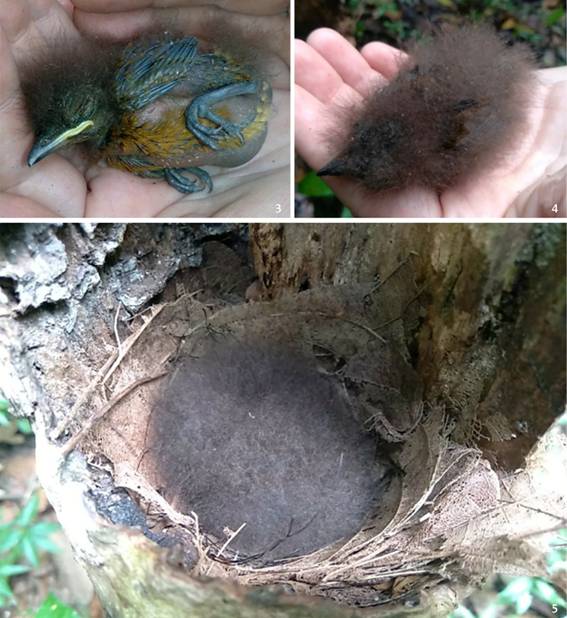
Camouflage in nestlings has been documented for passerines of the genus Schiffornis, but limited reproductive details exist for the majority of species. Here, we present the first description of the nests and eggs of a threatened population of the brown-winged schiffornis, S. turdina (Wied, 1831), from the Atlantic Forest of the Pernambuco Endemism Center, northeastern Brazil, and we reveal nestling characteristics that contribute to mimicry interpretation in the genus. Two nests were found in a 900 ha Atlantic Forest fragment in the State of Alagoas, northeastern Brazil. The nests were cup-shaped and were placed inside the top of broken, rotten trunks, 1.3 and 1.5 m above ground, in the understory of a mature forest. They were constructed mainly of dry leaves, some skeletonized, and contained two eggs each. Differently from many other birds, the nestlings remained motionless when the observers approached the nests, keeping their heads and legs hidden in the middle of their dense, downy feathers. The absence of movement offered minimal evidence for the idea of poisoning caterpillar mimicry, as it had been previously proposed for certain other Tityridae species. Their strategy might be closer to masquerading, which means imitating inedible formations like fungal hyphae, or employing disruptive camouflage, where an unrecognizable shape is formed to confuse predators. The initial report on nest location is significant for conservation, since the decayed trunks that are appropriate for nest building can be a limited resource in disturbed environments.
KEYWORDS:
Breeding behavior; nesting behavior; nestling mimicry
 Thumbnail
 Thumbnail