Nesting aspects of the brown-winged schiffornis, Schiffornis turdina (Aves, Tityridae), with comments on nestling camouflage
ABSTRACT
Camouflage in nestlings has been documented for passerines of the genus Schiffornis, but limited reproductive details exist for the majority of species. Here, we present the first description of the nests and eggs of a threatened population of the brown-winged schiffornis, S. turdina (Wied, 1831), from the Atlantic Forest of the Pernambuco Endemism Center, northeastern Brazil, and we reveal nestling characteristics that contribute to mimicry interpretation in the genus. Two nests were found in a 900 ha Atlantic Forest fragment in the State of Alagoas, northeastern Brazil. The nests were cup-shaped and were placed inside the top of broken, rotten trunks, 1.3 and 1.5 m above ground, in the understory of a mature forest. They were constructed mainly of dry leaves, some skeletonized, and contained two eggs each. Differently from many other birds, the nestlings remained motionless when the observers approached the nests, keeping their heads and legs hidden in the middle of their dense, downy feathers. The absence of movement offered minimal evidence for the idea of poisoning caterpillar mimicry, as it had been previously proposed for certain other Tityridae species. Their strategy might be closer to masquerading, which means imitating inedible formations like fungal hyphae, or employing disruptive camouflage, where an unrecognizable shape is formed to confuse predators. The initial report on nest location is significant for conservation, since the decayed trunks that are appropriate for nest building can be a limited resource in disturbed environments.
KEYWORDS:
Breeding behavior; nesting behavior; nestling mimicry
The suboscine passerines of the genus Schiffornis Bonaparte, 1854 occur throughout the humid forests and old-growth woodlands in Central and South America (Winkler et al. 2020), and together with Laniisoma Swainson, 1832 and Laniocera Lesson, 1841 they form a distinct clade within Tityridae (Ohlson et al. 2013). They are characterized by dull plumages, with the predominance of olive green and brownish colors, no sexual dimorphism, secretive behavior, and relatively low population densities (Ridgely and Tudor 1994, Kirwan and Green 2011, Prado et al. 2022). They inhabit the forest understory and midstory, where they are rarely seen and are more often detected only by their loud whistled songs (Ridgely and Tudor 1994, Snow and Kirwan 2020).
Recently, Lima et al. (2024) revealed that the brown-winged schiffornis, S. turdina (Wied, 1831), widely distributed in South America, comprises a complex containing six species: S. turdina, S. wallacii, S. amazonum, S. intercedens, S. steinbachi, and S. cracrafti. The Atlantic Forest species, S. turdina, has two geographically isolated populations, with distributions matching the Pernambuco Endemism Center (PEC), and the Bahia Endemism Center (Snow and Kirwan 2020). The PEC is the most degraded of the Atlantic Forest regions, with only about 12% of the original forest cover remaining in small and isolated fragments (Dias et al. 2023, 2024). For this reason, the PEC population is currently listed as Vulnerable in the Brazilian Red List based on the C2a(i) IUCN criteria, i.e., no individual population has a minimum number of 1000 individuals (ICMBio 2018). Recent sensus data has confirmed their status (Prado et al. 2022).
The nests and eggs of most Schiffornis species have been documented, yet reproductive information remains limited and unevenly distributed for this group of birds. In Costa Rica, four nests, eggs, nestlings, and one incubation period of the northern schiffornis, S. veraepacis (Sclater, 1860), were documented (Skutch 1969), with the author noting that these represented the only nests discovered in 27 years of field research. For the russet-winged schiffornis, S. stenorhyncha (Sclater, 1869), details about the nest, eggs, nestlings, incubation, and nestling period were provided based on a solitary nest located in Colombia (Sandoval et al. 2017). Three nests and eggs of the greenish schiffornis, S. virescens (Lafresnaye, 1838), were documented in Argentina (Bodrati and Cockle 2017); one nest with eggs and one hatchling was reported in southern Brazil (Willrich and Silva 2019), and Marini and Heming (2017) recorded two clutches found in the eggs collection of a museum. One nest containing eggs of the olivaceous schiffornis, S. olivacea (Ridgway, 1906), was reported in Guyana (del Hoyo et al. 2020). Nestlings of Schiffornis have been seen only on rare occasions, yet they draw interest due to their elongated downy plumage, occasionally featuring dendritic barbs, possibly serving as a form of camouflage for the nestlings (Londoño et al. 2022). Reconstructing ancestral characteristics via the phylogeny of the Tityridae suggests this may represent the ancestral condition that facilitated the development of the Batesian mimicry seen in the nestlings and fledglings of the cinereous mourner, Laniocera hypopyrra (Vieillot, 1817), which has modified downy feathers that closely resemble toxic caterpillars in its surroundings (Londoño et al. 2015, 2022). The thick, soft feathers of Schiffornis were proposed to be a form of Masquerade. Masquerade animals imitate things that their predators find unappetizing (Londoño et al. 2022), a fascinating hypothesis that needs to be tested.
The breeding information available for the brown-winged schiffornis is limited to the description of only one nest and two eggs of S. steinbachi, from the Peruvian Andes (Guerrero et al. 2020), and the brief information provided by Sick (1997) that the nest is constructed in a rotten trunk and is lined with dry leaves. Here, we describe for the first time the nests and eggs of the brown-winged schiffornis, S. turdina, from the Atlantic Forest of the PEC, with details on nestling characteristics and behavior that may contribute to elucidate camouflage interpretation within the clade.
Study area
We found the nests at an approximately 900 ha Atlantic Forest fragment from Alagoas, Rio Largo municipality, northeastern Brazil (9°31’23.82”S; 35°55’6.53”W; altitude 120 m). The area is a Private Natural Heritage Reserve (RPPN Mata do Cedro), surrounded by sugar cane plantations. The vegetation is open ombrophilous Atlantic Forest, and the climate is classified as AS’ according to Köppen: tropical with a well-defined dry and warm season from October through January and a long rainy season during the autumn and winter. The average annual rainfall is 1600-1700 mm, and the average minimum and maximum temperatures range from 21-22 °C to 30-31 °C (Roda and Santos 2005, Barros et al. 2012). Although logging has occurred in the past in this area, today it presents tracts in middle and late regeneration stages, with abundant emergent trees (see also Prado et al. 2022).
Field procedures
We performed ad libitum searches for bird nests in general from September to December 2022, 2-3 times per week, from sunrise to sunset. The nests and eggs were measured with a metal caliper accurate to 0.1 mm and weighted using a spring scale (Pesola Inc., 10 g) accurate to 0.1 g. The nests were located when incubating adults were flushed from their nests, and once found, they were checked every two to three days. Details on the nest materials were obtained after the nests were no longer being used, and we classified the nests and eggs following Winkler (2004).
Active nests: we found one on November 8, 2022 (Nest 1), and another on November 11, 2022 (Nest 2), both containing two eggs each, in the incubation stage. Both nests were cups constructed inside the top of broken-off rotten trunks of small diameters, with one side of the nest totally hidden by the trunk (Figs 1-2). They were located in areas of mature forest, where the understory was less dense (Fig. 2). The nests were lined with well-arranged dry leaves, many of them skeletonized, and black fungal hyphae. The birds filled the crevices below the nests with large amounts of decaying leaves and a few sticks, some of which were pointing out the lateral parts of the nests (Fig. 1). They were 1.3 (Nest 1) and 1.5 m (Nest 2) above ground, and measurements of Nest 2 were: 6.5 cm in internal diameter; 13.3 cm in external diameter; 13.3 cm in height, and 3.8 cm in depth. The eggs were glossy, with a slightly beige background color, marked with intense brown blotches and dull blotches of grayish color, concentrated at the larger end (Fig. 1). They were short-oval, and two eggs of Nest 1 measured 26.7 × 19.6, and 26.4 × 19.9 mm, and they weighted 5.4 and 5.7 g, respectively.

(1) Nest and eggs of the brown-winged schiffornis, S. turdina (Nest 1); (2) nesting habitat and a rotten trunk used for nest support (Nest 1).
On November 28, Nest 1 contained two nestlings in the early developmental stage. On December 4, the nestlings were still present, but on December 6, we observed that the nest was depredated. Nest 2 was depredated still during the incubation stage a few days after being found. Predators were a snake Chironius sp. and a South American Coati, Nasua nasua (Linnaeus, 1766) (see Lobo-Araújo et al. 2024). The nestlings were covered by brownish-gray downy feathers that were remarkably dense and elongated (Figs 3-5), which barely permitted the identification of the nestlings within the nest (Fig. 5). They had dark gray legs, feet, and beak, light yellow commissures, and dark red skin (Fig. 3).
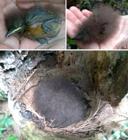
(3) Nestling of the brown-winged schiffornis, S. turdina, in early developmental stage photographed laterally (Nest 1); (4) from above (Nest 1); (5) and hiding their heads and legs within the nest, in a position likely associated with a camouflage strategy (Nest 1). Photos were taken on December 4, 2022.
The characteristics of the nests and eggs of S. turdina matched the general patterns previously described for the brown-winged schiffornis and also for the other congeners (Skutch 1969, Bodrati and Cockle 2017, Sandoval et al. 2017, Willrich and Silva 2019, Guerrero et al. 2020), suggesting that the nest structure and shape can be important diagnostic characters of this suboscine genus. The nest described for S. steinbachi in Colombia was in a crevice created by the root of a tree (Guerrero et al. 2020), while nests described for other Schiffornis were placed at the basis of palm leaves (Skutch 1969, Sandoval et al. 2017), or within bromeliads, clumps of vines, and tangles of bulky vegetation (Skutch 1969, Bodrati and Cockle 2017, Willrich and Silva 2019). Differently from these descriptions, the two nests we found inside the top of broken-off rotten trunks were very similar and they matched the pictures of two further nests present in a citizen science repository (https://www.wikiaves.com.br/midias.php?tm=f&t=b). While the quantity of documented nests remains limited to claim that this represents the typical nesting pattern for the species we examined, it raises conservation issues since decayed trunks with particular traits can restrict the breeding of numerous bird species (Cockle et al. 2010), which should be carefully investigated in future works.
Not rarely, morphological traits evolve in association with behavioral characteristics to increase camouflage efficiency. For instance, birds can select nesting microhabitats where background surfaces maximize the camouflage of eggs or nestlings (background matching - Gómez et al. 2018), or in the case of the Batesian mimicry observed for the cinereous mourner, the way the nestlings move their heads when potential predators approach resemble the movements of a toxic caterpillar (Londoño et al. 2022). It was previously noticed that nestlings of the northern schiffornis remained motionless with the approach of the observers, differing from many other bird species that raise their heads begging for food on similar occasions (Skutch 1969). It was proposed that the dense downy feathers of Schiffornis nestlings could be a type of masquerading, a strategy by which the prey is confounded with inedible structures present in its habitats, namely tufts of fungus (Londoño et al. 2022). The lack of movements could be part of this strategy, but this information is controversial because the motionless behavior was not observed in the russet-winged schiffornis (Sandoval et al. 2017, Londoño et al. 2022). In the nest we observed, we confirmed that the nestlings remain totally motionless with the approach of a potential predator (i.e., the observers). Furthermore, we noted that the nestlings stayed in a posture where their heads, legs, and feet were concealed beneath the downy feathers, with no visibility from above or the sides, and the boundaries between the bodies of the two nestlings were indiscernible. If they were in the typical position taken by most passerine chicks, their limbs would certainly be uncovered. We propose that concealing these body parts within the soft feathers is a tactic that functions in conjunction with the feathers, and together, they form a unified camouflage approach
Although we have not detected fungi species that could resemble the Schiffornis nestlings in our study area, fungus mimicry is a very plausible explanation for the evolution of the plumage pattern of Schiffornis nestlings (Londoño et al. 2022). However, based on our observations, we suggest that the hypothesis of disruptive camouflage also should not be discarded. In this strategy, organisms develop characteristics that give them an unreal shape, becoming less likely to be identified if detected by a potential visually-oriented predator (Mulder et al. 2021). It is difficult to confirm if the plumage characteristics and the motionless behavior of Schiffornis have served only to hide the real shape of the nestlings or if it also evolved to imitate fungal materials (see Londoño et al. 2022). Although few nests have been found for species of these closely related genera, the nestling camouflage strategies observed in the Schiffornis-Laniisoma-Laniocera clade are of significant interest to evolutionary biology. Further experimental studies could clarify their specific functions within Schiffornis.
ACKNOWLEDGMENTS
The authors are grateful to Fernando Pinto, Sônia Roda, and Marcela Daher for logistical support in the field. Flor Maria Guedes Las-Casas, Wallace Rodrigues Telino Junior, Guilherme Santos Toledo de Lima, and Manoel Martins Dias Filho provided important suggestions on the previous versions of this article. The authors are also especially grateful to Kristina L. Cockle and an anonymous referee for their valuable contributions to the manuscript. SISBio/MMA and the Ethic Committee on Animal Use from Universidade Federal de São Carlos authorized field work and approved the methods (Proc# 66157-6 and 1405291118).
LITERATURE CITED
- Barros AHC, Araújo Filho JC, Silva AB, Santiago GACF (2012) Climatologia do estado de Alagoas. Embrapa Solos, Recife, Boletim de Pesquisa e Desenvolvimento 211, 32 pp.
-
Bodrati A, Cockle KL (2017) Nest, eggs and reproductive behavior of Greenish Schiffornis (Schiffornis virescens). Revista Brasileira de Ornitologia 25: 273-276. https://doi.org/10.1007/BF03544407
» https://doi.org/10.1007/BF03544407 -
Cockle KL, Martin K, Drever MC (2010) Supply of tree-holes limits nest density of cavity-nesting birds in primary and logged subtropical Atlantic Forest. Biological Conservation 143: 2851-2857. https://doi.org/10.1016/j.biocon.2010.08.002
» https://doi.org/10.1016/j.biocon.2010.08.002 -
del Hoyo J, Collar N, Kirwan GM (2020) Olivaceous Schiffornis (Schiffornis olivacea). In: del Hoyo J, Elliott A, Sargatal J, Christie DA, de Juana E (Eds) Birds of the World. Cornell Lab of Ornithology, Ithaca, database version 1.0. https://doi.org/10.2173/bow.thlsch7.01
» https://doi.org/10.2173/bow.thlsch7.01 -
Dias TC, Silveira LF, Francisco MR (2023) Spatiotemporal dynamics reveals forest rejuvenation, fragmentation, and edge effects in an Atlantic Forest hotspot, the Pernambuco Endemism Center, northeastern Brazil. Plos One 18(9): e0291234. https://doi.org/10.1371/journal. pone.0291234
» https://doi.org/10.1371/journal. pone.0291234 -
Dias TC, Silveira LF, Francisco MR (2024) Endemic and threatened birds as surrogates for identifying conservation priority areas and ecological corridors in the America’s most endangered habitat. Scientific Reports 14: 21923. https://doi.org/10.1038/s41598-024-72948-1
» https://doi.org/10.1038/s41598-024-72948-1 -
Guerrero MMC, Muñoz J, Londoño GA (2020) Nesting information for the Brown-winged Schiffornis (Schiffornis turdina). Ornitología Neotropical 31: 42-46. https://doi.org/10.58843/ornneo.v31i1.589
» https://doi.org/10.58843/ornneo.v31i1.589 -
Gomez J, Ramo C, Troscianko J, Stevens M, Castro M, Perez-Hurtado A, et al. (2018) Individual egg camouflage is influenced by microhabitat selection and use of nest materials in ground nesting birds. Behavioral Ecology and Sociobiology 72: 142. https://doi.org/10.1007/s00265-018-2558-7
» https://doi.org/10.1007/s00265-018-2558-7 - ICMBio (2018) Livro vermelho da fauna brasileira ameaçada de extinção. Instituto Chico Mendes de Conservação da Biodiversidade, Brasília, vol. 3, 709 pp.
- Kirwan GM, Green G (2011) Cotingas and manakins. Christopher Helm, 624 pp.
-
Lima RD, Bocalini F, Silveira LF (2024) Integrative revision of species limits in the genus Schiffornis (Aves: Tityridae) reveals cryptic diversity in the Neotropics. Zoological Journal of the Linnean Society 200: 1048-1079. https://doi.org/10.1093/zoolinnean/zlad108
» https://doi.org/10.1093/zoolinnean/zlad108 -
Lobo-Araújo LW, Costa MC, Silveira LF, Francisco MR (2024) Massive bird nest losses: A neglected threat for passerine birds in Atlantic Forest fragments from the Pernambuco Endemism Center. Diversity 16: 207. https://doi.org/10.3390/d16040207
» https://doi.org/10.3390/d16040207 -
Londoño GA, García DA, Martínez MAS (2015) Morphological and behavioural evidence of Batesian mimicry in nestlings of a lowland Amazonian bird. The American Naturalist 185: 135-141. https://doi.org/10.1086/679106
» https://doi.org/10.1086/679106 -
Londoño GA, Sandoval JH, Sallam MF, Allen JM (2022) On the evolution of mimicry in avian nestlings. Ecology and Evolution 12: e8842. https://doi.org/10.1002/ece3.8842
» https://doi.org/10.1002/ece3.8842 -
Marini MA, Heming NM (2017) Breeding of the Greenish Schiffornis (Schiffornis virescens, Tityridae). Revista Brasileira de Ornitologia 25: 269-272. https://doi.org/10.1007/BF03544406
» https://doi.org/10.1007/BF03544406 -
Mulder T, Campbell CJ, Ruxton GD (2021) Evaluation of disruptive camouflage of avian cup-nests. Ibis 163: 150-158. https://doi.org/10.1111/ibi.12848
» https://doi.org/10.1111/ibi.12848 -
Ohlson JI, Irested M, Ericson PGP, Feldsa J (2013) Phylogeny and classification of the New World suboscines (Aves, Passeriformes). Zootaxa 3613: 1-35. https://doi.org/10.11646/zootaxa.3613.1.1
» https://doi.org/10.11646/zootaxa.3613.1.1 -
Prado LC, Dias TC, Lobo-Araujo LW, Silveira LF, Francisco MR (2022) Population density estimates for three endangered bird taxa from the Pernambuco Endemism Center, northeastern Brazil. Biota Neotropica 22(3): e20221361. https://doi.org/10.1590/1676-0611-BN-2022-1361
» https://doi.org/10.1590/1676-0611-BN-2022-1361 - Ridgely RS, Tudor G (1994) The birds of South America. University of Texas Press, Austin, vol. 2, 940 pp.
- Roda SA, Santos AMM (2005) Avaliação de fragmentos florestais para uma possível reintrodução do mutum-de-alagoas em seu ambiente natural. Centro de Pesquisas Ambientais do Nordeste, Recife, 29 pp.
-
Sandoval HJ, Chinome GA, Londoño GA (2017) Nesting biology of Schiffornis stenorhyncha (Tityridae). The Wilson Journal of Ornithology 129: 827-833. https://doi.org/10.1676/16-085.1
» https://doi.org/10.1676/16-085.1 - Sick H (1997) Ornitologia Brasileira. Editora Nova Fronteira, Rio de Janeiro, 912 pp.
- Skutch AF (1969) Life histories of Central American birds III. Families Cotingidae, Pipridae, Formicariidae, Furnariidae, Dendrocolaptidae, and Picidae. Cooper Ornithological Society, Berkeley, 580 pp.
-
Snow D, Kirwan GM (2020) Brown-winged Schiffornis (Schiffornis turdina). In: del Hoyo J, Elliott A, Sargatal J, Christie DA, de Juana E (Eds) Birds of the World . Cornell Lab of Ornithology, Ithaca , database version 1.0, https://doi.org/10.2173/bow.thlsch3.01
» https://doi.org/10.2173/bow.thlsch3.01 - Willrich G, Silva LZ (2019) New description of the nest, eggs and nestling of Greenish Schiffornis (Schiffornis virescens). Cotinga 41: 124-126.
- Winkler DW (2004) Nest, eggs, and young: The breeding biology of birds. In: Podulka S, Rohrbaugh RW Jr, Bonney R (Eds) Handbook of bird biology. Princeton University Press, Princeton, 1328 pp.
-
Winkler DW, Billerman SM, Lovette IJ (2020) Tityras and Allies (Tityridae). In: del Hoyo J, Elliott A, Sargatal J, Christie DA, de Juana E (Eds) Birds of the World . Cornell Lab of Ornithology, Ithaca , database version 1.0. https://doi.org/10.2173/bow.tityri1.01
» https://doi.org/10.2173/bow.tityri1.01
ADDITIONAL NOTES
-
Data Availability
Datasets generated or analyzed in this study are available from the corresponding author on reasonable request.
-
Funding
This research was due to the ARCA project by Fundação de Amparo à Pesquisa do Estado de São Paulo (FAPESP 2017/23548-2). LW Lobo-Araújo received a PhD fellowship from the Conselho Nacional de Desenvolvimento Científico e Tecnológico (CNPq 142308/2019-6); MR Francisco (CNPq 308702/2019-0 and 304213/2022-5) and LF Silveira (CNPq 308337/2019-0) received Productivity Research Fellowships also from CNPq, and MC Costa received a Post-Doc fellowship from FAPESP (2020/13489-1).
-
ZooBank register
https://zoobank.org/1C57266A-4292-47EF-9626-C02FDDD79820
-
How to cite this article
Lobo-Araújo LW, Costa MC, Silveira LF, Francisco MR (2025) Nesting aspects of the brown-winged schiffornis, Schiffornis turdina (Aves, Tityridae), with comments on nestling camouflage. Zoologia 42: e24083. https://doi.org/10.1590/S1984-4689.v42.e24083
-
Published by
Sociedade Brasileira de Zoologia at Scientific Electronic Library Online - https://www.scielo.br/zool
Datasets generated or analyzed in this study are available from the corresponding author on reasonable request.